Chapter 10.11: The Salt of the Earth

Introduction to Bacon & the Art of Living

The story of bacon is set in the late 1800s and early 1900s when most of the important developments in bacon took place. The plotline takes place in the 2000s with each character referring to a real person and actual events. The theme is a kind of “steampunk” where modern mannerisms, speech, clothes and practices are superimposed on a historical setting.  Modern people interact with old historical figures with all the historical and cultural bias that goes with this.


The Salt of the Earth

December 1892

Dear Kids,

We are bound for England, my beautiful fiance and I!  Thank you for your amazing arrangements for our engagement.  You guys give me endless pleasure! You made it all possible! I had the most amazing time with your grandfather! He is a formidable man. Every interaction we have is precious. He is getting old. On the one hand, it saddens me to see him being unable to do the things he could just a few years ago. On the other hand, his clarity of thought and insight into life becomes even more poignant. He continues to be intensely interested in my quest. Like he did every time I returned from a trip to the Transvaal, he prompted me to tell him everything, leaving nothing out. He would sit in his lounge chair and listen very intently, making careful mental notes on the different points he wanted clarification on.

He asked me how I propose one lives when there is so much evil perpetrated in our land against the indigenous people by the culture that I developed such enormous respect for. More than that, he wanted to know how I will respond if war would break about between the Boer republics and England. Of course, I gave him my view which is not important now. His suggestion is what I want you guys to take careful note of.

He proposed that four qualities should always rule supreme in our thinking. These four are love, compassion, understanding and respect. He explained to me that the older he gets, as he looks back over his life, the responses he had to various situations which were not in accordance with these four qualities were the ones that he regrets. The times when he responded with these attitudes, whether the outcome was materially beneficial to him or not, are the times that he is the proudest of. His motivation for choosing these are of huge interest. “It is these qualities”, he told me, “that makes us human. These qualities are all that is good and beautiful in life and its consistent application will, in the end, lead to the best outcome.” My dad then said something that I will never forget. “As you are learning the secrets of creating bacon, remember to use your knowledge in terms of love, compassion, understanding and respect. This does not mean that you don’t have to be competitive or keep secrets where it will protect work that you have done, but when faced with a choice of responses, choose the four qualities we are talking about and you will have a regret-free life. “Remains as fiercely inquisitive as you are, but never deviate from these qualities.” Your grandfather is an imposing man and has become one of my best friends. Make sure that you visit him often!

I want to use my travel time back to London to tell you more about the next beautiful aspect of making bacon namely salt.
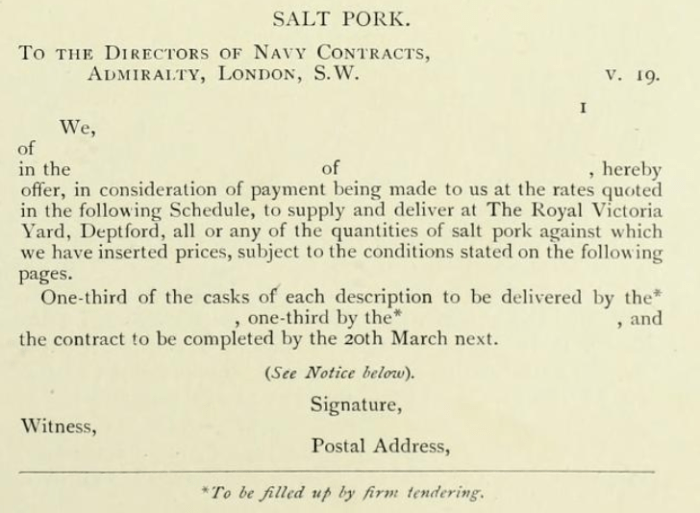
Tender doc Navy
A tender Document to supply the English navy with salted pork.

Salt

In terms of the chemistry of curing, we have made impressive progress. We learned about the importance of nitrogen and some of the compounds it forms. We looked in a bit of detail at saltpetre and how it is reduced through bacteria to nitrite which shortens the curing time of meat. It is nitrite that is responsible for the curing of meat. One will be forgiven if you think that saltpetre or sodium or potassium nitrite is the most important salts in curing, but that will be completely wrong.

The real magical ingredient in bacon is salt! So opens up to us, another vast world. The world of salt. You are by this time well familiar with the book we read in Denmark, Foods by Edward Smith, written in 1867. He writes, “the oldest and best known preserving agent is salt, with or without saltpetre.” (Smith, E, 1867: 34) (1)  Remember the quote from the American Encyclopedia of 1858. It said that “Very excellent bacon may be made with common salt alone, provided it is well rubbed in, and changed sufficiently often. Six weeks in moderate weather will be sufficient for the curing of a hog of 12 score.” (Governor Emerson. 1858: 1031) (1) As I could have guessed, the story of the use of salt goes back as far as the existence of humanity itself!

Prehistory

A study has shown that common salt (sodium chloride) was probably collected and stored by one of the oldest species of the genus Homo, Homo Habilis who lived between 1.4 and 2.4 million years ago. (Munas, F.; 2014 :213) Evidence suggests that our closest extinct relative, Neanderthal who lived between 40 000 and 400 000 years ago, dried meat as a way to preserve it. (anthropology.net)  It is easy to imagine them learning this very early on by observing meat scraps that remained at a killing or slaughtering site and freeze-dried or simply dried out and lasted longer than the fresh meat that was removed from the carcass. Whether they used salt is not known, but if Homo Habilis did and if they dried their meat to preserve it, it is easy to think that Neanderthal used salt also. Linking salt with nutrition and preservation of meat is easily identified by simple observation of nature. A society living next to the sea or any other salt source such as a salt pan or a salt spring, would have seen this and have incorporated it into their culture.

There is clear evidence that using salt to preserve has been practised since before the last ice age, some 12 000 years ago. Salt deposits in the hills of Austria and Poland, the shores of the Mediterranean and the Dead Sea, the salt springs and sea marches across Europe and Asia (Bitterman, M, 2010: 16) and on the vast plains of Africa would have provided salt to cultures across the world. It seems as if there is not a time known to humans when salt was not used to amend our diet and quite possibly to preserve meat. Humans dried their meat and salted it and this salting was called curing (2). Adding salt to meat evolved into art from the earliest time known to us.

As our way of life evolved, we domesticated our food sources. We started with the fig, probably many years before we did the same with grain. Archaeologists found domesticated figs dating back to 9400 BCE. Sheep were domesticated around 8000 BCE, cattle and pigs around 7000 BCE. (Bitterman, M, 2010: 17)

In general, we can say that sometime between 15 000 and 5 000 BCE, human society’s need for salt increased rapidly as we needed salt for ourselves and our domesticated livestock. The livestock had to supplement their diet with salt and we needed it for curing and preserving foods, tanning hides, producing dyes and other chemicals and for medicine. “We evolved with a physiological requirement for salt; our culture was born from it. Access to salt became essential to survive. Salt localized groups of people.” (Bitterman, M, 2010: 17)  Curing took meat which we culled from nature and brought it into culture. (Laszlo, P, 1998: 14) It turned the art of preserving into an expression of community and “togetherness” by transforming “preservation of food” into culinary delights of great enjoyment.

There is evidence that by 1,200 BCE, another great traders civilization of ages past, the Phoenicians, were trading salted fish in the Eastern Mediterranean region. (Binkerd, E. F.; Kolari, O. E. 1975: 655–661) Saltworks was one of the main features of their settlements in Lebanon, Tunisia, Egypt, Turkey, Cyprus, Crete, and Sicily. By 900 BCE, salt was being produced in ‘salt gardens’ in Greece and dry salt curing and smoking of meat were practised and documented. (Binkerd, E. F.; Kolari, O. E. 1975: 655–661)

Ancient records of 200 BCE tell us that the Romans learned how to cure meat of the Greeks and further developed methods to “pickle” various kinds of meats in a brine marinade. Salting had the effect of reddening the meat and the report of this observation became the first recorded record of the colour effect of saltpetre. (Binkerd, E. F.; Kolari, O. E. 1975: 655–661)

Marcus Porcius Cato (234 BCE – 149 BCE) or Cato the Elder was a Roman statesman, who devoted himself to agriculture when he was not engaged in military service. He recorded careful instructions in the dry-curing of hams. (Hui, YH, et al, 2001: 505) In his Latin work, De Agricultura (On Farming), written in 160 BCE,  this Roman statesman, and farmer, gives an ancient recipe for curing pork with salt.

“After buying legs of pork, cut off the `feet. One-half peck ground Roman salt per ham. Spread the salt in the base of a vat or jar, then place a ham with the skin facing downwards. Cover completely with salt. After standing in salt for five days, take all hams out with the salt. Put those that were above below, and so rearrange and replace. After a total of 12 days take out the hams, clean off the salt and hang in the fresh air for two days. On the third day take down, rub all over with oil, hang in smoke for two days…take down, rub all over with a mixture of oil and vinegar and hang in the meat store. Neither moths nor worms will attack it.” (economist.com)

Cato may have imitated a process whereby hams are smoked over juniper and beech wood. The process was probably imported by the Roman gourmets from Germania. (economist.com) Phoenician ships spread the technology of salt making across the Atlantic, to Spain and as far north as England. India, China, Japan, and Africa developed their own salt industries. Hardly a region on earth or a civilisation could be found who did not produce salt. Salt was taxed, traded, used as currency and consumed on a global scale. (Bitterman, M, 2010: 17 – 25)

A Dutch legend says that the curing of herring was invented by Willem Beukelsz around the early 1300s. Whether this is entirely true or not, we know that the Cossack’s produced cured caviar. The Romans used a sauce called garum on their food. Garum was made among others with brine (salt solution). (Laszlo, P, 1998: 5, 7, 11) The Danes are great traders and Copenhagen is a key centre for trading salt and Saltpeter. The domestication of our food sources, the need for preservation and the technology to produce salt developed hand in hand as features of the spread of human culture and civilization.

What was the mechanism that made salt such an effective preservative? What exactly is salt and how did we unravel its composition? In order to understand the mechanism of salts’ preservative power, we must first know what salt is.  Initially, only common salt was known and a handful of others, including nitre.  (Leicester, H. et al.; 1952:  75)

Salt Tray

What is Salt?

Humans noticed that not all salts were the same. Simple observation through taste and visual evaluation made us aware of differences in salt from different locations and regions. Some salts seemed to have almost magical properties. It is our desire to understand these differences that directly lead to the establishment of the science of chemistry. Unravelling the character of salt is one of the greatest stories that exist.

Today we know that salt is formed when an acid and a base are combined through what is called a neutralisation reaction. The crystal or in many cases, polycrystal are ionic compounds, meaning that it is a rigid and regular arrangement of particles of opposing electric charge. The particles are “glued” together by strong ionic or less strong, electrostatic bonds.

This simple explanation did not come easily and unravelling the mystery of the composition of salt took many years and the dedicated work of some of the most brilliant and often, eccentric people who ever walked this earth in recent years.  Simple observations of the reaction of different salts in combination with various compounds and understanding their characteristics such as taste was the first step. Soon, though, simple observations were not enough and a comprehensive system had to be built to take the analysis further. It took many years and the labour of many to develop a theoretical understanding of the nature of matter and the forces that hold it together and govern its reactions. Today we know this system as the scientific discipline of “chemistry.” In the process, often, understanding had to wait for the foundations of science itself to be developed before real progress became possible. In the end, incremental as it was and over many generations, insight developed to the point where we could claim the basic understanding of the nature, composition, and function of salts.

Early on, different salts that were known included sea salt, rock salt, saltpetre, and tartar. Clues to their identification come to us in writings and in drawings. Below is the woodcut of the “Man Collecting Tartar From an Empty Wine Barrel”, taken from Ortus Sanitatis, a book published in Strasbourg in 1497.  The man is “collecting precipitated solids (potassium hydrogen tartrate) from a wine barrel for use in making potash (potassium carbonate). The solids, known as wine lees, argol or tartar, are formed during wine fermentation. When the argol is heated it forms potash. Potash is used in the manufacture of soap and glass.”

Man collecting tartar from a empty wine barrel

The Principles of Paracelsus

The multi-talented physician, Paracelsus (1493 – 1541), saw salt as one of the three principles namely salt, sulfur, and mercury. This contemporary of Copernicus, Leonardo da Vinci, and Martin Luther, widely regarded as the founder of toxicology, imagined that in every object the principle responsible for its solid-state is salt; a second principle (sulfur) is responsible for its inflammability or “fatty” state, and a third (mercury) is responsible for its smoky (vaporous) or fluid state.  (www.scs.illinois.edu)

A “fire analysis” was done on a body to isolate the salt. Many cultures, across the world, developed the concept which in the West became popular by the teachings of Empedocle (c. 490 – c. 430 BCE) that all matter comprises of earth, air, fire, and water. Earth being the passive element that remains after the fire analysis. By the late 16th and early 17th century, it was realized that the solid which remained after the fire analysis, could further be divided into SALT, which could be removed by diluting it in water and what remained was called EARTH.  EARTH was the non-volatile residue left after burning and SALT diluted in water and had a saline taste. While Luther’s reformation gained a foothold in Central Europe and Da Vinci was painting the Last Supper in the Convent of Santa Maria Delle Grazie, in the city of Milan, Paracelsus taught that salt, thus extracted, demonstrated the presence of the universal salt principle and that it was this principle that was behind any body’s solid-state and its resistance to fire. The criteria for SALT being that it is diluted by water and have a saline taste is the reason why liquid acids also came to be known as salts. (Siegfried, R.; 2002: 76, 80, 81)

salt meter

Johann Glauber

The Bavarian alchemist and chemist, Johann Glauber  (1604 – 1670) reported in the mid-1600s on the mutual destruction of acids and alkali’. Hailing from a poor background, he travelled and learn alchemy from various laboratories and teachers. At age 20 he was afflicted with stomach problems, probably after contracting spotted typhus which, for some time after contracting it, causes nausea and vomiting. His travels across Europe brought him to the city of Vienna where the residents recommended that he drinks from a local miracle spring which will restore him to health again. Glauber was sceptical about the idea but did it in any event. He drank from the “Hungarian Spring.” (5) His appetite returned and soon he was in good health again. (www.thechemicalengineer.com and Siegfried, R.; 2002: 77)

This unlikely outcome pricked his curiosity. Locals believed the healing power to be due to the presence of saltpetre in the water.  He spent the winter, evaporating water from the spring and analyzing the salt. What he found was not saltpetre, but sodium sulfate. (www.thechemicalengineer.com) Sodium sulfate is a mild laxative and he would later market it as Glauber’s salt. The study of nitre would preoccupy him for years to come, but in his mid-fifties, sodium sulfate would take front and centre stage in his research work. He got carried away a bit when naming it “Sal Mirabilis Glauberi.” He overstated its healing power so dramatically that he received considerable opposition from his contemporaries who regarded him as a dreamer and charlatan. (The Guardian, 1934) An interesting fact to note for our continued interest in the study of saltpetre is the ease with which he was able to test for saltpetre by the mid-1600s. He was able to produce nitric acid (HNO3) by applying sulfuric acid to saltpetre. Later he made potassium carbonate (K2CO3, which is produced by burning saltpetre with charcoal) and nitric acid (HNO3, which they made by distilling saltpetre with fullers earth) from saltpetre and was able to combine these two, potassium carbonate and nitric acid to yield saltpetre, showing his thorough grasp of the acid-base composition of salts. (www.encyclopedia.com) Nitric acid or spirit of niter is a volatile acid and fixed niter (potassium carbonate) is a solid caustic. From this, Glauber concluded that twofold substance, containing both an acid and an alkali.

It was the fact that he could reconstitute saltpetre with fixed potassium carbonate and nitric acid that showed him that saltpetre was not the ultimate universal solvent that alchemists were looking for and that he claimed to have found. It was this disillusionment with niter that caused him to turn his attention back to his Sal Mirabilis Glauberi or sodium sulfate. The formulation of Glauber’s salt is Na2SO4·10H2O.

Glauber’s contribution to the study of salts was considerable. He eventually expanded the list of known salts far beyond common salt and niter. His work on the mutual destruction of acids and alkali’s was done with Otto Tachenius.  (The Age, 1975) The effervescence that was observed when acids and alkalies are mixed became the standard way of judging the alkali or acid quality of a body. The idea was simple. If a known acid is added to something and it effervesced, the other body is an alkali and vice versa. The early chemists did not see this effervescence as gas being liberated but as some kind of vigorous strife. Acid-base reactions usually produce heat and it is easy to see how the bubbling was seen as “boiling.” (Siegfried, R.; 2002: 76)

Glauber introduced the idea that acids could combine with metals or alkali’s to form a salt.  The mechanism behind the combinations is seen by him as a certain associative principle which he called “Gemeinschaft.” In his work, he insisted on an accurate description of the technical operation at work.  (todayinsci.com)  (6)

The Acid-Alkaline reaction of Salts

The medical chemist, Van Helmont, created a model in the 1600s and he postulated that this acid-alkali reaction is part of animal digestion. One of his students by the name of Sylvius progressed this idea and thought of all bodily functions as acid-alkali reactions and bodily fluids are either acid or alkali. (Siegfried, R.; 2002: 76)  Robert Boyle (1627 – 1691) refuted this suggestion by showing some of the many exceptions, yet the reaction between acids and alkali remained “the most familiar among real laboratory material.” By the end of the 1600s, there were three well-known mineral acids, namely, spirit of niter (nitric acid), spirit of salt (hydrochloric acid), and vitriolic acid or spirit of sulphur (sulfuric acid).  (Siegfried, R.; 2002: 77)

When exactly the acid-alkali reaction was first studied or who identified it has not been uncovered. It is one of the great untold stories of science. What we know is that during the 1600s, the term alkali was first used in the Arab world and referred to as a vegetable alkali. Books from that time refer to a plant that was called kali and contained potassium carbonate. The ancients obtained it from leaching ashes from the burned remains of the plant. (Siegfried, R.; 2002: 77)

By the 1600s, they recognized another common alkali namely alkali of tartar. This was obtained from the residue in wine barrels and today we know that it was also potassium carbonate. In the early days, they retained the particular name to link it to where it was found. (Siegfried, R.; 2002: 77)

The saturation point of an acid-alkali reaction was believed to be the point where the effervescence stops. At this time, air was not a recognized chemical element and nobody had the idea that the effervescence could be due to the liberation of air. Robert Boyle developed an alternative way to test for acidity or alkalinity and to determine the saturation point of acid-alkali reactions. In his time it was already well known that acids turn green vegetable colour, red. Boyle was probably the first to observe that an alkali would turn the blue to green. It took until 1750 before the use of colours to identify acids and alkali’s became commonplace in the scientific community.  (Siegfried, R.; 2002: 77)

Neutral Salts

By the beginning of the 1700s, a third class of salts was well established namely neutral salts, containing both acid and alkali. These salts did not effervesce with either acids or alkalies.  This category was soon expanded to include the combination of an “acid with earths and metals as well as with alkalies.”  (Siegfried, R.; 2002: 77)

Earth is what remains at the end in a distillation vessel and can not be dissolved in water. There has been a debate whether different earths exist as was the case with different salts and sulfurs (or oils). Scientists were able to, for example, identify a certain kind of earth derived from stones, coral or seashell. It is able to dissolve in acid and when strongly heated, it forms a powdery residue that absorbs water. These were known as absorbent earths.  (Heilbron, J. L.; 2003: 226)

The great French chemist, Guillaume- François Rouelle (1703-1770), under whom Lavoisier studied, published some of his most important work between 1744 and 1754 on the subject of salt. At this time, salt was defined as water-soluble, saline-tasting solid. He suggested what is essential, the modern understanding of salt (sel). He was the first to distinguish between acid, neutral, and basic salts. That is anything that would fix the acid into a solid-state whether an alkali, an earth or a metal. (Siegfried, R.; 2002: 79)

Another scientist of this time who devoted much effort to the study of neutral salts was the German scientist, Wilhelm Homberg (1652 – 1713). He spent his adult career in Paris. By the time of his most important work, the following has been established during the previous century. The neutralisation of an acid by an alkali. The mutual destruction of properties. “The available salts were the vitriolic or spirit of sulphur, spirit of niter, spirit of sea salt, and acid of vinegar. The only alkali was salt of tartar (potassium carbonate). ”  (Siegfried, R.; 2002: 86)

From the work of Homberg, it is clear the implicit principle behind his experimental work was the conservation of weight. An example is an experiment he did in 1699 where he set out to determine the number of volatile acid salts contained in its solution. “He added acid to weight quantity of alkali until the alkali was saturated, presumably judging that point by the cessation of effervescence. The resultant salt was then dried as thoroughly as possible and weighed. The increase in weight Homburg took to be the weight of the real acid in the solution used. He carried out this procedure using spirit of niter, oil of vitriol, aqua regia, and distilled vinegar, compiling tables of his results. He took no account of the loss of carbon dioxide that escaped from the alkali, of course, for he knew nothing of it.” We see “how futile these attempts were until glasses were recognized as part of chemistry and techniques were developed for measuring and isolating the different kinds of air.”  (Siegfried, R.; 2002: 88)

It was about this time when the analysis/synthesis cycle was established as a way to confirm the qualitative composition of a body. If elements obtained from an analysis by fire could be reformed again into the original body, it would prove that the analysis was done correctly and the elements that constitute it, identified. “The permanent secretary of the Academy (of science in France), whose duties included the writing of summaries of the worthy articles in the Mémoires commented that “One is never so sure of having decomposed a mix into its true principles as when with the same principles  one can recompose it.” (Siegfried, R.; 2002: 90)

Salts known in the 1700s

Before the 1700s, a scientist could not distinguish between the different alkali metals. Sodium and potassium were often confused. Potassium was produced artificially by slowly pouring water over wood ashes and then drying the crystal deposits. Some of these metals were also found naturally on the edges of dried lake beds and mines and sometimes at the surface of the ground.

Henri-Louis Duhamel (1700 – 1782) realised that certain metals had similar characteristics. He studied samples of salts found in nature and produced by people artificially. This included the study of saltpetre (potassium nitrite), table salt, Glauber’s salt, sea salt, and borax. (Krebs, RE, 2006: 51) He discovered sodium carbonate and hydrochloric acid, a solution with a salty taste, in 1736. (Brian Clegg, rsc, chemistryworld)

Antoine Laurent Lavoisier

It would be the work of Antoine Laurent Lavoisier that finally establishes chemistry into a science. He did for chemistry, what Newton did for mechanics 100 years earlier. Lavoisier did not discover any new substance, nor did he build any new laboratory- or investigative device. What he brilliantly did was to take the known facts and from these, gleaned the right interpretations. Acids and bases have been examined systematically, chemical substances have been described and characterized, and much work has been done on the relative affinity of bodies for one another.

About saltpetre, Lavoisier concluded that “nitrous and nitric acids are produced from a neutral salt long known in the arts under the name saltpetre.” He explains that this salt is extracted through the process of leaching from the “earth of cellars, stables, or barns, and in general of all inhabited places.” In these places, the reaction of nitric acid takes place with various bases such as lime, magnesia (magnesium oxide; magnesium reacts with nitric acid to give magnesium nitrate and hydrogen gas), potash or argyll.  (Lavoisier, A; 1965: 214)

Humphry Davy

Humphry Davy, an English Chemist, was the uniquely talented young man who changed history when he isolated sodium and potassium in 1807. He had the first direct electric current generator at his disposal, the electric battery that Alessandro Volta invented in Paris in 1800. Davy ran an electric current through caustic soda (sodium hydroxide) and was able to isolate sodium from it. He did the same for potassium, isolating it from potash.

Chlorine was already being produced through electrolysis by the decomposition of sea salt by the electric current. Caustic soda and chlorine had many applications by the end of the 1700s. Fats were processed with caustic soda to produce soap. Fabrics were being bleached with chlorine, a process discovered by Berthollet. (Laszlo, P, 1998: 50)

In 1807, Humphry Davy found that the “muriate of soda” produced by burning sodium in a vessel full of chlorine was chemically identical to salt. (Brian Clegg, rsc, chemistryworld) Humphry wrote in 1840, “Sodium has a much stronger attraction for chlorine than oxygen; and soda or hydrate of soda is decomposed by chlorine, oxygen being expelled from the first, and oxygen and water from the second.”

“Potassium has a stronger attraction for chlorine than sodium has, and one mode of procuring sodium easily is by heating together to redness common salt and potassium. The compound of sodium and chloride has been called muriate of soda, in the French nomenclature; for it was falsely supposed to be composed of muriatic acid and soda; and it is a curious circumstance that the progress of discovery should have shewn that it is a less compounded body than hydrate of soda, which 6 years ago was considered as a simple substance, and one of its elements. According to the nomenclature which I have ventured to propose, the chemical name for common salt will be sodane.”

“Common salt consists of one proportion of sodium, 88, and two of chlorine 134; and the number representing it is 222” (Davy, H. 1840: 247) The importance of this is that the knowledge that the salt used for preserving food is mainly sodium chloride, existed from the early 1800s. It was now possible to analyse the nature of sodium chloride and the other kind of salts that exist. The nature of the composition of salt that has been dissolved in water and the interaction between salt and meat and between salt and microorganisms such as bacteria that are present in meat now became possible. We can look at everything that makes up sea salt and salt from inland springs and dry salt beds and we can begin to understand and appreciate the effect of salting meat and how it happens that it preserves the meat.

It was found that salt had other metals and compounds of a diverse, but consistent nature. Are these other elements present in salt that we find naturally on earth, do they impact the curing process at all?  And if so, how? (4) As I have learned, answering these questions would be very important in order to improve the consistency and the quality of the bacon we cure.

Salt is one of the studies that we will return to time and time again over the following years due to its importance in meat curing.  Without it, we can not make any bacon.

Warm greetings, with love!

Your Dad.


Further Reading


green-next
green-previous
green-home-icon

(c) eben van tonder

Bacon & the art of living” in bookform
Stay in touch

Like our Facebook page and see the next post. Like, share, comment, contribute!

Bacon and the art of living

Promote your Page too


Notes

(1)  We have seen how pervasive the occurrence of nitrate is on earth.  One expects to find it in every natural salt spring, salt marsh, dry salt lake and in seawater.  “Some curing” will take place with almost any natural salt.  However, it has been shown that bacon that was produced with either no nitrites or nitrite levels of 15 ppm, “off-flavors were high and increasing rancidity.  A significant reduction in off-flavours in pork during storage was observed when nitrites were added > 50 ppm.”  (Rahman, SM,  2007:  307)

Salt springs, analysed in South Africa contained as little as < 1 mg/ L of Nitrate (H)

This does not correlate with the statement by Smith and the American Encyclopedia about the fact that normal salt was equally successful in curing meat.

Adding salt enhances the flavour, but it also accelerates lipid oxidation, even at low levels of addition.  Lipid oxidation leads to off-flavour development in meat that does not contain any nitrites.  Even a 0.5% addition of sodium chloride significantly increases lipid oxidation when added to restructured pork chops and pork sausage patties following freezer storage.  (Pearson, AM, et al, 1997:  269)

(2) ‘The binomial name Homo neanderthalensis – extending the name “Neanderthal man” from the individual type specimen to the entire species – was first proposed by the Anglo-Irish geologist William King in 1864 and this had priority over the proposal put forward in 1866 by Ernst Haeckel, Homo stupidus. The practice of referring to “the Neanderthals” and “a Neanderthal” emerged in the popular literature of the 1920.” (Wikipedia. Neanderthal)

(3). Meat curing can be defined as the addition of salt to meat for the purpose of preservation. (Hui, YH, et al, 2001: 505)

(4)  It turns out that “food-grade salt of the highest purity should be used in meat curing practices.  Impurities such as metals (copper, iron, and chromium) found in natural salt beds, salt produced from salt springs or sea salt accelerate the development of lipid oxidation and concomitant rancidity in cured meats.  Although salt may be of very high purity, it nonetheless contributes to meat lipid oxidation.  Nitrite and phosphates, help retard this effect.” (Hui, YH, Wai-Kit Nip, Rogers, R.  2001:  492)

(5)  One source says that this took place in Naples and not Vienna.  There could have been been a spring in Naples, called Hungarian Spring.  Drug Discovery: A History by Walter Sneader, 2005, John Wiley and Sons Ltd., p. 64 puts the place where he became ill as Vienna, which fits the Hungarian Spring designation much better.

(6)  There is at least one source that puts his invention of Glauber’s salt at 1659.  However, from The Renaissance of Science: The Story of the Cell and Biology, by Albert Martini, 2015, Abbott Communications Group, Glauber discovered a simple method of manufacturing hydrochloric acid in 1625 when he was 21.  He did this by combining sulfuric acid with table salt (sodium chloride).  Sodium sulfate salt was produced by this reaction which is Glauber’s salt, a mild laxative.  On the other hand, the 1659 date for the invention of Glauber’s salt may refer to the publication in 1658 of his Tractatus de natura salium.  In 1660 a second part was added to the Miraculum mundi. Is is apparently only here when Glauber started to make “sal mirabile” (Glauber’s salt) the main focus of his work, replacing niter.  (www.encyclopedia.com).

References

The Age, Melbourne, Australia, 3 June 1975, Page 1

Davy, H. 1840. The Collected Works of Sir Humphry Davy …: Elements of chemical philosophy. Smith, Elder & Co.

Gouverneur Emerson . 1858. The American Farmer’s Encyclopedia. A O Moore.

Heilbron, J. L..   2003.  The Oxford Companion to the History of Modern Science.  Oxford University Press.

Hui, YH, Wai-Kit Nip, Rogers, R. 2001. Meat Science and Applications. Marcel Dekker, Inc.

Krebs, RE. 2006. The History and Use of Earths Chemical Elements. Greenwood Press.

Laszlo, P. 1998. Salt, Grain of Life. Columbia University Press.

Leicester, H. M., Klickstein, H. S..  1952.  A Source Book in Chemistry, 1400-1900.  Harvard University Press.

Munas, F..  2014.  Mission To Earth.  New Authors Press.

Pearson, AM, et al.  1997.  Healthy Production and Processing of Meat, Poultry and Fish Products, Volume 11.  Chapman & Hall

Rahman, SM.  2007.  Handbook of Food Preservation.  Second edition.  CRC Press.

Siegfried, R.  2002.  From Elements to Atoms: A History of Chemical Composition, Volume 92, Issues 4-6.  American Philosophical Society

The Guardian, London, Greater London, 13 Oct 1934, page 13

Pictures

All photos from  William Douglas & Sons Limited, 1901, Douglas’s Encyclopaedia, University of Leeds. Library.

Chapter 10.10: Engaged to be Married

Introduction to Bacon & the Art of Living

The story of bacon is set in the late 1800s and early 1900s when most of the important developments in bacon took place. The plotline takes place in the 2000s with each character referring to a real person and actual events. The theme is a kind of “steampunk” where modern mannerisms, speech, clothes and practices are superimposed on a historical setting.  Modern people interact with old historical figures with all the historical and cultural bias that goes with this.


Engaged to be Married

December 1892

Dear Dawie1,

The quest that I embarked on with your support proved to be spectacular! I tried to write to you every few weeks and keep you abreast of our progress, but it has not always been possible. I think back with great fondness to the meeting we had on Oscar’s farm where the company was founded. Of everybody who was there, you were the only one to support our quest besides Anton. I hope that life is settling into a rhythm for you in Los Angeles.

I often think back to the years of our youth in Pretoria. Yes, we thought we were men when we met, but we were barely out of our boyhood. Nights was nothing for us! We could stay up from the setting of the sun till the next morning discussing life. We had the best of times! I wrote to you a couple of months ago that I intend to ask Minette to marry me. I was in Calne at the Harris factory when I decided to come back to South Africa for a short break. We have been growing ever closer and we had an amazing time in Denmark. Likewise, being together in England is fantastic! She is a great friend and companion! She is exceedingly bright and these adventures would not have been the same if I had to be completely alone.

This is something I want to discuss with you. We identified that we live life in our minds and that every cultural expression is a product of our mental world including religion, nationalism, etc. We also recognised that thought is a material product based on memories. Experience always has to be questioned because we can not separate the experience from the experiencer! The experience means nothing to anybody if it is not interpreted by our brains in light of historical knowledge which is material. We are at the time when we are alive the totality of the collective consciousness of our world. This extraordinary thing that happened that matter became self aware. This is who we are. It occurred to me when I contemplated this that despite the fact that our memories are material, the fact that we are aware of it is something very precious. We are the collective consciousness of our material world but also the particular consciousness of ourselves. We recognised with us a deep desire to be permanent, not temporary and through religion and other devices such as art, we strive for permanency, not understanding that the universal consciousness is permanent and we already that! What I discover in myself is that I derive immense pleasure from my memories. My memories can not be the same for you or anybody else, but I enjoy it when I am able to experience something with another conscious person and point to something which is pleasurable and say, “look at that!” “Do you experience the same pleasure that I am experiencing at this moment?!” In this way being together gives us great connectedness with people around us. It is this experience that binds the two of us together because we are able to construct and deconstruct mental images and as it were, see the same thing, and this collective seeing binds us through shared memories. Being on my adventures with Minette gives me the same remarkable sensation of shared memories binds us in a unique way.

So, I decided to ask her hand in marriage. I now know what it is like to be around someone and enjoy their company insanely but never realise that I was falling in love with her! That is what happened to me. Julie Pickton, Kevin’s wife, had a real heart to heart with me in Peterborough. Ever since I left for Calne I have been plotting to return with Minette to Cape Town to make our relationship formal.

Well, you know that none of these things is still in the future. At the moment we are already leaving Cape Town on a steamer, returning to London and from there back to Calne. It already happened. We are engaged. I wish that you could have been with us for our engagement but I realise America is very far!

My first week in Cape Town was hectic! I wanted to spend as much time with Tristan and Lauren whom I have not seen for almost two years. They have grown so much and are developing into the most amazing two human beings! Of course, I spend every free minute with my mom and dad. My dad is getting old. He wanted every bit of detail and we had a time that I will never forget. The bond between us is stronger than ever! In between everything, I met up with two old mountain friends of Minette and me, Tahir and Achmat.

I discussed the plan for our engagement with them and we set a date for Tuesday, 18 October 1982. (3)  They would meet Elmar, Juanita, Pieter Willem, Luani, Liam, Tristan, and Lauren at Kloof corner at the front of the mountain and hike up with Corridor Ravine to the spot where Minette and I would be waiting.  It was all a complete surprise for her.

I thought I had a lot of time to plan everything but this was not the case at all. I had no time left! If it hasn’t been for Tristan and Lauren I would not have finished everything in time. They ended up almost planning everything!

The Pendant

In Cape Town, I commissioned the work on the design and production of an engagement pendant. The company I used is freeRange JEWELS. They assigned the most perceptive designer to our case, Dawn Bolton.  Her love for nature and for the indigenous tribes of southern Africa made her perfect for the job. I was struck by the respect she has for all people which is very important to both Minette and me.

The main features that I chose for the design of the pendant, are words from the Korana language that describes Minette and my relationship. Close to Parys on the Vaal River is a Korana village that I like visiting whenever I have a chance. The Korana is a nomadic Khoe group and got their name from a chief called Kora (or Gora), who was the first leader of the Gorachouqua. They are related to the Griqua who originated from a freed slave, Adam Kok. He got burgher rights and a farm near the present Piketberg. Here he founded a vigorously mixed community. Some say that he was married to the daughter of the chief of a Khoikhoi (Khoe) clan, the Chariguriqua, during the 1750s. As he moved up from Piketberg to Little Namaqualand he attracted a following and by the 1790s the community moved to the Orange River and then eastwards along the bank. The place where they finally settled became known as Griqualand West. The leader at this time was Cornelius who gathered a large number of Basters, some Khoikhoi and escaped slaves around him. (sahistory.org.za)

They are very talented people! The Korana, like the Khoe is semi-pastoral people who grow their own crops and keep cattle and sheep. They live in villages and they used bricks for building and have an efficient method of government with a legislator. Their revenue sources are taxes, trading licenses, and fines. They printed their own currency in 1867.  The coins and notes had a limited circulation use and levies were paid with cattle, goats, sheep, and grain. (History of the Griqua) The Griqua was free but for only a very limited time. Their way of life and short-lived freedom inspired early astronomers to call asteroids with a short lifespan, a Griqua. This became convention is what they still call this phenomenon to this day.

Griqua

From Children of the Mist, The lost tribe of South Africa by Scott Balson. He tells the story of how he met a man wearing one of the old coins around his neck which set him on a quest to discover the story behind it and these remarkable people. For more information visit http://www.griquas.com/ and read his synopsis at Die Griekwa.

Dawie, I realised that my own memories are important to me. Likewise, Minette and my shared memories are important, but I find something within me from the time when I was a child that finds great importance in the collective memories of our world. The big things are impressive to me and capture my imagination, but also the little. The small stories of people all around us and especially those who are not so well known. In England, I gained the greatest respect for English culture. I can see why they are the most powerful nation on earth. It is not only powerful and productive, but it is also beautiful. Still, the Korana people equally arrested my heart and I have an affinity for them which is hard to explain. Here, over the last few hundred years, these semi-nomadic, pastoral people who came down from up north quickly adapted to the reality of western influence and through interaction with the San Bushman and the Europeans and by accepting many slaves into their midst to give them a new life of freedom, they created a magnificent society. I have a natural affinity for small stories like this and if I have a choice, I would just as much want to celebrate their lives and existence as I would want to recognise the beauty of the English culture!

This background is important to explain why I chose phrases from the Korana language for Minette’s pendant. I selected a pendant because I remembered Minette had previously said that she wouldn’t be very keen on a ring. I wanted something which reflects her character who always identifies with the lowly and downtrodden of society. Her spirit is bound to the earth – to what is beautiful and natural. She is very careful to treat poor former slaves and the richest of our community exactly the same. In this regard, she reminds me very much of the Korana. It is this spirit that I learned from her which motivated me to visit the Korana village at the Vaal River as often as I could. The story of Adam Kok and the kind of followers that he attracted beautifully reflects Minette’s spirit. If we were alive in the time of Adam Kok I, I have no doubt that we would have joined them in their trek to their own homeland. I used their language on the pendant and planned to follow their tradition of courtship when I propose to her. These I learned from the Korana people.

The reason why I chose a pendant is not only because Minette preferred it, but I got the idea when I visited a Griqua village just South of Bloemfontein on the farm Wilhelmshöhe. It was part of the farm Bruidegomspruit which was owned by the Griqua tribe. Adam Kok III, who was the captain of the tribe, gave the farm to Johannes Witvoet as a wedding present. The name Bruidegomspruit which means Bridegroom’s creek is in celebration of this event.  The farm was later bought from Witvoet by a missionary by the name of Friedrich Wilhelm Salzmann. It was Salzmann who divided the farm between his two sons, Carel and Martin, and so, part of the farm became Wilhelmshöhe. Martin Salzmann built the original house in 1885.

There was a large Khoi community who once lived on the farm, the ruins of which are still visible to this day as well as the old stone kraals that were built by M.J. Salzmann (Snr.) in amongst the stone ruins where the Khoi people lived. It was here where I met a man wearing one of the coins that were minted in 1867 which gave me the idea of a pendant. I attach photos of the ruins and the view they had from their homes.  The sheep they kept were fat tale sheep along with game from the area.

The other group that I, of course, interacted with a lot when I was riding transport, was the San Bushman. I selected 8 words that are important to Minette and I being, Family, Peace, Fire, Friendship, Marriage, Joy, Love, and Beauty. These I translated into the Bushman and Korana language to honour the hunter-gatherer people who roamed this land for millennia and the Griqua.

The words were placed around the image of an eland which I chose from a painting in a cave in Larinston, Barkley East. This is engraved on the one face of the pendant. The eland is a symbol of growth and spirituality in San culture. It is their most sacred animal, often evoked at rites of passage for women and men and features in a wedding dance.

Dawn suggested that for the other side of the small disc, the Quiver Tree, which is indigenous to South Africa and known as ‘choje’ to the San people. They hollowed branches out to use as a quiver for their arrows. Around this image she placed our names with the phrase, I love you, translated from Khoekhoe (Nama), a Khoisan language spoken in South Africa, Botswana and Namibia, by a bushman scholar from Namibia, Dr Niklaas Fredericks.  Dr Fredericks consulted with his tribe and got permission from the elders that we may use the two images. They also checked the translation of the words and its spelling.

Pendant

Will You Marry Me?

All was set for an amazing day. The ruse I used to get Minette to go on the hike with me is that I told her that her sister’s son, Liam, is hiking up with Achmat from the other side which is easier and less tricky, to meet us on top. She has always wanted Liam to do the route with us and despite her initial reluctance for such a strenuous hike she agreed quite excitedly. She was convinced the great surprise was that we will meet Liam on top.

On the 18th of October 2018 (3), we hiked the Suikerbossie route from Hout Bay, and halfway with the ascent towards the mid-way point I stopped and picked up a stick.  In the tradition of the Korana people, I broke the stick in two and asked Minette to marry me while I explain the Korana tradition. I did this as we were ascending a very steep hill on top of the mountain. Minette thought I was telling a story, as I often do, and remarked that it was a nice story and that we must press on. She was concerned about Liam and Achmat being alone on the mountain. For a second I wondered what on earth I was to do now. I tried again. “Will you marry me?” I asked her again. Slowly the reality of what I am doing dawned on her. She was completely taken by surprise. When she said “yes”, I handed her one half of the stick and kept the other half.  We completed the short distance to the midway point where we sat down and I gave her the necklace with the Eland/Quiver-tree pendant.

I served her coffee, an act that was also inspired by a Korana tradition.  The young man would ask the mother of his bride-to-be, if he could marry her daughter, in the presence of her father. If she agreed, he would return to his home where his own mother would give him coffee.  He would return to his fiance’s family where he would serve them the coffee as a sign that his own mom agrees to the union.

FRJ 3.gif

Minette and I had just finished our coffee when our two mountain guide friends, Taahir and Achmat arrived. The first thing she knew about the visitors was when her sister appeared through a hole in the rock. Minette exploded with excitement! Completely unbeknown to Minette, at 5:00 that morning, Achmat Jackson and Taahir Osman guided a small party of family onto the top of Table Mountain, and joined the Suikerbossie trail. This small party was made up of my brother, Elmar and his son, Pieter-Willem, Minette’s sister, Luani and her son Liam, as well as you two.

When we all settled down I recounted how I proposed to her and that she had accepted, and I further explained the symbolism of the pendant, the breaking of the stick, and the coffee.  Each person was given a mug, on which we had printed the pendant designs on each side, and each person’s name. I served the rest of the group coffee, and we drank together.

FRJ 4.jpg

Fanie, Luani’s husband, graciously offered to stay home with Luan, her second son, who is still too small for such a serious treck. On the way back we went past Tranquility cracks. We delayed here and soaked in the magic of this amazing place. It was an amazing gift we could give our guests who don’t make it onto the mountain and Tranquility Cracks is as special as it gets on top of Table Mountain. It was all in all the most magical time imaginable. When everybody eventually made it off the mountain, the celebrations continued at Klein Constantia wine farm.

Tristan and Lauren were magnificent and made the day possible. All the preparations were done by them and without their involvement, this would not have been possible. Johann and Julie attended as did Oscar and Trudie.

The Art of Living

The basis of our quest to understand and make the best bacon on earth is seated in family and love and great friendship. As we did during the wedding, so I will do now and not speak about business or bacon, but can this really be separated? Is bacon not the supreme example of how life is lived. One small discovery at a time! Loads of hard work. Luck! Serendipity! Commitment! And love! In the end, it all merges together into a beautiful relationship, as all the hard work we put into bacon will one day bloom into what is the best bacon on earth!

Everything I am learning about bacon culminates in a delicious delicacy and like discovering the art of bacon, our friendship and love culminated into what is nothing less than a mountain peak of our existence – such as what Minette and I experienced on Table Mountain with family and friends. We celebrated deep into the night on a beautiful wine farm. So, the story of bacon and the art of living merge into one.

I am blessed to have you as my friend, Dawie and even though you were not here, still, your spirit soared with us over mountain tops. With my brothers and their wives and family; Luani, Fanie, Liam, and Luan; Minette’s mom and dad; My mom and dad, the amazing and beautiful Tristan and Lauren, together with my most precious friend, you Mr. Dawie Hyman, we embrace life and all the good it has to offer.

Most of all, in this letter I celebrate my beautiful fiance. As we sail towards England, Minette is with me and I am insanely excited to introduce her to John Harris and the many friends I made in Calne; Michael and to Kevin and Julie Pickton and their family; to Lord Landsdown and his family and the beautiful people of Bowood. It all leaves me speechless and a bit afraid because I know I must find a way to do even better when it comes to our wedding! I, like you, am a firm believer that if one is going to do something, we may just as well do it excellently! For this, I trust the spirit of bacon to take us on many more adventures among which will be our wedding! Life will show me the way and I can hardly wait to see what is installed for us!

I am planning to visit you when I am done in Calne. I will love it if Minette can join me! Maybe we sail for America after England!  In America, there is much to learn and we have a lot of catching up to do.

The warmest greetings from Cape Town,

Your friends,

Eben and Minette!


green-next
green-previous
green-home-icon

(c) eben van tonder

Bacon & the art of living” in bookform
Stay in touch

Like our Facebook page and see the next post. Like, share, comment, contribute!

Bacon and the art of living

Promote your Page too


Notes

(1) Dawie Hyman

(2)  Elmar and Juanita is my brother and sister-in-law.

(3)  The actual date was 11th of March 2018

Reference

Trench, William Steuart, 1869, Realities of Irish Life, London, Longmans, Green, and co.

“History of the Griqua”. Griqua Royal House. Retrieved 8 December 2017.

Photo References

Griqua with coin around his neck:  Scott Balson, Children of the Mist

Chapter 10.09: The Wiltshire Cut

Introduction to Bacon & the Art of Living

The story of bacon is set in the late 1800s and early 1900s when most of the important developments in bacon took place. The plotline takes place in the 2000s with each character referring to a real person and actual events. The theme is a kind of “steampunk” where modern mannerisms, speech, clothes and practices are superimposed on a historical setting.  Modern people interact with old historical figures with all the historical and cultural bias that goes with this.


The Wiltshire Cut

August 1892

Dear Oscar,

Minette and I boarded the Union Shipping liner of Donald Currie & Company this morning en route to Cape Town. I was very excited to learn about James and Christel getting married. I am glad that you managed to secure the building behind Combrinck & Co. in Newmarket street! I am bringing the plans for the abattoir with me and all the drawings that I sent in my previous letter.

IMG_2807

Please see if I have the information about James and Christel correctly.  They asked me to give a small speech at their wedding and I want to be sure that I have my facts right.

They have been friends since university. They formally saw each other for 6 months and in accordance with all sense and sensibility, got engaged 2 months ago. James is responsible for the financial affairs of our company. He gambled a lucrative career in the Bank of the Netherlands with his move to Woody’s, which I am confident, will pay off handsomely.

Together, Minette and I have hiked up Table Mountain a few times with him and Christel and I consider it a great privilege to know them. He is an upstanding citizen and Christel is everything a good wife, should be as a friend, confidant, exceedingly able and overall an amazing person.

Her dad knows Livingston, being a seasoned explorer himself. You told me that Christel’s dad is travelling through Kazakhstan. I am looking forward to hearing his many stories at the wedding. Martin Sauer from Denmark’s dad also knows Livingston. He has been in Rhodesia to help farmers set up pork farms. Maybe they know each other.

IMG_2434

I am planning my engagement with Minette and want to share some of my plans with you. When I was riding transport between Cape Town and Johannesburg I made many friends from the native communities. One of these groups is the Korana. They are a nomadic Khoe group and got their name from a chief called Kora (or Gora), who was the first leader of the Gorachouqua (`-qua’ meaning ‘people of’). He splintered from this group with a band of followers and became the first great chief of the Korana. Some believe the name means ‘the real thing’.

Most of the Korana ended up living near the Gariep, Vaal and Harts rivers and others moved into the Overberg and the Karoo. I knew that their way of life, like that of the San Bushman, was disappearing fast and I went out of my way to befriend them and always stayed over at their village on the Vaal river whenever I had to camp in the area.  The chief gave me great information on how a young man would ask a girl to marry him. I am planning the same ceremony when I ask Minette to marry me. 

Khoe man

Khoe woman

Khoe Village

Table Mountain is Minette and my cathedral. It is not only where we hear the voice of God, but where our souls soar! I am planning to hike up from Hout Bay and across to the front of the mountain. The total hike is around 15km’s and is across the 12 Apostles. Halfway one gets to some very peculiar rocks and a place that is secluded, an ideal place to get engaged. I am planning to ask some of our mountain friends to take Elmar and Juanita and their son, Pieter Willem, Luani, Minette’s twin sister and her oldest son Liam to this spot, but beginning from the front of the mountain. Tristan and Lauren know the area well and they will join the party from the front.

I am timing it such that Minette and I will be there before the rest of the group gets there. While we wait will ask her to marry me. Instead of a ring, I asked a jeweller from Cape Town to make a pendant for her that celebrates our relationship. I chose words from the Korana language that celebrates our relationship. After that, we will hike down with the family who is meeting us at the top and we will have a small function at Klein Constantia where our parents will join us. If you and Trudie will be in time to meet us up on the mountain, that will be exceptional. Alternatively, if you guys arrive too late, you can join us at Klein Constantia with more friends we invited.

So, Mr. Oscar, these are our plans. I am insanely excited!

Wiltshire Cut – Exported to Denmark

While I have the time to write to you, I want to address the matter of what the Wiltshire cut is. It is just as important as the brine. I introduced the Danish curing method to John Harris and I plan to take the Wiltshire cut to Denmark. The basis of working the entire side of the pig together comes from the time before refrigeration where the carcass was cut up while it was still warm. It is not easy to separate the different primals as it’s done today. In Cape Town, most of the butchers cut the carcass up into small blocks of meat for stews and sausages. The larger meat cuts are the joints that are roasted. Someone who has been associated with the Harris operation for many years with a doctorate in veterinary sciences once told me that leaving the bones in the meat during curing gives the meat a firm structure which you lose when you debone the meat completely into primals.

I got the photos which I include here for you from the reading room at the Harris factory. It does not look all that nice in the photo, but it is a brilliantly complete picture of what the bacon looks like, produced according to the Wiltshire cut!

Describing the Wiltshire Cut

The classic Wiltshire Cut is where the side, including the shoulder, middle, and ham are treated as one. The style of trimming originated in Wiltshire. The head is cut off as close to the jaw bone as possible. The sides are taken off the gambrels. It is placed on the tables the inside upwards. Remove all excess fat by scraping them. All the blood meat is cut off from the neck by the sticking hole. The hams and belly are also trimmed; the steaks are cut out; front trotters are removed by cutting or sowing through the knee joint.

The neck and aitchbone are cut loose as close to the bone as possible. The spare rib and breast bone going along with the neck bone and the top of the ribs are sown off. Cut out the big vein in the neck. At the shoulder, make a hole as small as possible through which the blade bone can be drawn.

Before you attempt to draw the blade bone, first loosen it in the side. Do it with a long, narrow chisel that is inserted around the side and on top of and under the blade bone. When the meat has been loosened, a thong is slipped around the head of the blade bone. The thing is attached to a harness worn by the blade bone drawer.  Attach the thong and hold the shoulder and pull away from it and the blade bone will fly from its position in the side. You can use a mechanical blade bone catcher. Ensure that you do not tear the blade bone holder.  It easily attracts taint during the salting process.

Wiltshire cut 1

Wiltshire cut 2

Wiltshire cut 5

Wiltshire cut 4

wiltshire cut 6
wiltshire cut 7

wiltshire cut 8

Marriage and Meat Curing in Africa

Oscar, life is interesting. The art of cutting meat and curing developed around the world in the hands of skilled artisans. When I think back over the years as a transport rider, I have seen such artisans among the Khoe, the San and the black native peoples of South Africa. They too developed their own unique way of “curing” and smoking meat. As is the case in Europe and England, traditions developed and have been handed down for millennia through guilds and, as is the case in Africa, through the Medicine men and woman and over our vast continent. I am planning Minette and my engagement to be done in the tradition of these great people and one day, I hope, that we will feature their curing arts in our factory. To produce the best bacon on earth, not by way of copying what is done here in Wiltshire or in Denmark, but by giving the world something very special – cured meats done the way it has been done for many years in Africa.  This way we celebrate their culture in the engagement of Minette and me and one day we will showcase their best meat dishes in our factory in Cape Town.

Having said all of that, as far as the having the ability to produce inconceivable amounts of bacon of the highest pallatablity and acceptance, there is no firm on earth that can compete with C & T Harris.

I am looking forward to meeting everybody very soon.  I will mail this letter as soon as we dock in Cape Town and await your imminent arrival. What I am talking about in terms of the African tradition of meat curing is small and completely unsuited for producing the vast quantities produced by Harris. We entered one of the most exciting worlds that exists on our planet!

Warm greetings from somewhere in the Atlantic ocean!

Eben


green-next
green-previous
green-home-icon

(c) eben van tonder

Bacon & the art of living” in bookform
Stay in touch

Like our Facebook page and see the next post. Like, share, comment, contribute!

Bacon and the art of living

Promote your Page too


Notes

(1)  Elmar and Juanita is my brother and sister-in-law.

Reference

Trench, William Steuart, 1869, Realities of Irish Life, London, Longmans, Green, and co.

Photo References

Images of the Khoe/ Korana:  Sonqua

Chapter 10.08: Irish Animosity

Introduction to Bacon & the Art of Living

The story of bacon is set in the late 1800s and early 1900s when most of the important developments in bacon took place. The plotline takes place in the 2000s with each character referring to a real person and actual events. The theme is a kind of “steampunk” where modern mannerisms, speech, clothes and practices are superimposed on a historical setting.  Modern people interact with old historical figures with all the historical and cultural bias that goes with this.


Irish Animosity

June 1892

Dear Children,

The Impressive English Culture

The intensity of the English is formidable. There is a collective determination in how they function as a society which is impressive! A structure and a societal organisation that works. Coming from a new world, at least as far as the colonists are concerned, it is easier to observe it and when I speak to them about it, I don’t think they really understand what I am talking about. Our society in the Cape is new and free and less structured. Life in England is completely different. They have a depth in resources and like a machine that works as a uniform whole where the role of each part is precisely defined and never really questioned, they cooperate and the outcome is staggering.

It takes me back to the concept of culture. It is an amazing fact that the structure exists purely in the minds of the members of society. It resides in their collective memory based on conditioning, learning and indoctrination from a very young. Even when I use the word indoctrination, I mean it in a positive sense because we are all indoctrinated from young – in every society. It’s how we transfer technology and culture! In no way do I excuse the havoc that their application of the same structure in locations such as Africa has where they force their culture on others. Colonialism is evil and what they do when throwing a lot of resources to coerce others to think like them, the scars it creates and the havoc on other cultures will take many generations to heal. Still, the fact must be noted that the English culture is formidable. What they are as a collective is impressive and in England, it works extremely well! The existence of C & T Harris is a case in point.

Close to Calne is the ancient university town of Bristol. Calne and Bristol are barely 40 miles apart. Harris draws on every branch of science, from agriculture to engineering and utalise the latest thinking in every aspect of their endeavour to produce bacon and other smallgoods. Every process is carefully scrutanised by a team of scientists and every machine is constructed according to the best and latest engineering requirements. Their artisans with centuries of experience in ship construction and metalwork created support industries right here in Calne to up-close contribute to the mechanisation of the Harris operation in a way that I think very few other nations on earth could have mustered.

What about the Irish?

On my part, I have by now worked on every machine in the bacon plant of C & T Harris and are familiar with them. The one matter that I can not understand is how mild curing or, as they call it here, the Danish method did not come to them earlier.

Remember that it was invented by a chemist, William Oake from Ulster in Northern Ireland in the late 1820s or early 1830s.  The Danes learned the system when in 1880 there was a strike among butchers in the Irish town of Waterford.  Some shrewd members of the Danish pork processing guild happened to be in Ireland at that time, in Waterford and at the promise of lucrative employment in Denmark managed to persuade a number of the striking men to return with them to Denmark. In Denmark, it was arranged for them to train the Danish butchers and so mild curing came to Denmark.

Calne is situated on the estate of the Marquis of Landsdown. The Marquis was the  Governor-General of Canada from 1883 to 1888 and currently serve as Viceroy of India, a post he occupied since 1888. His life is not without pressure, even financial pressure! He was receiving government salary but the upkeep of his large manor house was extremely burdensome on him as it is on many other landowners.  It did then, as it does still now, threaten to reduce some of these landowners to bankruptcy.   

The Marquis of Landsdown’s estate manor, Bowood, is situated a mile away from his Calne which is located on the estate for which rent is received.  The Marquis of Landsdown, like the Marquis of Bath, is also a large landowner in Ireland. The one in Kerry and Kildare and the other in Monaghan. In Ireland, they are referred to as “absent landowners.”  A third English nobleman, Lord Digby, from the next county of Dorset owns  31 000 acres in King’s County near Tullamore.  It is interesting that all three have the same agent, Mr. Trench.

Irish Animosity

Why did the mild cured system have to come to Calne through Denmark and not through Northern Ireland with such close ties as being part of the United Kingdom or even the Republic of Ireland where many noblemen from Wiltshire own land. It was Michael who told me that these landowners did not have the same reputation in Ireland as in England. He likened it to wealthy slave owners in the South of America who are well-respected churchgoers, despite the completely non-Christian and barbaric management of their workforce. Here at home, they treat the occupants of their land with leniency, but in Ireland, they act differently as I experienced in the Cape Colony also. The disdain for the English absent landlords relates to how they treat their tenants especially in matters related to rent. In England, they are quite forgiving about rental payments and have a high reputation among their tenants but not so in Ireland.

There they instructed their Irish agent, Mr Trench to collect as much rental as he can from the tenants on their Irish estates. There is no regard for a public opinion from their tenants. Mr Trench’s father occupied the same position as the Irish agent to the fathers of the three noblemen.

Despite the fact that Mr. Trench tried to improve the farming by tenants on the Irish property, it seems to have never occurred to him that the occupants can not afford the rent. Nor did he seem to care for the impact on their lives. In 1843 Trench was appointed as the agent over the Monaghan estate of Mr Shirley, the rental of which, along with that of Lord Bath, were more than £40 000 per annum. The initial rental charged to the ancestors of the current occupants was £250 per annum, in 1606, payable in Dublin, since it was not safe to collect rent in Monaghan in the 1600s. In 1729, the rental was £4000 per year; in 1769 it was increased to £8000 and 74 years later, it was an astronomical £40 000.00.

Mr. Trench was newly appointed and met Mr. Shirly, the owner of the new estate under his care, in Carrickmacross.  His tenants asked him for abatement of rent and he said he would answer the following Monday. Over 10 000 men came to town on that Monday to hear Mr. Shirley’s answer. His decision was that no reduction in rent would be granted.

The late land agent, Mr Mitchell dropped dead in the courthouse of Monaghan a short time before. To illustrate how these men were viewed, the tenants, on the same night of his death, lid bonfires on almost every hill on the estate on a district of 20 000 acres in celebration of his death. There was no morning from any of the tenants. (Trench, 1869)

Mr Shirley, not willing to face the crowd himself, asked Mr Trench to convey the message to the men gathered on that Monday. The tenants told him, “We want a reduction of our rent. We are determined to pay the present rents no longer. We are pressed and ground down and we must have a removal of our grievances.” The first act of the newly appointed Mr Trench was therefore to convey Mr Shirly’s message. He went out and stood upon a chair and conveyed the message.  A voice called out, “Down on your knees, boys” and the entire crowd dropped to their knees. A voice from the crown sounded, “We ask you upon our knees, for God’s sake, to get us a reduction of our rent.” (Trench, 1869)

Irenad

The crowd was not pleased with the answer that Trench was only acting at the instruction of the landlord. They beat him up in a clear display of their frustration and desperation. (Trench, 1869)

Ireland 3

Michael told me bluntly, “THAT, Eben, is why no butcher had any interest in giving the wealthy landowners in Ireland who lived in Calne, any technology developed in Ireland.  The tenants, small farmers, and tradesmen loathed the landowners from Calne.” Many pork traders both in Ireland and in Calne made fortunes on the pork trade, but people trading in pork very seldom ever get involved in the processing of the meat. This was true then and is still true today.  Trading in pigs is seen as easy money. Owning or managing a processing facility is complex and is simply too much hard work.

Exporting Mild Cured Bacon to the South West of England

This did not mean that mild cured bacon did not make it to England. In fact, such a trade was established by non-other than the son of William Oak who invented mild curing. He set his company up very close to Calne.

I investigated the matter and found in The Bristol Mercury and Daily Post, Western Countries, 18 July 1885, page 8, a notice appeared for the dissolution of a partnership between William Howard (Horwood??) Oake, John Woods, and William Waring trading as Oake, Woods, and Waring, at Gillingham, Dorset. If the address is not a clear link to the son of William Oake from Limerick in Ireland, the commodities they traded in is the final proof and a picture is emerging of an imminent “bacon” family. They were, according to the notice, bacon and provision merchants. The partnership was dissolved due to Waring retiring. What is fascinating is that if (and there is good reason to suspect this), that William Oake from Limerick is the inventor of tank curing, this would indicate that by 1885 the process has not been exported to England and instead his son is selling the bacon which is being imported from Ireland.

The process of mild curing did not make it to England but the actual product did and front and centre in the trade is the son of the man who invented the process. The firm Oake, Woods, and Waring is situated in Gillingham, Dorset which is close to where Lord Digby lives. Remember that Lord Digby also owns land in Ireland, in King’s County near Tullamore. His agent in Ireland is the son of Mr Trench who was involved in the events in Ireland just described and his treatment of the people on his land is by all accounts the same as the other landowners.

Whether this is the full story of why mild cured bacon never crossed from the Republic of Ireland and Northern Ireland to Calne in Wiltshire is not certain, but the fact of great animosity that existed between the landlords in Calne and the tenants in Ireland is certainly is a very good possibility. Remember that butcher guilds were closed societies and the secrets of the trade were closely guarded. At the end of the 1800s, it was reported from America that every bacon factory manager had a secret black book that contained his most precious recipes and formulations which he guarded with his life.

The story contributes beautifully to the painting of events in Wiltshire from the time when the first Harris butcher shop was set up until the time when they finally received the coveted mild cure bacon production system. It is a matter that was nagging me and I had to get some kind of closure about the entire question.

I will meet Lord Landsdown before I finally leave Calne and this is a matter that I will definitely bring up with him to get his perspective. I am not here to pass judgment on anybody. All I desire is to understand the progression of events. To understand processes and sequences of events is after all at the heart of my quest to understand how bacon is made and then, to answer the “why?.”

Bacon is not something that was developed by anybody setting out to designs a food formulation – no, it is the result of the interaction of a multitude of scientific discoveries, the requirement of investors and managers of bacon curing operations and the reaction of the public on what is being presented to them. Factors such as nutrition and the practical requirement for meat with a particular longevity drive the process and the progression of the various bacon systems. I have written a description of the progression of these systems from the time of dry-curing in a pamphlet which I call, Bacon Curing Systems: From antiquity till now. Every progression related to quality and proper curing, a better taste and improving on the speed of production. These requirements which do not change gives the direction of the product and its production systems improvements which is, as it were, moved forward by an invisible hand. Woven into the story of bacon are some of the most dramatic tales of our human existence and in this way, bacon itself becomes a metaphor for life.  It tells the story of all of us!

I am immensely thankful for the opportunity to discover this story and to share it with those I love most and in a very small way, to be part of this great story of Bacon & the Art of Living!

Minette and I are planning to travel back to Cape Town in August. I plan to spend most of my time in Cape Town before I will leave for a week to Johannesburg and Potchefstroom where I will meet with Oscar, designing our Cape Town plant. Will it be possible for you guys to to join me on the trip to the interior? I will very much like it if it will be possible. I also expect to spend much time with Elmar and Juanita in Hermanus and of course with my mom and dad.

The knowledge that I will very soon see all of you fills me with great excitement. Please send greetings to your grandparents!

Much love from Calne!

Dad


Further Reading

Tank Curing Came from Ireland

The Mother Brine

Occurrences of “mild cure” in English Newspapers

Mild Cured Bacon – Recreating a Legend


green-next
green-previous
green-home-icon

(c) eben van tonder

Bacon & the art of living” in bookform
Stay in touch

Like our Facebook page and see the next post. Like, share, comment, contribute!

Bacon and the art of living

Promote your Page too


Notes

(1)  Elmar and Juanita is my brother and sister-in-law.

Reference

Trench, William Steuart, 1869, Realities of Irish Life, London, Longmans, Green, and co.

Photo References

Drawings from Ireland:  Trench, William Steuart, 1869, Realities of Irish Life, London, Longmans, Green, and co.

Chapter 10.07: John Harris Reciprocates!

Introduction to Bacon & the Art of Living

The story of bacon is set in the late 1800s and early 1900s when most of the important developments in bacon took place. The plotline takes place in the 2000s with each character referring to a real person and actual events. The theme is a kind of “steampunk” where modern mannerisms, speech, clothes and practices are superimposed on a historical setting.  Modern people interact with old historical figures with all the historical and cultural bias that goes with this.


John Harris Reciprocates!

May 1892

Dear Oscar,

“I recall Calne being a quiet place, pastoral, country town, with little to do, other than roam the fields and pastures, fish in the streams, and play in the streets,” Michael Caswell, the consultant to John Harris, told me over supper one evening. With a broad smile, he told me about Ellen Viveash who said about life in Calne, that there is a “want of education and refinement.” Mike added that she is not wrong. “Saturday nights, usually involved local lads brawling outside the pubs, and many a tooth was knocked out. They wore their smiles like a badge of honour, to show how ‘tough’ they were. They were an unpleasant lot!”  What Mike is saying is that Calne is an industrial town just like Johannesburg or Castelemain in Australia or Chicago in the US.

He told me that “before Calne was turned into a ‘pig’ town by the Harris family, it was an important market town for wool. The local Downs (rolling hills) were perfect for raising sheep, and all the farmers raised thousands of them, going back to neolithic times. Sheep bones were found in many of the local ‘barrows’, Celtic mounds that scatter the hills across Wiltshire. Stonehenge, and in particular, Avebury, go back 5000 years.

His own family, the Caswells, (it means someone who lives by a watercress bed or Cress – well) have farmed the area for over 1000 years. Fortunes were made on sheep. Wiltshire was famous for cloth making. Spinsters (local single women- hence the name) were engaged in the manufacture with spinning wheels. In the 1300s Witney (in Oxford) was a major manufacturer of blankets and his family grew rich supplying wool from Yatesbury, near Calne.

Over the years, the Caswell wealth moved from Yatesbury, Cherhill, Calne, towards Trowbridge, where cloth manufacture was prominent. The Casswells with two SS’s now (posh) owned many properties in this town. In fact, the church bells have RICHARD CASSWELL CHURCHWARDEN  cast on them. They all emigrated to Canada and became major pork and cheese exporters. (1)

John Harris did as he promised and made all the factory plans and details of equipment available to me. Mike helped me to start putting a list together of essential equipment for our Cape Town bacon plant.  Even though he gave me lots of information about abattoirs, I will give it to you when you visit or when I make it back to Cape Town for my break, whichever happens first. I want to get the information on the equipment for our bacon plant to you to look at it and see what we can make in Cape Town and what we must buy over here or in Europe. I also send you a few plans to start looking at our factory lay-out.

Meat Cutter

Meat Cutter

Here are three meat cutting machines used to mince the meat for sausages, lunch loaves, salami, and certain hams.  The hand-driven system will be sufficient for us to start with, but at some point, we will have to change to the ones driven by electricity.  These are the types used in the Harris factory but even they have many hand-driven meat cutting machines which they use whenever the big machines go down.

Large Meat Cutter

Meat Cutter 3

Bacon Branding

Bacon is branded in the same way as hams.

bacon branding

bacon branding 2

Bacon and Ham Rolling

Wrapper

The rolling machine rolls and wraps the bacon evenly.  The machine below is able to roll and wrap 2500 pieces in one day.  To work the machine requires one man and two youths. The one youth makes the first tie and hands it to the man.  The man wraps it and hands it to the second youth.  The youth makes the second tie.

 Factory Plans 50 Pigs per Week

Factory plans 50

Factory Plans 75 Pigs per Week

Factory

Factory Plans 1000 Pigs per Week

Bacon factory 1000

Chilling Room

Chilling Room

I have written to you much about the design of the chilling room.  I will not repeat it in this letter, save to attach a photo of it here.

Interior of the Bacon Factory

Mike made recent photos available to me of the C & T Harris operation.

Bacon Factory Photo

Curing Cellar

Bacon Curing Cellar

Bacon Truck

Trolly

Boning Knife

Boning Knife

Salinometer

salt meter

This device measures how salty the solution is.  The reason, given to me by butchers, on why they use salt is very interesting.  For starters, they say that it makes the meat “last”, but why this is true, nobody was able to tell me.  They also tell me that when meat is cooked, one loses up to 70% of the natural salt in the meat and it is, therefore, necessary to replace the lost salt. In order to understand why bacon is made the way we do, it will be very important for me to understand why we use salt.  If I understand the “why”, we will be able to manipulate it in order to improve on the way it is being used today.

Steels

Steel

Cooking Rack

Cooking Rack

Cleavers

Cleavers are large size choppers.

Cleavers

Choppers

choppers

Spouting

spouting

This is an apparatus that is designed to spray fat over meat which does away with any objectionable, old fashioned method of putting the fat into the mouth and spouting it.  Spouting by the mouth is not only objectionable but in the highest degree objectionable and disgusting, not only to the operator but also to the consumer, who, in many cases was compelled through the practice to swallow disease germs.  The mechanical device is easily operated.  The outer cylinder is filled with warm water, and the melted fat poured into the centre of the apparatus through a strainer.  The operator then blows through the pipe and the fine spray of fat falls evenly on the meat.

The reason for spraying the meat with fat is to keep flies and other insects off the meat.

Pepper Grinder

pepper grinder

Meat Pounder

Meat Pounder

Meat Mixer

Meat Mixer

Meat Cutter

Meat Cutter 1

Cleaning Brushes

Cleaning Brushes

Revolving Bone Washer

img_20200314_165055

A Ham and Bacon Pump

img_20200314_164925

Hand Hoof /Trotter Puller

img_20200314_165128

In a way, this letter is a remarkable progression in our quest. This is what we need to set up our bacon factory in Kraaifontein.  This is the highest point we have reached over the last two years and still, we are only beginning. There are more matters to understand before we can design a curing system that is not on par with C & T Harris or Jeppe’s bacon plant in Denmark but better. Nothing less than creating the best bacon on earth will do.

Please ask James to send me the date for their wedding so that I can start planning my vacation. Remember that I am bringing back many more plans and drawings! I intend to spend most of my time with the children in Cape Town. Will it be possible for you and Trudie to visit us? I am planning to ask Minette to marry me and it would be great if you could attend the function.

Please keep this very quiet as we can not let this get to her. Don’t tell anyone my plans, but please give them a credible excuse for your visit to Cape Town.

Warm greetings!

Your friend,

Eben


Further Reading

Bacon Curing – a historical review


green-next
green-previous
green-home-icon

(c) eben van tonder

Bacon & the art of living” in bookform
Stay in touch

Like our Facebook page and see the next post. Like, share, comment, contribute!

Bacon and the art of living

Promote your Page too


Notes

(1) Edwin Casswell had several farms in Trowbridge, which he sold. His business was responsible for Maple Leaf Foods, a major pork producer in Canada. He exported much cheese to England and was involved with Black Diamond brand cheeses.

Reference

All equipment drawings and photos are from William Douglas & Sons Limited, 1901, Douglas’s Encyclopaedia, University of Leeds. Library.  All or at least most of these equipment pieces would in all likelihood have been found in the Harris factory.  Description of the auto-cure for bacon comes from the same source.

The three last photos from Wilder, F. W..  Second edition revised and amplified by Davis, D. I..    1921.  The Modern Packing House.  Nickerson & Collins Co, Chicago.

Chapter 10.06: Harris Bacon – From Pale Dried to Tank Curing!

Introduction to Bacon & the Art of Living

The story of bacon is set in the late 1800s and early 1900s when most of the important developments in bacon took place. The plotline takes place in the 2000s with each character referring to a real person and actual events. The theme is a kind of “steampunk” where modern mannerisms, speech, clothes and practices are superimposed on a historical setting.  Modern people interact with old historical figures with all the historical and cultural bias that goes with this.


Harris Bacon – from Pale Dried to Tank Curing!

14 April 1892

Dear Lauren, Tristan and Oscar,

We are finally where we wanted to be, just over a year after I left the Cape of Good Hope. The vision is to not only produce bacon but the best bacon on earth. Last week was maybe the most monumental week for our venture. Here is how the week unfolded.

Harris Bacon – Best on Earth

Harris

Harris bacon is being hailed as the best bacon on earth, a designation that I aspire to for our bacon in Cape Town. It was the combination of stitch pumping and hot smoking that enabled the Harris brothers to reduce the brining and equalising steps that created sweet cured bacon. The net effect of stitch pumping and hot smoking made it possible to effectively cure meat with far less salt. This happened in the early 1840s. When refrigeration was set up through ice houses in the mid-1850s, it rounded off the system by allowing even less salt and saltpetre to be used and it stabilised the overall new system of mild curing.

The mildly salted, sweet-cured bacon was a huge success. The 1888 publication of  Wyman’s commercial encyclopedia of leading manufacturers of Great Britain, by Wyman and sons, says that the Great Western Railway Company’s mainline was opened, passing through Chippenham [and saw that railway facilities were brought] within six miles of the town; this, however, was not near enough, as the requirements of the bacon trade, for carriage of both pigs and bacon, rendered it most important that the town should be placed in direct railway communication with all parts of the country. The demands of the bacon industry led to the building of a branch line from Chippenham to Calne, in 1863; and at the present time, many tons of goods are despatched by rail daily from Messrs. Harris & Sons’ factory alone. The bacon manufactured by this Firm is supplied, through their agents, to the households of Her Majesty and H. R. H. the Prince of Wales, the Houses of Parliament, &c., and is not only sent throughout England, Scotland, and Ireland, but finds its way to the continent of Europe, India, China, the Cape of Good Hope, Australia, New Zealand, America, and numerous other distant places. For keeping in hot climates, the bacon is extra-cured and smoked.

By the end of the century, the Calne factories supplied the principal Transatlantic, Pacific, and Far Eastern steamship lines. There is a lot of competition from the colonies, especially cheap American bacon but nobody was able to compete with Harris on quality. The British Journal of Commerce wrote in January 1889 that Calne was “the chief seat of the bacon-curing industry of England.” It was said that Harris produces more bacon than any other four or five curers in England together. Between 2,000 and 3,000 pigs are slaughtered each week and over 200 workmen and 30 clerks are employed.  (british-history)

Pale Dried Bacon

The principal bacon produced by Harris at this point is no longer sweet cured bacon. Under John harris, a new progression was made from the sweet cure system to what they call pale dried bacon. Let me recap what Mr Smith told me a few weeks ago at Bowood which I reported to you in my previous letter when he defined sweet cured bacon, pioneered by Harris in the 1840s. It is bacon that is cured with less salt and saltpetre, with or without the addition of sugar and hot smoked immediately after curing without a drying or equalising step.” Pale dried bacon is produced in exactly the same way as sweet cured bacon. The difference is that after brining when sweet cured bacon is hot smoked, pale dried bacon is not smoked at all. Instead it is only dried or heat set.

Below are two pieces of equipment from Germany that illustrates the difference between sweet cure and pale dried bacon. On the first machine, the stove and the smoking chambers are separated so that the meat can either be heated on one side or hot smoked on the other. To produce sweet cured bacon, the meat will be placed on the hot smoking side and if you want to produce pale dried bacon, it would be hung in the chamber where only heat is applied and no smoking. Notice piping from the oven at the bottom where the smoke and heat is generated bypass the chamber that is open in the illustration – the chamber on the right in the picture below. Only heat will reach this section as there is a separation between the two chambers to shield the smoke from the pale dried variety.

Smoke oven 2

By contrast, the illustration below is only intended for sweet cured bacon since no option exists in its design for the smoke to bypass the meat. Smoke and heat will pass through the chamber and hot smoke the meat, resulting in mild cured bacon only.

Smoke Oven

The “pale” in the naming of the bacon, therefore, refers to the fact that instead of a golden brown colour of the bacon after hot smoking, the bacon will be pale since it is only heat dried as opposed to smoked. From there the term pale dried bacon. It may look as if Harris did not understand the benefits of smoking other than drying it. This will however be a wrong assumption. They recognised that smoking was in the first place done for drying the meat which they now achieved without smoking. The smoke itself contributed nothing to the drying. This was all done by the application of heat! It was customary for bacon to be shipped “green” to clients and once it arrives at its final destination, to be smoked there before it was sold. Instead of selling it green, hot drying would be better since the all-important drying is achieved and smoking was in any case done on the other end, why not omit the smoking in the initial production completely.

Harris constructed large, specially designed drying rooms for this and the German machine’s featured above are later small-scale designs to achieve effectively the same thing. Harris who invented this processes, however, build specially designed rooms. This room is equipped with a line of pipes on which are cast gills for radiating the heat. These pipes are laid around the room and are connected with a supply of steam. They radiate four times more heat than can be derived from plain steam pipes. The heat required in the drying room is from 80 deg F (27 deg C) to 95 deg F (35 deg C) at which temperature most goods will dry economically. The bacon is kept in the drying room for around 18 hours with a weight loss of only about 6% to 8% which is remarkable! Some of the bacon is smoked afterwards before it was sold but this leads to unacceptable weight loss. (Sutherland and Sutherland)

John Harris has been involved in several court cases this year where imitation pale dried bacon was being sold as Wiltshire bacon. I paste a clipping from Wrexham Advertiser (3 March 1894) that reports on John’s appearance in court to defend their invension.

Court case

Wrexham Advertiser, 3 March 1894.

Mild cured bacon, which I already wrote to you about in the greatest detail (Chapter 09.01 – Mild Cured Bacon) is specifically the Irish system, invented by Willian Oake from northern Ireland, adopted in Denmark and practised there almost exclusively. The key distinguishing feature of this system that sets it apart from sweet cured Harris bacon is the re-use of the old brine or the application of a live brine system as it would later be referred to. Harris made fresh brine for every production cycle and Oake’s system did not. The old brine contained the nitrates which were reduced through bacterial action into nitrite. Jeppe speculated, based on the observations of Dr Polenski, that it was the nitrite that is responsible for the quick curing of the meat. This gave another improvement in both the speed of curing as well as its consistency which Harris, at this time, has not happened upon.

Other features in producing sweet cured Harris bacon which is similar to the mild cured system of the William Oake include the initial extraction of meat juices after the bacon sides have been cut, the light salting of the flitches when they are stacked in the curing tubs, the emersion in cover brine and the second stage drying of the sides and light re-salting after pickling following the same method of re-packing or re-stacking the sides in the drying room as is done in the curing baths or tanks. Components of the total system have been in use by many and Harris already had most of the features included in their production of sweet cured bacon. William Oake’s mild curing system brought all the different aspects together in one industrialised unit along with his very specific requirement for using only top quality saltpetre and the one distinguishing feature of re-using the old brine.

Pickle Pump 2

The Deal – Trade the Danish Secret for Machines and Factory Plans from Harris (5)

Yesterday, 13 April 1892 was my birthday. John Harris invited Minette and me to his home for supper. His wife baked me a beautiful cake with candles that don’t go out when you blow them. We had great fun, singing and laughing. I enjoy their company! After supper, we went to his reading room where we had a nightcap when he asked me directly about the Danish system. We came to respect each other and he had a proposition for me. They will show me their complete system of mechanisation and exactly how pale dried bacon is made if I am willing to teach them the Danish system, as he calls it. Instead of moving from department to department and spending time with the different supervisors, he will assign me to work directly with his plant manager and chief engineer.

I was thrilled! It will allow me unprecedented access to their plant. He is even willing to share engineering drawings of machines with me so that we can either have the machines built in Cape Town or if it can not be done there, commission the machines to be built in England. They immediately started to take me through their plant in a very methodical way. The first order of business was to show me how they produce pale dried bacon. Whenever all the technicalities got too much for Minette, she would excuse herself and retreat to “an excellent [new] institution in the Harris factory [namely a] reading-room, which is well supplied with books and daily papers for the benefit of the employees. (Wymans)

Upon my return from the first factory tour, Minette and I joined John Harris for lunch in his office where I gave him a brief outline of the Danish system. John listened attentively as I explained the time benefit of mild curing and from what he already started to show me in exchange for this information, I can tell that he really wants the information.

It is amazing to think, Oscar, that our quest will improve the way that the best bacon in the world is produced when we combine the sweet curing and pale dried systems of Harris with mild cured bacon of William Oake. Could you ever imagine that we, all the way from Africa would play such a pivotal role in the global bacon trade! It was Friday and John asked me, starting on Monday, to work with his team of engineers and take them step by step through the complete Danish system.

pickle pump 3

Wiltshire Bacon Cure – Tank Curing

When I arrived at work on Monday, a small army of scientists was awaiting me and we started working on the transfer of information and incorporating the Danish system immediately. It was clear that the English were not interested in simply copying the system, but to integrate it into their existing system and improving on it. By the end of the week, this has been achieved.

pickling tank

Schematic Representation

Let me begin by giving you a schematic representation of the system.

Diagram from Sutherland & Sutherland (1995). Hot smoking was also used. Most bacon flitches were wholesaled and sliced by the clients as vacuum packing was not invented yet. Smoking continued to be done mainly by the clients.

Meat Selection

The first thing they showed me was the importance of the right meat selection. This lesson I first learned on Stillehoogte from Oupa Eben. Happy pigs make for good bacon! The thing is that if the carcass is going to be chilled immediately after slaughter, it is important to drop the temperature of the warm carcass as quickly as possible to prevent damage to the meat from lactic acid. It normally results from pigs that are stressed before they are killed. It is therefore important to rest the animals before slaughter. This condition that mostly afflicts pork is called PSSE which stands for pale, soft and exudative meat. The meat becomes soft, pale and mushy and it can not hold the brine. It is completely unsuited for curing. The other condition that can arise is dark, firm and dry meat (DFD) which normally afflicts beef, but also occurs in pork. This is characterised by meat with an ultimate pH of above 6.2 and even though it is not as ineffective for curing, is still undesirable. The meat fibres in this instance are enlarged. It holds the brine very well, the brine can not permeate the meat thoroughly resulting in uncured patches in the meat which is then the places where spoilage sets in. It occurs because glycogen is exhausted before slaughter and to prevent it the pigs must be well-rested before slaughter. In Northern Ireland, they feed the pigs 1kg of sugar about 16 hours before slaughter which seems to prevent this. One downside to this is that it affects the quality of the liver which is a sought after by-product. (Sutherland and Sutherlans, 1985)

Remember that in my previous mail, I told you that in the sweet curing system of Harris, the meat is injected before rigour mortis set in? It became customary at the Harris factory to hang the sides till the next morning in the cold rooms before further processing started. This meant that brine was not injected into warm meat, but after rigour set in. Because the problem of both PSSE and DFD only started becoming a big headache for Harris after the cold-rooms were installed and when further processing only started a day later, post-rigour, we can conclude that an application of injection brine pre-rigour prevents the onset of these conditions. In an industrial setup such as Harris, the benefit of not having the pressure to work the meat on the day of slaughter outstripped the advantages of managing DFD and PSE through the application of pre-rigour brining. (Sutherland and Sutherlans, 1985) I will return to this when I discuss brining because, in Denmark, they are experimenting with exactly such a step which they re-introduced based on the advantages of injecting the meat before rigour sets in.

Preparation

The pig sides are cooled after the backbone is removed, either at ambient temperature or in a chiller. “After cooling, the sides are trimmed.” Trimming involved removing the fillet (the psoas major muscle along the central spine portion), the shoulder blade bone (the scapula), and the pelvic bone (the aitch bone). The sides are now placed in a curing cellar (room temp of between 3 deg C to 7 deg C). (1) (Lawrie, R. A.; 1985)

Refrigeration Machine

Curing

– The Brine Makeup

Curing takes place in four stages. First, the brine is pumped into the sides, using stitch pumping or a single needle hand injector. The salt concentration in the brine must be between 25% and 30%,  2.5% to 4% potassium or sodium nitrate (saltpeter) and 0.5% to 1% sugar. Between 18 and 25 injections are required, most in the gammon region. The total weight of brine injected is about 5% of the weight of the side. 1kg then became 1.05kg injected.  (Lawrie, R. A.; 1985) The overall injection across the side can actually be as high as between 8% and 10%. The loin is injected less and the belly, not at all. The pressure of the injector is set at no higher than 60lb/in2 or 4 bar. In other words, inject the brine very gently!

– Dry Salting with liquid Brine Imersion

The sides are either sprinkled lightly with dry salt and placed in a tank of brine, stacked about 12 deep and tied down. If a wet cure is used, the sides are covered with a mix of salt and potassium nitrate in a ratio of 10:1. Liquid brine solution is run into the tank and the sides remained submerged for between 4 and 5 days. (Lawrie, R. A.; 1985)

Composition of injection and immersion brine in Wiltshire curing brines (%, w/v) From Sutherland & Sutherland, 1995.

pickle pump 4

– The Reuse of Old Brine

A distinct feature of the system is that old brine are re-used. John Harris already understood this. The live brine system meant that nitrates have been reduced to nitrites already in the old brine where bacteria removes one oxygen atom from the saltpetre molecule. The makeup of the tank pickle is between 20% and 28% salt (sodium chloride) and 3% – 4% saltpetre (sodium nitrate) when it was first prepared. In order to effect the reduction of the nitrates to nitrites, the brine is seeded with the specific microorganisms (6) that are responsible for the reduction. The “seeding” is done from microorganisms in the old brine. Such seeding has therefore the dual function therefore of introducing reduced nitrites to the new brine and microflora responsible for the reduction. (Lawrie, R. A.; 1985)

– Its Roots

The earliest mention I could find of the re-use of old brine comes from the 1830 edition of The Complete Grazier. The report says that wet cure is more expensive then dry cure unless the brine is re-used. First the meat is well rubbed with fine salt. A liquor is then poured over the meat and “though the preparation of such brine may, at first sight appear more expensive than that prepared in the common way, yet we think it deserves a preference, as it may be used a second time with advantage if it be boiled, and a proportionate addition be made of water, and the other ingredients above mentioned.” (The Complete Grazier, 1830: 304)

The concept of reusing the power of old brine is something that has been known in England from at least the 1820s. The earliest mention I could find about the re-use of old brine comes from the 1830 edition of The Complete Grazier It says that liquid brine may appear to be more expensive than if it is done “in the common way” which in the context should refer to dry curing or rubbing a mixture of dry ingredients onto the meat. The edition of the Complete Grazier referred to is from the 5th edition which means that by this time, the description may already be 5 years old if it appeared in the 1st edition. Notice the comment that the brine can be used “a second time.” It seems that the practice of reusing old brine in England of 1820 and 30 was a far cry from the complete system of William Oake from the same time in Ireland where the multiple (continues) re-use of old brines was part of Oakes complete mild cured system.

The reuse of the brine is a concept that possibly has its roots in Westphalia in Germany. William Youatt who compiled the Complete Grazier repeats this process in his 1852 work, Pigs: A Treatise on the Breeds, Management, Feeding and Medical Treatment of Swine; with directions for salting pork, and curing bacon and Hams. He says that “the annexed system is the one usually pursued in Westphalia : — ” Six pounds of rock salt, two pounds of powdered loaf sugar, three ounces of saltpetre, and three gallons of spring or pure water, are boiled together. This should be skimmed when boiling, and when quite cold poured over the meat, every part of which must be covered with this brine. Small pork will be sufficiently cured in four or five days; hams, intended for drying, will be cured in four or five weeks, unless they are very large. This pickle may be used again and again, if it is fresh boiled up each time with a small addition to the ingredients. Before, however, putting the meat into the brine, it must be washed in water, the blood pressed out, and the whole wiped clean.”

Youatt repeats the re-use of the brine in the publication just mentioned. He writes, “In three weeks, jowls, &c, may be hung up. Taking out, of pickle, and preparation for hanging up to smoke, is thus performed: — Scrape off the undissolved salt (and if you had put on as much as directed, there will be a considerable quantity on all the pieces not immersed in the brine; this salt and the brine is all saved; the brine boiled down [for re use].” Notice that his 1852 description is far more “matter of fact” and he does not go into all the explanations and caveats he did in the 1830 description.

The incorporation of this facet of curing brines was undoubtedly not as developed as it was in Ireland in the 1820s and 30s. John Harris did not elaborate exactly on when he became aware of the system. I stumbled upon information a day or two later which made it clear to me that by 1861 the concept was thoroughly entrenched in the English brining establishment. This fact came to me through the curing method of Auto Curing Bacon.

– Auto Curing

I learned that reusing old brine was part and parcel of the auto curing system of bacon production which, by 1861was already in use in England, Sweden, Denmark, and Canada. The process is described as follows. The pig is slaughtered in the usual way and the sides trimmed and chilled. After chilling, it is laid out in rows on a sort of truck that exactly fits into a large cylinder of steel 32 feet long, 6 feet in diameter and which will hold altogether 210 sides. When the cylinder is filled, the lid, weighing 3 ½ tons (7000lb. Danish) is closed and hermetically sealed by means of hydraulic pumps at a pressure of 3 tons to the square inch.

A vacuum pump now pumps all the air out which creates a vacuum of 28 inches. It takes about an hour to pump all the air out. The brine channel which leads to the brine reservoir, holding around 6000 gallons of brine is now opened. The brine rush into the chamber and as soon as the bit of air that also entered has been extracted again, the curing starts. It happens as follows.

The brine enters the cylinder at a pressure of 120 lbs. per square inch. It now takes between 4 and 5 hours for the brine to enter the meat completely through the pores which have been opened under an immense vacuum. When it’s done, the brine runs back into the reservoir. It is filtered and strengthened and used again.

A feature of the system is that it allows the bacon to be shipped overseas immediately, assuming that maturation would happen en route as was usual. The time for the total process is around three days. On day 1 the pig can be killed, salted on day 2 and packed and shipped on day 3.

There are two brine reservoirs. The one is used with a stitch pump to inject brine into the sides as usual before they are placed in the cylinder and the second tank is used. The largest benefit of this system is the speed of curing and many people report that the keeping quality of the bacon and the taste is not the same as bacon cured in the traditional way.

There is a fascinating point to be made here. The system cured the meat in a short time, not because of the vacuum or the penetration of the brine into the muscle, but because it too used the power of the old brine which is based on the reduction of nitrate to nitrite. The vacuum had an impact in rather keeping the brine inside the meat and sealing the meat fibres over the areas where holes were created during injection and brine normally leached out again.

It clearly is a progression of the mild cured system. The brine is distributed into the meat through step one and not primarily by what they call the “opening of the meat pores.” The fact that a vacuum is created without question adds to the uptake of the brine in the meat, but far less than what was ascribed to it. (11)

– Maintaining Adequite Levels of Nitrites and “Cleaning” the Brine

Let us return again to the concept of the reuse of the brine. The meat juices (protein) that leached from meat that was previously immersed in brine are used with the new brine. This that tank curing is, in effect the Danish system which they got from the Irish.” The amount of nitrite in the brine is managed by adjusting the salt (sodium chloride) concentration in the brine. (2)  (Lawrie, R. A.; 1985) The basis of this approach is the fact that the nitrite level in the brine remains at the same level provided that the salt concentration is maintained at approximately 22%. If the salt concentration increases, the nitrite level tends to decrease. At lower salt levels, the nitrite level may increase. No studies have unfortunately been done to date on the bacterial levels in these brines. It will then seem as if salt concentration levels impact the nitrite level in the brine. Other factors are the proportions of saltpetre and nitrate-reducing bacteria in the flora as well as the enzyme activity of these organisms, the amount of nitrite taken up by the meat and the amount destroyed through chemical means. (Mrak,1953)

The most effective method to clean the used brine at the end of the production day is filtration. The NaCl levels as well and saltpetre levels are adjusted back to the required levels. Temperature of a maximum of 4 deg C must be maintained. Keep in mind that the salt (NaCl) levels will fall by around 2.5% and the volume by around 7% due to leakage of the brine from the meat. New, fresh brines can be added or HCl can be used to stabilise the brine at the end of the day even though this is not always effective. Also, remember that circulating the brine continually during injection is not always practised for a good reason. (Sutherland & Sutherland, 1995)

Ingram (1951) made the following comments about ham and gammon taint. “A ham properly cured without injection, and internally ‘sterile,’ can be made to keep almost indefinitely. The bacteria injected into gammons slowly cause internal off-flavours even in cool storage. For long storage, it would seem wise to sterilize brine used for injection, and the addition of acid might be beneficial.”

– Acidifying Bacon?

Lactic acid in the muscle is beneficial for curing as well as for micro-control and many brines are slightly acidic in any event. The question then comes up why don’t we acidify the brine. It is a logical question and one that I asked right at the start of working in Uncle Jeppes factory in Denmark. (10) What we discovered was that when we used a weak acid, in our case acetic acid, the buffering capacity of the brine increased. We very soon had to use a large amount of acetic acid to adjust the pH. Thinking about it now, I realise that it would have been far better to use hydrochloric acid since excess chloride ions have no buffering action. The pH we aimed for was 4.5 and Jeppe doubted if it was typical of curing brines and the project was never completed. I heard subsequently that work was done where brine was buffered to a pH of 3.4 using a combination of citric acid and disodium phosphate. Meat itself is a powerful buffer. Adjusting the pH of the meat by preslaughter treatment as we already referred to in feeding the pigs sugar may yield better results than trying to do this post slaughtering with acid brines. (Mrak,1953) It still remains somewhat of a question in my mind. I am a great fan of acidification and will continue to return to the topic.

Alternative to Curing Option

Remember the comments I made in my previous mail where I stated that the existence of refrigeration brought about changes in the meat if the animal is worked cold compared to when the meat is still warm? In general, diffusion of the brine through the meat happens a lot faster if the meat is warm compared to when it’s cold. This why hot smoking contributes materially to this process. The downside is that there is a greater risk for microbial spoilage when the meat is warm. The way to overcome this is through very strict procedures. One way to still make use of the advantage of the warm meat is to inject brine using stitch pumping before rigour mortis sets in, while the meat is still warm. The result will be that the cure will spread rapidly through the meat and colour development will be faster. In addition, the overall yield will be better and cooking loss will be less. It is possible to now replace the emersion brine with dry salting only and sides can be hung quickly and individually which allows the side to be chilled quickly after this operation. It has been shown in some factories in Denmark where this has been tested that good bacon can be made in this way in as little as 5 days. (Lawrie, R. A.; 1985)

Maturing

The sides are placed in a maturing cellar for 6 to 7 days. Maturing days for as low as 2 days have been used in Denmark, but the curing was not as good. Many processors there report good curing in between 4 to 5 days. This was another major progression of the sweet-cure process used in the Harris factories since the 1840s. The temperature was kept at between 3 deg C and 4 deg C as was the case in the brine cellar. The goal of this step was to diffuse the brine of sodium chloride, nitrate, and nitrite throughout the meat. (Lawrie, R. A.; 1985) It took me some time to properly describe this step to the Harris engineers since the maturing step as I learned in Denmark should not be confused with the maturing step in a dry-cured system as it is not expected to yield any chemical changes in the meat.

It is important to construct the pallets used for stacking the bacon during this stage from steel. (7) Wood should be avoided due to the likelihood of contaminating the meat again. The relative humidity should be kept at between 82% to 85%. One way that the relative humidity can be achieved is to keep the floor of the maturing room wet with brine. Since extensive microbial growth can occur during this step, they may want to reduce the time the bacon spends maturing to as low as 2 days.

There is a school of thought that during maturing bacon flavours are produced through the action of bacteria. This may or may not be the case and if bacon flavours develop as a result of long maturing times, the question still remains if the public will notice these changes. Many people swear by it and others can not detect any difference between bacon where long maturing times were used and those where it was not used. This will remain a subject to be studied in the future. Where long transport times are envisaged, maturing can be done en-route. (Mrak,1953) As I already mentioned, it’s best not to expect any positive flavour development in the meat quality to take place during this step.

Smoking

Most of the cured meat was un-smoked (green) but some would be smoked for between 2 and 3 days, normally for local sales.  The traditional Wiltshire process yielded well-cured bacon in anything between 10 and 21 days. (Lawrie, R. A.; 1985) (8)

It has been shown that smoking reduces the number of bacteria present on bacon considerably. It is estimated that it is able to double the storage life of bacon. On the other hand, smoking seems to increase mould formation of bacon. (9) As storage temperatures decrease and salt levels increase, the time is increased before slime formation on the surface of bacon can be noticed. If the final pH of bacon is reduced from 6 to 5.6 the microbial flora in bacon drops significantly. (Mrak,1953)

harris 4

Packing and Shipping

Bacon is baled for shipping. Cloth that is wrung out of hot water or dry sterile cloth is used to wipe dirt, salt, bits of fat and bone dust from the sides. During sea voyages, the bacon is packed under refrigeration and if the sides have been wiped well, this also removes a lot of the bacteria and the onset of slime is retarded. (Mrak, 1953) When slime formation occurred, one can normally just wipe this off unless the flavours have been affected. Normally this does not happen unless yeast developed and leaves a yeast flavour on the bacon. In this case, smoking should mask any off flavours. For this reason, most Wiltshire sides are packed unsmoked and smoked at the final destination. (Mrak,1953)

Mould is a different story and the taste can normally not be disguised or removed by washing. This is why borax was originally used on Wiltshire sides as a preventative measure and when shipping times were delayed and long term storage was required. Borax prevents mould formation but it may encourage bacteria growth. Boric acid has the opposite effect namely removing bacteria but encouraging mould formation. The reason for this is probably the change in the surface pH. (Mrak,1953)

Storing temperature at -15 deg C prevents large ice crystals from forming and at this temperature it can be kept in a good state for 3 1/2 months. Eventually, all bacon will spoil if stored for too long. The fat of bacon turns yellow as it becomes rancid. This happens even under frozen storage. (Mrak,1953)

Smoked bacon keeps longer in both the frozen and the unfrozen state due to the well known anti-oxidant effect of smoke. The deeper layers of fat where the smoke did not rich, remain unprotected and is prone to spoilage. (Mrak,1953)

It is done! The Irish invention of mild curing was acquired by the Danes and now finally made its way to England and the operations of C & T Harris where they started to refer to it as tank curing. Tank curing is then the English modification of the mild curing system of William Oake.  A question immediately came up as to why they did not get this from Ireland directly much sooner, especially in light of the fact that many wealthy families from Cale were involved in the pork trade from Ireland. Lord Lansdown was a landowner in Ireland, as were many of his neighbours. It was a question that I have to find answers to, but for now, my focus is completely on the task at hand at Harris. The meat is prepared for pickling and cured in a new way. This week, for the first time ever, it was done in this way at the world-famous operation of C & T Harris.  Harris adopted the Danish system and tank curing was born!

It is Sunday now and the most momentous week of my life came to an end. I am both exhilarated and exhausted.  Despite the quality of the Danish bacon, it is, in my opinion, the British bacon of C & T Harris that we have to imitate and similar to how they improved on the Irish and Danish method, in the same way, we have to use their bacon as the starting point and seek to improve on it.

(Below, some Harris memorabilia by Steven Thomas‎.)

Oscar, I can report that I have found what we are looking for and that it will not be of little benefit if you could join me in the United Kingdom for a time. My interest is in chemistry and meat science, and you are far better at machines and understanding engineering drawings. I am doing my best to learn as much as I can, but I am convinced that if you spend the same time with the engineers, that the benefit to us will be greatly enhanced by your ability to grasp it better.

Children, I am seeing our plan coming together in a way that I could not have imagined. Please take the letter to my dad also and to Elmar and Juanita in Hermanus. I also sent a mail to Dawie Hyman and invited him to visit me in Calne.  He is an engineer and I am convinced he will not only find it immensely interesting but will be able to offer insights and help with our Cape improvements.

I am planning to return to Cape Town with Minette for a short break. She is needed at her job in the bank and I will enjoy travelling back with her. Oscar, maybe you can visit us and we can all return to the Cape together. Returning will also give me the opportunity to see you guys again and I have to attend to important matters. Here in Calne, we stay in an Inn and it will be great to have a bit of a break from this. It is different from Denmark where we could stay with Andreas and his family. I will keep you all abreast of my plans.

Lots of greetings and love from Calne,

Your friend and dad,

Eben


Further Reading

Bacon Curing – a historical review

Tank Curing Came from Ireland

The Mother Brine

Occurrence of “mild cure” in English Newspapers

Mild Cured Bacon – Recreating a Legend


green-next
green-previous
green-home-icon

(c) eben van tonder

Bacon & the art of living” in bookform
Stay in touch

Like our Facebook page and see the next post. Like, share, comment, contribute!

Bacon and the art of living

Promote your Page too


Notes

(1)  Callow gave us a description of Wiltshire cure in 1934.

(2)  Ingram, Hawthorne and Gatherum described this process in 1947 of how it was possible to manage the amount of nitrite in the brine by adjusting the salt (sodium chloride) concentration of the brine.

(3)  A 1958 publication gives this description of a typical Wiltshire pork cut (Warde, F. and Wilson, T.;  2013:  55).

(4)  The equipment drawings and photos are from William Douglas & Sons Limited, 1901, Douglas’s Encyclopaedia, University of Leeds. Library.  All or at least most of these equipment pieces would in all likelihood have been found in the Harris factory.

(5)  I estimate that the transfer of technology must have happened either right at the close of the 1800s or right at the beginning of the 1900s.  The person who brought the technology to England is not known by name, but casting myself in this role makes it realistic since the transfer, in all likelihood, involved a scenario similar to what I am describing. I have written extensively about it in Bacon Curing – a historical review.

(6) Ch Hansen sells the following starter packs for such applications using:

  • Scarnosus subsp. utilis
  • Scarnosus 
  • S. xylosus

(7) Plastic pallets are used today in the place of steel or stainless steel pallets. Wood is completely forbidden is modern factories.

(8) Tumbling is incorporated in the maturing step by modern producers. They then place the bacon for between 1 and 2 days in Wiltshire cover brine followed by 2 – 3 day maturing.

(9) Storage time of bacon is discussed here if it’s stored without proper packaging. For a detailed discussion on the subject, see The Freezing and Storage of Meat

(10) I asked the question at the start of my processing career at Woodys. I used the exact method described here.

(11) When I returned to Calne many years later, Michael was still working with them and we conducted an experiment where we added colour to the brine and used one of the smaller autoclaves to evaluate the rate of diffusion. We did not use the injector needle to inject brine as is done in step one. This way we could see the effect of the vacuum on its own. At the end of the 5-hour curing process, we cut the muscle in two and saw that brine entered the meat, but it was not well diffused through the muscle.

We repeated the experiment but this time we injected the meat first as per the prescribed method. When we cut that meat open at the end of the process, we saw that small brine pockets formed in the meat, but not even this distributed the brine evenly. It explains to me on the one hand why there are many problems with bacon cured in this way and on the second hand, it shows the superiority of the tank curing or mild bacon system where brine is allowed to enter the meat over several days. Tank curing, therefore, removes the expensive cylinder and vacuum and it achieves much better brine distribution using time. It can be shown that the distribution of brine through the meat happens through diffusion which is simply the movement of the brine from an area of high concentration to an area of low concentration.

The most important contributor of diffusing the brine through the meat quickly and evenly still remains hot smoking. We concluded our experiment by hot smoking and heating some of the bacon in a pale dry chamber after we injected the meat with colour. The results were exactly as we expected. Proper diffusion of the brine took place during smoking. My guess is that it takes place as the meat heats up. This concept of autoclaving the bacon would later be combined with the concept of tumbling or massaging the bacon to create vacuum tumblers.

References

Ingram, M.. 1951. Internal Bacteria Taints (‘Bone Taint” or ‘Souring’) of Cured Pork Legs.

Mrak, E. M., Stewart, G. F. (Editors). 1953. Advances in Food Research, Volume IV. Academic Press.

Lawrie, R. A., Ledward, D. A.. 1985. Lawrie’s Meat Science. Woodhead Publishing.

Sutherland, J. M., Sutherland, J. P.. 1995. Meat and Meat Products: Technology, Chemistry and Microbiology. Springer Science & Business Media.

Wrexham Advertiser (3 March 1894)

Wyman and sons. 1888. Wyman’s commercial encyclopedia of leading manufacturers of Great Britain.

Chapter 10.05: Ice Cold Revolution

Introduction to Bacon & the Art of Living

The story of bacon is set in the late 1800s and early 1900s when most of the important developments in bacon took place. The plotline takes place in the 2000s with each character referring to a real person and actual events. The theme is a kind of “steampunk” where modern mannerisms, speech, clothes and practices are superimposed on a historical setting.  Modern people interact with old historical figures with all the historical and cultural bias that goes with this.


Ice Cold Revolution

April 1892

Dear Children,

It is the third day in a row that I am writing to you about ice. I can not get it out of my mind. For refrigeration to work, we need electricity. In Cape Town, David de Villiers Graaff has a vision for Cape Town to turn it into a world-class city and I heard that he is planning to bring electricity to our city. The plan is to construct the first power station at the Molteno dam. The dam is named after the country’s first Prime Minister, John Molteno.  (1)

The Graaff Electrical lighting works at the Molteno Dam.

Electricity from Platteklip Stream

There is a river from Platteklip Gorge on Table Mountain, that used to flow above ground, all the way to the sea. Jan van Riebeek built the VOC Castle right next to the mountain river due to the strategic importance of the water. The reason for the creation of the VOC post at the Cape of Good Hope was to sell water and food to passing ships.

I remember that construction started on the dam in 1877 since the city fathers saw the water running into the sea from the mountain as a waste. It was completed in 1881 which is ten years ago. (1) Both Minette and I have always disagreed with our city fathers on how they altered the landscape. We would prefer for things to have staid natural and wild. Recently they forced the glorious river underground. It would have been a much better plan to keep the river intact and undisturbed. I fear we have lost an important feature of the land forever. Then again, how is that different from losing countless wild animals to mindless hunting.

I will bring up the matter of conserving our land for future generations with David when we meet again. I sent a letter to Oscar yesterday asking him to go out of his way to meet with David to discuss refrigeration for our bacon plant in Cape Town.

Waterfall that became the mountain stream that ran from Platteklip Gorge to the sea.  Now, into the Malteno Dam.

Waterfall became the mountain stream that ran from Platteklip Gorge to the sea. Now, into the Molteno Dam.

I am glad that they will be discussing refrigeration since this single invention has the most profound impact on curing bacon as it has on all meat production, processing and trade. In southern Africa, we don’t have the climate of other nations that makes ice from frozen rivers and lakes available for the kind of refrigeration they use in Calne and the distance to countries that could supply us is so great that it will make such an endeavour very expensive.

The fact remains that the ability to freeze or chill meat is of crucial importance to the curing of bacon. That we presently do not have electricity in Cape Town and therefore do not have refrigeration plants explains to me, on the one hand, the heavy salting that David has practised at Combrink & Co and gives a time frame for the start of our own curing plant. We can not do it before David has constructed the electricity plant at the Molteno dam. That is, of course, if we can use some of its electricity. I heard that he intends to use it exclusively to power streetlights for Cape Town which I assume is only the first step of a much wider drive for electrification.

Refrigeration, as Oscar and I discovered, will allow us to cure bacon in warm climates such as we have at home of the same quality as it is done here in England, Denmark, Germany, and Holland. The colder the meat and the brine, the better we will be able to control the growth of bacteria and the meat will not spoil before it has cured through.

The reason why I am writing to you about this is that I have always thought of Cape Town as probably lagging far behind the rest of the world in terms of development. Despite the major scientific discoveries that came from Bowood and Calne and the fact that Harris is the centre of the bacon universe, they also do not have electricity. It seems to me that Cape Town can be ahead in its material development when compared with many other parts of the world. I observe that men like David are key in bringing about leadership in the world. I am humbled by the hope that Oscar and I will be able to at least be in the same league as many of the leading bacon producers in the world through diligence and vision.

On the one hand, I am proud of our friend and the monumental impact he is making in our city back home. On the other hand, I am disappointed that what we are doing as Europeans in Africa is to be evangelists of the West instead of, as Alexander von Humboldt taught us to learn from the native peoples in the new world how to live in harmony with the natural world and to embrace the best in their culture. The matter of meat curing is a very good example. There are traditions among the Khoe and the San of meat curing and fermentation. I believe that discoveries of ancient civilizations along the southern coast of Africa shows that people lived in these regions almost 200 000 years ago. These people possessed a remarkable ability to invent very complex processes in terms of the production of arrowheads and tools. Even as a child I heard the legends of San nomads of the earliest forms of fermentation of honey into mead. It is possible that it was this technology that spread north by the trade routes into what is today known as Arab lands and into Mesopotamia where mead production was first described in written form at least 2000 years before the Christian era. The plain fact is that based on the sophistication of the southern African societies of 100 000 years ago, these technologies may very well have originated in our land.

The same is true of the drying of meat. I find the technology of hanging meat out in the sun to dry after it has been salted by rolling it in ash to protect it from insects such as flies to be universally applied. American traders told me that the exact same is done by the American Indians. Merchants from Nepal informed me that it is practised in communities across India and Nepal – up into the high Himalayan mountains. These communities did not all cover the meat in ash before they hang them out in the sun and wind to dry, but what all of them have in common is that they would pulverise the dry meat when its time to consume it and they would re-hydrate it in water, creating a meat soup to enjoy. In Africa, it is customary to add ground nuts and other plant-based extenders to such a soup. I have myself investigated this matter in great detail when I was travelling across southern Africa as a transport rider and found the technology to be pervasive across the sub-continent.

An Australian boat captain told me that tribes in Papua New Guinea would create ash from trees that were known to soak up lots of salt from the earth and the ash, therefore, contained high salt levels. I have seen the exact same thing across southern Africa, that in regions where there are not many salt pans or natural salt fountains, locals would use plants which they refer to as salt bushes for exactly the same reason. Even though some think that salt was a scarce commodity in Africa, in reality, this was not the case and by rolling the meat in the ash, they not only protected it from insects, but they also salted it. In this way, salt-cured meat technology in Africa is probably as old as human existence there itself.

Similar to the technology of fermented honey, it would not surprise me if the technology of the drying and salting of meat was invented in Africa from where it was spread across the globe. In this way, Africa dealt with the matter of meat spoilage millennia before Europe identified this as a problem. There are countless examples of technology where the European is wrong to think that Africa is primitive and its people less developed. Instead of collaborating with the African, the European thinks that culture only evolved in this part of the globe.

There is of course the very real possibilities that many of these technologies were discovered independently by several societies across the globe but similarities between what is practiced in the Cape and across Africa with practices in India, Nepal, Russia and North America are so specific that it would seem to be technology that originated at one location and spread across the globe over many thousands of years.

David is, in this regard, a captive of the European mindset, something that I hope I will have more opportunities to discuss with him. If we look at science as a more recent cultural development and if we accept the fact that all of humanity has the same right to contribute to the scientific progress of all of humanity, irrespective of the cultural setting where it takes place, in this regard, I am happy to be here. When I say that science is a more recent development, what I should rather say is that the current of scientific inquiry and the development of a formal system of evidence-based, observation derived thinking, I should rather say that it was a trickle right from the earliest existence of humanity, but in our time has become a raging river. It may even have been that the process of observation and resultant deductive reasoning was more prominent many tens of thousands of years ago and the dominance of religion for a time derailed the best development of human culture. My belief is that the native African has a far better understanding of the application of these principles in a way that is not destroying the earth, but this is a matter for another day.

Recent Scientific Discoveries

Scientists are having a major impact on elusidating the different and hitherto hidden forces behind meat processing and preservation. It is showing us the effect of bacteria, not just temperature. These discoveries will impact on how meat is packaged and sold in the future.

It has been known since time immemorial that meat in a frozen state lasts a long time just as it has been known that dry meat lasts a long time. We now understand that one of the reasons for this is that at low temperatures, there is little bacterial growth, just as we now understand that in order for bacteria to function, there must be a certain amount of water present in the meat. Scientists have identified three distinct phases in bacterial growth generally speaking. Slow acceleration, maximum acceleration, and reduced acceleration.  (Winslow, CEA and Walker, HH. 1939) (2)

The fact that there is a lag time in bacterial action (slow acceleration) has by itself an important lesson for bacon processing apart from the consideration of temperature on bacterial activity. It means that meat must be progressed through the various stages of production at a well-controlled and pre-defined pace which will ensure that no stage takes any longer than it should in order to prevent bacteria from “settling in.” Any step must utilize the “lag time” fully and be progressed before maximum acceleration takes over again.

From The_Times (London), Thursday, 20 May 1920

From The Times (London), Thursday, 20 May 1920

The Harris family’s bacon empire from Great Britain saw the benefits of refrigeration even before refrigeration plants existed. They applied the principles and benefits of cold to bacon production since the time when ice houses existed and in this way laid the foundation for the existence of large bacon plants.

From Cook County Herald, Friday, 29 Nov 1907.

From Cook County Herald, Friday, 29 Nov 1907.

The development of refrigeration and the subsequent revolution it brought about in the meat industry was in the air well before the end of the 1880s. In fact, so many experiments were being done in the 1870s and early ‘80s (Critchell, JT, 1912: 4) that it will take a long and cumbersome book to try and chronicle any more than what I gave you in my previous letter.

How to Transport Meat from the New World to the Old

What is of interest is that the supply of meat in England and on the continent has been overtaking supply during the mid-1800s that made the development of refrigeration a national priority for the English and for European countries. Not even refrigeration in particular, but the need for preservation that would allow meat to be transported over long distances has become a major priority. (Critchell, JT, 1912: 4) Among the many suggested ways to achieve this, refrigeration was only one of many options. Another option was, of course, curing and changing the meat into bacon, but this did not allow meat in its unprocessed form to be moved in large volumes between countries.

If a way could not be found, through whatever means, to economically supply England and Europe with meat from the new world of the Southern Hemisphere, the people of England and Europe either had to learn to be content with less meat or pay much higher prices for it. (Critchell, JT, 1912: 4) Losing frequent meals that included meat was not just the loss of desirable food, but would seriously hamper the efforts to combat starvation, hunger and poor nutrition. Remember that I have detailed at great lengths the recognition of the link between nutrition and the protein of meat which contain nitrogen. Refrigeration was by no means the obvious solution.

In around 1860, the Privy Council, also known as His (or Her) Majesty’s Most Honourable Privy Council, a body of advisers to the sovereign of the Kingdom of England, started to discuss the matter of food supply to England. (3)  Many societies and institutions followed their lead. (Critchell, JT, 1912: 4)  This was undoubtedly the most important matter in Europe and England.

In 1863 the Privy Council laid down a rule “that, to avoid starvation diseases, the weekly food of an average adult must contain 28,600 grains of carbon and 1,300 grains of nitrogen.” Dr Brown, in ” The Food of the People,” published in 1865, wrote that “the plague-spot, the skeleton in the closet of England, is that her people are underfed.”” (Critchell, JT, 1912: 4) A committee of the Society of Arts was established which first met on 21 December 1866 to give direction to the charge to find a way to increase the food supply to England. (3) (Critchell, JT, 1912: 4)

Hunger and starvation were a major threat to the population and nutritional values were tested to find food that will best prevent starvation. (Critchell, JT, 1912: 4) In 1876, Edward Smith writes about the value of bacon to the poor: “Dried bacon divides itself during the process of cooking into two parts, of which the labourer and his wife may have the solid and the children the liquid part, and thus both be in a degree pleased, if not satisfied.” (Smith, E, 1873: 65)

Smith continued that “so far, it may be said, that bacon is the poor man’s food, having a value to the masses which is appreciated in proportion to their poverty, and it is a duty to offer every facility for its production in the homes of the poor.” (Smith, E, 1873: 65) Many patents and methods were proposed to the committee of the Society of Arts. Each thoroughly investigated. Canned meat was just invented and on trial as well as pemmican (4), and a certain Mr Alexander’s powdered beef. (Critchell, JT, 1912: 4, 5)

Interestingly enough, the committee found that “weight for weight, the dried beef was four times more nutritious than ordinary beef.” (Critchell, JT, 1912: 4, 5) Remember that I showed above how drying of meat was a priority in all ancient civilizations. Is this something that they already knew through simple observation and personal experience? I have no question about this as anybody who has ever been on a long hike will attest when they have even a small bit of biltong with them. In total, 200 patients were registered for the preservation of meat. (Critchell, JT, 1912: 5) I list some of the important ones here.

“Medlock and Bailey claimed that by dipping meat in their bisulphide of lime solution “anything of animal origin, from a beefsteak to a bullock, from a whitebait to a whale, can be preserved sweet for months. C. Nielson proposed to fix blood in the form of sausages, puddings, cakes, and so on. The Rev. M. J. Berkeley delivered a stirring address on fungi, but somehow the mushroom palliative failed to impress the committee as a substitute for the roast beef of Old England.” (5) “De la Peyrouse’s idea was to pack meat in barrels, and to pour in fat at a temperature of 300 F. all round the stored viands.” (Critchell, JT, 1912: 5)

“Professor Gamgee loomed large, and his method, though revealing a touch of Max Adeler, certainly possessed genius. He suggested that cattle should be happily dispatched by being made to inhale carbonic oxide gas, at a cost of 2s. to 3s. per animal. The flesh of oxen so slain was declared to retain its fresh and bright appearance, and the committee reluctantly and warily tasted chops from a sheep killed in this way, reporting, doubtless to the chagrin of the Professor, that the meat was “slightly flat.” (Critchell, JT, 1912: 5) (6) “A tin of meat forty-one years old, from the stores of H.M.S. Blonde, was tested and found sound. Professor Redwood advocated raw meat preserved in paraffin.” (Critchell, JT, 1912: 5)

“Scores of different processes for tinning meat were tested. Dr Hassalts ” Flour of Meat,” Australian “mutton hams,” meat dried by sulphurous acid, and many other inventions, were put before this committee, evidence which contained the germs of many of the modern methods of preserving and handling animal substances for food. The work of the committee came to a sudden stop in 1881. After 15 years of focused and hard work, it has failed to produce a way to export meat successfully.” (Critchell, JT, 1912: 5, 6)

“In 1881 the committee delivered a gloomy report, and found itself unable to award the £100 prize which Sir Walter Trevelyan had presented for the best means of preserving fresh meat. This £100 was disposed of by being divided into five sums of £20 and granted to food and cooking exhibits at the 1884 Health Exhibition.” (Critchell, JT, 1912: 6) “Without doubt, the introduction of frozen meat in 1880 settled the whole difficulty which the Society of Arts’ committee had spent so many years in trying to solve” (Critchell, JT, 1912: 6)

It was the United States of America who first exported meat in artificially cooled storage units when in 1874, beef was exported to Great Britain. “Undoubtedly, the real genesis of the meat export trade under conditions of refrigeration is to be found in the shipments of chilled beef from the United States of America in the seventies. By the end of 1880, when only 400 carcasses of mutton had reached home from Australia, Great Britain had imported from North America 120,000 tons of fresh beef.” (Critchell, JT, 1912: 19)

Solving the refrigeration riddle

The photo on the right by Colin Beazley  Hy wife works in the building previously occupied by Goldsborough, Mort & Co. on the Ultimo side of Darling Harbour.

Thomas Sutcliffe Mort from Australia is probably the most important name in the story of the frozen meat trade. (Critchell, JT, 1912: 19) Mr Mort was born at Bolton, Lancashire, on December 23, 1816, and emigrating to Australia in 1838.  He founded the great financial and wool-broking firm of Mort and Co.. His company amalgamated with that of R. Goldsbrough and Co., Ltd., under the name of Goldsbrough, Mort and Co., Ltd. In 1843 he turned his attention to meat matters and was introduced by Mr Augustus Morris to the French engineer Nicolle. Together they took up the subject of freezing meat for export and started experimenting with it.  Mort supplying the capital and Nicolle the engineering skill.

Partial freezing or “chilling,” which was Telh’er’s plan, was tried and rejected, as they realized that thorough congealing was required for the preservation of meat. Mr Mort in 1861 established at Darling Harbour, Sydney, the first freezing works in the world. Thirteen years later Mr Mort’s company became the New South Wales Fresh Food and Ice Co.. The original freezing process at these works was applied in two large apartments, each about 75 feet square and 9 feet 9 inches high, and enclosed by brick walls 4 feet 6 inches thick. The freezing room below was used for the treatment of meat for export. In 1875 the collateral enterprise, the slaughtering works at Lithgow Valley, Blue Mountains, was completed. The two establishments were intended to supply the Sydney market. Ammonia compression refrigerating machinery was used at these works.

At an inaugural lunch on September 2, 1875, at which 300 persons attended, Mr Mort made his famous speech, the concluding part of which remains a jewel in the annals of the Australian meat trade. It portrays him as a man of imagination, noble aims, and high character. Mr Mort in this speech said that Mr. Morris first suggested the “diabolical idea” of freezing meat to send to England. “I can tell you that not once but a thousand times have I wished that Mr. Morris, Mr Nicolle, and myself had never been born.” Mr Mort mentioned that the Sydney Chamber of Commerce about 1867 had put up a sum of money for him to provide meat for distribution in England, and to overcome the English prejudice against “frozen” meat. This is an interesting comment since, in 1867, not a single morsel of (mechanically) frozen meat had reached England! The that Mr. Mort served for his 300 guests was, of course, all frozen.  He claimed that some of it had been kept since June 1874. In his speech, he said that Australia was to become “the great feeder of Europe.” (Critchell, JT, 1912: 19) With great pride, I give you the concluding remarks of Mr. Mort.

“I feel, as I have always felt, that there is no work on the world’s carpet greater than this in which I have been engaged. Yes, gentlemen, I now say that the time has arrived at all events, is not far distant when the various portions of the earth will each give forth their products for the use of each and of all; that the over-abundance of one country will make up for the deficiency of another; the superabundance of the year of plenty serving for the scant harvest of its successor; for cold arrests all change. Science has drawn aside the veil, and the plan stands revealed. Faraday’s magic hand gave the keynote, and invention has done the rest. Climate, seasons, plenty, scarcity, distance, will all shake hands, and out of the commingling will come enough for all, for ‘the earth is the Lord’s and the fulness thereof,’ and it certainly lies within the compass of man to ensure that all His people shall be partakers of that fulness. God provides enough and to spare for every creature He sends into the world, but the conditions are often not in accord. Where the food is, the people are not; and where the people are, the food is not. It is, however, as I have just stated, within the power of man to adjust these things, and I hope you will all join with me in believing that the first grand step towards the accomplishment of this great deed is in that of which you yourselves have this day been partakers and witnesses.” (Critchell, JT, 1912: 20)

These monumental developments would mark, not only the start of the frozen meat trade but would continue to impact the way bacon is being made and priced. Frozen meat will at some point be used as raw material. Freezing will alter the characteristics of bacon and add to the complexity of how bacon is created.

Freezing solved the matter of the long term preservation of meat but proved another point. In our effort to preserve meat we have developed products of such supreme quality and taste that they will be part of human culture for as long as humanity will prevail. Bacon, with its reddish/ pinkish fresh meat colour and distinct taste; its subtle saltiness in the case of mild cured and sweet cured bacon and smokiness in the case of smoked bacon; its inherent ability to withstand bacterial spoilage, its meatiness, all work together as characteristics of one of the greatest products on earth.

There is one statement that I am not sure if I am in full agreement with Mr Mort. It relates to his comment that “cold arrests all change.”  This is a matter that “feels right”, but animal and human remains that have been discovered in places of extreme cold have been preserved remarkably well and seems to support his point, but in no way can it be said that the flesh is complete without any change in its frozen state. What exactly the changes are and how they will impact bacon taste is something that must be investigated very carefully.

I keep his speech in front of the notebook I currently use and I refer to it often. It is Biblical in its tone. In the midst of all these matters that continue to flood my mind, I think of you, my dear children. Can I ask that you share this letter with your grandparents also? Oupa wrote me and pleaded with me to share more technical details with him about what I am learning and I fear that I have neglected him in this regard.

In other matters, how is the rugby going Mr T? I hear from Minette that you intend to go to Rondebosch boys high for high school. Lauren wrote to her and told her about your plans. It is an excellent suggestion even though I would have chosen Wynberg Boys High. The decision is, however, yours my son! 

I miss you, Lauren!  You’re infectious laugh! Please remember that someone who laughs as effortlessly as you also feel sorrow in equal strong and unexpected measures! I miss you so much that it physically hurts and it helps to keep my mind occupied with quotes from old Australians about refrigeration. 🙂

I continue to miss all of you dearly!

Your Dad.


Further Reading

C & T Harris and their Wiltshire bacon cure – the blending of a legend

The Freezing and Storage of Meat

Freezing for Slicing Bacon


green-next
green-previous
green-home-icon

(c) eben van tonder

Bacon & the art of living” in bookform
Stay in touch

Like our Facebook page and see the next post. Like, share, comment, contribute!

Bacon and the art of living

Promote your Page too


Notes

(1)  The Graaff Electrical Lighting Works, constructed at the Molteno Dam was commissioned in 1895.  It was Cape Town Municipality’s first power station. It was able to run on steam (the chimney stack has since been removed) as well as water. It was the first hydro electric station in South Africa.

Graaff electrical station.  Photo taken in 2014 by Eben

Graaff electrical station. The photo was taken in 2014 by Eben

WP_20140921_09_21_47_Pro__highres

Graaff electrical station. The photo was taken in 2014 by Eben.

WP_20140921_09_22_37_Pro__highres

Graaff electrical station. The photo was taken in 2014 by Eben

WP_20140921_09_23_24_Pro__highres

Graaff electrical station. The photo was taken in 2014 by Eben

WP_20140921_09_24_10_Pro__highres

Graaff electrical station. The photo was taken in 2014 by Eben

WP_20140921_09_25_43_Pro__highres

Graaff electrical station at the Molteno dam. The photo was taken in 2014 by Eben

(2) Ward wrote a ground-breaking paper in 1895, Bacillus Ramosus on the topic. (WINSLOW, CEA and WALKER, HH. 1939)

(3) Its members were often senior members of the House of Lords and the House of Commons, together with leading churchmen, judges, diplomats and military leaders (Wikipedia. Privy Council of England)

(4) “Pemmican is a concentrated mixture of fat and protein used as a nutritious food.” (Wikipedia. Pemmican)

(5) This method of creating “meat replacements” has gained wide popularity in the early 2000’s. So much so that the Woodys Team has put it on their list of long term trends to watch.

(6) “CO2 stunning will reduce bloodsplash,” thus improving quality of meat. The disadvantage is that it is considerably more expensive and difficult to maintain. (Temple Grandin, 2000) Pigs killed with CO2 show a reduced occurrence of PSE meat, less petechiae (red or purple spot on the skin, caused by a minor hemorrhage ) and ecchymoses (larger than 1 centimeter or a hematoma). It appears however that animals who carry the halothane gene are more sensitive to CO2 gas so that the meat quality advantages may be dependant to some extent on the genotype of the pigs. (Warriss, PD. 2010: 54, 55)

References:

Critchell, JT and Raymond, J. 1912. A history of the frozen meat trade. An account of the development and present day methods of preparation, transport, and marketing of frozen and chilled meats. Constable & Company LTD

Hui, YH, et al.  2004.  Handbook of Frozen Foods. Marcel Dekker Inc.

Smith, Edward. 1873. Foods. Henry S King and Co.

Temple Grandin. 2000. Methods to reduce PSE and bloodsplash. Veterinary Outreach Programs, UNIVERSITY OF MINNESOTA

*Warriss, PD. 2010. Meat Science: An Introductory Text

Winslow, CEA and Walker, HH. 1939. The earlier phases of the bacterial culture cycle

Pictures

Figure 1:  http://en.wikipedia.org/wiki/Molteno_Dam

Figure 2:  Waterfall on Platteklip Gorge by Eben van Tonder in 2014.

Figure 3:  The Times (London), Thursday, 20 May 1920

Figure 4:  Cook County Herald, Friday, 29 Nov 1907.

Figure 5 – 9:  Graaff electrical station. Photo taken in 2014 by Eben

Figure 10:   The Molteno dam. Photo taken in 2014 by Eben

//

Chapter 10.04: Ice Cold in Africa

Introduction to Bacon & the Art of Living

The story of bacon is set in the late 1800s and early 1900s when most of the important developments in bacon took place. The plotline takes place in the 2000s with each character referring to a real person and actual events. The theme is a kind of “steampunk” where modern mannerisms, speech, clothes and practices are superimposed on a historical setting.  Modern people interact with old historical figures with all the historical and cultural bias that goes with this.


Ice Cold in Africa (1)

April 1892

Dear Children,

I continue to miss you and mom and dad very much! I try and write to them whenever I write to you, but I don’t share the same detail with them. I received mail from dad and it broke my heart with pride to read how proud he is of what I am doing here in England. They sent us a parcel with his sweet cured bacon, beskuit and biltong. I gave John Harris some of the bacon and he was very much impressed with it. This gave me the opportunity to tell him the story of the Kolbroek pigs which he enjoyed very much! Besides family, I miss table mountain the most. There are no high mountains here in Wiltshire. The fact that Minette is here with me makes it very much bearable. While I work in the factory, she spends her days hiking through the hills and spending much time with Susan.

Cape Town, 1877
Cape Town, 1877

The excitement of meeting John Harris is something that is hard to explain. The first week at C & T Harris has been one of the most exhilarating weeks of my life. John is one of the most impressive people I have ever met! His no-nonsense approach to life reminds me of Dawid! He introduced me to one of their consultants, Mike Caswell. (2) The other person who made a huge impression on me right off the bat is the lady in charge of the spice rooms, Anita Waite (nee Holman) (3).

Anita’s Recollections of Calne

As at Jeppe’s factory in Denmark, John assigned me to spend a few weeks in every department C & T Harris. The factory is as impressive as one can imagine and even though they do not use the mild cure system of the Irish or the Danes, the level of mechanisation is something that I have never seen before! They are without any doubt ahead in this field of the Danes.

Just as impressive as the mechanization in the factory is the great heart of the people of England. It struck me that they are people just like us who have hopes and dreams and who desire nothing more than to live a quiet life, providing for themselves and their families by working hard and minding their own business. It occurred to me that blind ambition in Africa of individuals has much to do with forming a very negative view of the English. That and the “small” matter of the war we fought with the English. Anita helped me to see the English as ordinary people. I would often spend lunchtime with her and Mike in the cafeteria where they would tell me stories of Calne.

She attended Calne Junior School with Micke Caswell. The school is known as the School on the Green. The classes were in a few different locations. Class one was held in a church hall up by the Recreation Ground. On the way, they crossed Doctor’s Pond and admired the ducks. Most of them were brown and speckled, a few were white, but their favourites were the drakes with their iridescent green feathers. A large plaque at the side of the pond stated that Dr. Joseph Priestley had discovered oxygen at Calne. They are rightfully very proud of that fact.

Lingering too long at the pond made them late. They would run up the Anchor Road hill, to arrive puffing at Mrs. Lucas’ class-room. Hanging their bags on stands at the back of the hall, they waited for roll-call. The class was divided into three long rows of desks. If you had learnt your ” tables” well, you sat up the back and the less fortunate sat right under Mrs. Lucas’ watchful eye. She tells me that they spent a lot of time chanting our “tables”. The reward for reciting all twelve “tables” to Mrs. Lucas was to have a paper snowflake pasted in their arithmetic book. They all coveted that snow-flake.

After the monotony of playing outside the small Church hall, they enjoyed playtimes on the Green. The quiet boys played marbles and the others simply ran wild. The girls had skipping ropes and she tells me that they never tired of chanting,

“Little black doctor, how’s your wife?
Very well thank you, that’s all right.
She won’t eat a bit of fish, or any licorice,
O-U-T spells out!”

I love these simple, innocent stories. It reminds me of my own childhood. She told me, “The rhyme didn’t make sense, but we turned the rope and jumped until our feet felt fuzzy. We worked out our destinies with the skipping rope and rhymes. When we returned to the classroom, we knew who we were going to marry, what type of home we would live in and how our husbands would earn a living.”

Every lunch I would prompt her to tell me more. “The only thing I can remember,” she told me yesterday after Mike joined us, “is that I had to sit next to “a boy.” In the schoolroom, we were to sit according to age, with the oldest in the back seats. Being the youngest girl, I waited patiently to discover who I would be sitting next to. Oh no! It was Michael Caswell! As he was left-handed, his elbows were always going over my work and if I said anything, he scowled at me. He had straight sandy hair and lots of light coloured freckles. Some children had little dark dots of freckles over their noses. Michael Caswell had spectacles sitting on his nose. I felt sad for him when he smashed his glasses or wore them with cracks across them. All the other boys wore hand-knitted school jumpers, but he always wore a little grey serge jacket with cuffs. I really liked it. After a while, I enjoyed sitting there. He drew wonderful pictures of boats in a grey-lead pencil.” I can not tell you how much I enjoyed these tales.

She shared much more with me. “In the late Summer, we attended the Harvest Festival at Calne Parish Church. Everybody arrived at school laden with carrots, parsnips, cabbages potatoes, in fact, every vegetable you could think of. It was more like a competition as to who had grown the biggest of each variety. My Dad said that Harvest festival should be to thank God for His bounty, not a time to gloat about who had grown the biggest marrow. I guess he was right. However, I was quite intrigued about going inside a Church. We met, every Sunday with other Christadelphians in our plain brick Meeting-hall in Swindon and I had never been in a church with a spire or tower. It was very cold and musty inside, the seat was hard and the floor was littered with cushions. I guess they were for kneeling on. The stained glass windows were very impressive but it was all a bit too ornate for me.”

She told me one day that as she thinks back at all those good friends, she feels glad that she spent her childhood in Wiltshire and attended the Calne Junior school, the school on the Green. (3)

Anita’s stories not only took me back to my own childhood in the Cape but also to you. Like her, I am glad that I went to school there and for the many friends I made. I miss Cape Town terribly. It’s autumn back home and you have the most beautiful days of the year. Very soon large storms from the south will arrive and winter will set in over the Cape. Despite the amazing excitement of being at the Harris bacon operation, tonight I think back about all that I have learned. Curing bacon, like living life, is indeed an art worth cultivating. I enjoy how Mike and Anita embraced Minette and me and how life has become ordinary for us. It feels as if we are home – that’s how welcome they made us feel!

Last night over supper with John Harris and Mike Caswell, it was again my chance to tell a few stories. The discussion around the table turned to the matter of using ice to preserve food and why we have difficulty curing bacon in South Africa.

Notes from Denmark on Refrigeration

In Denmark at the Østergaard household, we read the 1876 book by Edward Smith, Foods, that you are familiar with by now. He lists refrigeration as a major way to preserve food. For him, refrigeration was mainly the supply of ice. Remember that the challenge in the 1800s was to supply enough food for the old world and a solution was to import food from the new. Apart from the long voyage from the new world to the old, the fact is that new worlds have warm climates.

Smith says that the “real difficulty is to provide a sufficient quantity of ice at the ports of South America and Australia.” (Smith, Edwards, 1873: 25) Of course, one solution was to load a ship with enough ice to make the journey to the new world, pack the meat in the iceboxes and transport it back to the old world, still under refrigeration of the ice. This would have been very costly. Smith stays “so long as our supplies of meat are from hot climates the expense will be a serious impediment to such a commercial enterprise.” He suggested that countries with cold climates must start producing meat for the old world and large quantities of ice should be stored in “an economical manner at the ports of meat-producing countries” (Smith, Edwards, 1873: 25, 26) Every effort should be undertaken to make such transport of meat possible.

He refers to the work of Messrs. Nasmyth of Manchester who “produced machines on the patent of M Mignot, by which 50 lbs. of ice may be made per hour at the cost of condensing and then rerafying air. ” (Smith, Edwards, 1873: 26) Apparently, ice houses started to be built in the northern hemisphere on the property of wealthy owners from the 1700s. These were generally brick-lined pits, build below the ground where ice from surrounding lakes was stored. (Dellino, C, 1979: 2)

Reviewing some of my notes from Denmark, Andreas told me, it is clear that the seeds for solving the refrigeration problem were planted and in the 1600s when the Englishman Robert Boyle (1627 – 1691) showed that water under pressure has a reduced boiling temperature. (3) (Kha, AR, 2006: 26) The mathematics Professor, Sir John Leslie (1766 – 1832) at Edinburgh University in Scotland created ice in his laboratory by absorbing water from a water container with sulfuric acid, thereby producing a vacuum in the closed container. The vacuum, in turn, caused the saturation temperature of the water producing the vapour, to be low enough to form ice.

Dr William Cullen at Glasgow University observed in 1755 that an isolated container where water is being evaporated from will drop in temperature. In 1871 Thomas Masters in England demonstrated an ice cream maker where a temperature of close to freezing point can be obtained if a brine mix of salt and ice is used. (Kha, AR, 2006: 26) The American Charles E. Monroe of Cambridge, Massachusetts, demonstrated a food cooler that affected cooling through the evaporation of water through the porous lining of the refrigerator. (2) (Kha, AR, 2006: 26)

M. Howell observed in 1755 that air leaving a pressurized airline, cooled when it escaped. A patent, based on this observation, was granted to Dr. John Gorrie (1803 – 1855) for the first machine to work successfully on the air refrigeration cycle. (Kha, AR, 2006: 26) In 1824 Ferdinand P E Carre showed that ammonia could reach much lower temperatures than water when boiled at the same pressure. (4) (Kha, AR, 2006: 26)

Refrigeration was “in the air” in the 1800s. It was just a matter of time before this was being done successfully in our homes, at harbours, meat markets and on ships.

My Mind Wanders back to Africa

It is doubtful that David de Villiers Graaff kept abreast of all the particular developments in refrigeration that Andreas told me about. The practically minded man that I know, and without having talked to him about this, my guess is that he paid close attention to the development of freezing technology. This was, I am sure, by the inspiration of Philip Armour! In particular, the race to apply it to ships in order to transport frozen meat successfully from Australia to England and the creation of refrigerated railway carts must have been of huge interest to him. This affected him directly, after all, and I am sure he noticed the commercial opportunity immediately.

He no doubt took careful notice of the development in England where the railways were using refrigerated cars for transporting perishable goods. Cold storage works were springing up in docklands and markets from Auckland and Buenos Aries, London, Antwerp, and Chicago. (Brooke Simons, P, 2000: 22) One year after he was appointed manager of Combrinck & Co, he noticed the docking of the Dunedin in Cape Town harbour. This was the first successful shipment of meat between Australia and England. David was consumed by the quest to make Cape Town a world-class city and by making Combrink & Co a world leader in the supply of meat. (Brown, R.) It is only to be expected that David must have identified the creation of large storage works in Cape Town and across Southern Africa and linking these by the equipping of railway cars with refrigeration as a priority. He had the background and the means to effect this.

SS_Dunedin_loading_1882
The Dunedin loading at Port Chalmers in 1882. Reference: https://www.wikiwand.com/en/Dunedin_(ship)

I would expect that one of the things that were on his mind as the Dunedin docked was the question: why is the beef not being transported from South Africa? A much closer source than Australia and why are we not setting up a network to support similar distribution across Africa? Refrigeration became his business! Where our current quest is discovering the art of preserving pork through the curing process and creating the world’s best bacon, David was looking at solving the problem of preserving meat for later use by the application of refrigeration.

He set out in the 1880s on a world journey to investigate refrigeration and to familiarise himself with every aspect of the meat trade in England and in the USA. In Chicago, he looked at the most modern systems of meatpacking. As soon as he returned to Cape Town, he set out to apply refrigeration to Combrink & Co. (Brooke Simons, P, 2000: 22, 23)

Great business leaders often capitalist in areas where they already have a presence. Combrink & Co was best positioned to take advantage of refrigerated railway cars and cold storage works. A Scotsman, Sir Donald Currie, the owner of the Castle Line of mail ships, servicing the line between South Africa and Great Britain, was in an ideal position to exploit the need to transport meat between South Africa and England. (5) Currie’s first ship with a refrigeration facility was Grantully Castle which set sail from Cape Town on 13 February 1889 with 15 tons of grapes. The experiment with grapes was a disaster, but David was ready with a supply of a far more durable product to ship under refrigeration. Meat! (Brooke Simons, P, 2000: 23)

Bacon and Refrigeration

There is a very specific application of refrigeration to the production of bacon. Remember that I told you how Oscar and I tried to cure our own bacon on his farm in the Potchefstroom district and how, when we ate it, the meat was off? The reason was that we had an unexpectedly warm snap which caused the meat to go off. The Harris invention of their ice houses was the answer to effect year-round curing!

We will need refrigeration at our Cape Town bacon plant! Our investment is in the process of curing and not in large scale storage or transportation. Donald Currie and David Graaff have already staked their claims in these areas of business. We have neither the money, not the time to compete against them. Since they are not experts in the curing and processing of pork, this is an area where we can steak our own claim with a great likelihood of success for our venture.

The fact that David is about to build a new, much bigger storage works in Cape Town will be to our advantage since we can use this as refrigerated storage for our carcasses as well as for our bacon before it is sold to ships and clients throughout South Africa. Initially, I would not ever worry about setting up our own refrigerated chambers. I will ask Oscar to discuss these matters with David so long so that we can have a plan by the time I finally return home.

East London’s harbour at the mouth of the Buffalo River. In the absence of facilities ashore, the vessel SV Timaru, fitted with cold chambers, was moored here by the East London Cold Storage Company for an extensive period early in the 20th century. (From Ice Cold in Africa). The businesses of David de Villiers Graaff and Moor were intertwined and mutually dependant.

Minette put a stop to my talk about refrigeration if Africa when John’s wife joined us for supper. The rest of the evening we spend telling stories of our many adventures. Of runaway slaves and hidden caves; of the Witels River and how we almost got stuck; of what life is like in Africa and the some of the many adventures I had while riding transport between the Cape and Johannesburg.

I’m homesick and still, I can’t stop thinking and planning what our next step should be. I will get some sleep. Let’s see if I can get refrigeration out of my head!

Tons of love!

Your Dad.


Further Reading

C & T Harris and their Wiltshire bacon cure – the blending of a legend

The Freezing and Storage of Meat

Freezing for Slicing Bacon


green-next
green-previous
green-home-icon

(c) eben van tonder

Bacon & the art of living” in bookform
Stay in touch

Like our Facebook page and see the next post. Like, share, comment, contribute!

Bacon and the art of living

Promote your Page too


Notes

(1) Ice Cold in Africa is the title of a book by Phillida Brooke Simons, on “The history of the Imperial Cold Storage & Supply Company Limited” which was taken over by Tiger Brands in October 1989. ICS dates its official foundation to Wednesday, 19 February 1902 when it was legally registered in Pretoria. The company’s origins were much older. It was in 1868 when a Swiss-born butcher names Othmar Bernard Scheitlin handed the over his business which he owned since 1849 to his foreman Jacobus Combrinck. The business became Combrinck & Co and dominated the meat trade in Cape Town Peninsula. When Jacobus retired, he handed over the reins to David Graaff who was his foreman, just as he has been to Mr. Scheitlin.

During the 1880’s David Graaff traveled extensively throughout Europe and the USA to familiarise himself with among other, developments in refrigeration. Upon his return refrigeration chambers were constructed on the premises of Combrink & Co., thus bringing refrigeration to Southern Africa. Combrink and Co was transformed into the Imperial Cold Storage & Supply Company Limited who later changed its name to ICS.

By the time that ICS lost its independance, ICS had over 100 subsidiaries as well as branches all over South Africa. (Brooke Simons, P, 2000: 7, 22, 27)

Phillida Brooke Simons

This chapter is named in honour of the work of Phillida Brooke Simons who has been responsible for many other books, including ones on South African architecture. She was the editor responsible for retelling the story “Jock of the Bushveld” by Sir Percy Fitzpatrick.

One obituary reads: “A distinguished Honorary Life member of the Historical Society of Cape Town, Phillida Audrey Fairbridge Brooke-Simons died on 29 July 2013 and we remember her with deep affection in this memorial to her life and work. Her contribution to historical literature was considerable, particularly in recording the history of the old buildings in the Cape and the lives of those who have contributed to progress in South Africa.” (Sabinet.co.za)

(2) Mike Caswell lived in Calne and is my most important reference to what it was like growing up in Calne. His family farmed sheep in the area for over 1000 years. Mike worked for Harris in their offices, Bowyers of Trowbridge as a relief van salesman, Millers as a junior salesman, Pork Farms (Slades of Christchurch) as a van salesman. He sold more pork products than most people have ever seen.

He was on the Weymouth round for Millers. Weymouth was a summer seaside resort and was packed with people. If it was sunny, they sold out of pork pies, if it was raining/dull, they sold steak and kidney pies. They never had enough hams in the summer. Michael jokes that they were trying to breed pigs with 4 hind legs, but their customers weren’t amused. This was a huge truck and was so overloaded, the springs bottomed out. Mike had to sit on boxes because there was no other room. This was the biggest round that Millers had. It was the biggest round of any meat company in England at that time. They started work at 6am and finished at 9pm. Saturday was a half-day and they finished at 5pm. For a teenager, the pay was fabulous, but like a teenager, it was frittered away.

His interest in Calne and Wiltshire is wast. He has a blog https://moonrakers.createaforum.com/casswell/ where you can find full biographical information and many fascinating related articles. I include Mike as a consultant to C & T Harris so that I can use his many stories and recollections.

Mike still remembers the list of Millers products he sold. He remembers the invoice blank.

Pork Sausage 8s 1lb
Pork Chipolatas 1lb
Pork Skinless Sausages 3/4lb
Pork Sausage Meat 1lb
Beef Sausage 8s 1lb
Beef Chipolatas 1lb
Beef Skinless Sausages 3/4lb
Beef Sausage Meat 1lb
Pork Pie Individual 1 doz
Pork Pie Cocktail 1 doz
Steak & Kidney Pie Individual 1 doz
Sausage Roll 1 doz
Cornish pasty 1 doz
Chicken & bacon pie 1 doz
 
Pork Pie 1lb 2lb 3lb
Steak & Kidney Pie Major family
Veal Ham and Egg Pie 1lb 2lb 3lb
Veal Ham & Egg Pie Magnum (loaf 4lb)
 
Polony Sausage Individual 1 doz
Liver Sausage Individual 1 doz
Black pudding Individual 1 doz
 
Beef Luncheon Meat 4lb
Spiced Pork Roll 4lb
Liver Sausage 3lb
Ham mild cure 10lb
Black Pudding Rings 1lb
 
Fresh Shoulder of Pork 5lb
Fresh Loin of Pork 10lb Bone in
Fresh Plucks
 

Mike writes that Millers was “a GREAT company. We owned ALL the business on the south coast of England. Harris just picked up the scraps! :-)” Below are two photos he sent me.

Mike also sent me “Adventures of a Pie Man!” by Mike Caswell (Vanboy) What a fascinating read and glimpse into an amazing past!

(3) Anita Waite (nee Holman) is an old school friend of Mike Caswell and wrote a beautiful essay on life in Calne. It is superbly done. I include her in the narrative as the “lady in charge of the spice room” so that I can use her own words to describe life in Calne. I quote verbatim from her essay. Memories of Calne by Anita Holman.

(4) The French meat processing equipment producer Lutetia used the same basic principle discovered by Robert Boyle in their thawing massager/tumbler (patent 92-07091).

Under pressure, the temperature of steam injected into a chamber drops and thawing of meat is effected without cooking and therefore denaturing the meat proteins.

Lutetia describes their invention as follows: “Defrosting is obtained by injecting expanded steam into the massager previously put under vacuum. At low pressure, the steam condenses on the surface of the food at low temperatures. So, at 50mbar, the steam condenses at 33°C which is insufficient to lead to coagulation on the surface of the meat. The steam can come from a LUTETIA steam generator or from the factory boiler via the LUTETIA client kit. In order to reduce the humidity level, the massager drum may be fitted with a double envelope fed with a tepid mixture of mono-propyl glycol and water. In order to accelerate the heat transfer and to homogenise the defrosting, the blocks of meat may be passed through the block breaker before defrosting.” (http://de.lutetia.fr/equipement.php?id=7)

(5) In 1930 the Crosley system of refrigeration, based on Carre’s cycle was widely sold in the US. (Kha, AR, 2006: 26)

(6) In 1891 the Lions (the British Isles) became the first team to tour South Africa. The team was entertained on the voyage to South Africa by Donald Currie himself. It was the maiden voyage of his most recent steamboat. In Currie’s luggage was a golden cup which he planned to present to the team who performed best against the touring Lions. The tourists were too strong for the locals and the trophy went to Griqualand West who lost by the smallest margin, 0-3. (Joffe, E, 2013: 99)

In 1892 the cup became known as the Currie Cup, presented to the winner of a fiercely contested local tournament. The inaugural Currie Cup tournament was held in 1892 with Western Province earning the honour of holding it aloft as the official first winners. (Wikipedia. Currie Cup)

WP_20140921_13_28_22_Pro__highres

WP_20140921_13_27_20_Pro__highres

WP_20140921_13_28_47_Pro__highres

WP_20140921_13_29_01_Pro__highres

References

Brooke Simons, P, 2000, Ice Cold in Africa, Fernwood Press.

Brown, R. Design Dissertation Report. http://issuu.com/archirube/docs/designreportprint2/1#

Dellino, C. 1979. Cold and Chilled Storage Technology. Blackie Academic and Professional.

Joffe, E. 2013. Before Mandela’s Rainbow. Author House

Kha, AR. 2006. Cryogenic Technology and Applications. Elsevier, Inc.

Smith, Edwards. 1873. Foods. Henry S King and Co.

The Cape Town Guide 1897 Cover

Pictures

Figure 1: https://www.flickr.com/photos/8270787@N07/sets/

Figure 2: https://www.flickr.com/photos/8270787@N07/sets/

Figure 3: Ralp Hoagland: Popular Science Month, March 1912; 481 Fourth Avenue, New York. Popular Science Month, March 1912; 481 Fourth Avenue, New York, page 40, page 1.

Figure 4: http://www.namibiana.de/namibia-information/who-is-who/autoren/infos-zur-person/phillida-brooke-simons.html

Figure 5: Photo supplied by Andre van Tonder. I think my dad took the pic.

Figure 6 – 11: Eben van Tonder of the Curry Cup at the Springbok Museum in Cape Town

Chapter 10.03: American Ice Houses for England: Year-Round Curing

Introduction to Bacon & the Art of Living

The story of bacon is set in the late 1800s and early 1900s when most of the important developments in bacon took place. The plotline takes place in the 2000s with each character referring to a real person and actual events. The theme is a kind of “steampunk” where modern mannerisms, speech, clothes and practices are superimposed on a historical setting.  Modern people interact with old historical figures with all the historical and cultural bias that goes with this.


American Ice Houses for England: Year-Round Curing

April 1892

Dear Kids,

q-wiltshire-worker-@200dpi

The Ice houses in Calne constructed by Harris had thatched roofs. This photo is entitled, “Tough Crowd… ‘A Wiltshire Worker,’ from around 1905. This ‘worker’ is kitted out with knee pads and a leather palm guard; a sure sign he is a thatcher. Who, by his apparent age, has climbed many a ladder… The white sign notes that one Tom Popejoy was licensed to sell tobacco. The Popejoys seem to have been based at Burbage; giving a clue to our man’s location…”

Reference: https://thatchinginfo.com/thatching-in-wiltshire/

When I was not reading history and studying chemistry at Bowood, I was walking through the magnificent gardens with Minette. One sunny mid-morning we bumped into Susan Waite from the village of Calne strolling through the gardens. She was sitting on a bench reading and we introduced ourselves. She was fascinated to meet people from Africa and the conversation soon turned to the Bowood gardens.

She told us how “her grandfather was head game-keeper on the Bowood estate and her dad had a wonderful childhood roaming the woodlands and playing by the lake.” “The gardens were designed by Capability Brown in the 1700s,” she told us. (3) He was lauded as “England’s greatest gardener.” Lancelot Brown, as his parents called him, got the nickname, “Capability,” because he would tell his clients that their property had “capability” for improvement. (McKenna, 2016) We loved the story and made us even more fond of these beautiful place. I love it when interesting tales romance a location or a building.

We remained on at Bowood for a week before Mr Smith arranged with Mr Fife to instruct the servants to prepare the couch and take us to C & T Harris where we were expected. I remained very surprised that the discussion about curing was centred around sweet cured bacon and not mild cured, which was the way it was done in Denmark. I read in local newspapers that C & T Harris were advertising pale dried bacon and wondered what it was. Was it a form of mild cured bacon where the meat juices were used to increase the curing rate? Remember that bacteria in the meat juices and old brine removing an oxygen atom from the nitrate or saltpetre molecule consisting of a nitrogen atom and three oxygen atoms. Two being tightly bound and one sitting rather loosely enable the bacteria to, so to speak, pluck the “loose” oxygen atom off and thus change the nitrate into nitrite which in turn results in a quicker curing time. The short curing time is then, as Jeppe speculated because the old brine will already have nitrites and there is no need to first wait for the bacteria to do their “plucking” job. I however seriously doubt that pale dried bacon has anything to do with mild cured bacon.

These matters were swirling around in my mind when we bid farewell to my host at Bowood. We were to return to Bowood many times at the invitation of Mr. Smith and later Lord Lansdowne himself, but for now, we were on my way to finally visit the legendary C & T Harris Bacon factories in Calne. I could scarcely contain my excitement. It is nothing less than a priest being invited to visit the Vatican! I am allowed into the heart of the most legendary curing operation on earth. Uncle Jacobus Combrink, David de Villiers Graaff, my dad, and countless newspapers proclaimed the absolute superiority of bacon produced in this factory.

We drove through the streets of Calne. I looked at the “pink” houses. Ian Gruncell told me that “pink was once a common colour for many Wiltshire cottages. Achieved by using lime wash and a bucket of blood from the local slaughter house.” One such “pink” house belonged to Dr. Jan Ingenhousz (1730-1799). He was a Dutch physiologist, biologist and chemist who discovered photosynthesis in 1779. He died at Bowood and is buried in St. Mary’s church.

Calne house

The “pink house” of Dr Jan Ingenhousz (1730-1799). Photo by Chris Downer and information by Michael and Beverley Painter.

Bowood, which existed initially as a hunting lodge, was acquired by John Petty, 1st Earl of Shelburne. The 2nd Earl was Prime Minister from 1782 to 1783, and William Pitt, who became prime minister in 1783, made him Marquess of Lansdowne for negotiating peace with America after the War of Independence.

Shelburne was possibly introduced to Dr Jan Ingenhousz by none other than Priestley. In the same laboratory where Priestly discovered oxygen a few years earlier, at Bowood, Jan Ingenhousz discovered photosynthesis. It is fascinating that Calne hosted such magnificent scientists and from Bowood came these volcanic discoveries. Ingenhousz became a regular at Bowood! It is reported that Lord Shelburne used to say that the English philosopher, Jeremy Bentham, was the most good-natured man in the world until he had made an acquaintance with Ingenhousz or “until the arrival of the doctor.” He wrote to him that “there is no peace at Bowood for want of your presence”. (Letter to Jan Ingenhousz, 1792)

The relationship between Dr Ingenhousz and the Engish physician and scientist, Edward Jenner now becomes important. This formidable scientist pioneered the concept of vaccination and created the world first vaccine namely against dreaded smallpox and as such any of the many collaborators in this achievement with Jenner deserves a special place in human history. One of these is none other than Dr Ingenhousz. The most important contributions by the Dr was done from Bowood! His contribution was both in the actual scientific work of Jenner and as an evangelist in Europe of this new treatment.

It was from Bowood that he composed his first letter to Edward Jenner. Jenner privately published work he did on cowpox and its apparent power to protect people against smallpox in September 1798. This paper is known as the Inquiry and represents a milestone in the history of medicine. (Beale and Beale, 2005)

Let’s correlate the known movements of Dr Ingenhousz leading up to the September publication by Jenner and the time immediately following. We know that Dr Ingenhousz was in London on Tuesday 24 July 1798, two months prior to this publication. His whereabouts during August are uncertain. He visited William Herschel’s observatory at Slough on 11 September. By early October he was in Wiltshire, welcomed into the Bowood House party hosted by the Marquis of Lansdowne where we know that Jenner’s tract was being debated. The Marquis and his guests could draw on the renowned expertise and opinions of Ingenhousz who found himself in dairy farming country where he had the opportunity to learn more about cowpox. Jenner was initially alerted to the possible link between the development of immunity against smallpox by people who contracted cowpox when as a teen he overheard a dairymaid say, “I shall never have smallpox for I have had cowpox. I shall never have an ugly pockmarked face.” (Riedel, 2005) By mid-October, Ingenhousz had first-hand knowledge of what seemed a very relevant case history. This compelled him to write his first letter to Jenner on Friday 12 October 1798 (Beale and Beale, 2005), a month after Jennefers publication.

Ingenhousz developed into an oddity. “The odd personal appearance of the doctor, and the strange tongue which he spoke, gradually caused him to be looked upon as “uncanny” by the country folk who lived around. When late at night the lamp was still seen to be burning in the little room beyond the library overlooking the terrace at Bowood, then the peculiar sanctum of Ingenhousz and still known as “the Laboratory,” the inhabitants of the village which then existed on the opposite hill whispered to one another that the learned doctor was sitting up in the company of the Father of Evil and plotting the destruction of mankind.” (Life of William, Earl of Shelburne) I was fascinated that the very air about Calne was pregnant with creativity and a study of the sciences. No wonder that a firm like Harris flourished and developed into the undisputed world leader in bacon production, nourished in the fertile soils and the ether of Calne!

As for Minette and me, we spend the week at Bowood soaking up the same productive energies that seemed to be magically part of the landscape. Apart from the access to an impressive library, I had copies of newspapers stretching back to at least the last fifty years. I made it my habit to start very early in the morning while most of the Bowood residents were still asleep to very systematically paged through local newspapers where I carefully read any mention of the Harris operation. Besides these, the chambermaids and groundsmen provided me with by far the most vivid descriptions of more ingredients that blended together to form the legendary company.

C & T Harris: George in America

I have, for example, learned much about George Harris’s famous trip to America. In the mid-1800s, catastrophic events unfolded in Ireland that precipitated George’s travel plans. A devastating potato famine occurred between 1845 and 1852. When it was all over, more than a million people died and another million immigrated to flee the devastating conditions in Ireland. It was human suffering on an unprecedented scale.

The mass migration of people from Ireland to places like the USA happened on an unprecedented scale. It was reported in England that the emigration of 1847 would probably end up being as high as between 200,000 or 300,000 people from Ireland alone. An international effort followed and government agents from Europe prepared for the influx of people as the number of Irish heading to the port cities of the continent dramatically increased. Vessels were being hired to ship people to such cities at an ever-increasing rate, and Captains were forced to carry full compliments of passengers on every voyage, sometimes even exceeding the legal limits. (theshipslist)

While ships sailed from Ireland to North America with passengers, they sailed from America and Canada to Ireland with provisions. One such instance happened on 4 March 1847, when the Constitution and Sarah Sands sailed from Boston. The Tartar sailed in April. The destination was in all cases, Ireland! A New York paper reported that in March some $1,250,000 of supplies a week were leaving from that port for Ireland and about $5,000,000 from all parts of the U.S. (theshipslist)

The disaster in Ireland had a severe impact on the Harris brothers, as it did on food production around the world. The pigs stopped arriving in Bristol, threatening the existence of the butchers of Calne. George and his mom, Mary, hatched a plan to rescue the situation.

The plan was ingenious. George would leave for America to set up a pork business with an American farmer. They would slaughter the animals and figure out a way to carry the meat across the Atlantic, packed in boxes, well-salted to prevent spoilage. The plan was that the meat would cure in transit into ham. (Smithsonianmag) The plan was not novel. By 1847 barrel pork had been exported from America to England for years. On Saturday, 4 November 1843, a circular appeared in Boon’s Lick Times (Fayette, Missouri) by George K. Budd, where advice is given to American pork producers on what they can do to ensure that the barrel pork reaches England in an excellent condition in order to fetch the best possible price.

The plan seems to have been for the 23-year-old George to procure the pigs directly from farmers as opposed to buying it from American packing plants. If George could procure the pigs directly from the farmers, pack the pork in America and export it, the Harris brothers would cut out the middlemen and would again regain not only their supply of foreign pork but also affect the imports at the best possible price. The supply of cured meat for bacon from America to England was, however, the poor quality barrel pork. Besides buying the pork directly from the farmers and packing it himself in the USA for export to England, George planned to do it by using their well-known dry cure process. George was the innovator and the driving force behind the Harris brothers. His brothers said about him, “Of all us brothers, George was a long way ahead; he was the smartest businessman of any of us. He was the means of lifting us out of the old rut and laid the foundation of the new system and its prosperous future.” (SB)

One can only imagine what the voyage to America was like. Hundreds of thousands of Irish were fleeing the deadly conditions in their homeland, cramming the ships. “Adding to the misery, the northern U.S. and Canada had a hard winter in 1846-7 and the snow and ice were causing delays for many of the vessels. There are reports of gales and of vessels being stuck in the ice for weeks. The Albion, from Greenock, for example, sailed on March 25, 1847, and on April 10 hit the ice about 40 miles off Cape Ray. The vessel did not arrive in Quebec until June 4, 1847!” (theshipslist)

zzxq061

“Of no little consequence… This image, by a Mr Trotman of Chippenham, shows thatchers in Richard Jefferies area; a couple of decades after his time.”

Reference: https://thatchinginfo.com/thatching-in-wiltshire/

Curing – All Year Round

George arrived in America witnessing the misery of the Irish. He took a year travelling and visiting many bacon-curers. He bought bacon, lard, cheese, and other provisions that he sent home. In the summer of 1848, he briefly visited home and returned to America to open a bacon curing establishment in Schenectady (New York State). The venture failed and the American business was closed. (british-history) In the process, he was exposed to a development in America that would transform the way that bacon is cured and would give rise to the birth of the legend.

Ice houses started to be built in the northern hemisphere, including England, on the property of wealthy owners from the 1700s. These were generally brick-lined pits, built below the ground where ice from surrounding lakes was stored (Dellino, C, 1979: 2) to keep ice-cream, fruit and vegetables from the kitchen garden, but they were not used much in industry at this time in Britain. (SB) This concept of this natural refrigeration was first used as a business venture by the 23-year-old businessman and merchant, Frederic Tudor (1783 – 1864), from Boston. (Kha, AR, 2006: 26) He initiated the international distribution of ice in 1806.

Harris  Factory 1887

Later in the 1800s, commercial cold storage facilities were being built at harbours in America and Europe, mainly for the storage of carcasses, fruit and dairy products. The ice was cut from frozen ponds, lakes or rivers in the winter and stored in the heavily insulated ice house. (Mfo.me.uk) “In the U.S., this method allowed farmers to slaughter pigs not only in months ending in an ‘r’ (or those cold enough for the meat not to rot before it could be cured and preserved) but during any time of year – even in steamy July or August. Curing was then the only way to preserve pork for periods of time longer than 36 hours. Such horrendously salty meat was eaten out of necessity rather than enjoyment, however, and it often required sitting in a bucket of water for days at a time before it could be rinsed of its saltiness to the point that it would even be palatable.” (smithsonianmag)

The revolutionary idea was the storage of meat on a commercial scale in ice houses for the purpose of slow curing. George did not make the link with the curing of bacon straight away. It was back in Calne where butchers attempted to find a way of curing bacon in hot weather instead of curing it in the winter and keeping it hard salted for summer use. Despite great effort, they were not successful. George made the connection and suggested that they should follow the American method of cooling, and so the prevailing cooling technology was applied to bacon curing for the very first time.

CURING IN ICE HOUSES

George persuaded his brother Charles, who owned the Grocer and Butchers shop on Butchers Row with Thomas and some of his staff, to go back to America with him and look at the process. “As a result, both he and Charles set up ice houses in their separate factories.” (SB) The first ice-house was constructed at the High Street factory in 1856.

After a great deal of experimentation, it was found that charcoal was the best insulating material for use in the walls around the ice-chamber. This fascinated me because it was the exact way that the “cooler” on my grandparents’ farm was built. Laid out with bricks on the outside and filled with charcoal on the inside. Water was trickled down the sides from the roof and the result was cooling inside to, oh, if I must think back and try and gauge the temperature, probably at around 15 deg C. In the very hot African summers, this was already a huge improvement. (2)

The cooler on the farm Stillehoogte.  Taken some time before 1977
The cooler on the farm Stillehoogte. Taken some time before 1977. Oupa Eben can be seen in the photo sitting in front of the cooler.

Thatching is very popular in Calne and the Harris ice houses have thatched roofs. A steel-plated ceiling was installed to pack the ice on with drainage outlets. They measured the rate of melting and could estimate the stock of ice that was in the ceiling at any point in time. They used the unemployed and people from the workhouse to collect ice from streams and ponds but in warmer winters it was imported from Norway and transported by Canal. The ice preservation process was patented by Thomas Harris in 1864. (SB)

Harris Factory 1930
Harris Factory 1930

“Most of the important bacon-curers throughout the country took advantage of the chance to improve their output by constructing such ice-houses under license.” The volume of trade from the two Harris operations continued to increase throughout this time and in 1863 the Harris family joined with other local interests to finance a branch railway line between Calne and Chippenham. Meanwhile, the income from the ice-house patent together with their own expansion enabled the two Calne businesses to increase their rate of mechanization. “At the High Street premises a new ice-house, furnace, and pigsties were built in 1869; and ten years later it was said that at the Church Street factory the pigs were moved almost entirely by machinery after they had been killed.” (british-history) “The first mechanical refrigeration was introduced in 1885. One 6 ton and one 4 ton Pontifex and wood absorption machines” (SB) “There was always close co-operation between the two firms and in July 1888 they were amalgamated as Charles & Thomas Harris & Co. Ltd.” (british-history) The legend of C & T Harris was born!

PIGS TO SUIT INDUSTRIALISATION

While the Harris brothers were working towards greater mechanization, shortly before the installation of brine refrigeration in place of the ice-house method, they set out on a campaign to persuade farmers to breed the type of lean pig best suited to bacon. Pigs were received from 25 counties in England and Wales in 1887, of which Wiltshire, Hampshire, Somerset, Dorset, and Devon were the most important. In the same year, large quantities of pigs were again being received from Ireland. (british-history)

I was well prepared when on Monday morning, 11 April 1892 Minette and I arrived at the offices of C & T Harris. We were warmly received by none other than Mr John Mitchell Harris.

Dear children, the level of excitement off the chart! It has been the most amazing experience imaginable. I wish Oscar and you guys could have been here with us. If my dad could see me on this amazing day, walking through the large imposing and formal doors and meeting John Harris! I am glad that Minette is with me to experience it all and for the time we spend at Bowood, preparing for this monumental day.

LOTS more to follow!

LOVE,

Dad.


Further Reading

C & T Harris and their Wiltshire bacon cure – the blending of a legend

The Freezing and Storage of Meat

Freezing for Slicing Bacon


green-next
green-previous
green-home-icon

(c) eben van tonder

Bacon & the art of living” in bookform
Stay in touch

Like our Facebook page and see the next post. Like, share, comment, contribute!

Bacon and the art of living

Promote your Page too


Notes

(1) Blackland Mill, Calne, c. 1903 from the Wiltshire & Swindon History Centre, Chippenham,

“It is likely that there was a mill on this site in the 13th century or earlier. The mill was rebuilt in three stages in c.1800 to incorporate the mill, a mill house, and a detached granary. This mill had a 19 ft. wheel, three pairs of stones, and a loft, which could accommodate 1,000 sacks of wheat. Milling ceased between 1915 and 1920 but then continued until 1982. The mill was restored between 1982 and 1983 and then produced wholewheat flour until 1993. When this photograph was taken the miller was Abraham Lock.”

Source: https://history.wiltshire.gov.uk/community/getimage.php?id=2411

(2) My grandparents used a similar system on their farm Stillehoogte in Vredefort district. The “cooler” had two layers of bricks. Between the inner and the outer was a layer of insulation of anthracite. The outer layer was “staggered”. Water dripped over the outer part of the wall to affect refrigeration on the inside.

The cooler on the farm Stillehoogte.  Taken some time before 1977
The cooler on the farm Stillehoogte. Taken some time before 1977

They continued using the system well after they got electricity on the farm.

To the right of the cooler, my grandfather, Eben Kok is looking through his binoculars. He was sitting like that many afternoons to see who was driving over his motor-gates (motorhekke). He had signs put op next to the gates “privaat motorhek/ private motor gate”. The idea was that only his family could use these gates. The rest of the people had to use the traditional gates. He passed away when I was either 7 or 8.

(3) Susan Waite moved to Melbourne, Australia when she was 14 but graciously sent me a mail with the recollections of her childhood.

SusanHolman7yCurzonSt

Susan Waite, Calne

(4) For more information on Capability Brown, see capability_brown_at_bowood_leaflet


Special thanks:

Special thanks to Susan Boddington (SB), curator of the Calne Heritage Centre, for the liberal supply of information, insights, advice and photos.

References:

Beale, N., & Beale, E. (2005). Evidence-based medicine in the eighteenth century: the Ingen Housz-Jenner correspondence revisited. Medical history, 49(1), 79–98. https://doi.org/10.1017/s0025727300008292

Cullen, L. M.. 1968. Anglo-Irish Trade, 1660-1800. The University Press, Manchester.

First Marquis of Lansdowne, Bowood, letter to Jan Ingen Housz, 7 Sept. 1792. Gemeentearchief, Breda, IV

Holland, LZ. 2003. Feasting and Fasting with Lewis & Clark: A Food and Social History of the early 1800s. Old Yellowstone Publishing, Inc.

Horowitz, R. 2006. Putting Meat on the American Table. The Johns Hopkins University Press.

Kha, AR. 2006. Cryogenic Technology and Applications. Elsevier, Inc.

Lawrie, R. A.. 1985. Meat Science. Pergamon Press.

Life of William, Earl of Shelburne/Volume 2/Chapter 9. 2019. Retirement. 1785-1788

McKenna, S.. 17 April 2016. “Highclere Castle: The real-life Downton Abbey”. The Sydney Morning Herald. Retrieved 18 April 2016.

Malcolmson, R. and Mastoris, S.. 1998. The English Pig: A History. Hambledon Press.

Riedel, S.. 2005. Edward Jenner and the history of smallpox and vaccination. Journal ListProc (Bayl Univ Med Cent)v.18(1); 2005 JanPMC1200696.

Smith, Edwards. 1873. Foods. Henry S King and Co.

St. Louis Post-Dispatch (St. Louis, Missouri), 9 October 1892

Susan Boddington (SB) is the curator of the Calne Heritage Centre. Information from private correspondence.

Warde, F. and Wilson, T.. 2013. Ginger Pig Farmhouse Cook Book. Mitchell Beazley.

Wilson, W. 2005. Wilson’s Practical Meat Inspection. 7th edition. Blackwell Publishing.

http://www.smithsonianmag.com/arts-culture/how-one-family-helped-change-the-way-we-eat-ham-21978817, article by Rachel Nuwer

http://www.theshipslist.com/1847/ Emigration To North America In 1847

Photos

Bowood Photos: https://www.alamy.com/stock-photo/bowood.html

Wiltshire cut. Harrington, G. 1958. Pig Carcass Evaluation. Page 55. Commonwealth Agricultural Bureaux Farnham Royal, Bucks, England. Robert Cunningham and Sons, Ltd. Alva

The Wiltshire injection: Wilson, W. 2005: 220

Chapter 10.02: Sweet Cured Harris Bacon

Introduction to Bacon & the Art of Living

The story of bacon is set in the late 1800s and early 1900s when most of the important developments in bacon took place. The plotline takes place in the 2000s with each character referring to a real person and actual events. The theme is a kind of “steampunk” where modern mannerisms, speech, clothes and practices are superimposed on a historical setting.  Modern people interact with old historical figures with all the historical and cultural bias that goes with this.


Sweet Cured Harris Bacon
February 1892

Dear Kids,

Last Monday evening we arrived at Bowood! 

Untitled
Bowood Manor House

We were received by Mr Henry Herbert Smith, Esq. the agent of Lord Lansdowne and other wealthy landowners. While we were in Peterborough, Lord Lansdowne was in India. He was informed of our visit to the United Kingdom, my quest to make the best bacon on earth and the subsequent invitation to Bowood. I was told later that he immediately sent word to Mr Smith and Fife that no effort should be spared to assist us.

It was late when the coach arrived at Bowood. Mr Smith and the Bowood staff welcomed us at the door. We were shown to our very impressive rooms in this magnificent mansion and invited to dine with Mr’s Fife and Smith.

The service started and Mr Smith inquired as to the purpose of the visit. I started recounting to him and Mr Fife in order the events that brought us here. I told him how we made our own bacon on the farm. (Dry Cured Bacon) My transport adventures across South Africa and my meeting with Oscar Klynveld. (The Greatest Adventure and Woody’s Bacon) I told them of my arrival in Copenhagen and the hearty welcome by Andreas and Uncle Jeppe and about Kevin and Julie Pickton in Peterborough and how right from the outset of my trip I had a great desire to visit the legendary curing facility of the Harris family in Calne and the serendipitous events that brought us to Bowood! Mr Smith interrupted me. “Yes, it is true that the firm C & T Harris was established on Lord Lansdowne’s property and that he already made arrangements for you to meet with them after you had a few days to recover from your travels.”  There was something important that he had to tell me. He is not only the agent for Lord Lansdowne and several local landowners, which means that he is amongst others, responsible for collecting rent from the tenants, but he is also the first chairman of a new firm that was created to provide the Wiltshire farmers with an alternative market for their pigs namely the Wiltshire Bacon Curing Co. Ltd.. The Harris operation has for years existed as a monopoly in the bacon trade and continued operating for years with no competition. The Wiltshire Bacon Curing Co. Ltd. was created to challenge that status quo.

After listening in silence, I said, “The privilege is mine, then, that I have the honour of not only learning from one bacon company but two.” “That is true,” he replied, “but I do not want you to divulge everything you learned in Denmark without knowing that you are talking to a competitor of C & T Harris.” He told me that he was amazed that the Danes shared so much with me of a trade that is still very much secretive as it was in the time of the old guilds where every small process and practice was a closely guarded secret, revealed only to members of the society. He told me that in his estimation if Andreas and Uncle Jeppe did not know Kevin, who sold English bacon knives in Denmark, and through Kevin’s wife introduced me to Bowood and its staff, he doubted that I ever would have found my way to Calne, let alone received an audience with two such prominent firms.

Mr Smith continued that the Danish method was not that much of a secret anymore since the firm Oak-Woods Ltd from Gillingham, Dorset was established by the son of the man who invented the mild cured process, William Oake. His son, William Horwood Oake created the firm with partners, and they produced mild cured bacon in Wiltshire. WH Oake created a progression on the mild cured system which he calls auto curing. The factory and offices where they operate from are close to the railway station in Dorset. The firm was established here in 1847. (Steiner) Both systems had as the cornerstone the continued reuse of the old brine. I was a bit surprised because it seemed as if they already knew exactly how Uncle Jeppe produced bacon in Copenhagen.

He noticed my confusion and put my mind at ease. “Eben,” he said, “knowing about a system and understanding its mechanics are two different things. Exactly how do they handle the live brine system? Years ago, when the system was started in the German area of Westphalia, they re-used the brine only twice. First, they would boil it and when it’s cooled down, they would use it again. Both the mild cured system and the auto cured system re-uses the same brine indefinitely. How is this being achieved? Does this not make the meat spoil sooner?”

There is another brine system from the east that use old brine. It is from Russia and is called the Empress of Russia’s Brine. It was prepared as follows.” Boil together over a gentle fire six pounds of common salt (that in most common use in Russia is rock salt), two pounds of powdered loaf sugar, three ounces of saltpetre, and three gallons of pure spring water. Skim it while boiling and when quite cold pour it over the meat, every part of which must be covered with the brine. This pickle may be used again and again if it be fresh boiled up with a small addition of ingredients. Before putting the meat in the brine, wash it in water, pour out the blood and wipe it clean.” (Belfast News-Letter (Belfast, Antrim, Northern Ireland), 1841)

This intriguing brine clearly shows that the re-use of the old brine was not only practised in Westphalia in Germany but in Russia also, dating from a time well before the 1840s. The difference with William Oakes system seems to be the complete system that he devised along with the fact that he did not boil the old brine. The time in Denmark prepared me well for England. Not only did I know the individuals they were talking about, but in Denmark, I gained an intimate knowledge of both the theory and the art of these brines.

Bowood 1

Bowood Gardens, courtesy of Bowood House & Gardens

For the first time ever, I became conscious of the intense international rivalry in the bacon trade and the importance of the English market. I did not feel like a “beggar” for knowledge any more all the way from unsophisticated South Africa, the son of a magistrate and a former transport rider. I was very thankful for Mr Smith’s approach and for the first time became wary of what I was going to tell him. I would guard my words and tell him very little about the actual Danish process and especially about mild-cured bacon and the art of re-using old brine in tanks.

By this time, a small number of staff from the Bowood estate who came to hear me speak about my many experiences started filling up the dining room as word spread of our presence. I was glad for this because the questions they had, had more to do with Africa than Denmark. One of my favourite South African pig stories from my youth is the one about the Kolbroek pigs and how they came to South Africa from England. It’s a story that my Oupa Eben told me many times and I wrote about in a previous mail, the Kolbroek (Chapter 3). I told the story of Kolbroek pigs and the sinking of the Colenbrook at least five times that evening. Every time I would get to the part of the story where the ship hit Anvil Rock at Cape Point, there would be a collective gasp from the audience. When I told them how the Colenbrook limped across False Bay towards Kogel Bay, the two other English ships following closely, some of the female listeners started crying. When I told them of the water started coming through the front hatches as they approached land, the tension was palpable. The small crowd grew as the word spread through the estate and children sat at my feet, hanging on every word.

This was the first time I realised that the story of bacon is powerful and belongs to all of humanity! Mr’s Smith and Fife gave up their seats to allow more people to get close to me and hear me speak. It was a magical evening and took me and Minette completely by surprise.

Bowood 2

Bowood Gardens, courtesy of Bowood House & Gardens

We spent a full week at Bowood before I eventually made it to C & T Harris. I used most of my time reading books on chemistry. I naturally gravitated to this subject. Minette did a fair bit of reading herself but between books, she strolled through the magnificent gardens and got to know many of the local woman and their children. I enjoyed the formal and predictable structure of chemistry and as in Cape Town, used every opportunity to advance my understanding of it. Besides chemistry, I had an intense interest in the business side of the work of running a large curing operation as managing the business will be just as important as making the bacon. It was great having Minette there to talk through the various business models I came across.

The Bowood Library

Minette and I spend many hours in the library and this requires special mention. The library is the room where Joseph Priestly, on 1 August 1774, acting as a tutor for the children, did his experiments and discovered oxygen. It is a cosy, intimate setting.

Dr Priestly

The room in Bowood where, on 1 August 1774, Priestly discovered oxygen.

Two of the most important works that I studied during my time at Bowood, apart from the study notes of Priestly and other works on chemistry were “The Economics of the Industrial Revolution,” by Joel Mokyr and “The Foundations of British Maritime Ascendancy – Resources, Logistics and the State, 1755–1815” by Roger Morris. Working in such a historical setting was exactly the kind of thing to inspire me.

Wiltshire Bacon Curing Co. Ltd

Mr Smith shared what knowledge he had about C & T Harris with me. This iconic firm stood for many years as the benchmark of bacon quality around the world and was appointed official bacon curer to the King of England. Lord Landsdown did not invest in the Harris operation but opted instead to create his own firm in the Wiltshire Bacon Curing Co. Ltd. in opposition to the Harris Family. By this time, they were so successful and well-funded through capital they build up over many years that when Lord Landsdown approached them to invest in their firm, the Harris family declined his offer. (2)

Minette gave me interesting insights into the predictable patterns of such new firms. She explained to me that all companies start off very opportunistic. In the early days, they exploit all opportunities that come their way. As companies mature, they start dominating their supply line. In the small town situated in places like Calne, this often gives rise to frustration on the side of smaller suppliers who often experience the actions of their large clients as bullying and intimidation. Harris dictated the pork prices and the small-scale farmers did not like it!

The more mature and bigger firm, in this case, Harris, wants stable and low prices from their suppliers and farmers with no shareholding in their client, as is the case with the Danish cooperative model, see little benefit in selling their animals at the low prices demanded by the large client especially if they would have realised far higher prices from selling to small scale butchers in the area. The Danish model ensures that the farmers reap the ultimate benefit through their membership in the cooperative, despite initial low selling prices to the company, but the Calne farmers had no such benefit. They saw the difference between the selling prices to local butcheries and the prices that Harris demanded and felt cheated. They could not sell all their pigs to local small-scale butchers and the biggest volume would be sold to Harris at low prices. From the perspective of Harris, as is normally the case as Minette explained to me, they would require low prices as the total cost of running a large bacon plant as opposed to a small-scale butchery is enormous and they need higher gross profits to enable them to continue to fund their day-to-day operation and expand the business. “The bigger a firm is, the higher the risk and higher the cost of being in business”, Minette explained to me, “and this should be reflected in the profit margins of a firm like Harris.”

That this tension existed in Calne is therefore understandable. Minette told me that David de Villiers Graaff experienced the exact same pressure in his business and for this reason, Combrink and Co. back in Cape Town set up their own cattle farms to supply themselves and, in this way, escape the pressure from many small suppliers. I personally loved these different patterns that emerged, and, in a way, it reminded me of the structure in chemistry.

C & T Harris: The Making of a Legend

Delving into the history of the Harris operation was my number one point of interest and unravelling the creation of this legendary company was of large interest to me. The making of a legend in the bacon world was, as is usual in these cases, the result of several seismic movements of tectonic plates which created the world of C & T Harris and their Wiltshire bacon cure. Several key ingredients were blended to create it. I was there to learn what these ingredients are so that we can duplicate them in South Africa. Instead of sharing what I learned in Denmark, I decided to listen to what Mr Smith could tell me. Let him speak!

C & T Harris: Abundant supply of local and Irish Pigs

Mr Smith shared his views with us one evening before supper. According to him, the first ingredient needed in blending this bacon legend was an abundant supply of pork at decent prices. In Calne, there was a large local supply of pigs. Wiltshire is an area associated with pigs since early. Mr Smith referred me to a book in their library at Bowood by Daniel Defoe, Tour Through the Whole Island of Great Britain, published in 1720 about a strong pork industry in Wiltshire on account of the abundance of whey from the local dairy industry. In this work, Defoe makes mention of enormous quantities of bacon sent from, among others, Wiltshire to London. He wrote, “The bacon is raised in such quantities here, by reason of the great dairies. . . the hogs being fed with the vast quantity of whey, and skimmed milk, which so many farmers have to spare, and which must otherwise be thrown away.”  (Malcolmson, 1998)

Besides local supply, there was a strong supply of imported pigs from Ireland. Between 1770 and 1800 exports of Irish pork to England increased eight-fold. Over 60% of the Irish imports into England were done to London. (Cullen, 1968) The pigs arrived by ship in Bristol. From here they were walked on the hoof all the way to the Smithfield Market in London. Along the way, it was important to rest the animals and give them a chance to graze to ensure good meat quality when they arrive in London. Calne is a convenient location for such a resting place on the long walk. Mr Smith pointed to several wealthy families in Wiltshire who set up buying operations in Ireland to exploit these imports by facilitating them.

Availability is driven by seasonal domestic and export demand and external influences such as the supply of the army and the navy. With the English fighting several foreign wars and a large navy to supply, the demand for bacon was unusually strong. There are other factors such as pork disease that impacts its availability. Even the time of year plays a role since pork could only be cured in the winter on account of the meat going off in the summer before the cure could diffuse through the entire muscle. Access to pigs from local as well as foreign sources was vital. The demand and supply in the foreign market will inevitably differ from local trends and the producer is able to exploit low price cycles to ensure low input cost and the best possible quality.

The second important ingredient was saltpetre. Mr Smith invited a local historian and author of several historical novels living in Calne to join us for dinner that evening to give me some background on the origins of the Harris operation. Her name is Susan Boddington and she arrived just before 6:30 p.m..

C & T Harris: Saltpeter

The dinner was set for 6:30 p.m.. Minette and I spent most of my day in the library reading. Susan arrived around 5:20. Mr Smith, very punctual as usual, arrived at 6:30 exactly. After introductory pleasantries, we were escorted through to the large dining room. Mr Smith continued the analogy of ingredients required for a masterful brine blend and set the stage for Susan by giving her an overview of what we already discussed of a good local and international supply of pigs. Mr Smith re-announced his point for Susan to take it further. “The other important ingredient is saltpetre.” It was clear that he was unnerved by Susan’s presence. 

Harris 8

Harris Bacon, courtesy of Calne Heritage Centre

Susan sat very quietly, listening to his every word. She impressed me as someone who listens quickly and is slow to speak. My dad and grandfather would have liked her with a deep-seated dislike for a “salesman-like” approach to storytelling. When Mr Smith was done with his introduction, she started very quietly. “Well, yes, Mr Smith, “the geology around Calne is excellent for saltpetre. The Calne Guild Stewards’ Book has an entry for 1654 listing payment for the removal of saltpetre tubs. It is mentioned in relation to glassmaking in the 17th Century. A token was found for use at the glasshouse in Calne, suggesting there was glass manufacture going on in the town, although no record has been found of it. Saltpetre is essential for making glass. The antiquarian John Aubrey, in his book ‘Topographical Collections’ 1659-70, says concerning Calne that the ‘Sand on the hills here about is very fit for glass making.’ He described it as being very white and having the largest grains he had ever seen. He also mentions ‘The deep lane from Bowden to Raybridge is very full of nitre, as a warm day will indicate.’ Bowden Hill and Raybridge are only a few miles from Calne.” (SB)

“This means, therefore, gentlemen, that in your analogy you can say that the essential ingredients for good bacon were all present by the late 1700s. An almost unlimited supply of pigs, both local and imported, low prices and a mature local industry for the supply of the principal curing ingredient of saltpetre. The scene was set for an entrepreneur to step forward, mix all these together and create a legend!”

C & T Harris: John Harris and Sons

I interrupted Susan. I read about the next bit of the story. “The first Harris to come to Calne,” I said, “was John Harris in the late 1700s. He moved here with his widowed mom, Sarah Harris, in 1770. They were living in a small market town of Devizes, about ten miles from Calne. When they moved to Calne, John set up in a small property in Butchers Row.”

Susan smiled. “Actually,” she said, “it was his mom, Sarah Harris who set up the butcher’s shop in Calne in 1770. Her son, John was only 10 years old when they moved from Devizes. He of course helped his mother in the shop and took over when she retired. The famous business owes its foundation to a woman!”(SB) Susan smiled and asked me, “You want to continue?”

“No, no, no, please continue” I protested. “What do I know?”

She found it very amusing and continued. “When he died in 1791 the business was carried on by his wife but on a very small scale. (SB) She ‘thought it was a good week if she had killed five or six pigs and sold clear out on a Saturday night’.  Two of her sons helped her in the butchery, John, and Henry. When she passed away, she left in her will £60 to each of her three sons, John, Henry, and James. Henry and James were twins, but James had no interest in butchery and became a civil servant.” (SB)

“Her one son, John, married Mary Perkins in 1808, who, in 1805/1806, opened a butcher’s shop and bacon curing business of his own in Calne, High Street. His younger brother, Henry Harris, married Sophia Perkins in 1813. He managed the Perkins Family Grocery and Butchers in Butcher’s Row (later Church Street). He took the business over when his father-in-law passed away.”

Calne 1
Calne High Street. Date unknown. Date supplied by Robin Earle.

“John and Mary had twelve children. Disaster struck the young family when John passed away at a young age in 1837. “His wife, Mary, continued to run the business until eventually handing it over to one of their sons, Thomas. Henry and Sophia were childless and looked after four of John’s children. He left the Church Street business to his nephew George. Charles later joined George as a partner in Church Street. John’s son Thomas took over the High Street business when his father died. George died in 1861, leaving Charles running the Church Street factory. Charles and Thomas amalgamated their businesses in 1888. It is interesting to note that one of Thomas Harris’ sons struck out on his own and founded the Bowyers Bacon factory in Trowbridge.” (SB)

C & T Harris: Sweet cure

“They remained close, and innovations were done together. The first progression that created the legend was a simple one. They created a ‘sweet-cured bacon’.”

Injection line Harris Bacon factory, c. 1960

I excitedly interrupted Susan. I have first-hand knowledge of what sweet cure was. “The process was invented by my father!” Of course, I was saying it as a joke, but the point was well made. I wrote to you about this right at the start of my journey, Dry Cured Bacon. My dad’s legendary sweet cure recipe from the Cape called for the use of molasses resulting in a magnificently sweet bacon taste. My dad never told me where he got the recipe and I always suspected he got it from an American farmer or a British bacon-man visiting Cape Town. He started curing bacon with the new recipe in 1886, which was many years after the Harris brothers introduced their sweet cure and it may very well have been that it was like the old Harris sweet cure which was in use in Wiltshire in the 1840s.

My first thought about “sweet cure” was that it was simply adding sugar or molasses to the brining process. I told Susan that I spent the day in the library looking for the oldest reference where sugar was added to the brine. I found just such a reference to the mix of salt and sugar from 1776, where a liquid curing brine is described for bacon as containing “4 lb. of salt, 2 lb. of brown sugar, and 4 gallons of water with a touch of saltpetre.” (Holland, LZ, 2003: 9, 10) This salt/water mix was used to cure barrel pork.

Susan was impressed. “Yes,” she said. “Barrel pork was a crude process of laying pork joints in a wooden barrel and immersing it in a water brine mix of salt, saltpetre, and sugar. It was food for a poor family, shared by slaves, farmers or wage earners. It was disdained by the elites as “sea-junk,” cured by sopping in brine that imparted a nauseous taste to the meat. (Horowitz, R.; 2006:  45) It is easy to see how adding sugar to barrel-pork was an attempt to improve its taste.” I was fascinated. “Could it be that sugar was not part of the standard dry-cure process employed in Calne and the Harris brothers took this idea of adding sugar to the dry-cure from barrel pork?”

harris 6

Harris sausage line, courtesy of Calne Heritage Centre

Mr Smith interjected in a way that made me suspect that he is allowing us to run with the possible meanings of “sweet cure” as far as we can go but he knows exactly what it means. “So, you guys say that it probably should be taken, as sweet as opposed to bacon turning putrid due to curing that was not effective.”  “Yes!” Susan said. “In this instance!” Susan referenced a quote from Critchell in 1912 where the term “sweet” is used in exactly this context. The statement is made in the context of various attempts to get meat to last during sea voyages and it reads, “Medlock and Bailey claimed that by dipping meat in their bisulphide of lime solution “anything of animal origin, from a beefsteak to a bullock, from a whitebait to a whale, can be preserved sweet for months.” (Critchell, JT, 1912: 5)

Susan knew her facts and responded by informing us that “there is a description of the dry-cure process employed in Calne that could have been used by John Harris when he opened his butchery in 1770 and also by his sons in their curing operations. “The description comes to us,” Susan said, “from an 1805 account from right here in Wiltshire. She gave the quote verbatim. “When the hog is killed, the sides are laid in large wooden troughs, and sprinkled over with bay salt, after which they are left for twenty-four hours, in order to drain off the blood and superfluous juices. Next, they are taken out and wiped thoroughly dry, and some fresh bay salt, previously heated in an iron frying pan, is rubbed into the flesh till it has absorbed a sufficient quantity; this rubbing is continued for four successive days, during which the sides, or flitches, as they are usually called, are turned every other day. Where large hogs are killed, it becomes necessary to keep the flitches in brine for three weeks, and in that interval to turn them ten times, after which period they are taken out and dried in the common manner; in fact, unless they are thus treated, they cannot be preserved in the sweet state, nor will they be equal in point of flavour, to bacon that is properly cured.”  (Malcolmson,1998)

A feature of this old Wiltshire curing description is the regular turning of the sides of bacon and its re-salting. Another feature of the heating of the salt. The obvious advantage this would have had was to ensure the salt is clear of organic impurities including bacteria.

“In this instance,” said Susan, “I wonder if “in the sweet state” does not simply mean that it was not putrid. There is no mention of sugar. There is another well-known brine recipe for ham dating back to 1781, from Buckinghamshire, that I want to refer you to. The ham and its curing process are reportedly named after the last Lord Bradenham of Buckinghamshire. According to this recipe, the hams are first dry-cured with salt, saltpetre and brown sugar after which it is placed in a liquid cure of molasses, coriander, juniper berries, and other ingredients after which it is aged for another 6 months. Some claim that the ham should not be smoked while others maintain that smoking it was part of the original recipe.” “My point is that bacon “in a sweet state” could refer to simply bacon that is not putrid. Where they referred to sugar, it was included in the recipe and adding sugar to ham, and bacon brines was not uncommon in the late 1700s and early 1800s. Would it really have been so revolutionary if sweet cure referred to simply sugar that was added to the brine?”

harris 5

C & T Harris, courtesy of Calne Heritage Centre

At this point, Minette made an extremely valuable contribution to the discussion. She copied a sketch down from a Canadian publication she happened upon in the Calne library. The authors concluded that sweet cure may simply be that less salt is used or that sugar is added, but even where it is added, it may be to reduce the saltiness without there being actual sweet notes detectable in the bacon. A modern bacon curing method exists with the name of “tendersweet” bacon. It is given as a variation on Wiltshire curing and it may harken back to the original sweet cured bacon. Sutherland & Sutherland gave the following diagram to explain the modern process;

Sutherland & Sutherland wrote in 1995 and the steps following tumbling are decidedly modern inventions. Overall modern procedures show up everywhere. Slicing and pre-packing, for example. Still, it sheds light on the meaning of the term.

A key difference between sweet cure and Wiltshire cure is that in sweet cure a fresh batch of brine is made for every batch of bacon to be cured where Wiltshire bacon brine is re-used. The only other obvious difference that I can see between the original sweet cure method and what it is today is the tumbling step and the hot smoking which most certainly was not practised in the 1840s. The importance of the heat in the smoking house is such that I have to discuss it.

Suddenly I realised that Minette has spent far too long with me when she made a conclusion that startled some of us. “Before 1840, what was the major way that meat was smoked,” she asked us. “Cold smoking,” I replied. “Yes, she said. Cold smoking for several days!” “Another question,” she continued. Did refrigeration exist at this time?” Susan answered this question. “George and Charles set up ice houses in their separate factories and the first ice-house was constructed at the High Street factory in 1856 and the ice preservation process was patented by Thomas Harris in 1864.”

I could not see the relevance but Minette continued. “Until that time, what was the practice after the pig was butchered? Did they work the meat immediately, while the carcass was still warm?”

“Yes,” I said. “Obviously!”

She smiled when she noticed the slight irritation in my voice. This is also not entirely true. John Selby, an agriculturist from Tennessee in America wrote an 1841 article in which he advocates that the carcass must be properly cooled down after the hair has been singed off and the entrails removed; before the carcass is cut open any further, no effort should be spared to get the carcass temperature down. Spray a concrete floor with cool water before the carcass is laid on it. If the flesh remains soft, dash cold water on it. The meat must be firm before the process of salting is started. He made bacon once or twice from meat solidly frozen which had to be cut entirely with an axe and it turned out to be some of the best bacon he ever made. (Cheraw Advertiser (Cheraw, South Carolina), 1841)

“After refrigeration was set up by the Harris brothers, it would have been easier to ensure the meat is chilled after the hair has been removed. Was the old process not to kill the animal and immediately burn the entire carcass with straw and using boiling water and scrapers, to remove the hair from the hide before the animal was cut into sides and salted?”

An old postcard was sent to me by Michael Caswell who grew up in the town of Calne in Wiltshire. He writes about the postcard, “this historic postcard shows what most local people did with their backyard pigs shortly after slaughter. The pigs were laid on a bed of straw and then the straw was set alight to burn off all the hair! Pretty simple really.” It is an excellent example of how Harris must have de-haired their pigs in the very early days.

“Yes!” I replied again. This time with admiration.

Minette continued. “At this point, the meat would be warm. Well, it would have been warm, to begin with, because moments earlier the animal was still alive. De-hairing it would raise the temperature even further from the process used. Just think about it! The clock would be ticking to cut the carcass up as quickly as possible and heavy salt the meat so that the nighttime air which is around 2o C in Calne, could take over the work of restricting the microbial activity. It could be the middle of the day by now with the sun out and even in the winter, the temperature would have reached at least 10o C. Sometimes higher. So, by having an ice house the carcass can be left to hang first and cool down since the micro-control is achieved through the effect of the winter temperature in the ice house and not solely on the salt. In this way, through the application of the ice house, even in the winter, the level of salt could be reduced.”

Another book that Minette discovered in the Calne library was the 1888 publication Wyman’s commercial encyclopedia of leading manufacturers of Great Britain. She brought it with her to the dinner table and quoted us a few interesting sections from his work, relevant to our discussion. Wyman writes, “The essential difference between the old system and the new consists in the adoption, in the new system, of artificial means for reducing the temperature of the curing – rooms when the natural heat of the atmosphere is too great.” He further writes, “Immediately after slaughter each carcass is passed, by a machine invented for the purpose, into a furnace to be singed; the moment this is accomplished the machine is turned round, the carcass deposited on a block ready to receive it, and a fresh one placed by the same machine in the furnace. When the singeing process is over, the carcasses are removed to another part of the premises, and there cleaned and dressed. After hanging for a day, the sides are taken to the curing-rooms, each carcass, however, being inspected by a member of the Firm, only the very finest sides being branded with their name.”

Minette produced a copy of the magazine and showed us what such a side looked like after it was stamped;

From Wyman’s commercial encyclopædia of leading manufacturers of Great Britain.

“So,” Minette concluded, “the fact that less salt was used was ultimately made possible because of refrigeration and not the addition of sugar!” Was this not the essence of the “sweet cure?”

“The process you just described, Minette,” said Susan, was invented by Henry Denny, another legendary Irish curer. He automated the singeing process he too achieved a mild cured bacon due to the simultaneous use of less salt along with refrigeration (The Jewish Master Curer and the Prince of Ireland), but this was done years after sweet cured bacon was pioneered by Harris in the 1840s.

Smoking and the Invention of a Dedicated Smokehouse by Robert Henderson

Mr Smith was listening in silence. I could see he was ready to reveal the hand he was playing close to his chest up to this point. “Let’s define one term before we continue,” he started. “After brining, the bacon is referred to as green bacon. Remember that the main purpose of curing has always been preservation. What was the purpose of smoking, Eben?”

I hesitated. “To coat the meat with protective properties inherent in the smoke?”

“No, Sir!” Mr Smith responded emphatically with a smile on his face! “We may be discovering this benefit today. There are components of the smoke that on their own and in combination have a material impact on prolonging the shelf life of the bacon but the main reason for smoking dry-cured bacon was to keep insects away. An unintended consequence of smoking it was to dry it out. Dry bacon lasts longer but care must be taken that it is not too dry. This was established through simple observation, trial, and error. Smoking was done to keep insects at bay, but an unintended consequence was drying.”

“In the sweet cure system, long-process cold smoking is not done. The meat is cured and smoked immediately thereafter which had a huge impact on the time required to make bacon. We must make a distinction here between hot and cold smoking. Initially, all attempts were made to remove heat from the smokehouse, but in later years, people experimented with warmer smokehouses. It complicates our quest a bit because the question is if Harris in the 1840s cold-smoked their bacon or used a warmer smokehouse.

Let’s assume for a moment that hot smoking was used. The total time of hot smoking can be as little as 2 hours as opposed to the week that can be used to cold smoke bacon (8 hours smoking and resting overnight for 7 days) but the biggest benefit of the system is that far less salt and saltpetre are used! Now, presumably hot smoking was not used, but, as you will shortly see, developments in that time meant that they in all likelihood started using a built-for-purpose smokehouse which had the benefit of restricting the weight loss during smoking and this, by itself would have resulted in a less salty bacon.”

“A downside of hot smoking will be dry meat – a lot more than cold smoking. Today this is offset by the injection of around 10% of moisture into the bacon during the curing stage. For sure, hot smoking does not achieve the amazing flavour changes which are associated with the action of enzymes in the dry curing system.”

“It has recently been shown that hot-smoking has another very important function namely the diffusing of the brine throughout the meat which means that not only is the drying stage omitted, but there is no need for a resting phase after brining. The heat softens the internal structure of the meat to such an extent that diffusing takes place much quicker than if it’s done at cool temperatures. The temperature that hot smoking is done at is often as high as 65o C.”

“The reason for cold-smoking dry-cured bacon is then in the first place to prevent flies infesting the bacon and consequences of this action was the drying of the meat and imparting a smoky taste. (Sutherland and Sutherland). Refrigeration takes care of a lot of the spoilage problem. Add to this the fact that we hot smoke, not to dry the bacon anymore, but to develop the flavour and diffuse the brine and get rid of some of the surface bacteria. The invention of sweet cured bacon involves infinitely more than just adding sugar to the bacon! Likely, it involved cold smoking, but much faster and better controled smoking! The result is that the ingoing salt levels can now be reduced dramatically. Back in the 1840s the boys at Harris still used cold smoking.

The Scottish farmer and pork trader, Robert Henderson is the earliest record I could find of the construction of a fit-for-purpose smokehouse in Britain when he designed such a smokehouse in 1791. A noticeable feature of his smokehouses was that they resulted in less weight loss which by itself would have resulted in less salty bacon. (Robert Henderson and the Invention of the Smokehouse)

The practice up until the late 1700s and early 1800s was that bacon flitches would be hung in the kitchen on the farms above the fireplace. Robert Henderson was a Scottish farmer at Broomhill, near Annan. He distributed the flitches to farmers to hang in their kitchens to dry and smoke. They not only hung it in the kitchen but throughout the farmhouse to dry. Henderson reports several difficulties with this approach. He had to take pieces of wood along to hang the flitches. For several days after they have been hung to dry, from the flitches would pour down salt and brine upon the farm woman’s “caps.” From time to time a ham would, for example, fall down and break something like the spinning wheel or knock down some of the children. The result was that he had to buy ribbons or tobacco to compensate for the inconveniences or the damage caused. (Henderson, 1811)

The biggest disadvantage was that the bacon or hams would only be taken down if Henderson received an order for it which sometimes took three months. By this time, the bacon would be overly dry and have lost a great deal of weight. Henderson reported that this method was still in use by 1811 in Dumfriesshire and he laments the fact that people are very slow to change to a better system. (Henderson, 1811)

Robert Henderson claims that twenty years earlier, in 1791, he designed a simple, dedicated smokehouse for smoking hams and bacon. He describes it as being twenty feet square (1.8m2) with the walls about seven feet high (2.1m high). Each wall allowed for 6 joints. Twenty four flitches can be hung together in a row without them touching. Each one of the flitches was resting on a beam. There are five rows, allowing for a total of 120 flitches in the smokehouse. The flitches were hung between 21/2 to 3 feet (900mm) from the floor which is covered with sawdust of five or six inches (100 to 150mm), kindled at two different sides. (Henderson, 1811)

The door is kept closed with a small hole in the roof for ventilation. Bacon and hams smoked in this smokehouse were ready for dispatch within eight to ten days. An advantage of this system is that there is only a little loss in weight. (Henderson, 1811)

So, the system was that the bacon was kept in the salt-house till an order is received. At this point, it was moved to the smokehouse for drying and smoking before it was dispatched to the client. Henderson no longer needed to employ people to cart his bacon around the country for drying, but the biggest benefit was that less weight was lost. (Henderson, 1811)

It is clear that during this time, the invention of the smokehouse by Robert Henderson, and, I am sure by others, had a dramatic impact on the quality of the bacon. One of the consequences of too much drying is very salty meat since water escapes, but salt is left in the meat.

This invention was “in the air” already since Henderson’s 1791 invention of the smokehouse and if Harris started to employ these better designed smokehouses, it would certainly have resulted in a sweeter cure. Mr Smith took a sip from his tea and added one more point. “There is, of course, one progression on sweet cured bacon that John Harris launched over the last few years namely pale dried bacon, but I will leave it to him to explain to you how that is produced. He is very protective over it, and I am careful not to discuss something which he feels very protective about!” I sat back in my chair and folded my hands behind my head. “My goodness! I exclaimed! Absolutely riveting!”

I was keen to summarise. “Sweet cured bacon is, therefore,” I said slowly to myself, “bacon that is cured with less salt and saltpetre, with or without the addition of sugar and smoked immediately after curing in a specially designed smokehouse.”

On Sugar

Mr Smith invited us to the library where tea and coffee will be served. I could tell that Susan was equally energised from the discussion. When we all seemed to have regained our composure and settled in our new chairs in the library all made small talk. There was an unexpected silence and suddenly everybody got busy with their tea or coffee and their own thoughts. When the silence continued long enough to be uncomfortable, Susan spoke softly. “Mr Smith, can I for a moment return to a statement that you made that sweet cured bacon could possibly have involved the use of sugar in the cure? Please allow me to say something about how widespread the use of sugar was during this time.”

Mr Smith looked very excited with her suggestion and prompted her to continue. “For sugar to have been used, it had to be a common ingredient not just in the houses of aristocrats, such as in the kitchen of Lord Bradenham but in large scale factories such as Harris. I mean, “Susan explained, “was it sufficiently common to also be affordable? The use of sugar in brines, even though there are examples of such brines from this time and even earlier, may still have been limited. Harris may still have been one of the first to use sugar on a large scale in their bacon brines and not only in their premium offerings and, of course,” she added, “later as part of the overall system which you so well explained during dinner which in its totality is called sweet cured bacon.”

We were all immediately fascinated, and we prompted her to tell us more. While Minette was carefully returning the books, she took from the library from which she shared some passages with us, Susan gave us a brief review of the development of the use of sugar in Europe and England. “One thing we know for certain is that they would have used cane sugar.” “The use of sugar in Europe was greatly expanded in the 13th century when the Crusaders brought a new “spice” from North Africa. There are records of sugarcane being produced in Spain as far back as 600 A. D.. Sugarcane was industrialized in Europe during the 1600s as can be seen from records that show it was imported regularly and being processed locally. The Portuguese colonized West Africa from the 1600s and started growing sugarcane on the back of good climate conditions and cheap labour. The profits from these ventures were substantial. So much so that they were able to finance their expansion into the new world, at least partially from it. Columbus, for example, brought sugarcane to the Americas in 1493 and the Portuguese used the newfound land to expand the lucrative sugar cane trade.”

“The term used in Britain in the early 1700s to refer to their colonies which produced sugar was “sugar colonies.” In Barbados, the British established a sugar cane industry in the 1800s and managed to retain a monopoly of its supply into Europe for well over a century. The Napoleonic wars of 1803 to 1815 temporarily put an end to the English sugarcane trade with Europe, as was the case with all merchandise. This created a shortage of sugarcane in Europe which led to the search for alternative sources of sugar. It contributed to the discovery of beet sugar. The first sugar factory for beet sugar was opened in France in 1812. In the 1820s, farmers started growing beet sugar on an even larger scale than ever before.” (Clemens et al., 2016)

Harris 7

C & T Harris, courtesy of Calne Heritage Centre

Mr Smith confirmed that in their factory they use what they call Egyptian sugar. “The point, Mr Smith said, “is not that it is produced in Egypt, but that it is pure cane sugar. I know about beetroot sugar but according to the most experienced butchers, it is a dangerous product to use for curing. I am not sure why, but it is a matter that you, Eben and Minette would like to investigate further. Harris may have used it initially to reduce the saltiness of their bacon, but it is added today more for flavour than anything else.” Mr Smith said that they add it in his plant to sweet pickles, pumping pickles, pickles for curing tongues – they use it in about everything on account of the enhancement to the taste. “There are reports that it is slightly antiseptic, but that is not why we use it.” “We generally use it at a rate of 2 ½%.” (William Douglas & Sons Limited, 1901) Mr Smith was certain that Harris used sugar in the same way.

The diversion into a brief history of sugar was fascinating and I had a nagging thought that it would become more important later. The fact that I now know about two types of sugar means that there is more I will discover. Different sugars will likely have different reactions in meat. I was glad that I continued Uncle Jeppe’s extensive use of notebooks and took careful notes while Susan was talking with a note to myself to return to the subject of sugar. 

Sweet Cured Bacon before Refrigeration

Something was not sitting right with me. I got up and started to pace the library while Minette, Mr Smith, his wife and Susan made small talk about the incredible history of the library. “Surely,” I said to Susan, “various kinds of sugars have been widely available in Britain for long enough to be used commonly in brines by the 1840s. The various reports of the invention of sweet cured bacon are so specific that it was in the 1840s, we are missing something! Refrigeration followed in the mid to late 1850s. Minette is spot on there. It would have made it so much easier to shorten the process and reduce the reliance on salt for micro control through drying. We are missing something!” “What step do you know was invented in the 1840s which we have not discussed yet?”

Stitch Pumping and the Reduction of Salt

Suddenly our small party of friends has gone quiet again. All eyes were riveted on Susan. Susan answered almost immediately. “Stitch pumping!” she replied in a contemplative tone. “It is reported that Harris has used stitch pumping with their dry-curing process as early as 1843.” (SB) “The major development took place when the dry cure was replaced with a wet cure, late in the 1800s.” (SB) “This change was however gradual. Stitch pumping was first invented and used in combination with dry-curing before the dry curing step was completely replaced by wet curing in the late 1800s. Stitch pumping was invented in the early 1840s.”

Mr Smith interrupted our discussion. “For the sake of my wife and Minette, please allow me to explain stitch pumping. It involved pumping brine through a single needle brine injector directly into the meat, thus speeding up the process of diffusing the brine throughout the muscle.”

I fell into my chair. “Well, my good friends, there you have it then! The last piece of the puzzle has revealed itself. Even before refrigeration was incorporated with all the benefits so well elucidated by Minette and Mr Smith, stitch pumping solved the time constraining step of allowing the dry salt and saltpetre rubbed onto the meat to diffuse into the bacon flitches. By injecting the brine into the meat with a needle, it shortened the time for the brine to be distributed through the flitches considerably. Refrigeration is not necessary to achieve this.”

“Stitch pumping and quick-smoke-smokehouses would have worked very well together! Even though I find no historical reason to assume this, over the following few years as the smokehouse temperature was increased, it was easy to see how warmer smoking of the meat would have facilitated better diffusing of the brine ingredients.

Even without hot or warm smoking, the brine diffused better through the meat. The salts that were injected no longer exist in their crystal form when a liquid brine is introduced to the meat. They exist in their much smaller and more mobile forms of sodium and chloride in the case of salt and potassium and nitrate, or calcium and nitrate or sodium and nitrate in the case of saltpetre. For the salt to diffuse throughout the meat, the crystal first dissolves into two chemical ionic forms and then diffusion takes place. The mechanism of diffusion for ionic compounds is different and more effective than that of large, charge-neutral molecules! Stitch pumping was done before refrigeration was invented. It was injected into the sides before the onset of Rigour Mortis or the stiffness of death which means that it was done while the meat was still warm or, put in another way before carcass cooling took place which was practised only after the application of refrigeration.”

“I was complete besides myself! The prevailing levels of technology in the 1840s, without refrigeration, allowed Harris to reduce the salt levels! This is when sweet cured bacon was born! In the 1840s! The entire process was far better controlled, and it was quick! The brining step was reduced to a fraction of what it was when dry curing with dry ingredients only was used. This fits the timeline absolutely 100%, Susan! Henderson’s smokehouse, invented in the 1790s was brilliant! The introduction of cold through the ice houses complimented the system in so many ways by removing the need for an early heavy salting step but it was not what made it possible in the first place! This honour goes to the invention of the smokehouse and stitch pumping!”

Pickle Pump 1

When I looked around to see where Minette is, she was paging through another publication from the library. “So,” she asked Mr Smith, “this is what you guys are talking about?” pointing to a diagram indicating the position where brine was injected with the stitch-pumping method. (4) 

wiltshire injection

I again summarised what we’ve learned for myself. “Sweet cured bacon was cured with less salt and saltpetre, with or without the addition of sugar and smoked immediately after curing in a built-for-purpose smokehouse which resulted in less moisture loss (and therefore tasted less salty); liquid brine was injected with a single needle injector into the meat which further allowed for reduced salt levels and cover brine may or may not have been used.” This then, sweet cured bacon from the 1840s!

C&T Harris, 1902 supplied by Steven Thomas‎.

Minette had an old newspaper report from 1840 where curing in three counties is listed. One of these counties is Wiltshire.

Was this customary in Wiltshire in the 1840s?

In asking this question, we look one more time at the possible nature of sweet cured bacon invented by Harris in the 1840s. An article from the Yorkshire Herald and the York Herald (1840) reports on the following method of curing used in Hants, Wilts, and Somerset.

The pork is singed by packing straw around the carcass and burning the bristles and hair off. Scalding tends to soften the meat and this method ensures the meat is left firm. The carcass is left to cool after which it is cut into flitches and salted and treated with saltpetre. The flitches are left for two to three weeks and turned three to four times. They are then wiped dry and suspended over a chimney over a wood or turf fire to dry out. A note is made that coarse sugar is used in Hampshire bacon but not in Wilts and Somerset. Hampshire bacon is imported with its particular flavour by the wood and turf smoke. During smoking, the flitches must be taken down and inspected for bacon-fly.

The 1840 newspaper report does not claim to be exhaustive, but it nevertheless creates the picture of a simple non-industrialised process and most certainly there is no mention of a dedicated smokehouse or salt house. There is most certainly no reference to stitch pumping! This leaves the possibility wide open that the sweet cured bacon of Harris did indeed make use of a fit-for-purpose built smokehouse and stitch pumping. For that matter, they may even have added sugar since it was not widely used in Wiltshire at the time.

I realised that a major difference between the mild cure system and what I learned in Denmark is that in the sweetcure system a new batch of brine is made for every curing cycle. In the system that Uncle Jeppe uses, the brine is re-used. I intend to keep this to myself for the time being. Lord Lansdown would have been proud of the way we were received at Bowood. More than this, I think he would have enjoyed the entire experience of working through the nature of the invention of sweet cured bacon.

The story is epic and more is to come! For now, it’s long past midnight and I wonder if the villagers who see the light in my room still burning think that I too am maybe conspiring with the prince of darkness against humanity as they thought when they saw Dr Jan Ingenhousz working till very late in his room in Bawood. It all makes me smile! Please show my dad and mom this letter also and keep it safe.

Kids, so ended the most volcanic bacon evening, not just of my trip, but one of the most important ones of my life. It forged a friendship bond between all who were there that will last the rest of our lives!

Lloyds of London Image Portfolio Feb2011
Lloyd’s building Adam Room

I realised that one cannot predict when such volcanic moments will occur but when it happens, one must be ready with a notebook with lots of blank pages and a good pen! I am thrilled that I can share all this with you!

Lots of LOVE,

Dad.


Further Reading

C & T Harris and their Wiltshire bacon cure – the blending of a legend

Wiltshire Cured or Tank Cured Bacon

Robert Henderson and the Invention of the Smokehouse


green-next
green-previous
green-home-icon

(c) eben van tonder

Bacon & the art of living” in bookform
Stay in touch

Like our Facebook page and see the next post. Like, share, comment, contribute!

Bacon and the art of living

Promote your Page too


Notes

(1) Blackland Mill, Calne, c. 1903 from the Wiltshire & Swindon History Centre, Chippenham,

“It is likely that there was a mill on this site in the 13th century or earlier. The mill was rebuilt in three stages in c.1800 to incorporate the mill, a mill house, and a detached granary. This mill had a 19 ft. wheel, three pairs of stones, and a loft, which could accommodate 1,000 sacks of wheat. Milling ceased between 1915 and 1920 but then continued until 1982. The mill was restored between 1982 and 1983 and then produced wholewheat flour until 1993. When this photograph was taken the miller was Abraham Lock.”

Source: https://history.wiltshire.gov.uk/community/getimage.php?id=2411

(2) The notion that Lord Lansdowne approached the Harris Family to invest in their company is entirely fictional. The existence of the Wiltshire Bacon Curing Co. Ltd. and the fact that Mr Smith was in fact the agent for Lord Lansdowne and a number of local landowners, that he was as an agent for the landowners responsible for collecting rent from the tenants, and was also the first chairman of a new firm that was created to provide the Wiltshire farmers with an alternative market for their pigs namely the Wiltshire Bacon Curing Co. Ltd. is of course of great interest. Without knowing what the actual share structure of this company looked like, based on the fact that he was so closely associated with the administration of the Landowners, I surmise that this company was possibly funded by some of these landowners amongst whom could have been Lord Landsdown himself. He would have had his ear to the ground and would have picked up that some pig farmers were indeed looking for an alternative to sell their pigs to as one of the natural progressions of any business is that they start to dominate the supply chain as they mature. My inference is therefore based on conjecture, but I will be surprised if my deductions are wrong.


Special thanks:

Special thanks to Susan Boddington (SB), curator of the Calne Heritage Centre, for the liberal supply of information, insights, advice and photos.

Further Reading

References:

Belfast News-Letter (Belfast, Antrim, Northern Ireland), 1841)

Cheraw Advertiser (Cheraw, South Carolina), 21 Jul 1841

Cullen, L. M..  1968.  Anglo-Irish Trade, 1660-1800.  The University Press, Manchester.

Clemens, R. A., Jones, J. M.,  Kern, M.,  Lee, S-Y., Mayhew, E. J.,  Slavin, J. L., and Zivanovic, S.. 2016. Functionality of Sugars in Foods and Health. Comprehensive Reviews in Food Science and Food Safety Vol.15, 2016

Critchell, J. T., Raymond, J.. 1912. A History of the Frozen Meat Trade. Constable & Company, Ltd. London.

Henderson, R.. 1811. A Treatise on the Breeding of Swine and the Curing of Bacon. Leith. Archibald Allardice.

Holland, LZ. 2003. Feasting and Fasting with Lewis & Clark: A Food and Social History of the early 1800s. Old Yellowstone Publishing, Inc.

Horowitz, R.  2006.  Putting Meat on the American Table.  The Johns Hopkins University Press.

Kha, AR.  2006.  Cryogenic Technology and Applications.  Elsevier, Inc.

Lawrie, R. A..  1985.  Meat Science.  Pergamon Press.

Malcolmson, R. and Mastoris, S..  1998.  The English Pig: A History.  Hambledon Press.

Smith, Edwards. 1873. Foods. Henry S King and Co.

St. Louis Post-Dispatch (St. Louis, Missouri), 9 October 1892

Stanier, P. 1989. Dorset’s Industrial Heritage. Twelvehead Press

Susan Boddington (SB) is the curator of the Calne Heritage Centre.  Information from private correspondence.

Sutherland, J. M., Sutherland, J. P.. 1995. Meat and Meat Products: Technology, Chemistry and Microbiology. Springer Science & Business Media.

Warde, F. and Wilson, T..  2013.  Ginger Pig Farmhouse Cook Book.  Mitchell Beazley.

Wilson, W.  2005.  Wilson’s Practical Meat Inspection. 7th edition.  Blackwell Publishing.

William Douglas & Sons Limited, 1901, Douglas’s Encyclopaedia, University of Leeds. Library.  

Wyman and sons. 1888. Wyman’s commercial encyclopedia of leading manufacturers of Great Britain.

Yorkshire Herald and the York Herald (1840)

http://www.smithsonianmag.com/arts-culture/how-one-family-helped-change-the-way-we-eat-ham-21978817, article by Rachel Nuwer

http://www.theshipslist.com/1847/ Emigration To North America In 1847