We offer an alternative system which, in our estimation, fits the data and the environment better.
Eben van Tonder and Christa van Tonder-Berger, 20 November 2026. A continuation of Polenske and the Hallstatt Curing Basin.
Summary
Between about 1300 and 1100 BCE, curers in the high valley above Hallstatt salted and possibly cured pork in timber basins on a scale unknown anywhere else in Bronze Age Europe. One basin could hold the meat of 150 to 200 pigs, and eight such basins are known. The excavations describe the salting. The familiar picture of hams hanging on racks in the salt mine rests on a reconstruction for which the archaeologists themselves report no specific finds.
Our reconstruction is different and simpler. We propose that the curing basins were filled with prepared pork, salt bearing clay and curing liquor kept from earlier batches. They were sealed and opened when the cure was complete. The cured sides could have been laid on a floor and pressed under weights such as filled sacks for a few days before they were distributed. We arrived at this model through two working hypotheses. Our original model followed the chemistry, but it required a model in which we had to divide the cure into two sealed periods separated by an opening for stirring and aeration. The second, which we favour, relies on reused brine and needs one enclosure only.
The model draws on a body of old technology that survived into the nineteenth and twentieth centuries and in places survives today, as well as on the likely chemical processes. We evaluated and considered the fact that meat and fish were buried in pits and pressed under stones, packed in barrels under their own weight and weighted lids, and cured in tanks of reused brine in which the stacks were turned from top to bottom. Lime was burnt and applied to walls and floors for more than ten thousand years. Technologies of this kind changed very slowly. There is ample evidence that rudimentary technologies continue to be used. Pottery, for example, made by hand and fired in the open has been in continuous use for about twenty thousand years and is still made this way by potters in West Africa. We argue that the curing practices recorded in modern times are echoes of much older systems, and that Hallstatt is the earliest known place where such a system was run at industrial scale. After our analysis of the work of Polenske, the likely chemistry turned out to be relatively simple and therefore likely, and we could eliminate more complex and therefore less likely production sequences.
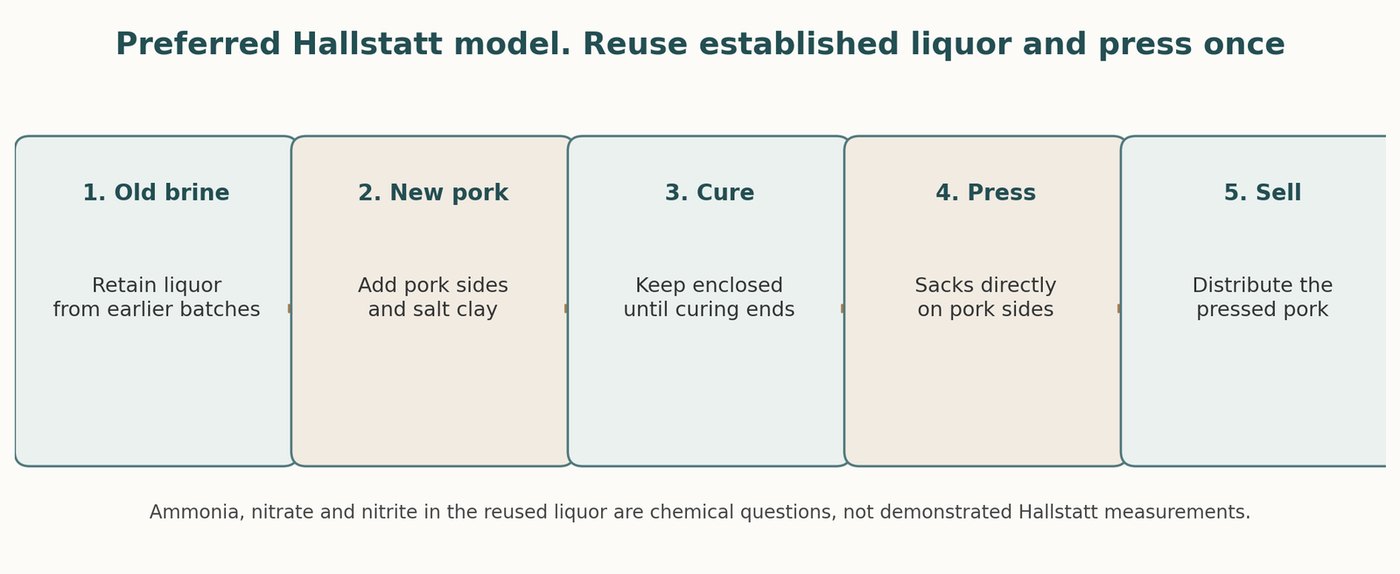
Figure 1. The preferred Hallstatt model. Old brine is retained, the basin is filled with new pork and salt clay, the basin is sealed for one cure and the cured pork is pressed under sacks before distribution. The nitrogen chemistry of the reused liquor is a question for experiment, not a Hallstatt measurement.
1. What Happened After the Curing Basin
Hallstatt lies in the Salzkammergut of Upper Austria. Underground salt mining in the Salzberg valley above the town began around 1500 BCE, and beside the Bronze Age mine lie the remains of Europe’s oldest known pork curing industry. In The Origin of Salted Pork Traditions, Eben described the basins, the bones and the production system, and in The Celtic Cradle of European Meat Curing he followed the tradition into the Iron Age. Together we then examined the possible source of nitrate in the cure in The Nitrate Source of the Hallstatt Cure and the chemistry of a reused basin in Polenske and the Hallstatt Curing Basin.
Each of these studies followed the meat into the basin and out of it again, and each stopped at the same point. After the cure, the meat had to be removed from the curing basins, drained, dried, and stored or sold. The usual illustration of joints suspended in the mine passes over the hardest practical question. Where would the output of a basin of 150 to 200 pigs have hung, and where would the output of the next batch have hung while the first was still drying? Hans Reschreiter and Kerstin Kowarik, who lead the research at the mine, are explicit on the point. Their reconstruction of everyday life in the Bronze Age mine shows salted meat hanging on drying racks, although there have been no specific finds to support this assumption (Reschreiter and Kowarik 2019).
Our answer starts from scale. Hanging costs nothing when the quantity is small. A farmer or a village butcher with a few sides needs only a hook, a beam and a cool room, and butchers, like farmers, do not spend money they do not need to spend. The bacon trade of Calne in Wiltshire grew from such beginnings. The Harris business there began in 1770 as a small butchery, and for small butchers of that kind a week in which a few sides were sold was a good week. Dry curing and hanging belong to that scale. When the quantity becomes large, hanging becomes expensive in space, timber, rope and labour, and the meat’s own weight becomes a free resource. Large curing systems recorded over the last 200 years used that weight, by stacking, by packing in barrels and tanks, and by turning stacks so that the top layer ended at the bottom. Hallstatt was a large system. We therefore expect pressing, not hanging, to have carried the bulk of its output.
2. Pressing, an Ancient Drying Technology
We were introduced to the concept of pressing through omasum, the third stomach of cattle, which is dried by salting and pressing because hanging achieves little with it. Eben first saw this in a Chinese operation, where 28 sandbags of 50 kg, 1 400 kg in all, lay on about 400 kg of salted omasum, and in our own processing in Tanzania the omasum gives up its free water in about 48 hours under about one and a half times its own weight (Van Tonder and Van Tonder-Berger 2026a).
Far more important was what followed. In Pressed Meat. A Chinese Technology Set, our main source for this section, we found that drying by pressing is a far older technology than we had thought, that it is probably Asian in origin and that it was far more widely used in the past. Chinese texts describe salted meat and fish pressed under stones and heavy objects from the Qimin Yaoshu (齊民要術, Qímín Yàoshù, Essential Techniques for the Welfare of the People), written about 533 to 544 CE, onward (Section 14). The technology fits a route into Europe through Turkey and Bulgaria, where pastırma and pastarma are still pressed today. That it was once widely used is evidenced by its use in biltong. A Cape recipe of 1891 pressed salted beef overnight before drying it (Pressing in Biltong’s Past, Van Tonder 2025), which shows that it was used much more widely than in Turkey, Bulgaria and China.
As a technology set, drying through pressing may be ancient and much older than even the Chinese texts suggest. It was probably used pervasively wherever large volumes had to be dried, and we suspect that only in China was it incorporated further into other crafts, for example the drying of tiles.
Pressing dries a large quantity within about two days on very little floor, which fits an industrial processing operation. Suddenly it presented itself as a possible drying system for the Hallstatt cure.
3. What the Hallstatt Finds Establish
Any reconstruction of the steps after the basin has to start from what the excavations and analyses have established. The following facts are documented.
- The basins. Eight log structures sunk into the ground are known in the Salzberg valley. Two have been examined, one exposed by a landslide in 1877 and one excavated by Friedrich Morton in 1939, whose double walls were sealed with clay. They date to the 13th and 12th centuries BCE, measured about 4 by 4 m and are estimated to have held the meat of 150 to 200 pigs at a time (NHM, Bronze Age meat curing vats, Reschreiter and Kowarik 2019). Hammer and colleagues (2018) describe an industry that processed several hundred pigs a year.
- The fill. The basins were filled with salt bearing clay from the mine. Fritz Eckart Barth concluded that the curers used the small unwashed salt that falls during mining (Barth 2001), and grey mountain loam was packed into the walls and floors to make the timber watertight.
- The animals. More than 10 000 bones were identified from the 1993 and 1994 excavations in the valley. Pig accounts for 60.5 percent, sheep and goat for 21.5 percent and cattle for 17.6 percent. Of the pig jaws, 102 are male and 9 female, and the pigs were killed at one and a half to two years, with no piglets and no old breeding animals (NHM, Analysis of animal bones). Ancient mitochondrial DNA places them within the range of European domestic pigs and wild boar (Hammer and colleagues 2018).
- The cut. The skull was cut off at the upper end of the jaw, and the spine and ribs were removed with the entrails. The result was a carcass that kept the lower jaw and the four lower limbs. The long bones lack cut marks, which suggests that the meat was cured on those bones (NHM, Analysis of animal bones). The museum compares the opening of the carcass along the back to the way Gailtal bacon is still prepared in Carinthia.
- The weight. For an assumed live weight of 85 kg, the museum estimates a carcass of about 50 kg including bones. It suggests that such a carcass could have been carried on a stave, perhaps using the canines of the lower jaw as hooks, and describes this as plausible but unconfirmed (NHM, Analysis of animal bones).
- Full use of the carcass. Graphite tempered cooking vessels and bones boiled until the broth gelled and could be dried indicate that every part of the animal was used (Pucher and colleagues 2013). Eben examined this practice in Bone Collagen. From Ancient Broths to Modern Food Science.
- The mine. The galleries offered a temperature of about 7 °C, a relative humidity of about 60 percent, moving air and the smoke of burning splints of fir (Barth 2001). Experiments showed that ten days of curing in the basin gave sufficient salt penetration to conserve the meat, and that the bacon then matured for about half a year in the mine air (NHM, Bronze Age meat processing). In those trials the cured pieces were hung in suitable places in the mine and laid in small heaps, and lost about a third of their weight within six months (Barth and Lobisser 2002, translated by Christa in Van Tonder 2024).
- Carrying technology. Salt was carried inside the mine in leather sacks with a reinforced rim, each holding up to about 30 kg, and then transferred into woollen sacks and hauled up the shafts on ropes (NHM, Carrysacks, NHM, Transport flow, NHM, Uses of textiles). Women’s skeletons from the cemetery bear strong muscle markings from lifting, carrying and pulling heavy loads (NHM, Anthropology).
Two points follow. The Hallstatt meat unit was a mantle opened along the back, with the four legs on the bone, not a boneless slab. And the only documented trial of maturing this meat in the mine compared hanging with heaping and did not include deliberate pressing.
4. Technology Sets Change Slowly
Before turning to the curing record, it is useful to recall how slowly basic technologies change. A method that works with local materials, that a family can teach its children and that needs no purchased equipment tends to survive for thousands of years, even beside newer alternatives. The butchery trade and the farm belong to this world. That is why practices recorded in the nineteenth century can preserve the outline of much older systems (Figure 2).
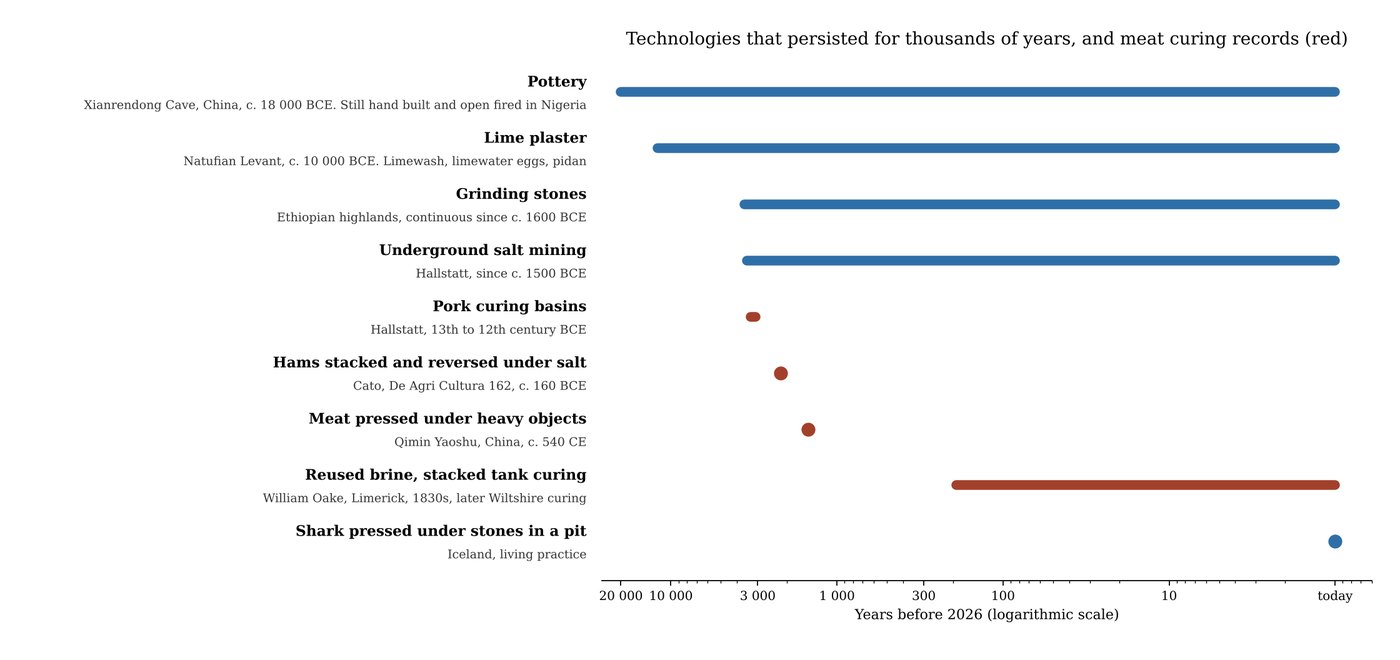
Figure 2. Technologies that persisted for thousands of years, set beside the written and archaeological records of meat curing discussed in this article. Logarithmic time scale. Living practices are shown at the present.
Pottery
Pottery is the clearest example. Sherds from Xianrendong Cave in Jiangxi Province, China, come from contexts dated to 20 000 to 19 000 calendar years before the present and were made by mobile hunter gatherers, ten millennia or more before farming (Wu and colleagues 2012). The basic method of shaping clay by hand and firing it in an open fire has continued since. In Nigeria, traditional pottery remains largely the work of women, and hand built pots are still made and bought for household, economic and religious purposes because they are cheap and culturally valued, although plastic and metal containers are widely available (Busari and Odetoyinbo 2021). The potters of Kwali village, where Ladi Kwali learnt to make large water jars by coiling from her aunt, built pots by hand turning, beating, dragging, coiling and smoothing and fired them in open wood fires (Te Papa, Kwali pot). A technology twenty thousand years old therefore still serves households beside its modern replacements.
Grinding stones
Grain was ground on a stone slab with a hand stone in Egypt, in Neolithic Europe and across Africa. In the northern highlands of Ethiopia, archaeological, ethnographic and traditional knowledge research has demonstrated continuity of grinding stones and non mechanised crop processing from at least 1600 BCE to the present (Nixon-Darcus and colleagues 2023). That continuity begins in the same centuries as the Hallstatt mine.
Lime
Lime is older still. Burnt lime plaster of high quality covered burials at the Natufian cemetery of Nahal Ein Gev II about 12 000 years ago, and its production required burning limestone above 700 °C and slaking the quicklime with water (Friesem and colleagues 2019). Plaster production expanded into an industry in the Pre Pottery Neolithic B of the Near East (Kingery and colleagues 1988). Lime has been used ever since to plaster and whitewash walls and floors, to line pits and to treat hides, and in the nineteenth century to preserve eggs in limewater (Section 5).
Salt mining at Hallstatt
Hallstatt itself is an example. Salt has been extracted in the high valley for thousands of years, and the operators of the present mine describe some 7 000 years of salt history at the site (Salzwelten Hallstatt). Underground mining dates from about 1500 BCE, and the brine pipeline built there in 1595 is described as the oldest pipeline in the world (Salzwelten Hallstatt). The community that built the curing basins therefore belonged to one of the longest continuous industrial traditions in the world.
Against this background, it would be surprising if the methods of curing and drying meat at large scale had been invented only in the nineteenth century. It is far more likely that the nineteenth century recorded, refined and mechanised methods that were already very old.
5. Old Curing Technology Still Visible
A large body of written and ethnographic evidence documents curing and storage techniques that do not fit the familiar picture of dry salting and hanging. Several of them survived into living memory, and some are still practised. Each describes one part of the system we propose for Hallstatt (Figures 3 and 4).
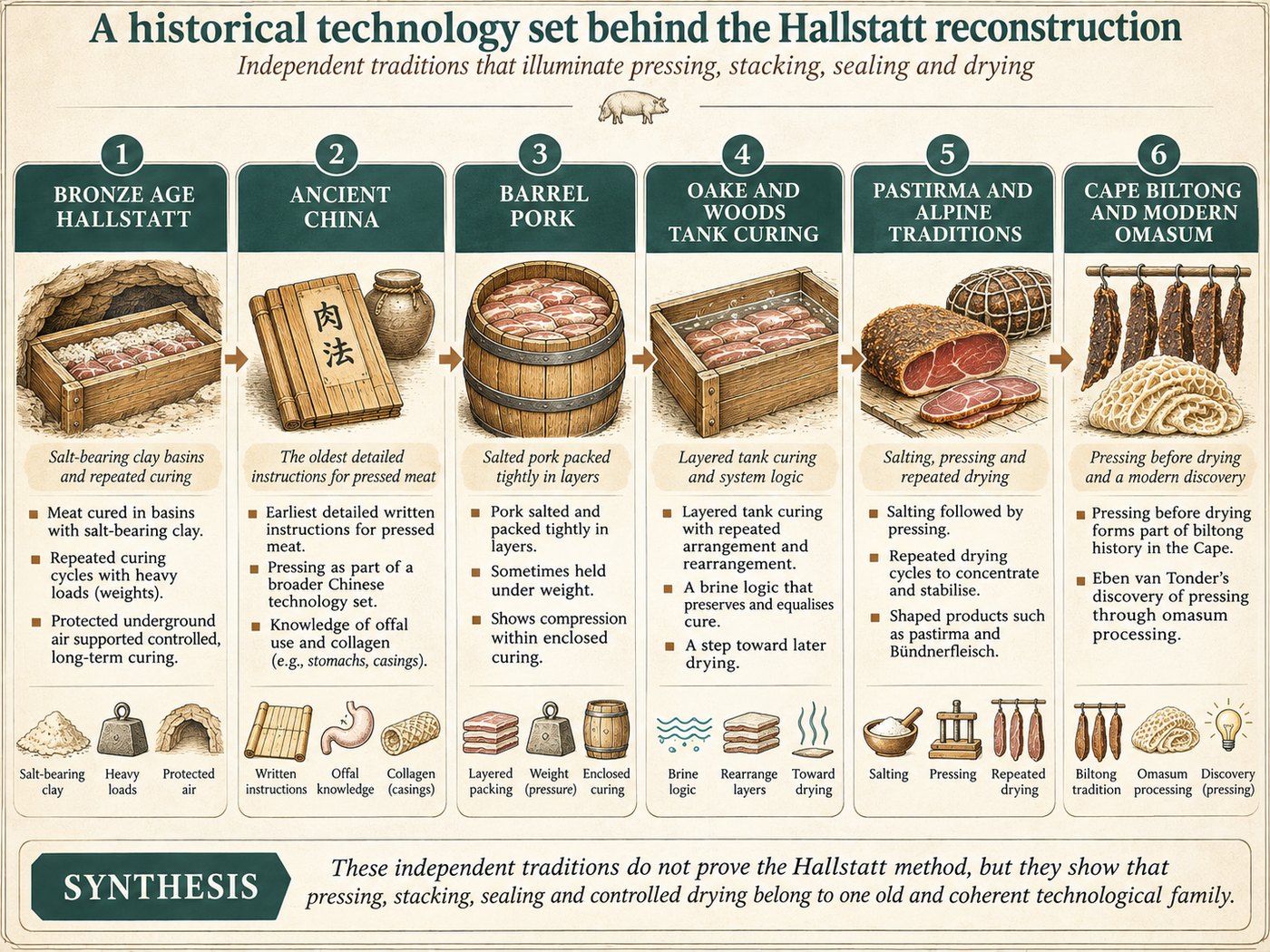
Figure 3. Independent traditions of pressing, stacking, sealing and controlled drying. These traditions illustrate one technological family and are not evidence of a particular Hallstatt operation.
Pits, burial and ammonia
Burial of meat and fish in pits is documented across the northern world. In Iceland, Greenland shark is still prepared as hákarl. The fish is placed in a shallow pit dug in gravel, covered with sand and gravel, and loaded with stones that press the fluids out of the body for six to twelve weeks, depending on the season (Skåra and colleagues 2015). During that period bacteria break down urea and trimethylamine oxide to ammonia, and the meat is then cut into strips and hung in a drying shed for several months. Hákarl therefore combines a pit, a covering, pressing by weight, the formation of ammonia and subsequent drying in one documented process.
Among the Inuit, igunaq is walrus meat and fat sewn back into the animal’s skin and buried in or on the permafrost to ferment for months (CBC News 2025). Kiviaq consists of hundreds of auks stuffed into a sealskin, sewn shut, sealed with fat and buried under stones for several months (Van Tonder, Inughuit Meat Preservation). Public health guidance warns that walrus should not be aged in airtight containers, because Clostridium botulinum produces its toxin in low oxygen conditions (Nunavik walrus project 2020). These traditions demonstrate how much practical knowledge of sealing, burial and fermentation was carried by communities without writing. They do not involve salt, and they are not models of the Hallstatt chemistry.
Lime in preservation
Lime appears in food preservation in several forms. In nineteenth century American households, eggs were preserved in limewater. The Kentucky Housewife of 1839 called limewater the best method, and Lydia Child, in later editions of The Frugal Housewife, recommended one pint of coarse salt and one pint of unslaked lime to a pail of water (Farm Collector, Grandma’s eggs). In China, pídàn (皮蛋, pídàn, skin egg), the so called century egg, is made by coating duck eggs in a paste of clay, ash, salt and quicklime, which raises the pH of the egg to about 9 to 12. The 17th century writer Fang Yizhi (1611 to 1671) described eggs salted with tree ash in his Wuli Xiaoshi (物理小識, Wùlǐ Xiǎoshí, Small Notes on the Principles of Things). Clay, lime and salt sealed around an animal product are therefore a documented preservation method. Lime also has an old place in buildings and pits. It was used to whitewash stables, dairies and meat stores, and tanners still lime hides in pits to loosen hair. For Hallstatt, lime remains a possible lining of the basin. The documented seal is clay and loam.
Barrel pork. Pressing by the meat’s own weight
Barrel pork is pressing in a vessel. American instructions for packing pork tell the curer to cover the bottom of a clean oak barrel with an inch of dry coarse salt and then to pack the pieces in layers with salt (Civil War News 2024, quoting nineteenth century instructions). Prime mess pork for the United States Army was supplied in oak casks each holding 50 four pound pieces, 200 pounds of pork, packed in salt and brine (Liberty Rifles). Household practice placed a wooden lid on the meat and weighted it to keep the pork under the brine (Townsends, Preparing Salt Pork). In such a barrel the upper layers press the lower ones, and the weighted lid adds a load on top. The barrel is both curing vessel and press.
Oake’s tanks. Reused brine and turned stacks
The clearest industrial parallel is the tank curing of William Oake. In the 1830s Oake, a young chemist in Limerick, developed what became known as mild curing, later tank curing and Wiltshire curing (Van Tonder 2024, Understanding William Oake). The essence of the system was the use of old brine that already contained nitrite (Van Tonder 2019, Mild Cured Bacon). Sides were laid in tanks on a bed of salt in crossing rows with curing material between them, and the stacks were later moved, turned and rebuilt on the floor so that the top layer went to the bottom (Van Tonder, William Oakes Mild Cured Bacon). Each layer was thus pressed by the weight of the layers above it, and turning evened out both salting and load. Oake’s operation was large and cheap enough to win a substantial share of a Navy contract (Van Tonder 2019, Tank Curing Came from Ireland).
Eben had long regarded Oake’s system, like the double salting of the Cape, as a new technology. On Eben’s own reading, however, the genius of Oake was not a new preservative but his ability to take what others had done and combine it into one system (Van Tonder, William Oakes Mild Cured Bacon). Reused brine, layered stacks, turning and pressing by weight are each documented in older practice, from Cato’s reversed hams to barrel pork. Oake may therefore have drawn his inspiration from methods far older than he knew. Seen this way, Hallstatt and Oake did the same thing nearly three thousand years apart. Each took practices that were used on a small scale in many places and organised them at industrial scale.
What the record shows
Taken together, the record documents pits sealed against air, linings and coatings of lime and clay, brines kept and reused, meat stacked and packed under its own weight, stacks turned from top to bottom, and pressing under stones or bags to drive out water. Hanging and slow drying in air form only one branch of this family, and it is the branch suited to small quantities. Curing in antiquity was in all probability organised very differently from the picture of individual hams on hooks. The Hallstatt system we propose is the earliest known industrial assembly of these old elements, and its echoes are still visible in the nineteenth century records.
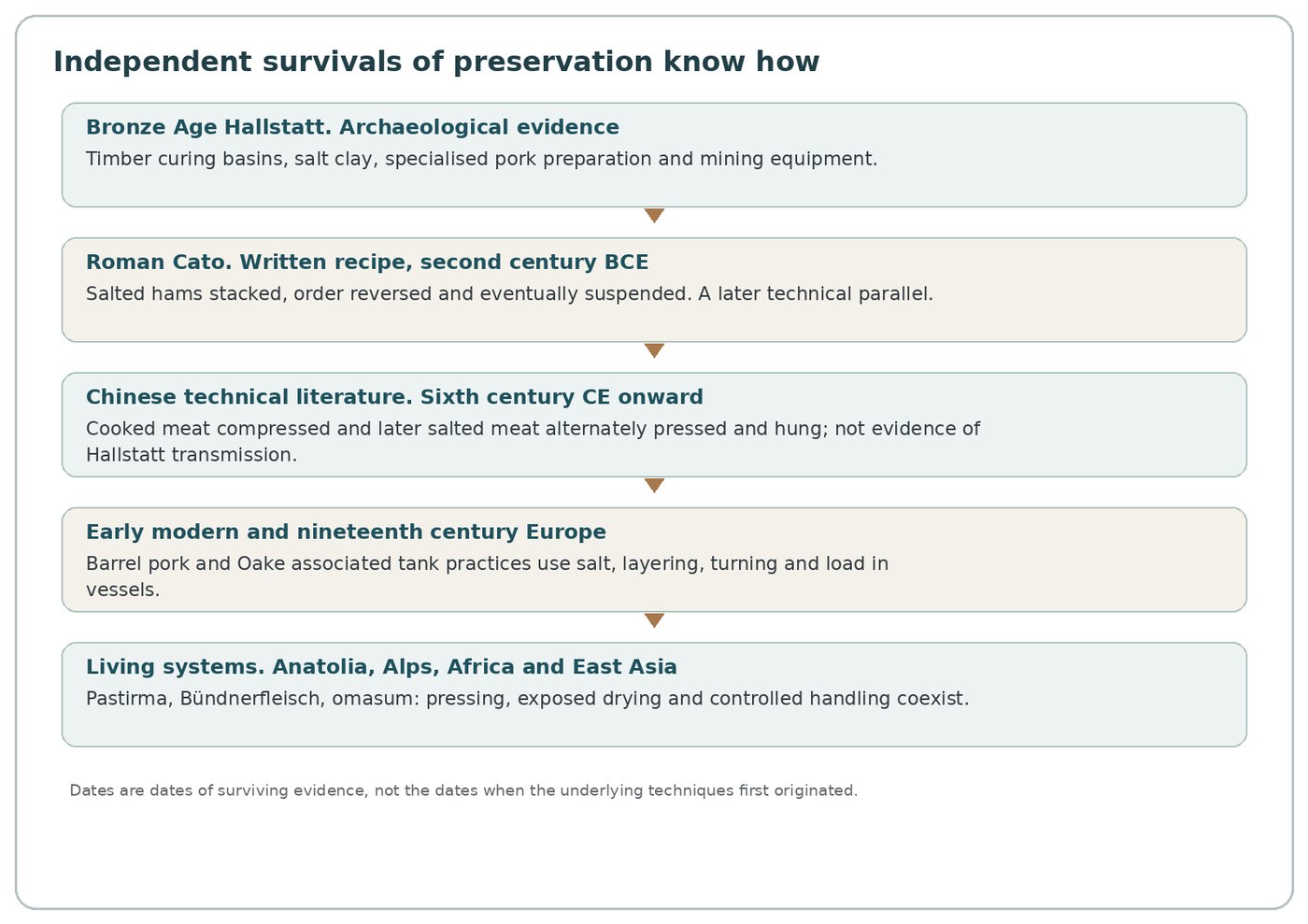
Figure 4. Independent survivals of preservation knowledge. Dates are dates of surviving evidence, not the dates at which the techniques began.
6. Two Working Hypotheses for the Cure
Our study of the basins produced two possible operating systems. Both seek to explain how the curers could have obtained the chemistry of nitrate and nitrite curing with the materials available to them. They differ in the source of nitrate and in whether the basin had to be opened during the cure.
How our search for the nitrate source developed
The two hypotheses are the end point of a search that began in early 2024, when Christa drew Eben’s attention to the Hallstatt basins. The question from the start was not salt, which the mine supplied in abundance, but the source of the nitrate or nitrite that gives cured meat its colour. Each step of that search is published on EarthwormExpress, and each changed the next.
The meat cured while it hung in the mine. In The Hallstatt Curing Method (April 2024), Eben followed Barth and Lobisser and placed the decisive step in the mine. The meat was salted in the clay basins and then matured in the cool, smoky galleries. Our first explanation of the cured colour followed from that picture. In Meat Preservation in Clay with Ammonia, Saliva and Lime (December 2024), we proposed that urine treated the meat before burial in the clay, that urea became ammonia, and that the bacteria that convert ammonia to nitrite became active only when the meat was taken out of the clay and exposed to air (Van Tonder and Berger 2024). In The Hallstatt Meat Curing Method. An Update on Late Bronze Age Industrial Processes (January 2025), we kept this sequence, with the meat rinsed after the cure and hung in the mine to dry, while nitrifying bacteria turned ammonia into nitrite and nitrate (Van Tonder and Berger 2025).
Where did the ammonia come from? Eben’s own trials had shown that meat tends to putrefy before it produces ammonia in useful quantities (Van Tonder, Admont Abbey). We therefore looked for a nitrogen source outside the meat. Eben had long argued that sal ammoniac, ammonium chloride, preceded saltpetre as a curing salt and that ancient people were skilled in managing urine and manure (Van Tonder 2024, Re-evaluation of the Discovery of Nitrate and Nitrite Curing). We examined saliva and lime, boiled pig skins and fermented grains as sources of lysine and other amino acids, the deamination of lysine, glutamine and glutamate, and protein rich broths poured into the basins (Van Tonder 2025, Exploring the Hallstatt Salt Curing Method, Amino Acids in Late Bronze Age Curing). In Urine in Meat Curing (April 2025), Eben turned to aged human and animal urine. In The Nitrate Source of the Hallstatt Cure (2026), we concluded that the most likely source was material the curers could scoop up and add to the basins, such as earth soaked with urine from stables and dung heaps, which farmers cleared as part of their daily work and which forms nitrate naturally in air.
Polenske and the two stage cure. The experiments of Eduard Polenske (1891) then changed the frame. His old saltpetre brines gained ammonia over six months while nitrate was reduced, which he attributed to microorganisms. In Polenske and the Hallstatt Curing Basin (November 2026), we asked how ammonia formed in a sealed basin could become nitrate, which needs air, and then nitrite, which needs the air to be gone again. Our answer was a cure in two sealed periods, separated by an opening in which the brine was stirred and diluted. Working through that model brought us to its weakness, the volume of water a strong brine would need, and to the simpler answer that the curers kept and reused their brine. At that point the nitrogen chemistry no longer depended on the meat hanging in the mine, and the question of how the meat was dried had to be asked afresh (Section 9).
The chemistry both hypotheses follow
Both hypotheses follow the same chain of chemistry, which runs through three stages with opposite requirements. In the first stage, organic material breaks down. Proteins, peptides and amino acids drawn from the meat are degraded by enzymes and microorganisms, and the removal of their amino groups releases ammonia, held in the brine mostly as ammonium (NH4+). This stage proceeds in a closed, wet mass. In the second stage, ammonium is oxidised to nitrite (NO2-) and nitrite to nitrate (NO3-). This is nitrification, and the bacteria that carry it out need oxygen. In the third stage, nitrate is reduced back to nitrite. Here bacteria use nitrate in place of oxygen for their respiration, so this step needs oxygen to be scarce. The nitrite formed in this last stage is what produces nitric oxide and the cured colour.
Our question was how a single curing system could accommodate a stage that needs air between two stages that run without it. The first answer followed the chemistry literally. Seal the basin so that ammonia forms, open it and stir in air and water so that nitrification can take place, then seal it again so that the nitrate is reduced to nitrite. That logic produced the two step operation of the first hypothesis. Reusing the brine resolves the same problem in one step. If the liquor is kept from batch to batch, the aerobic stage can take place in the old brine between batches, when it stands exposed to air, and each new batch starts with nitrate already present. The new batch then needs only one sealed period, in which ammonia forms from the fresh meat while the inherited nitrate is reduced to nitrite. The condition is that the brine must actually be kept and reused. Both hypotheses are set out below.
First hypothesis. Two sealed periods with an opening
In our first reconstruction, the prepared pork was packed into a timber basin with salt bearing Haselgebirge and the basin was sealed with clay. As salt drew water and soluble nitrogenous substances from the meat, brine collected in the basin, and proteins, peptides and amino acids in the liquid could be broken down further. Deamination would release ammonia, most of which would remain dissolved as ammonium.
Ammonium does not become nitrate simply by being present in brine. Nitrification requires oxygen and suitable microorganisms, and strong salt inhibits them. The first hypothesis therefore adds an opening. The workers remove the cover, stir the brine to bring in air and possibly add water, or even urine or urine soaked earth, to lower the salt concentration and add nitrogen. The basin is then sealed again. As oxygen is consumed, nitrate reducing bacteria convert nitrate to nitrite, and nitrite forms nitric oxide, which binds to myoglobin to give the cured colour (Figure 5). Urine supplies urea, which the enzyme urease converts to ammonia, and Eben has examined its historical use in Urine in Meat Curing. It remains a possible input but is not required for a cure.
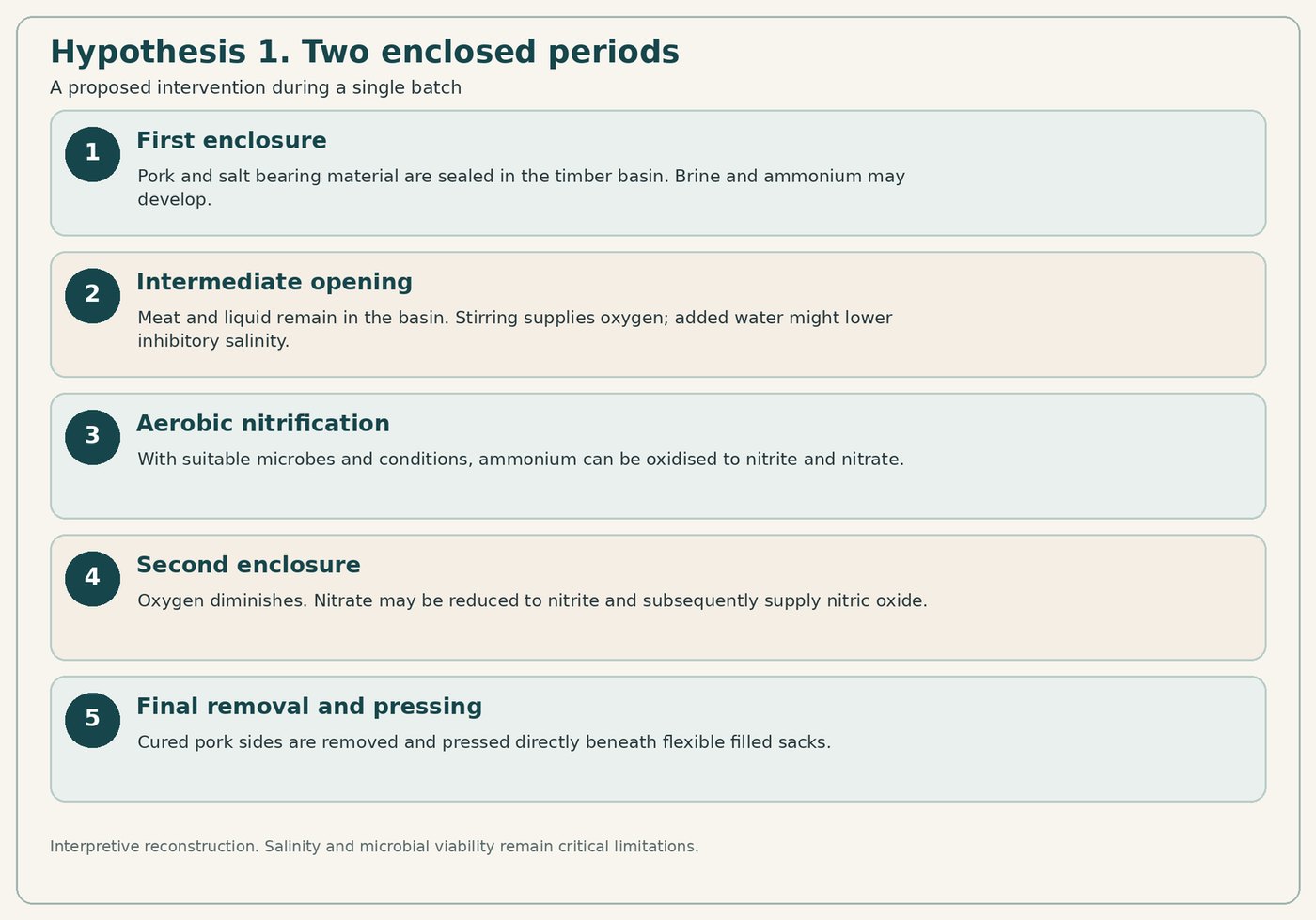
Figure 5. Hypothesis 1. Two enclosed periods with an intermediate opening for aeration. Salinity and microbial viability remain critical limitations.
Second hypothesis. One sealed cure in reused brine
Further reflection brought us to a simpler possibility. The curers may have kept the brine from earlier batches. A reused brine is not fresh salt water. Repeated contact with meat adds soluble nitrogenous substances, and microbial activity alters the amounts of ammonia, ammonium, nitrate and nitrite. If earlier cycles, exposure of the liquor to air between batches or nitrate bearing additions had built up a reservoir of nitrate, each new batch would begin with nitrate already present. The basin could then be filled with pork, sealed once and left closed for the whole cure. Inside it, salt would continue to draw water from the pork, ammonium would form, oxygen would be used up, and nitrate reducing bacteria could convert the inherited nitrate to nitrite (Figure 6).
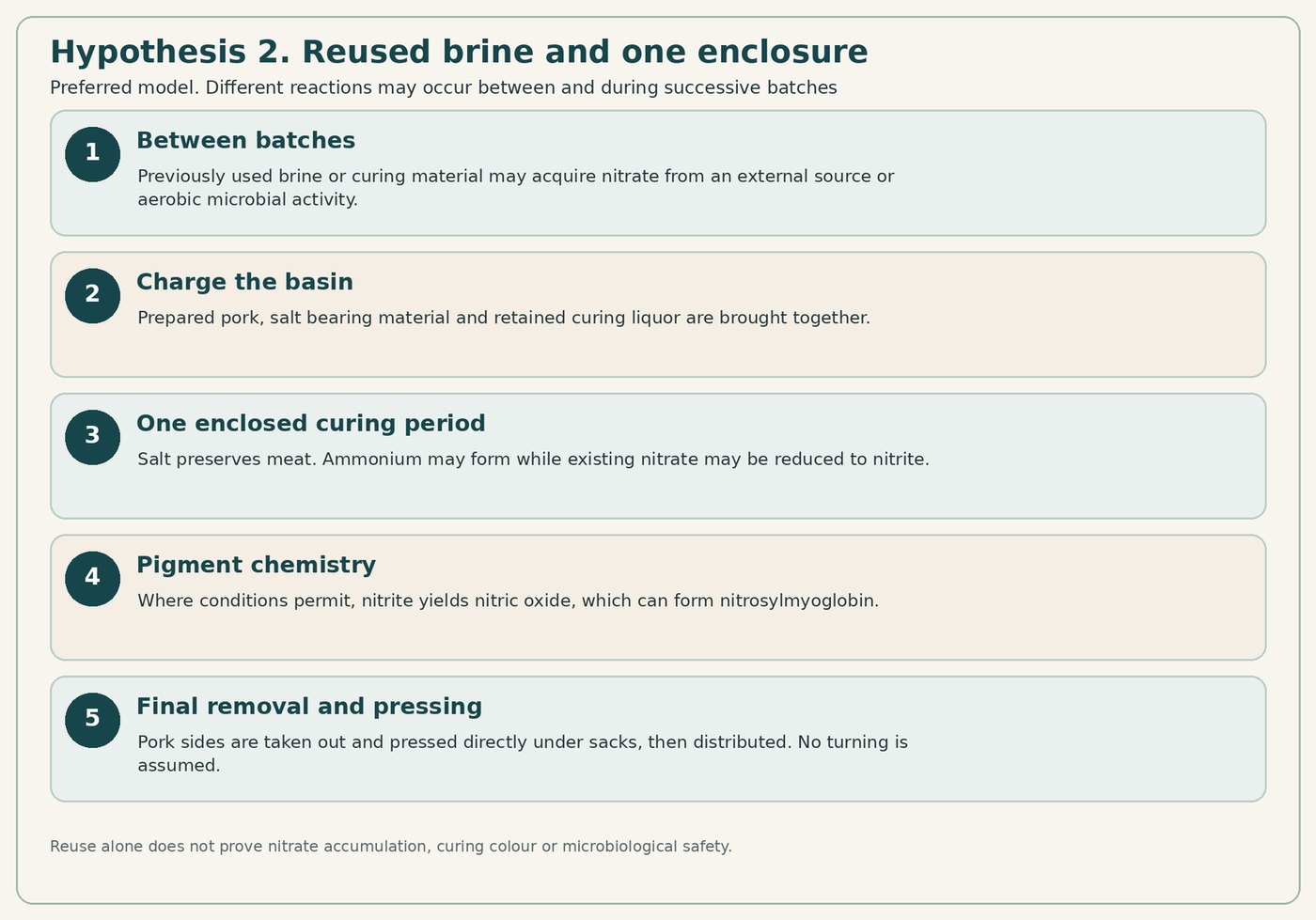
Figure 6. Hypothesis 2, the preferred model. Reused brine and one enclosure. Regeneration of nitrate, if it occurred, would take place between batches rather than during a sealed cure.
Why we favour the second hypothesis
The second system needs fewer operations. The first requires the basin to be sealed, opened, stirred, perhaps diluted and sealed again, and its success depends on nitrification in a liquid strong enough to preserve meat. The second requires the meat to be packed, cured under one cover, removed and pressed. It also explains why a curer would value old curing material, because a working basin would carry a chemical history from one batch to the next. This is the principle at the heart of Oake’s system nearly three thousand years later.
One requirement remains explicit. Reusing brine does not by itself guarantee that nitrate accumulates. Nitrate has to enter the system or be formed when the liquor is aerated and diluted enough between batches. The first hypothesis remains useful because it defines the conditions under which ammonium can become nitrate. The second places those conditions in the continuing life of the basin rather than inside each sealed batch.
7. The Chemistry and the Evidence of Polenske
The chemistry of a salted, sealed and reused basin involves several separate processes. Each has its own conditions, and they must be kept apart in any reconstruction.
Polenske’s ammonia
In 1891 Eduard Polenske at the Imperial Health Office in Berlin examined beef cured in saltpetre brine (Polenske 1891). His investigation concerned the nutritional losses of curing and was not designed to reproduce Hallstatt. He reported ammonia of 0.0049, 0.0066 and 0.0306 g NH3 per 100 g of brine after three weeks, three months and six months, and losses of 7.77, 10.08 and 13.78 percent of the nitrogenous substances of the meat (Van Tonder and Van Tonder-Berger 2026c, discussing Polenske 1891, pp. 471 to 474). Ammonia therefore rose slowly for three months and increased about fivefold between three and six months, as nitrogenous material extracted from the meat accumulated in the brine and was broken down. Polenske attributed these changes in writing to microorganisms, and he was right. His data establish that an old brine changes chemically with time. They do not establish that ammonium in a strong brine became nitrate.
Why salt extracts protein but does not itself make ammonia
Sarcoplasmic proteins and small nitrogenous extractives dissolve readily in water. Myofibrillar proteins such as myosin dissolve within certain ranges of ionic strength, so salt can increase their extraction. Very strong salt, however, can inhibit microorganisms, change protein structure and cause aggregation. Salt extraction yields a protein rich liquor, and the ammonia appears only when enzymes or microbes break those compounds down and remove their amino groups (Figures 7 and 8).
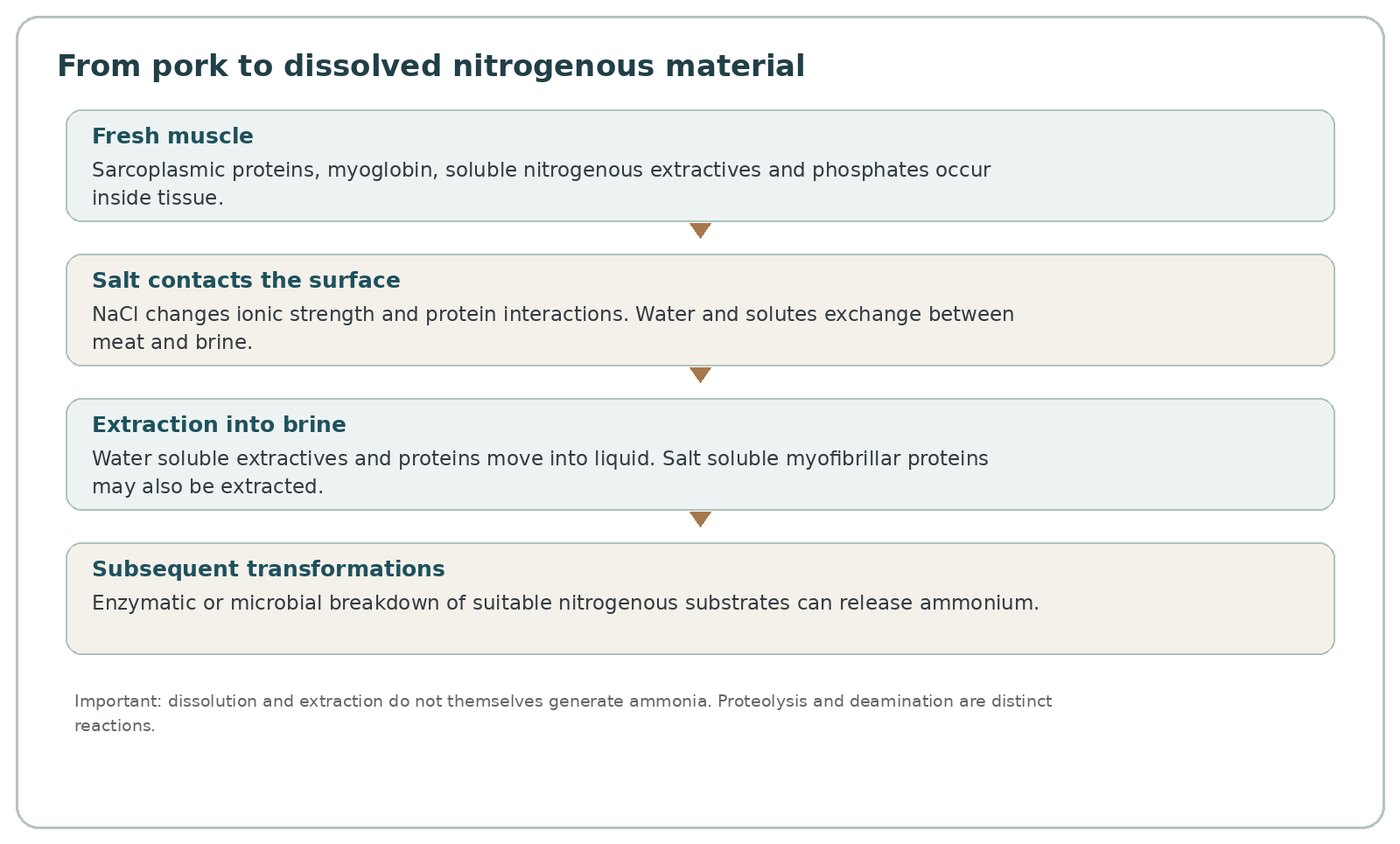
Figure 7. From pork to dissolved nitrogenous material. Extraction and ammonia release are separate steps. Based on Polenske (1891), Van Tonder and Van Tonder-Berger (2026c) and the protein extraction literature.
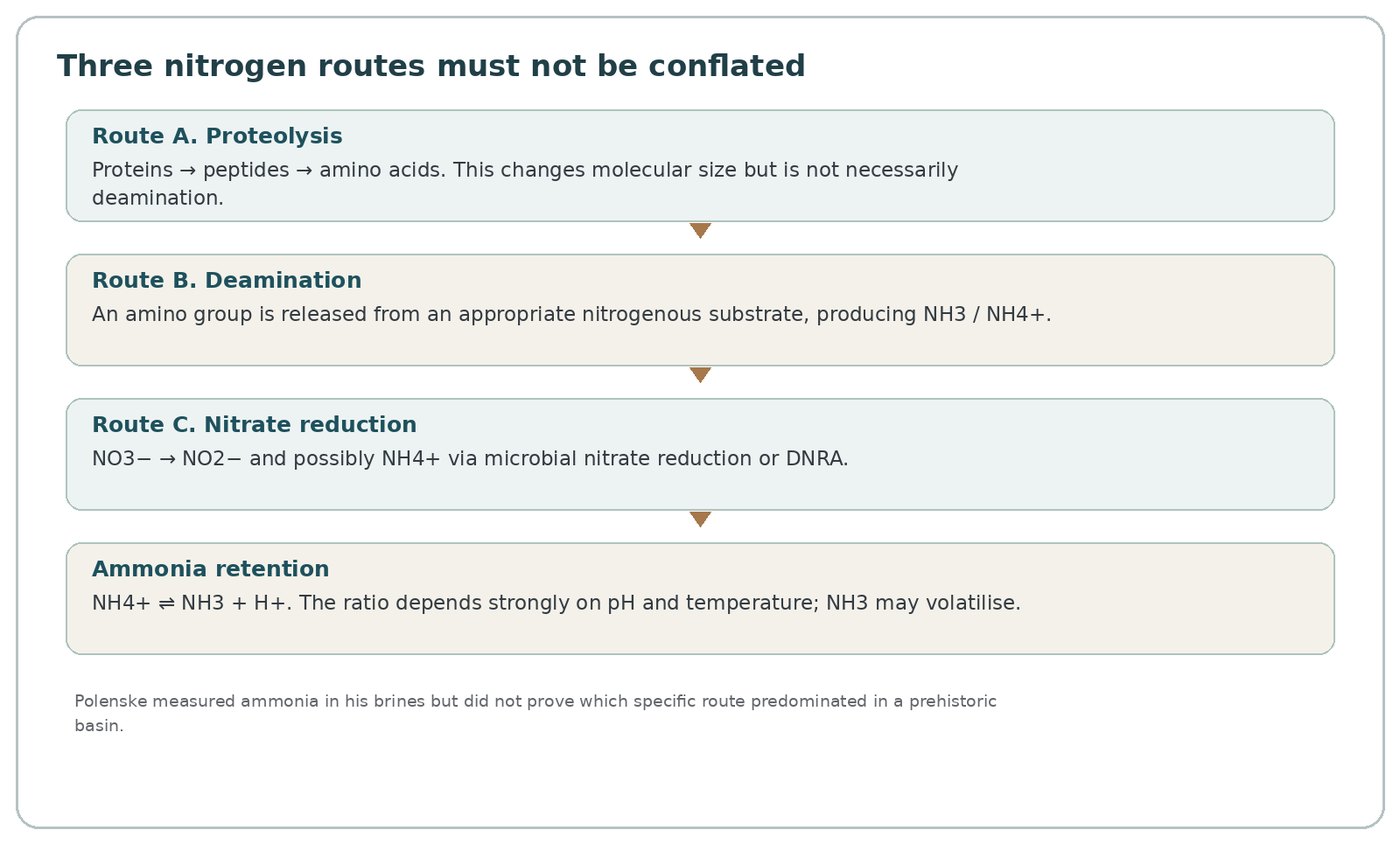
Figure 8. Three nitrogen routes that must not be confused. Proteolysis, deamination and nitrate reduction have different conditions and are not a measured Hallstatt sequence.
Ammonium, pH and lime
Dissolved ammonia exists in equilibrium with ammonium, NH4+ ⇌ NH3 + H+. A rise in pH increases the share of uncharged NH3, which escapes as gas when the liquid meets air. A clay seal would reduce gas exchange, while lime would raise the pH and drive more ammonia into the volatile form. That is consistent with the strong ammonia smell of hákarl pits and of old brines. Lime treatment of the Hallstatt basins has not been reported, and the documented seal is clay. Lime remains a possible variable for experiment.
The salinity limit and the size of a dilution
Conventional nitrifying bacteria are strongly inhibited at salt concentrations far below those of a curing brine (Moussa and colleagues 2006). The scale of the problem can be calculated. A hypothetical 1 000 kg of liquor at 20 percent sodium chloride contains 200 kg of salt. Lowering it to 3 percent would require about 5 667 kg of additional water, and lowering it to 2 percent about 9 000 kg (Figure 9). That volume makes whole basin dilution impractical and is a main reason we favour the reused brine model. Small additions of water or urine could, however, create less salty pockets or surface zones where nitrifiers might work, and the cooler, wetter margins of a basin or a brine pit between batches may have provided such niches.
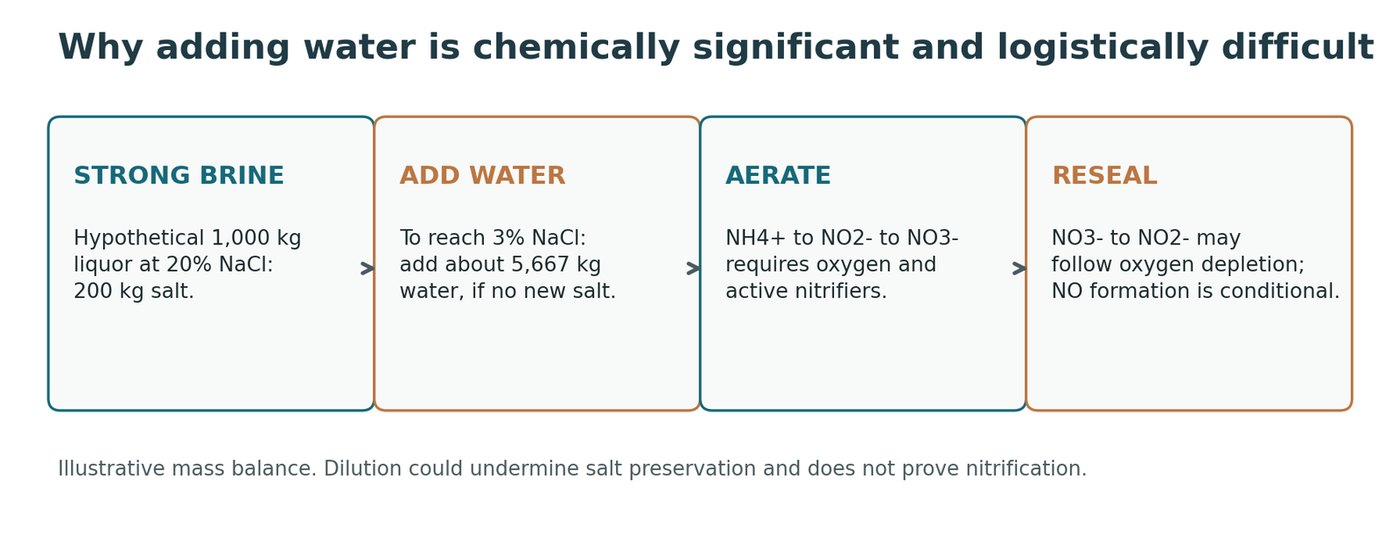
Figure 9. Why adding water is chemically significant and logistically difficult. Illustrative mass balance for the two period model.
Nitrate reduction, colour and the limits of chemistry
In a sealed batch containing nitrate, nitrate reducing organisms can produce nitrite under low oxygen conditions. Nitrite forms nitric oxide, which binds to ferrous myoglobin to form nitrosylmyoglobin, the pigment of uncooked cured meat. Neither nitrate nor ammonia gives cured colour directly. The chemical limits discussed above restrict how much nitrate and nitrite the system could produce, but they do not prevent the process as a whole. Salt alone preserves meat. The nitrogen chemistry would have added colour and flavour where conditions allowed, and the Hallstatt product would have been preserved salted pork even where that contribution was small.
8. The Integrated Hallstatt Sequence
Drawing these strands together, the preferred operation can be stated in plain terms. Steps marked as possible have no excavated confirmation and are proposed on technical grounds.
- Prepare the basin. A timber basin set into the ground is sealed with clay and loam (documented). A lime wash of the walls and floor is possible.
- Fill the basin. Prepared pork mantles are laid in layers with salt bearing Haselgebirge and covered with brine retained from earlier batches (basin and fill documented, brine reuse proposed).
- Seal. The filled basin is covered and sealed with clay (clay sealing documented in basin construction, clay cover proposed).
- Cure. The basin stays closed for the curing period. Salt penetrates the meat, ammonium forms, and inherited nitrate may be reduced to nitrite (proposed chemistry).
- Optional intervention. In the first hypothesis only, the basin is opened, stirred and diluted with water, urine or urine soaked earth, then sealed again. It remains possible but is not necessary in the preferred model.
- Open and drain. The cured meat is lifted out and the brine retained for the next batch.
- Press. The mantles are laid on a prepared floor and loaded with filled sacks for a few days. Expressed brine runs away (proposed).
- Distribute. The pressed pork leaves the site as trade goods. Further airing, smoking or hanging by the buyer is possible but is not part of the proposed Hallstatt operation.
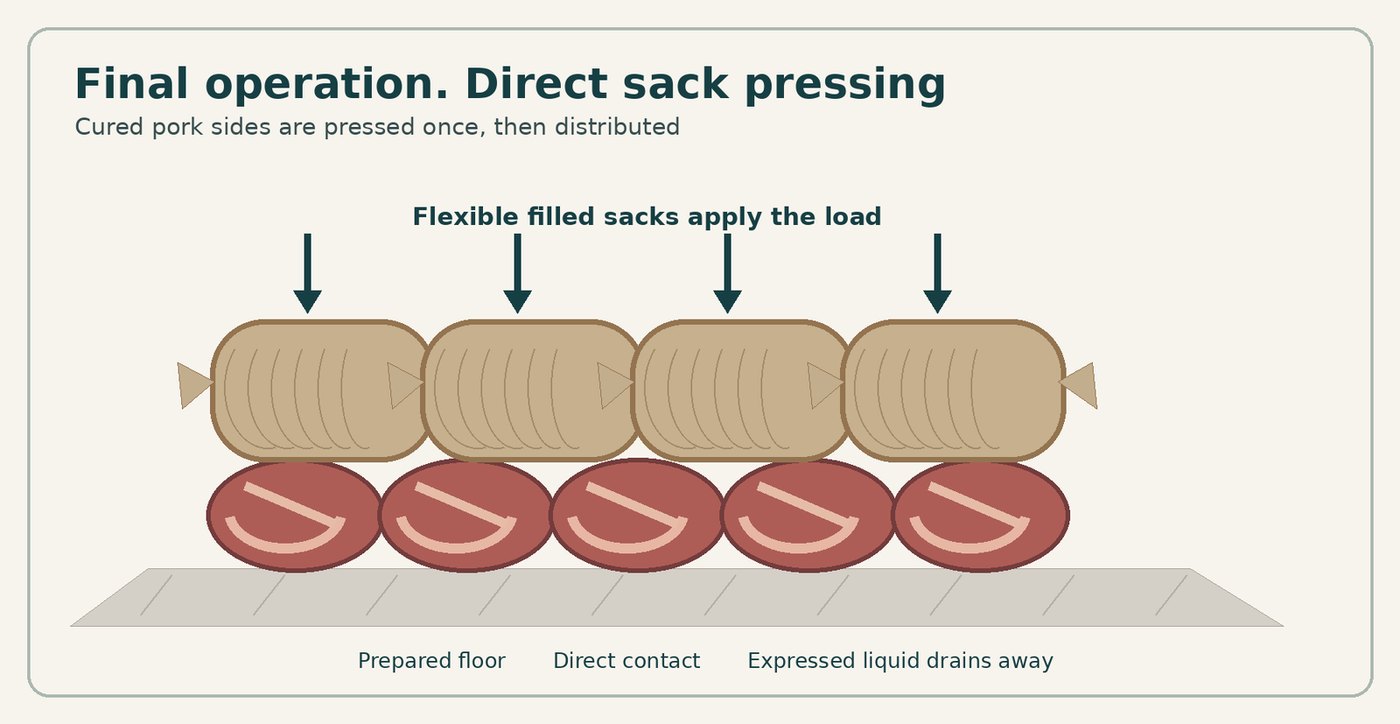
Figure 10. The final operation. Flexible filled sacks rest directly on cured pork laid on a prepared floor, and expressed liquid drains away.
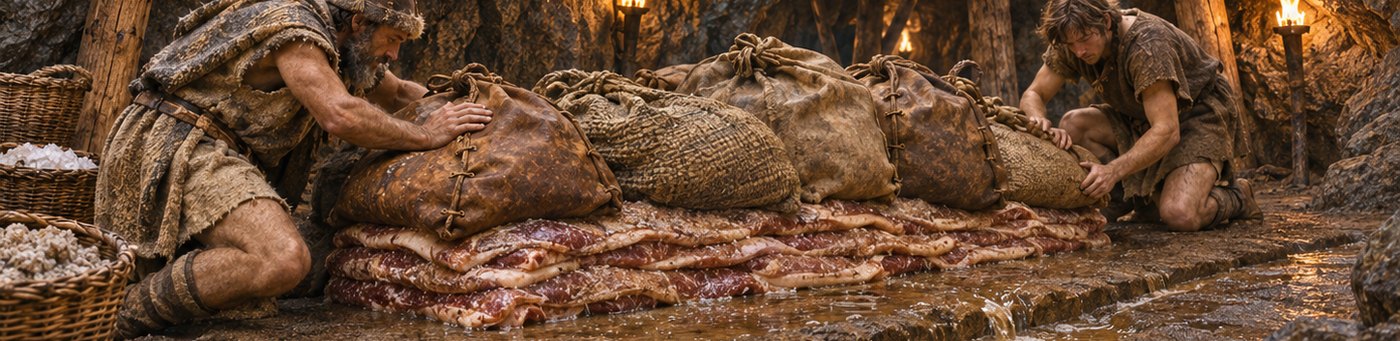
Figure 11. Interpretive reconstruction of direct sack pressing of salted pork. Not a depiction of an excavated installation.
9. The Drying Dilemma and Why Not Hanging
Our view of the drying stage developed in the same way as our view of the nitrate source, and the case against hanging as the main method rests on scale, structure and cost.
How our view of drying developed
For most of our work the drying stage was not in question. Barth and Lobisser placed the maturing of the meat in the galleries of the mine, the museum’s reconstruction drew it hanging on racks, and our own early models adopted this picture because it also explained the cured colour, with nitrifying bacteria working on the hanging meat in the air of the mine. Once the nitrogen chemistry moved into the basin and its reused brine, the hanging stage no longer had a chemical role, and its practical side came into view. The output of one basin was 150 to 200 pigs. We could not see where such volumes, batch after batch, would have hung in the narrow galleries of a working mine.
Pressing came into the picture through omasum and our study Pressed Meat. A Chinese Technology Set (September 2026), which revealed pressing as an ancient, widespread drying technology (Section 2). The more we followed these ancient methods, the more the separate pieces of the Hallstatt problem fitted together. Sealed pits and ammonia, reused brine, stacked meat pressed under its own weight, turning from top to bottom and pressing under weights appeared in one record after another as parts of a single old system, and Hallstatt emerged as the earliest place where that system was run at industrial scale (Section 5).
The figures below rest on stated assumptions and are not measurements of Hallstatt galleries.
The rail and floor required
Suppose each animal yields two hanging pieces and each piece needs 0.30 m of rail. A batch of 150 pigs then needs 90 m of rail and a batch of 200 pigs 120 m. At 0.50 m per piece the rail grows to 150 to 200 m. With rows 0.8 m apart, a single level needs about 72 to 160 m² of floor before any aisles. The batch weighs seven and a half to ten tonnes, all of which has to hang from timber or rock (Figure 12).
| Hanging assumption | 150 pigs | 200 pigs |
|---|---|---|
| Two pieces per animal | 300 pieces | 400 pieces |
| 0.30 m of rail per piece | 90 m | 120 m |
| 0.50 m of rail per piece | 150 m | 200 m |
| Floor at 0.30 m, rows 0.8 m apart | 72 m² | 96 m² |
| Floor at 0.50 m, rows 0.8 m apart | 120 m² | 160 m² |
| Meat at 50 kg per animal | 7 500 kg | 10 000 kg |
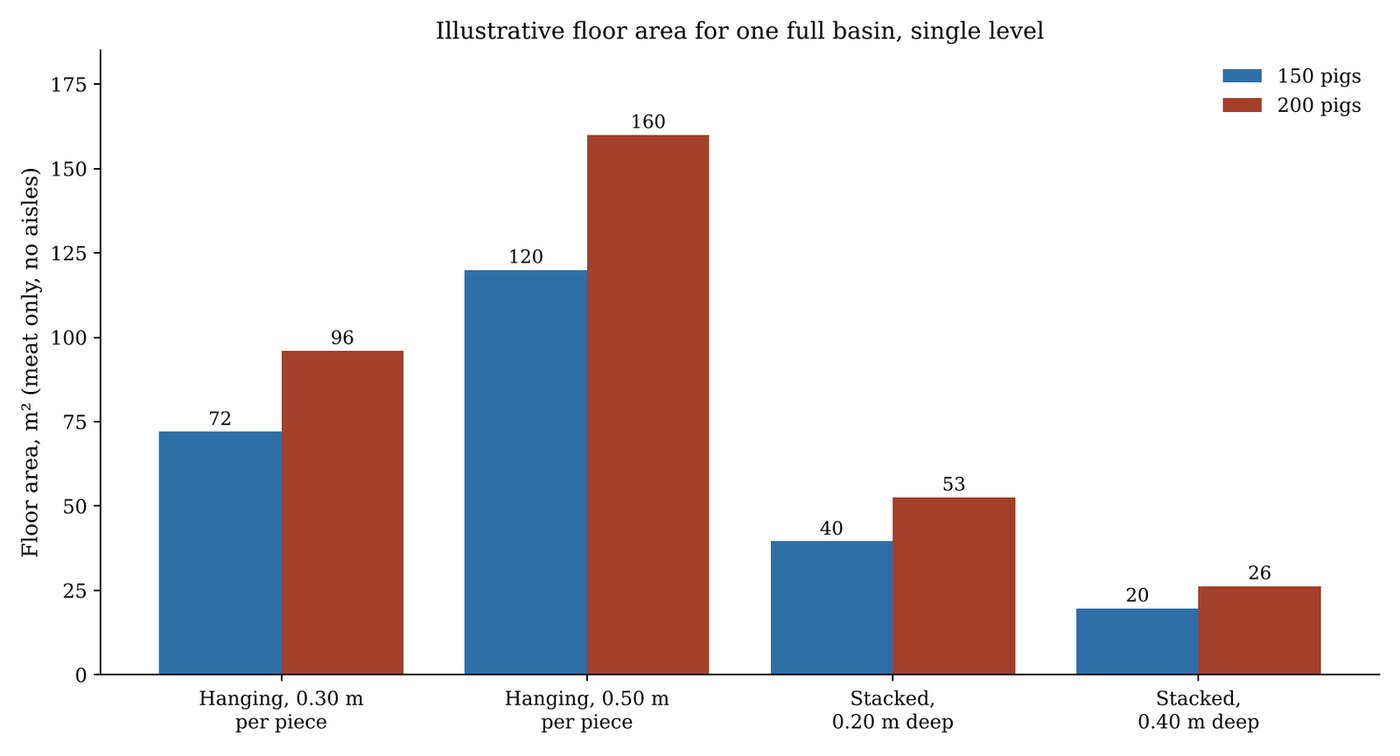
Figure 12. Illustrative floor area for one full basin under hanging and stacking assumptions, single level, meat only. Aisles and working space are excluded for both methods.
Overlapping batches
A single batch is not the whole problem. If N animals leave the basins every B days and each batch spends T days in post cure treatment, the number of animals in treatment at any time is N multiplied by T divided by B. With 150 animals discharged every ten days and a hanging period of 60 days, 900 animal equivalents, about 45 tonnes of meat on 540 m of rail, would be hanging at once. With pressing for a few days followed by distribution, the same calculation gives at most one or two batches on the floor at a time. Neither the cycle of ten days nor a drying period of 60 days is documented for the Bronze Age. The calculation shows why the duration of the post cure stage dominates the space required.
Structures that would have been needed
A hanging system needs suspension points, a supporting frame, headroom, working lanes, drainage for dripping brine and air movement. Four forms are conceivable. Free standing timber frames would need stable floors and bracing. Poles carried on the mine timbering would depend on spare capacity in the supports. Short removable rails in recesses or surface buildings would spread the work over several places. Ropes and pegs fixed in the rock raise questions of anchorage and abrasion. Ten pieces of 25 kg on a 3 m module already impose 250 kg on the rail. None of these forms has yet been identified as a meat drying installation at Hallstatt.
Cost and the practice of butchers
Hanging costs nothing when a butcher hangs a few sides from beams he already has. At Hallstatt scale it requires hundreds of metres of timber rail, ropes, hooks and space taken from mining. Pressing uses the weight of the meat itself in the basin and, afterwards, sacks of a kind the miners already made and used every day. Butchers and farmers do not spend money and effort they can avoid, and at large scale pressing is the cheaper solution.
10. The Basin Was Already a Press
Before any deliberate pressing, the meat in the basin lay under load. Layers of pork covered with wet salt clay carried the weight of everything above them. Assuming a fill density of about 1 800 kg per cubic metre, each half metre of fill exerts an average vertical stress of about 8.8 kPa and a metre of fill about 17.7 kPa. For comparison, a 30 kg sack on 0.10 m² exerts about 2.9 kPa and on 0.30 m² about 1.0 kPa. The Chinese omasum stack exerted about 11.4 kPa and the Tanzanian practice about 2.1 kPa (Figure 13). These are idealised averages, because the timber walls, the clay and the meat share the load. They indicate that the lower layers of a full basin lay under a load comparable to industrial omasum pressing, exactly as the lower layers of an Oake tank or a pork barrel did.
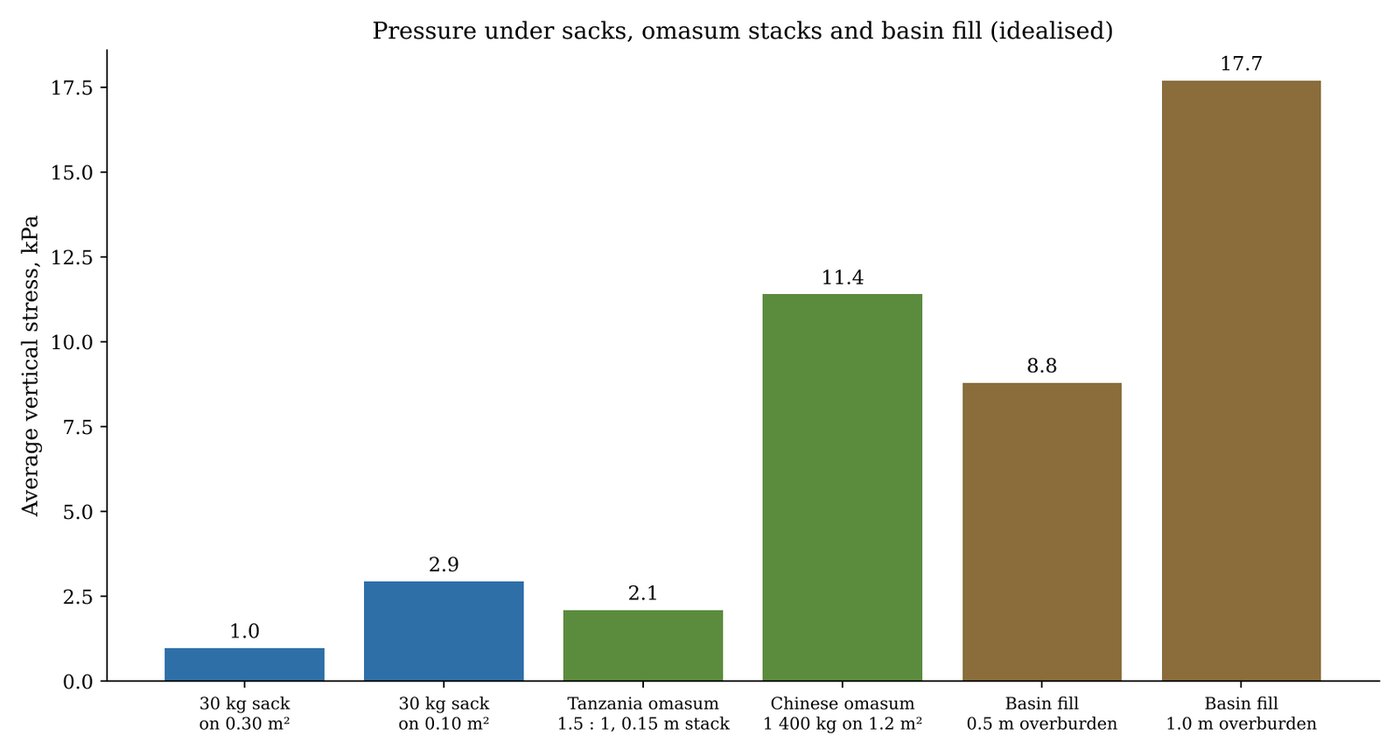
Figure 13. Average vertical stress under a 30 kg sack, under two omasum pressing practices and under salt clay fill in a curing basin. Idealised calculation. The fill density and the omasum stack geometries are assumptions.
11. Pressing After the Cure
The deliberate pressing stage follows the opening of the basin. Its feasibility turns on the shape of the meat, the weights available and the pressure applied.
The bone in mantle
A bone in mantle does not rule out pressing. With the spine and ribs removed, the belly and loin form a broad sheet of meat and fat, the part of a pig most easily pressed. The four legs, with their bones, form thicker blocks that take more of the load. Flexible sacks spread weight around such irregularities better than a stone. San Daniele hams are pressed on the bone after salting, which gives them their guitar shape (Consorzio del Prosciutto di San Daniele), and pastirma muscles are pressed between drying stages (Kaban 2009).
Weights and pressure
Applying the Tanzanian ratio of 1.5 kg of weight per kg of meat to a batch of 7.5 to 10 tonnes would require 11.25 to 15 tonnes of weights, 375 to 500 sacks of 30 kg. Pork is not omasum, and a much lower load may suffice. At 0.5 kg per kg, the batch needs 125 to 167 sacks, and smaller portions of a batch can be pressed in turn. The miners moved such tonnages of salt and rock by hand every day. The ratio of weight to meat is not a pressure, and trials must report pressure in kilopascals together with sack mass, contact area and stack geometry.
| Pressing scenario | 150 pigs | 200 pigs |
|---|---|---|
| Prepared meat at 50 kg per animal | 7.5 t | 10 t |
| Floor for meat at 0.40 m stack depth | 19.7 m² | 26.3 m² |
| Floor for meat at 0.20 m stack depth | 39.5 m² | 52.6 m² |
| Weights at 1.5 kg per kg of meat | 11.25 t, 375 sacks | 15 t, 500 sacks |
| Weights at 0.5 kg per kg of meat | 3.75 t, 125 sacks | 5 t, 167 sacks |
| Weights at 0.25 kg per kg of meat | 1.9 t, 63 sacks | 2.5 t, 84 sacks |
Hygiene
Direct contact between sacks and meat raises a hygiene question, since salt clay or fibres could pass to the meat. Hide sacks turned hair side outward, a layer of leaves or cloth, or a final rinse in brine would reduce the risk. Each is a variable for experiment.
12. Where Was the Meat Pressed?
The basins lay outside the mine, in the high valley close to the Bronze Age mine workings. The location of the pressing stage cannot be fixed from the evidence now published, and two options remain open.
A mine gallery offers shelter from rain and weather, a cool and stable climate and controlled access. If the pressing took place underground, the basins would be expected close to a mine entrance, and the distance, gradient and route between the known basins and the contemporary entrances should be mapped. A sheltered building beside the basins would minimise carrying and could provide a compact floor, but it would need a roof, drainage and protection from animals. Pressing for a few days needs far less space than hanging for months, so either option is practical. We see no reason to exclude the mine, and the shortness of the pressing stage makes a building equally likely (Figure 14).
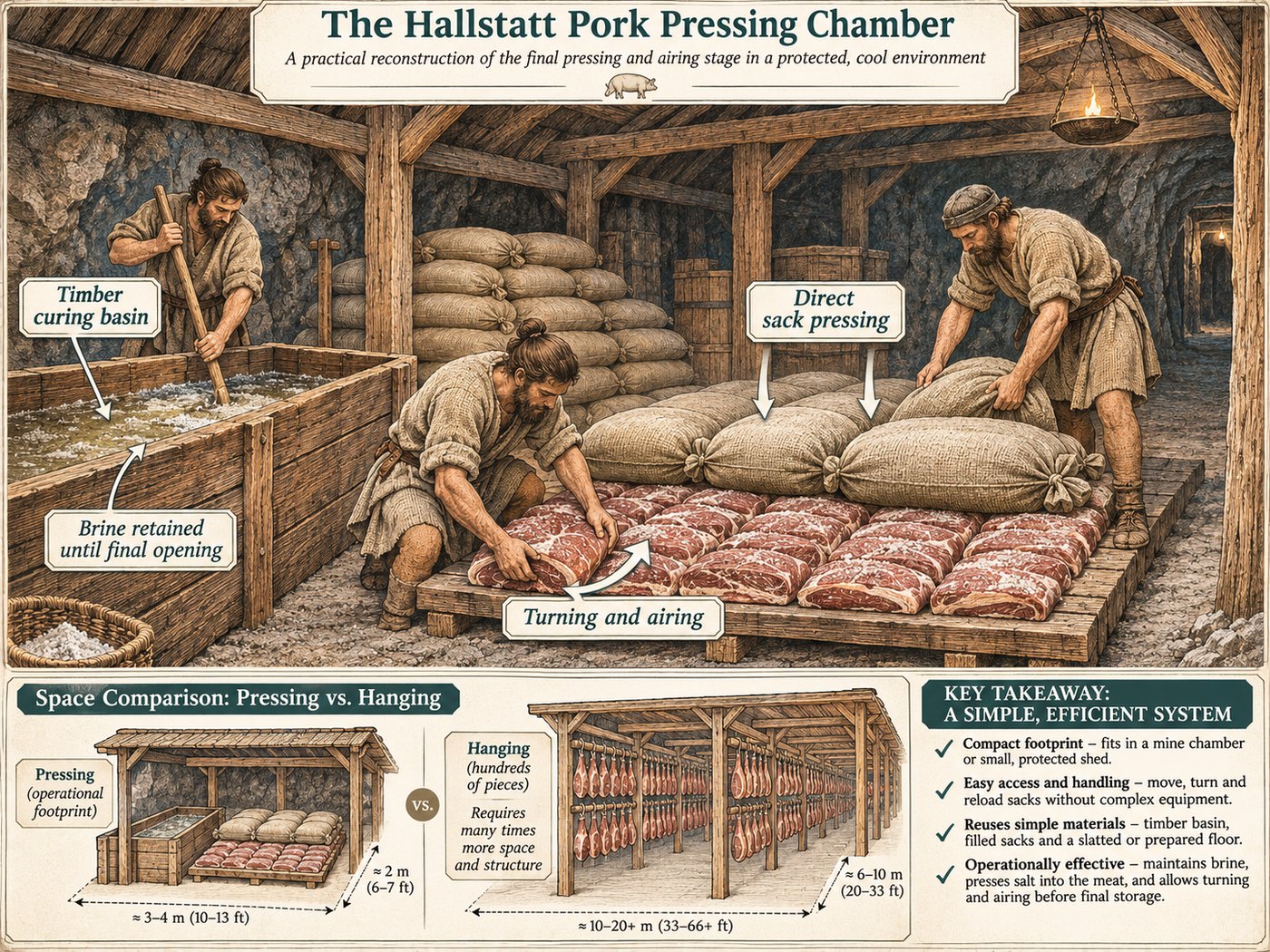
Figure 14. Interpretive reconstruction of a pressing chamber in a cool, protected setting. Turning and airing are shown as options. The preferred model ends with pressing and distribution.
13. The Meat Science of Pressing
Pressing salted meat combines three processes that must be measured separately.
- Brine expression. Pressing expels free brine soon after loading. It can be collected and weighed as runoff, separately from later evaporation.
- Evaporation. Evaporation depends on exposed surface, humidity, air speed and temperature. A tight stack reduces exposed surface, so evaporation is mainly a matter for any later airing. In the simplest diffusion model, drying time rises with the square of thickness, so pressing a piece thinner shortens later drying. This is a limiting case and not a prediction (Álvarez and colleagues 2021).
- Water activity and safety. Salt lowers water activity before the meat dries. In the first 48 hours of pastirma production, water activity fell from 0.985 to 0.942 while moisture fell only from 74.56 to 66.64 percent (as reviewed in Van Tonder and Van Tonder-Berger 2026a). A safe end point must be measured, not inferred from loss of weight.
A complete mass balance tracks water drawn into the basin brine, liquid expressed under load and water lost by evaporation, together with the salt gained by the meat. An unweighted stack, opened on the same schedule as the pressed stack, separates the effect of load from the effect of handling.
14. Pressing in the Ancient and Living World
Pressing as a food technology is far older than any written instruction for pressing meat, and it survives in several regulated products today.
Strainers, torsion presses and beam presses
Pottery sieves from Kuyavia in Poland, about 7 000 years old, carry milk fat residues and are interpreted as cheese strainers (Salque and colleagues 2013). In Egypt, the torsion press appears in the tomb of Nebemakhet, about 2600 to 2500 BCE (Dodd 2022), and a wine pressing scene in the tomb of Nekhebu dates to the reign of Teti, 2323 to 2291 BCE (Museum of Fine Arts, Boston). In the southern Levant, installations interpreted as olive oil presses appear from the Late Bronze Age II to the Iron Age IIA, roughly 1400 to 900 BCE (Onozuka 2012), and an installation in the central hall of the Late Bronze Age North East Temple of Lachish was identified in 2025 as an olive oil press (Weissbein and Garfinkel 2025). In the weighted beam press, flat baskets of crushed olives were stacked under a beam weighted with stones (Ritmeyer). These presses were contemporary with the Hallstatt basins.
Rome
Cato the Elder, in De Agri Cultura of about 160 BCE, lays hams skin side down in a jar with salt between and over them. After five days they are taken out and laid back in reverse order, top to bottom. After twelve more days they are brushed, hung in a draught for two days, oiled, smoked and stored (Cato, De Agri Cultura 162). The reversal of the stack is the same operation recorded in Oake’s tanks two thousand years later. A century and a half after Cato, Strabo named the Sequani as the source of the finest salted pork sent to Rome (Strabo, Geography 4.3.2).
China
The Qimin Yaoshu (齊民要術, Qímín Yàoshù, Essential Techniques for the Welfare of the People), written by Jia Sixie about 533 to 544 CE under the Northern Wei and Eastern Wei, describes salted fish pressed on a stone board and meats pressed under heavy objects, although several of its pressed dishes are cooked preparations (Van Tonder and Van Tonder-Berger 2026a). A later household text, the Pujiang Wushi Zhongkui Lu (浦江吳氏中饋錄, Pǔjiāng Wúshì Zhōngkuì Lù, Household Recipes of Madam Wu of Pujiang), of the Southern Song (1127 to 1279) or Yuan (1271 to 1368), salts meat in summer, presses it under a stone overnight, hangs it and presses it again under a heavier stone if water appears. The Zhou Li (周禮, Zhōu Lǐ, Rites of Zhou), compiled in the late Warring States period (475 to 221 BCE), lists 脾析 (pí xī, beef omasum) among ritual foods. These texts are later than Hallstatt and are not evidence of transmission. They record the same practical solution.
Living pressed products
Pastirma from Kayseri is salted, dried, pressed, dried again, pressed a second time and coated with çemen (Kaban 2009), and the Turkic verb basturmak, to press under a heavy object, was recorded by Mahmud of Kashgar in the 1070s (Van Tonder 2024). Bulgarian pastarma govezhda is pressed for 12 to 24 hours at each stage (European Commission 2017). Bündnerfleisch, protected since 1999, must be pressed during drying to shape it and even out its moisture (Federal Office for Agriculture, Pflichtenheft Bündnerfleisch), and Bündner Rohschinken is pressed for shape and compaction (graubündenVIVA). San Daniele hams are pressed after salting (Consorzio del Prosciutto di San Daniele), and a Cape biltong recipe of 1891 pressed salted beef overnight before drying (Van Tonder 2025). Several of these products continue with drying after pressing. Our Hallstatt model does not require that step, but trials should test whether a buyer’s further airing would have been needed.
15. Hallstatt and the Wider Bronze Age World
Contacts across Eurasia in the second millennium BCE are documented in textiles and crops. The oldest known twill cloth comes from the Hallstatt mine, and twill trousers from Yanghai near Turpan are about two centuries younger (Beck and colleagues 2014). Broomcorn millet, domesticated in northern China, reached Europe by the 16th century BCE (Filipović and colleagues 2020). Ideas travelled far, but the written Chinese record of pressing is about 1 700 years later than the basins, while the presses of Egypt and the Levant were contemporary and much closer. The most economical explanation is that the Hallstatt curers either learnt pressing from the wider technical world of the Bronze Age or arrived at it through their daily work with heavy salt clay and wet meat.
16. A Technically Advanced Society
Press curing would not have demanded any skill the Hallstatt community lacked.
- Heavy timber construction. The log basins, the timbering of the galleries and the wooden staircase dated to 1344 BCE, the oldest preserved wooden staircase in Europe, demonstrate large scale carpentry (Salzwelten Hallstatt).
- Standardised tools and containers. The tools and carrying sacks of the mine were made to standardised dimensions (Reschreiter and Kowarik 2019).
- Moving tonnes by hand. Salt and rock were carried and hauled in sacks every working day.
- Controlling water in materials. The curers sealed basins with loam and boiled bones to a gel that could be dried.
- Working with salt clay under load. Filling and emptying a 4 by 4 m basin meant handling a heavy, consolidating material whose behaviour under weight the workers knew intimately.
A community with these skills needed no new invention to lay cured meat on a clean floor and cover it with sacks of salt rock. It needed only a reason, and the volume of meat leaving the basins supplied it.
17. How the Model Can Be Tested
Direct proof of pressing is hard to find, because pressed meat leaves the site as food and the sacks used to press it look like ordinary sacks. Hanging may be equally invisible, since movable racks need not leave fixing holes. Statements about either method should therefore read as not documented in the examined inventory. The following programme would allow indirect evidence to emerge.
Archaeology
- Map the production chain. A georeferenced map should link the dated basins, paths, Bronze Age entrances, galleries, possible working floors and spoil heaps, with distances and gradients between basins and entrances.
- Reanalyse sacks, hides and wood. Wear, flattening and residues on sacks should be compared blind with replicas used for carrying and for stationary loading on meat.
- Sample floors and basin fill. Micromorphology can record compaction in horizontal layers. Lipid and protein residues, soluble salts and drainage patterns should be sampled with controls from galleries not used for meat.
- Test the basin chemistry. Basin fills and timbers can be analysed for nitrogen species, lime and fat and protein residues, and the covellite on copper objects from the basins, attributed by Seemann and Brandstätter to sulphur from meat (Pucher and colleagues 2013), can be compared with mine contexts.
- Reexamine the bones. The mantle can be reconstructed element by element from the bone data and replicated at full scale.
Experiment
A controlled study should address two chemical questions and one physical question. Can a reused curing liquor with measured nitrate or nitrite support an uninterrupted sealed cure? Can an opened and aerated alternative produce nitrate at a salt concentration that still preserves meat? And after an identical validated cure, how do hanging, unweighted stacking and sack pressing at two measured pressures compare? Reconstructed bone in mantles should be used, stacks rather than individual pieces should be the replicated units, and all groups should experience about 7 °C and 60 percent humidity, with a sheltered surface building as a second location. Outcomes include salt and nitrogen species, pH, dissolved oxygen, microbial populations, water activity, expressed brine, cured pigment, labour and floor area. No product should be eaten without independent food safety approval.
Competing models
| Model | Predicted traces | Main weakness |
|---|---|---|
| A. Hanging in the mine | Rack anchoring, frame timbers, broad aisles, drip zones | No meat racks identified so far, and space and load are large |
| B. Unweighted heaps | Contact residues and drainage without load wear | Does not explain controlled compression |
| C. Sack pressing after a sealed cure | Load wear on sacks, contained runoff, compact floors near basins or entrances | Press sacks may be indistinguishable from carrying sacks |
| D. Mixed sequence | Pressing near the basins with some hanging elsewhere | Hardest to test |
18. Evidence Audit
The claims of this article stand on different levels of evidence.
| Claim | Present standing | What would change confidence |
|---|---|---|
| A large Bronze Age salting installation existed | Fact | Further structural publication |
| One basin held 150 to 200 pigs | Published capacity estimate | Volumetric reconstruction |
| Mantles boned at spine and ribs, legs on the bone | Fact | Element by element publication |
| Basins sealed with clay and loam | Fact | Further excavation |
| The basin loaded the meat under salt clay | Probable | Micromorphology of basin fill |
| Curing liquor was reused between batches | Probable on operational grounds | Nitrogen species and residues in basin fills |
| Pits, lime, barrels, reused brine, stacks, turning and pressing are old technologies | Fact, from ethnographic and written records | Earlier dated records |
| Lime lining of the Hallstatt basins | Possible | Residue analysis of basins |
| Meat hung on racks in the mine | Possible, reconstruction without specific finds | Identified racks or anchors |
| Meat pressed under sacks after the cure | Possible, on technical and comparative grounds | Associated artefacts or converging residues |
| Pressing in the mine rather than a building | Possible | Spatial and residue study |
19. Could the Hallstatt Pig Carcass Have Been Pressed Under Weights After Curing?
Yes. Based on the reconstructed anatomy, pressing the carcass under weights after removal from the curing basin is mechanically feasible (Figure 15).

Figure 15. Interpretive reconstruction of the Hallstatt pig carcass after dorsal opening. The skull, spine, ribs and entrails are removed, and the lower jaw, four legs, meat and skin form the mantle.
The removal of the vertebral column and ribs would have made the carcass considerably more flexible. The remaining meat, fat and skin could have been spread out, with the exposed flesh facing upwards and the skin against the supporting surface. However, three anatomical features would influence pressing.
- The shoulders and hams would be substantially thicker than the abdominal regions.
- The four remaining limbs would contain bones that resist compression.
- The retained lower jaw would create a particularly rigid projection at one end.
Consequently, a weight placed directly onto the carcass would not produce uniform compression. It would preferentially compress the thicker regions and could leave some thinner sections relatively unaffected. Our preliminary conclusion is that deliberate pressing is entirely plausible as a physical process, but its actual use at Bronze Age Hallstatt remains archaeologically unproven.
How pressing might have worked
A physically plausible sequence would be as follows.
- Remove the cured carcass from the basin and allow the surface brine to drain.
- Spread the carcass flat, keeping the skin underneath.
- Place leather sacks containing salt bearing clay directly onto the exposed meat.
- Concentrate the loading over the shoulders, loins and hams, while avoiding excessive pressure on projecting bones.
- Allow expressed liquid to escape rather than accumulate beneath the carcass.
- Remove the weights and reposition the meat if a further pressing cycle is required.
The use of leather sacks as weights is a proposed reconstruction. Such sacks were used for transporting salt at Hallstatt, and their use for pressing meat is our reconstruction.
What would pressing accomplish?
Pressing could have three technological effects. First, it could mechanically expel some free brine from the spaces between muscle groups. Second, it could reduce the thickness of the boneless portions and produce a flatter, more compact product. Third, it might influence subsequent drying by changing the geometry of the meat. However, compression would also reduce the exposed surface area where meat was in contact with the ground or other pieces. Therefore, faster or more uniform drying cannot be assumed. The weight loss achievable by pressing would need to be measured experimentally. It cannot be derived from the archaeological evidence.
What the Hallstatt evidence supports
The Natural History Museum in Vienna confirms the distinctive dorsal deboning method, the removal of the ribs and spine, and successful curing experiments. It does not identify deliberate pressing as a documented Hallstatt operation (NHM, Bronze Age meat processing, NHM, Analysis of animal bones). The excavated anatomy nevertheless makes pressing a testable hypothesis.
The most useful experiment would be to cure two comparable, dorsally opened pork carcasses and then press one under a measured load while leaving the other unpressed. Both would subsequently mature under identical controlled conditions. Measurements should include mass loss, thickness, salt concentration, water activity and moisture distribution. This would establish whether pressing offered a meaningful technological advantage over the documented hanging and heaping methods. It would not, by itself, prove that the Bronze Age Hallstatt processors used pressing.
20. Conclusion
The archaeology of Hallstatt establishes an exceptional pork salting operation of the 13th and 12th centuries BCE, with clay sealed basins, salt clay fill, prepared mantles with their legs on the bone, strong carrying sacks and a community organised to move tonnes of material by hand. It does not establish what happened to the meat after the basin. Hanging the full output would have required hundreds of metres of rail, tonnes of suspended load and space taken from mining, and those requirements multiply when batches overlap.
The written and ethnographic record supplies the missing elements. Pits sealed and opened with a smell of ammonia, lime and clay used as preservative coatings, pork packed in barrels under its own weight, tanks of reused brine in which stacks were turned top to bottom, and fish pressed under stones in pits all survived into the nineteenth and twentieth centuries, and several survive today. Technologies of this kind changed very slowly, as pottery, grinding stones, lime and the Hallstatt salt mine itself demonstrate. Curing in antiquity was therefore in all probability organised as large sealed and weighted systems, with dry curing and hanging reserved for small quantities.
We propose that the curing basins at Hallstatt were filled with pork, salt clay and reused brine, sealed once and opened when the cure was complete, and that the cured meat was pressed under sacks for a few days before it was traded. It is a fact that they had every element this system requires. It is probable that the basin itself pressed the meat and that old brine was kept. It is possible that a deliberate pressing stage under sacks followed, in the mine or in a building beside the basins. When William Oake built his tanks in Limerick in the 1830s, he may have been rediscovering, rather than inventing, an industrial curing system that was already running in the high valley above Hallstatt three thousand years earlier.
References
Álvarez, S., Álvarez, C., Hamill, R., Mullen, A. M. and O’Neill, E. (2021). Drying dynamics of meat highlighting areas of relevance to dry aging of beef. Comprehensive Reviews in Food Science and Food Safety, 20, 5370 to 5392.
Barth, F. E. (2001). Bronzezeitliche Fleischverarbeitung in Hallstatt. Arheološki vestnik, 52, 139 to 141.
Barth, F. E. and Lobisser, W. F. A. (2002). Das EU-Projekt Archaeolive und das archäologische Erbe von Hallstatt. Veröffentlichungen aus dem Naturhistorischen Museum in Wien, Neue Folge 29. Translated by Christa van Tonder-Berger in Van Tonder (2024). The weight loss figure is to be confirmed against the German original.
Beck, U., Wagner, M., Li, X., Durkin-Meisterernst, D. and Tarasov, P. E. (2014). The invention of trousers and its likely affiliation with horseback riding and mobility. Quaternary International, 348, 224 to 235.
Cato, M. P. (c. 160 BCE). De Agri Cultura, chapter 162. Loeb Classical Library (1934), online text by B. Thayer. https://penelope.uchicago.edu/Thayer/E/Roman/Texts/Cato/De_Agricultura/L*.html
Civil War News (February 2024). The pork ration, quoting nineteenth century packing instructions. https://civilwarnews.com/issues/2024/february/the-pork-ration/
Consorzio del Prosciutto di San Daniele. How to recognise San Daniele ham. https://prosciuttosandaniele.it/en/the-ham/how-to-recognize-it/
European Commission (2017). Implementing Regulation (EU) 2017/1106, Pastarma govezhda, traditional speciality guaranteed. Official Journal of the European Union, L 160.
Farm Collector. Grandma’s eggs. Historical egg preservation, citing The Kentucky Housewife (1839) and L. M. Child, The Frugal Housewife. https://www.farmcollector.com/looking-back/grandmas-eggs-zb0z2207/
Federal Office for Agriculture, Switzerland. Pflichtenheft für Bündnerfleisch (GGA). https://www.blw.admin.ch/dam/de/sd-web/bQV8MdCpOgk8/B%C3%BCndnerfleisch%20Pflichtenheft.pdf
Filipović, D. and colleagues (2020). New AMS 14C dates track the arrival and spread of broomcorn millet cultivation and agricultural change in prehistoric Europe. Scientific Reports, 10, 13698.
Friesem, D. E., Abadi, I., Shaham, D. and Grosman, L. (2019). Lime plaster cover of the dead 12,000 years ago. New evidence for the origins of lime plaster technology. Evolutionary Human Sciences, 1, e9. https://doi.org/10.1017/ehs.2019.9
graubündenVIVA. Factsheet Bündnerfleisch and Factsheet Rohschinken. https://graubuendenviva.ch/sites/graubuenden_viva/files/2025-02/grviva-schatz-3-bf-factsheet-250204.pdf
Hammer, S. E., Tautscher, B., Pucher, E., Kowarik, K., Reschreiter, H., Kern, A. and Haring, E. (2018). Bronze Age meat industry. Ancient mitochondrial DNA analyses of pig bones from the prehistoric salt mines of Hallstatt (Austria). BMC Research Notes, 11, 243. https://doi.org/10.1186/s13104-018-3340-7
Busari, D. and Odetoyinbo, M. O. (2021). Home grown, home inspired. The resilience of traditional hand built pottery production in Ijaye, Abeokuta, South-west Nigeria. African Identities, 21(3), 510 to 526. https://doi.org/10.1080/14725843.2021.1940839
Kaban, G. (2009). Changes in the composition of volatile compounds and in microbiological and physicochemical parameters during pastırma processing. Meat Science, 82(1), 17 to 23. https://doi.org/10.1016/j.meatsci.2008.11.017
Kingery, W. D., Vandiver, P. B. and Prickett, M. (1988). The beginnings of pyrotechnology, part II. Production and use of lime and gypsum plaster in the Pre-Pottery Neolithic Near East. Journal of Field Archaeology, 15(2), 219 to 244.
Liberty Rifles. Barrels, boxes, and bags. Notes on US and CS Army ration packaging. https://www.libertyrifles.org/research/uniforms-equipment/ration-packaging
Nixon-Darcus, L. A. and colleagues (2023). Archaeology, ethnoarchaeology and traditional knowledge of grinding stones and crop processing in northern highland Ethiopia. Ethnoarchaeology (full title still to be checked). https://doi.org/10.1080/19442890.2023.2269762
Moussa, M. S., Sumanasekera, D. U., Ibrahim, S. H., Lubberding, H. J., Hooijmans, C. M., Gijzen, H. J. and van Loosdrecht, M. C. M. (2006). Long term effects of salt on activity, population structure and floc characteristics in enriched bacterial cultures of nitrifiers. Water Research, 40, 1377 to 1388.
Museum of Fine Arts, Boston. Relief from the tomb of Nekhebu, wine pressing scene. Dynasty 6, reign of Teti, 2323 to 2291 BCE.
Natural History Museum Vienna (NHM). Analysis of animal bones. https://www.nhm.at/hallstatt/en/trading_hub/meat_processing_industry/analysis_of_animal_bones
Natural History Museum Vienna (NHM). Bronze Age meat processing around the mine in Hallstatt. https://www.nhm-wien.ac.at/hallstatt/en/trading_hub/meat_processing_industry
Natural History Museum Vienna (NHM). Bronze Age meat curing vats. https://www.nhm.at/hallstatt/en/trading_hub/meat_processing_industry/meat_curing_vats
Natural History Museum Vienna (NHM). Carrysacks, Transporting salt to the surface, Uses of textiles found in the mines, and Anthropological research at the burial site. https://www.nhm.at/hallstatt/en/salt_mine/bronze_age/transport_flow
Nunavik walrus project (2020). Benefits and risks of consuming Atlantic walruses in Nunavik. Université Laval. https://www.littoral.chaire.ulaval.ca/wp-content/uploads/2020/04/WalrusProject_Sum_V3.pdf
Weissbein, I. and Garfinkel, Y. (2025). Olive Oil Production in the North-East Temple of Canaanite Lachish. Bulletin of the American Society of Overseas Research, 393, 23 to 43.
Onozuka, T. (2012). Keeping Up with the Demand for Oil? Reconsidering the Unique Oil Presses from Late Bronze Age IIB to Iron Age IIA in the Southern Levant. Orient, 47, 67 to 90. https://www.jstage.jst.go.jp/article/orient/47/0/47_67/_article/-char/en
Polenske, E. (1891). Ueber den Verlust, welchen das Rindfleisch an Nährwerth durch das Pökeln erleidet, sowie über die Veränderungen salpeterhaltiger Pökellaken. Arbeiten aus dem Kaiserlichen Gesundheitsamte, 7, 471 to 474. https://earthwormexpress.com/about-meat-curing/the-history-and-use-of-nitrate-and-nitrite/arbeiten-aus-dem-kaiserlichen-gesundheitsamte/
Pucher, E., Barth, F. E., Seemann, R. and Brandstätter, F. (2013). Bronzezeitliche Fleischverarbeitung im Salzbergtal bei Hallstatt. Mitteilungen der Prähistorischen Kommission 80. Vienna. Austrian Academy of Sciences Press.
CBC News (21 November 2025). As permafrost thaws, a generations-old Inuit delicacy faces new risks. Republished by Eye on the Arctic, Radio Canada International. https://www.rcinet.ca/eye-on-the-arctic/?p=200833
Reschreiter, H. and Kowarik, K. (2019). Bronze Age Mining in Hallstatt. A New Picture of Everyday Life in the Salt Mines and Beyond. Archaeologia Austriaca, 103, 99 to 136. https://austriaca.at/0xc1aa5576%200x003b1206.pdf
Ritmeyer, L. Reconstruction of an olive press with weighted beam. Biblical Archaeology Society image library.
Salque, M., Bogucki, P. I., Pyzel, J. and colleagues (2013). Earliest evidence for cheese making in the sixth millennium BC in northern Europe. Nature, 493, 522 to 525.
Salzwelten Hallstatt. Press information and history of the Hallstatt salt mine. https://www.salzwelten.at/en/presse/hallstatt/
Dodd, E. (2022). Here’s How to Make Olive Oil Like an Ancient Egyptian. SAPIENS, first published in The Conversation. https://sapiens.org/archaeology/olive-oil-ancient-egypt
Skåra, T., Axelsson, L., Stefánsson, G., Ekstrand, B. and Hagen, H. (2015). Fermented and ripened fish products in the northern European countries. Journal of Ethnic Foods, 2, 18 to 24. https://doi.org/10.1016/j.jef.2015.02.004
Strabo (early 1st century CE). Geography, 4.3.2. Translated by H. L. Jones (1923). Loeb Classical Library 50.
Te Papa Tongarewa. Large pot, Kwali village, Nigeria, GH012174. https://collections.tepapa.govt.nz/object/843008
Townsends. Preparing salt pork. https://www.townsends.us/blogs/blog/preparing-salt-pork
Van Tonder, E. Bone Collagen. From Ancient Broths to Modern Food Science. EarthwormExpress. https://earthwormexpress.com/the-meat-factory/meat-science-research/bone-collagen-from-ancient-broths-to-modern-food-science/
Van Tonder, E. Survival, Spirituality, and Celebration. Inughuit Meat Preservation Practices and the Quviasukvik Winter Feast. EarthwormExpress. https://earthwormexpress.com/survival-spirituality-and-celebration-inughuit-meat-preservation-practices-and-the-quviasukvik-winter-feast/
Van Tonder, E. The Celtic Cradle of European Meat Curing. Hallstatt’s Salt and Iron Legacy. EarthwormExpress. https://earthwormexpress.com/salt-salz-sul-%e7%9b%90-yan-sol-%ce%b1%ce%bb%ce%b1%cf%83-usawoti-%d9%85%d9%84%d8%ad-letsoai-sel-sal-%d9%86%d9%85%da%a9-muoi-%e9%b9%bd-sout-%e5%a1%a9-shio-%ec%86%8c/the-celtic-cradle-of-european-meat-curing-hallstatts-salt-and-iron-legacy/
Van Tonder, E. (2025). Urine in Meat Curing. Revisiting Historical Practices through Biochemical and Agronomic Insights. EarthwormExpress. https://earthwormexpress.com/about-eben/k-b/the-austria-articles-die-osterreich-artikel/hallstatt-notes/the-hallstatt-curing-method/urine-in-meat-curing-revisiting-historical-practices-through-biochemical-and-agronomic-insights/
Van Tonder, E. William Oakes Mild Cured Bacon. Bacon and the Art of Living, Chapter 12.01.1. EarthwormExpress. https://earthwormexpress.com/bacon-the-art-of-living/chapter-12-01-mild-cured-bacon/
Van Tonder, E. (2019). Tank Curing Came from Ireland. EarthwormExpress. https://earthwormexpress.com/tag/tank-curing/
Van Tonder, E. (2019). Mild Cured Bacon. Recreating a Legend. EarthwormExpress. https://earthwormexpress.com/2019/05/19/mild-cured-bacon-recreating-a-legend/
Van Tonder, E. (2021). William and William Harwood Oake. EarthwormExpress. https://earthwormexpress.com/about-meat-curing/functional-ingredients/william-oake/
Van Tonder, E. (2024). Understanding William Oake. EarthwormExpress. https://earthwormexpress.com/about-meat-curing/functional-ingredients/tank-curing-came-from-ireland/understanding-william-oake/
Van Tonder, E. (2024). The Hallstatt Curing Method. With translations of Barth and Lobisser (2002) by Christa Berger. EarthwormExpress. https://earthwormexpress.com/about-eben/k-b/the-austria-articles-die-osterreich-artikel/hallstatt-notes/the-hallstatt-curing-method/
Van Tonder, E. (2024). Re-evaluation of the Discovery of Nitrate and Nitrite Curing. EarthwormExpress, 17 July 2024. https://earthwormexpress.com/about-meat-curing/reevaluation-of-the-discovery-of-nitrate-and-nitrite-curing/
Van Tonder, E. Uncovering the Link Between Celtic Curing Traditions and Early Monastic Practices in Austria. A Journey from Hallstatt to the Benedictine Abbey. EarthwormExpress. https://earthwormexpress.com/uncovering-the-link-between-celtic-curing-traditions-and-early-monastic-practices-in-austria-a-journey-from-hallstatt-to-the-benedictine-abbey/
Van Tonder, E. and Berger, C. (2025). The Hallstatt Meat Curing Method. An Update on Late Bronze Age Industrial Processes. EarthwormExpress, 7 January 2025. https://earthwormexpress.com/about-eben/k-b/the-austria-articles-die-osterreich-artikel/hallstatt-notes/the-hallstatt-curing-method/the-hallstatt-meat-curing-method-an-update-on-late-bronze-age-industrial-processes/
Van Tonder, E. (2025). Exploring the Hallstatt Salt Curing Method. An Archaeological and Biochemical Investigation. EarthwormExpress, 22 March 2025. https://earthwormexpress.com/about-eben/k-b/the-austria-articles-die-osterreich-artikel/hallstatt-notes/the-hallstatt-curing-method/exploring-the-hallstatt-salt-curing-method-an-archaeological-and-biochemical-investigation/
Van Tonder, E. Amino Acids in Late Bronze Age Curing. Investigating the Role of Lysine, Glutamine and Glutamate in Ammonia Production. EarthwormExpress. https://earthwormexpress.com/about-eben/k-b/the-austria-articles-die-osterreich-artikel/hallstatt-notes/the-hallstatt-curing-method/amino-acids-in-late-bronze-age-curing-investigating-the-role-of-lysine-glutamine-and-glutamate-in-ammonia-production/
Van Tonder, E. (2025). Pressing in Biltong’s Past. From Horse Sweat to Pressing Boards. EarthwormExpress. https://earthwormexpress.com/about-meat-curing/functional-ingredients/saltpeter-horse-sweat-and-biltong-the-origins-of-our-national-food/pressing-in-biltongs-past-from-horse-sweat-to-pressing-boards/
Van Tonder, E. (2026). The Origin of Salted Pork Traditions. EarthwormExpress. https://earthwormexpress.com/salt-salz-sul-%e7%9b%90-yan-sol-%ce%b1%ce%bb%ce%b1%cf%83-usawoti-%d9%85%d9%84%d8%ad-letsoai-sel-sal-%d9%86%d9%85%da%a9-muoi-%e9%b9%bd-sout-%e5%a1%a9-shio-%ec%86%8c/the-origin-of-salted-pork-traditions-hallstatt-the-bronze-age-pork-industry-and-the-formation-of-the-european-curing-tradition/
Van Tonder, E. and Berger, C. (1 December 2024). Meat Preservation in Clay with Ammonia, Saliva and Lime. EarthwormExpress. https://earthwormexpress.com/about-eben/k-b/sacred-salt-and-the-northern-gods/holisticus-index-page/meat-preservation-through-ammonia-a-historical-and-chemical-perspective/
Van Tonder, E. and Van Tonder-Berger, C. (2026a). Pressed Meat. A Chinese Technology Set. EarthwormExpress. https://earthwormexpress.com/the-meat-factory/meat-science-research/pressed-meat-a-chinese-technology-set/
Van Tonder, E. and Van Tonder-Berger, C. (2026b). The Nitrate Source of the Hallstatt Cure. EarthwormExpress. https://earthwormexpress.com/salt-salz-sul-%e7%9b%90-yan-sol-%ce%b1%ce%bb%ce%b1%cf%83-usawoti-%d9%85%d9%84%d8%ad-letsoai-sel-sal-%d9%86%d9%85%da%a9-muoi-%e9%b9%bd-sout-%e5%a1%a9-shio-%ec%86%8c/the-origin-of-salted-pork-traditions-hallstatt-the-bronze-age-pork-industry-and-the-formation-of-the-european-curing-tradition/the-nitrate-source-of-the-hallstatt-cure-2/
Van Tonder, E. and Van Tonder-Berger, C. (2026c). Polenske and the Hallstatt Curing Basin. EarthwormExpress, 18 November 2026. https://earthwormexpress.com/salt-salz-sul-%e7%9b%90-yan-sol-%ce%b1%ce%bb%ce%b1%cf%83-usawoti-%d9%85%d9%84%d8%ad-letsoai-sel-sal-%d9%86%d9%85%da%a9-muoi-%e9%b9%bd-sout-%e5%a1%a9-shio-%ec%86%8c/the-origin-of-salted-pork-traditions-hallstatt-the-bronze-age-pork-industry-and-the-formation-of-the-european-curing-tradition/the-nitrate-source-of-the-hallstatt-cure-2/polenske-and-the-hallstatt-curing-basin/
Wu, X., Zhang, C., Goldberg, P., Cohen, D., Pan, Y., Arpin, T. and Bar-Yosef, O. (2012). Early pottery at 20,000 years ago in Xianrendong Cave, China. Science, 336, 1696 to 1700. https://doi.org/10.1126/science.1218643