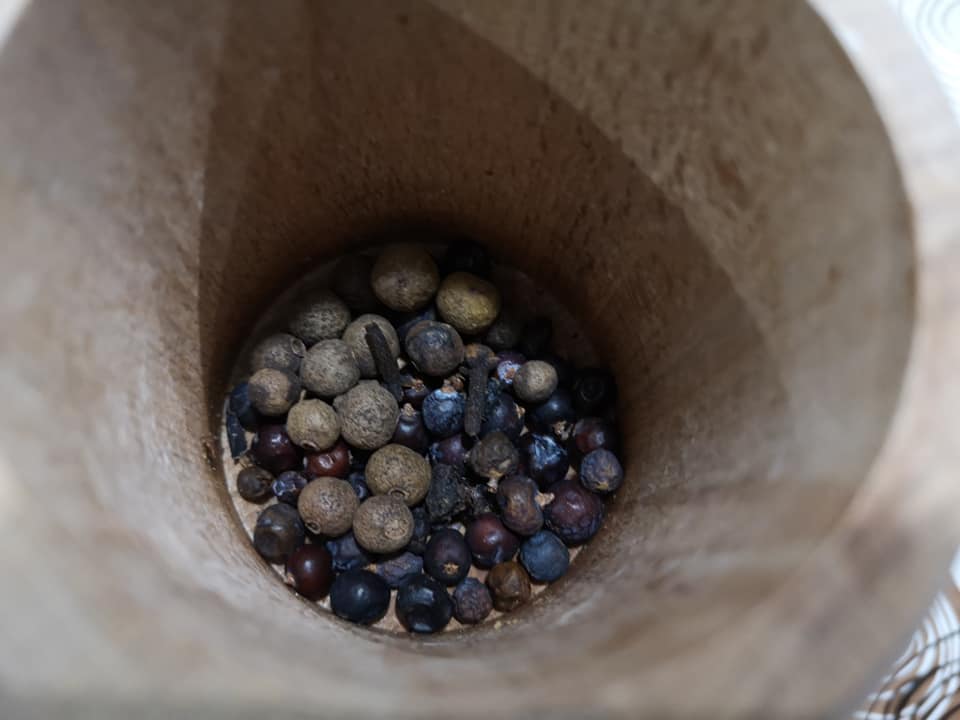
Milen Nenchev (Милен Ненчев) from Sofia, Bulgaria shared details of Beef Heart Pastrami he made. The work is of such quality that I had to include it in my list of artisan recipes.
He writes, “Harvest wasn’t going well so I thought I’d make the cats a Christmas present but decided to taste it before making the final decision…!? A gross mistake I would have made if I hadn’t tried. Unfortunately, the kittens will be left without a gift!!! ”
Controlled salting for 10-12 days.
The right amount of spices for 1000 grams
30 grams of salt (12 nitrite / 18 plain)
5 grams of sugar
5 grams of black pepper
5 grams of conifer
2 grams of cumin
2 grams of pride
3-4 pcs of cloves
1 gram of cardamom
50 ml of red wine
Cheers! 🍷
There are other Beef Heart Pastrami recipes on the web, but this is my favourite due to the low water activity and the possibility to create another biltong hybrid! I include this on my list of artisan products to make. Shall I call it Milen (Милен)-Biltong? I like the name! 🙂
Progressions
Ladies and gentlemen, licantropes! Good news for horror lovers and fans of brutal music. In my attempts to create something different, more interesting, better… I present to your attention the experiment that exceeded all expectations. Here is the final continuation of the saga “Lukanka from a Beef Heart”
Milen Nenchev (Милен Ненчев) not only made beef heart pastrami but also sausages.
One of his friends, Nikolay Nikolov (Николай Николов) made an interesting comment worth noting. He wrote, “I have done a lot of experiments, beef heart and pork 50/50, 60/40 and one sample of beef heart only, a perfect sausage is always obtained, I also put pork hearts instead of beef and it still works, the woman likes more the one with hearts than the one with only meat.”
Very special people live around the Black Sea with a natural “feeling” for meat that goes back thousands of years! It shows!
Westphalia is a region in Germany from where the most iconic hams in the history of ham making came. A key feature of the ham is that it is cold smoked. I give the complete list of Westphalian ham and bacon recipes available to me below. I suggest you read through all of them carefully and develop your own particular recipe. The two key features of the ham and bacon are that it must be cold smoked and I would use the Emperor of Russia’s Brine recipe, but it all depends on your own preference.
The 1872 publication edited by Ellet, E. F and published by H. Bill, Norwich, Conn. boast “five thousand practical receipts and maxims from the best English, French, German, and American sources.” I quote the following from his work, The New Cyclopedia of Domestic Economy and Practical Housekeeping
867. — HOW TO MAKE HAM SUPERIOR TO WESTPHALIA. (Udo.)
As soon as the pig is cold enough to be cut up, take the two hams, and cut out the round bone, so as to have the ham not too thick: rub them with common salt, and leave them in a large pan for three days; when the salt has drawn out all the blood, throw the brine away, and proceed as follows: for two hams of about eighteen pounds each, take one pound of moist sugar, one pound of common salt, and two ounces of saltpetre, mix them together, and rub the hams well with it, then put them into a vessel large enough to contain them in the liquor, always keeping the salt over them; after they have been in this state three days, throw over them a bottle of good vinegar. One month is requisite to cure them; during which period they must be often turned in the brine; when you take them out, drain them well, powder them with some coarse flour, and hang them in a dry place. The same brine will serve again, except that you must not put so much salt on the next hams that you pickle. If the hams are smaller, put only three-quarters of a pound of salt, but the salt will not do any harm if you do not let them remain too long in the brine; if you can get them smoked, they are then not so subject to be infested by vermin; no insect whatever can bear the bitterness of the soot; the smoke of wood is preferable to the smoke of coal. Be particular that the hams are hung as far as possible from the fire, otherwise the fat will melt, and they will become dry and hard and rank.
The following are recipes collected from around the world by
913. – WESTPHALIA HAMS
Prepare the hams in the usual manner by rubbing them with common salt and draining them; take one ounce of saltpetre, half a pound of coarse sugar, and the same quantity of salt; rub it well into the ham, and in three days pour a pint of vinegar over it. A fine foreign flavor may also be given to hams by pouring old strong beer over them, and burning juniper wood while they are drying: molasses, juniper berries, and highly flavored herbs, such as basil, sage, bay leaves, and thyme, mingled together and the hams well rubbed with it, using only a sufficient quantity of salt to assist in the cure, will afford an agreeable variety.
918. – WILTSHIRE BACON
Sprinkle each flitch with salt; and let the blood drain off for twenty – four hours. Then mix one pound and a half of coarse sugar, the same quantity of fine salt, six ounces of saltpetre, and four pounds of coarse salt; rub this well on the bacon, turning and wetting it in every part daily for a month; then hang it to dry, and afterwards smoke it ten days.
925. – A PICKLE
That will keep for years, for hams, tongues, or beef, if boiled and skimmed between each parcel of them. To two gallons of spring water put two pounds of coarse sugar, two pounds of coarse, and two and a half pounds of common salt, and half a pound of saltpetre, in a deep earthen glazed pan that will hold four gallons, and with a cover that will fit close. Keep the beef or hams as long as they will bear before you put them into the pickle; and sprinkle them with coarse sugar in a pan, from which they must drain. Rub the hams, & c., well with the pickle; and pack them in close, putting as much as the pan will hold, so that the pickle may cover them. The pickle is not to be boiled at first. A small ham may lie fourteen days; a large one three weeks; a tongue twelve days; and beef in proportion to its size. They will eat well out of the pickle without drying. When they are to be dried, let each piece be drained over the pan; and when it will drop no longer, take a clean sponge and dry it thoroughly. Six or eight hours will smoke them; and there should be only a little sawdust and wet straw burnt to do this; but if put into a baker’s chimney, sew them in a coarse cloth, and hang them a week. Add two pounds of common salt, and two pints of water, every time you boil the liquor.
Have a Westphalian recipe?
If you have a Westphalian recipe, please share it with me for inclusion here.
Westphalia Bacon and Ham & the Empress of Russia's Brine: Pre-cursers to Mild Cured Bacon
Eben van Tonder
18 December 2021
-: Dedicated to my Son, Tristan van Tonder who is 24 today and Shanonnon Hounsell who share his life and his birthday! You have been part of so many quests and discoveries! What an amazing world we live in! :-
Introduction
The study of Westphalia Bacon and Ham smoking techniques and the Empress of Russia’s Brine leads us to one of the most astonishing discoveries about the history of curing since I uncovered the role of the First World War and the direct addition of nitrites to curing brines. (The Direct Addition of Nitrites to Curing Brines – the Master Butcher from Prague and The Direct Addition of Nitrites to Curing Brines – The Spoils of War) Whether fermentation or through adding nitrites directly, curing is dependent upon nitric oxide formation from nitrite salts. How nitrite salts are accessed brought about two roads that run parallel and have been for hundreds of years. The direct and most recent development in curing where nitrite salts are used instead of nitrates. The first curing salt where this was included was Praganda from the city of Prague. Griffiths Laboratories brought out Prague Salt and soon afterwards Prague Powder and became the international evangelists of this new curing system. Before this, nitrite salts were accessed through deliberate fermentation in the system that was invented by William Oake in Northern Ireland (Mild Cured Bacon), was exported to Denmark through disgruntled striking bacon workers (The Danish Cooperative and Saltpeter) and became Wiltshire cure or tank curing or the live brine system which was so typical of English bacon (Wiltshire Cured or Tank Cured Bacon). The power of the old brine is in the fact that nitrate salts have been reduced to nitrite salts through bacterial fermentation. By re-using the old brine, one now has a brine with nitrites in it already and curing speed is vastly improved. I never dreamt that I would be able to discover how this was brought about? Why did people start to re-use the old brine? What forces caused people to start using it? A study of Westphalian bacon and ham and the Empress of Russia’s Brine leads me to the discovery of the origins of what later was progressed and composed into a complete system by the Northern Ireland chemist, William Oake. (Mild Cured Bacon) Unravelling the mechanism of moving from an immersion brine with dry salting to start re-using the brine was completely unexpected and, in the end, became one of the most thrilling discoveries of my career!
The Primitive Descriptions of Dr Cogan
It started with a study of Westphalian ham and bacon. A description of the process is given by Dr Cogan who toured the region of Westphalia. His description comes to us from a 1796 newspaper article. His language could be a bit clearer, and considering it carefully, he seems to be speaking about the application of stove technology in the houses in Westphalia in the 1700s.
He describes the Scheuren or Barns where the people lived as housing a small family and their livestock. Hogs and poultry occupied the middle section with horses, milk cows and oxen on the one extremity. The family lived mostly on the gable end of the building. The hearth or fireplace was far from the door. The fire was normally made of oak wood and smoke, with no chimney or vent, collected in the middle of the roof and was distributed through the entire structure and finally escaped through the barn door. A reflecting board was placed perpendicular above the fireplace at such a height that it prevented the collecting of the smoke among the beams and rafters by diffusing each column as it rises over the middle region. Dr Cogan compared it to the sounding board on a pulpit.
Some of the Scheuren or Barns had a second small apartment called a stove room. This room was warmed by a stove, or a furnace placed against the wall and generally heated from without through an opening in the partition wall so that the air in the apartment has no access to the fuel but received a close, hot, humid, and unwholesome heat from an accumulation of ignited particles which have no proper vent.
He referred to these machines as ovens. It is a generic term used referring to a particular furnace which is most generally used in Germany at the time. It looks like a furnace! The ovens of the rich were elaborately constructed with an elegantly crafted iron with ornaments and figures in relief with crafted Saxon china. It is useful in large and spacious apartments but in these small spaces, they yield suffocating heat.
To Dr Cogan, this seemed to be the cause for frequent pulmonary complaints in Germany and in England. He mentioned that this is not the case in Holland where rooms are more spacious and fires not so violent and the inhabitants are better dressed for the cold.
The success of the Westphalian hams and bacon was in large part ascribed to the construction of these barns and to the fact that they do not have chimneys. The ham and bacon were hung in the thick stream of smoke, a few yards away from the board by which it was repelled. The fact that it hung in the smoke and not in the heat meant that the fat did not turn rancid as is the case with chimney smoked ham.
Another report points out that if hams are left in a warm and moist environment “they have acquired that degree of softness which precedes purification. Then they are duly salted and exposed to the current [of smoke]. (The Ipswich Journal, 1796) This refers to the curing process but once it has been cured, the meat is hung in the smoke. Curing and smoking are always dealt with in combination and, as we will see later, most often in the context of a very particular brine from Russia called the Impress of Russia’s Brine.
A newspaper report from Northern Ireland in 1841 fills out the picture more fully. It seems that Dr Cogan’s report speaks about small villages. A description comes to us from much earlier, in 1841 and it describes a more “formal” or bigger Westphalia smoking operation. Smoking Westphalia hams was done at this time in “extensive chambers in the upper stories” as Dr Cogan describes, but then seems to be speaking about a structure in a city, either an apartment or large factory because it says that the buildings are “high. . . , some of four or five stories.”
The fire was made in the cellar which also speaks of a bigger building and “the smoke was directed to the meat through pipes in which the heat was absorbed, and the moisture removed.” I would love to know how this was achieved! (Belfast News-Letter, 1841) “The smoke was dry and cool when it came into contact with the meat. The meat is, in this way, perfectly dried and had a flavour and a colour far superior to meat smoked in the “common method.” (Belfast News-Letter, 1841)
The strict aversion to heat of any kind in the smokehouse was not shared universally. Some favoured meat in the drying stage due to the removal of moisture through heat. The Westphalia method of smoking was called “cold smoking” as early as 1864 but there was also a method of smoking called “wet smoke” or “moist smoke” as opposed to “dry smoking”. The complete quote related to Westphalia hams is: “Westphalia Hams. —These usually come by way of Hamburg, and owe their fine flavour to their being “cold smoked.” The hams are hung in the upper part of tin building; the smoke is generated in the cellar and carried up to the smoking-room through tubes. During its ascent, it deposits all moisture, and when it comes in contact with the hams it is both dry and cold so that no undue change occurs in the meat while being smoked. —Newspaper paragraph.” (The English and Australian Cookery Book, 1864)
Revelations by Richard Bradley
Our earliest reference to Westphalia hams and bacon comes through the English botanist, Richard Bradley who sent a letter to James Petiver seeking information on the secret of salting, drying, and blackening bacon, gammon, or ham in the west German way as early as 1714.
The 17th- and early 18th-century methods of preparing these, delicacy eluded him until his great friend John Warner of Rotherhithe went to Germany and wrote him a letter on the subject in about 1721. I quote the entire letter published in 1726.
“Friend Bradley, Thy favour of the 30th ult. I receiv’d; in answer to which, I send thee the method used to cure bacon in and about Hamburgh and Westphalia, which is after this manner: Families that kill one, two, or three hogs a year, have a closet in the garret joining to their chimney, made very right and close, to contain Smoke, in which they hang their Bacon to dry out of the reach of the heat of the fire, that it may be gradually dried by the smoke only, and not by heat; the smoke is conveyed into the closet by a hole in the chimney near the floor, and a place made for an iron stopper to be thrust into the funnel of the chimney about one Foot above the hole, to stop the smoke from ascending up the chimney, and force it through the hole into the closet. The smoke is carried off again by another hole in the funnel of the chimney above the said stopper, almost at the ceiling, where it vents itself. The upper hole must not be too big, because the closet must be always full of smoke, and that from wood fires; for coal, or turf, or peat smoke, I apprehend will not do so well.” (Richard Bradley, 1726)
In terms of curing the meat, the process does not mention the reuse of the old brine which shows that it was not always used in Westphalia. So, even in Westphalia, there were two basic curing methods. One with saltpetre and one where only salt is used. In this instance, the latter is described. John Warner of Rotherhithe writes, “the manner of salting is no other than as we salt meat in common; sometimes they use our Newcastle salt, or St. Ubes, or Lisbon Salt, and a Salt that’s made at Nuremberg (not so good as Newcastle) made from salt springs; in those parts they do not salt their bacon or beef so much as we do in England . . .” (Richard Bradley, 1726)
He quickly returns to the subject and the importance of salt and smoke and shows that in this curing method, no saltpetre is used. In the salt-smoke combination, he focuses again on the smoke. He writes, “the smoke helps to cure, as well as the salt; for I have seen when dry’d flesh hath not hang’d long enough in the smoke, it would be green within, when if it had hung its time, it would have been red quite through; for as the smoke penetrates, it cures the flesh, and colours it red without any salt-petre, or any other Art.” (Richard Bradley, 1726)
The last purported special ingredient in Westphalia ham and bacon is the feed. Some authors try and make a case that they feed their swine differently before they are slaughtered by letting them roam the woods and feed on acorns, but this was also the practice in many parts of England. John Warner of Rotherhithe therefore correctly observes “as to the feed of their swine, I saw no difference between their feed and ours here if any have the preference, I believe the English, and our bacon would be full as good, if not better than the Westphalia if cured alike.” (Richard Bradley, 1726)
He concludes, “I have here above answered thy desire, and wish it may be approved by our Bacon Makers; for the bacon will not only be not so salt, but relish better every way, Thy Friend, John Warner.” (Richard Bradley, 1726)
Transferring the Technology to England
Back to the topic of smoking meat, Bradley gives the most satisfying news that someone in England took him up on his description of the Westphalia smokehouse. First, he thanks his collaborator, Mr Warner for providing him with the information which he was quick to disseminate to interested parties in England. He writes, “I am obliged to Mr John Warner, a very ingenious gentleman of Rotberbith, for the first just account of preparing bacon in the Westphalia manner, and from whose letter to me, I have already communicated to the public the principles of the art.” (Bradley, 1732)
The most satisfying part of the exchange is the report that some took the method up in England. “Since which [the communication to the English public], my learned and curious friend, Dr Corbet of Bourn-Place near Canterbury, has built a bacon-house capable of drying (as I am informed) sixty large hogs at one time, and has even improved upon the Westphalia method, viz. by drying so large a quantity by one fire, when the drying-rooms or closets abroad do not cure, perhaps, above five or fix hogs at a time.” (Bradley, 1732)
The construction in Westphalia smokehouse is the same as we have seen repeatedly, namely a closet that was installed in the attic for ham or bacon smoking. Dr Corbet of Bourn-Place constructed the largest dedicated smokehouse that we are so far aware of in the early 1700s, capable of accommodating 60 large pigs. I assume the Dr Corbett who is referred to and is associated with Bourne-Park, is Dr John Colbert who married the eldest sister of Sir Hewitt, Elisabeth. (Godfrey, 1929) He was not a very savoury character but the fact that he embraces this new method of smoking reveals a positive angle on his character. It may, however, have more to do with him being desperate to fund the large estate than anything else.
An 1852 report by Youatt makes it clear that the method of reusing old brine and boiling it in between was practised in Westphalia. One cannot take the earlier accounts we looked at as exhaustive and a summary of all the various techniques used in Westphalia. They represent what the reporters saw and none of them set out to do a complete survey of curing and smoking techniques in Westphalia. The account we will look at next is later and may point to a progression in curing techniques of the early 1700s to the early 1800s. On the other hand, it may simply include a method that may have been in use in the early 1700s at certain places and one that the reporters of earlier simply did not see.
It relates to the re-use of the old brine. He writes, “The annexed system is the one usually pursued in Westphalia: — ” Six pounds of rock salt, two pounds of powdered loaf sugar, three ounces of saltpetre, and three gallons of spring or pure water, are boiled together. This should be skimmed when boiling, and when quite cold poured over the meat, every part of which must be covered with this brine. Small pork will be sufficiently cured in four or five days; hams, intended for drying, will be cured in four or five weeks, unless they are very large. This pickle may be used again and again, if it is fresh boiled up each time with a small addition to the ingredients. Before, however, putting the meat into the brine, it must be washed in water, the blood pressed out, and the whole wiped clean.” (Youatt, 1852) This cure was called the Empress of Russia’s Brine.
The Magazine of Domestic Economy, and Family Review, Volume 1, Jan 1843, W.S. Orr & Company gives the same description as Youatt in 1852. The 1843 account begins as follows. “In Europe, the Russian pork is much esteemed, and bears a high price; its quality is supposed to be owin to the pickle in which it is preserved.” The rest of the quote which Youatt omits in his 1852 work reads as follows from 1843: “Pickling tubs should be larger at the bottom than at the top; by which means, when well packed, the pork will retain its place until the last layer is exhausted. When the pork is cool, it may be cut up, the hams and shoulders for bacon, and the remainder salted. Cover the bottom of the tub or barrel with rock-salt, and on it place a layer of meat, and so on till the tub is filled. Use the salt liberally, and fill the barrel with strong brine, boiled and skimmed, and then cooled. The following method of preparing hams and shoulders is a good one, as many who have tried it in substance can testify. To ascertain the probable weight of the meat to be prepared, weigh a number of the hams and shoulders. Then pack them with rock-salt in a suitable tub or cask, being careful not to lay the flat sides of the large pieces upon each other, and filling the intervals with hocks, jowls, & c. To every 300lbs. of meat, then take 20lbs . of rock-salt or Onondaga coarse salt, 1lb. of saltpetre, and 14lbs. of brown sugar, or half a gallon of molasses, and as much water ( pure spring water is the best ) as will cover the meat: put the whole in a clean vessel, boil and scum, then set it aside to cool, and pour it on the meat till the whole is covered some three or four inches. Hams weighing from 12 to 15lbs. must lay in the pickle about five weeks; from 15 to 25lbs. , six weeks; from 25 to 45lbs., seven weeks. On taking them out, soak them in cold water two or three hours to remove the surface salt, then wipe and dry them. It is a good plan in cutting up to take off feet and hocks with a saw instead of an axe, as it leaves a smooth surface and no fractures for the lodgment of the fly. Some make only six pieces of a trimmed hog for salting; but it is more convenient when intended for domestic use, to have the side pork, as it is called, cut in small pieces. The goodness of hams and shoulders, and their preservation, depend greatly on their smoking, as well as salting.”
The Empress of Russia’s Brine
This 1843 report we just looked at and where the brine is described in detail links the Empress of Russia’s brine with Westphalia’s method of smoking. It is not called that specifically, but other sources name the brine. The rest of the quote reads as follows, “The goodness of hams and shoulders, and their preservation, depend greatly on their smoking, as well as salting. Owing to some misconstruction of the smoke house, or to the surface of the meat not being properly freed from the saline matter, or other causes, it not infrequently happens that during the process of smoking, the meat is constantly moist, and imbibes a pyroligneous acid taste and smell, destructive of its good qualities. The requisites of a smoke-house are, that it should be perfectly dry; not warmed by the fire that makes the smoke; so far from the fire, that any vapour thrown off in the smoke may be condensed before reaching the meat; so close as to exclude all flies, mice, & c., and yet capable of ventilation and escape of smoke. The Westphalian hams are the most celebrated in Europe, principally cured at, and exported from, Hamburg. The smoking of these is performed in extensive chambers in the upper stories of high buildings some of four or five stories; and the smoke is conveyed to these rooms from fires in the cellar, through tubes on which the vapour is condensed and heat absorbed, so that the smoke is both dry and cool when it comes in contact with the meat. They are thus perfectly dry and acquire a colour and flavour unknown to those smoked in the common method. Hams after being smoked may be kept any length of time, by being packed in dry ashes, powdered charcoal, or being kept in the smoke-house, if that is secure against the fly, or a smoke is made under them once a week. When meat is fully smoked and dried, it may be kept hung up in a dry room, by slipping over it a cotton bag, the neck of which is closely tied around the string which supports the meat, and thus excludes the bacon bug, & c. The small part of a ham, shoulder, & c., should always be hung downwards in the process of smoking, or when suspended for preservation.”
The long version of the recipe also appeared in a number of newspapers at that time. New England Farmer, 1841 is one example. Several more carried it between 1842 and 1844. Of great interest is the same report that appeared in the Belfast News-Letter, 1841. The name of the brine is given as the Empress of Russia’s Brine.
Who was the Empress?
– Alexandra Feodorovna?
So, the origin of the cure is Russian, but who will the Empress be that is referring to. I asked the question on a Russian site and Maria Didurenko responded almost immediately. “At that time, the Empress was Alexandra Feodorovna, the wife of Nicholay the First. She was of Prussian origin and according to my information, which, perhaps, colleagues will correct, she was not fond of gastronomy at all. Salt was relatively expensive at that time, the cost of a pood of salt (16 kg) was about 300 silver rubles (source General I. F. Blaramberg). I can assume that it was the high cost that made it necessary to look for options for the most efficient use of expensive raw materials.”
The first option I have is then Alexandra Feodorovna, born Princess Charlotte of Prussia, the wife of Nicholay the First. Without any reason to doubt the veracity of the information given me I wondered if there was another Empress of Russia who was closely associated with salt. From the references we looked at so far, it seems unlikely that she is the empress referred to since she passed away in 1860 and the 1810 reference to the brine which we will look at momentarily, refers to her as already “late” by 1810. It, therefore, ruled out Alexandra Feodorovna.
More importantly than the actual name that Maria Didurenko gave me “what to look for!” She started a twofold quest. On the one hand, to see if I can find a name associated with the reference in any of the many references to this brine and on the other hand, can I identify an Empress of Russia who was deeply involved in salt?
– A clue – Catherine?
Baylor (1889) offers a further clue when he writes, about an “Incomparable Method of Salting Meat as Adopted by the late Empress of Russia,” “more expensive than common brine,” as imperial brine has a right to be, “but promising advantages that most people would be glad to purchase at a much higher price.” It seemed as if the phrase, “Incomparable Method of Salting Meat as Adopted by the late Empress of Russia,” was a heading for the discussion on the brine and the reference to it as the “Empress of Russia’s Brine” to be a change that was later made. So, when I searched for the more likely original title, I happened upon the 1810 publication, The Family Receipt-book, Or, Universal Repository of Useful Knowledge and Experience in All the Various Branches of Domestic Economy, Oddy and Company. This publication gives the same Empress of Russia’s Brine, with the phrase, “Incomparable Method of Salting Meat as Adopted by the late Empress of Russia” as the heading, just as I suspected it would be but adds the following sentence, “the following method of salting meat is asserted to have been used by the great Empress Catharine, in her household establishment, with the utmost success.”
Before we look at the identity of the Empress in question, first a look at additional information given about the brine in what is most likely the original quote. The wording is slightly different and other elements are discussed. It begins the same way. “Boil together, over a gentle fire, six pounds of common salt, two pounds of powdered loaf sugar, three ounces of saltpetre, and three gallons of spring water. Carefully scum it, while boiling; and, when quite cold, pour it over the meat, every part of which must be covered with the brine .”
The fact that it is intended to be used again only becomes clear towards the end of the quote. The following is what is omitted by the other references. “In this pickle, it is said, the meat will not only keep for many months, but the hardest and toughest beef will thus be rendered as mellow and tender as the flesh of a young fowl; while either beef, pork, or even mutton, will have a fine flavour imparted by it. In warm weather, however, the blood must be expressed from the meat, and the whole well rubbed over with fine salt before it is immersed in the liquor. Young pork should not be left longer than three or four days in this pickle, as it will then be quite sufficiently softened: but hams, intended for drying, may remain a fortnight before they are hung up; when they should be rubbed with pollard, and closely covered with paper bags, to prevent their being fly-blown. Though this pickle is, at first, somewhat more expensive than common brine, as it may be again used, on being boiled with additional water and the other ingredients, it is far from being, on the whole, importantly more dear; while it seems to promise advantages which most people would be happy to purchase at a much higher price.”
The enigmatic phrase “it seems to promise advantages which most people would be happy to purchase at a much higher price” without question refers to the speed of curing. The phrase “with advantage” has also cropped up in other references to the re-use of brine and I wonder if those references are not all based on this one from the brine of Catherine!
The link which other authors make between the Empress of Russia’s Brine and Westphalian hams and bacon is almost certainly a later addition, a link that did not originally exist. It is quite possible that due to the reference we have of the re-use of the brine in Westphalia, that this region became one of the earliest to adopt the “Empress Brine” outside Russia and the link between the two may be as simple as this. The original method used in Westphalia was described in the same terms as the “Empress Brine.”
– Catherine the Great!
Catherine, who is referred to, was most certainly non-other than Catherine II (born Sophie of Anhalt-Zerbst; 2 May 1729 – 17 November 1796), most commonly known as Catherine the Great. She was the last reigning Empress Regnant of Russia (from 1762 until 1796) and the country’s longest-ruling female leader.
The Belfast News-Letter (Belfast, Antrim, Northern Ireland), 26 Oct 1841 now becomes important. If this brine was discovered by Catherine the Great, or someone associated with her court, and if the reports of the brine made it to Antrim, Northern Ireland much earlier than 1841, then the tantalising possibility exists that William Oake, the chemist from Ulster in Northern Ireland, learned of the existence of this brine and progressed the idea by doing away with the boiling step between the different batches. The earliest mention of mild cured bacon I could find was in newspaper reports from Antrim, Northern Ireland in 1837. It is fair to conjecture that the invention did not happen far from there. The report that William Oake from Ulster invented the process and the earliest reference to “mild cured bacon” coming from Antrim correlates since Antrim is in Ulster. The fact that the existence of the Empress of Russia’s brine was reported on, four years later, also in Antrim, seems to be too much to be merely coincidental!
Of all the Empresses of Russia, Catherine the Great fits the profile of the inspiration behind the brine or possibly its inventor, the best. It was in her time that the salt tax would play a major part in Russian society. By the end of the 1760s, the combined direct taxes, the salt tax with the liquor tax would account for more than 3/4 of the national income in a time when the Russian economy was desperate for revenue to fund its expansions. (LeDonne, 1975)
The person behind the drive to raise indirect taxes was Petr Ivanovič Šuvalov, the chief of the artillery. His thinking dominated policy in the 1750s to the extent that he was in reality the minister of the economy. Collecting the indirect taxes amongst which salt was a major component was so successful that between 1750 and 1756 he was able to reduce direct taxes. (LeDonne, 1975)
The first expression of Petr Ivanovič Šuvalov’s new policy was then a steep increase in the price of salt. “In January 1750 the price of a pud of salt was raised from about 21 kopeks to 35 kopeks and in August 1756, at the outset of the Seven Years’ War, to 50 kopeks. This was a dangerous expedient and it backfired in the form of reduced consumption and increased smuggling. . . Salt became out of reach for so many that one of the first acts of Catherine was to reduce the price by 20% to 40 kopeks in July 1762.” (LeDonne, 1975)
“The second component of Suvalov’s policy was to open up new and possibly cheaper sources of salt. The production of Perm (Solikamsk) salt could not be raised beyond a certain level because it depended on the availability of labor, the supply of wood fuel, and the length of the work season. In the late 1740s the state began the exploitation of Ileck rock salt and, more important, the extraction of salt from Lake EPton. Transportation costs, however, were so great, resulting in part from the insecurity of the trans-Volga region, that these salts could only supplement Perm salt, not replace it. The result of this increased production was the closing of older but uneconomical sources, at Bachmut, Staraja Russa, Balachna and Soligalic.” (LeDonne, 1975)
Suvalov’s policy only created an ambiguous situation because it rested on a contradiction: raising the price of salt cancelled part of the benefits that could be expected from the rise in supply. Catherine’s policy was wiser. It combined a cut in prices with a major effort to develop production, and it resulted in making salt available everywhere at a reasonable price. During the first decade of her reign, however, little was done beyond reducing the price of salt. This, however, shows us that she was deeply aware of the suffering that the salt tax caused and she was actively involved in finding ways to reduce the cost of salt. It is perfectly in step with the invention of a way to recover salt that would be lost if the old brine is discarded.
“A commission of three members under general Fermor was set up in 1764 to make a thorough examination of the salt trade and to recommend measures to remove widespread abuses. It was closed in 1768 and its work left little mark on legislation. In 1771 the president of the College of Audit was transferred to the Main Salt Board ostensibly to remedy a chaotic situation. It was decided in 1772 to reorganize the Board, to require it to purchase enough salt to have a permanent two-year reserve always available, and to improve the accounting of procedures. Four years later, however, a major reform of local government began to take effect and the salt administration was integrated into the new structure. This was the purpose of the code of 1781.” (LeDonne, 1975)
For the full treatise on the salt tax in Catherine’s Russia and the salt code of 1781 by John P. LeDonne, see “Further Reading.“
Salt was a key commodity in the world of Catherine the Great! One of the uses was in curing meat. For Catherine to suggest the boiling of the brine as a way of “cleaning” it so that it can be re-used was a stroke of genius. I refer you to the production method of one of the major sources of salt in Russia namely that of Penn salt. It was produced exclusively from natural brines. “Production techniques were relatively simple, but they required careful supervision and consumed large quantities of firewood. It was first necessary to pump up the brackish water to the surface or, in favourable circumstances, to tap an artesian source. The next step was to remove the suspended impurities and to increase the salinity of the solution – even a rich natural brine might include but three percent salt – by exposing it to the sun so as to cause evaporation. This was done by various methods, their chief purpose being to create maximum exposure and ventilation.” (LeDonne, 1975)
“The brine was then poured into large horizontal pans [creny] under which a fire was kept going without interruption. The brine was brought to the boiling point and kept boiling for several hours. Impurities sank to the bottom or rose to the surface and were removed with a long hoe-like instrument called a kocerga. Then precipitation began. Heat was reduced and when little of the mother-liquor remained the salt was raked away. Boiling down the brine took about six hours, and the precipitation lasted from half a day to three days depending on the desired grain of salt.” (LeDonne, 1975)
There may have been another reason for boiling it which is at first not all that obvious. I found many of the references specifying the use of rock salt. Let’s return to LeDonne (1975). He writes, “At the southern end of the Ural range, sixty versts south from Orenburg, exploitation by the state of a huge underground salt dome began in 1754 near the Ilek river. Rock salt is of lesser quality than salt obtained by boiling – it dissolves more slowly and is never free from impurities -but it is easier to obtain. Petr Ivanovic Ryckov, who became the administrator of the mine in 1770, pronounced it so pure that it could not be distinguished from sugar, although the Salt Board in Moscow was of a different opinion. The Board was probably right because rock salt strata are usually interbedded with thin layers of gypsum. The salt was extracted in the form of large blocks weighing thirty to forty puds (since 1899, set at approximately 16.38 kilograms or 36.11 pounds), then broken up with hammers. In such blocks a “heart” was sometimes found as pure and clear as crystal. But salt dust often became mixed with dirt and sand on the way to the stores and this lowered its general quality.” (LeDonne, 1975) Boiling the brine would therefore have been a very good idea, nevertheless, even before any curing is attempted. This may be a reason for heating salt in a pan before it is rubbed into the meat, as was commonly practised, even where dry salting is used and not a liquid brine. The fact that heat was used to “clean brine” was a well-known practice. The progression was the boiling of the used brine.
There is a problem with this theory though in the context of the Empress of Russia’s brine. The first brine batch was not boiled! The technique of boiling the salt was a known technology but it was not used to concentrate the salt as was the case in salt recovery and if the purpose were sterilizing the salt, it would have been done for the first brine batch also. Considering the knowledge of microorganisms during the time of Catherine the Great, my suspicion is that decay through microorganisms was associated with meat and not with salt. I suspect that in their view, the brine was “contaminated” only after it encountered the meat. I developed this thought in detail in my article, “The Mother Brine.”
A comment is in order as to the relationship between the Empress of Russia’s Brine and the smoking of Westphalia Hams. If it is true that salt was in short supply, it would have been doubly so for saltpetre. It warrants careful future study, but the fact that saltpetre was omitted from some of the cures in Westphalia could almost certainly be ascribed to the scarcity of this resource. So, saltpetre was scarse in Russia. Westphalia learned how to cure meat with smoke only with salt – no saltpetre. That Russians adopted the Westphalian smoking techniques, and that Westphalia adopted the Empress of Russia’s salt recovery technology stands to reason! That they witnessed extraordinary value in a salt/ saltpetre brine that is re-used both in Russia and Westphalia is a deduction that flows from the facts!
Conclusion
The fact that William Oake is the inventor of the mild curing system that developed into tank curing is by now a well-established fact. (Mild Cured Bacon) His inspiration to re-use the old brine could very likely have come from this Russian invention under Catherine the Great! The link with the smoking technology of Westphalia is fascinating and that cross-pollination took place between these two curing-superpowers stands to reason. The impetus of the invention was the salt tax and the actions of Petr Ivanovič Šuvalov and Catherine the Great’s desire to mitigate the effect of these measures on the Russian curers.
The world has seen two major movements to facilitate the curing with nitrite salts. One was this one. The method is indirect and came about almost by accident. Russian technology that became known in Ireland which, in the hands of a chemist, became tank curing. Nitrite formation through fermentation.
Youatt, W. 1852. The pig: a treatise on the breeds, management, feeding, and medical treatment, of swine; with directions for salting pork, and curing bacon and hams. New York, C. M. Saxton
Creating the Optimal Frankfurter Style Sausage in Africa: Hungarians and Russians
by Eben van Tonder
27 November 2021
Over the years I have written about the history of the development of Russian sausages in South Africa (Origins of the South African Sausage, Called a Russian). I’ve created poems about it! 🙂 (Ode to the Russian Sausage – a Technical Evaluation) It is a South African frankfurter style sausages. In Australia, it is called a Kransky and in Zambia and parts of the DRC, it is called a Hungarian. A Hungarian is made without showpieces which means that the exact same product in South Africa is called a smokey or a penny polony. The basic formulations are, however, the same. It is a fine emulsion sausage.
I have looked at every aspect of Russian/ Hungarian making except cooking/ smoking and packing it. This week attention shifted to these final aspects. Daniel Erdei from the smokehouse producer Kerres visited me in South Africa. Their new hybrid smoke system, combining vertical and horizontal airflow systems make them, in my opinion, the best option in the world. They claim a reduction of 30% in cooking/ smoking loss.
Apart from smoking/ cooking, I looked at packaging with shelf life in mind. Many of the large producers in South Africa opted for High-Pressure Pastorisation over the last few years following the Listeriosis epidemy. It is an extremely expensive solution, and I was keen to see what else is on the market.
In South Africa there are several producers who manufacture between 60 and 100 tons of these sausages per day and the economic benefit of this consideration can hardly be overrated. Besides these, current projects underway in other African countries will soon see the same production levels from other African regions. This, coupled with the devastating effects of Covid on international food prices makes the work urgent.
The danger and impact of Covid were highlighted to us while we were in Simons Town, at the famous Brass Bell-Inn and Daniel, a German citizen, started getting calls from family and from the management at Kerres as they were scrambling to get him on the first available flight out of South Africa after the discovery of a new Omicron variant (Variant B.1.1.529) and as countries from around the world were announcing the immediate cancellation of flights from and into South Africa.
After the logistics were arranged and we were satisfied that the best measures were taken to ensure his speedy return to Germany, we continued with our adventure while designing the optimal Russian/ Hungarian line and processing approach.
The following discussion points were all highlighted and interrogated yesterday.
Novel Processing Techniques
– DCD Technology from Green Cell
Work done with DCD Technology (The Power of Microparticles: Disruptor (DCD) Technology) shows the feasibility to use nutritious parts of an animal carcass previously not included in raw material for such sausages. DCD has proven to be extremely important even though it was shown to be less effective in certain specific areas of application (Muscle Structure (Biology)). For large throughput factories it, however, is an ideal solution to increase the overall digestibility of certain raw materials since digestibility is closely related to comminution (Notes on Comminution and Digestibility). It also offers a way to apply pressure for micro control in a way that was previously only possible with HPP or similar systems (for example pulse technology). Two years of intensive work showed that DCD technology has a definite place in meat processing. A proper understanding of its strengths and weaknesses, along with alternative processing techniques that we developed for certain areas of application allows us to create our own MDM/ MSM. MDM or MSM is widely used in Africa as the basis for these sausages (MDM – Not all are created equal!). The MDM-replacer we created has been shown to be more nutritious compared to MDM, imported from, for example, South America and has greater functionality than using MDM alone.
– Binding of water
Water act as the plasticizer in the system. The meat’s texture in these sausages “is due to its property of heat-induced long-chain gelling or setting” and the “cooked meat is classifiable as a water-plasticized, filled-cell mixed-composite thermosetting plastic biopolymer. The word “polymer” denotes long-chain macromolecules which are crosslinked, such as proteins or starches. The word “plasticizer” indicates that water is the filling solvent that hydrates the polymer and supports its “plastic” behaviour.” (Review of comminuted and cooked meat product properties from a sol, gel and polymer viewpoint)
The optimal binding of water has been shown to be a balance between the creation of various base emulsions (for example fat and skin emulsions) and the inherent requirement for water as the plasticizer. In other words, there is a certain amount of water required to form the gel which is the basis of the product – all other water is better pre-bound. Adding “fillers” with high water-holding capacity such as soy isolate or TVP serves an important function of making the sausage less “rubbery”. LaBudde (1992) states it as follows. “Fillers with high water-holding capacity will effectively de-plasticize the system, resulting in lower strains to failure and higher stresses.” (Review of comminuted and cooked meat product properties from a sol, gel and polymer viewpoint). Like in whole muscle chemistry, we are looking at the role of bound, immobilized, and free water in the sausage matrix (see the section under “water” in Muscle Structure (Biology)
– Losing Some of the Water
Managing the process of water loss is of the utmost importance. Water act as the plasticizer in the system. In a frankfurter style sausage, “the proteins are gelled not only through the heat of cooking, but also through the mechanisms of water loss (shrinkage), pH (acid rinse) and smoke application.”
That water loss must take place and is important. “The effect of moisture loss through shrinkage is twofold: a drop in the plasticizer percentage and an increase in the percentage of other materials, including protein. Consequently, the strength of a “shrunk” product will be larger than that of the “unshrunk” product by at least the percentage shrink [ 1/(1-s) ], and the strain to failure lower by approximately the shrink [ 1-s ].” (Review of comminuted and cooked meat product properties from a sol, gel and polymer viewpoint)
Water loss is important but too much water loss is uneconomical. In the right drying, smoking and cooking chamber, the method of applying heat to the sausages, the rate of temperature application, humidity and wind speed (velocity) are key factors to control. From a business perspective, the role of an excellent personal banker is key to success. In terms of meat processing, the right smokehouse partner is as important as a personal banker to the overall business. They must be entrusted with the management of water or fat loss during the final cooking step. They are also the custodians of the final look of the product before packaging. Texture and gel formation is within their scope of responsibility. I cannot over emphasis the importance of choosing the right smokehouse and the right smokehouse supplier.
In producing these sausages, a customary South African formulation will result in between 15% and 18% moisture loss during the cooking cycle to 71o C. Kerres smokehouses technology promises a 30% reduction in this loss to between 10 and 13%. Trails are underway in Germany, using South African recipes, to confirm these. The overall loss we are targeting by using the correct product ingredients, along with the Kerres smokehouse technology I set at between 8% and 10%. These targets are ambitious, and results will be made available in updates of this article.
Old School Smoking/ Drying -> Latest Technology
“Kerres smokehouses technology promises a 30% reduction in smoking/ cooking loss”
Blending and Filling
The grinder -> mixer -> emulsifier -> filler configuration is retained with key adjustments in the state of the ingredients added at the various stages. The entire discussion of the mix of traditional processing technology using micro cutters and grinders and incorporating DCD’ed raw materials discussed above feature prominently under this heading. For Africa, I advocate the incorporation of Ethyl Lauroyl Arginate (LAE) in the product as one of the micro hurdles.
Drying/ Smoking
There is a trend in the rest of Africa (excluding South Africa) not to dry the sausages before sale and to use liquid smoke in the product composition instead of natural smoke. This is an unacceptable compromise because it seriously compromises the product quality, and our goal is to deliver more nutritious food to Africa of a quality equal to or higher than what is found in European and North American supermarkets in Frankfurter sausages.
I have found the Kerres team to be the best to outsource the final look, feel and texture of the product to. I base this statement on the versatility of their equipment. It is a familiar frustration to all production managers that they buy equipment and lock themselves into a certain processing system which invariably comes to haunt them later when they want to change the production system. In smokehouse technology, it is clearly seen in the choice between a system with vertical or horizontal airflow.
As a case in point, consider the change from natural or artificial casings and the emergence of alginate casing technology. The use of alginate casing technology has become widely available, in South Africa, through the spice supplier Freddy Hirsch, but when drying, the sausages can’t hang and are packed on trays which favours a horizontal airflow and not the vertical airflow systems used when smoking sausages that hang on smoke sticks and are linked together. So, ineffective smokehouses now become an obstacle when the production manager wants to change how the sausages are produced.
Even more, what do you do if you only want to change part of the processing system to alginate casings and still offer the consumers the natural or collagen casings they are used to?
The same applies to bacon processing technology. The traditional way is to hang the bacon in the smoke chamber. However, the latest method of bacon processing using grids to “shape” the bacon, favours again a horizontal airflow system as opposed to the vertical flow systems. The latter is favoured by the traditional way of hanging the bacon. (Best Bacon and Rib System on Earth)
Because drying/ cooking/ smoking is so important in the final product, it is surprising that many owners/ investors or managers base their decision on “an easy deal” or the cheapest option available to them. The wrong smokehouse partners are one of the most expensive mistakes we’ve made at Woody’s!
The Kerres smoker has a hybrid system that incorporates both horizontal and vertical airflow. They offer it as an added option, but in my mind, it is an easy decision!
Drying and smoking are dependent on many factors. Airflow is amongst the most prominent features. Below is a clip showing the Kerres system. The hybrid system is a stroke of genius. This system along with an introduction to the smokehouses of Kerres is dealt with in the video clip below.
Demonstrating the effectiveness of the hybrid smoking system
Below is a clip from a client of Kerres in the USA. Whether alginate casings are used for sausage production, or the grid system in bacon processing, the hybrid system is the best solution I ever came across. The clip below which I got from their website is absolutely astounding! See how close the shelves are stacked and how full they are loaded and have a look at the consistency! It is without a doubt the single most impressive display of what can be achieved in a smokehouse than I have ever seen!
Vegetable sausages are nothing new to areas in the middle east, but the West has suddenly woken up to this important product class when it realised its heavy reliance on meat-based diets presents health challenges that cannot be overcome apart from reducing the consumption of meat.
This area of application represents a feature of DCD Technology that cannot be achieved more effectively in any other way. Let me state it like this. DCD technology makes the high throughput production line of such sausages possible. It speaks to the essence of the approach I followed in re-evaluating the production of hybrid sausages two years ago (Nose-to-Tail and Root-to-Tip: Re-Thinking Emulsions).
Packaging
The matter of final product packaging and shelf life is closely related as is shelf life and raw materials used in the blending and filling stage. In general, shelf life will be achieved through:
Level of water binding achieved;
Pressure from the DCD processing system of Green Cell on key ingredients;
The use of LAE both included into the meat mix as well as fogging the roll stock pouch after forming and fogging into the pouch after packing.
If applied correctly, this natural preservative will extend the product shelf life dramatically. The key to the effectiveness of the product is dosage and application method which we are in the process of addressing. Watch this space for updates and announcements!
Using the combined approach as outlined above yields unsurpassed shelf-life results.
Conclusion
Over the years I have seen the tremendous benefit in stepping periodically back from one’s work and re-evaluating everything I have learned and asking the question if there is not a better way of doing it. This is true when it comes to bacon production technology (Best Bacon and Rib System on Earth). I have not yet integrated a new application of the Kerres smoker technology to the article I just cited on bacon production, but I will do this over the weeks following and publish it as new and updated articles.
In our current consideration of the best Frankfurter style sausage system available, the Kerres smokehouse technology, along with LAE and DCD Technology draws years of work together into a complete and extremely versatile and productive system.
Africa is emerging as the future economic powerhouse and the driver of world markets, and I am honoured to be a small part of this awakening when it comes to meat processing technology.
Regarding Meals with Beef Tendons
Eben van Tonder
19 September 2021
Introduction
Tendons have been an important dish around the world, including in the west. In the Okmulgee Daily Times (Okmulgee, Oklahoma), 20 May 1936, a report appeared on the Times Cooking school. It says that “several complete dinners were cooked by Miss Hogue, “beef tendons being the foundation for one.” Its western tradition has largely been lost. It is, however in the scientifically advanced Eastern societies where the traditions of enjoying beef tendons as part of regular meals endure.
In recent years the Western world rediscovered the health benefits of collagen, something which the mom’s in the East have known for years and still insist their families regularly enjoy. In the west, we have a situation now where collagen powder is being imported at an exorbitant cost from European collagen manufacturers to access its health benefits. A far less costly and more enjoyable way to get your daily dose of collagen is simply to look towards deliciously prepared beef tendons. It is available locally at a fraction of the cost of the imported material. A key feature of our work is to make this available in a convenient format both for consumer products and for factories who want to include it in its food formulations.
My work on tendons started in April 2020 when South Africa had its first hard lockdown. It is one of the most versatile products in the beef carcass. There are some who want to do it the old fashioned way and include tendons in their meal plans for the week, I asked the question what recipes with tendons in would look like. Here I explore this question.
Cooking with Tendons
Audrey Wilson did a magnificent treatment of exactly this issue in the Hawaii Tribune-Herald (Hilo, Hawaii), 25 Aug 2020 in a segment entitled “Cooking with Tendons”. She gives us insight into how it is being enjoyed in the east.
Bring a small pot of water to a boil. Blanch tendons for 2 -3 minutes. Drain and rinse off the scummy residue from the pot. Rinse tendons. Using a sharp knife, slice each tendon into pieces in the cleaned pot and use enough water to cover the tendons by 1 inch. Bring to boil. Immediately reduce heat so water is at gentle simmer. Cover pot and simmer for 7 hours. The pots lid should be tight-fitting so the water does not evaporate. Remove tendon pieces from broth and serve for soup.
Three cups of this stock for 5 quarts of soup is enough for a great soup. Keep rest in the refrigerator. It will gel.
1 pound beef tendons, cubed
1 pound beef shank meat, cubed
8 stalks green onion, white and green parts seperated
1/2 large daikon radish, sliced
2 whole cloves garlic
1/2 cup sake
4-1/2 cup dashi stock
3 tablespoons sesame seed, plus more for garnishing
Sea salt
2 cups cooked tteok
(Korean rice cake)
Water
In a soup pot boil beef tendons and beef shank meat in plain water for 10 minutes. Drain, rinse, removing scum. Place tendons back in pot.
Pour half of the dashi stock, 3 cups water and all of the sake, add the white section of the green onions, garlic and some sea salt. Bring it to a boil, then simmer for one more hour on low heat.
Season with sea salt, if needed, add the cooked Korean rice cakes garnish with green parts of green onions and toasted sesame seed. Serve.
* * *
This dish is often served as a dish selection in a dim sim restaurant:
Beef Tendons in Soy Sause, Vinegar and Chili Oil
1 pound beef tendons
1/4 cup soy sause
1/3 cup more soy sause for dressing, or to taste
3 tablespoons Chinkiang rice vinegar
3 tablespoon sugar, or to taste
1/2 teaspoon salt
1 tablespoon sesame oil
Finely chopped cilantro
Finely chopped green onions
Rinse beef tendons under cold water and place into a bowl in a steamer insert.
Add 1/4 cup soy sauce and 1/2 cup water to partially covered tendons. Bring water to boil, then reduce to steady simmer and cook for 4 hours. Add additional water as needed to ensure the bottom of the pot does not dry out.
You can also cook the tendons in a pressure cooker for two hours.
Remove tendons, set aside in the simmering liquid for another use. Let cool to room temperature, refrigerate. Thinly slice tendons into 1/8 inch slices. (Can keep in refrigerator for up to one week).
* * *
Japanese Beef tendon stew is called gyusuji nikomi. Gyusuji is the Japanese word for tendon. This recipe uses an Instant Pot to prepare the dish.
Add tendons and 4 cups water into Instant Pot. Press “saute” button and and change setting to “More” by pressing “Adjust” button. Once boiling press “Keep Warm/ Cancel” button to step cooking. Remove pot, discard water, add 4 cups water.
Peel ginger skin, cut into thin slices. Cut green onions in half receiving white bottom parts. Add ginger and green part of green onions to pot. Cover, press “manual” button, set HIGH pressure for 30 minutes.
Cut konnyaku into bite-size pieces. Sprinkle with 1/2 teaspoon kosher salt and rub with your hands.
Boil konnyaku in water for 5 minutes. Peel and cut daikon into 1/2-inch quarters. Remove gobo skin with back of knife, place in cold water.
When Instant Pot is is at “Keep warm” setting, release pressure naturally, about 20 minutes.
Open lid and take out inner pot. Drain cooking liquid and rinse tendons under cold water. Cut into small pieces. Place in a bowl and set aside.
Rinse inner pot and add 2 cups dashi, 3 tablespoons sugar, 3 tablespoons saki in pot. Put clean tendons and mix together with sauce.
Cover and lock the lid. Press “Manual” button set to HIGH pressure for 10 minutes.
When Instant Pot is at “Keep Warm,” let pressure release naturally for 20 minutes. Add konyaku, diako, and gobo.
Cover and lock lid.
Set to HIGH pressure for 10 minutes.
After cooking, let pressure release. Chop reserved green onions into thin rounds. Serve tendons stew in a bowl and garnish with green onions.
Conclusion
Understanding how beef tendons are used in dishes around the world informs us about applications of my collagen paste.
References
Hawaii Tribune-Herald (Hilo, Hawaii), 25 Aug 2020
Okmulgee Daily Times (Okmulgee, Oklahoma), 20 May 1936
I have been working on processing the 5th quarter with a range of new and traditional technology. Here I feature our newest developments. This page is put together for the NPD specialist to feature end products and raw materials resulting from the process.
I consider two distinct product classes namely products for the end-user and for the food processors to be used as ingredients in the production of other products.
I combined 40% beef body fat and 60% beef tendons (which by itself contains 20% fat) into a fat replacer. Here is a video I did when I evaluated the product.
In evaluating the fat replacer that Tristan and I made, and realised the taste was exquisite!
I posted it on my Facebook page. Someone remarked that it does not look appetising. The purpose was to create something that IS delicious which we achieved. The next step is to make it also look delectable. We achieve this with combinations. There are endless possibilities for collagen combination products. I list a few.
1. Maple Pumpkin Collagen Shake
This delicious shake is made with antioxidant-rich pumpkin puree and collagen, containing 20% fat
Sweet potatoes are naturally sweet (hence the name), and even though it’s not a common flavour for a soda, it actually works really well. Sweet potatoes ferment very easily, and I had a super bubbly probiotic soda in no time with this sweet potato kvass recipe! (www.growforagecookferment.com/)
We will re-work this recipe with DCD Technology.
3. Banting Beef Bone Broth, Collagen & Fat Mix
Mix dry bone broth into our collagen mix which contains 20% fat for a high protein, high-fat protein shake or to be sold in tubs as a stock replacer.
4. Vegetable Puree infused with Collagen
All dressings should contain a scoop of our collagen. It is great for use with vegetables!Vegetable puree has been shown to be a brilliant application of DCD Technology since it requires no e-numbers.
B. Industrial Product for Food Ingredients
1. Protein and Fat Enriched Collagen
Enrich the Collagen with pork stomach. Pork stomach on a dry basis contains 11% fat and 21% protein. The stomach proteins “coagulate” well which means that they are suited for inclusion in fine emulsion sausages. In combination with beef tendons, it blends into a beautiful fat replacer which is ideal for inclusion in canned products, bangers and other course sausages. The product settles into a firm solid homogenous mass after it has been reated. The new product has an added benefit for the formulation specialist in that it is packed with meat proteins and will contribute not just to the fat, but also collagen and meat protein requirements.
2. Beef Tendons with Beef Body Fat
The beef tendons contain about 20% fat along with collagen proteins. Infusing this with either pork lard or beef body fat change the properties of the fat in that it “contains” it during heating and it alters that mouthfeel considerably giving it a smooth, pleasant taste and mouthfeel.
Conclusion
The 5th quarter is one of the biggest opportunities for world-class new product developments. On this page, I share the various combinations we are working on. I will continue to feature end products and raw materials for further processing and will re-post this page from time to time.
Please mail me if you would want to be added to our mailing list of people we notify every month of our latest developments. Alternatively, sign up to our Facebook page where all updated pages will be posted or friend me on Linkedin where regular updates will appear.
Notes on Comminution and Digestability
Eben van Tonder
11 Sptember 2021
Introduction
I am now 52 years old and have two teeth missing and one is cracked which the dentist suggested I don’t have anything done too until I replaced the two missing ones with implants. It goes with the territory of being 50+! 🙂 I discovered that it is much harder for me to eat meat with two molars missing and one that I cant use to chew. I recently bought a liquidiser and started to make fruit and vegetable smoothies for lunch and supper. A world opened up for me!
After making smoothies morning, evening and at night for a few weeks now, I understand much more about bowl cutting. In fact, my first lesson teaching bowl cutting techniques will in the future start with a liquidiser. After a week, I had good cause to suspect that I digest my food much better than before which made me re-look at the relationship between comminution and digestibility. More broadly, I ask the question what are the different factors influencing digestibility from the perspective of food preparations.
I give the notes based on extensive quotes from two studies.
The Li Study (2017) on Pork Digestability
The first study I referenced was that of Li (2017) where they compared digestability when pork products were prepared by cooking, emulsifying in emulsified-type sausage, dry-cured and stewed pork. The pH was adjusted to 2 after which gastric pepsin and trypsin were used to digest. After incubation at 37oC for 2 hours, pH was adjusted to 7.5. The pork sausages were cooked at 72oC. “The in vitro digestibility was expressed as the percentage of the difference in protein contents before and after digestion.” (Li, 2017)
The results of the Li (2017) study is as follows:
Pork products were made with pork longissimus dorsi muscles from the same carcasses.
The four products evaluated showed a “significant differences in protein digestibility.”
Highest digestability was emulsion-type sausage at both conditions.
The lowest digestability was stewed pork, after pepsin digestion alone, followed by trypsin digestion,
Cooked pork and dry-cured pork had similar digestability after pepsin digestion. Dry-cured pork was lower in digestibility than cooked pork after trypsin digestion.
I give their methods of preparing the experiments with each relevant discussion point grouped together for each of the 4 preparation methods.
Stewing
Preparation: Stewed pork was prepared according to the following formulations: pork muscle was vertically divided into strips (5 cm width) and cooked. The stewing was done as follows: Pork strips were blanched in boiling water for 5 min, chilled and cut into 5 × 5 × 5 cm cubes. The cubes were pan-fried (180 °C) for 5 min with soybean oil (10 g kg−1 of meat) on a pot-induction surface. The cubes were fried and turned twice at an interval of 60 s (skin side not fried) and then cooked in boiling water (water/meat: 1/4) for 5 min. After that, the cubes were stewed at 100 °C for 150 min. Eight replicates were applied for each product.
Discussion: “For stewed pork, long-time cooking may induce proteins to oxidation and aggregation that affects proteolytic susceptibility.” In the present study, stewed pork was cooked at higher temperature and for much longer time than the other three pork products, which may cause a higher level of protein oxidation and aggregation, and lower digestibility. The difference in digestibility between Bax et al. (2012) and the present study could be attributed to distinct cooking time (0.5 h vs. 1.5 h).
Dry Cured Pork
Preparation: Dry-cured pork was prepared as follows: curing with 5% salt and sun-drying for one month. The dry-cured pork was softened in hot water and cooked to the center temperature of 72 °C.
Discussion: For dry-cured pork, salting and drying are two critical steps, during which protein surface hydrophobicity increases and dehydration, oxidation and aggregation occur as well.
Cooked Pork
Preparation: Cooked pork was prepared according to the following steps: pork muscle was cut vertically into 15 × 10 × 5 cm pieces that were packed in retort pouch and directly cooked in water bath till the center temperature reached 72 °C.
Discussion: Cooking temperature has a distinct influence on the proteolytic susceptibility of myofibrillar proteins to digestive enzymes. At 70 °C, moderate denaturation happens to meat proteins with the exposure of more protein cleavage sites accessible to digestive enzymes. However, protein oxidation and aggregation would increase at 100 °C or higher temperatures, which is a condensing effect (Promeyrat, Bax, Traore, Aubry, Sante-Lhoutellier & Gatellier, 2010), but meat protein overall digestibility would be improved at high temperature (Bax et al., 2012).
Emulsion Sausages
Preparation: Emulsion-type sausage was prepared according to the following formulation: pork muscle and back fat at a ratio of 4 to 1, salt (1.8%) and tripolyphosphate (0.4%). Meat and fat were chopped using a high-speed chopper during which salt and tripolyphosphate were mixed, and the batter was stuffed into 48-mm-diameter plastic casings. The sausages were cooked till the centre temperature reached 72 °C.
Discussion: Although emulsion-type sausage, dry-cured pork and cooked pork were cooked at the same temperature (70 °C), an emulsifying system was formed during the preparation of emulsion-type sausage, and the fat droplets around muscle fibres would decrease protein oxidation and aggregation (Youssef, Barbut, & Smith, 2011), and thus increase the digestibility.
Conslusion from Li (2017) Study
The Li (2017) study introduced me to factors impacting digestibility such as oxidation and aggregation along with the fascinating effect of fat on this process in fine comminuted products. Further, cooking times and temperatures and their impact on aggregation and compacting as temperatures rich 100oC. I have an interesting story about this. A few months ago I was testing an emulsion type sausage and the cooking pot malfunctioned, boiling the sausage at 100oC for half an hour. When I opened the cooking pot and discovered this the natural hog casings I used were all cooked off but amazingly the sausages aggregated and compacted to such an extent that the sausages were all still almost perfectly intact.
Casing cooked off at 100o C for 30 minutes. A good example of aggregation.
Casing cooked off at 100o C for 30 minutes. A good example of aggregation.
When I repeated this at 72oC I did not nearly have the same “compacting” effect. The products were made with 45% MDM and 10% product which I made from beef hide. The sausages that I made with the same inclusion of MDM but 10% product I made from collagen did not have the same dramatic effect of compacting and aggregation. By adding these materials I obviously moved outside a direct application of the Li (2017) study, but the observations are nevertheless fascinating and the points of aggregation and compacting are well demonstrated.
Farouk (2019) Study on Beef-Centric Meals Digestability
I give the different aspects they investigated and their conclusions.
Animal Age
Beef protein was highly digestible regardless of the age of animal from which the meat was collected (4-day-old calf, 18- to 24-month-old bull, or 6-year-old cow).
Rigor State
The time of sampling of LD muscle (prerigor, from 50 min through 200 min postmortem) had little influence on the digestibility of beef proteins, and this was not markedly affected by rigor at 48 h.
Ultimate pH
The proteins of high ultimate pH meat digested faster than their low ultimate pH equivalent. Densitometry measurements of each gel lane were used to calculate digestion efficiencies and rates for each of the treatment combinations. Physiological and biochemical mechanisms underpinning the greater digestibility of high ultimate pH beef have been discussed by Farouk et al..
Muscle/ Meat Cuts
While there were few differences up to 5 min, by 60 min supraspinatus appeared more digested (fewer and fainter protein bands), suggesting that this cut might be faster and more thoroughly digested.
Mincing/Particle Size
There was little effect of particle size on the digestibility of cooked proteins in meat. Exposure of meat proteins to pepsin activity in vitro should have been much greater for the finely milled substrate, yet this did not markedly influence the rate or extent of proteolysis. Note that the samples were milled and not finely chopped in a bowl cutter or similar. Particle size was therefore still relatively large,
Organ Meats
The structure and composition of organ meats is substantially different from muscle meat, and this has consequences for digestion. For instance, the protein content of the heart, kidney and spleen from prime steers was 10–27% less on a fresh-weigh basis. Digestion commenced at a significantly faster pace for the kidney and liver compared to muscle, when evaluated as the relative digestibility of T5. The lower molecular weight and globular nature of the kidney and liver proteins likely contribute to their faster in vitro digestibility.
Discussion: Animal organ meat, sometimes referred to as offal or the fifth quarter of a carcass, is only a minor contribution to typical Western diets for a variety of reasons, thus missing out on its potential culinary and nutritional values. Connective tissue substances are resistant to in vitro digestion with pepsin and so lowered the total relative peptic digestibility of calf beef compared to the older cattle. They were more digested (less intense) in prerigor bull beef than in 48 h postrigor, in less collagenous cuts compared to higher rcontaining cuts, and in finely ground milled meat compared to coarsely smashed meat.
Meat Accompaniments
An online survey of menus from New Zealand and Australia restaurants revealed that the most common accompaniments served with red meat were potato, onion, mushroom, tomato, rice, noodle, bean, and carrot. This is varied slightly by country and markedly by cuisine. For instance, in New Zealand, noodle, rice, and bean were more popular at Asian restaurants, while potato, mushroom, and tomato were more popular with European cuisine.
SDS PAGE separation of proteins and peptides in the digesta of beef cooked with the top five accompaniments plus pumpkin showed that meats from all three age categories of animals (4-day-old calf, 18- to 24-month-old bull, or 6-year-old cow) were most digestible when cooked with mushroom, whereas digestion was least efficient when the meats were cooked with rice and potatoes. Based on relative digestibility calculation and averaging over all animal ages, the rank order of protein digestibility was found to be mushroom > pumpkin > onion = tomato > rice > potato.
Bull meat cooked with mushrooms was very effective in promoting digestion through the gastric and intestinal phases. In contrast, meat cooked by itself did not digest completely even after 240 min.
Enhanced digestion from cooking with mushroom (and pumpkin) could be due to the presence of endogenous proteolytic enzymes in these vegetables that were not present in the other accompaniments.
Conclusions from the Farouk (2019) Study
Prerigor, low collagen supraspinatus muscle finely ground prior to cooking would be judged more digestible than the alternatives in these experiments.
Sustainable production of animals as a source of food demands that we make full use of every carcass. Unlocking the potential of the less familiar cuts and promoting their inherent benefits is an important role for nutritional research. Beef organ meats/ofals such as liver and kidney were more digestible than muscle meat from the same carcass. This suggests new opportunities for organ meat as a versatile ingredient, perhaps by formulating highly digestible animal protein foods for infants with less developed GIT or for elder consumers with compromised GIT function. The soft texture and minimal myofribril content of the liver and kidney also offer functionality. These could be a valuable resource for the 1st and 3rd age consumer groups who struggle with chewing and swallowing muscle meat.
Well-informed combining can also produce beneficial biochemical synergies. For instance, consuming orange juice that contains ascorbic and citric acids will enhance the bioavailability of ferric iron in plant foods. It is possible that some accompaniments affect the digestion of food and so might be chosen to optimise benefits for a particular consumer or to better suit an occasion.
Regarding the effect of cooking, it is important to note that cooking meat on its own has variable effects on meat digestibility depending on both temperature and time. For instance, peptic digestibility of beef is lowered, and pancreatic digestibility is enhanced when meat is cooked quickly to 100°C, with longer cooking at the same temperature reducing overall susceptibility of meat proteins to proteolytic enzymes; cooking pork mildly at 70°C enhanced peptic digestion, while at 100°C slowed peptic digestion. In the present study, the combined meat and accompaniments were cooked at 100°C; cooking at this temperature with some of the accompaniments improved the digestibility of muscle meat from animals of all ages; Mushroom affected the bull beef. Note that even the resistant proteins near 42–40 kDa were digested by T30. A zymogram of the enzymes in extracts of accompaniments revealed proteolytic enzymes in mushroom and pumpkin. These enzymes may be contributing to digestibility. Mushroom and pumpkin are known to contain proteolytic enzymes, but their effects on wholetissue digestion had not been demonstrated.
Within the parameters of the present study, beef was observed to be more digestible or digested faster when it came from an older animal, at prerigor, and when it had high ultimate pH or contained less collagen content. Some beef organ meats were more digestible than beef muscle. Digestibility improved when meat was cooked with vegetables that contain proteolytic enzymes and diminished slightly with carbohydrate-rich or starchy foods such as rice and potatoes.
References
Factors Affecting the Digestibility of Beef and Consequences for Designing Meat-Centric Meals. Farouk, M. F., Wu, G., Frost, D. A., Staincliffe, M., and Knowles, S. O..
Li, L., Liu, Y,. Zou, X., He, J., Xu, X., Zhou, G., Li, C.. 2017. In vitro protein digestibility of pork products is affected by the method of processing. Food Research International 92 (2017) 88–94; Elsevier.
William and William Harwood Oake
By Eben van Tonder
10 July 2021
From Worth, R. N.. Jan 1888. Tourist’s Guide to Somersetshire: Rail and Road. E. Stanford
Introduction
It’s been a while now since the early hours one Monday morning when I learned the name of the man who invented mild cured bacon, William Oake. All I knew about him is that he was a pharmacist from Ulster in Northern Ireland. I was reviewing my book on the history of bacon curing, Bacon & the Art of Living. I had just worked through the chapter where I give my historical review of bacon curing, Chapter 12.09: The Curing Reaction. I worked through the progression of mild cured bacon to pale dried bacon and tank curing. Just before tank curing, I included Auto Curing in the review. Something about the timing and the sparse description of the process did not sit well with me. I knew that the re-use of old brine was in its infancy in England in the 1820s and 1830s from a quote from The Complete Grazier where the reference speaks about it in very tentative forms and says that the brine can be re-used twice. In 1852 Youatt gives a far more confident reference to the reuse of old brine. I knew that that reusing old brine was part and parcel of the auto curing system of bacon production which, by 1861 was already in use in England, Sweden, Denmark, and Canada.
The adoption of the mild curing system by C & T Harris only took place in the second half of the 1800s. By 1861 auto cure was already in use in England which relies on a complete re-use of old brine. Why did they not work the concepts of tank curing out long before the end of the decade? Besides these, I was still wrestling with the question if Oake was the one to rely on a continual re-use of the old brine. Was this his invention, so to speak? If I take that out of the equation, then it reduced the uniqueness of the mild curing system and it would mean that there was not much of a difference between mild curing and the sweet cured system of C & T Harris.
These questions plague me. I was sure I am missing something. If Oake was the one who started re-using the old brine repeatedly and if this is one of the features of auto curing, I wondered if there is a link between Oake and auto curing. There had to be! It was around 19:00 on Tuesday evening, 6 July 2021 when I started searching a combination of auto curing and William Oake and an explosion of information followed. Unfortunately for me, I had just figured out that the Maillard Reaction was responsible for unexpected results in my MDM replacement product I was working on and the rest of the night was spend intermitted searching for information on Oake and Auto Curing and frantically reviewing the Maillard reaction! Needless to say that I did not get much sleep that night, but what an absolutely glorious night it has been!
I dedicate this article then to William Oake and his son, William Harwood Oake. William should be celebrated and I share what I have been able to uncover about his life. I also reveal that his son was the inventor of auto cured bacon. I want to immediately extend an invitation to anybody with more information to share it and in particular to their extended family who may have valuable source material. The English factory started by Howard Oake only closed in the 1980s and there should still be many people from Gillingham who have first-hand recollections of the process and his factory.
Mild Cured Bacon
William Oak invented mild cured bacon and the essence of the invention centred around the power of the salts he used in the brine. The initial information came to me from The Journal of Agriculture and Industry of South Australia, edited by Molineux, General Secretary of Agriculture, South Australia, Volume 1 covering August 1897 – July 1898 and printed in Adelaide by C. E. Bristow, Government Printer in 1898. By the time of writing in 1897 and 1898, William Oake has already passed away.
A second reference comes to us from the Cape of Good Hope (Colony). Dept. of Agriculture, VOL . VIII . 1896. Published for the Department of Agriculture, Cape of Good Hope by WA Richards & Sons, Government Printers, Castle Street, Cape Town. It quotes the same paper published in Australia in 1889. It refers to a paper that was read at a congress of the South Australian Agricultural Bureau on pig-breeding and bacon-curing by Mr TN Grierson of Bodolla, New South Wales.
“There is at the present time a new process coming into vogue, which is attracting considerable attention amongst bacon-curers. The process is called the “mild cure.” The discoverer of the new process of curing was, it appears, an eminent chemist – the late Mr William Oake, of Ulster. In the course of an experiment, he discovered that the antiseptic properties of salt were found in nature apart from chloride of sodium (salt) and that the obnoxious effects of dissolving the albumen in the curing process could, therefore, be avoided. This is really the key to the new system of curing. By the new process of treatment, it is said that the bacon and hams, although thoroughly cured with the very essence of salt, still retain all the albumen originally in the meat, and yet do not taste salty to the pallet. By the new process, the lean of the cured bacon remains soft and juicy, and natural in colour; and the best proof of the value of the system is in the fact that where mild cure has been adopted the bacon and hams will keep for any length of time in any climate. A great deal of labour, it is said, is saved by the new process, while the article put on the market is declared to be much superior in taste and flavour quality to bacon cured on the old system.” ( Department of Agriculture, Cape of Good Hope, 1896)
A definition of albumen from 1896 defines it as follows. “Albumen is a substance found in the blood and the muscle. It is soluble in cold water and is coagulated by hot weather or heat. It starts to coagulate at 134 deg F (57 deg C) and becomes solid at 160 deg F (71 deg C).” It is distinguished from fibrin which is the substance in blood that causes it to coagulate when shed. “It consists of innumerable delicate fibrils which entangle the blood corpuscles, and from with them, a mass called blood clot. Fibrin is insoluble in both cold and hot water.” (Farmer, 1896). Albumin, with an “i”, in the modern use of the term refers to “any of a class of simple, sulfur-containing, water-soluble proteins that coagulate when heated, occurring in egg white, milk, blood, and other animal and vegetable tissues and secretions.” (Dictionary)
Albumen, therefore, refers to meat juices in particular. It is then the opaque fluid found plentifully in eggs, meats, fish and succulent vegetables, especially asparagus. (Gejnvic) It is the red substance that oozes from our steaks when we fry it and is mostly myoglobin, a protein from muscle tissue.
The reason why the meat juices do not leach from the meat is simply a function of the brine which surrounds the meat and comes down to the matter of partial pressure. Bristow gives us the real reason for the effectiveness of the system in terms of the speed and consistency of curing when he says “the same pickle can be used for many years – the older the better; it only requires, when it becomes somewhat muddy, to be boiled and clarified.” He follows this statement by saying that he has “seen pickle which had been used in one factory for 16 years, and that factory produces some of the best bacon and hams in Australia.”
There is no question that the preservative that William Oake observed is saltpetre, reduced to nitrite. In the detailed process description given, Oake insisted that the blood be drained properly. I give the full system as described by Bristow in note 1. The meat is cut up and notice that Oake’s system called for “the portions [to be] (are) laid on the floor of the factory (which should be made of concrete or flagged), flesh uppermost, and lightly powdered over with saltpetre, so as to drain off any blood.”
Here he does not use salt. He only uses saltpetre. After this step the pork cuts are “placed in the tanks” and he now introduces salt (NaCl) for the first time. He writes, “for salting. . . — sprinkle the bottom of the tank with salt, then put in a layer of sides or flitches, sprinkle saltpetre over them lightly, and then salt and sugar. The next layer of sides or flitches is put in crosswise and served in the same way, and so on until the tank is full. Then place a lid to fit inside the tank (inch battens 3in. apart will do); fix an upright on top of the lid to keep the bacon from rising when putting in the pickle.”
Now let’s consider the makeup of the pickle. He says that it is prepared as follows: “To every 10lbs. of salt add 8lbs. of dark-brown sugar, lib. of spice, and 1/2lb. of sal-prunella. Make it strong enough to float an egg; let it settle for some time, then skim, and it is ready to go on to the meat.” Let us pause for a second and clearly understands what is meant by sal-prunella. Sal-Prunella is, according to Errors of Speech or Spelling by E. Cobham Brewer, Vol II, published by William Tegg and Co, London, 1877, a mixture of refined nitre and soda. Nitre, as used at this time was refined saltpetre used in the manufacturing of explosives.
Let us again quote Oake through Bristow when he says that “in the course of an experiment he (Oake) discovered that the antiseptic properties of salt were found in nature apart from chloride of sodium (salt) and that the obnoxious effects of dissolving the albumen in the curing process could, therefore, be avoided. This is really the key to the new system of curing.”
Based on these statements I am convinced that what William Oake was testing for was to identify the exact substance which is responsible for preservation of the meat. He tested the salt and that is not it. Salt preserves primarily through the drying effect it has on meat. He no doubt tested saltpetre and as experiments from the 1920s confirmed, by itself, it is a very poor preservative. However, there was a preserving power that developed in the brine which he clearly did not understand. It is due to this, I firmly believe, that I make the vague statement that he “discovered that the antiseptic properties of salt were found in nature apart from chloride of sodium (salt).” He knew it was something that was added to the salt and based on the priority he gives saltpetre in the application of the different salts, I believe he had a suspicion that it had something to do with the saltpetre but by itself, he knew that it was not it! Still, there is an “antiseptic” mechanism at work that is from nature but his vague wording at this point clearly shows that he is uncertain as to what it is exactly. In the cure, there is “antiseptic properties of salt were found in nature apart from chloride of sodium (salt).”
When I started this journey, I was very reluctant to say that Oake’s main characteristic of his mild cured system is the repeated re-use of the old brine. I could not come to that conclusion precisely because I very dearly wanted that to be the conclusion. I, therefore, forced myself to find other options besides this and I refused to concede the point until such a time arrives when I am forced by the overwhelming weight of the clear evidence to say that to Oake goes the credit for using the power of old brines in a system of curing where the older the brine is, the better! Such a time has now arrived where I can say that the preponderance of evidence forces me to make this one simple conclusion that William Oake came to the understanding of the power of the repeated use of old brines albeit that being achieved without a full understanding of the mechanisms which was not understood at that time. This is absolutely and comprehensively remarkable!
Therefore, look at my handling of the matter in my 2019 article when I was first introduced to Oake, Tank Curing Came From Ireland. The best explanation I could give of exactly what made mild curing so revolutionary was the overall system that he developed by taking known techniques from his time and ordering it in a better way so that the outcome of the work would be better. You can see how I tried to avoid the conclusion that Oake pioneered the multiple re-uses of the old brine! I now believe that the former statement is still correct related to his ordering of the different components in the work of curing bacon in a better way and that it holds up to evaluation and scrutiny, but by far the biggest feature in his new system was the repeated re-use of the old brine. For this reason, I now choose to retain the original articles I have written and I will simply amend it with a note referencing this article and my better and fuller conclusion on the matter.
Another point that must be made and which is probably far more important than I ever realised is that the genius of Oake was not just what he used in his brine, but what he omitted. From the Sessional Papers, Volume 34, Page 204, Great Britain. Parliament. House of Commons,1902, we have the statement about Oake’s invention “to meet the increased demand for mild – cured goods without the use of modern preservatives.” This means that Oake is not just responsible for the repeated reuse of the old brine but for omitting any other preservative from bacon. It was then his work that was directly responsible for steering the course of the development of curing technology away of artificial preservatives and keeping the process, unbeknownst to him, close to the natural processes which take place in meat in dead matter and in living animals and humans. Sure, at this time Oake and Harris used borax or boric acid as preservatives in their hams, but Oake identified another preserving principle from nature which we now know as nitrite!
Its Roots
The first clue I got that there was something distinctly different to Oakes system of continued reuse of the brine from anything that was in use at the time came to me from an 1830 edition of The Complete Grazier. The report says that wet cure is more expensive than dry cure unless the brine is re-used. First, the meat is well rubbed with fine salt. A liquor is then poured over the meat and “though the preparation of such brine may, at first sight appear more expensive than that prepared in the common way, yet we think it deserves a preference, as it may be used a second time with advantage if it be boiled, and a proportionate addition be made of water, and the other ingredients above mentioned.” (The Complete Grazier, 1830: 304)
The concept of reusing the power of old brine is something that has been known in England from at least the 1820s or possibly many years earlier. The Complete Grazier (1830) says that liquid brine may appear to be more expensive than if it is done “in the common way” which in the context should refer to dry curing or rubbing a mixture of dry ingredients onto the meat. The edition of the Complete Grazier referred to is from the 5th edition which means that by this time, the description may already be 5 years old if it appeared in the 1st edition. Notice the comment that the brine can be used “a second time.” The continued reuse of the brine was not what the author in the Complete Grazier was describing. The practice of reusing old brine in England of 1820 and 30 was a far cry from the complete system of William Oake from the same time in Ireland where the multiple (continues) re-uses of old brines were part of Oakes complete mild cured system.
I must also add that in the system that Oake developed the brine was no longer boiled after every use which has a major impact on the microorganisms responsible for the reduction of saltpetre which is added before the brine is re-used. By not boiling the brine after every use, a distinct microflora develops.
The inspiration to re-use old brine was European with its roots in Westphalia in Germany. William Youatt who compiled the Complete Grazier restates this process in his 1852 work, Pigs: A Treatise on the Breeds, Management, Feeding and Medical Treatment of Swine; with directions for salting pork, and curing bacon and Hams. He says that “the annexed system is the one usually pursued in Westphalia : — ” Six pounds of rock salt, two pounds of powdered loaf sugar, three ounces of saltpetre, and three gallons of spring or pure water, are boiled together. This should be skimmed when boiling, and when quite cold poured over the meat, every part of which must be covered with this brine. Small pork will be sufficiently cured in four or five days; hams, intended for drying, will be cured in four or five weeks, unless they are very large. This pickle may be used again and again, if it is fresh boiled up each time with a small addition to the ingredients. Before, however, putting the meat into the brine, it must be washed in water, the blood pressed out, and the whole wiped clean.”
Youatt repeats the re-use of the brine in the publication just mentioned. He writes, “In three weeks, jowls, &c, may be hung up. Taking out, of pickle, and preparation for hanging up to smoke, is thus performed: — Scrape off the undissolved salt (and if you had put on as much as directed, there will be a considerable quantity on all the pieces not immersed in the brine; this salt and the brine is all saved; the brine boiled down [for re use].” Notice that his 1852 description is far more “matter of fact” and he does not go into all the explanations and caveats he did in the 1830 description and his reference to pickle . . . used again and again is a progression from the 1830 reference.
The incorporation of this facet of curing brines was undoubtedly not as advanced as it was in Ireland in the 1820s and 30s. Mild cured bacon was separately listed in newspapers of the time related to price and market conditions. The very first reference goes back to 1837 to a report from Antrim, Northern Ireland. It is fascinating that following this initial reference, Antrim completely disappears from the map and Limerick and Waterford takes over. This report simply said about bacon arriving from Ireland and that the Bacon market was dull the past week but (except) for “a small parcel of mild cure.” (Belfast News-Letter (Belfast, Antrim, Northern Ireland) 21 July 1837)
Before this date, mild cured bacon is not mentioned. Remember that bacon was a commodity with prices regularly quoted in newspapers like maize and other farming commodities in certain publications. The second reference is in 1842 reported in the Provisions section of Jackson’s Oxford Journal which would regularly report on bacon prices from Ireland. In a mention about produce from Ireland, it says, “in the bacon market there is no great alterations; heavy bacon is more inquired after, and all fresh mild cure meets a fair demand.” Heavy bacon seems to be used as opposed to mild cure. (Jackson’s Oxford Journal (Oxford, Oxfordshire, England) 17 September 1842, p4)
The progression in the references, all related to bacon from Ireland and all focussed on amongst other, Limerick and Waterford. An 1845 report said that “choice mild-cured Bacon continues brisk.” (Jackson’s Oxford Journal (Oxford, Oxfordshire, England) 26 July 1845, p4.)
An 1853 report from Ireland itself is very instructive. From Dublin, a report says “We are glad to observe that several Dublin curers are now introducing the system of mild cure in bacon as well as hams, in consequence of the great difference had in price. (The Freeman’s Journal, (Dublin, Dublin, Ireland) 11 Feb 1853, p1)
From this, it would seem that we are justified in retaining the most likely place for the invention of mild cure to have been in Northern Ireland, sometime just before 1837. (see my addendum to this work, Addendum A, Occurrences of “mild cure” in English Newspapers.
Following Reports About Oake and his Son
Report from The Freeman’s Journal (Dublin, Dublin, Ireland) 23 Sep 1853, Fri, Page 4
There is a reference in The Freeman’s Journal (Dublin, Dublin, Ireland), 23 September 1853 reporting that the previous Wednesday, letters from London “announced the disposal of the provisions contract for the royal navy, 12 000 tierces (casks) of pork and 4000 tierces (casks) of beef.” The short notice says that “we have the satisfaction to add that half the pork contract was taken for Irish account, and a considerable portion will be made up in Limerick, by Shaw and Duffield, William G. Gubbins, William Oake, and Joseph Matterson.” The article is quoting the Limerick Chronicle and shows that Oake had tremendous commercial success.
We also know that at least one of his sons was involved in the business with him, but not in Ireland. A notice was posted in Manchester Weekly Times and Examiner (Manchester), Saturday, 28 September 1889 of the death of William Harwood Oake from Gillingham, Dorset “elder son of the late William Oake of Limerick“, aged 49. This means that WH Oake was born in 1840 and if we presume William Oake from Limerick had him when he was 20, William was probably born around 1820. I later revised this estimate, taking more information into account and it seems that he was born around 1807.
From Daily News (London, Greater London, England) 18 Jul 1885, Sat Page 3 about the dissolvent of the partnership of the firm Oake Woods Waring. The new firm Oake Woods was created from this.
In The Bristol Mercury and Daily Post, Western Countries, 18 July 1885, page 8, a notice appeared for the dissolution of a partnership between William Howard (Harwood??) Oake, John Woods, and William Waring trading as Oake, Woods, and Waring, at Gillingham, Dorset. If the address is not a clear link to the son of William Oake from Limerick in Ireland, the commodities they traded in is the final proof and a picture is emerging of an imminent “bacon” family. They were, according to the notice, bacon and provision merchants. The partnership was dissolved due to Waring retiring. At first, I thought that if (and there is good reason to suspect this), that William Oak from Limerick is the inventor of tank curing, this would indicate that by 1885 the process has not been exported to England since his son is selling the bacon which is, probably being imported from Ireland.
The circumstantial evidence is strong. William Oake had a substantial bacon curing operation and was able to do it at prices so far below curers in Britain that they were able to secure a large part of a lucrative Navy contract. The cost compared to dry salt curing is one of the main benefits of tank curing is compared to dry salting. The driving force for these was then, as it is today, cost and quality, but mainly cost. The other one that goes hand in hand with cost, is speed. Tank curing or mild curing is much faster than dry salting.
Britain was the main market for Irish bacon and it stands to reason that the Irish would have been very protective over their technology. It makes sense that he set his son up to trade their bacon in England and did apparently not export the technology to England.
I discovered that my conclusion is only partly correct. His son and partners may have started selling Irish bacon produced by his dad but it quickly changed into a fully-fledged bacon curing operation itself. It turns out that the Gillingham, Dorset was a curing operation where auto curing was employed.
Talking about the Gillingham station, The Dorset Life reports that “the effect on agriculture was the rise in the number of Gillingham farmers; 12 in 1842; 34 in 1859; 45 in 1875. In 1860 and 1893 the station platform was extended to cater for the vast numbers of milk churns that were brought in each day. Close to the railway was Oake Woods & Co., bacon curers. Pigs arrived in cattle trucks to be delivered just yards away to the bacon factory. Next to Oake Woods was the Salisbury, Semley & Gillingham Dairy which acted as a collection depot and purchased milk from farmers whose production was in small quantities.” (Dorset Life. 2016)
This factory became intimately associated with Wiltshire bacon curing. They won first prize as well as the silver medal at the annual Dairy Show held in the Agriculture Hall, Islington. (Cassell, 1894)
William Oake, his Son and Possible Relatives
Information that I could find about William Oake, his son and possible relatives. I will continue to update this section. A death notice appeared for Harriette Oake who passed away on 27/07/1844, Henry Street. She was the wife of William Oake who was the Commander of the Eleanor which was a trader between the port and London port. This could be the parents of William Oake from Limerick.
There is a record of the death of William Oake on 24/08/1859 Thomas Street, a provision merchant, buried at St. Munchin’s
William Harwood Oake from Gillingham Dorsetpassed away on 28 September 1889.
There is an interesting reference to William Oake, a master butcher who lived in Perth, Perthshire, in Scotland referring to records for 1939 and 1940. A direct descendant? (Leslie’s Directory,1939-1940)
Auto Curing
So far the timeline that was fixed in my mind was that the continued re-use of the old brine was adopted by C & T Harris in the last half of the 1800s or possibly the very early years of the 1900s. The one fact that did not fit my timeline was auto curing. I learned that reusing old brine was part and parcel of the auto curing system of bacon production which, by 1861 was already in use in England, Sweden, Denmark, and Canada. If this was the case, how did Harris only got introduced to the system so late?
Let us first understand what auto curing is. The process is described as follows. The pig is slaughtered in the usual way and the sides trimmed and chilled. After chilling, it is laid out in rows on a sort of truck that exactly fits into a large cylinder of steel 32 feet long, 6 feet in diameter and which will hold altogether 210 sides. When the cylinder is filled, the lid, weighing 3 ½ tons (7000lb. Danish) is closed and hermetically sealed by means of hydraulic pumps at a pressure of 3 tons to the square inch.
A vacuum pump now pumps all the air out which creates a vacuum of 28 inches. It takes about an hour to pump all the air out. The brine channel which leads to the brine reservoir, holding around 6000 gallons of brine is now opened. The brine rush into the chamber and as soon as the bit of air that also entered has been extracted again, the curing starts. It happens as follows.
The brine enters the cylinder at a pressure of 120 lbs. per square inch. It now takes between 4 and 5 hours for the brine to enter the meat completely through the pores which have been opened under an immense vacuum. When it’s done, the brine runs back into the reservoir. It is filtered and strengthened and used again. This is very clearly the continued reuse of old brine. I was baffled.
A feature of the system is that it allows the bacon to be shipped overseas immediately, assuming that maturation would happen en route as was usual. The time for the total process is around three days. On day 1 the pig can be killed, salted on day 2 and packed and shipped on day 3.
There are two brine reservoirs. The one is used with a stitch pump to inject brine into the sides as usual before they are placed in the cylinder and the second tank is used. The largest benefit of this system is the speed of curing and many people report that the keeping quality of the bacon and the taste is not the same as bacon cured in the traditional way.
The system cured the meat in a short time, partly because of the vacuum and the penetration of the brine into the muscle, but also because it too used the power of the old brine which is based on the reduction of nitrate to nitrite. The vacuum had an impact in rather keeping the brine inside the meat and sealing the meat fibres over the areas where holes were created during injection and brine normally leached out again.
It clearly is a progression of the mild cured system but who invented it? The brine is distributed into the meat through step one and not primarily by what they call the “opening of the meat pores.”
There is a reference from another source that meat cured in this way is more tender. The system allowed for a 3% to 4% brine pick up which would have added to the bacon being much more tender than with dry curing.
Capital Structure
The following article appeared in The Morning Post (London, Greater London, England) 23 Nov 1889 reporting on new companies (Limited) which has been registered recently. The firm opted for public funds to finance the imminent international expansion.
The Morning Post (London, Greater London, England) 23 Nov 1889
The Gillingham, Dorset Operation and Oake-Woods’ Patent
Oake’s son and partners were responsible for setting up the curing operation in Gillingham, Dorset, making it clear that they were not just re-selling Irish bacon cured by Oake’s father, but they actually used the auto cure technology.
The Journal of the British Dairy Farmers’ Association (1887) reports that Oake, Woods and Company won a bronze medal for their British Mild Cured Bacon. This being the case, we know for certain that mild cured technology, including the repeated re-use of the old brine which was the cornerstone of the system, was in wide use in Britain by 1887 which hones in on the time when C & T Harris acquired the technology. It must have been well before 1887. The second important point to note is that Oake, Woods and Company not only used auto curing but also mild curing.
An article appears in The Age, Melbourne, Australia in 1898 which describes the proliferation of the system. It reports that the leading factories in Canada, Denmark and Sweden are all adopting the new auto-cure process because the article produced by it means is superseding all other brands in the largest market in the world” which at this time was England. The author of the article gives us a date when the curing operation of Oake, Woods and Company, Ltd was started in Gillingham, Dorset using auto curing. He refers to them as “curers of Wiltshire Bacon” which was in operation for 18 months by 1895 taking the establishment of the auto curing line to 1896. We know that by 1861 it was already in use in England, Sweden, Denmark, and Canada. It was, however in the 1890s when international patents were taken out and it would appear as if the expansion plans were truly global including the Scandanavian countries just mentioned but also the USA, South Africa and New Zealand.
A certain Mr Down, “the patentee of the process” described the process in his own words which are reported in great detail. It is a tedious description and the reason why it was so successful is attributed to incorrect factors, but it is nevertheless instructive and gives the full description of the process. Those who are interested can read the full article at https://www.newspapers.com/clip/80931212/auto-cure/. I received a mail from Will Dean who writes that Mr Down was the managing director of Oake Woods in the 1890s. His full name was Evan Roberts Down.
Stanier elaborates on this information provided by Down. He says that the factory and offices close to the railway station was established in 1847. Vitally he credits William Harwood Oake, son of William Oake from Limerick for the invention of auto cured bacon. He writes, “Oake (referring to William Harwood) invented the ‘Auto-Cure’ method of curing bacon under pressure in cylinders, for which the Danes paid a £4,000 annual royalty. It seems then, that the factory was established in 1847 and sometime between then and 1861 he invented auto curing. Very importantly, the Danes who obtained the system of mild curing which was invented by his dad paid him a royalty for the use of his technology. This fact along with the reference to Mr Down as the patentee, informs us that he very well protected the invention. By 1896 it was in full operation in Gillingham.
Dean who looked at the actual patents told me in private communication that he “had always thought [the process patented by Oake Woods] sounded extremely similar to the “tanalising” process for treating timber – amusingly this is actually mentioned in one of the patents.” He also provided me with copies of the actual patents.
Special thanks to Will Dean who sourced these and sent them to me.
The fact that Down is clearly listed as the inventor in these patents is of considerable interest. It may be that he takes the place of the inventor, who had to be listed as filing the application simply on account of William Harwood Oake having passed away on 28 September 1889. Down may in fact have been responsible for improvements to the system in addition to the reality that Oake was not around in the 1890s to file the application.
We return to product quality briefly and an observation related to the Gillingham site is in order. We know that water quality was very important to William Oake. Stanier mentions related to this site that “water was pumped from a well, and extensive cellars beneath the factory were said to be the best in the country for curing-by hanging bacon in the smoke of smouldering hardwoods. 150 were once employed but the factory closed in about 1980.” He makes it clear that he is talking about the same factory we referred to above when he writes that “the United Dairies milk and cheese factory remains next door along Station Road.”
Food Flavourings, Ingredients, & Processing, Volume 1, 1979 likewise confirms the 1861 date of the invention of the auto cure system. The invention was featured at the Paris show in 1867. The 1897 Diplomatic and Consular Reports, Morocco, Harrison and Sons, mentions that the system was brought out not just by Oake but by his company, Oake, Wood & Co.
Two personal sidenotes are in order related to Down. Will Dean tells me that his family own the house which belonged to, and was built for a “certain Mr Down.” This is the same E. R. Down who filed the patents for Oake-Woods and who ran the firm in the 1890s. A second note is that Evan Down’s son was killed in WW1. I include the information because throughout my work on bacon I strive to link the human story to the profession and art of meat curing. It goes hand in hand and is the basis for the double emphasis in my work on the history of bacon, Bacon & the Art of Living. For this reason, I site a reference also given to me by will Dean that provides fascinating background information on the Down family where the story is told of Captain William Oliphant DOWN MC. For his actions he received the military cross and including this reference in a work on bacon is an honour! In Bacon & the Art of Living, I include many stories from the Anglo Boer war. It seems as if there is nothing like war to remind us about the value and joy of living! A distant second is the epic story of bacon!
International Expansion
The matter of international sales of this patented system is very interesting. Henry, M. (1897) reports in a section called “A tip to Bacon Curers”. “SINCE the beginning of May this year experiments have been going on with a new method of curing bacon at the Ystad bacon factory in Sweden, and the results that have been attained have been so successful that it has been adopted at the Landskrona factory also, which belongs to the same owner. Mr Philip W. Heyman, of Copenhagen, the well-known curer of bacon, is adopting the same method, too, at two of his Swedish factories, and five of his Danish factories, and other bacon factories in Sweden and Denmark are making arrangements for having the same method introduced. The auto-cured bacon is treated in the following manner: The meat is cooled in the usual way and placed in large strong iron cylinders that can hold about 200 sides of bacon at one and the same time, and the lids are closed and can be kept closed by water pressure. The advantages claimed for this method, which is patented, are, besides others, the following: The auto-cured bacon will retain the juice of the meat, by which it becomes more nutritious and tender and of milder and more agreeable flavour than bacon cured according to the usual method, and it is easier to digest and keeps for a longer time than the latter so that it need not be ” forced off ” in sale even during hot weather. It will lose no more in weight than other bacon when smoked. Swedish auto-cured bacon has been sent “unbranded” for some time to London from the above-mentioned factory, together with other bacon cured according to the usual method, and has been referred to the latter, having attained about a couple of shillings per cwt, higher price. The first bale of branded auto-cured Swedish bacon, marked “Down’s auto – cure patents, Sweden, ” has been forwarded to the official representative for Sweden, Dr Hugo Wedin, of Lancaster Avenue, Manchester, ” for showing, ” having arrived last week, and has been inspected and tested by a number of merchants interested in the bacon trade here. It is expected that this bacon will soon find an increased sale on its own merits.” (Henry, 1897)
The elaborate quote gives us an insight into the extent of the propagation of the system due to international interest. I retained the description of the process to remove all doubt that we are talking about William Harwood Oake’s system and the advantages have been re-stated. From the quote, one wonders if the annual royalty of £4,000 paid by the Danes for the system was paid by Mr Philip W. Heyman or by some Danish association. The publication in 1897 seems to point to the system being introduced into Scandinavia closer to the end of the 1800s.
There is a report from the Queensland Agricultural Journal: Volume 2, Jan 1898, Queensland Department of Primary Industries which says that “A NEW process of bacon – curing ( says the Australasian ) has been brought under the notice of the Minister for Agriculture in Victoria, named the “ Auto – cure Process of Bacon – curing, ” which has been adopted by some of the large bacon factories of Sweden, and by Messrs . Oake, Woods, and Co., Gillingham, Dorsetshire, who have employed it for the last eighteen months in the production of Wiltshire bacon.” The article then makes the interesting statement that “the new process will be used on a considerable scale in Canada and Denmark”
A year later, The Journal, Volume 2 by South Australia’s Department of Agriculture (1899) reports that “in Sweden and Dorsetshire (England), at the factory of Oake, Wood & Co., at Gillingham, a new process under the name “auto cure” has recently been adopted. About seven hours only is required to cure meat, which retains its albumen in an almost unchanged condition, so that the meat is tender, mild, and sweet. The process is carried on in air-tight cylinders of considerable capacity. The meat is then impregnated with brine under considerable pressure. The cost of apparatus to treat 150 sides at a time is said to be £780 in Britain.”
From New Zealand comes information that the same patent was lodged on 3 September 1896 number 8750 E. R. Down from Gillingham, Dorset, Eng. for cylinder or vessel for curing bacon and hams. (Appendix to the Journals of the House of Representatives of New Zealand) It seems likely that similar applications were filed around the world.
An 1893 reference from the NZ official yearbook mentions that a very definite expectation existed among farmers that the trade of raising pigs will meet the demand of local meat curers and the trade is expected to increase rapidly. It reports that an unnamed firm, referred to as “one of the largest suppliers in the UK of mess pork to the navies of the world and the mercantile marine operations” sent an agent to New Zealand in order to investigate the viability of setting up a branch in the colony. The agent was there a couple of months and was making inquiries as to the prospect of opening up a branch establishment. Reference is made to a trial that he ran to test the quality of the New Zealand pig for their purposes. The trial was done by preparing some carcasses by a process patented by the firm. It is this last statement that makes me suspect it to be Oake-Woods that is referred to. Market research, done clandestinely before the patent application is lodged seems very plausible. It would fit the scenario where an actual application was done and granted three years later in ’96. I am sure that like today, foreign patent applications was an expensive process and the approach would seem reasonable. The close time between the report of the clandestine work and the actual granting of a patent, the reference to an existing international footprint to supply the navies of the world and the fact that the head office was in England makes it almost certain that this reference is to Oake-Woods doing market research before filing the application.
The approach of protecting the process with a patent, followed by appointing local producers to use the system under license is an extremely effective way of expanding internationally. Oake-Woods was one of the only firms that could do it based on the fact that their process was highly patentable. The reason for this is that theirs was not only a process as was the case with mild cured bacon of William Oake but involved very specific equipment. A process is impossible to protect as the case of William Oakes mild cure system illustrated beautifully. The moment unique equipment enters the equation, the entire situation changes and it becomes highly patentable! No other firm to my knowledge had both a totally unique process as well as totally unique equipment going along with the process at this time. A process is only protected till your staff leaves. It was true then as it is true today! To my knowledge, Oake-Woods had the most expansive international coverage of any bacon and ham curing company at the time by far!
The agent of the company in question in New Zealand ran the trails and then shipped these to his principals in England. He received a cablegram which stated that the meat and the curing were done to “perfection.” As a result of this, arrangements were made for extensive trade throughout the colony. The English firm was prepared to erect factories at a cost of £20,000 each in areas where they have a reasonable expectation to secure 2,000 pigs per week. (The NZ Official Yearbook, 1893) I wondered if this was not C & T Harris for a long time but Oake-Woods fits the profile of the unnamed company in question much better.
Through a Gillingham, Dorset Facebook group, Helen Shorrocks contacted me with the following interesting recollection of a South African operation. She writes, “My Grandad worked for them (Oakes William & Co.) all his life, I believe he was head butcher and was offered a job in South Africa as a young family man with the company as they had a factory out there. My Grandmother wouldn’t go.” The same modus operandi would have been used in South Africa where a local company was granted a license to use the technology after it was patented.
Conclusion
The Oak family is responsible for giving us two powerful and historically significant systems of curing. The first being mild curing by William Oake and the second was auto curing by William Harwood, his son. The key feature of both systems is the repeated re-use of the brine where the microflora is retained for as long as possible and the brine was only boiled under very specific conditions. The second, auto curing, adds vacuum and pressure with the accompanying befits. This is a remarkable journey and we salute the work of William Oake and his son.
Notes
(1) Mild Cured System
I quote the entire section from The Journal of Agriculture and Industry of South Australia. A better treatment of tank curing of that time is as far as I know, not in existence. I can only imagine the Irish immigrants who brought this technology to Australia. After quoting it, I will make a few comments on the system.
“Bacon-Curing under the Factory System.
Like the dairying industry in the latter years, the manufacture of bacon and hams has undergone great changes. The old expensive system of dry-salting has been almost entirely superseded by the less expensive method of curing with pickle in tanks. This method is not only less expensive, but it is the safest and most profitable for the climate of the Australian colonies.
There is at the present time a new process coming into vogue, which is attracting considerable attention amongst bacon-curers. The process is called the “mild cure.” The discoverer of the new process of curing was, it appears, an eminent chemist — the late Mr William Oake. of Ulster. In an experiment, it is said he discovered that the antiseptic properties of salt were to be found apart from chloride of sodium (salt), and that the obnoxious effects of dissolving the albumen in the curing process could, therefore, be avoided. This is supposed to be the key to the new system of curing. By the new process of treatment, it is said that the bacon and hams, although thoroughly cured with the very essence of salt, still retain all the albumen originally in the meat, and yet do not taste salty to the palate. By the new process, the lean of the cured bacon remains soft and juicy, and natural in color; and the best proof of the value of the system is in the fact that where the mild cure has been adopted the bacon and hams will keep for any length of time in any climate. A great deal of labor, it is said, is saved by the new process, while the article put on the market is declared to be much superior in taste and flavor and quality to bacon cured on the old system.
Whatever may become of the new process, whether a success or not, it is certain that the time has now gone past for farmers to kill and cure for sale their own pigs to best advantage. The trade now requires an article well got up and of uniform quality to bring the highest prices, and as a rule, farmers have not the convenience for such work, and therefore are unable to compete against factories where they have all the latest appliances. It is therefore advisable for farmers either to co-operate and build a factory or to sell their pigs to some individual or company in the trade.
A factory with a capacity for working from 120 to 150 pigs per week, with refrigerating room and all machinery required, can be erected for about £1,000, and pigs of an average weight of 125lbs. can be killed, cured, smoked, and made ready for placing on the market at a cost of 4s. per head. In these times of keen competition and low prices, to make bacon-curing a profitable industry- no bacon should be held longer than from six weeks to two months, and hams from three to four months — the longer it is held the more weight it loses, and very often does not improve in quality.
The following is the system adopted in curing bacon with pickle. It is necessary to have a number of tanks, either built of brick and cement, slate, or wood. If timber is the most easily got, 2 1/2 in. planks well put together will answer. These tanks, if made 5ft. square by 40in. deep, will hold fifty ordinary sized pigs. Tanks sufficient for one week’s killing, with one spare tank for turning over the bacon, will be required.
Pigs that are to be killed should be kept without food for twelve or fourteen hours, and during that time should be yarded up adjoining the slaughter house. In no case should pigs be driven or heated in any way just prior to killing. From the yards to the killing pen a small race can be made, where from six to eight at a time can be run in and killed ; and the best method of killing is to stun the pig by a smart blow on the forehead, halfway between the eyes and the top of the head, with a hammer or similar weapon ; then, before the pig can struggle, turn him square on his back, place a foot on each side of the head, facing the animal, holding the head down to the floor by placing the left hand on the snout. Now place the point of the knife on the animal’s throat, at the same time looking over the carcass and pushing the knife in a straight line in the direction of the root of the tail. If you do not stick just right the first time, you will see why when the pig is opened. A little observation will enable you to become an expert pig sticker.
The killing pen should be raised from the ground about 2ft. 6in., and the floor allowed about 2in. fall. The blood will then flow all into one corner, where a receptacle can be placed underneath, and the blood all saved and used or sold for manure. From the floor of the killing pen the pigs can be drawn easily into the scalding vat, which should be placed adjoining the killing pen. A good size for the scalding vat is 6ft. long, 4ft. wide, and 2ft. 6in. high, and if a steam pipe is laid on from the boiler into the scalding vat the water can always be kept at a regular temperature — the best heat for scalding is 160°. Adjoining the scalding vat should be placed another vat of similar dimensions for cold water. After the pig is scraped it should be dropped into the vat of cold water, which will cleanse and cool the carcass and get the final scrape before being drawn up by the gamble on to the aerial tram, where the internals are removed and the backbone cut out, and then run into the factory, where they are allowed to hang till the following morning, when they are cut up into flitches or full sides, according to the size of the pigs.
As the carcasses are cut up the portions are laid on the floor of the factory (which should be made of concrete or flagged), flesh uppermost, and lightly powdered over with saltpetre, so as to drain off any blood. It can then be placed in the tanks for salting in the following manner: — Sprinkle the bottom of the tank with salt, then put in a layer of sides or flitches, sprinkle saltpetre over them lightly, and then salt and sugar. The next layer of sides or flitches is put in crosswise, and served in the same way, and so on until the tank is full. Then place a lid to fit inside the tank (inch battens 3in. apart will do); fix an upright on top of the lid to keep the bacon from rising when putting in the pickle. The pickle to be made as follows: — To every 1Olbs. of salt add 8lbs. of dark-brown sugar, lib. of spice, and 1/2lb. of sal-prunella. Make it strong enough to float an egg; let it settle for some time, then skim, and it is ready to go on to the meat.
Explanatory note by Eben: Note Sal-Prunella is, according to Errors of Speech or Spelling by E. Cobham Brewer, Vol II, published by William Tegg and Co, London, 1877, a mixture of refined nitre and soda. Nitre, as used at this time was refined saltpetre used in the manufacturing of explosives.
At the end of forty-eight hours turn the meat over into another tank, taking care to put the sides that were on top in the bottom of next tank, treating it as regards saltpetre, salt, and sugar exactly the same as at first, and using the same pickle. It can then remain until the seventh day from when first put in. It can then be taken out, and stacked on the floor of the factory, putting some salt between each layer, but do not stack higher than four sides deep, until it has been on the floor for some days when it should be turned over, and stacked higher each time until the fourth week from the day it went into the tanks; the bacon will then be cured.
The bacon can then be placed in tanks containing cold water, and allowed to soak all night. Wash well with a brush, then hang up to dry, and when properly dry it can be trimmed and smoked.
As hams require slightly different treatment from the bacon, separate tanks are required. Before placing the hams in the tank rub over the face of each one a thin layer of brown sugar. When the first layer is placed in the tank sprinkle over with saltpetre and salt, same as with the bacon, treating the balance the same as at first until the tank is full. Make the pickle same as for bacon, and leave the hams same time in tanks. Always retain the same pickle for the hams, and in no case use the bacon pickle for hams. The same pickle can be used for many years — the older the better; it only requires, when it becomes somewhat muddy, to be boiled and clarified. I have seen pickle which had been used in one factory for sixteen years, and that factory produces some of the best bacon and hams in Australia.
Explanatory note by Eben: This means that tank curing or “mild cure” as it was called, was in use in Australia at least by 1880.
Smoking Bacon and Hams.
The smokehouse should be built according to the intended output of bacon and hams, and the walls of the building should not be less than 12ft. high. One of the principal things in smoking bacon is to have the smoke as cool as possible before coming into contact with the bacon and to assist this it is well to put a floor 6ft. 6in. or 7ft. from the ground, just allowing a slight opening between the flooring boards to allow the smoke to make its way up to where the bacon is hung. The flitches or hams should be hung as close together as not to touch, so as to allow the smoke to penetrate every portion. A small slide can be put in the gable of the smokehouse to regulate the smoke as required. A place should be made in the centre of the floor, say 6ft. by 3ft., where the sawdust is placed. This is lighted, and if the door is kept closed there will be no flame, but the sawdust will smoulder and cause a great quantity of smoke. From twenty-four to forty-eight hours will suffice to properly smoke the bacon if the weather is suitable, after which it may be packed and forwarded to market.
Where teatree (Melaleuca) is obtainable it is excellent for smoking ; it imparts a flavor to the bacon which is much appreciated by many people.
A Conclusion is offered
Mild-cure Bacon. — In all of the large cities of Britain and the European continent, the public demand is for mild-cure bacon. The system of cure is very simple and perfect, but requires expenditure of at least £1,000 on the plant for carrying it out. By this process the albumen of the meat is retained and is not coagulated, so that the bacon is devoid of excessive salt, is by no means hard or dry, and there is no loss of weight in the curing. A factory costing £2,000 to construct could easily cure 400 pigs per day. The process takes about a month to complete, but after the first day there is no further labor involved.”
References
The Age. Melbourne, Victoria, Australia29 Mar 1898, Tue, Page 7
APPENDIX TO THE JOURNALS OF THE HOUSE OF REPRESENTATIVES OF NEW ZEALAND . SESSION II . , 1897 . VOL . III .
Belfast News-Letter (Belfast, Antrim, Northern Ireland) 21 July 1837
The Bristol Mercury and Daily Post, Western Countries, 18 July 1885, page 8
Cape of Good Hope (Colony). Dept. of Agriculture, VOL . VIII . 1896. Published for the Department of Agriculture, Cape of Good Hope by WA Richards & Sons, Government Printers, Castle Street, Cape Town.
Cassell. The Official Guide to the London and South Western Railway: The Royal Route to the South and the West of England, the Channel Islands, Europe and America, Cassell and Company, ltd Jan 1894
Diplomatic and Consular Reports, Morocco, 1897. Harrison and Sons.
The Freeman’s Journal, (Dublin, Dublin, Ireland) 11 Feb 1853, p1
The Freeman’s Journal (Dublin, Dublin, Ireland), 23 September 1853
Jackson’s Oxford Journal (Oxford, Oxfordshire, England) 17 September 1842, p4
Jackson’s Oxford Journal (Oxford, Oxfordshire, England) 26 July 1845, p4.
The Journal of the British Dairy Farmers’ Association: For the Improvement of the Dairy Husbandry of Great Britain (1887), Volume 3
The Journal of Agriculture and Industry of South Australia, edited by Molineux, General Secretary of Agriculture, South Australia, Volume 1 covering August 1897 – July 1898 and printed in Adelaide by C. E. Bristow, Government Printer in 1898.
The Journal, Volume 2 by South Australia. Department of Agriculture. Vol II, No. 1. Edited by A Molineux, F. S. L., F. R. H. S, General Secretary Agriculture. Bureau of S. A., August 1898, to July 1899, Government Printers. 1899.
The Queensland Agricultural Journal, Issued by the direction of the Hon. A. J. Thynne, M. L. C. , Secretary for Agriculture. Edited by A. J. Boyd, F.R.G.S.Q. Vol. II. PART 1. January 1898. By Authority: Brisbane: Edmund Gregory, Government Printer.
The English Pig, the Kolbroek and the Kune Kune in Bacon & the Art of Living
By Eben van Tonder
26 June 2021
Introduction
I fell in love with the story of the Kolbroek from the first time I heard it. It is one of the indigenous South African pig breeds, closely related to the Kune Kune from New Zealand. In trying to trace the origins of these breeds I had to go back to the development of the English pig. It’s one of the greatest stories of our trade and here I share the complete work from Bacon & the Art of Living on these amazing animals!
From Bacon & the Art of Living
Below is the list of chapters dealing specifically with the Kolbroek, the Kune Kune and the English pig.

 ”
”