Manual and mechanical production systems using equipment commonly available in meat processing plants worldwide including Nigeria
Technical guide by Eben van Tonder and Christa van Tonder-Berger, 19 September 2026
Companion documents
This guide should be read alongside the product trade specification and a simplified production description, both published at earthwormexpress.com.
Product trade specification: Dry-salted beef omasum: product specification
Simplified step-by-step production overview: Salted, Dried, Frozen Omasum Production Description: Simplified
Background
Dry salted beef omasum is the cleaned and defatted third stomach compartment of cattle, with its characteristic book like leaves substantially whole and attached. It is preserved through the controlled application of food grade salt, followed by pressing under load until a defined weight and preservation endpoint are reached.
Under the current production system considered in this guide, the product is dry salted but must subsequently be maintained under refrigeration or frozen storage to achieve the required shelf life and to control mould growth and other forms of deterioration. Commercially, this functions as an IQF or frozen omasum product rather than as a genuinely shelf stable, ambient product. The reason is straightforward. The water activity ceiling specified in the product trade specification, 0.85 at the worst location, does not by itself prevent mould and yeast growth. Most ordinary moulds continue growing up to approximately aw 0.80, and xerophilic moulds, the most resistant group, can still grow at water activities down to approximately 0.60 to 0.65. Common spoilage yeasts remain active up to approximately aw 0.88. A product at aw 0.85 with only salt as a preservation barrier is therefore not mould-stable at ambient temperatures; this is precisely why the product is held and transported frozen. Achieving ambient stability requires additional hurdles beyond salt and drying alone, as this guide describes.
This distinction is central to the purpose of this guide. The existing refrigerated or frozen dry salted process is considered as the starting point. However, the guide also examines what additional processing controls and finished product specifications would be required to produce a genuinely dry salted beef omasum that does not require refrigeration after manufacture and that can be stored and transported at ambient temperatures while maintaining acceptable microbiological stability, mould control, physical quality and commercial shelf life.
The objective is therefore to distinguish between two product systems. The first is the current dry salted product that depends on refrigerated or frozen storage after salting. The second is a shelf stable dry salted product in which preservation is achieved sufficiently through salt, moisture reduction, water activity control, hygienic processing and appropriate packaging to permit ambient storage and transport without dependence on a refrigerated supply chain.
The process in this guide has been revised in the light of production planning for a fully manual operation, in which the only equipment available is drums, sandbags, knives and a platform scale. Three findings shape the revision. Water activity is set by the salt dissolved in the water that remains in the tissue, and not by how much water is pressed or dried out. Pressing sets the weight, and therefore the yield. Air drying after pressing is consequently no longer part of the process, and the current product is bagged and frozen as soon as it is released from the press.
This guide describes both manual and machine assisted manufacture, together with the associated quality control and packing requirements. The intended commercial packing format is 30 kg or 40 kg polypropylene bags for shipment to Haiphong Port, Vietnam. The product is not intended for direct consumption. It requires desalting, rehydration and adequate cooking before consumption.
The purchase specification covers AA, A and B piece weights and the required grade mix. It also covers packaging, indicative container loading, Vietnam plant eligibility and a 2 percent shipping loss allowance. These commercial requirements apply to prospective manufacturers. Separate regulatory and establishment requirements apply where the product is intended for onward supply to China.
Before commercial production begins, the plant must approve a documented operating sheet. This must state the salt charge, curing conditions, pressing conditions, the pressing stop rule, finished product limits, packaging requirements and the shelf life that can be supported by the validated process and storage conditions.
Particular attention must be given to establishing the conditions necessary for ambient stability. A product should not be classified or marketed as suitable for ambient storage merely because it has been dry salted. The manufacturing process must demonstrate that the combined effects of salt concentration, moisture removal, water activity, hygienic control and packaging are sufficient to prevent unacceptable microbial growth, mould development and deterioration throughout the stated shelf life under the defined storage and transport conditions.
Section 16 provides the commissioning procedure through which these parameters must be established and verified. The same finished product quality criteria must be applied to manual and machine assisted production. Where an ambient stable product is the objective, the relevant preservation parameters and shelf life must be validated specifically for ambient storage rather than extrapolated from the performance of refrigerated or frozen dry salted omasum.
How to use the guide
The guide covers the full production process for two routes, a fully manual system and a mechanical system using standard meat processing equipment, through a shared specification and testing framework to packaging, export and shelf life. Use the reader guide below to go directly to the sections most relevant to your purpose. Commissioning settings are approved once in the plant operating sheet and are not repeated as recipes throughout the text.
| Your interest | Sections to read first |
|---|---|
| Trade: buying, selling or structuring an agreement for dry-salted omasum | Introduction, About this publication. Section 17 (Export and container planning). Section 9 (Product specification). Section 15 (Grading and packing). Section 14 (Grade mix and shipping-loss settlement). Contact Eben and Christa van Tonder directly for a structured trade agreement. |
| Manual production in an abattoir or simple facility | Introduction, What omasum is, Composition, Function of dry salting, Shelf life. Product grades, colour and classification. Sections 2 to 4 (Manual procedure). What sets water activity and what sets yield. Section 7 (Controls and faults). Section 8 (Capacity). Preservation From Harvest to Dry Salting. Sections 9 to 16 (Shared specification, testing, commissioning). |
| Mechanical production using standard meat plant equipment | Introduction, What omasum is, Function of dry salting. Product grades, colour and classification. What sets water activity and what sets yield. Sections 5 to 8 (Mechanical process, controls and capacity). Preservation From Harvest to Dry Salting. Sections 9 to 16 (Shared specification, testing, commissioning). |
| Maximising yield without compromising preservation | What sets water activity and what sets yield, including the yield maximising steps. Step 9 (The stop rule). Section 13 (Composition and mass balance). |
| Investigating high moisture loss or shipping losses above the 2 percent allowance | Section 14 (Grade mix and loss settlement, including the cause-by-cause table). Section 13 (Composition and mass balance). Section 9 (Product register, water activity). Section 16 (Commissioning and shelf life). |
| Investigating colour: white areas, dark areas, uneven appearance | Introduction, colour section. Product grades, colour and classification (causes of lighter or uneven colour table). Section 10 (Product quality, colour and texture). Section 7 (Defect and corrective action table). |
| Diagnosing production or product faults | Section 7 (Machine controls and faults, including the defect table and sanitation checklists). Section 10 (Product quality, colour and texture). Section 11 (Hazards and corrective action). Section 12 (Laboratory control). Preservation From Harvest to Dry Salting. |
| Culinary and market uses of dry-salted omasum | Introduction, Omasum around the world. Sections 18 to 22 (Chinese and Vietnamese uses, Nigerian dishes, peer-reviewed and regional accounts). |
Introduction
The introduction sets out who publishes this guide, what the omasum is and how it is composed, and how dry salting and the hurdles acting together determine shelf life.
About this publication
Eben and Christa van Tonder publish this guide for abattoirs and meat processors.
What omasum is
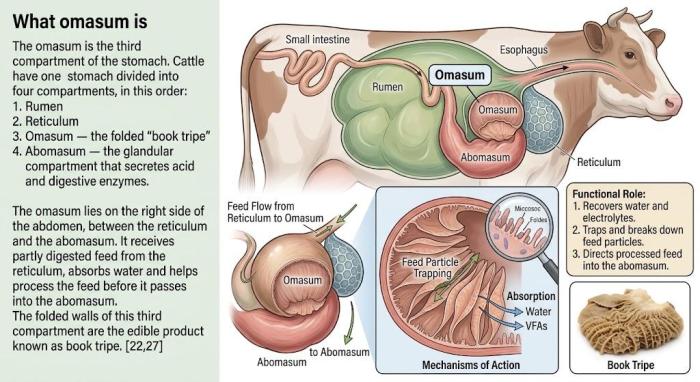
The omasum is the third compartment of the stomach. Cattle have one stomach divided into four compartments, in this order:
- Rumen
- Reticulum
- Omasum, the folded “book tripe”
- Abomasum, the glandular compartment that secretes acid and digestive enzymes
The omasum lies on the right side of the abdomen, between the reticulum and the abomasum. It receives partly digested feed from the reticulum, absorbs water and helps process the feed before it passes into the abomasum. The folded walls of this third compartment are the edible product known as book tripe. [22,27]
The name omasum comes from the Latin word for ox’s tripe. In modern anatomical usage, it refers specifically to the third stomach compartment. [26]
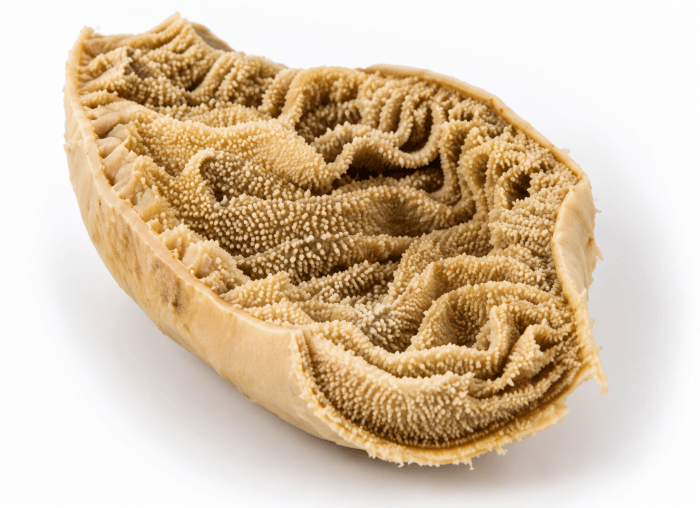
The omasum is distinguished by large, thin folds called laminae, arranged in graduated sizes like the pages of a book. These leaves project inward from the organ wall; their supporting tissue contains smooth muscle, and their surfaces have a tough, keratinising epithelial lining. The rumen has surface papillae and the reticulum has honeycomb-like folds, whereas the omasum has this dense book of leaves. [27] English names include book tripe and leaf tripe; German Blättermagen and Afrikaans or Dutch boekmaag use the same leaf or book image. Portuguese names include livro and folhoso, and Spanish librillo. [R24,R29]
The folding serves the omasum’s role in digestion. Its large combined leaf surface absorbs water, volatile fatty acids and minerals from the digesta before it moves on, which concentrates what would otherwise be a much wetter stream of material. The muscular wall also presses and works fine particles between the leaves as it contracts, continuing the mechanical sorting that began in the reticulum. [22]
Composition
Cleaned fresh omasum is predominantly water and protein, with relatively little fat after trimming. Direct analyses of bovine omasum provide the following measured compositions. Percentages are grams per 100 grams of fresh sample; the columns are separate study means rather than a purchasing tolerance. [28,29]
| Component | Korea, Seong et al 2014 | Brazil, Maysonnave et al 2020 |
|---|---|---|
| Water | 84.64% | 74.1% |
| Protein | 13.90% | 24.6% |
| Fat | 1.53% | 0.84% |
| Ash or mineral residue | 0.46% | 0.42% |
The Korean study used washed, trimmed offal from 40 Hanwoo cattle; the Brazilian study used four samples of each organ collected at an inspected slaughterhouse. Differences in animal material, preparation and analysis mean the results should remain separate. Salt uptake and water removal alter the composition of the finished product, which must be analysed on its own as-sold basis.
Like almost all internal hollow organs of the digestive tract, the omasum consists of smooth muscle. A special feature of the omasum is that that its its inner mucous membrane is folded into over 100 leaf-like sheets (lamellae) to drastically increase the surface area. What makes it unique is that these thin leaves do not just consist of mucosa but they contain three distinct layers of smooth muscle inside.
It is described as a “squeezing machine.” When the muscles in the lamellae contract, water, electrolytes, and volatile fatty acids are extracted (absorbed) from the pre-digested plant pulp. The pulp is thickened and further broken down mechanically before being passed on to the true stomach (abomasum). In veterinary medicine and histology, the omasum is a textbook example of highly specialized smooth muscle due to this three-layered, extremely motile muscular core within the mucosal leaves.
Proteins and other molecules
Collagen supports the connective tissue and contributes to toughness; keratins form part of the protective surface lining. Smooth-muscle cells contain contractile proteins, including actin and myosin. These protein chains are built from amino acids. Collagen has a triple-helical structure rich in glycine, proline and hydroxyproline; extended moist cooking can convert some collagen to gelatin, softening the tissue. Fat includes storage lipids and cell-membrane lipids, while the ash measurement represents mineral residue. The tissue is a mixture of these components, not purified collagen. [27,28,30]
One comparative study reports omasum collagen at 8.5%, with its Figure 3 specifying the basis as percentage of protein. This is an individual published result, not 8.5% of whole fresh omasum or an established standard composition. The paper has reporting inconsistencies, so use it as background until corroborated. Reliable percentages for every individual protein type are not available from the sources reviewed. [30]
Comparison with skeletal muscle tissue
Typical lean beef skeletal muscle runs approximately 75 percent water, with reported ranges of roughly 65 to 80 percent, and approximately 16 to 23 percent protein, on a fresh basis. [R58,R59] Measured against that range, the Brazilian omasum figures sit close to typical muscle water content but report protein clearly above the typical muscle range, while the Korean figures show water clearly above typical muscle and protein below it. Neither study on its own supports a simple statement that omasum is “wetter than muscle” or “leaner than muscle”; the two direct analyses of omasum diverge from each other by roughly the same margin that each diverges from typical muscle tissue, which is consistent with this section’s caution that these are separate study means rather than values to average or reconcile.
The divergence has a plausible structural explanation rather than pointing to a measurement error in either study. Omasum’s leaves are supported by smooth muscle and a tough, keratinising epithelial lining over connective tissue, as described above, rather than being predominantly the myofibrillar skeletal muscle that typical meat-composition figures describe. Connective tissue, smooth muscle and a keratinised epithelium do not necessarily hold or release water the same way skeletal muscle fibre does, so a starting water content noticeably above or below typical muscle tissue is plausible for this organ without implying either published analysis is wrong.
Water content at the start of the process
The two studies place the starting water content of cleaned omasum between 74.1 and 84.64 percent. The starting water content affects yield, because it sets how much water is available to be pressed out. It does not decide the water activity of the finished product, which depends on how much salt is dissolved in the water that remains. The section What sets water activity and what sets yield works through this with a mass balance. The incoming material of a particular plant has not been measured against either study, so measure it directly during the pilot lots in section 16.
Starting weights implied by the AA, A and B grades
The AA, A and B weight bands in the grading system section are finished weights. They describe the piece after pressing and release, not the cleaned, drained piece entering the salting step. The process in this guide stops pressing at a loss of no more than 45 percent of M0, so every 100 kg of M0 yields at least 55 kg of finished product, including the salt retained in it. Applying that minimum yield to the grade boundaries gives the approximate cleaned starting weight for each grade.
| Grade | Finished weight | Starting weight (M0) at the 55% minimum yield |
|---|---|---|
| AA | ≥1,500 g (no upper limit) | ≥2.7 kg |
| A | ≥800 g and <1,500 g | 1.45 to 2.7 kg |
| B | ≥500 g and <800 g | 0.9 to 1.45 kg |
The AA figure is a minimum starting weight, not an upper size limit, since the AA grade itself has no ceiling. The figures follow from the 55 percent minimum yield, and a batch released at a lower loss needs a smaller starting piece for the same grade. Confirm the actual yield from the pilot lots in section 16 before using this table to pre-sort incoming material, and treat it as a planning aid rather than a grading criterion, because grading is still done on the finished piece as section 15 sets out.
Salt and preservative percentages are calculated at the point of application
Every salt and preservative percentage given elsewhere in this guide, the salt charge in section 3 and section 6, and the acid wash and sorbate figures in the Preservation From Harvest to Dry Salting section, is calculated against the omasum’s weight at the point that ingredient is actually applied, meaning the cleaned, drained weight M0 before pressing, not the finished weight. The Preservation section already works through why this is critical for the sorbate figure specifically, since the same absolute retained mass becomes a materially higher percentage of the lighter, finished product once pressing is complete; the same principle applies to the salt charge itself. A percentage figure quoted anywhere in this guide should therefore be read as a percentage of the piece as salted, at that point in the process, not of the piece as eventually sold.
Function of dry salting
Dry salting draws water out of the tissue by osmosis while depositing sodium chloride into it. The combined effect lowers water activity, the measure of how much of the remaining water is free to support microbial growth, and the chloride ion itself further inhibits many spoilage and pathogenic organisms. [6] Because the omasum is folded rather than flat, salt has to be worked between the leaves and into the roots near the central pillar for this effect to reach the whole piece rather than just the outer surface. This is why the manufacturing steps later in this guide return repeatedly to opening the leaves fully at cleaning, salting and pressing. Salting alone does not sterilise the product. It shifts the balance toward organisms that tolerate a saltier, drier environment, and it needs enough time to bring water activity down throughout the piece. [4,5] When the tissue stays in contact with undissolved salt until it reaches equilibrium, the water in the tissue approaches a saturated salt solution, and a saturated sodium chloride solution has a water activity of 0.753 at 25 °C. [7,R64] This is the principle on which the process in this guide now rests.
Shelf life
No single figure decides how long a dry salted product stays safe and acceptable outside refrigeration. The main variables are the water activity actually achieved through the whole piece, including the thick roots and deep folds where moisture is hardest to remove, the retained salt content, the microbial load present before salting began, whether the process includes any validated step aimed specifically at pathogen reduction, the barrier properties of the packaging against moisture regain, and the temperature and humidity of storage and transport. A product that looks dry on the outside but is still wet at the roots, or one packed in a bag that lets ambient humidity back in, can fail well before a laboratory reading from a single surface sample would suggest. This is why the later sections of this guide treat a single water activity ceiling as a useful development target rather than a complete specification, and why they call for sampling the worst location in a piece rather than an average across it. [4,6]
This product relies on several preservation factors acting together rather than any single one, a pattern generally described as hurdle technology. [R51] Water activity is targeted at 0.80 or below at the thick base, and it is reached by salting the tissue towards saturation, which on its own points to about 0.75. The acetic acid wash uses 2 percent acetic acid after cleaning and before salting. Potassium sorbate is an option for the ambient route only, mixed into the dry salt. The current commercial product is frozen promptly after release, and the finished pack relies on a moisture barrier liner and closure through storage and transport. Each figure still needs validation before it enters the plant operating sheet, and the subsections below set out each one in more detail and show how it is checked without a water activity meter.
Expected water activity after salting and pressing
Water activity in a salted product depends on the concentration of salt in the water phase of the tissue. Standard data for sodium chloride solutions show that a water activity of 0.80 corresponds to about 23 percent salt in the water phase, which is about 300 g of salt per kg of water. [R73] A saturated solution holds about 26 percent salt and has a water activity of 0.753 at 25 °C. [7,R64] Dissolved proteins lower water activity slightly further, so these solution figures are conservative for tissue.
The process in this guide therefore sets 0.80 or below at the thick base as the working target, and salting to saturation gives a margin of about 0.05 below it. No Chinese or Turkish standard sets a water activity limit for salted omasum. The 0.80 figure comes from the rules for salted ruminant casings, which are discussed in section 17. The pilot lots in section 16 must confirm the water activity actually reached at the thick base before the target is fixed in the plant operating sheet. The 0.85 in section 9 is the outer screening ceiling of the trade specification and not the working target.
The 0.85 ceiling does not prevent mould and yeast growth. Most ordinary moulds continue growing at water activities up to approximately 0.80, common spoilage yeasts remain active up to approximately 0.88, and xerophilic moulds, the most resistant fungal group, can still grow at water activities down to approximately 0.60 to 0.65. A product at aw 0.85 with only salt as its preservation barrier will develop mould in ambient storage. This is precisely why commercially traded dry-salted omasum is held and transported frozen rather than distributed at ambient temperatures. Salt alone cannot take the water phase below saturation, so the range that excludes even xerophilic moulds, below approximately 0.60 to 0.65, is out of reach without drying the product hard. That level of dryness would cause case hardening, trap moisture in the thick base and produce a piece that resists rehydration. Freezing, and for the ambient route potassium sorbate, therefore bridge the gap between what salting achieves and what storage requires.
Controlling water activity without a meter
Confirming water activity reliably is the critical step in establishing ambient shelf stability. Dedicated commercial water activity meters cost in the region of 1,700 euros for an entry-level reference unit, which places them outside the reach of many plants starting production. A low-cost hybrid system using calibrated DIY sensing chambers alongside a single shared commercial reference instrument has been developed specifically for this product and is described in detail at: https://earthwormexpress.com/the-meat-factory/meat-science-research/building-calibrating-and-operating-a-low-cost-water-activity-aw-system-for-dry-salted-omasum/ That system reduces the measurement cost per chamber by roughly a factor of ten while retaining traceability to a calibrated reference unit. An external laboratory, already referenced in the Manual workspace and section 12, remains an alternative for plants that cannot invest in either instrument at the outset.
The controlling principle is that saturated contact produces a water activity close to 0.75. Four checks keep the process at that point, and none of them needs more than a scale and a measuring cylinder.
| Check | Method | Rule |
|---|---|---|
| Undissolved salt rule | At the end of the salt hold, inspect the leaves and in particular the opened base. | Undissolved crystals must still be visible. Where crystals remain, the brine around them stayed saturated. A piece that has lost all its crystals receives more salt and more time. |
| Saturated rinse | Stir food grade salt into 20 L of potable water until some stays undissolved at the bottom of the bucket, which takes about 7.2 kg of salt near 20 °C. | Crystals must remain in the bucket. Brine standing over undissolved salt is saturated, so no measurement is needed. |
| Drip brine density | At each 12 hour weighing, discard the first drops from the drain channel of the reference stack, collect 1 L in a measuring cylinder and weigh it, or read a salinometer calibrated in percent NaCl. | Saturated brine weighs about 1.20 kg per L, since 26 percent NaCl has a density of 1.1972 g/cm³ at 20 °C, and 23 percent weighs about 1.17 kg per L. The proposed screening threshold during validation is 1.19 kg per L. [R74] |
| Laboratory water phase salt | For the first 10 to 20 batches, send samples cut from the thick base of finished pieces for moisture and NaCl, and for direct water activity where available. | Water phase salt equals NaCl divided by the sum of NaCl and moisture, times 100. About 23 percent corresponds to 0.80 and 26 percent to saturation. [R73] |
Brine is slightly less dense at tropical temperatures than at 20 °C, so a reading taken warm is conservative, and dissolved protein adds a little density, which the margin also covers. None of these field checks proves internal equilibrium on its own. The drip brine is external to the tissue, and crystals show excess salt only where they are present. The field checks become routine release controls only after the laboratory results from the validation batches show that they predict the thick base reliably. Laboratory checks then continue on a monthly sample and after any change in process, raw material or piece size.
The hurdles acting together
The hurdles applied in this process, the actual value or setting proposed for each, and where each is fixed in this guide, are as follows.
| Hurdle | How it is applied in this process | Where it is set |
|---|---|---|
| Reduced water activity | Dry salting at 0.30 kg NaCl per kg M0 and a salt hold that brings the water phase towards saturation. Target 0.80 or below at the thick base | Sections 3, 4, 6, this section |
| Salt content and chloride ion | Salt is worked into the leaves and roots during curing; retained salt is part of the preservation system, not just a flavour ingredient | Sections 3, 6, 9 |
| Lowered surface pH at the point of highest risk | 2 percent acetic acid wash after cleaning and the final rinse in Step 4 or Step M4, and before salting | Preservation From Harvest to Dry Salting |
| A targeted antimicrobial against mould and yeast | Potassium sorbate at 0.1 to 0.3 percent of the omasum weight, mixed into the dry salt, for the ambient route only | Preservation From Harvest to Dry Salting |
| Freezing | The current commercial product is bagged and frozen to −18 °C or colder promptly after release | Step 10, section 15 |
| A moisture barrier during storage and transport | The qualified liner and closure in the 30 or 40 kg PP bag, preventing humid ambient air from raising water activity back up after release | Section 15 |
| Controlled processing temperature | Wash water kept below the temperatures that denature the tissue, and a refrigerated salt hold | Sections 2, 3, 5 |
None of these hurdles is validated as sufficient on its own for this product, and this guide does not claim that the combination has been challenge-tested for omasum specifically. The commissioning trials in section 16 remain the step that confirms whether this particular combination, at the settings this plant actually uses, achieves a safe and stable finished product; this section sets out what the hurdles are and where each is controlled, not a validated outcome.
Omasum around the world
Once desalted and cooked, omasum turns up in kitchens across several continents, usually as one part of a mixed dish rather than the centrepiece. In Cantonese dim sum kitchens, cleaned book tripe is cut into strips, blanched briefly, then steamed with shredded ginger and spring onion, or simmered into the spicy, numbing broth of Sichuan hotpot, where it is known as maodu. In Hunan, a thinner cut known as hair thin book tripe is stir fried with bamboo shoots and chilli. [12,R13]
In Vietnam, sách bò is parboiled, sliced thin across the leaves, then stir fried quickly with pineapple, Vietnamese coriander and fish sauce in a dish called sách bò xào dứa, which sets the tripe’s chew against the fruit’s sweetness and acidity.
In West Africa, tripe from several stomach compartments, including the leafy omasum sold in Yoruba markets as onigbaawe, goes into long simmered pepper soups and stews such as Nigerian assorted meat pepper soup and the related Ghanaian light soup, a thin, chilli forward tomato broth of Akan origin in which the tripe cooks alongside goat or beef until tender. [R23,R27,R28]
In Mexico, librillo is one of several stomach cuts, alongside panza and callo, simmered for hours with dried chillies, garlic, oregano and hominy into menudo, a caldo eaten as a weekend breakfast and reputed hangover remedy. [R25] Brazilian and Portuguese cooks call the same cut livro or folhoso and add it to dobradinha, a white bean and tripe stew descended from a dish of Porto. [R24,R26] Further south, South African mogodu simmers rumen, reticulum and omasum together with onion and chilli for hours until soft, and in Turkey, işkembe çorbası is a garlic and vinegar tripe soup usually made from rumen but sometimes extended to the other compartments. [R30,R17]
The dried, salted export product described in this guide is a different starting point from the fresh or frozen tripe that most of these recipes assume. It needs its own desalting and rehydration step, described in section 18, before it can go into any of them.
Product grades, colour and classification
Weight grades, the buffalo and split forms, and the natural colour range define what a buyer receives. This section sets out each of them, followed by the manual workspace in which production begins.
The grading system
Weight is the primary sorting variable across the trade, and this guide uses the three-grade system AA, A and B that the trader’s specification defines. A fourth grade, C, appears consistently in broader trade listings and is described below for reference, even though it falls outside the purchase specification for this export route. [R41,R42]
| Grade | Piece weight (finished, pressed, dry) | Leaf integrity and condition |
|---|---|---|
| AA | ≥1,500 g | Leaves substantially intact, attached to the central pillar, no significant tearing or detachment |
| A | ≥800 g and <1,500 g | Leaves substantially intact; minor surface blemishes acceptable if the structure is sound |
| B | ≥500 g and <800 g | Sound structure with minor leaf damage; not rejected on size alone |
| C (outside this specification) | Below 500 g or pieces not sorting cleanly into A or B; sometimes sold as a mixed bag | Smaller pieces, heavier leaf damage, or animals that produced consistently undersized omasum; a legitimate separate product for a different buyer rather than a defect class within this export route |
These are the contractual weight bands for this export route, matching the grading and packing table in section 15, and are the figures to use in production. Broader trade listings consulted for this guide show a wider range of practice across the market generally, some setting the AA floor as low as approximately 1.0 kg or citing 1.3 kg rather than 1.5 kg; that variation is background on how the wider trade grades omasum, not an alternative threshold for this route. [R41,R42] Where this guide’s own text elsewhere refers to grading, it means the table above. A single container is normally packed to one grade. How the nominal AA 35%, A 60%, B 5% mix in section 14 relates to single-grade containers, whether by container count, by product mass across the shipment, or some other method, is not established in this guide and should be confirmed and agreed with the trader in writing, not assumed.
Buffalo omasum and the split form
Buffalo (Bubalus bubalis) omasum reaches the market under the same AA, A, B and C weight bands as beef omasum, and is exported in volume from India and Pakistan toward the same Chinese and Vietnamese destinations. Buffalo omasum is anatomically equivalent but typically larger per piece than omasum from standard commercial beef breeds, which means that a higher share of a buffalo-origin shipment sorts into the AA band. The processing steps in this guide apply to it without modification, though the trader should confirm whether the buyer is purchasing beef omasum, buffalo omasum, or either. [R41]
Split omasum, meaning each piece cut into two separated halves before salting and pressing, is a distinct product form rather than a lower grade of the whole piece. La Parmentiere markets a dedicated bible splitter for exactly this purpose. Some buyers specify split because it simplifies leaf-by-leaf cleaning after import and is faster to rehydrate. A buyer specifying split omasum is specifying a different product from this guide, which covers the whole, intact piece. The two should not be mixed in the same bag without the buyer’s prior agreement. [R35]
Colour: the natural range, its quality meaning, and why it is not a single target
The natural colour of unbleached, properly cleaned omasum runs from grey-brown to dark grey and, on some pieces, approaches near-black. This range is normal and acceptable. A Zhihu forum discussion consulted for this guide, with multiple contributors including a food science background, confirms that the surface of natural omasum has a black membrane. The feed history of the animal also influences the colour of that surface, and the peer reviewed evidence for this is set out in the subsection below. White or very pale omasum in the fresh or prepared-tripe market is characteristic of hydrogen peroxide or peroxide-equivalent bleaching, which this guide prohibits. Several trade sources confirm the specification as “black and brown” or “black and grey”, referring to the natural unbleached range, not to a single target colour. [R43]
Darker does not always mean better. The natural target for this product is grey-brown to dark grey, meaning tissue that has been properly cleaned without chemical treatment and dried without over-oxidation. Uniformly near-black can be natural for certain animals and feeds, but a very dark appearance can also indicate advanced surface oxidation from long exposure to air during processing, dirty processing that left dark material in the roots, or bruising and contamination in the animal before slaughter. The colour alone does not confirm the cause, which is why this guide’s visual condition criteria in section 10 use both colour and the physical condition of the tissue together, rather than colour alone.
Why omasum is black or brown. The role of feed
The dark colour of omasum comes from pigment held in its surface lining, and the diet of the animal influences how much of that pigment forms. The rumen, reticulum and omasum are all lined with a keratinising epithelium, as described in the anatomy at the start of this guide, so findings on the colour of the rumen and reticulum lining are relevant to the omasum. [27] In 1961, Brownlee and Elliot reported in the Veterinary Record on the influence of diet on an iron containing pigment in the keratinised layer of the epithelium of the rumen, reticulum and omasum of cattle. [R67]
Controlled feeding trials later tested this mechanism. A study published in the Journal of Dairy Science in 1970 controlled the dark brownish colour of the rumen lining of Japanese meat type goat kids through purified rations, and iron proved to be the most important mineral. A ration containing 0.03 percent ferrous iron produced considerable pigmentation, whereas 0.003 percent produced none, and chopped hay in the ration increased pigmentation. However, the darkness of the lining was not directly related to the iron content of the tissue, and the colour of the lining closely matched the colour of the rumen contents. The authors therefore concluded that iron and other minerals influence the formation of coloured substances inside the rumen. They also referred to earlier reports that pelleting a cattle ration increases the colour of the lining, and they proposed reduced saliva secretion, and therefore less sodium bicarbonate in the rumen fluid, as a possible explanation. [R68]
Rumen acidity is a second route by which feed alters colour. A Greek study followed 75 feedlot cattle, aged 8 to 10 months and drawn from five farms, with repeated rumen pH measurements over one year before slaughter. Rumen pH correlated positively with the redness (0.853) and the lightness (0.862) of the lining, which means that cattle with a more acidic rumen had darker linings. The authors attributed this darkening to the effect of low rumen pH on the keratinised layer, and they noted that the high concentrate diets used widely in beef and dairy production can cause a rapid fall in rumen pH. [R69]
Forage acts in the opposite direction. When alfalfa hay was added to a total mixed ration fed to Naemi lambs, the black colour of the rumen disappeared and the papillae grew. The lightness, redness and yellowness of the rumen lining were also significantly higher in the lambs that received the hay. [R70]
Three points follow for this product. Black and brown omasum are both natural, and the difference between them largely reflects diet, mineral intake and rumen conditions rather than processing. Most of the controlled work measured the rumen rather than the omasum, and only the 1961 study examined the omasum directly, so omasum specific colour trials are still needed. The evidence also favours describing lighter omasum as the product of forage based feeding. High grain rations lower rumen pH and are associated with darker linings, and grain feeding should therefore not be grouped with grass feeding as a cause of lighter colour. Because the pigment sits in the keratinised surface layer, the pale streaks that heavy scraping leaves behind, listed in the table below, are consistent with removal of that layer.
Causes of lighter or uneven colour
| Cause | Appearance | How to distinguish it | Acceptable for this specification |
|---|---|---|---|
| Normal base and root area | Consistently paler at the thick base and leaf roots than at the leaf tips | Uniform gradation from base to tip; consistent from piece to piece | Yes; this is anatomical, not a defect |
| Forage based diets | Yellowish or lighter grey-brown overall rather than darker grey | Even, whole-piece colour rather than patchy | Yes, provided the tissue is sound and the piece passes condition criteria |
| Salt residue on surface | Dry white crystals sitting on top of tissue surface, removable | Brushes off cleanly; tissue underneath is the expected grey-brown | Yes; remove before packing |
| Mechanical over-scraping | Patchy pale pink-white streaks following the direction of scraping | Streaked or worn patches rather than even; knife tracks visible under good light | No; this is surface damage to the tissue |
| Fat still attached after trimming | Solid off-white areas, particularly at the base or outer wall | Feels fatty or waxy; does not have the normal leaf texture | No; reclean and trim |
| Chemical bleaching with peroxide, lime, or caustic soda | Uniform, even pallor across the whole piece; often whiter than natural grey-brown; may feel swollen or unusually soft | Whole-piece evenness that looks different from natural variation; no directional pattern | No; prohibited by this specification |
| Fungal growth on inadequately salted areas | Pale or white powdery patches with visible surface texture, typically at deep folds or bases | Powdery or fuzzy texture; in locations where salting was weakest | No; reject and investigate the salt hold and the cold chain |
| Previous injury or healed inflammation on the live animal | Pale or discoloured area with altered texture, often near the base | Localised; tissue may be thickened or scarred | Trim out the affected area; remainder acceptable if it passes condition criteria |
Colour in the finished dry-salted product versus colour in the cooked product
The buyer in China or Vietnam is purchasing the finished cooked texture, not the dry product’s appearance. Natural grey-brown to dark dry-salted omasum turns distinctly pale, almost grey-white, when rehydrated and cooked or blanched, because heat denatures the surface pigments. This is the expected outcome for properly processed natural product and should not alarm the end user. The white, swollen appearance of hot-pot book tripe that Chinese consumers know well is achieved by this cooking step, not by pre-bleaching the dry ingredient. A buyer expecting a white cooked result does not need a white dry product; they need a properly cleaned, unbleached dry product and the correct rehydration and cooking step. [R43]
Manual workspace
| Station | Manual equipment and arrangement |
|---|---|
| Dirty receiving and emptying | Covered food-grade tubs; washable raised table; knives; dedicated waste containers; gravity-fed potable water. Keep gut contents and dirty tools here. |
| Leaf cleaning and trimming | Separate raised table, smooth basins, rounded scraper, dedicated knives, handwashing point and clean draining baskets. Provide enough water to exchange dirty wash water promptly. |
| Salting and salt hold | Food-grade salt kept dry and covered; bench scale; food grade drums or bins with a drain; refrigerated space for the salt hold. Identify each batch and size group. |
| Rinsing and pressing | Buckets of saturated brine. A raised pallet with a drain channel standing on a platform scale. 50 kg sandbags wrapped in food grade plastic, so that no sand reaches the product and the bags do not absorb brine. Shade and cover against flies. A clean container and a 1 L measuring cylinder for the drip brine. |
| Finishing and bagging | Dry clean table, clean dry brush, scale, food-contact liner, 30/40 kg PP bags and hand closure tools, with access to a freezer or rented cold store at −18 °C or colder. Separate this area from raw washing and splashes. |
Basic measuring instruments are still necessary. These are a platform scale for the pressing stack, a bench scale, a 1 L measuring cylinder or a salinometer for the drip brine, time records and a thermometer. An external laboratory can perform water-activity, salt, moisture and microbiological testing; no powered production machinery does not mean no process measurement.
Before starting each batch
Wash, rinse and sanitise contact surfaces using the approved sanitation procedure; allow dry-area equipment to dry. Separate clean and dirty aprons, tubs and tools. Arrange one-way product movement and remove waste without crossing the finishing area. Admit only inspected edible offal from traceable slaughter. [1,2]
Limit throughput to the slowest station, usually leaf-by-leaf cleaning or pressing space. Do not accumulate warm wet offal while waiting for workers or rack space. Use a controlled cool buffer or stop intake when immediate processing cannot be maintained; raw-material handling limits belong in the plant recipe.
2 Manual cleaning procedure
Cleaning takes the omasum from the dirty receiving area to a drained and weighed piece that is ready for salting on the same day. Four steps cover this work.
Step 1: Receive, identify and empty
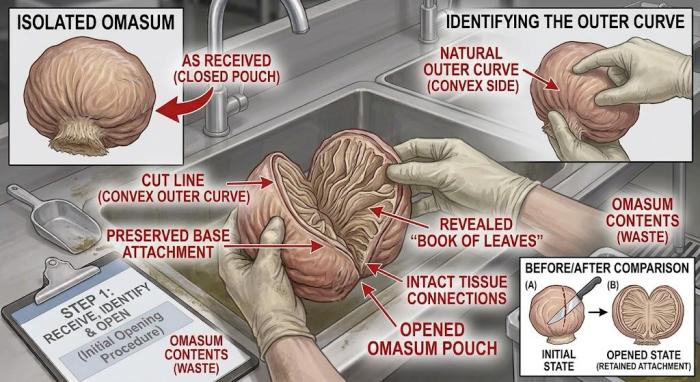

Keep each slaughter lot identifiable. Separate omasum from other stomach compartments. Place it in the dirty-area tub and open sufficiently along its natural outer curve to expose the book of leaves while retaining the connecting base. Empty the bulk contents into the waste container. Do not cut the leaves into strips or detach them to make cleaning faster.
Step 2: Unfold and rinse between the leaves
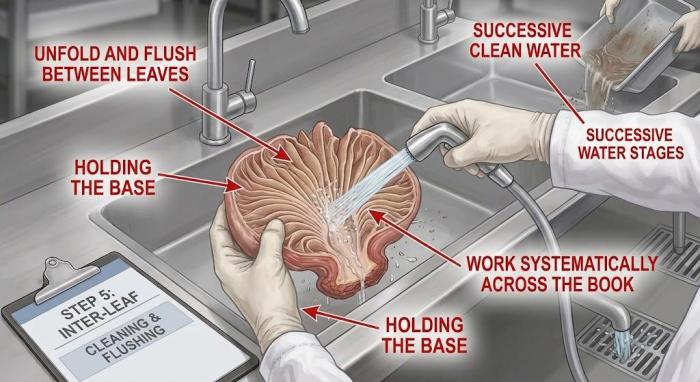
Hold the base in one hand. Fan apart a small group of leaves with the other hand and flush the spaces with potable water, directing the wash away from cleaned material. Work systematically from one end of the book to the other. Rub gently with fingers or a smooth rounded scraper where contents cling. Repeat on both faces and at the deep roots of the folds. [2]
Use warm water rather than cold for this rinse, at the same working temperature given for the machine wash cycle in section 5, roughly 30 to 40 degrees Celsius. Warm water improves the removal of clinging contents at the leaf roots over a cold rinse with minimal colour change, on the same basis given later in this guide for the machine wash. [R45] Do not exceed this range by hand any more than by machine; the protein denaturation thresholds in section 5 apply equally to a hand-held hose or basin.
Use successive clean-water stages rather than washing every piece in one increasingly dirty basin. Empty and clean a basin when fouled. A clear final rinse is a useful work indicator, but the operator must also open and inspect the deep spaces: clear water alone does not prove that all material has been removed.
Step 3: Trim attached fat and damaged tissue
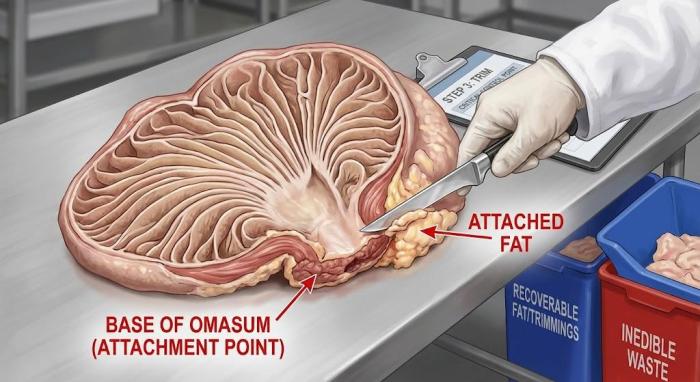
Turn the exterior outward. With a sharp knife, pare visible attached fat from the base and outside without cutting through the leaf attachment. Remove unacceptable damaged areas according to the veterinary disposition. In practice this means abscesses, hydatid or other parasitic cysts, hemorrhage, bruising, and inflamed, discoloured or malodorous tissue consistent with early spoilage; official inspection criteria already require stomach tissue to be free from hemorrhage, cysts, swellings and worms before it is accepted at all. [1,2] Identify these by sight, smell and touch while opening each piece, not by testing after the fact, and when a finding is uncertain, set the piece aside for the responsible veterinary or quality officer rather than trim around it and pass it. Do not use salt to cover decomposition or to rescue condemned material. Keep recoverable edible product separate from waste.
While the piece is open, cut into the thick base once with a controlled knife cut. The time salt needs to penetrate tissue rises with the square of its thickness, so halving the thickness cuts the salting time to about a quarter. [R75] The opened base then takes extra salt in Step 5 and no longer lags behind the thin leaves. Trim only attached fat, damaged tissue and unwanted connective tissue, and keep the trimming loss close to the costing allowance of 2 percent of the cleaned weight.
Defatting as a separate consideration
Defatting is not a cosmetic step. In the live animal the omasum sits under the lesser omentum and has adherent fat at its own surface and at the neck where it joins the reticulum and abomasum, and this is the fat Step 3 removes with the knife rather than dirt or contamination. [22] Because that fat sits mostly at the base and outer surface rather than inside the leaves themselves, trimming it does not require opening the book any further than cleaning already does, but it does need its own pass with a sharp knife rather than being assumed to come away during washing or salting.
Not every omasum on the market is defatted to this standard. Wholesale listings distinguish a cheaper, less processed form sold with fat and other adherent organ tissue still attached, alongside the cleaned and trimmed form this guide specifies. [R34] That untrimmed form is a different product for a different buyer; it is not a shortcut available within the AA, A and B grades defined here, which already require zero removable attached fat at finishing under the visual condition criteria in section 10. A batch arriving with more fat than Step 3 anticipates should be flagged and trimmed to the full standard, not passed through with a lighter trim to save time.
Step 4: Finish cleaning and drain
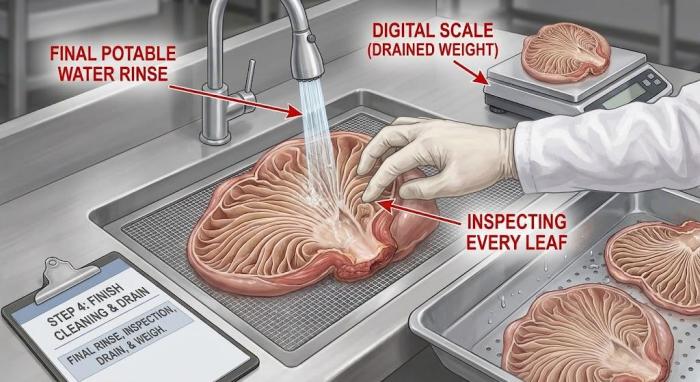
Give the cleaned piece a final potable-water rinse in the clean area. Open every leaf group once more under good light; remove remaining visible particles by cleaning, not by bleaching. Transfer directly to a sanitised perforated tray with the folds opened so rinse water can escape. Weigh at the defined drained condition to establish M0, the basis for the salt charge and for every loss calculation that follows. Salting follows on the same day. The omasum must not stand unsalted in drums overnight, because before freezing salt is the main hurdle available.
The acetic acid wash
After the final rinse and before salting, the cleaned piece receives a wash in 2 percent acetic acid, made up as 4 L of glacial acetic acid per 200 L of water, and is then drained thoroughly. The contact time and solution temperature are fixed in the pilot trials in section 16, and a test piece is checked for colour, because the buyer expects a dark product. When applied as a surface rinse that is subsequently drained before salting begins, the acid wash functions as a processing aid rather than a food additive and does not typically attract labelling declarations or ingredient listing requirements in the destination countries covered by this guide, because it is not intentionally carried through to the finished product. Regulatory classification should be confirmed with a qualified regulatory affairs advisor before commercial production, but this distinguishes the acid wash from the potassium sorbate, which is retained in the product and therefore must be declared and accounted for in finished product compliance.
Control colour by the cleaning method
For the natural grey/brown target, avoid aggressive scraping of the entire lining. Clean with fingers, a smooth rounded scraper or a soft food-grade bristle brush. Use a firmer dedicated food-grade brush only where necessary for stubborn debris; reserve the knife for trimming. Remove dirt while retaining sound tissue. Investigate unexpected lightening or patchiness against the approved sample and processing records. Check cleaning severity, temperature and any chemical use; colour alone does not identify the cause. Do not use lime, detergent, peroxide, caustic soda or whitening agents as improvised cleaning shortcuts.
The most important manual skill is opening the leaf roots without tearing the book. Train workers on this movement, then allocate enough time per piece to complete it; pay or scheduling incentives must not reward a fast surface-only wash.
3 Manual dry salting and salt hold
Salting follows cleaning on Day 1, and the salt charge is weighed against the drained mass M0. Two steps cover the application of salt and the salt hold.
Step 5: Weigh and apply salt
Separate large and small pieces before curing. Weigh cleaned, consistently drained product as M0. Weigh 0.30 kg of food-grade sodium chloride per kg M0 and record the amount actually added. Confirm this working charge through the trials below, accounting for piece size and salt distribution. Use fresh food-grade salt, not industrial salt or salt recovered from a dirty batch.
Spread a measured portion of the charge on the clean curing tray. Open the book and distribute salt across both faces of successive leaf groups, reaching the deep folds and thick base. Work through the full piece, and pack extra salt into the opened base. Salt on the outside of a closed bundle is not a substitute for contact between the leaves. Place the salted pieces loosely in the tray and apply the remainder of the charge as specified. [2,4]
Where the plant operating sheet includes potassium sorbate for the ambient route, mix the sorbate into the dry salt before this step rather than adding it separately. The illustrative starting inclusion rate, expressed against the omasum weight at application and requiring recalculation against the finished product weight, is set out in the new section Preservation From Harvest to Dry Salting later in this guide, along with the food category confirmation that figure still needs before it can be treated as a compliant dose; do not exceed the figure being trialled by working from an assumed salt application rate without checking it against the actual charge used in this plant.
Step 6: Salt hold with drainage
Hold the salted omasum refrigerated for at least 24 hours from the completion of salting, with the expressed liquor able to drain freely. Pieces above 1.5 kg are held for 36 hours during validation, unless trial data show that 24 hours is enough. Label each drum or tray with lot and start time. Keep pieces protected from insects and dirty splashes, and collect the drained liquor away from the product for disposal through the controlled waste route.
At the end of the hold, inspect the leaves and in particular the opened base. Undissolved salt crystals must still be visible. Where crystals remain, the brine around them stayed saturated throughout the hold. A piece that has lost all its crystals was not in saturated contact, and it receives more salt and more time before it moves on.
Do not arbitrarily top up salt, mix batches of different ages, or leave newly salted thick pieces at uncontrolled tropical room temperature. Salt penetration takes time, especially at the thick base and roots; control the time and product temperature before preservation develops throughout the piece. Salting does not reverse earlier abuse, meaning mishandling that happened before the salt went on: omasum left ungutted or uncleaned for hours after slaughter, offal held warm in a vehicle or yard without chilling before it reached the plant, or a cleaned batch left unsalted while workers dealt with a backlog elsewhere. None of that is corrected by adding salt afterwards, however much is used; a batch with a known delay of this kind should be assessed on its own history, not folded into a normal batch. [4,5]
Time alone does not prove water activity, and the hold settings above are working figures for validation. The warm, wet period before salt has penetrated the thick base is the period the hazard section flags for staphylococcal growth and toxin formation, which is why the hold is refrigerated. Fix the actual hold time and temperature through the pilot trials in section 16, and record the validated setting in the plant operating sheet.
How to determine the amount of salt (salt charge)
Set the charge through trials on the largest intended AA pieces, using the actual draining and pressing method. The working figure is 0.30 kg NaCl per kg M0. Measure internal salt and water activity at leaf roots and thick bases as well as outer tissue. Select settings that achieve the storage target without excessive saltiness, leaf damage or rehydration loss. Fix the successful settings in the operator recipe, including size limits and maximum tray loading.
The Ethiopian training operation sheet describes opening and trimming omasum, salting each leaf, holding for one day, removing loose salt, rinsing in retained salty liquid, pressing and cold storage. Its leaf-by-leaf handling is useful, but its cold-storage endpoint is different from this export process. Use the measured hold and pressing results to establish total residence time and pressing capacity. Neither that one-day hold nor FAO meat-strip recipes supplies the operating schedule for a whole dry-salted omasum. [2,3]
Surface salt and absorbed salt are different
The trader’s “zero residual salt” is implemented here as no loose visible crystals at finishing. Absorbed salt remains part of the preservation system. The specification cannot be read as a literal zero total-salt product since it would contradict the defined salted product.
4 Manual rinsing, pressing and release
After the salt hold, the omasum is rinsed in saturated brine, pressed to the stop rule and released for bagging and freezing. Four steps cover this stage of the manual route.
Step 7: Saturated rinse and standard drain
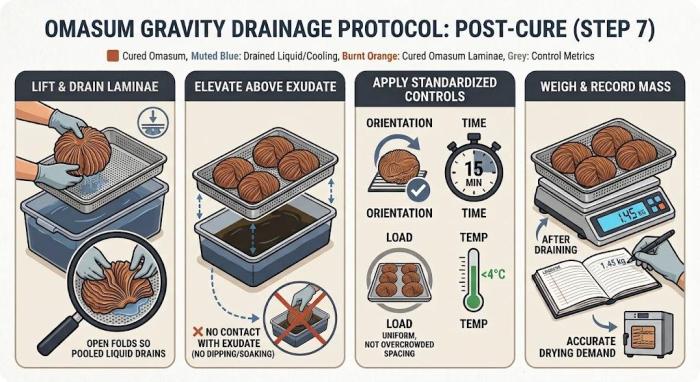
After the salt hold, give each piece a brief dip in saturated brine. Make the brine by stirring food grade salt into 20 L of potable water until some stays undissolved at the bottom of the bucket, which takes about 7.2 kg of salt near 20 °C. Do not soak. A weak rinse would desalt the surface and raise its water activity, whereas saturated brine leaves the salt balance unchanged. Replace the brine when it is visibly contaminated, and add salt whenever the crystals at the bottom disappear.
Then lift each piece into a clean perforated tray, open the folds so pooled liquid drains, and apply the same drain orientation and time to every batch. Record the mass after draining as M1. The difference between M0 and M1 shows how much of the permitted loss remains for pressing.
Step 8: Press under sandbags
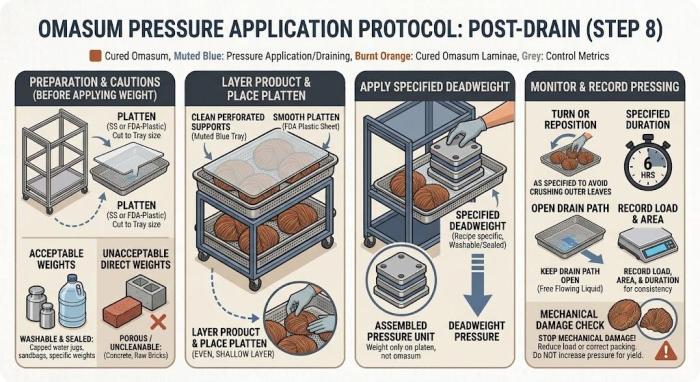
Stack the drained pieces, approximately 700 kg per stack, on a raised pallet with a drain channel. Lay a smooth food grade sheet over the top and load it with 50 kg sandbags wrapped in food grade plastic. The plastic keeps sand away from the product and stops the bags absorbing brine and changing weight. Keep the stack in shade, covered against flies, with the drain path open. The sandbags sit only on the sheet, never directly on the omasum, and they are cleaned and dried between batches like any other food contact surface.
The planned load is 28 bags, which is 1,400 kg on 700 kg of omasum, or 2 kg of load per kg of product. A present day Chinese operation observed by Eben van Tonder used the same 28 bags of 50 kg on about 400 kg of omasum, which is about 3.5 kg per kg. The lighter ratio may therefore need a longer press, and the pressing time is confirmed in trials.
One stack from each day serves as the reference stack. It stands on a platform scale for the whole pressing period, and the brine drains off the scale platform. The reading covers pallet, omasum, sheet and sandbags, and the omasum weight is found by deducting the known tare, so the 1,400 kg of sandbags never has to be lifted off to weigh. Weigh after 12 hours under load and every 12 hours thereafter. During the first three or four batches, weigh every 3 to 4 hours so that the loss curve is known before the 12 hour interval becomes routine. Collect the drip brine for the density check at each weighing. The other stacks from the same day are pressed identically and released together with the reference stack. Where no platform scale is available, release the load in the same way at each check and weigh the product.
Step 9: The stop rule
For every 100 kg of M0, the lowest acceptable finished weight is 55 kg. That weight includes the salt retained in the product, which is why the figure is a processing yield and not a water loss. The 45 percent loss is a ceiling and not a target. Loss is calculated as M0 minus the current drained product mass, divided by M0, times 100.
| Situation | Action |
|---|---|
| The field checks, and during validation the laboratory, show that the preservation endpoint is met, and the loss is 45 percent or less | Stop pressing and release the batch, whatever the weight. |
| The loss reaches 45 percent before the endpoint is met | Remove the load. Re-salt bare base areas and hold the batch under light cover without pressure until the endpoint is met. Do not press further. |
| The endpoint is repeatedly not met at 45 percent | Investigate salt distribution at the base, drainage, piece thickness and sampling location. |
Pressing squeezes out brine at the same salt concentration as the brine that stays inside the tissue. It removes weight without lowering water activity. When water activity falls while a stack is under load, the cause is salt continuing to diffuse into the base over time. A batch with a high water activity therefore needs time or better salting of the base, and a heavier load does not help.
Step 10: Release, finish and freeze
Once released, remove loose salt with clean dry tools reserved for finishing. Do not wash after pressing, and do not give a final fresh water rinse, because both reverse the salt balance at the surface. Grade and bag at once, weighing each bag, and freeze promptly to −18 °C or colder. The water in the product is close to saturated brine, and saturated sodium chloride brine does not freeze completely above about −21 °C. [R74] At −18 °C the product is therefore firm but partly unfrozen, which is normal for this category but worth agreeing with the buyer.
Why air drying is no longer part of the process

Earlier versions of this guide dried the pressed omasum on screened racks or in passive solar enclosures for 3 to 7 days, followed by 24 to 48 hours of equilibration. That stage is now removed. Once the water phase is close to saturation, further drying lowers water activity only slowly while it removes saleable weight. A peer reviewed biltong study illustrates the pattern. Biltong dried to about 50 percent weight loss had a water activity above 0.81, while biltong dried on to 65 percent weight loss had a water activity below 0.78, so a further 15 points of weight loss bought only a few hundredths of water activity. [R63]
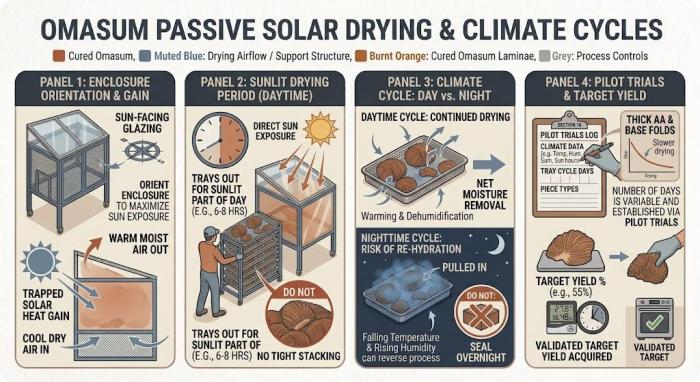
Air drying also exposes the product to insects, dust, rain and night humidity for several days, and it adds rack space and labour. Humid weather can slow or even reverse drying at the thick base. Salting to saturation and pressing to the endpoint reach the target in about three to five days without that exposure.
Manual process: time from raw omasum to finished packed product
The following estimates assume approximately 50 kg M0 cleaned drained omasum per working batch and a single operator at each hand step. AA pieces sit at the longer end of every range.
| Step | Elapsed time per batch | Cumulative elapsed time (running total) |
|---|---|---|
| Step 1: Receive, identify and empty | 15 to 30 minutes | 15 to 30 min |
| Steps 2 to 4: Unfold, rinse, trim fat, cut the base, acetic acid wash | 1.5 to 3 hours | 2 to 4 hours |
| Weigh (M0) | 5 to 10 minutes | 2 to 4 hours |
| Step 5: Weigh and apply salt | 45 to 90 minutes | 3 to 5.5 hours, Day 1 |
| Step 6: Refrigerated salt hold | 24 to 36 hours | Day 2 to 3 |
| Step 7: Saturated rinse and standard drain (M1) | 30 to 60 minutes | Day 2 to 3 |
| Steps 8 and 9: Press under sandbags to the stop rule | 24 to 48 hours | Day 3 to 5 |
| Step 10: Loose-salt removal, grading, bagging and freezing | 2 to 4 hours per tonne | Day 3 to 5 |
| Total: raw omasum to frozen packed product | 3 to 5 days |
The salt hold and the press are the two largest fixed times. Both are set by salt diffusion into the thick base, which is why the knife cut at the base is the practical way to shorten them. Neither can be shortened by a heavier load.
What sets water activity and what sets yield
Two quantities decide whether a batch of dry salted omasum is both safe and profitable. Water activity decides preservation, and yield decides how many kilograms are sold. The process in this guide treats them as separate controls, because different steps set them. Salting sets water activity, and pressing sets weight.
A worked mass balance
Using the Korean composition in the introduction, 100 kg of M0 holds about 84.6 kg of water and 15.4 kg of solids. [28] At the 45 percent ceiling the finished product weighs 55 kg, so water and salt together make up about 39.6 kg. If no solids are lost and the water phase reaches saturation at 26 percent salt, the 55 kg consists of about 29.3 kg of water and 10.3 kg of salt, which puts moisture near 53 percent. If the water phase holds only 23 percent salt, the level that gives a water activity of 0.80, the same 55 kg contains about 30.5 kg of water and 9.1 kg of salt.
The finished weight is identical in both cases, whereas the water activity is not. The weight loss therefore does not tell the operator whether the target has been reached, and only the salt in the water phase does. Some protein and other solids leave with the drip brine, so the real solids are slightly lower than the figure used here. The example is mass accounting and not a measured omasum result. The buyer’s specification should also be checked for any moisture limit, since at 45 percent loss the product holds a little over 50 percent moisture.
Yield maximising steps
Every step below protects saleable weight without weakening the preservation endpoint. None of them changes what counts as safe.
| Step | What to do | Why it protects yield |
|---|---|---|
| Standard drain before M0 | Drain every batch in the same orientation for the same time before weighing M0. | An honest M0 stops wash water from being counted as product, so the loss ceiling is applied to the real starting weight. |
| Minimal trim | Trim only attached fat, damaged tissue and unwanted connective tissue, within about 2 percent of the cleaned weight, and avoid aggressive scraping. | Sound tissue that is scraped or trimmed away is lost before salting begins. |
| Salt on Day 1 | Salt immediately after cleaning, the acid wash and weighing. | Omasum left unsalted overnight risks spoilage and rejected lots, which is the largest possible yield loss. |
| Open the thick base | Make one knife cut into the base and pack extra salt into it. | The base reaches saturation together with the thin leaves, so the stack is not held under load while the base catches up. |
| Saturated rinse only | Dip briefly in brine with undissolved salt at the bottom of the bucket, and never soak. | A weak rinse desalts the surface, which raises water activity and forces a longer hold or a re-salt. |
| Treat 45 percent as a ceiling | Release as soon as the endpoint is met, whatever the loss. | Pressing past the endpoint only sells fewer kilograms of the same product. |
| Fix high water activity with salt and time | Re-salt the base and hold without pressure. | Pressing removes brine at the same concentration and does not lower water activity, so extra load only removes weight. |
| Weigh on a schedule | Weigh the reference stack every 12 hours, and every 3 to 4 hours during the first batches. | Knowing the loss curve lets the operator release at the endpoint instead of overshooting it. |
| Press by size class | Stack AA, A and B material separately. | Small pieces are not over-pressed while the stack waits for the thick AA bases. |
| Lower the ceiling when the data allow | Compare laboratory water phase salt with loss for the first 10 to 20 batches. | If every batch passes at, for example, 42 percent, the ceiling can be lowered to that figure and each point of loss avoided is sold. |
| No washing after pressing and no surface brine at bagging | Remove loose salt dry and bag drained product. | Brine carried into the bag drips out in the cold store and reappears as a shortfall claim at arrival. |
| No air drying | Bag and freeze at release. | Air drying beyond saturation removes saleable weight for little gain in water activity. |
5 Mechanical process
Manual salting by hand remains the proven baseline for this product, and every verified account of salted omasum found for this guide, Ethiopian, Chinese trade, and Turkish trade alike, still describes hand work at the leaf level. That said, washing, fat removal, splitting and pressing are not exclusively manual tasks. Dedicated equipment for these steps exists and is set out below, alongside the standard meat processing machines already covered in the step-by-step guidance, so the plant can weigh a purpose-built omasum line against general-purpose equipment already common in a red meat plant. [H1,H2,R35,R36]
The strength of the mechanical process
The mechanical process described in this section takes standard equipment already found in a well-equipped meat processing plant and applies it to the key stages of omasum production. With the exception of the HELMAKS omasum washer, which is abattoir equipment, every other machine used here, the vacuum tumbler, the mechanical meat press, the perforated pressing forms, the vacuum sealer, is a piece of standard meat-plant infrastructure. No special-purpose omasum factory or dedicated salting facility is needed.
This moves the main production steps firmly into the meat processing plant, where they belong. The omasum arrives from the abattoir already washed. From that point forward the work happens inside an environment built around food safety, hygiene and quality: cleanable stainless steel surfaces, temperature-controlled rooms, HACCP systems already in place, trained staff, calibrated scales and a cold chain.
This partnership between abattoir and meat plant is also operationally sensible. Washing is best done close to slaughter, while the offal is fresh. Salting, pressing and packing benefit from the hygiene and systems discipline of a food manufacturing environment. Keeping those two roles in the right place, rather than trying to build a complete standalone omasum facility at either location, is one of the practical advantages the mechanical route offers over a purely manual operation.
Washing and preparation: not always a manual step
Machines built specifically for paunch and bible (omasum) washing, defatting and splitting are commercially available from more than one manufacturer, and HELMAKS’s own general slaughterhouse washer, already specified as the supplier for this line, performs the same washing function using standard abattoir equipment rather than an omasum-dedicated machine. What remains manual regardless of which washer is used is the fine work, opening the leaf roots fully, trimming defects and fat the machine could not reach, and the final visual and tactile check, because no machine in this survey is described as replacing that finishing step. [H1,H2,R35,R36]
Step M1: Prepare the machine and the product
Prepare separate, weighed omasum batches by size and remove bulk contents and foreign matter before loading. This preparation step is straightforward and can equally be done by hand if no machine is available: the task is simply opening each piece, emptying the contents, and sorting by weight, which requires no equipment beyond a clean raised table, a scale and a knife. The machine step that follows begins with the warm water washing cycle. With the machine isolated, clean the vessel, rotor, discharge channel, seals and waste outlet. Reassemble correctly and verify guards, lid and door interlocks, emergency stop and drainage. Restore power only after people and tools are clear.
Step M2: Load a measured batch
Load through the designated feed point using the maker’s safe loading sequence and permitted mass range. Start the machine with warm water in accordance with the manufacturer’s instructions for the omasum programme. Do not imitate reaching through an opening in a running machine. Record batch mass and the programme identification. Do not copy a filling level or speed from the video; follow the manufacturer’s rated limits instead.
Step M3: Wash under controlled conditions
Agitation in an appropriate washing machine can help dislodge retained contents; the precise rotor and contact mechanism must follow the installed machine’s design. Use the validated water-exchange arrangement to carry contamination away. Keep drainage clear and prevent wash water returning to cleaned product. Do not introduce recycled dirty water without a separately validated treatment and reuse system.
Use warm water in accordance with the manufacturer’s instructions for the omasum programme.
HELMAKS does not publish specific cycle temperatures in its public catalogue, so the operating temperature is set from the machine’s own programme documentation. As a working principle supported by meat science: at around 30 to 40°C cleaning improves over cold water with minimal colour change; above approximately 55°C myosin and sarcoplasmic proteins begin to denature, the surface membrane starts to lighten and firm, and the natural grey-brown can shift unevenly toward a cooked pallor; above 65°C visible cooking begins, the surface whitens and the tissue toughens perceptibly; at 80°C and above the piece looks and feels part-cooked. [R45] For natural-colour unbleached omasum the effective working window sits roughly between 30 and 50°C, where cleaning is adequate and surface character is preserved. The higher temperatures used for scalded or bleached tripe serve a different purpose and must not be borrowed for this product.
Choose the omasum programme that cleans while retaining the attached leaves and required natural colour. Excessive duration, speed, loading or heating can increase damage or alter appearance; insufficient treatment leaves material in the roots. Adjust only through controlled trials, changing one factor at a time and recording cleaning defects, torn leaves and yield. This description is an engineering interpretation of the process rather than the filmed vessel’s actual internal design.
Step M4: Discharge safely and finish by hand
Discharge by the manufacturer’s guarded procedure into a raised clean food-contact trolley or tray. Do not use hands to assist moving machinery or bypass an interlock. Before reaching inside, isolate and verify the stopped state under the plant procedure. Keep discharge away from floors and waste splash. Fan open the cleaned books, finish missed pockets by hand, trim attached fat, open the thick base with one knife cut, rinse as specified and drain consistently before weighing M0.
The same acetic acid wash
As in the manual route, the 2 percent acetic acid wash follows once this step, hand trimming and the specified rinse are complete and the piece has drained, and before Step M5 salting begins. It does not belong earlier in the wash cycle, because the washer removes bulk soil and is not the point in the sequence for this wash. Its contact time and solution temperature are fixed in the pilot trials in section 16.
A washer cleans. It does not sanitise automatically or provide a microbial kill step, and no temperature, chemical concentration or lethality claim follows from these videos. Even heated water needs a validated tissue time-temperature treatment before it can support a pathogen reduction claim. [1,4]
6 Machine assisted salting and pressing
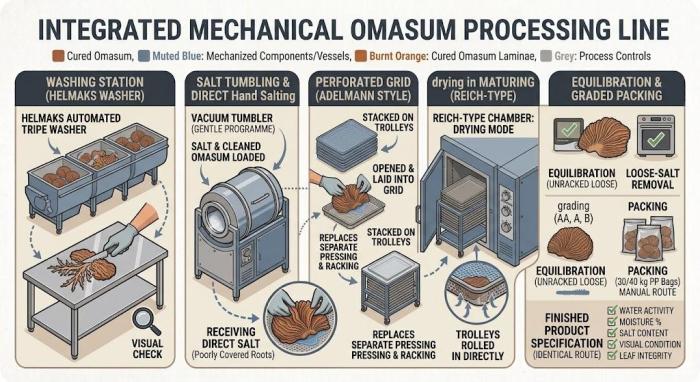
Dry salting and/or a tumbler with salt brine
Dry salt worked by hand between the leaves is the baseline this guide specifies, because it is the method every verified salted-omasum account actually describes and because it keeps the product inside the trader’s own definition of a dry-salted item. Two mechanical alternatives exist and are worth naming honestly rather than dismissing.
A drum-type vacuum tumbler, already covered in this guide’s trial guidance below, can be run dry, with salt but no added liquid, to speed and even out distribution once salt has been placed between the leaves by hand. Published tumbling research confirms the mechanical action helps move surface-applied cure into folded and structured tissue faster than standing time alone. [23,24] It does not reduce the total amount of water pressing still has to remove, and the folded leaf structure calls for gentler settings and shorter cycles than a solid ham would use, as set out under Step M5 below.
Tumbling in a brine works the liquid into the piece through mechanical action and immersion. Brine tumbling is well established for whole-muscle cuts such as ham and turkey breast, where it speeds cure distribution and is paired with vacuum and a controlled rpm. [R37,R38] For omasum, brine tumbling’s main advantage over dry salting is faster and more even penetration into folds and root areas, exactly the places where this guide already flags dry salting as hardest to get right. Brine does not inevitably add net water to the piece: whether it does depends on the brine’s salt concentration relative to the tissue, and a sufficiently concentrated brine can draw water out of the tissue by osmosis in much the same way dry salt does, rather than adding moisture that pressing must remove. Three separate quantities need to be measured rather than assumed: liquid added as brine that is actually absorbed into the tissue, any net water lost from the tissue to the surrounding brine, and liquid mechanically carried in the folds and on the surface that drains away in pressing without ever being absorbed. Treating all three as one figure misstates the pressing load a brined batch presents. Whatever the route, the salt must bring the water phase close to saturation, because that is what sets water activity.
Kromtaş, a Turkish manufacturer already covered in this guide for its washing and splitting equipment, also markets a dedicated omasum brine machine, claiming a reduction in brining time from the six to seven days it reports as normal to two days, at a stated daily capacity of 800 kg. [R55] This is direct evidence that mechanised brining is an actual, commercially offered option for omasum specifically, not only an approach borrowed from whole-muscle products; it does not supply a conventional vacuum-tumbler programme, brine concentration or independent validation, and the claimed time reduction is the manufacturer’s own figure rather than a published trial result. The same manufacturer’s omasum drying oven is described as dehumidifying “brined products coming out of the press,” which is direct evidence that pressing before drying is an existing arrangement for brined omasum in at least one commercial line, without making pressing compulsory for every route through this guide. [R56]
A Brazilian case study of offal handling at a slaughterhouse in São Luís, Maranhão State, documents washing, brining and a subsequent dry-salt layering step among the technical procedures applied there to omasum along with fetal blood and ears. [R57] The study’s authors were critical of the plant’s hygiene, finding it did not have infrastructure fully adequate for the offal-handling techniques observed, and reported only a short keeping period for the resulting product; this is evidence that the washing-then-brining-then-dry-salt sequence is practised in at least one real plant, not evidence that it is a validated or hygienically sound version of that sequence, and its short reported keeping period is consistent with this guide’s own caution against treating any of these time and temperature figures as established.
What determines the product’s classification is the final water activity, moisture content and salt content, not the route by which the salt was applied, but meeting those endpoints does not by itself establish that a wet-cured or brine-tumbled product satisfies every buyer’s own commercial definition of “dry salted”; some buyers may specify the dry-salting method itself, not only the finished specification, so confirm this with the trader before committing a shipment to the brine route. A piece that is properly dried to the water activity target after brine tumbling meets this guide’s technical dry-salted specification on the same terms as one dry-salted by hand. The practical trial question is therefore not only whether the trader will accept it on the finished specification, but whether the brine concentration, tumbling programme and subsequent pressing together achieve the same endpoint in less total elapsed time, or with fewer pieces that need reworking for uneven salt at the roots. That comparison, and the buyer confirmation, both need their own pilot run and their own written agreement to answer. [R37,R38]
Salting and curing method options
| Method | How it works | Time | Temperature | Open question before adoption |
|---|---|---|---|---|
| Hand dry salting (baseline) | 0.30 kg salt per kg M0 worked between opened leaves and into the cut base by hand | Hold of at least 24 hours, 36 hours for pieces above 1.5 kg during validation, per section 3 | Refrigerated, with drainage | Hold time confirmed by laboratory water phase salt at the thick base, per section 3 |
| Dry salt with tumbler assist | Salt applied by hand, then dry tumbling to even out distribution | 15 to 30 minutes tumbling, added to the cure above | Ambient | Leaf damage at speeds and durations built for solid muscle; needs its own trial |
| Immersion brine with tumbling | Omasum soaked in salt solution, then tumbled to speed uptake | 30 to 120 minutes tumbling, per general brine literature; 2 days by mechanised brining, per commercial equipment claims against a reported 6 to 7 day baseline | Chilled brine, typically 2 to 6°C | Net moisture change depends on brine concentration and needs measuring, not assuming. Final product classification depends on the water activity, moisture and salt endpoint, not the salting method, but does not by itself confirm every buyer’s own definition of dry salted. |
Step M5: Salt the cleaned books
Retain dry salt application between opened leaves as the baseline for the requested dry-salted product. Weigh 0.30 kg salt per kg drained M0, distribute it through all folds and into the cut base, and use controlled holding bins as in section 3. A metered salt dispenser can improve dosing, but a worker must still expose the roots unless equipment trials demonstrate equivalent distribution.
Where potassium sorbate is included for the ambient route, mix it into the salt charge before this step, at the illustrative starting rate against the omasum weight given in the new section Preservation From Harvest to Dry Salting later in this guide, recalculated against the finished product weight as that section describes. Metered salt dispensing does not remove the need to confirm the actual salt application rate used at this station before fixing the sorbate dose as a percentage of that salt, and that figure is not to be treated as a compliant dose until the food category confirmation in that section is complete.
A purpose-designed mixer is optional and requires trials for salt distribution and leaf damage.
A drum-type tumbler may be trialed to improve salt distribution and reduce labour, provided it preserves the attached leaves. Commercial units are available for other meat products. [R31] The university extension source explains protein extraction during tumbling of sectioned and formed meat. [23] The cited beef-muscle experiment used 30 minutes at 8.5 rpm, 4 to 6°C, without vacuum; its results do not establish omasum performance. [24] Compare a manufacturer-defined gentle programme with a hand-salted control, measuring internal salt distribution, torn leaves, yield and cooked quality. Set speed, fill, vacuum where used, cycle duration and rest periods from those trials; do not copy a ham or biltong programme. After tumbling, open each piece by hand and salt the base and any poorly covered roots directly.
Step M6: Drain and press
Transfer cured product to perforated food-contact baskets. Load a uniform bed; set load, platen area, hold time and stack depth from trials. Establish the lowest effective load and hold time through trials, recording pressure, layer depth, drainage and leaf damage. Drain expressed liquid away from product and record mass before and after pressing. Avoid excessive compression and leaf shearing. Pressing is dewatering, not evaporative drying or a kill step.
If the supplied line includes spin dewatering, qualify it separately for imbalance, retained liquid and tearing, because neither clip shows that operation.
Mechanical presses for omasum
Mechanical presses that can press omasum already exist, because pressing is established practice elsewhere in meat processing. Ham and bacon presses apply force through platens or moulds driven by pneumatic or hydraulic cylinders. One commercial Iberian ham press, for example, is built entirely from AISI 304 stainless steel, runs on a pneumatic drive with a pressure regulator, and allows pressing times to be programmed and selected automatically. [R72] Multi layer press racks go further. They stack several platens vertically so that many pieces are pressed at once, while a hydraulic lock holds a constant pressure on the load. [R71] Within the omasum trade itself, Kromtaş describes its omasum dehumidification oven as serving brined products that come out of the press, which shows that pressing already forms part of at least one commercial omasum line. [R56]
A press of this kind offers two practical benefits over deadweights. The first is that weight loss during pressing can be measured. The loaded press tray or form is weighed before pressing and again after the hold, and the difference gives the pressing loss for that batch. Because the press applies a set pressure for a set time, the pressing losses of successive batches can be compared directly, and this makes the mass records called for in section 9, section 13 and section 16 more reliable.
The second benefit is that the liquid which exudes from the omasum can be collected. A drip tray and drain beneath the press lead the expressed liquid into a closed container instead of onto the floor. Its mass or volume can then be recorded, and its salt content can be measured in the same way as the drained brine strength referred to elsewhere in this guide. The expressed liquid carries dissolved salt, soluble tissue material and any sorbate that the tissue has not retained. Recording it therefore separates liquid lost by pressing from other losses, and it allows the retained sorbate to be accounted for, as the Preservation From Harvest to Dry Salting section requires. Once measured, the collected liquid leaves through the controlled waste route.
A press does not change the limits already set for pressing. Record the pressure as force divided by platen contact area, together with layer depth, hold time and any leaf damage, and establish the lowest effective pressure through trials. A pneumatic press with a pressure regulator makes that setting easier to reproduce than deadweights do. However, pressing remains dewatering, and it is neither a drying step nor a kill step.
Weigh each press load before pressing and at every check, collect the drip brine for the density test, and apply the stop rule in Step 9. A mechanical press is released under the same rule as a sandbag stack, and the saturated rinse in Step 7 comes before it.
Using perforated grid forms as pressing forms
[Insert the existing perforated pressing form image here]
A perforated stainless steel meat form of the type made by Adelmann GmbH, such as the ME950 (950 mm long, 190 mm wide, 105 mm high, 17 kg capacity, welded stainless steel), is designed to hold a whole muscle product in shape while it is pressed. [R44] Loaded with salted omasum, this type of form works as a pressing form. The lid provides the pressing force as it closes, and the perforations allow the expressed liquid to drain into a collection tray below.
The practical advantage lies in workflow at the pressing stage. Instead of building a separate platen stack for each tray, the operator loads the forms, closes the lids and stands the loaded forms on a trolley over a drip tray. Each loaded form or trolley can be weighed before and after the pressing hold, so the forms deliver the same two benefits as a mechanical press, namely a measured pressing loss and collected liquid. At the volumes involved, 27 to 30 tonnes per 40 ft container, less handling of individual pieces also saves labour. After release, the pieces are taken out of the forms for finishing, bagging and freezing.
The Adelmann Lochblechformen (perforated metal forms) category includes several sizes and lid configurations; the ME950 dimensions are a reasonable starting point but the right size depends on the average piece geometry of AA versus B material, which the pilot lot data in section 16 will establish.
Adelmann GmbH, the supplier of the ME950 and related forms. Address: Wilhelm-Leonhard-Strasse 5, 77694 Kehl-Goldscheuer, Germany. Telephone +49 (0)7854 98339-0. Email info@adelmann.net. Website katalog.adelmann.net. [R44]
The grid form is straightforward to fabricate locally in stainless steel or food-grade aluminium at a fraction of the import price, since the design is simply a rectangular perforated tray with a hinged or removable perforated lid. Any competent metal fabricator can produce it to the required dimensions once the omasum piece geometry is established from the pilot lots. There is no functional difference between a locally made version and an Adelmann product for this application; only surface finish, material certification and dimensional consistency need to be verified before use.
Step M7: Release, finish, pack and freeze
Release under the stop rule in Step 9, remove loose salt dry, then weigh and grade. Use a liner sealer and outer bag stitcher for the 30 kg or 40 kg PP format, keeping the stitch line clear of the barrier. Double-chamber vacuum sealers and rollstock thermoformers such as the Multivac R105 serve smaller pouch formats; they do not replace the bulk-bag closure. Qualify each closure on filled packs, and freeze promptly to −18 °C or colder as in Step 10.
Putting the options together
Based on what is documented internationally and on the equipment available for this operation, the complete mechanical process runs as follows. Washing with the HELMAKS washer is followed immediately by hand finishing at the discharge table to complete the leaf roots, fat trim, base cut and visual check. The 2 percent acetic acid wash follows before salting. Salt at 0.30 kg per kg M0 is loaded into the vacuum tumbler with the cleaned omasum and tumbled briefly on a gentle programme to work salt into the deep folds, after which each piece is opened by hand and the base and any poorly covered roots receive direct salt. The salted pieces are held refrigerated with the liquor draining away, and the undissolved salt rule is checked at the end of the hold. After a brief saturated rinse and a standard drain, the pieces are pressed in a pneumatic or hydraulic meat press, or in Adelmann or locally fabricated perforated pressing forms, with each load weighed at every check and the drip brine collected. Release follows the stop rule, and loose salt removal, grading, packing and freezing follow the same method as the manual route. The finished product specification, water activity, moisture, salt content, visual condition and leaf integrity, is the same regardless of which route was used.
Mechanical process: time from raw omasum to finished packed product
Times assume approximately 50 kg M0 per batch with the HELMAKS washer, vacuum tumbler and a mechanical press.
| Step | Elapsed time per batch | Cumulative elapsed time (running total) |
|---|---|---|
| M1: Prepare machine; receive and pre-sort | 30 to 45 minutes | 30 to 45 min |
| M2 to M4: Machine wash, hand finishing, base cut and acetic acid wash | 35 to 65 minutes | 1 to 2 hours |
| Weigh (M0) | 5 to 10 minutes | 1 to 2 hours |
| M5: Dry tumble then hand salt the base and roots | 30 to 60 minutes | 1.5 to 3 hours, Day 1 |
| Refrigerated salt hold | 24 to 36 hours | Day 2 to 3 |
| Saturated rinse and standard drain | 30 to 60 minutes | Day 2 to 3 |
| M6: Mechanical press to the stop rule, with weighing and liquid collection | 24 to 48 hours | Day 3 to 5 |
| M7: Loose-salt removal, grading, packing and freezing | 2 to 4 hours per tonne | Day 3 to 5 |
| Total: raw omasum to frozen packed product | 3 to 5 days |
The press times are working figures until the pilot trials in section 16 set them.
Manual and mechanical routes compared: time from raw omasum to dispatch
| Process stage | Manual route | Mechanical route | Time saving |
|---|---|---|---|
| Cleaning and fat trim | 1.5 to 3 hours | 35 to 65 min (machine + hand finish) | 30 to 90 min |
| Salt application | 45 to 90 min | 30 to 60 min (tumble + hand finish) | 10 to 30 min |
| Salt hold | 24 to 36 hours | 24 to 36 hours | None; determined by diffusion |
| Saturated rinse and drain | 30 to 60 min | 30 to 60 min | None |
| Pressing | 24 to 48 hours under sandbags | 24 to 48 hours in a press or pressing forms | None established; the press gives a reproducible pressure and collected liquid |
| Grading, packing and freezing | 2 to 4 hours per tonne | 2 to 4 hours per tonne | None |
| Total elapsed time | 3 to 5 days | 3 to 5 days | Hours rather than days |
With air drying removed, the two routes take about the same elapsed time. The mechanical route saves hand labour at washing and salting and gives a reproducible pressing pressure, but it does not shorten the salt hold or the press, because both are set by salt diffusion into the thick base of the piece.
7 Machine controls and faults
| Stage | Settings to record | Result used to establish the setting |
|---|---|---|
| Washer | Model and rotor; kg/batch; water flow and temperature; cycle time; speed if adjustable | Clean roots, intact leaves, acceptable colour and yield |
| Salt application and salt hold | kg salt/100 kg M0 (working figure 30); distribution method; base cut; size class; hold temperature/time; undissolved salt at end of hold | Internal salt distribution and controlled time before preservation |
| Press | Stack or load mass; load; platen area; stack depth; time; 12 hourly weights; drip brine density; mass or volume and salt content of expressed liquid | Loss no more than 45% of M0 at the preservation endpoint; no crushing |
| Packing | Net fill; liner; sealing programme; closure strength; packing condition | No leakage, puncture or excessive moisture exchange |
Troubleshoot by changing the responsible operation
| Defect | Corrective action |
|---|---|
| Dirty roots with clean outer faces | Improve opening and pre-emptying; reduce overloading or correct the approved wash programme. Do not conceal the defect by salting. |
| Torn leaves | Examine rotor suitability, speed, cycle duration and discharge handling before increasing throughput. |
| Pale, bleached or uniform white surface | Investigate water temperature and cleaning severity immediately. Uniform pallor across the whole piece points to chemical whitening (lime, peroxide or caustic soda) or wash water above approximately 55°C causing protein denaturation. Never correct appearance by adding colourants; stop the programme and establish the cause. |
| Patchy lighter or streaked areas on otherwise normal colour | Investigate mechanical over-scraping at the hand-finishing station. Streaked lighter patches following the direction of scraping are surface tissue damage. Retrain staff and review tool selection. |
| Uneven salt | Correct fold access, size grouping and curing arrangement. If using a tumbler, review cycle time and speed. |
| Bare base or high water activity at the base | Open the base with a knife cut, add salt and extend the hold without pressure. Do not increase the press load. |
| Loss reaches 45% before the endpoint | Remove the load, re-salt the base and hold without pressure. Investigate salt distribution, drainage and piece thickness. |
| Excessive arrival weight loss | Investigate surface brine at bagging and package moisture transfer. See section 14 for a cause-by-cause analysis. |
| Mould or putrid odour | Segregate the lot immediately for formal quality disposition. Normal equipment adjustment is not a rescue. Investigate salt distribution, the salt hold, moisture re-entry, the cold chain and sanitation before the next batch. |
Sub-standard product must not be blended into an acceptable lot or relabelled. Corrective action must address the responsible processing step, not the symptom at the end of the line.
Sanitation and worker protection
Sanitation of the washer and the protection of workers are treated separately below.
Washer sanitation
- Separate the dirty inlet and waste path from clean discharge at all times.
- Clean and sanitise inaccessible rotor undersides, door gaskets and drains at the established frequency.
- Remove salt deposits that can conceal contamination or damage equipment.
- Follow the manufacturer’s cleaning chemical and material-compatibility limits.
- Inspect for loose fasteners, worn surfaces and fragments before restarting.
Worker protection
- Guard moving parts; isolate before clearing blockages.
- Control hot-water or steam exposure where present.
- Manage slippery brine floors with adequate drainage and non-slip surfaces.
- Screen coarse solids from wastewater and dispose of saline organic effluent through the permitted system.
- Do not assume machinery supplier cleanliness claims establish toxin removal or microbiological safety.
8 Capacity and production costs
| Operation | Manual line | Machine assisted line |
|---|---|---|
| Open and empty | Individual hand work | Still normally individual hand work |
| Wash | Leaf-by-leaf flushing and rubbing | Batch washer plus hand examination and finishing |
| Salt | Weighed hand distribution | Hand distribution or qualified metering system |
| Press | Plastic wrapped sandbags on a raised pallet over a platform scale | Guarded pneumatic or hydraulic platen press with liquid collection |
| Pack | Qualified manual liner closure and outer tie/seam | Qualified liner sealer and outer bag stitcher |
Manual route: estimating throughput
In the manual route, throughput is determined by labour rather than machine cycles. The limiting step is hand cleaning, typically leaf-by-leaf flushing and fat trimming, which runs at roughly 15 to 30 pieces per operator-hour depending on piece size and cleanliness of incoming material. For example, an operator producing 25 cleaned, drained pieces per hour at an average cleaned piece weight of 1 kg is handling roughly 25 kg of cleaned material per hour; applying the minimum yield of 55% from cleaned drained weight to finished packed product once, not repeatedly, gives roughly 14 kg finished product per hour. These are illustrative; record actual pieces-per-hour, average piece weight and yield from your own pilot lots before setting staffing levels or quoting capacity.
Required holding and pressing capacity for the manual route: plan total in-process volume by multiplying daily cleaned input by the full elapsed time from salting to packed product, roughly 3 to 5 days. At 100 kg M0 per day, this implies up to 500 kg of material in the system at any one time, spread across salt hold drums and pressing stacks. Record capacity separately for AA, A and B pieces, since AA material needs the longer hold.
Mechanical route: estimating throughput
In the mechanical route, throughput is set by the washer. Calculate washer input capacity in kg per hour as batch input in kg, multiplied by 60, divided by total cycle minutes. Total cycle includes loading, washing, discharge and allocated cleaning/changeover time. Multiply by availability and subsequent saleable yield to estimate finished output. Do not compare a raw washer kg/day claim with finished packed tonnes/day.
For illustration only, a 50 kg batch on a 20-minute complete cycle gives 150 kg/hour nominal input. At 80% availability and the 55% minimum finished yield, output works out to 66 kg/hour or 528 kg in an eight-hour shift. These are arithmetic examples rather than measured machine performance or expected omasum yield.
Required pressing capacity for the mechanical route: daily M0 multiplied by the pressing time in days, adjusted for press loading and scheduling. At 1,000 kg per day and a two day press, 2,000 kg of press capacity is needed before any operating allowance. Two days is an arithmetic example for illustration, and the actual release point is set by the stop rule, not by a fixed time.
Process time analysis
The table below gives illustrative elapsed-time estimates for each step. These are planning figures derived from the process parameters given in this guide, not measured results from a pilot trial. All times assume a batch of approximately 50 kg cleaned drained omasum (M0), a single operator for hand steps, and the salt hold and pressing described in sections 3 and 4. AA pieces sit at the longer end of every range; smaller B material is typically faster through the salt hold and the press.
| Step | Manual route | Mechanical route | Notes |
|---|---|---|---|
| Receiving and pre-sorting | 15 to 30 min per tonne | 15 to 30 min per tonne | Manual in both routes; simple work, no equipment needed |
| Emptying and gross cleaning | 15 to 30 min per 50 kg batch | 15 to 30 min per 50 kg batch | Both routes are effectively manual at this step |
| Machine washing or hand washing | 30 to 60 min per 50 kg batch | 15 to 25 min machine cycle plus 20 to 40 min hand finishing per batch | Machine route faster; hand finishing still required at discharge |
| Fat trim and defatting | 15 to 30 min per 50 kg batch | 15 to 30 min per 50 kg batch | Included in hand finishing after machine discharge |
| Weighing (M0) | 5 to 10 min per batch | 5 to 10 min per batch | |
| Salt application and tumble | 45 to 90 min per 50 kg batch | 15 to 30 min tumbling plus 15 to 30 min hand finishing per batch | Tumbler speeds deep-fold distribution; hand finishing at roots corrects gaps |
| Salt hold | 24 to 36 hours | 24 to 36 hours | AA at the longer end; determined by piece thickness, not route |
| Saturated rinse and drain | 30 to 60 min per batch | 30 to 60 min per batch | Brief dip only; brine kept saturated |
| Pressing to the stop rule | 24 to 48 hours under sandbags | 24 to 48 hours in a press or pressing forms | Weighing every 12 hours; release at the endpoint, maximum 45% loss from M0 |
| Grading, loose-salt removal, packing and freezing | 2 to 4 hours per tonne | 2 to 4 hours per tonne | |
| Total elapsed time, clean omasum to frozen packed product | Approximately 3 to 5 days | Approximately 3 to 5 days | The salt hold and the press are the dominant variables |
The salt hold and the press account for most of the total elapsed time. The tumbler saves meaningful hand labour on salt distribution but does not shorten the hold, because the hold is determined by salt diffusion into the thick base. These are planning figures; verify them in the pilot trials described in section 16.
Preservation From Harvest to Dry Salting
| Stage | Preservative | Concentration | When applied |
|---|---|---|---|
| After trimming and the final rinse in Step 4 or Step M4, and before salting | Acetic acid | 2 percent, made up as 4 L glacial acetic acid per 200 L water | Wash, then drain thoroughly; contact time and temperature set in trials |
| During dry salting, for the ambient route only | Potassium sorbate | Illustrative starting figure of 0.1 to 0.3 percent of the omasum weight at the point of application, subject to recalculation against the finished product as described below | Applied with the salt |
The acetic acid concentration in the table is the working figure for production. Its contact time and solution temperature are not yet fixed, and a concentration without a defined contact time does not describe a reproducible antimicrobial process. Fix both, together with the resulting microbial reduction, during the pilot trials in section 16, and record the validated settings in the plant operating sheet. The sorbate figure is a starting point for the ambient route and not a confirmed compliant dose.
Calculating the sorbate dose against the finished product
The 0.1 to 0.3 percent figure above is calculated against the omasum’s weight at the point of application, before pressing, which is not the basis a regulatory ceiling is normally expressed on. Regulatory limits are typically expressed against the finished product as sold, and this process removes up to 45 percent of the piece’s starting weight during pressing, so the same absolute mass of retained sorbate is a materially higher percentage of the finished, dried weight than of the starting weight. For example, 300 g of sorbate mixed into 100 kg of fresh cleaned omasum is 0.3 percent of that starting weight, but if the batch is pressed to 55 kg of finished product and the sorbate is largely retained rather than lost with expressed liquid, that same 300 g is about 0.55 percent of the finished product, a different and higher figure. Calculate the actual dose against the applicable finished-product weight basis, using this plant’s own measured yield rather than an assumed one, before comparing it to any regulatory ceiling; account for sorbate lost with drained or expressed liquid rather than assuming full retention. Confirm, as part of that calculation, whether the applicable limit is expressed as milligrams of potassium sorbate itself or as sorbic acid equivalent: potassium sorbate is the potassium salt of sorbic acid and is not the same mass as the free acid, so a limit stated as sorbic acid equivalent requires converting the potassium sorbate mass added, not comparing it directly.
How the treatments work
The acetic acid wash targets the bacterial load on the fresh, wet surface before the salt has had time to act, which is the period of highest microbial risk. Acetic acid has demonstrated antimicrobial effects against relevant enteric organisms, including E. coli and Salmonella, on comparable meat and carcass surfaces, but this is not an omasum specific validation of the concentration and contact time used here. [R46] The wash is kept below the temperatures at which the tissue proteins begin to denature, since myofibrillar protein unfolding begins as low as 30 to 32 °C and proceeds faster under lowered pH, so that the lining is not cooked or bleached. [R45]
Potassium sorbate addresses the specific risk that salt alone does not control, namely mould and yeast growth during ambient storage at water activities between about 0.60 and 0.80. It is not needed for the frozen product, but it is not an optional extra for the ambient-stable product. Without a targeted antifungal hurdle, a product brought only to the 0.85 specification ceiling, with salt as the only preservation barrier, will develop mould during ambient storage. Potassium sorbate is the established choice at the concentrations used here. Natamycin (pimaricin) is an alternative antifungal permitted in various cured meat products and is sometimes preferred because of its targeted action against moulds and yeasts without broad antibacterial activity; it is an option to trial if sorbate encounters a regulatory category difficulty at the destination. Like other weak-acid preservatives, sorbate’s own antimicrobial activity is pH dependent, but it remains substantially active up to a higher pH than some alternatives, and applying it does not require the temperature control the acid wash needs, since it is not carried in a heated solution. The 0.1 to 0.3 percent starting figure was derived by reading the cured and dried meat product categories of Codex GSFA and GB 2760, once recalculated against the finished product weight as described above; this is the basis for the figure, not a statement that it is permitted or compliant, which remains unconfirmed until the food category confirmation below is complete. [R48,R50] A published salami dip study found 2.5 percent sorbate insufficient to prevent mould in most cases, so even a confirmed, correctly calculated dose should be verified with a trial run for visible mould control rather than assumed effective on the strength of a regulatory limit alone. [R47]
Both substances are listed as permitted substances under the frameworks named, in the categories consulted for this guide. Acetic acid appears in China’s GB 2760 permitted additive tables and in Vietnam’s Circular 24/2019/TT-BYT, which adopts Codex GSFA maximum levels, with acetic acid and its sodium salts explicitly listed as acidity regulators and preservatives. [R49] Potassium sorbate is likewise listed in GB 2760 and covered under the Codex aligned Vietnamese framework as a preservative for cured and dried meat products, applied whole or in cuts. [R48,R49,R50] Being listed substances in those tables does not by itself confirm that dried salted omasum falls under the same food category used to read these levels, which is the confirmation called for immediately below. The acid wash and the sorbate are not necessarily sequential in their effect: the acid is applied and drained before salting, but its residual antimicrobial effect on the surface may still overlap with the sorbate once salting begins, rather than being fully spent beforehand, so treat the two as complementary hurdles rather than assuming a clean handover between them.
The food category still needs confirming
The GSFA and GB 2760 figures above are read from the cured and dried meat product categories, the closest match available in the published tables consulted for this guide. Dried salted bovine omasum is offal rather than conventional cured muscle meat, and this guide has not checked whether Vietnam’s Circular 24/2019/TT-BYT or China’s GB 2760 places offal in that same category, in a separate one with its own permitted levels, or excludes it from a permitted use altogether. Until that category, its permitted application and its limit are established with the destination regulatory authority or a qualified regulatory affairs advisor, treat the 0.1 to 0.3 percent figure as an illustrative starting point for trials only, not as a compliant dose or an instruction to use in commercial production. If the applicable category differs from the one read here, the permitted sorbate level, and potentially the acid additives, could differ from the figures given in this guide, in either direction.
9 Product and process parameter register
Use this register for both routes. Fixed values are commercial requirements; development settings are not authorised production limits.
| Parameter | Value or status | Application |
|---|---|---|
| Grades | AA ≥1,500 g; A ≥800 to <1,500 g; B ≥500 to <800 g | Finished piece after release; 1,500 g allocated to AA |
| Nominal mix | AA 35%; A 60%; B 5%; tolerance ±5% | Basis unresolved; calculations in section 14 |
| Bag and transport loss | 30 or 40 kg PP; loss allowance 2% | Product net mass, consistent tare and drain conditions |
| Visual condition | No visible dirt, fecal matter, removable attached fat or loose surface salt | Every piece opened before final folding; absorbed salt is retained |
| Water activity | Working target 0.80 or below at the thick base. Saturation gives about 0.75. The trade screening ceiling of 0.85 is an outer limit only | Laboratory aw, moisture and NaCl at the thick base during validation; field checks thereafter |
| Salt and final moisture | No defensible product range established | Measure retained NaCl and water on wet basis; do not infer them from added salt or appearance |
| Salt dose and hold | 0.30 kg NaCl per kg M0; refrigerated hold of at least 24 h, 36 h for pieces above 1.5 kg during validation | Separate size groups; cut the base; undissolved salt at end of hold |
| Processing loss | Maximum 45% of M0; minimum 55 kg finished per 100 kg M0, including retained salt | Weigh the reference stack every 12 hours; release at the endpoint |
| Press | About 700 kg per stack under 28 plastic wrapped 50 kg sandbags, or a mechanical press; no fixed duration | Record load, stack mass, weights, drip brine density and product response |
| Colour and texture | Natural grey/brown and lighter tissue; intact leaves; no established numerical ratio | Standardised photographs and preparation test |
| Shelf life | Not established for either route; the current product is frozen at −18 °C or colder | Validate actual bags, conditions and duration; section 16 |
General sources explain water activity and preservation; they do not supply a complete salted-omasum recipe. The same release endpoint applies whether cleaning and pressing are manual or mechanical. [4,6]
10 Product quality colour and texture
| Quality attribute | How the producer controls it |
|---|---|
| Cleanliness | Open and clean the leaf roots; use separate wash stages; remove attached fat. Finish with zero visible dirt, fecal material, foreign matter or loose surface salt. Visual cleanliness is not sterility. |
| Whole, useful leaves | Open at the outer curve; retain the connecting base; avoid harsh scraping, twisting and excessive pressing. Separate torn fragments from whole-piece grades. |
| Natural colour | Retain sound lining and use the same cleaning severity across batches. Grey, brown and lighter tissue can coexist. Do not mistake natural dark tissue for dirt or accept dirt as natural colour. |
| Uniform preservation | Salt between leaves, cut and salt the thick base, separate sizes, check for undissolved salt at the end of the hold, and sample the thick base during validation. Surface readings alone can miss wet pockets. |
| Texture after preparation | Avoid excessive pressure and do not press past the endpoint. Compare rehydrated pilot samples using one standard preparation and cooking method. |
| Stable sale weight | Release at the endpoint, drain surface brine and do not wash after pressing. Use a moisture barrier and consistent tare and surface-salt removal. Never add water to reach a grade. |
| Odour and keeping quality | Begin with sound offal, minimise processing delays, remove attached fat and prevent moisture ingress. Sour, putrid, rancid or mouldy lots are not corrected by more salt. |
Colour and texture measurement
Colour and texture are usually judged by eye in the trade, although both can be measured in a repeatable way.
Quantify colour without inventing a ratio
Choose the evaluation state first: as-sold dry-salted product or standardised rehydrated product. Photograph both the outer face and defined opened leaves against a neutral background with diffuse lighting, fixed exposure, a scale and colour card. Exclude hands, background and loose salt from tissue area. Classify dark tissue, pale tissue and shadow/indeterminate regions separately.
Calculate dark fraction as 100 times dark classified tissue area, divided by total classified tissue area. Report the unclassified fraction and piece-to-piece range. Establish colour-space thresholds against real approved samples if software is used; a simple brightness threshold cannot distinguish shadow, dirt and anatomy. Photographic area is not a mass proportion.
11 Hazards and corrective action
Non-refrigerated storage is the intended result, although the current commercial product is frozen after release. Produce for that route only within a validated combination of internal water activity, salt, processing time/temperature, packaging and shelf life. A general water-activity screening benchmark of 0.85 is useful in process development, but is not a complete omasum safety specification: pathogens can survive drying, and mould or toxin risks require separate assessment. [4,5,6]
| Hazard or failure | Manufacturing control |
|---|---|
| Fecal pathogens, including Salmonella/STEC | Inspected source; effective emptying and leaf cleaning; prevent cross-contamination. Establish whether the process needs a validated reduction step and what the destination requires; final cooking instructions do not excuse uncontrolled manufacture. |
| Staphylococcal growth and toxin | Salt on Day 1 and hold refrigerated until salt has penetrated the base. Record time and product temperature. Later cooking cannot be relied on to remove preformed heat-stable toxin. [5] |
| Wet centres or moisture re-entry | Cut and salt the thick base and sample it, not just surfaces. Qualify the liner and closure under humid transport conditions. |
| Mould, rancidity and infestation | Salt to saturation; trim attached fat; freeze promptly after release; protect stored bags; investigate any growth or off-odour. Do not brush off mould and release the lot. |
| Chemical and physical contamination | Food-grade salt and contact materials; controlled sanitiser use; no improvised bleaching chemicals; account for knives, spacers, brush bristles and bag needles. |
The site HACCP analysis assigns critical control points and records the limit, monitoring, operator, corrective action and verification for each. Do not downgrade, blend or average a safety failure into acceptance. Rework must address the actual hazard. [1,4]
12 Laboratory control
Laboratory control covers how samples are taken during development, which analytical methods apply and what microbiology is required.
Development sampling
For commissioning, begin with at least five pieces per defined pilot lot, covering size groups, stack positions and worst-case AA pieces; take separate readings at thick roots, deep folds and exposed leaves. This is a starting development screen, not a statistically justified commercial lot-acceptance plan. Do not average a failing location into compliance.
Inspect every piece for identity, visible contamination, attached fat, leaf damage and foreign material before folding. Weigh every piece for the stated grades. Define a process lot by source and shared processing conditions, rather than treating a mixed shipping container as one homogeneous lot. Increase development coverage where heterogeneity or borderline results warrant it.
Analytical methods
Use ISO 18787:2017 or a validated equivalent for water activity and ISO 1442:2023 or equivalent for moisture. Verify meter calibration across the working range, record sample temperature and allow readings to stabilise. Report salt and moisture on the same wet basis with method and uncertainty. [7,8]
For chloride expressed as NaCl, ISO 1841-1 covers the Volhard method at or above 1.0% salt. Use an appropriate alternative or demonstrated method performance for lower concentrations; the earlier discussion of a below-1% claim was not a measured result for this product. [13]
Microbiology
Use an accredited laboratory programme addressing Salmonella, relevant pathogenic E. coli/STEC, coagulase-positive staphylococci, hygiene indicators, yeasts and moulds; determine Listeria scope from the process, intended use and destination category. FDA BAM chapters 5 and 12 provide recognised Salmonella and S. aureus methods; verify suitability and recovery of stressed organisms in this salted matrix. [14,15]
A proposed Salmonella commissioning screen is “not detected in 25 g” across five samples with zero positives allowed. Treat this as a starting point rather than a universal legal limit or proof that a lot is free of Salmonella, and set the actual destination criteria, sample units, action limits and test frequency before commercial release.
Establish indicator and yeast/mould limits from the applicable category, process baseline and shelf-life data. Investigate time-temperature excursions and adverse staphylococcal results for possible toxin formation. Finished-product tests support process validation but cannot replace it or prove that every piece received adequate treatment. [4,5]
13 Composition and mass balance
| Quantity | Definition and reporting basis |
|---|---|
| Moisture, wet basis | 100 × water mass / sample mass; g/100 g finished product |
| Salt, wet basis | 100 × NaCl mass / sample mass; report analytical method |
| Water phase salt | 100 × salt% / (salt% + moisture%), on the same basis; not a water-activity measurement |
| Processing yield | 100 × finished saleable mass / cleaned drained starting mass M0 |
| Transit loss | 100 × (dispatch net product mass − arrival net product mass) / dispatch net product mass |
| Rehydration yield | Drained rehydrated mass / original dry-salted sample mass; report fixed soak/drain method |
| Press pressure | Force divided by platen contact area; for deadweights, force is mass multiplied by gravitational acceleration |
| Pressing loss | 100 × (mass before pressing − mass after pressing) / mass before pressing; record per batch |
| Expressed liquid | Mass or volume of liquid collected from the press, with its salt content; recorded separately from other losses |
Illustrative mass balance
The worked mass balance in the section What sets water activity and what sets yield uses the Korean composition and the 45 percent ceiling. It gives 55 kg of finished product per 100 kg M0 at about 53 percent moisture when the water phase is saturated. These values demonstrate mass accounting rather than observed omasum composition or a target recipe.
A shipping loss is not the same as a moisture target. The trader’s allowance is 2 percent shipping loss, and no moisture target is prescribed by the trader.
Use the balance to plan grades
Estimate the cleaned input weight needed for a finished boundary as target finished weight divided by measured saleable yield fraction, using a size-specific yield. For example, the 55% minimum yield requires about 2.73 kg cleaned input for a 1.50 kg finished piece. Salt uptake and trimming vary, so treat one assumed yield as a planning figure rather than a guarantee for every AA piece.
Record raw gross organ mass separately from cleaned M0; count removed contents, trim, wash losses, added salt, expressed brine, pressing losses and rejects. Water lost and total weight lost differ whenever salt is added or solids leave the process. [6,7,8,13]
14 Grade mix and loss settlement
Grade mix and shipping loss are settled against the trade specification. The subsections below cover tolerance, the two percent guarantee, weighing and the causes of loss.
Production mix and tolerance interpretation
The confirmed nominal mix is AA 35%, A 60%, B 5%, with ±5% variance acceptable. If interpreted as percentage points, bands are AA 30 to 40%, A 55 to 65%, B 0 to 10%. If interpreted as relative percentages, they are AA 33.25 to 36.75%, A 57 to 63%, B 4.75 to 5.25%. Every selected mix must still total 100%. Confirm with the trader which interpretation and which basis, count or mass, applies before production. As noted in the grading system section, a single container is normally packed to one grade; whether the 35/60/5 mix is then achieved by container count, by product mass, or some other method, and over what shipment scope, is not established in this guide and must be confirmed with the trader, since container count does not necessarily equal product mass when average piece weight differs by grade.
If the mix is by net mass, a 27 tonne shipment nominally contains AA 9.45 t, A 16.20 t and B 1.35 t. At 30 tonnes the corresponding quantities are 10.50 t, 18.00 t and 1.50 t. These allocations are conditional arithmetic rather than additional trader instructions.
The established two percent guarantee
Retain the agreed rule: 2% loss is acceptable; above 2% the supplier reimburses. Set identical product-only tare, surface-salt and draining rules at dispatch and arrival; identify numbered bags and calibrated scales, record transit duration and conditions, and define claim timing and independent survey evidence. Record loose liquid and damaged bags separately so leakage is not automatically called evaporation.
For 27 tonnes, 2% equals 540 kg; for 30 tonnes it equals 600 kg. A 27 tonne dispatch arriving at 26.10 tonnes has 900 kg or 3.333% loss. If reimbursement covers only excess above 2%, the compensable mass is 360 kg; if the contract triggers payment for all loss, it is 900 kg. Confirm with the trader which payment interpretation applies, then multiply the agreed compensable mass by the contractual price basis.
Reproducible weighing
Weigh dispatch product after release and finishing, using the actual bag tare. At arrival use the same defined drain and loose-material rules, a traceable scale and witnessed sampling when a whole-lot reweigh is impractical. Do not use a casually squeezed arrival sample against an undrained dispatch weight. Include scale uncertainty in dispute assessment without altering the confirmed 2% allowance.
For production control, tighten internal dispatch targets enough to accommodate expected package variation. The required margin must come from paired transport trials, not an arbitrary additional sale-weight allowance. Record grade at the contractual point, because a piece near 1,500 g can cross a boundary after mass loss.
Prevent shipping losses above two percent
The 2% allowance applies after the finished dispatch weight has been established. Manufacturing dehydration must therefore be completed before that baseline. Investigate the following causes when arrival losses exceed the allowance; use matched bags and the same weighing procedure at both ends.
Causes of shipping loss above the 2 percent allowance
| Cause | What to investigate and check |
|---|---|
| Trapped liquid | Open roots and folds fully during draining and pressing. Use a fixed drain orientation and procedure. Check for surface brine before bagging. Record expressed liquid separately from moisture loss. |
| Continued drying in transit | Separate grades during processing. Verify the thick AA bases by tracking identified pieces during pressing. A dry surface does not confirm that the interior has reached equilibrium. |
| Moisture transfer through packaging | Qualify the liner, seams and closure as a complete filled 30 kg or 40 kg pack. Check for punctures, abrasion and water-vapour transfer under actual journey conditions. Woven PP protects mechanically but is not by itself a reliable moisture barrier. |
| Leakage or solids loss | Weigh free liquid, loose salt and fragments separately. Leaking brine carries dissolved salt and soluble tissue material as well as water, so total loss is not pure water evaporation. |
| Weighing differences | Use the actual packaging tare, calibrated scales and identical loose-salt and drain rules at both dispatch and arrival. Establish whether grade is assessed at dispatch or arrival; pieces near a weight boundary can cross it with mass loss. |
For example, 30 kg of finished product at 40% moisture has 18 kg solids. If solids stay constant and moisture falls to 38%, the new mass is 18 divided by 0.62, giving 29.03 kg, a loss of 0.97 kg or 3.23%. A two-percentage-point moisture change is not the same as 2% shipping loss.
Water transfer depends on the vapour-pressure difference between product and surrounding air and on the package barrier. A product at water activity 0.80 tends to lose water to air at 60% RH; in more humid air the direction can reverse. Passing a water-activity check does not guarantee stable sale weight. [6]
Run paired dispatch and arrival trials on identified full bags from repeated lots, recording route duration, temperature, humidity and damage. Use the results to correct the responsible stage and set an internal dispatch margin. Do not add water or moisture-binding additives to conceal an unfinished process. Investigate the product and process rather than assuming an origin effect.
15 Grading and packing
| Grade | Finished single-piece weight | Trader mix |
|---|---|---|
| AA | ≥1,500 g | 35% |
| A | ≥800 g and <1,500 g | 60% |
| B | ≥500 g and <800 g | 5% |
Grade only after release from the press and loose-salt removal. Allocate exactly 1,500 g to AA to remove the trader’s overlapping boundary; treat 799 to 800 g consistently with scale resolution. Product below 500 g and fragments require a separate disposition. The stated mix tolerance is ±5%; whether this means percentage points and whether the mix is by count or mass must be fixed in the production order, not assumed.
Step 11: Pack in 30 kg or 40 kg PP bags
Use new food-contact bags, with a liner and manual closure demonstrated to protect against water-vapour transfer through the full voyage. Woven PP alone is normally not a reliable moisture barrier. Keep the liner mouth clean and dry; close by the qualified manual method, then tie or sew the outer bag without puncturing the liner. A simple knot or folded mouth cannot be assumed vapour-tight.
Weigh product net of all packaging. Fill with finished pieces without added loose salt or liquid. Pack promptly after release and move the bags to the freezer without exposing them to humid air. Identify product, species, grade or mix, net weight, lot, producer/approval identity, production date, shelf life, storage limits and “desalt and cook before consumption”, with the destination’s required label particulars.
Qualify the complete package
Use the actual 30/40 kg PP construction, liner and closure in compression, vibration, drop/handling and moisture-transfer trials. Evaluate seal contamination, punctures from hard folds and abrasion during stowage. Confirm food-contact suitability for salty animal food. Record net product and packaging tare separately.
Vacuum is optional and changes the package environment; it cannot correct an inadequately preserved product. Do not import higher water-activity allowances from unrelated vacuum-packed meats. Container desiccants, if used, stay outside the food-contact liner and do not correct wet cores. FDA dried-food guidance supports prevention of moisture re-entry, with its seafood scope acknowledged. [16]
16 Commissioning storage and shelf life
Commissioning confirms the settings in this guide before commercial production begins, and it establishes the shelf life that can be claimed.
Commission manual and machine routes separately
Run at least three independent pilot lots as an initial development structure, covering raw-material variation, the largest AA pieces, maximum loading and least favourable processing positions. Three lots are not universally sufficient. Record M0, salt charge, complete time-temperature history, press settings, stack weights, drip brine density, sample locations and yields. Machine trials additionally identify the rotor and programme.
Approve the plant operating sheet
Record the tested setting and acceptance evidence for each operation: salt charge and distribution; the acetic acid wash concentration, contact time and solution temperature, and the potassium sorbate inclusion rate, all set out as a proposed starting point in the Preservation From Harvest to Dry Salting section and to be fixed here only once validated; the confirmed food additive category applicable to dried salted omasum specifically, obtained from the destination regulatory authority or a qualified regulatory affairs advisor, per the food category caveat in that same section; salt hold temperature and duration, and the undissolved salt check; drain orientation and time; press pressure, layer depth and duration, pressing loss and expressed liquid collected; the pressing stop rule and the loss ceiling; freezing; and pack closure. Include maximum piece thickness as well as grade weight. Approve settings only after repeat lots meet internal preservation, leaf integrity, prepared eating quality and shipping-loss requirements. Set a maximum cumulative warm wet exposure and a disposition for any exceedance. Use this single controlled sheet at both manual and machine stations; replace trial estimates as results become available.
Map internal salt and water activity over the salt hold and pressing stages. Determine the maximum permitted warm wet exposure and whether a validated reduction step is needed. Any challenge study must be performed by a qualified laboratory or appropriately controlled surrogate programme, not by introducing pathogens into the production room. Biltong surrogate research is supporting methodology, not a transferable omasum schedule. [19]
Expected shelf life
No numerical shelf life can yet be assigned to the manual route or the HELMAKS supplied route. A German trader advertises 12 months in cool, dry conditions without supporting water-activity, packaging or trial results, and a Tanzanian marketplace lists 24 months in a description that contains contradictory product-state information and an AI-generated safety summary. Treat both as unverified commercial claims rather than a 12 to 24 month expected-life range for this process. [R6,R7] A Brazilian slaughterhouse case study documenting a washed, brined and dry-salt layered omasum reported only a short keeping period for that product, from a plant its own authors found had infrastructure not fully adequate for the techniques used; this is a further data point against assuming a long shelf life without validation, not a substitute for this guide’s own commissioning trials, and the brining and hygiene conditions in that case are not the same as this guide’s specified process. [R57]
The earlier engineering starting point of 10 to 25°C and 60% RH or below is a proposed warehouse design brief rather than a proven limit, so test the actual exposure or provide environmental control. Put closed bags on dry pallets, protected from walls, leaks, direct sun, pests and chemicals. Record conditions and rotate by expiry.
Water activity equals equilibrium relative humidity divided by 100 at equilibrium; this does not give the rate of moisture movement through a bag. Real-time trials must include seal integrity, cycling temperatures, internal redistribution, worst-location water activity, microbial endpoints, mould, odour/oxidation and cooked quality. [6]
For a chosen commercial life L, a proposed study schedule is release, approximately one-quarter L, one-half L, three-quarters L and L, with extra early sampling if deterioration is rapid and a justified period beyond L. Choose L with the process specialist and customer; this scheduling formula is study design, not an assigned expiry. Test actual 30/40 kg packs and the intended voyage, rather than relying on a small laboratory bag.
Issue the production specification and manage deviations
Finalise validated process limits, product salt/moisture ranges, water-activity working margin, pack construction, storage limits and expiry. The site HACCP analysis assigns critical control points, monitoring frequency, responsible operators, corrective actions, verification and records. Grade changes, blending or averaging do not correct a safety failure. Trace and segregate affected lots and use only validated rework for the actual hazard.
Retain veterinary source records, species/origin identity, lot processing sheets, laboratory certificates, packaging details, calibration, sanitation and dispatch records. Confirm exact Vietnam establishment/product eligibility and the separate lawful China route. These are manufacturer release responsibilities within this production guide.
17 Export and container planning
Export planning covers how containers are loaded and the plant approvals that determine eligibility.
Container planning
The trader reports approximately 27 to 30 tonnes per 40 ft reefer, varying by origin. Retain this as a planning figure, not guaranteed payload. At 30 kg per bag it represents 900 to 1,000 bags; at 40 kg it represents 675 to 750 bags, before pallets or dunnage. Respect the actual container payload plate, road limits and stowage requirements. Container type alone does not establish the operating temperature.
Use a clean, dry, odour-free container, intact packaging and a voyage monitoring arrangement consistent with the tested storage envelope. Do not load bags wet from rain or overfill in a way that damages closures. Agree the actual carriage settings as part of the production and shipping specification.
Export eligibility is a plant requirement
The intended discharge port is Haiphong, Vietnam; the ultimate market is China. The production establishment must have the required official Vietnamese eligibility for the exact origin, species and product category, with the applicable veterinary certification and import conditions. The Vietnamese authority publishes establishment lists; a generic company export claim is insufficient. [9]
Where the country of origin has foot and mouth disease, a further question arises. For ruminant casings, WOAH prescribes salting for at least 30 days with dry salt, or with saturated brine at a water activity below 0.80, kept above 12 °C, to inactivate foot and mouth disease virus. [R76] The 0.80 target in this guide is taken from that rule. The product described here reaches the water activity figure but is frozen after about three to five days, so it does not meet the 30 days at temperature that the casings rule attaches to it. The buyer and the Vietnamese veterinary authority must therefore confirm whether the product is accepted without a 30 day hold, and this should be settled before the first container is planned.
Vietnam admission does not by itself authorise subsequent entry into China. The China route must independently comply with applicable product access, overseas manufacturer registration, certification and lawful onward movement. The GACC registration service is the primary starting point. This guide describes the requirement rather than certifying a particular plant or approving a trade route. [10]
The trader reports purchasing from Brazil, Paraguay, India, Turkey and Spain. That experience is commercial context and does not extend eligibility to every establishment in those countries, or to a new Kenyan or Nigerian plant.
18 Chinese and Vietnamese culinary uses
Use the culinary references to understand the desired eating quality. Product preparation and test consistency are covered in sections 10 and 12.
Omasum is a true delicacy highly appreciated worldwide under various names. While rumen (the first forestomach) has a rather tough, rubbery texture, the omasum stands out with its unique consistency: the many thin layers of tissue provide a distinct bite (“crunch”), while the meat itself has very little flavor of its own and absorbs aromas like a sponge.
Prepare dry-salted material for cooking
Shake off any loose crystals, rinse with potable water, then soak under hygienically controlled cool conditions with water changes to remove salt and restore flexibility. Time depends on salt content, thickness and dryness; no fixed soaking time is established for the supplied material. Discard soaking water, rinse, cut as required and cook thoroughly. This desalted product no longer has the original preservation system. USDA gives 71.1°C/160°F as a general organ-meat cooking benchmark; texture may require additional cooking. [11]
China book tripe 牛百叶 (niú bǎiyè, beef book tripe) or 牛柏葉 (niú bǎiyè, beef book tripe, traditional Cantonese writing)
Steaming with ginger and spring onion is a documented dim-sum use of omasum; it is distinct from honeycomb tripe. Other linked examples include omasum in congee. The recipes below describe culinary preparation, separate from the industrial dry-salting process. [12]
Chinese recipe, PY’s Kitchen: Chinese Dim Sum Beef Tripe. YouTube, Steamed Beef Tripe (Omasum): 薑蔥蒸牛柏葉 (jiāng cōng zhēng niú bǎiyè, beef book tripe steamed with ginger and spring onion). YouTube, HAPPY WOK: Beef Omasum Tripe with Ginger Congee.
Vietnam sách bò, lá sách bò
A directly documented use is sách bò xào dứa: book tripe stir-fried with pineapple and Vietnamese coriander. The recipe’s cleaning instructions cover its fresh starting ingredient, not the export product, so salted dried material needs its own prior desalting and safe preparation.
Vietnamese recipe, Cookbeo: Sách bò xào dứa rau răm. YouTube, Cookbeo: sách bò xào dứa (embedded in the recipe).
Online recipe and video listings were checked during this guide’s research, though playback and regional availability may vary. The two locally supplied videos were examined separately for the visual observations in section 1.
Additional documented uses include Chinese hotpot maodu, dressed book-tripe appetisers and Vietnamese sách bò xào khế with starfruit and steamed lá sách bò. See the linked research and menu sources; a dish name alone does not indicate whether its tripe was salted or fresh. [17,R13,R14,C1,C2,C3,C4,C5]
19 Nigerian dishes and identification limits
Nigerian culinary sources use shaki, towel and abodi inconsistently. Some identify omasum specifically, while others describe tripe generally or a different stomach compartment. A wholesale glossary consulted for this guide uses the Yoruba term onigbaawe for leaf or book tripe specifically, while treating abodi as reed tripe from the abomasum rather than the omasum, though other retailers use abodi for omasum instead. [R23] The table below distinguishes documented dishes from a proposed use of this particular dry-salted ingredient, rather than claiming that Nigerian cooks routinely use this export product.
| Dish | Evidence | Use of this product |
|---|---|---|
| Peppered shaki | Abby Soetan’s Guardian Nigeria recipe explicitly includes “omasum” among its names | Direct culinary naming evidence, but anatomical terminology is loose; desalt and cook the verified book tripe first |
| Egusi soup | UN Tourism’s Nigerian gastronomy booklet includes shaki among assorted meats | Documented tripe use; substituting prepared omasum is an inference, not proof of the original cut |
| Ogbono and okra soup | Nairaland recipes specify shaki/cow tripe | Documented local accounts; exact stomach compartment and preservation state are unspecified |
| Pepper soup and assorted stew | Retail and community accounts describe stomach/tripe in these dishes | Suitable for a cooking trial after desalting; no evidence here of a standard dry-salted omasum recipe |
For a production usability trial, use a verified omasum sample, standardise desalting and cooking, then incorporate it into the dish, recording cooked yield, saltiness, chew and leaf integrity. Adding dry-salted tissue directly to a recipe written for prepared shaki changes both salt balance and cooking demand, so adjust for that rather than substituting weight for weight. [R8,R9,R10,R11,R20]
Guardian Nigeria, Spicy Shaki by Abby Soetan. UN Tourism, A tour of African gastronomy Nigeria. Nairaland, Nigerian recipes including ogbono and tripe. YouTube, Pepper kpomo and shaki with vegetables linked by its Nairaland creator.
The last video is a general shaki demonstration rather than an anatomically confirmed omasum or industrial preservation demonstration.
20 Peer reviewed and academic evidence
The evidence consulted for this guide falls into three groups, namely direct omasum studies, Chinese academic and patent material, and related research and cultural scholarship.
Direct omasum studies
Yin and colleagues, Food Chemistry 475 (2025), article 143371, DOI 10.1016/j.foodchem.2025.143371: a peer-reviewed study of enzyme-alkali treatment of salted bovine omasal leaves. The abstract reports improved swelling with changes in water migration and collagen, and texture changes associated with lower total and higher soluble collagen. It supports measuring texture and hydration as separate quality attributes, though it does not provide an ambient shelf life for dry-salted export omasum. Only the abstract and bibliographic record were accessible for this guide. [R1]
Zhu and Jiang, Advance Journal of Food Science and Technology 8(6) (2015), 446 to 451, DOI 10.19026/ajfst.8.1542: the earlier omasum-specific journal study addresses rehydration for hotpot. It is relevant to downstream eating quality rather than a validated cure or dry schedule, and its treatment is not adopted here as an additive recipe. [17]
A useful result in the full 2015 paper is the reported 40% weight loss after 12 hours following alkaline rehydration and adjustment to pH 10. This concerns swollen, treated omasum, not dry-salted shipment. For cooking-quality trials, measure retained drained yield after a defined holding period as well as immediate expansion. [17]
Chinese academic and patent material
Chinese 2025 master’s thesis records address rehydration/tenderisation of salted maodu. An indexed abstract on enzyme-alkali treatment reports that location and cutting direction affect shear measurements and proposes consistency in sampling. This supports standardising the preparation test, though its numerical texture targets belong to a treated product and should not be imposed on this untreated dried one. Only the thesis abstracts were consulted for this guide, not the complete dissertations. [R2,R3]
Chinese patent CN103340422A begins with salted maodu and claims a life over 20 days for its processed product at 0 to 4°C. That claim concerns a rehydrated, treated product in a different storage system and supplies neither an ambient expiry nor a dry-salting recipe. A patent disclosure is also not independent validation. [R4]
Related research and cultural scholarship
The earlier biltong surrogate study informs how process validation can be designed; its meat geometry and treatment differ from omasum. Guldemir, Hakli and Isik’s 2018 Turkish journal review draws on oral and written sources to describe regional breakfast soups, including işkembe. It supports culinary context rather than a salt-drying process, and does not prove that the soup uses omasum specifically. [19,R12]
This search did not locate a product-matched peer-reviewed study giving a complete ambient shelf-life specification for the trader’s whole dry-salted omasum. A further or differently worded search could still find one.
21 Chinese Turkish and Tanzanian accounts
Regional accounts from China, Turkey and Tanzania add practical and cultural context to the published evidence, and their limits are set out at the end of the section.
China and Chinese language communities
A Hunan government cultural account describes hair-thin book tripe, 发丝牛百叶 (fàsī niú bǎiyè, hair thin beef book tripe), within the history of Muslim-influenced Changsha cooking. Its preparation uses shredded book tripe with bamboo shoots and chilli. Chinese-language community posts describe dressed book tripe, 麻辣百叶 (málà bǎiyè, numbing and spicy book tripe) and 凉拌牛百叶 (liángbàn niú bǎiyè, cold dressed beef book tripe), and maoxuewang containing sliced book tripe. These provide direct culinary accounts, though diaspora forums describe home cooking rather than mainland factory practice. [R13,R14,R15]
Chinese wholesale listings use 盐百叶 (yán bǎiyè, salted book tripe) and 盐干百叶 (yángān bǎiyè, salt dried book tripe) for salted or salt-dried book tripe. They confirm trade vocabulary rather than processing measurements. [R16]
Turkey
Altınbıçak lists Tuzlanmış Kırkbayır, supporting Turkish trade in salted omasum, without publishing a complete cure or shelf-life specification. Ekşi Sözlük contributors describe the difficulty of cleaning the many folds and possible soup use. These are first-person community accounts with inconsistent anatomical statements, so this guide draws only on their cleaning experience and culinary context. [R17,R18]
Tanzania and East Africa
A Swahili JamiiForums recipe describes utumbo cooked with mchicha and coconut or groundnuts, served with rice, ugali or fried bananas. Utumbo is a broad term, and the post neither identifies the omasum compartment specifically nor describes dry-salted processing. This search did not turn up a verified Kenyan, Nigerian or Tanzanian factory account giving a complete no-machine export recipe. [R19]
Limits of ethnographic interpretation
This is desk research drawing on cultural history, an oral and written source review and public community accounts, without field interviews or direct ethnographic observation. Do not label a proposed hand process “the Kenyan method” or “the Nigerian method” solely because it can be performed with inexpensive tools.
22 Search coverage and evidence decisions
| Language or region | Terms and material consulted | Result used |
|---|---|---|
| Chinese | 盐渍牛百叶 (yánzì niú bǎiyè, salt cured beef book tripe), 盐干百叶 (yángān bǎiyè, salt dried book tripe), 盐渍毛肚 (yánzì máodǔ, salt cured beef tripe), 复水 (fùshuǐ, rehydration), 保藏 (bǎocáng, preservation); academic records, patents, official cultural page and forums | Direct evidence for salted input and culinary texture; no transferable ambient life |
| Turkish | kırkbayır, tuzlanmış, salamura, kurutma, raf ömrü; producer pages, journal review and Ekşi Sözlük | Terminology, cleaning experience and culinary context |
| Swahili and Tanzania | utumbo, chumvi, kukaushwa; JamiiForums and Tanzania trade listing | General offal dish; unsupported shelf-life listing rejected |
| German | Blättermagen, gesalzen, getrocknet, Haltbarkeit; trade and community results | One unverified 12-month human-food claim; pet-food results excluded from human-food limits |
| Austria | Austrian Blättermagen pages and academic search results | Retrieved material was chiefly animal feed; no relevant human-food ambient specification found |
| English, Nigeria and Ghana | salted/dried omasum shelf life, tripe/shaki/abodi dishes, Ghanaian light soup; journal abstracts, official guidance, wholesaler glossaries, recipes and Nairaland | Manual principles, quality methodology and explicitly qualified culinary uses |
| Spanish and Mexico | librillo, panza, menudo, pancita; recipe sites and regional food writing | Culinary naming and preparation context for menudo; no salted export process found |
| Portuguese and Brazil | omaso, folhoso, livro, dobradinha; exporter cuts book, community blogs and a peer-reviewed slaughterhouse case study | Official multilingual naming table and culinary context; one peer-reviewed Brazilian factory case study documenting washing, brining and dry-salt layering, with hygiene criticism and a short reported keeping period [R57] |
| Afrikaans and Dutch | boekmaag, pens, netmaag, lebmaag; language reference sources | Terminology only, confirming the book stomach naming pattern |
Searches and accessible pages were reviewed on 11 and 12 September 2026. Publication dates are separate from retrieval dates. Paywalled or inaccessible full texts are not described as read. Marketplace listings and forum posts are evidence of what their authors report; they are not treated as validated manufacturing specifications. Spanish, Portuguese, Afrikaans and Dutch searches added for this version located consistent book stomach naming and established culinary uses such as Mexican menudo and Brazilian dobradinha; the Brazilian search also located a peer-reviewed slaughterhouse case study documenting a domestic washing, brining and dry-salt process, distinct from a validated international export process. [R24,R25,R26,R29,R57]
German and Austrian examples remain in R21 and R22 as trade and community context. The measured composition data in the introduction use the direct omasum studies in references 28 and 29. References 27 to 30 support the revised anatomy and composition discussion.
23 Sources and access limits
Where this list gives a working hyperlink, it was confirmed by direct access during this update; where it names a source without one, that source is identified by title and publisher only, consistent with how it was originally consulted, and the person using this guide should search for it directly rather than assume a broken or missing link means the source does not exist. DOIs throughout this list are rendered as clickable links to https://doi.org/ plus the DOI shown.
[1] Codex CXC 58 Meat hygiene. International hygiene framework.
[2] Ethiopian Federal TVET Agency Performing Offals Processing 2020. Printed pages 59 to 60 and 73 support dressing and leaf salting/pressing; no ambient validation.
[3] FAO Manual on Simple Methods of Meat Preservation chapter 2. General drying principles, not an omasum recipe.
[4] FSIS Fermented Salt Cured and Dried Products Guideline 2023. General validation and shelf stability; RTE product scope differs.
[5] FDA Bad Bug Book second edition. Pathogens and preformed staphylococcal toxin.
[6] FDA Water Activity in Foods. Water activity and equilibrium humidity.
[7] ISO 18787 2017 Water activity. Measurement method scope.
[8] ISO 1442 2023 Meat moisture. Measurement method scope.
[9] Vietnam veterinary authority eligible overseas meat establishments. Official listing portal; no named plant approval verified.
[10] China Customs overseas food manufacturer registration. Official service; does not itself establish product access.
[11] USDA FSIS Safe temperature for organ meat. General 160°F/71.1°C cooking benchmark.
[12] Hong Kong Centre for Food Safety Nutrient Values of Dim Sum. Official record of omasum dim sum.
[13] ISO 1841 Part 1 Chloride in meat. Method scope at or above 1% NaCl.
[14] FDA BAM chapter 5 Salmonella. Laboratory method.
[15] FDA BAM chapter 12 Staphylococcus aureus. Laboratory method.
[16] FDA Fish and Fishery Products Guidance chapter 14. Moisture re-entry and packaging principles; seafood scope.
[17] Zhu and Jiang 2015 Alkaline treatment and bovine omasum rehydration. Journal article on hotpot preparation; not ambient shelf life.
[18] USDA AMS historical weekly meat report. Unbleached omasum terminology only; no current prices used.
[19] Karolenko and colleagues 2022 Biltong surrogate research. Peer-reviewed analogous-process methodology; not directly transferable.
[H1] HELMAKS official website. Company spelling and slaughterhouse engineering scope.
[H2] OSTİM HELMAKS company listing. Company identity and Murat contact; not equipment process settings.
[R1] Yin and colleagues 2025 Food Chemistry 475 article 143371. Peer-reviewed omasum study; abstract reviewed; DOI 10.1016/j.foodchem.2025.143371.
[R2] Chinese thesis record on enzyme alkali processing of omasal leaves. Indexed abstract consulted; full text not reviewed.
[R3] Zhu Shijin 2025 Salted tripe rehydration and tenderisation thesis. Jiangnan University thesis record; indexed abstract only.
[R4] Chinese patent CN103340422A. Primary patent disclosure for a different rehydrated product; claims are not independent validation.
[R6] United Food GmbH Dry Salted Omasum. Unverified 12-month ambient claim; no supporting trial provided.
[R7] Freshdi Tanzania salted dried omasum listing. 24-month field; contradictory description and AI summary. Rejected as shelf-life evidence.
[R8] Abby Soetan Spicy Shaki Guardian Nigeria 2017. Original culinary recipe; loose tripe/omasum nomenclature.
[R9] UN Tourism A tour of African gastronomy Nigeria. Egusi recipe includes shaki; exact compartment unspecified.
[R10] Nairaland Learn Nigerian Recipes Daily. Community recipe account, not factory evidence.
[R11] Nairaland Pepper kpomo and shaki with vegetables. Creator post links its YouTube demonstration.
[R12] Guldemir Hakli and Isik 2018 Turkish breakfast soups. Journal review using oral and written sources; Selçuk social sciences journal 39, 56 to 66.
[R13] Hunan government Cultural influence of commercial migration. Chinese cultural history of 发丝牛百叶 (fàsī niú bǎiyè, hair thin beef book tripe).
[R14] OurSteps 麻辣百叶 (málà bǎiyè, numbing and spicy book tripe) community recipe. Chinese-language diaspora account, 2005.
[R15] Wenxuecity 山城毛血旺 (Shānchéng máoxuèwàng, Chongqing blood and offal stew) community recipe. Chinese-language dish account including book tripe.
[R16] Chinese salted book-tripe wholesale listing. Trade vocabulary only; no verified chemical or shelf-life data.
[R17] Altınbıçak Tuzlanmış Kırkbayır. Turkish producer’s salted-omasum listing; no adopted recipe.
[R18] Ekşi Sözlük kırkbayır. Community cleaning and culinary accounts; anatomical assertions not adopted.
[R19] JamiiForums Jinsi ya kupika utumbo mchicha. Swahili community recipe; omasum not anatomically identified.
[C1] Chinese book-tripe appetiser video. Retained earlier indexed creator link; playback unverified.
[C2] Vietnamese sách bò xào khế video. Retained earlier indexed link; direct fetch unavailable at recheck.
[C3] Ông Giá TV Dạ sách bò xào khế. Retained creator link; no cleaning chemistry adopted.
[C4] Equatorial Ho Chi Minh City dim sum menu 2025. Book-tripe culinary use; no preservation disclosure.
[C5] Chinese book-tripe preparation video. Retained earlier indexed link; playback unverified.
[R20] Favy African Market Abodi cow stomach listing. Retailer identifies omasum and pepper soup use; naming conflicts with other retailers, so not anatomical authority.
[R21] LOYS Austria Blättermagen listing. Animal-feed listing consulted and excluded from human-food specifications.
[R22] German community discussion of tripe keeping quality. Pet-feeding discussion; not used to set human-food storage limits.
[20] Chinese food composition data for beef omasum. Legacy secondary nutrition compilation; superseded for the introduction by direct analyses in references 28 and 29.
[21] Huber Tiernahrung Blattermagen Rind analytical declaration. Legacy animal-feed declaration; superseded for the introduction by direct analyses in references 28 and 29.
[22] ScienceDirect Tripe overview. Reference-work description of ruminant stomach anatomy and tripe processing steps.
[R23] Ratouli Foods Shaki is beef tripe the complete guide. Wholesaler glossary distinguishing onigbaawe, shakoto and abodi; commercial source, not an anatomical authority.
[R24] ABIEC Livro Brasileiro de Cortes Bovinos. Brazilian Beef Exporters Association cuts book giving Portuguese, English, Spanish, German and Japanese names side by side.
[R25] Hablemos Claro de Alimentos Menudo pancita o mondongo mexicano. Regional overview of Mexican menudo and pancita preparation, citing Larousse Cocina.
[R26] Come-se Bucho casinha-de-abelha com batatas e linguicas. Brazilian Portuguese blog describing omaso, folhoso and livro terminology and preparation.
[R27] Wikipedia Light soup. Background on the Akan origin and tomato broth style of Ghanaian light soup.
[R28] YouTube Super Tasty Beef Light Soup Ghanaian Cow Meat Light Soup. Creator recipe listing cow tripe among the assorted meats used in the soup; anatomical compartment unspecified.
[R29] Afrikaans Wiktionary pens. Afrikaans and Dutch terminology for the four ruminant stomachs, including boekmaag for the omasum.
[R30] African Food Network Tripe Mogodu. South African recipe and background for mogodu, made from rumen, reticulum and omasum.
[23] Ohio State Meat Science Extension Sectioned and Formed Meat Products. University extension explanation of tumbling and massaging mechanism, myofibrillar protein exudate, salt and phosphate role.
[24] Translational Animal Science postmortem tenderization and processing yield study. Peer-reviewed trial finding no significant purge reduction from tumbling or blade tenderization without added moisture.
[R31] Pacific Food Machinery 200L Vacuum Tumbler and Massager. Commercial equipment listing confirming a 200 litre drum tumbler marketed for biltong, ham, bacon and jerky.
[R34] Accio Omasum Tripe Raw wholesale listings. B2B listings including a form sold with fat and organs still attached, alongside the cleaned and trimmed form; indicative trade terminology, not a formal grading standard.
[26] Merriam-Webster omasum etymology. Dictionary etymology; corroborated by the Oxford English Dictionary and Wiktionary entries for the same word.
[27] Jennings and Premanandan 2017 Veterinary Histology. University teaching text describing the ruminant stomach, omasal laminae, smooth muscle and keratinising epithelium. Relevant chapter reviewed.
[28] Seong and colleagues 2014 Characterization of Hanwoo Bovine By products. Korean Journal for Food Science of Animal Resources 34(4), 434 to 447. DOI 10.5851/kosfa.2014.34.4.434. Direct omasum analyses; Table 3 supplies fresh composition and later tables report amino acids, fatty acids and minerals. Full article consulted.
[29] Maysonnave and colleagues 2020 Physicochemical characterization of by products from beef cattle slaughter and economic feasibility of commercialization. Acta Scientiarum Animal Sciences 42, e46545. DOI 10.4025/actascianimsci.v42i1.46545. Table 1 gives as-received omasum composition, with sample preparation and analytical methods. Full article consulted.
[30] Kenenbai and colleagues 2022 Processing of beef rumen with ultrasonic waves. Potravinarstvo Slovak Journal of Food Sciences 16, 810 to 823. DOI 10.5219/1794. Table 1 and Figure 3 include omasum collagen; the figure labels percentage relative to protein. Reporting inconsistencies limit use to an individual background result. No ultrasound programme is adopted. Article text and figure labelling consulted.
[R35] La Parmentiere beef bible, paunch and rennet equipment. French manufacturer’s own equipment listings for the two-speed paunch and bible washer (470P to 980P), the refiner used to remove fat from paunches and bibles (470RD to 980RD), and the bible splitter (360CF, 480CF); confirmed via the manufacturer’s site and the Hantover and Bangma distributor listings for the same model numbers.
[R36] Ollarieconti omasum (bible) splitter. Italian manufacturer’s equipment listing for a rotating-drum, circular-blade omasum splitter, connectable to a centrifuge washer; used here as an alternative source to the La Parmentiere splitter.
[R37] Tumbling and brine distribution in modified dry curing. Peer-reviewed ScienceDirect research confirming that mechanical tumbling action enhances brine distribution through structural changes in meat, and that vacuum tumbling is an established technique for reducing curing time; a muscle-meat study, not an omasum-specific one.
[R38] Brine pump and tumbler equipment and practice. Industry equipment and process description confirming that brine injection is mainly used for whole-muscle products such as ham and turkey, that it is normally paired with vacuum tumbling, and giving typical tumbling parameters; used here for general mechanism and settings, not omasum-specific validation.
[R41] AWF Global Trading dry and salted beef and buffalo omasum grade listing. Trade listing giving AA 1500g+, A 1000 to 1500g, B 600 to 1000g, C below 500g weight bands and the ten-step preparation sequence; one of several consistent market sources used to establish the grade table above.
[R42] EC21 buyer specifications for beef omasum. Buyer enquiry giving AA 1800g+, A 1000 to 1500g, B/C 700 to 900g, moisture 3% max, salt 1% max; one of several specifications used to triangulate the weight band ranges.
[R43] Zhihu community discussion on natural versus bleached omasum colour. Chinese-language community forum with contributor answers confirming: natural omasum surface is black; feedlot cattle produce darker omasum; grass- or grain-fed produce more yellowish; white indicates peroxide bleaching. Consumer source, not an analytical food science study; used here only for the black surface membrane and for white omasum as a sign of bleaching. Its claim that grass or grain fed cattle give more yellowish omasum is not relied on, and the feed effect is taken from the peer reviewed and academic sources R67 to R70.
[R44] Adelmann GmbH ME950 Lochblechform product page. German manufacturer’s own product listing for the ME950 stainless steel perforated ham form; dimensions 950 x 190 x 105 mm, 17 kg capacity; used here as a reference for the grid form concept and supplier contact details. Company site confirmed by direct access at https://www.adelmann.net/en/; the specific ME950 catalogue page was not independently reconfirmed for this update and should be checked before relying on the stated dimensions.
[R45] Tornberg 2005 Effects of heat on meat proteins. Tornberg, E. (2005). Effects of heat on meat proteins: implications on structure and quality of meat products. Meat Science, 70(3), 493 to 508. DOI 10.1016/j.meatsci.2004.11.021. Sarcoplasmic proteins aggregate between 40 and 60°C; collagen denaturation occurs between 53 and 63°C; myofibrillar protein unfolding begins at 30 to 32°C with progressive gelation at 45 to 50°C. These are the temperature thresholds used here to contextualise the effective working window for washing natural-colour unbleached omasum and, in the Preservation From Harvest to Dry Salting section, the temperature ceiling for the combined acid wash. General meat science review; not an omasum-specific study.
[R46] Nkosi DV, Bekker JL, Hoffman LC (2021). The use of organic acids (lactic and acetic) as a microbial decontaminant during the slaughter of meat animal species: a review. Foods, 10(10), 2293. DOI 10.3390/foods10102293. Peer-reviewed review confirming lactic acid and acetic acid reduce E. coli and Salmonella loads on carcass and offal surfaces; a review of whole-carcass and cut-surface studies, not an omasum-specific trial. Used here for the general mechanism behind the combined acid wash in the Preservation From Harvest to Dry Salting section.
[R47] Holley RA (1981). Prevention of surface mold growth on Italian dry sausage by natamycin and potassium sorbate. Applied and Environmental Microbiology, 41(2), 422 to 429. DOI 10.1128/aem.41.2.422-429.1981. Peer-reviewed commercial-scale trial finding that a 2.5 percent potassium sorbate dip did not reliably prevent surface mould on salami, while acetic and citric acids potentiated sorbate’s effect. A salami study, not an omasum-specific one; used here to caution that the illustrative sorbate figure in the Preservation From Harvest to Dry Salting section should be verified against actual mould control rather than assumed effective, once confirmed as a permitted dose.
[R48] Codex Alimentarius Commission. General Standard for Food Additives, CODEX STAN 192-1995, Sorbates (INS 200 to 203) provisions for cured and dried meat product categories, FAO/WHO GSFA online database. Official international standard; used here for the illustrative sorbate figure referenced in the Preservation From Harvest to Dry Salting section, subject to the food category confirmation that section describes.
[R49] Ministry of Health, Vietnam. Circular 24/2019/TT-BYT on the management and use of food additives, adopting Codex GSFA CODEX STAN 192-1995 maximum levels, effective 16 October 2019. Official Vietnamese regulation; used here to confirm the acids and the sorbate are permitted within the destination market’s own additive framework.
[R50] National Health Commission of the People’s Republic of China. GB 2760-2024, National food safety standard for uses of food additives, sorbic acid and potassium sorbate provisions for cured and dried meat product categories. Official Chinese standard; used here to confirm the sorbate is permitted in the intermediate China market alongside the Vietnam entry route referenced in the Preservation From Harvest to Dry Salting section.
[R51] Leistner L (2000). Basic aspects of food preservation by hurdle technology. International Journal of Food Microbiology, 55(1-3), 181 to 186. DOI 10.1016/S0168-1605(00)00161-6. Peer-reviewed foundational review of hurdle technology, the combined-preservation-factor concept; not an omasum-specific study. Used here to frame the set of hurdles listed in the Shelf life section.
[R54] Dehydrators America. Biltong food safety. Commercial dehydrator supplier’s trade blog describing the conventional “wet” versus “dry” biltong distinction by touch and appearance, and citing a literature-based recommendation to dry to approximately 0.70 to 0.75 water activity. Trade source, not a peer-reviewed study; used here only for the touch-and-appearance distinction referenced in the Estimating water activity without laboratory equipment section.
[R55] Kromtaş Machinery Industry. Fast Omasum Brine Machine. Manufacturer’s own product page, confirmed by direct access: “Third Stomach (Omasum) normally brined in 6-7 days, this machine provides shorter brining time (2 days). Daily capacity: 800 Kg.” Commercial equipment listing, not an independent trial; used here as direct evidence that mechanised brining is an actual industry option for omasum, in the Dry salting and/or a tumbler with salt brine section. https://kromtas.com.tr/en/urun/fast-omasum-brine-machine/
[R56] Kromtaş Machinery Industry. Precise Omasum Dehumidification Oven. Manufacturer’s own product page, confirmed by direct access, describing the oven as used “for precise dehumidification of brined products coming out of the press,” with a stated daily capacity of 2 tonnes. Commercial equipment listing; used here as evidence that pressing before drying is an existing commercial arrangement for brined omasum, in the Dry salting and/or a tumbler with salt brine section. https://kromtas.com.tr/en/urun/precise-omasum-dehumidification-oven/
[R57] Sousa SRS, Alexandrino Neto PS, da Silva HT, Bezerra DC, Coimbra VCS, Bezerra NPC (2020). Use of bovine fetal blood, omasum and ears in a slaughterhouse in São Luís County, Maranhão State. Acta Veterinária Brasílica, 14(3), 140 to 146. ISSN 1981-5484. Peer-reviewed case study of offal-handling procedures, including omasum washing, brining and dry-salt layering, at a Brazilian slaughterhouse; the authors found the plant’s infrastructure not fully adequate for the artisanal techniques observed against Brazilian sanitary, hygiene and humane legislation. Abstract reviewed for this guide; used here for the washing, brining and dry-salt layering sequence in the Dry salting and/or a tumbler with salt brine section, and for the reported short keeping period noted in section 16 and section 22.
[R58] Geletu US, Usmael MA, Mummed YY, Ibrahim AM (2021). Quality of Cattle Meat and Its Compositional Constituents. Veterinary Medicine International, 2021, 7340495. DOI 10.1155/2021/7340495. Peer-reviewed review giving water as the most important component of meat, comprising up to approximately 75 percent of weight, for skeletal muscle generally; a general meat-science review, not an omasum-specific study. Used here for the muscle-tissue water comparison in the Composition section.
[R59] Lawrie RA, Ledward DA (2006). Lawrie’s Meat Science, 7th edition. Woodhead Publishing, Cambridge. Standard meat-science textbook giving average muscle composition as approximately 75 percent water, 19 percent protein and 2.5 percent fat; general reference work, not consulted in full for this guide, cited via its composition figures as reported in subsequent peer-reviewed literature. Used here alongside R58 for the muscle-tissue comparison in the Composition section.
[R63] Jones M, Arnaud E, Gouws P, Hoffman LC (2019). Effects of the addition of vinegar, weight loss and packaging method on the physicochemical properties and microbiological profile of biltong. Meat Science, 156, 214 to 221. DOI 10.1016/j.meatsci.2019.06.003. Peer-reviewed study; used here for the small fall in water activity between 50 and 65 percent weight loss, in the section on why air drying is no longer part of the process.
[R64] Greenspan L (1977). Humidity fixed points of binary saturated aqueous solutions. Journal of Research of the National Bureau of Standards, 81A(1), 89 to 96. Standard reference giving the equilibrium relative humidity over saturated sodium chloride as 75.3 percent at 25 °C; used here for the water activity of saturated brine.
[R67] Brownlee A, Elliot J (1961). The influence of diet on the presence of an iron-containing pigment in the keratinized layer of the epithelium of the rumen, reticulum and omasum of cattle. Veterinary Record, 73, 384. Cited through the reference list of R68; the original was not consulted in full. Used here for the diet link to pigment in the omasum lining in the colour section.
[R68] Effects of minerals on formation of color in the rumen epithelium of kids. Journal of Dairy Science (1970), article S0022-0302(70)86257-9. Peer-reviewed feeding trial in Japanese meat type goat kids; abstract and discussion reviewed. Used here for the iron, hay and pelleting findings in the colour section. A rumen study, not an omasum-specific one.
[R69] Voulgarakis N, Gougoulis D, Psalla D, Papakonstantinou G, Katsoulos PD, Katsoulis K, Angelidou-Tsifida M, Athanasiou L, Papatsiros V, Christodoulopoulos G (2023). Can computerized rumen mucosal colorimetry serve as an effective field test for managing subacute ruminal acidosis in feedlot cattle? Veterinary Research Communications, published online 9 October 2023. DOI 10.1007/s11259-023-10231-w. Peer-reviewed study of 75 feedlot cattle; used here for the link between low rumen pH and a darker lining. A rumen study, not an omasum-specific one.
[R70] Characteristics of rumen in Naemi lamb: morphological changes in response to altered feeding regimen. Acta Histochemica (2016), ScienceDirect record S0065128116300344. Peer-reviewed study; abstract reviewed. Used here for the disappearance of the black rumen colour when alfalfa hay was added to a total mixed ration. A rumen study, not an omasum-specific one.
[R71] United States Patent 5,862,747. Apparatus and method for pressing meat products. Patent describing a multiple layer press rack with vertically stacked platens and a hydraulic locking mechanism that maintains constant pressure on the load. Used here as evidence that multi layer meat presses exist, in the Mechanical presses for omasum section.
[R72] Exapro equipment listing, Pujolàs Iberian ham press. Used-equipment listing describing a pneumatic ham press built from AISI 304 stainless steel, with a pressure regulator and programmable pressing times. Trade listing, not a peer-reviewed source; used here only as evidence that regulated pneumatic meat presses are commercially available.
[R73] Chirife J, Resnik SL (1984). Unsaturated solutions of sodium chloride as reference sources of water activity at various temperatures. Journal of Food Science, 49(6), 1486 to 1488. Peer-reviewed reference data; the correspondence of a water activity of 0.80 with about 23 percent salt in the water phase is the authors’ calculation from these data.
[R74] Haynes WM (editor). CRC Handbook of Chemistry and Physics. CRC Press. Concentrative properties of aqueous solutions, sodium chloride, and the sodium chloride and water phase data. Standard reference; used here for the density of 26 percent NaCl brine, 1.1972 g/cm³ at 20 °C, for the density of 23 percent brine, and for the eutectic temperature of about −21 °C.
[R75] Crank J (1975). The Mathematics of Diffusion, 2nd edition. Clarendon Press, Oxford. Standard reference for Fick’s laws; used here for the rule that diffusion time rises with the square of the thickness through which salt must travel.
[R76] World Organisation for Animal Health (WOAH). Terrestrial Animal Health Code, Chapter 8.8, Infection with foot and mouth disease virus, article on procedures for the inactivation of foot and mouth disease virus in casings of ruminants. Official international standard; used here for the 30 day salting rule with dry salt or saturated brine below a water activity of 0.80, in section 17.