Eben van Tonder and Christa van Tonder-Berger , 14 September 2026
| This is a simplified production description intended as a quick reference. It must be read alongside the full consolidated technical guide and the trade specification, Dry-salted beef omasum: product specification. |
Objective
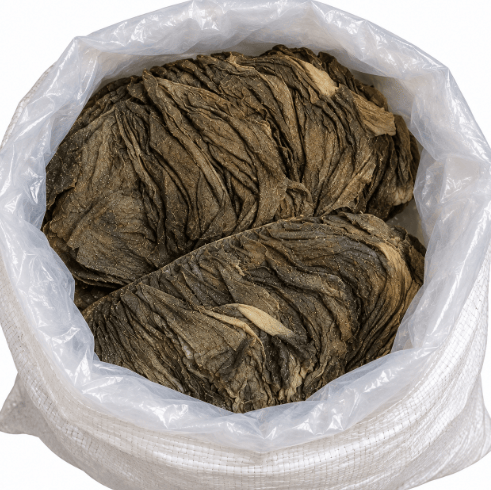
Produce clean, intact beef omasum with the characteristic book-like leaf structure preserved, free from attached fat and contamination, and sufficiently salted and dried before packing and freezing.
Finished product requirements
• Colour: Natural black and brown. Not bleached. No whitening agents used at any stage.
• Leaves: Substantially intact and attached to the central pillar. No significant tearing or detachment.
• Fat: No removable attached fat.
• Contamination: No visible dirt, faecal material or foreign matter.
• Surface salt: Loose salt brushed off before packing. No loose salt inside the pack.
• Moisture: Below 3% at the worst location in the piece (root and deep folds, not surface only).
• Retained salt: Below 1% in the finished tissue.
• Odour: Fresh, characteristic of salted dried omasum. No sour, rancid, putrid or mouldy odour.
Grade and weight
Grades are based on the finished weight of the individual piece after pressing, drying and equilibration.
| Grade | Finished weight per piece | Notes |
| AA | 1,500 g and above | Some buyers set a lower AA floor. Confirm before production. |
| A | 800 g to below 1,500 g | |
| B | 500 g to below 800 g | |
| C | Below 500 g | Outside this specification. Agreed separately with the buyer if required. |
Grade mix for this shipment: AA 50%, A 50%. Confirm the mix basis (count or mass) with the buyer before production.
Processing steps
1. Open and empty.
Cut the omasum open and empty the gut contents completely.
2. Wash between the leaves.
Fan the leaves open and flush each space with potable water. Work by hand to clean the deep folds and the thick root area. Scrub only where necessary. Excessive scraping damages the leaves and produces pale surface areas that are unacceptable in a natural-colour product. Use smooth, round scraper where necessary. Use warm water at aproximately 40°C. This main omasum washing operation uses approximately 40°C water because it improves physical removal of digesta, mucus, adhering material and fat.
3. Trim fat.
Remove all removable external and internal fat with a sharp knife.
4. Final rinse.
Rinse thoroughly with potable water. As an additional microbial control step, briefly rinse the cleaned omasum in diluted food grade vinegar. Commercial vinegar with a labelled acidity of approximately 5 percent, calculated as acetic acid, may be used because it is generally more readily available than concentrated food grade acetic acid. Dilute the vinegar with potable water to obtain a final acetic acid concentration of approximately 1 to 2 percent. For vinegar containing 5 percent acetic acid, one part vinegar to four parts potable water produces approximately 1 percent acetic acid. Use the solution warm, at approximately 35 to 40°C. Contact should be brief and the omasum should remain in the solution for no longer than 30 seconds, followed by immediate draining. The purpose of this treatment is to reduce surface microbial contamination immediately before salting and drying. It is not a sterilisation step and does not replace hygienic handling, thorough cleaning, adequate salting and effective drying. Where the vinegar or acetic acid is used solely as a processing aid during this washing step and has no technological function in the finished omasum, it does not normally have to be declared as an ingredient on the product label. The acidity stated on the vinegar label must always be checked because commercial vinegar does not invariably contain exactly 5 percent acetic acid..
5. Apply salt.
Drain the omasum and apply food-grade sodium chloride by hand. Open the piece fully and work salt physically between successive groups of leaves, into the deep folds and around the thick root and central pillar. Salting only the outside of a closed piece is not adequate.
6. Drain.
Place the salted omasum in a clean perforated food-grade tray or container so that the liquid drawn from the tissue can drain away freely. Do not leave the product standing in its own expressed liquid.
7. Press.
Cover the omasum with a clean food-grade surface and apply weight. Pressing physically removes water and brine from the folded structure, reducing the total amount of water the drying step must remove.
8. Cure hold.
Hold the pressed product for 24 to 48 hours as the initial curing period. The actual operating time should be confirmed from production trials, because piece thickness and salt penetration rate determine the endpoint rather than the clock alone.
9. Dry.
Remove from the press and continue drying under clean, protected conditions. A controlled smokehouse-cooker-dryer set to its drying function (no smoke, no cooking cycle) gives the most reliable result, particularly in humid climates. Passive air or solar drying may be used where conditions allow, provided the product is protected against insects, rain, dust and contamination. The thick root and deep folds dry considerably more slowly than the exposed leaf surfaces. The drying endpoint is a water activity or moisture reading at the worst location in the piece, not elapsed time.
10. Remove loose salt.
Once drying is complete, brush all loose surface salt from the outside of the piece using a clean, dry brush. Do not wash the finished product again, because this would reintroduce water and require a separately validated redrying stage.
11. Grade and weigh.
Sort by finished piece weight and assign to the appropriate grade.
12. Pack.
Load into a food-contact moisture-barrier liner inside a woven polypropylene bag. Standard commercial packs are 40 kg. Seal the liner and the outer bag securely. No loose salt or liquid should be added to the pack.
13. Freeze.
Freeze the sealed pack to minus 18°C.
14. Maintain the cold chain.
Keep frozen during storage, loading and transport. Ship in a reefer container maintaining the specified frozen temperature through dispatch.
Full consolidated technical guide and trade specification available at Dry-salted beef omasum: product specification and for shelf stable omasum, at Dry Salted Beef Omasum Production – No Refrigeration Needed.
Trade enquiries and structured agreements: contact Eben and Christa van Tonder via earthwormexpress.com or at Ebenvt@ebenvt