Discussion Paper: Requirements, Mechanisms of Transfer and Tests
Eben van Tonder and Christa van Tonder-Berger. 12 October 2026
Summary
My earlier work traced the use of urine in antiquity and its value as a curing agent. The ancients valued bodily excretions and experimented with them. Strabo [1] (about 64 BCE to 24 CE) reported that the Cantabrians stored urine in cisterns, Pliny the Elder [2] gave chapters of his Natural History (77 CE) to remedies from urine and saliva, and the Koryak of Kamchatka collected and drank the urine of people intoxicated with fly agaric [3]. Direct use of urine is a simple possible precursor of the use of nitrous earth, the nitrate bearing earth that the saltpetre makers of Europe dug from stables and houses from the 14th to the 19th century. At Hallstatt the meat was cured in Haselgebirge, the salt clay of the mine. I examine whether nitrate from urine soaked earth of the high valley reached the curing basins together with that salt clay.
A nitrate cure has two bacterial stages. Nitrifying bacteria first form nitrate from the nitrogen of urine, dung and refuse, which requires oxygen and little salt. Staphylococci then reduce the nitrate to nitrite in the meat. Their nitrate respiration is induced and favoured under oxygen limitation, and they tolerate strong salt. The two stages cannot run efficiently at the same time under the same saline and oxygen limited conditions. The gross nitrogen in the urine of one person over 8 to 14 days equals the nitrogen of the nitrate that one basin needs for lasting colour, although this does not imply efficient conversion to nitrate. The limits are nitrification, salt, aeration, protection from rain and time.
The source of nitrogen, the place of nitrification and the medium of transfer need not have been the same. A byre floor collects nitrogen, a heap of its cleanings may nitrify, and water leached from that heap may bring nitrate to the basin. I assume that the clay of the basins stayed in the basins, and I examine principally a local source, because human waste and the waste of household animals could have provided such earth in the high valley. Material from outside Hallstatt, such as traded sal ammoniac, cannot be excluded. Three mechanisms of transfer are compared, namely nitrous earth added directly, a water extract of it, and accidental entry through salt, floors, walls, storage or water. A geological source, nitrate in the Haselgebirge itself, has not been excluded and has to be tested first. Very little would be needed. For illustration only, if 5 to 10 tonnes of salt clay were in contact with the meat of one basin, about 41 to 134 mg of nitrate per kg would supply the modern nitrate equivalent of lasting colour. The test is therefore for nitrate at this trace level and not for visible saltpetre. The measurements that would test the proposal are listed at the end.
Figure 1. The proposed route from urine to the cured pigment at Hallstatt

Introduction
In earlier articles on EarthwormExpress I argued that urine would have been an effective curing agent [4, 5, 6]. Its urea yields ammonia, bacteria convert the ammonia to nitrite and nitrate, and nitrate yields the nitric oxide of the cured pigment. In 2025 Christa and I proposed [7] that small amounts of urine were added to the Hallstatt basins. In The Hallstatt Curing Method [8] and in Meat Preservation in Clay with Ammonia, Saliva and Lime [9], written with Carys Brynwyn, I examined the ammonia that meat releases under salt clay. My trials of that route ended in putrefied meat before much ammonia had formed. I reported the result in the article on Hallstatt and the Benedictine abbey of Admont [10], founded in 1074.
As a store of nitrogen for curing, however, urine is poor. Bacteria hydrolyse its urea, the liquid reaches a pH of about 9 [11], and much of the nitrogen escapes as ammonia. Abell and colleagues [12] allowed for a loss of about 45 percent in their model of urine salts. Where people needed the nitrogen of urine, they took it from the ground instead. Biringuccio (1540) named the earth of stables and old latrines, and Ercker (1580) the earth of old sheep pens [13]. Wiesenthal (1776) [14] listed the earthen floors of stables, cellars and sheds where cattle resort, and the ducal ordinances of Württemberg from 1554 to 1747 regulated the digging of barns, stables and threshing floors [15]. A floor collected urine without labour, and bacteria converted its nitrogen over years into nitrate, which, unlike ammonia, is not volatile, although it can later be lost by leaching or denitrification.
Farm sources of the 18th and 19th centuries, collected in my article A Newspaper’s Record and Old Chemistry Textbooks References on Use of Urine and Dung in Antiquity [16], describe clay and earth prepared with urine on purpose. The New England Farmer of 3 January 1838 reported that in Sweden urine was mixed with clay in vats and left for at least twelve months [16]. The Hillsborough Recorder of 1 August 1844 advised fixing the ammonia of urine with gypsum, lime or ashes, and the Philadelphia Inquirer of 12 March 1791 described a hog wallow of loam in which urine and dung composted into manure [16]. Its application to meat is my hypothesis.
At Hallstatt the curing was done in clay. The basins were found filled with salt clay, and Barth [17] concluded that the curers used the unrefined small salt of the mine. The Natural History Museum Vienna [18] identifies the material as Haselgebirge, a natural mixture of salt, clay and anhydrite, and notes that the bacon took a strong flavour from it. The possibility examined here is that a second material, earth or clay enriched with the nitrogen of urine, was combined with the salt clay in the basins. Chemistry sets one condition. Because the nitrogen of urine becomes nitrate only where salt is scarce and air is present, the urine earth could have matured on a floor, in a latrine, in a wall or in a heap of pen cleanings in the high valley.
In this paper the word cure refers to the chemistry of the cured colour and of nitrite. Salt, loss of water, cold and maturation preserved the Hallstatt meat and do not require nitrate. Nitrite adds a protection against botulism and other bacteria that salt alone does not give, and this is taken up in the section on colour as a sign of safe meat.
Earlier articles used
Table 1 lists the earlier articles on EarthwormExpress used in this paper, with the sources cited in them. Statements that rest on my own conjecture are marked.
Table 1. Earlier articles on EarthwormExpress used in this paper
| Article | Contribution, with the sources cited there |
| Saltpeter. A Concise History and the Discovery of Dr. Ed Polenske [19] | Polenske (1891) [20] found that microorganisms reduced the nitric acid of a curing brine to nitrous acid and ammonia. Lemery (1717) wrote that nitre forms slowly in the upper part of the soil and is of organic origin, citing Aulie (1970) |
| Salt, 7000 Years of Meat Curing [21] | Binkerd and Kolari [22] wrote that desert salts contained nitrates as impurities and that meat preservation was first practised in saline deserts and coastal areas |
| And Then the Mummies Spoke [23] | The open question of how easily nitrate salts could be collected from pens and animal housings |
| Chapter 05.01 [24] and Chapter 12.04 [25] of Bacon & the Art of Living | Cato described curing ham with salt alone about 160 BCE. Saltpetre was in curing mixes across Europe by 1750, citing Keeton and colleagues (2009) |
| Chapter 12.06.2 of Bacon & the Art of Living [6] | Ammonia from urine treated as a curing agent |
| Chapter 12.07.1 [26] and The Nitrogen Cycle and Meat Curing [27] | The nitrogen cycle, Polenske (1891) [20], Lehmann (1899), Maassen and Hoagland (1908) |
| A Newspaper’s Record and Old Chemistry Textbooks References on Use of Urine and Dung in Antiquity [16] | Urine mixed with clay and matured in Sweden and China [16]. Urine fixed with gypsum, lime or ashes [16]. Stale urine in cattle medicines of 1749 |
| Re-evaluation of the Discovery of Nitrate and Nitrite Curing [4] | The thesis that urine and dung were managed and used in curing before saltpetre and sal ammoniac. Conjecture |
| Chemistry and Biochemistry of Fertilizer Production [28] | The nitre bed, turned to keep it aerobic. Ercker (1580) |
| The Hallstatt Curing Method [8], Meat Preservation in Clay with Ammonia, Saliva and Lime [9], The Hallstatt Meat Curing Method. An Update [7] and Urine in Meat Curing [5] | The proposed pathways for the Hallstatt basins and the proposal that urine was added. Conjecture, tested in this paper |
From Pure Urine to Nitrous Earth
Classical authors record many uses of bodily excretions. Strabo [1], who wrote at the turn of the eras, reported that the Cantabrians and their neighbours bathed with urine aged in cisterns and washed their teeth with it (Geography 3.4.16). Pliny the Elder [2] gave separate chapters of Book 28 of his Natural History, completed in 77 CE, to the properties of human spittle, to remedies derived from urine, to the signs of health read from urine and to remedies from the spittle of women (chapters 7, 18, 19 and 22 in the translation of Bostock and Riley). Suetonius [29], writing in the early 2nd century CE, records that Vespasian, emperor from 69 to 79 CE, taxed the urine of the public latrines and replied to the objection of his son Titus with the remark that the coin came from urine and did not smell (Vespasian 23.3).
Urine was also collected because people had observed what passed into it. Krasheninnikov, whose account of Kamchatka appeared in Russian in 1755 and in the English translation of Grieve in 1764, wrote that the Koryak did not allow a person intoxicated with the fly agaric, Amanita muscaria, to pass water on the ground [3]. They gave him a vessel to save his urine in and drank it, and it had the same effect as the mushroom itself [3]. Bourke (1891) [3] quotes the passage from pages 207 to 209 of the translation. Bourke (1891) [3] also attributes to Steller, who worked in Kamchatka in the 1740s, the observation that the urine remained effective to the fourth and fifth man, and Jochelson, who worked among the Koryak in 1900 and 1901, wrote that the urine of persons intoxicated with fly agaric is not wasted [30]. I discussed the practice in The Ancient Use of Urine as a Filter for Amanita Muscaria Consumption [31]. It depended on noticing that the effect of the mushroom reappeared in the urine and on collecting that urine on purpose.
Reindeer herders manage human urine for their animals as well. Among the Tozhu of southern Siberia, men urinate near the house, sometimes into a urinal built for the reindeer, where the urine freezes and is kept for the animals to lick, and reindeer gather round a man who is about to urinate [32]. Donahoe (2004), cited by Stépanoff [32], reports that Tozhu herders give their urine selectively to favoured animals or to those that seem to need it most. The same herders give salt so that the reindeer return to the camp, and Stépanoff [32] describes urine as strengthening the attachment between reindeer and people. Saliva was treated with the same attention, and my work with Carys Brynwyn on meat preservation in clay with ammonia, saliva and lime [9] examines its place in curing.
Pure urine, fresh or stored, needs less technology than nitrous earth and may have been used before it. Applied directly it supplies little nitrate, because its urea becomes ammonia, and in strong salt its nitrogen remains mainly ammonium. My trial with ammonium chloride produced a red colour by a route that is still unexplained (Routes Without Nitrate). People who poured urine on floors, heaps and clay over generations could have observed that the soaked earth became stronger than the urine itself. Nitrous earth was a major preindustrial source of nitrate in Europe from the 14th to the 19th century, and its use may be far older. Neither a transition from urine to earth nor its date can be demonstrated, and the sequence is a hypothesis.
Nitrate, Nitrous Earth and Saltpetre
Nitrate is the ion NO3−, the only part of these materials that the bacteria of the cure use. Nitrous earth is earth in which bacteria have formed nitrate from urine, dung and other organic material. Saltpetre is potassium nitrate refined from that earth. The historical analogue of the Hallstatt source is therefore nitrous earth and not saltpetre.
The salts of nitrous earth
Ganapathi Rao and colleagues [33] found the nitrates of calcium and magnesium, with common salt, in crude Indian saltpetre. Soentgen [34] describes the wall saltpetre of European buildings as calcium nitrate, and Abell and colleagues [12] identified nitratine, sodium nitrate, in the refuse of Aşıklı Höyük. The saltpetre makers converted calcium nitrate to potassium nitrate with wood ash for gunpowder [14, 34, 35]. A cure needs no such step, because nitrate reductase acts on the nitrate ion whatever cation accompanies it.
Three stages of a nitrate source
Bacteria first form the nitrate. It then accumulates in earth or migrates with moisture to a surface, and the saltpetre men broke open the walls of houses to obtain it [34]. Finally, people concentrate it by leaching, boiling and refining, or simply carry the earth or its water elsewhere. The saltpetre industry needed all three stages and refined the third. The Hallstatt hypothesis needs only the first two and a simple transfer of earth or water to the basin.
Recognition without chemistry
Nitrate salts move with moisture and crystallise where water evaporates, so that a white efflorescence forms on the walls of cellars, stables and houses. German calls it Mauersalpeter, or Kalksalpeter because it is calcium nitrate [34]. Thévenot (1665) [36] reported that Indian makers chose the black earth of deserted villages, and the peasants of Württemberg knew what made saltpetre grow on their floors and what destroyed it [15]. These observations from the 17th to the 19th century are used here only as an analogy. It follows from them only that people who lived beside such material could recognise it by sight.
The Hallstatt curers would likewise have needed only empirical observations, for example that earth from one place gave redder meat, that a white crust from a wall improved the colour, that a basin used for many cycles cured better than a new one, or that water from a certain floor or heap improved the cure. A red cured interior beside grey salted meat is a conspicuous difference. Selection of the material that produced it required no knowledge of its chemistry, and a conscious nitrate technology is not proposed.
Wall saltpetre in early curing
The historical account of Binkerd and Kolari [22], as summarised by Keeton [37] (still to be checked), states that saltpetre was gathered in China and India before the Christian era for use in meat curing, together with wall saltpetre, calcium nitrate formed by nitrifying bacteria on the walls of caves and stables. If the account is correct, however, the technological step needed for the Hallstatt hypothesis becomes smaller. A community did not need to manufacture potassium nitrate. It could recognise a nitrate bearing crust or earth and apply it directly to meat.
Wall efflorescence is visible, concentrated, dry, easily scraped and protected from rain. For this reason it may have been the material through which the effect was first noticed, with floor earth and its water extract following as larger sources. Recognition and supply are different questions. A wall crust is easy to notice but small in quantity, whereas the cleanings of a byre are large in quantity but less conspicuous. A possible sequence, which is not documented, runs from the wall crust to old floor earth in larger quantity and then to a water extract that moves nitrate efficiently.
Calcium and limestone
The first oxidation of nitrification releases acid, and Udert and colleagues [11] found that the nitrification of urine stopped at about pH 6 when the acid was not neutralised. Calcium carbonate neutralises that acid, and calcium is also the counter ion of the accumulating nitrate. The saltpetre makers added lime to their beds [14, 34], and Smith [35] attributes the failure of an experimental pit bed to poor aeration and to too little urine and lime. Kidd (1814) [38] studied saltpetre that formed on the walls of buildings in Oxford, found it almost always on limestone, and concluded that lime appeared necessary to its natural production. The Dachstein massif above Hallstatt is limestone [39]. Calcareous earth would have favoured the formation of nitrate.
Two Routes to Nitric Oxide
In Urine in Meat Curing [5] and The Hallstatt Curing Method [8] I described the route from urea through ammonia to nitrite and nitrate, performed by Nitrosomonas and Nitrobacter, which need oxygen. In my history of saltpetre [19] I reported that Polenske [20] found in 1891 that microorganisms reduced the nitrate of a curing brine to nitrite. The chapter on the nitrogen cycle in Bacon & the Art of Living [26] adds Maassen, who found that 85 of 109 bacteria reduced nitrate, and Hoagland, who established in 1908 that this reduction is necessary for the cured pigment. Table 2 joins the two routes. Bacteria drive the first four steps, and chemistry in the meat completes the last three.
Table 2. The route from ammonia and the route from saltpetre to the cured pigment
| Step | Reaction | Agent | Condition |
| 1. Ammonia route | CO(NH2)2 + H2O → 2 NH3 + CO2 | Bacteria with urease | Stored urine. The pH rises to about 9 |
| 2. Ammonia route | NH3 + 1.5 O2 → NO2− + H+ + H2O | Ammonia oxidising bacteria such as Nitrosomonas | Oxygen, little salt, acid neutralised |
| 3. Ammonia route | NO2− + 0.5 O2 → NO3− | Nitrite oxidising bacteria such as Nitrobacter | Oxygen, little salt. Months to years in earth |
| 4. Saltpetre route | NO3− + 2 H+ + 2 e− → NO2− + H2O | Staphylococci with nitrate reductase | Little oxygen. Salt tolerated |
| 5. Both routes | NO2− + H+ ⇌ HNO2 | Chemistry | Acidity and reducing reactions in the meat |
| 6. Both routes | 2 HNO2 ⇌ N2O3 + H2O, and N2O3 ⇌ NO + NO2 | Chemistry | In the meat |
| 7. Both routes | NO + myoglobin → nitrosomyoglobin | Chemistry | The red pigment of raw cured meat |
Steps 2 and 3 need air and are severely inhibited by strong salt, whereas step 4 runs best with little oxygen and tolerates salt. The ammonia route must therefore be completed in earth before the cure, and the saltpetre route runs in the cure itself. Steps 5 to 7 are simplified after Honikel [40]. In the meat, reducing reactions as well as acidity promote the formation of nitric oxide from nitrite.
The Requirements of a Nitrate Cure
The Late Bronze Age curing basins in the Salzberg valley above Hallstatt date to the 13th to 12th century BCE [18]. A nitrate cure there required nitrate, limited oxygen during the cure, a source of nitrogen and an aerobic stage in which that nitrogen became nitrate.
Nitrate
Bacteria reduce nitrate to nitrite, and nitrite reacts with the meat. Honikel [40], of the federal meat research centre at Kulmbach that is now part of the Max Rubner-Institut, described the remaining steps as chemistry. Gøtterup and colleagues [41] found that when nitrate was the only curing agent, only staphylococci with nitrate reductase formed the pigment. Sindelar [42] gives 2 to 14 mg of nitrite per kg as sufficient to induce cured colour and 40 to 50 mg per kg to maintain it, which corresponds to about 3 to 19 and 54 to 67 mg of nitrate per kg.
The nitrate need not be pure. Honikel, as quoted by Huffman and Bryan [43], wrote that saltpetre was recognised in the 19th century as a contaminant of salt that reddened meat, and Binkerd and Kolari [22] wrote that desert salts contained nitrates as impurities. Krause and colleagues [44] cured ham with vegetable juice powder as the only source of nitrate, together with Staphylococcus carnosus.
Limited oxygen
Staphylococcus carnosus reduces nitrate to nitrite in cured meat [45]. Oxygen limitation, together with nitrate or nitrite, induces its nitrate and nitrite reductases [46, 47], and the organism then uses nitrate in place of oxygen [48]. Once the nitrate is used up, the cells reduce nitrite further to ammonia, a step that nitrate inhibits [46]. As a result, an oxygen limited cure with a reserve of nitrate keeps its nitrite.
Staphylococci reach the meat from the raw material, the surroundings or the salt, and staphylococci made up about 60 percent of the microbiota of salt used for Spanish ham, according to Cordero and Zumalacarregui (2000) as cited by Shi and colleagues [49]. Casaburi and colleagues [50] found that six strains from traditional sausages grew with 10 to 20 percent of salt and at pH 5.0 and 5.5, and reduced nitrate at 15 to 30 °C. For colder conditions, the Wiltshire specification [51] requires a live brine at 1 to 5 °C with more than one million colony forming units, mainly micrococci and lactobacilli, and a controlled conversion of nitrate to nitrite. The rate in pork under mine salt at 6 to 8 °C remains to be measured.
A source of nitrogen
Rose and colleagues [52] give a median urine output of 1.42 litres per person per day with 10.98 g of nitrogen, mainly as urea. Nitrate supplies only 18 to 60 mg of that nitrogen, or 0.2 to 0.5 percent [53]. Grazing steers passed 93 to 134 g of urine nitrogen per day [54], and dairy cows 143 to 247 g [55], in the form of urea, allantoin, hippuric acid and creatinine [56]. Bronze Age cattle were smaller, and their output was lower.
Dung and refuse added further nitrogen. Urine was probably the principal readily mobile input, because its nitrogen is dissolved, whereas the nitrogen of dung is less soluble [12]. Almost none of this nitrogen is nitrate.
Formation of nitrate before the cure
Urease bacteria hydrolyse urea to ammonia, and two groups of nitrifying bacteria oxidise the ammonia, first to nitrite and then to nitrate.
CO(NH2)2 + H2O → 2 NH3 + CO2
NH3 + 1.5 O2 → NO2− + H+ + H2O
NO2− + 0.5 O2 → NO3−
Soentgen [34] summarises the craft of the saltpetre makers in one sentence. Saltpetre forms when bacteria decompose urine, dung and other organic material in the presence of air, and the beds needed air, moderate temperatures and a roof against rain. Four limits follow.
Oxygen. Both oxidations consume oxygen. Under strongly reducing conditions other bacteria respire nitrate and release its nitrogen as gas, provided that suitable organisms and electron donors such as organic material are present [57]. Mielke and Ellis [58] found an average of 1,800 kg of nitrate nitrogen per hectare in soil cores of 9.1 m under feedlots in use, 7,200 kg under abandoned feedlots and 570 kg under cropland.
Salt. Moussa and colleagues [59] found that 10 g of chloride per litre reduced the activity of ammonia oxidising bacteria by 36 percent, and that 40 g reduced the activity of both groups by about 95 percent. Inubushi and colleagues [60] found nitrification in two soils inhibited from an extract conductivity of about 1 dS per m. Du and colleagues [61] incubated soil with sodium chloride and found that 0.04 and 0.10 percent enhanced nitrification in the first week, whereas 0.20 percent inhibited it. Oren [62] attributes the absence of autotrophic nitrification at the highest salt concentrations to the small energy yield of the reaction.
Acidity. Without neutralisation, the oxidation of the ammonia in urine stopped at about pH 6, with no more than 50 percent converted and mainly to nitrite [11].
Time. Soentgen [34] gives at least two years for a managed bed. In modern trials with urine, dung and earth the yield after one and a half years was of the order of one percent [13], and in Württemberg the same stable floor could be dug again after six to eight years [15]. In a cold high valley I assume the process was slower than in the lowland.
Table 3. The two stages of a cure that begins with urine
| Stage 1. Formation of nitrate | Stage 2. Reduction of nitrate | |
| Reaction | Urea to ammonia, ammonia to nitrite, nitrite to nitrate | Nitrate to nitrite by bacteria, then nitrite to nitric oxide by chemistry |
| Organisms | Bacteria with urease and nitrifying bacteria | Staphylococci with nitrate reductase |
| Oxygen | Required | Must be scarce |
| Salt | Inhibits. About 95 percent loss of activity at 40 g of chloride per litre | Tolerated. Growth of staphylococci with 10 to 20 percent of salt |
| Acidity | Stops at about pH 6 unless the acid is neutralised | Acidity and reducing reactions of the meat favour nitric oxide |
| Time | Years | Days to weeks |
| Place | Aerated earth under a roof | The salted meat and the covered basin |
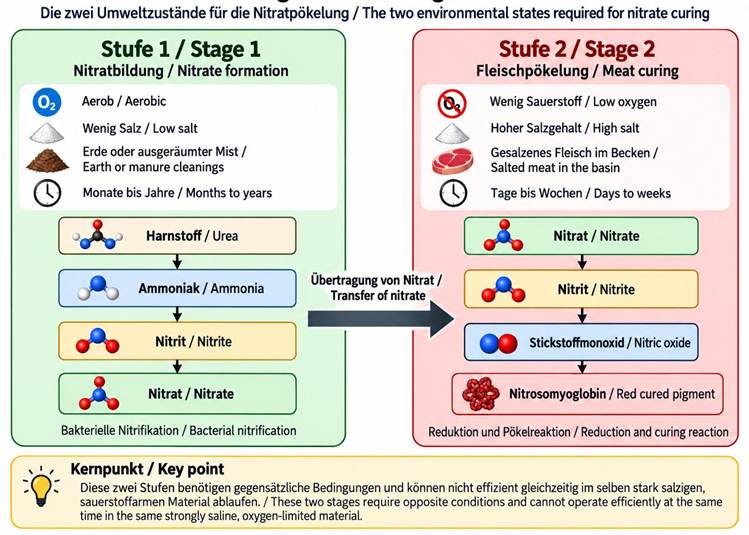
Efficient nitrification and nitrate reduction cannot occur simultaneously under the same strongly saline and oxygen limited conditions. A salty, wet material without air that receives urine accumulates ammonium and would be expected to form little nitrate by the conventional pathway. A material could, however, pass from one state to the other through dilution, aeration and reuse. The two states are compared in Figure 2.
Figure 2. The two environmental states of a nitrate cure
The Candidate Sources
Eight candidate sources are compared with the requirements in Table 4. Five come from my earlier work and from discussion. Plants are included because modern natural curing relies on them, a leached liquor because the saltpetre makers moved nitrate in that form, and natural nitrate in the Haselgebirge because it must be excluded before any other source is accepted.
Table 4. Candidate sources measured against the requirements
| Candidate | Nitrogen supply | Can Stage 1 take place | Assessment |
| Natural nitrate in the Haselgebirge | Not applicable | Not required | Untested. Must be excluded by measurement first |
| Urine poured into the basin | Large | No. The brine is too salty | Only the nitrate already in the urine takes part, and the volume needed for lasting colour is too large |
| Waste on the floor of the mine | Small in the Bronze Age, larger in the Iron Age | No. Salt, and no bacterial turnover | Improbable |
| Haselgebirge as a pen floor or a salt lick | Large | Only at the diluted margin | Weak. Open ground also loses nitrate to rain |
| Nitrous earth under a roof | Large | Yes | Strong mechanistic candidate. The classic historical source of nitrate |
| Liquor leached from nitrous earth | Taken from the earth | Yes, in the earth before leaching | Strong mechanistic candidate. The documented historical method of moving nitrate out of earth |
| Plants grown on nitrified ground | Taken from the soil | Yes, in the soil beneath the plants | Possible. A second path from the same ground |
| Recovered and boiled brine | None of its own | No | Concentrates nitrate that came from another source |
Natural nitrate in the Haselgebirge
Nitrate in uncontaminated Haselgebirge remains to be measured. If the rock salt or its clay contained enough natural nitrate, the salt alone would have supplied the cure, and the pathways through urine would be unnecessary. Very little would be needed. The mass of salt clay in one basin remains to be determined. For illustration only, if 5 to 10 tonnes of Haselgebirge were in contact with the meat of one cycle, the 405 to 670 g of nitrate required for lasting colour (Table 5) correspond to only 41 to 134 mg per kg of salt clay. This possibility is simpler than any of the others and has to be excluded by measurement before they are accepted. It is treated as the decisive open question before the list of measurements.
Urine poured into the basin
A brine in contact with solid salt contains several times the 40 g of chloride per litre at which nitrification almost stopped [59]. Only the nitrate already present in urine, about 57 to 186 mg per litre according to Florin and colleagues [53] and Rose and colleagues [52], could take part, and lasting colour in one basin cycle would need 2,200 to 11,700 litres (Table 5). Stored urine is also alkaline, which hinders the acid step that releases nitric oxide [40]. These nitrate figures come from modern diets.
Waste on the floor of the mine
Bronze Age mine waste consists of spent tapers, discarded items, clay and gypsum with hardly any salt, and only seven pieces of excrement are known from those workings [63]. The Iron Age waste, from about 800 to 400 BCE, contains salt and excrement in quantity but postdates the basins by centuries. Its excrement survived because salt and airtight conditions excluded bacteria [18, 64], so that its nitrogen was never converted to nitrate.
Haselgebirge under animals
Pens floored with Haselgebirge, or a lump of it used as a salt lick, have been proposed. Haselgebirge is about 55 percent salt [65], and urine nitrogen on it would remain ammonium except at diluted margins. Salt also does not keep animals in one place, since cattle with GPS collars in Oregon were found near water 354 times and near salt 38 times [66]. Salt increased the number of urinations by up to 69 percent [67] without changing the total nitrogen in urine [56]. Wiesenthal (1776) [14] took earth only where rain had not penetrated, and an open lick in a wet alpine valley would lose its nitrate.
Nitrous earth under a roof
Biringuccio (1540) and Ercker (1580) named the earth of stables, latrines and sheep pens as the best source [13]. Soentgen [34] describes licensed saltpetre men who dug floors and walls from the 14th to the middle of the 19th century. A man was expected to deliver about one tonne a year from more than a hundred times that weight of earth, which usually contained only a few grams per kg. In Switzerland the diggers worked mainly in cattle stables, and before the early 16th century the Swiss imported saltpetre mainly from southern Germany and the Tyrol [68]. Indian earths analysed by Hooper contained 1.17 to 29.6 percent of potassium nitrate, and most worked earths 3 to 5 percent [33]. The preference for old stables and deserted villages is consistent with the higher nitrate under abandoned feedlots [58].
Liquor leached from nitrous earth
Thévenot (1665) [36] described Indian makers who ran water through the earth and boiled the liquor. Wiesenthal (1776) [14] gave the same instruction, and Smith [35] reports leaching in barrels in the experiment of the Medieval Gunpowder Research Group. Water passed through a basket of nitrous earth takes up most of the nitrate. Poured on the salt clay without boiling, it would have brought nitrate to the meat without earth, together with the common salt and soluble organic material of that earth.
Plants grown on nitrified ground
Gebauer and colleagues [69] found higher nitrate contents in Central European plant species from nitrate rich sites. Herbs from dunged ground could have supplied nitrate, as vegetable powder does in modern natural curing [44]. Plants form no nitrate themselves but take it from soil in which bacteria formed it. No botanical analysis of the basin fill is known, and the museum [18] notes that the Hallstatt bacon needed no spices.
Recovered and boiled brine
Barth [70] described a partitioned gap in the structure exposed in 1877 from which concentrated brine could be scooped, and graphite clay vessels for boiling. Boiling concentrates existing nitrate but forms none. In Indian refining, common salt crystallised first and nitre afterwards from the remaining liquor [33]. Barth [70] interpreted the boiled liquor as a food, an interpretation that requires no nitrate.
The Quantities
The figures for one basin and one cycle are given in Table 5, assuming complete transfer and complete reduction of the nitrate. The real requirement would be higher. The figures compare the requirement with modern thresholds for cured colour and are not a reconstruction of Bronze Age dosing. Quantities reported historically as potassium nitrate have been converted to the nitrate ion for comparison.
The requirement for one cycle can be written as two equations.
Required nitrate = meat mass × target nitrate equivalent ÷ transfer efficiency
Required source mass = required nitrate ÷ nitrate concentration of the source
The unknowns are the mass of meat, the mass of Haselgebirge in contact with it, the nitrate concentration of each material, the efficiency of transfer, the efficiency of reduction to nitrite and the dose that forms the pigment at 6 to 8 °C. Each measurement can later replace one assumption without changing the calculation.
Table 5. Nitrate equivalent of modern cured colour thresholds for one basin and one cycle, and the material that could supply it
| Quantity | Value | Basis |
| Meat and bone per basin per cycle | 7.5 to 10 tonnes | 150 to 200 pigs [18] at about 50 kg per carcass [71] |
| Nitrate to induce cured colour | 23 to 190 g | 3 to 19 mg per kg, from Sindelar [42] |
| Nitrate to maintain cured colour | 405 to 670 g | 54 to 67 mg per kg, from Sindelar [42] |
| Nitrogen contained in 405 to 670 g of nitrate | 91 to 151 g | Calculated |
| Urine nitrogen of one person | About 11 g per day | Rose and colleagues [52] |
| Urine nitrogen of one grazing steer | 93 to 134 g per day | Betteridge and colleagues [54], modern animals |
| Unaltered urine needed to maintain colour | 2,200 to 11,700 litres | 57 to 186 mg of nitrate per litre, from Florin and colleagues [53] |
| Earth with 3 g of saltpetre per kg needed to maintain colour | 220 to 364 kg | A few grams per kg in European earth [34]. The figure of 3 g is my illustration |
| Earth with 1 percent of saltpetre needed to maintain colour | 66 to 109 kg | Order of magnitude from the Medieval Gunpowder Research Group [13] |
| Earth with 3 to 5 percent of saltpetre needed to maintain colour | 13 to 36 kg | Leather and Mukerji, cited by Ganapathi Rao and colleagues [33] |
The 91 to 151 g of nitrogen required equal the urine nitrogen of one person over 8 to 14 days, or of one modern steer over one to two days. Even if only one percent of that nitrogen ended as nitrate, the urine of a village of 50 people over about two and a half to four weeks would suffice. Nitrogen is therefore not the limit. The difficult steps are converting enough nitrogen into nitrate and keeping it from washing away. Transfer need not be efficient either. For 500 g of nitrate from earth that contains 1 percent of nitrate, 50 kg of earth are needed at complete transfer, 100 kg at 50 percent, 200 kg at 25 percent and 500 kg at 10 percent. A floor of 4 by 4 metres, the size of an excavated basin [63], dug one foot deep as Wiesenthal directed, yields about 6 tonnes of earth at an assumed density of 1.3 tonnes per cubic metre. At 3 g of saltpetre per kg it would contain about 12 kg of nitrate, enough for 17 to 29 basin cycles.
From these calculations it follows only that the total quantity is plausible. The rate and depth of nitrate transfer into whole muscle cannot be derived from them and have to be measured in a curing experiment with the Hallstatt geometry, temperature and salt clay.
Three Mechanisms of Transfer
The Haselgebirge of the basins would not have been carried out of the valley and brought back, and the clay remained in them. Nitrous earth from outside Hallstatt is unlikely, because the floors, latrines and byres of a village occupied all year could have supplied it locally. Other outside material, for example sal ammoniac obtained by trade, remains possible. On these assumptions the nitrate could have reached the meat by three mechanisms, which are compared in Table 6. The entries derive from the evidence above, and none has been measured at Hallstatt.
Table 6. Three mechanisms by which nitrate could have reached the meat
| Criterion | 1. Nitrous earth added directly | 2. Water extract of nitrous earth | 3. Accidental entry |
| Source of nitrogen | Urine, dung and refuse on floors, in latrines and on walls of the high valley | The same nitrogen, dissolved in water | Either of the first two, without intention |
| Ability to nitrify | Good in aerated floor earth and heaps of cleanings | Nitrification takes place in the earth before leaching | Little expected in salt clay or mine waste. Elsewhere as in the source |
| Protection from rain | Required. Roofed floors and walls | Required for the earth. The liquor is made when it is needed | Not controlled |
| Salt concentration | Low on a floor where salt is fed in small pieces | Low. The liquor contains the salt of the earth | Variable |
| Transfer mechanism | Earth scooped and carried in baskets | Water passed through earth and poured on the clay | Salt stored or handled on nitrous floors, basins sunk in such ground, water from such ground |
| Required quantity per cycle | 13 to 364 kg of earth, according to its grade (Table 5) | The nitrate of the same earth in a smaller volume of water | Unknown |
| Archaeological visibility | Phosphate, spherulites and faecal markers of floor earth in the basin fill | Low. Only a heap of leached earth and the vessels | Lowest. No distinct deposit |
| Historical or ethnographic analogue | The nitrous earth of the saltpetre makers and urine clay matured on the farm [16] | The leaching of the saltpetre makers [14, 35, 36] | Nitrate as an unrecognised impurity of salt [22, 40] |
| Experimental testability | Curing trial with byre earth | Curing trial with a leachate of byre earth | Analysis of stored salt and of the trial salt of Barth [17] |
The mechanisms are not exclusive, and accidental entry could have accompanied either of the others. Direct addition and the water extract have the closest historical analogues, whereas accidental entry requires no intention at all.
Possible Collection Sites in the High Valley
A working cure also needs a place in the high valley where the material lay ready to be scooped up. Table 7 assigns eight such places to categories rather than to numbered ranks, because the available evidence is not sufficient for a finer order. No written record exists for the 13th century BCE, and the categories rest on excavated evidence and on chemistry. The first six places belong to the time of the basins and the last two to the Iron Age, from about 800 to 400 BCE.
Table 7. Places where the material could have been scooped up, grouped by category
| Place and category | Recovered by excavation or recorded | Assumed | What it would deliver |
| Byre or fold in which animals received Haselgebirge as salt, with the heap of its cleanings. Strong mechanistic candidate | Pen floors were excavated at Oppeano and Povegliano (1650 to 1300 BCE), and the pens at Povegliano were cleaned out and the cleanings discarded outside [72]. Livestock were wintered indoors at Mooswinkel. Herders in Romania carry impure rock salt to the fold [73] | A byre stood in the high valley, and salt clay was fed in it | Nitrate in the aerated heap of cleanings. The trampled floor itself is without air and accumulates ammonium and phosphate |
| Walls and structural surfaces of roofed byres and houses. Strong candidate for recognition, small in quantity | Saltpetre men broke open the walls of houses to obtain nitrate [34], and peasants carted the earth of old walls to their fields [15]. Wall saltpetre is calcium nitrate [34] | Clay or calcareous walls of roofed livestock structures stood in the high valley | Nitrate efflorescence and nitrous wall earth, protected from rain and visible to the eye |
| Latrine or midden of the valley settlement. Strong chemical candidate, not attested locally | Only seven pieces of excrement come from the Bronze Age mine, which is consistent with waste being disposed of mainly at the surface, although changed mining and disposal practices are alternative explanations. A village population lived there all year [18] | The settlement had latrines and middens. It remains to be located | Nitrate, if covered and low in salt. This is the old latrine earth of Biringuccio [13] |
| Trampled ground at the basins and at the shaft mouths. Weak, because of salt | All mined salt, small chips included, was hoisted to the surface [18]. Hundreds of carcasses a year were salted in basins of 4 by 4 metres, and a thick bone deposit lay beside them [63, 71] | Workers urinated there, and spilled salt clay, blood and urine mixed underfoot | Mainly ammonium. Nitrate only at the margin, where the salt was thin |
| Stale urine collected in vessels and poured on the clay in the basin. Weak | Nothing direct. Bronze Age textiles from the mine were vat dyed, probably with woad, but no urine is mentioned [74] | Urine was collected | Ammonium and very little nitrate. In strong salt its nitrogen remains mainly ammonium |
| Mud at a natural brine spring. Weak, open to rain | Saline springs emerge at the surface in the high valley [18]. Deer seek out salty pools and rocks [75] | Animals gathered and urinated there | Some nitrate where the brine was dilute. Open ground loses it to rain |
| Floor waste of the Iron Age mine. Later than the basins | Salt chips were left on the floor with excrement in abundance, and food was cooked underground [18] | Urine fell on the same floor. No Iron Age basin is known | Ammonium. The salt preserved the waste |
| Floors of the later settlement on the Dammwiese. Later than the basins | Dwellings and farm buildings stood on the Dammwiese, where mining began in the 2nd century BCE [18] | Salt clay and urine met on those floors | Little nitrate where the ground was wet |
Where salt clay dominates, urine nitrogen remains mainly ammonium. The trampled ground at the basins, stale urine in the basin and the floor waste of the Iron Age mine would therefore have produced an ammonium rich clay rather than nitrous earth. Nitrate requires a low proportion of salt, as on a floor, in a latrine or in a heap of pen cleanings where salt is scarce.
For the byre to be a source, animals must have received Haselgebirge as salt. At the Alghianu beck in Vrancea County, Romania, Alexianu and colleagues [73] recorded between 2010 and 2014 that herders carry rock salt of 70 to 90 percent sodium chloride, mixed with dirt, to sheepfolds within about 15 km. The sheep there are kept indoors from December to the middle of April, and the informants prefer cleaner salt for their own food. Harding [75] quotes an estimate by Jockenhövel that 20 cows need 220 to 365 kg of salt a year. That Haselgebirge was fed to animals at Hallstatt is my inference.
Archaeological Evidence
The evidence comes from Bronze Age pen floors elsewhere, from the state of research at Hallstatt and from one site at which urine nitrate has been measured.
Pen floors of the Bronze Age
Nicosia and colleagues [76] studied four of eight waterlogged huts at Oppeano near Verona, dated to 1650 to 1550 BCE. The floors consisted of trampled herbivore dung alternating with ash and contained faecal spherulites, fragments of phosphate crust, herbivore faecal stanols and the pupal cases of the sheep ked. From the buds among the fodder the authors dated the use of the floors to winter and early spring.
At La Muraiola di Povegliano, dated to 1650 to 1300 BCE, Polisca and colleagues [72] and Baldan and colleagues [77] describe two hard orange crusts, 2 to 5 cm thick, covering about 6.5 square metres inside a possible barn. The crusts consist of 50 to 86 percent of hydroxylapatite, a calcium phosphate, with phytoliths, spherulites and herbivore stanols. The authors conclude that compacted dung and liquid waste were cemented under anaerobic conditions. They interpret crust fragments in ash deposits elsewhere on the site as the debris of periodic cleaning, discarded outside when the pens were cleared in spring.
Closer to Hallstatt, Jakobitsch and colleagues [78] found stable litter and manure at the pile dwelling of Mooswinkel on Lake Mondsee, dated to about 3770 to 3371 BCE, and concluded that cattle and sheep or goats were kept inside the settlement in winter.
Hallstatt
The museum [18] states that mudslides covered the Bronze Age surface with several metres of debris. The La Tène settlement on the Dammwiese, where mining began in the 2nd century BCE, was excavated in the 1880s and the early 20th century, before sediment chemistry was used. Late Bronze Age settlement pottery has, however, been found during recent building work in the high valley [18], so that people lived there at the time of the basins. At Dürrnberg no animal remains or harness parts have been found in the Iron Age mine [79].
Nitrate in occupation deposits
Aşıklı Höyük in central Turkey was occupied from about 10,400 to 9,300 years ago, and sheep and goats were kept inside the settlement. Abell and colleagues [12] analysed 113 samples. The general midden contained a mean of 3.73 moles of soluble nitrate per 1,000 kg, about 230 mg per kg, and one excavation area 9.77 moles, about 600 mg per kg. The alluvium beneath the mound contained about 294 times less. Three points follow from the site independently of Hallstatt. Nitrate accumulated in settlement earth thousands of years before the basins and without any saltpetre industry, the urine of people and animals was its principal source, and its concentrations were chemically significant. It is an archaeological demonstration of the precursor process proposed here. The mean of the general midden, about 230 mg per kg, is of the same or a greater order than the illustrative 41 to 134 mg per kg calculated for 5 to 10 tonnes of curing material. The two figures are not directly equivalent, because the Hallstatt calculation assumes complete availability and transfer of nitrate from the whole curing mass. The sites and their conditions of preservation differ, and no concentration for Hallstatt can be derived from the comparison. It follows from it, however, that settlement earth affected by urine reached concentrations of the required order without any manufacture of saltpetre.
The refuse was enriched in sodium, chloride and nitrate together, the soluble ions of urine. Its nitrate had δ15N values of plus 5.8 to plus 17.7 per mil, with a mean of plus 13.2, within the range of plus 10 to plus 20 per mil that Kendall [80] gives for animal waste. The ranges of different sources overlap, and volatilisation, nitrification and denitrification shift the values [80], so that δ15N can be used to attribute a source only together with soluble ions, faecal markers, phosphate and micromorphology. Nitratine crystals were identified by micromorphology and infrared spectroscopy, and micro X ray fluorescence mapped the elements. The authors rejected denitrification because the sediments are dry and well aerated. The dung rich midden contained only 0.105 moles per 1,000 kg, which they attribute to the lower solubility of dung nitrogen and to possible displacement of the dung. At the nitrate concentrations measured in these deposits, about 0.7 to 2.9 tonnes of earth would contain the 405 to 670 g of nitrate needed for lasting colour in one basin cycle.
Nitrate alone is not diagnostic, because it has other sources and is easily lost. Samples from Hallstatt or from Bronze Age pens should be analysed for all soluble ions, namely sodium, potassium, calcium, magnesium, chloride, sulphate, ammonium, nitrite and nitrate, together with phosphate, micromorphology, spherulites and faecal stanols [81, 82]. The European pen floors remain to be analysed for nitrate and soluble salts, although waterlogged sites would have lost their nitrate.
Preservation of nitrate
Nitrate dissolves readily and moves with water, and in wet, oxygen depleted ground bacteria reduce it [57]. A Bronze Age surface in the wet high valley, buried under several metres of debris, is therefore unlikely to have kept its nitrate, and the absence of nitrate today would not prove that none was present. Phosphate crusts, spherulites and faecal stanols persist, and through them a former source of nitrate can still be identified. For this reason I expect a third material in the curing system, distinct from geological Haselgebirge and from the grey sealing loam. Material from a byre, latrine, midden or wall could keep phosphate, faecal stanols, bile acids, spherulites, phytoliths, charcoal and its own microstructure long after its nitrate was leached. A comparison of fresh Haselgebirge, mine waste, basin fill, sealing loam and Bronze Age occupation sediment would test deliberate addition even where nitrate has disappeared.
Implications for the source
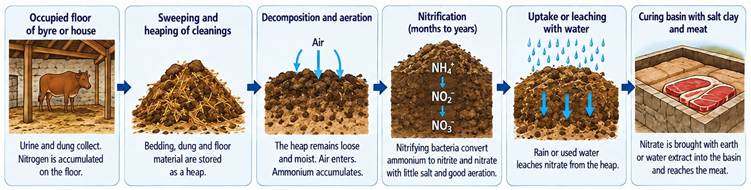
At Aşıklı Höyük the aerated midden contained about 35 times the nitrate of the compacted dung. Abandoned feedlots contained four times the nitrate of feedlots in use [58]. My reading, which differs from the explanation of Abell and colleagues [12], is that a wet, trampled floor is anaerobic and forms little nitrate. Nitrate then forms after the material is removed and aerated, or after the animals leave. Because the pens at Povegliano were cleaned and the cleanings discarded outside, a sheltered heap of pen cleanings is a probable form of nitrous earth. The active pen floor accumulates nitrogen, and the discarded cleanings are the probable site of nitrification. Ordinary removal of manure thus creates the conditions that nitrification needs. Inside the occupied byre the floor is wet and compacted, and nitrification is restricted. When the material is dug out in spring it breaks up, air enters it and, kept under a roof, it can nitrify. Nobody had to understand nitrification for this to happen. Deliberate heaping is not required either, because from the feedlot figures it follows that an old floor can also nitrify where it lies once it is abandoned and dries. Occupation, loading with nitrogen, cleaning or abandonment, aeration and time would be sufficient. This sequence is drawn in Figure 3.
Figure 3. The proposed operational sequence from occupied floor to curing basin
An Observation from Omasum Processing in Tanzania
In October 2026, while processing fresh beef omasum in Tanzania, we observed that within about twelve hours of slaughter the omasum developed a very strong smell of ammonia and felt alkaline and soapy on the hands. The organs were handled under simple slaughter conditions, without rapid chilling, and stayed wet, initially warm and heavily populated by the microorganisms of the rumen.
The first rapid change in such material is the hydrolysis of urea and the release of ammonia from organic nitrogen. Ruminant digestive contents carry urea, proteins, peptides, amino acids and microbial biomass together with a diverse ureolytic community. In a rumen simulation system Jin and colleagues [83] found that urea was rapidly hydrolysed to ammonia, that ammonia peaked two hours after feeding and that urea was hydrolysed faster than the ammonia was used. Among the ureolytic bacteria they identified Pseudomonas, Haemophilus, Neisseria, Streptococcus, Actinomyces, Bacillus and unclassified Succinivibrionaceae. After slaughter, absorption and recycling stop while these organisms continue to work, and the ammonia accumulates.
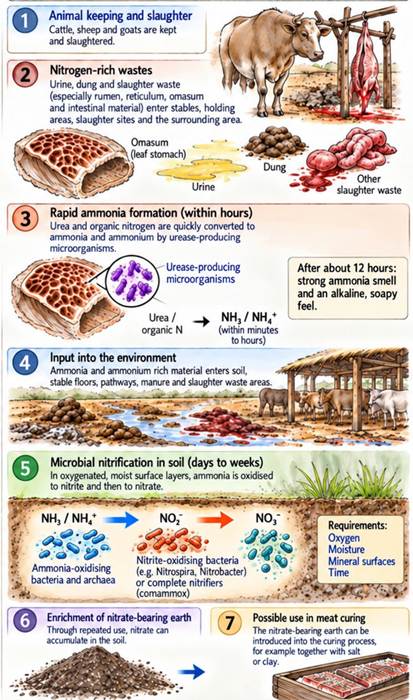
The second stage, nitrification, needs air. Ammonia oxidising bacteria and archaea oxidise ammonia to nitrite [84], nitrite oxidising bacteria such as Nitrospira oxidise nitrite to nitrate, and some Nitrospira carry out both steps on their own [85, 86]. These organisms live in soils, sediments and biofilms, so that a byre, a holding pen or a slaughter place needed no special inoculation. The animals supplied the nitrogen, the earth supplied the organisms, and air and time allowed nitrification. The process and its timeline are drawn in Figure 4.
Figure 4. From the ruminant to nitrate bearing earth, process and timeline
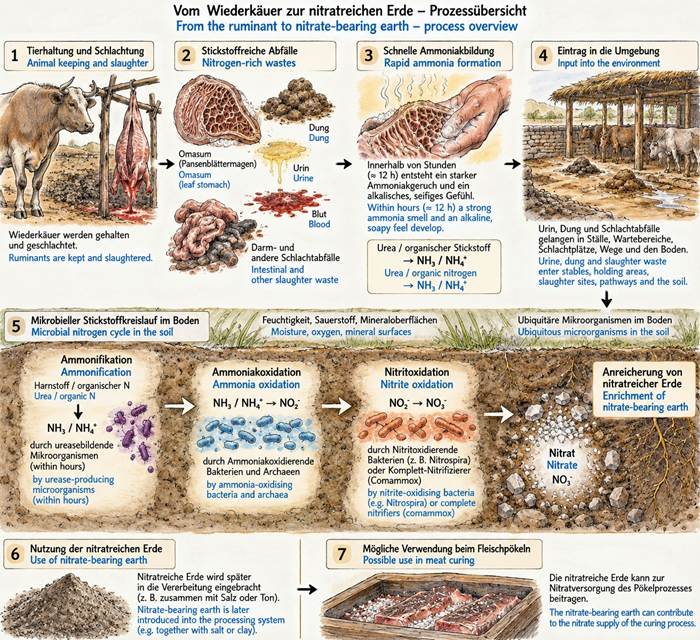
From the observation it follows that the first stage can run within hours, before the material reaches the ground. Slaughter waste, urine and dung could therefore reach a floor, a pen or the surrounding earth already rich in ammonia and ammonium, ready for nitrification in the aerated surface. The omasum itself would not have formed nitrate within twelve hours. Stable floors, holding pens and slaughter places at Hallstatt, however, received nitrogen again and again in this ammoniacal form, which makes them likely places for nitrous earth to develop. The sequence from the ruminant to nitrate bearing earth is summarised in Figure 5.
Figure 5. From the ruminant to nitrate bearing earth, a process overview in German and English
Domesticated Animals at Hallstatt
The bone deposit beside the basins contained more than 10,000 identified bones, of which 60.5 percent were pig, 21.5 percent sheep and goat and 17.6 percent cattle [71]. All arrived as selected parts of animals in their prime, mostly castrated males, and Pucher [71] concluded that they were bred and slaughtered on productive farms in the surrounding valleys. Hammer and colleagues [87] recovered mitochondrial DNA from seven pig bones, six of European type and one intermediate between the European and Asian groups. They regard the result as a first step toward showing that pigs were bred in and around Hallstatt.
The Bronze Age miners protected their hands with cowhide [63] and wore wool [18]. On the Dachstein plateau, 21 hut sites document alpine pasturing from 1700 to about 1000 BCE, with bones of cattle, pigs or dogs, goats or sheep and horses at one hut [39], and Kowarik and colleagues [88] describe the plateau as pasture since the Bronze Age. At the copper mines of Schwaz and Brixlegg in the Tyrol, from 1300 to 450 BCE, livestock arrived as whole animals, and the bite marks were attributed to large dogs [89].
In the Iron Age, 70.5 percent of 229 leather and hide finds from the mine were sheep, 21.5 percent goat and 8 percent cattle [90]. The miners ate the feet of pigs, sheep and goats and kept cheese in bentwood boxes [18], and Maixner and colleagues [64] identified blue cheese in their diet. At Dürrnberg beef was the most common meat [91].
The museum [18] states that a village population with children and old people lived in the high valley all year. A community of this kind would very probably have kept household animals, cattle for milk, sheep or goats for milk and wool, and pigs for the household, whatever the origin of the carcasses salted at the basins. From the bone findings of Pucher [71] it follows only that pigs were not bred at the basins for the industry, not that the village had no household animals. Cowhide and wool among the Bronze Age finds of the mine and the pasture huts on the Dachstein from 1700 to about 1000 BCE are consistent with livestock kept by the miners themselves. Their byres would lie in the Bronze Age settlement, which remains to be located.
A Seasonal Model
A seasonal model that can be tested can be built from this evidence. Livestock were housed in winter at Mooswinkel [78] and at Oppeano [76], and Pucher [71] considers winter the probable season of slaughter at the basins. In this model urine and dung accumulate on the floors of byres and houses through the winter. In spring the pens are cleaned, as at Povegliano [72], and the cleanings are heaped under cover. Through spring and summer the heap is aerated and nitrifies, while efflorescence forms on the walls. When the carcasses arrive for curing in the following winter, the heap, the floor earth and the walls contain nitrate. Within a cycle of this length there is time for substantial nitrification, and whether one spring and summer suffice has to be tested.
Stable Earth in Farming Practice
Schahl [15] studied the saltpetre boilers of the villages of Württemberg through the ducal ordinances of 1554 to 1747. The boilers had the right to dig on the level of the ground in barns, stables and threshing floors. The ordinance of 1603 complains that peasants covered their floors with boards and stone slabs, which suffocated the saltpetre, and poured water into the pits, which drowned it. The ordinance of 1747 complains that they carted the earth of old walls to their fields.
The peasants knew that stable earth was valuable, that it needed air and dryness and that it fed their fields. They did not make saltpetre, because the manufacture was a sovereign right exercised by guild craftsmen. Soentgen [34] describes licensed saltpetre men across Europe, and Summermatter [68] records official patents in Switzerland. Governments turned to farmers only late, as when the Bavarian crown commissioned a guide to saltpetre making for farmers in 1812 [34]. Wiesenthal addressed his instructions of 1776 to the public of Maryland [14]. From these records it follows that farmers in several documented regions recognised the value of stable earth, whereas the manufacture of saltpetre belonged to the state. No such claim on stable earth is known for the 13th century BCE.
Herders fed salt to animals at the fold and in the byre, where the animals also urinated and the earth changed. The proposed process did not require recognition of nitrate. Repeated preference for a material that gave a desirable colour or flavour would have been sufficient to preserve the practice.
A Possible Innovation at Hallstatt
Urine soaked earth and clay were a farm material wherever animals were kept, and salt had been used on meat long before the 13th century BCE. If nitrous earth formed part of the process, the distinctive Hallstatt development may have been its combination with the salt clay of the mine in one curing mass, kept in sealed basins and reused at the scale of an industry. The combination offered several advantages, each inferred from the chemistry and the excavated record.
One mixture for salting and colour. The salt clay supplied the salt and the urine earth the nitrate. Barth [70] found that the basin fill had been turned repeatedly, as the handling of a mixture would require.
Selection of the right bacteria. Strong salt severely inhibits the bacteria that oxidise ammonia [59], whereas staphylococci tolerate high salt and reduce nitrate [50]. My trials with weak brines ended in putrefied meat, whereas pork salted in mine salt and matured in the mine kept for half a year [70].
Exclusion of air. The basins were sealed with grey mountain loam [18], and a dense wet mass of salt clay and meat admits little air, the condition for nitrate reductase [46].
Use of a by-product. The museum [18] describes the salt of the basins as Haselgebirge, a low grade by-product, so that clean salt remained for trade. The urine earth cost only the labour of collecting it.
Self inoculation, a microbiological possibility. A reused mass transferred its bacteria from one batch to the next. Because the clay stayed in the basin, repeated cycles could have maintained a salt tolerant, nitrate reducing flora. This applies to the bacteria rather than to nitrate, which dissolves and would not accumulate reliably. The Wiltshire specification [51] releases a new brine only after it has cured other pork for at least two months, but a live brine of the modern era is a distant analogy for a clay mass of the Bronze Age and is not evidence of how that mass behaved.
Possible quality effects. Nitrate and its reduction help to control lipid oxidation in dry cured ham and contribute to cured flavour [92].
Repeatability. Hundreds of carcasses arrived each year [63], and a curing mass prepared and reused in a similar way could have made the result more repeatable.
Colour as a Sign of Safe Meat
Clostridium botulinum takes its name from the Latin word for sausage. Kerner investigated the recurrent sausage poisonings of Württemberg from 1817 onwards and published monographs on them in 1820 and 1822 [93, 94]. Van Ermengem discovered the organism in 1895 after an outbreak in Belgium [95]. Kerner established the clinical picture long before the organism or the antimicrobial action of nitrite was known. Archer [96], citing Pierson and Smoot (1982), writes that botulism was a significant hazard in meats and sausages before nitrite was used in curing, that nitrite inhibits both the emergence of vegetative cells from spores and the division of emerging cells, and that 43 of 51 botulism outbreaks from home processed meat in the United States and Canada since 1899 involved uncured meat. Nitrite therefore adds a protection that salt alone does not give.
Recorded figures for botulism in Europe begin in the late 18th century. In Württemberg the first well recorded outbreak, at Wildbad in 1793, affected 13 people, of whom 6 died, and at Herrenberg in 1815 three of seven patients died after eating liver sausage [97]. Kerner’s monographs of 1820 and 1822 contained 76 and 155 case reports [97]. In France, where ham was still cured at home in the 20th century, more than 500 outbreaks with over 1,000 cases were reported from 1940 to 1944, cured ham accounted for 90 percent of the incriminated foods, and mortality was about 2 percent. From 1971 to 1986 France recorded 821 cases, mostly of type B and mostly from pork prepared at home [98]. The authors link the risk to salt concentrations below 5 percent and storage at room temperature for weeks or months, which is consistent with hams that were salted rather than cured with nitrite. Across the European Union and the European Economic Area, 82 confirmed cases were reported in 2021, a rate of 0.02 per 100,000 inhabitants [99]. From these records it follows that sausages and salted pork prepared at home were important documented vehicles of botulism in parts of Europe.
Nitrite protects against more than C. botulinum. Nitrite and the reactive nitrogen species formed from it contribute to the inhibition of spore germination, of vegetative growth and of other bacterial processes [100]. Watson [100] also writes that pathogens, especially Listeria monocytogenes, grow more readily during refrigerated storage in products without added nitrite. Majou [101], summarising Majou and Christieans [102], attributes the bactericidal effect of nitrite in cured meat mainly to peroxynitrite, a strong oxidant formed from nitric oxide that damages the proteins, DNA and lipids of bacteria. Salt acts differently, and in two ways. It draws water out of the meat and out of bacterial cells, and the salt dissolved in the remaining water lowers its water activity, an effect that drying increases by concentrating the salt [100]. Salt thus preserves by removing water and by reducing water activity, whereas nitrite and the reactive nitrogen species formed from it act on the bacteria themselves. Where nitrate was effectively reduced to nitrite under otherwise comparable conditions, the cure could therefore have provided an antimicrobial hurdle in addition to salt, drying and cold, and I expect such meat to have kept better than meat preserved with salt alone.
This knowledge developed slowly. In Concerning Nitrate and Nitrite’s Antimicrobial Efficacy [103] I set out the chronology of research on the antimicrobial action of nitrate and nitrite from the review of Tompkin [104]. In the early studies salt was found to be the stronger inhibitor. Tanner and Evans saw no effect of sodium nitrite in 1933, and Steinke and Foster found in 1951 that salt was the main factor slowing the outgrowth of C. botulinum, while a mixed cure of salt, nitrate and nitrite was the most inhibitory, as Bulman and Ayres also found in 1952. Tarr in 1941 and Henry and colleagues in 1954 found that nitrite acts mainly in slightly acid conditions, around pH 5.6 to 6.0, and Baird-Parker and Baillie found in 1974 that its effect increases at lower temperature, lower pH and higher salt. Nitrite was accepted as antimicrobial only by the end of the 1960s, and in 1972 Greenberg suggested that the clean botulism record of the curing industry was due to nitrite. Salt, acidity, cold and nitrite therefore act together, and meat held in salt clay at 6 to 8 °C would have been under conditions in which nitrite is more effective.
People who cured meat without nitrite met the hazard of botulism. In my view curers might, over repeated experience, have associated particular curing materials both with a red colour and with better keeping quality, so that the colour became a visible sign of well cured meat and the material that produced it was valued for that reason. This is my inference. Nor is redness a reliable sign of nitrite, because zinc protoporphyrin reddens meat without nitrate or nitrite [105]. Because salt, acidity, water activity, temperature and the load of spores act together on C. botulinum, the safety of a cured product does not follow from its colour alone. The inference concerns what curers could have observed and not a reliable rule. On this inference, however, the Hallstatt curers had a motive beyond colour and flavour. Hallstatt was then more than a place where meat was salted, and a cure that reddened the meat would have been kept once it had been found.
The Oxygen Limited Stage at Hallstatt
The meat lay buried in salt clay inside sunken timber structures, and the structure that Morton excavated in 1939 had double walls sealed with clay [70]. Barth [70] concluded that the contents were turned repeatedly and grew softer and richer in clay and protein with each cycle, until the basin had to be rebuilt. Oxygen was never measured, so the oxygen limited condition is an inference from this description.
Barth [17] reported that muscle salted with unrefined mine salt took on a fine red colour, and the museum [18] puts the salting step at about ten days. If the colour developed during this period, it developed within a mass that was probably oxygen limited. Slaughter probably took place in winter, and the mine has a steady temperature of 6 to 8 °C [70]. The rate of reduction at that temperature and the staphylococci of the basin fill and the trial meat remain to be measured.
Continuity after Hallstatt
Continuity of salt curing in the Alps can be traced, and continuity of nitrous earth as a curing ingredient is possible.
The Alpine bacon
The museum [18] states that the Hallstatt method of cutting the pig, deboned from the back into two boneless halves for salting and smoking, survives in Gailtal bacon and at Kaning near Radenthein in Carinthia. The Austrian ministry responsible for traditional foods [106] records that Surspeck has been known across Europe since antiquity, and Barth and Pucher [107] call the Hallstatt basins Surbecken. The ministry [106] also records that larger pieces are still cured with saltpetre, which microorganisms convert to nitrite, and that some producers use salt alone and rely on the ripening flora to form the colour more slowly.
The Celtic and Roman hams
Salt mining continued at Hallstatt through the Iron Age, and from the 5th century BCE Dürrnberg was densely settled by miners and craftsmen [91]. By the 1st century BCE Varro wrote that the best and largest hams reached Rome from Gaul, and Strabo named the land between the Rhine and the Saône as the source of the best cured meats [108]. In The Celtic Cradle of European Meat Curing [109] I argued that Celtic culture spread the salt and curing technology of Hallstatt across Europe. The classical sources describe salt, smoke and drying.
Nitrous earth in later curing
The nitrous earth proposed for Hallstatt is the material from which Europe later made its saltpetre. Licensed saltpetre men dug it from the 14th to the 19th century [34], and farmers carted it to their fields [15]. Refined into saltpetre, it entered curing mixes across Europe between 1600 and 1750 [24, 25], and English cookery books of the 18th and early 19th centuries used sal prunella, a fused saltpetre, for beef and ham [110]. After Polenske [20] showed in 1891 that bacteria converted the nitrate of a brine to nitrite, the direct use of nitrite followed in the 20th century, as described in my articles on Ladislav Nachmüllner and Prague salt [111]. One major historical route to modern curing salts therefore passed through nitrous earth, refined saltpetre and finally purified nitrite.
The living cure and natural curing
Wiltshire curers still reuse a live brine with nitrate reducing bacteria, and producers of natural cures combine an unpurified nitrate source with staphylococci [44]. Both practices are documented. Their descent from Hallstatt is my hypothesis.
The Minimum Hypothesis
The proposal needs only four propositions. First, nitrogen rich settlement material existed in the high valley. Second, part of that material lay aerated and low enough in salt to form nitrate. Third, some of that nitrate reached the curing material. Fourth, nitrate reducing bacteria converted it to nitrite in the oxygen limited salted meat.
Everything else is one possible form of these four propositions. Salt licks, wall crusts, deliberate leaching, the recognition of urine and any understanding of nitrate are not required. The failure of one of these forms would not refute the minimum hypothesis, whereas the failure of one of the four propositions would.
Objections and Replies
The pigs were not kept at Hallstatt. Pucher [71] concluded that the pigs of the curing industry were bred elsewhere. The proposal does not depend on them. It depends on the floors and latrines of the village that lived in the high valley all year and on any household animals it kept. Human urine and settlement waste alone would satisfy the first proposition of the minimum hypothesis. Hammer and colleagues [87] regard the breeding of pigs in and around Hallstatt as an open question.
A high alpine valley is too wet and too cold. A roof keeps off the rain, and time compensates for the cold. Kidd (1814) [38] observed that saltpetre formed on walls in Oxford more rapidly in frosty, clear and dry winter weather than in summer, and that damp air slowed or stopped its formation. The Tyrol exported saltpetre before the 16th century [68], so the climate of the eastern Alps did not prevent nitrate formation in buildings. A settlement that served a mine for generations had far longer than the two years of a managed bed [34].
No such earth has been found. Several metres of debris cover the Bronze Age surface [18], and the settlement has not been located. Pen floors of the same centuries exist at Oppeano and Povegliano, and urine nitrate has been measured at Aşıklı Höyük. Nitrate itself would not have survived in the wet valley, for the reasons given under the preservation of nitrate, whereas phosphate crusts and faecal markers would.
The curers would not have put earth into food. They cured in Haselgebirge, which already brought clay and anhydrite into contact with the meat. A liquor leached from nitrous earth would have delivered nitrate without earth, as the saltpetre makers moved it. Deliberate addition is also unnecessary if salt was stored on a floor of nitrous earth or a basin was sunk into such ground.
Routes Without Nitrate
Ras and colleagues [112] found that Staphylococcus xylosus forms nitric oxide through a nitric oxide synthase, which converts metmyoglobin to the nitroso pigment without added nitrate or nitrite. A mutant without the enzyme lost the activity under aerobic conditions, and its activity fell by about 35 to 40 percent when oxygen was limited. This route depends on oxygen and could have added colour while the meat hung in the mine, but colour formed under salt cannot be explained by it.
Pork belly that I cured with 2 percent of ammonium chloride and 4 percent of salt at about 7 °C took on a stable reddish pink colour within 14 days. Ammonium chloride supplies no nitrate, and no proven route leads from ammonium to nitrite in salted meat. Ammonia oxidising bacteria do, however, release nitric oxide while they oxidise ammonia, and more of it as oxygen runs out [113]. Ammonium can therefore give rise to nitric oxide where such bacteria are active, and whether they act in salted meat remains to be tested. I did not analyse the pigment or the nitrite, and the labelled trial described below would resolve the result.
In earlier work I proposed that sal ammoniac, ammonium chloride, preceded saltpetre in meat curing [114, 115]. Johnstone (1833) [116] (still to be checked) wrote that a little crude sal ammoniac goes far in preserving meat without making it salt. In China, 硇砂 (náoshā, sal ammoniac) is recorded in the 新修本草 (Xīnxiū běncǎo, Newly Revised Pharmacopoeia) of 659 CE, compiled under the Tang dynasty (618 to 907 CE), and Chen Ming [117] groups it with the materia medica connected with pre-Islamic Persian culture. The record of trade names sal ammoniac and not saltpetre. Scale fee receipts of about 600 CE from a tax station outside Turfan list ammonium chloride in 6 of 37 receipts, as one of five principal commodities with spices, gold, silver and silk thread, and none lists saltpetre or another nitrate salt. Hansen [118] reports these counts from the analysis of Skaff [119]. Ibn Hawqal, writing in the 10th century, described mines of sal ammoniac in the mountains of Setroushteh, the district of Usrushana east of Samarkand, where vapour rose from a cavern that was roofed over and the deposited salt was gathered [120]. My argument rests on this record. Sal ammoniac dissolves readily, and a Chinese account quoted by Needham [121] (still to be checked) states that it disappears when exposed to wind, wetness or damp. Porter Smith (1871) [122] (still to be checked) reported that the salt sold as sal ammoniac in China was often sulphate of soda or common salt, and that soda nitrate and borax were also confused with it. The Turpan Hami basin of northwestern China contains nitrate deposits of Pleistocene age, concentrated near the surface, with resources equivalent to those of the Atacama [123]. Nitrate salts thus lay within easy reach in the region where sal ammoniac was traded. In Nitrate Salt’s Epic Journey [124] I concluded that sal ammoniac which absorbed moisture on long journeys became difficult to distinguish from nitrate salts, and that traders could have collected nitrate salts from the surface of the Turpan and Tarim depressions, by mistake or deliberately, and sold them as sal ammoniac. If the traded material contained nitrate, it could have supported conventional nitrate curing, because staphylococci would reduce the nitrate to nitrite while the ammonium remained unused. Whether the ammonium itself contributed to the colour in salted meat is unresolved, and this question would also be decided by the labelled trial. Sal ammoniac, or nitrate salts sold under its name, could also have reached Hallstatt.
Zinc protoporphyrin
A red colour does not by itself prove nitrate curing. Parma ham is made without nitrate or nitrite and develops a bright red colour, which Wakamatsu and colleagues [105] attributed to zinc protoporphyrin IX on the evidence of fluorescence, chromatography and mass spectrometry. The red colour obtained with mine salt in the Hallstatt reconstruction therefore cannot be attributed to nitrosomyoglobin by eye. Zinc protoporphyrin forms slowly, however. In Parma ham the red pigment increases throughout processing up to full maturity at about 18 months, and a component that was probably zinc protoporphyrin rose over the first 3 months, according to the summary of earlier work by Wakamatsu and colleagues [125]. A red colour that appeared within the salting period of about ten days at Hallstatt is therefore unlikely to be zinc protoporphyrin, which belongs to long term curing. The pigment has nevertheless to be identified analytically, and the second measurement in the list below does this.
The Decisive Open Question
Barth [17] obtained a fine red colour with pork and unrefined mine salt alone, and where that salt was taken and how it was won remains to be established. Chambers in the modern mine are opened by blasting [65], and explosives are the dominant source of nitrate at mine sites [126]. Much of this proposal depends on one question. Did prehistoric, hand mined Haselgebirge contain about 40 to 130 mg of nitrate per kg, or another amount shown to be sufficient once the mass of salt clay, the transfer of nitrate and the pigment requirement are known? If it did, the salt alone supplied the nitrate, and the pathways through urine become unnecessary. If it did not, and the trial salt came from modern workings, the colour of the trials was a modern artefact, and a source of nitrate outside the salt becomes much more probable. The first measurement in the list below is the necessary first test of this question, and with the second the pigment of the reconstruction is identified.
Measurements That Would Test the Proposal
Table 8 lists the values that I expect for each candidate in the material in contact with the meat. I derived them from the argument above, and they are to be tested. The isotope range for nitrate from animal waste is that of Kendall [80], and isotope values overlap between sources, so that they are used only together with the other markers.
Table 8. Expected values for the material in contact with the meat, by candidate
| Candidate | Nitrate | Ammonium | Faecal markers | δ15N of the nitrate |
| Natural nitrate in the Haselgebirge | Detectable in uncontaminated geological Haselgebirge if this source is real. Distribution may be uneven | Low | None | Not known for Haselgebirge |
| Urine poured into the basin | Low | High | None | Measurable if nitrate is present, but of limited diagnostic value |
| Waste on the floor of the mine | Low | High | Human | Measurable if nitrate is present, but of limited diagnostic value |
| Haselgebirge under animals | Low, higher at the margin | High | Herbivore | Plus 10 to plus 20 per mil where nitrate is present |
| Nitrous earth under a roof | High | Low to moderate | Herbivore or human | Plus 10 to plus 20 per mil |
| Liquor leached from nitrous earth | High | Low | Few. Soluble markers only | Plus 10 to plus 20 per mil |
| Residue of explosives, modern trials only | High | Variable, depending on the explosive | None | Overlaps other sources. Not diagnostic alone |
In Table 9 the proposal is set against the competing explanations, with the prediction of each. Several of them could have acted together, and the test numbers refer to the list below.
Table 9. Competing explanations of the red colour and their predictions
| Explanation | Requires nitrate | Nitrate in prehistoric Haselgebirge | Faecal markers in basin fill | Expected pigment | Deliberate transfer | Decisive test |
| Geological nitrate in prehistoric Haselgebirge | Yes | Yes | No | Nitrosyl haem | No | Test 1 |
| Residue of explosives in modern reconstruction salt | Yes, modern trials only | No | No | Nitrosyl haem in the modern trials | No | Tests 1 and 2, with δ15N |
| Nitrous earth added directly | Yes | No | Yes | Nitrosyl haem | Yes, or by accident | Tests 3 and 5 |
| Water extract of nitrous earth | Yes | No | Few. Soluble markers only | Nitrosyl haem | Yes | Test 5 |
| Vegetable nitrate | Yes | No | No. Plant remains instead | Nitrosyl haem | Yes | Test 10 |
| Urine poured directly into the basin | Only the nitrate of the urine | No | Few | Little nitrosyl haem | Yes | Test 5 |
| Staphylococcal nitric oxide synthase | No | No | No | Nitrosyl haem, mainly where air reaches the meat | No | Test 2, with and without air |
| Zinc protoporphyrin | No | No | No | Zinc protoporphyrin IX | No | Test 2 |
The proposal can be confirmed or refuted by ten measurements. The first five are decisive and are listed in order of priority. The remaining five are secondary.
- The decisive measurement. Nitrate, nitrite and ammonium in fresh geological Haselgebirge from undisturbed parts of the deposit, in hand mined Bronze Age and Iron Age waste and in any surviving salt from the trials of Barth [17]. The samples should include unblasted geological material, prehistoric hand mined fragments, modern blasted material, mine water and surface dust, with field blanks to control contamination from blasting. The halite rich and the clay rich fractions are analysed separately, because nitrate need not be evenly distributed. The analysis must detect nitrate in the range of tens of milligrams per kilogram. If nitrate is present, its concentration is compared with the requirement in Table 5. Ammonium without nitrate would be consistent with inhibition of nitrification in the saline mine material, but that mechanism would not be established by this result alone, because ammonium has several possible origins and nitrate could have been lost.
- A replication of the reconstruction of Barth [17] with documented salt, in which the red pigment is identified analytically and nitrosyl haem is distinguished from zinc protoporphyrin IX and other haem pigments. The arms are uncontaminated hand mined Haselgebirge, modern Haselgebirge from blasted workings, purified sodium chloride, and desalted clay of the Haselgebirge with a controlled amount of sodium chloride, all at the same temperature and comparable water activity. Nitrate, nitrite, ammonium, chloride, pH, water activity, the microbial community, nitrosyl haem, zinc protoporphyrin IX and total haem pigments are measured at the start and over time. If nitrosyl haem is identified, the red colour is a cured pigment derived from nitric oxide and not zinc protoporphyrin IX. Nitrate is not thereby established as the source of the nitric oxide, because staphylococci can also form nitric oxide through a nitric oxide synthase [112]. The nitrate pathway is shown only when the pigment result is read together with nitrate depletion, nitrite formation, nitrate reductase activity and, ideally, isotopic tracing. With these arms a geological, microbial, contaminant or zinc protoporphyrin origin of the colour can be distinguished.
- Sediment from inside and outside any basin excavated in future, from the Bronze Age surface of the high valley where building work exposes it, and from the floors of the Dachstein huts. Faecal stanols and bile acids, interpreted together, can help to distinguish likely sources of faeces, including ruminants, pigs, horses and humans [82], and penning deposits can be identified from spherulites and micromorphology [81]. All soluble ions and phosphate should be measured with them. Because nitrate leaches from wet ground, its absence would not refute the proposal.
- A cleanings trial in which compacted floor material and cleanings from a modern byre are kept under cover for a season at the seasonal temperatures of the Salzberg valley, one heap turned and one left compacted. A third portion of floor material is left in place, unoccupied and under cover, to test nitrification after abandonment. Ammonium, nitrite, nitrate, oxygen and temperature are followed over time. I expect nitrate in the aerated cleanings and little in the compacted floor material.
- A curing trial with one batch of pork and mine salt at 7 °C in eight arms, namely salt alone as the negative control, salt inoculated with a known nitrate reducing staphylococcus, which separates the absence of bacteria from the absence of nitrate, salt with a known low dose of nitrate as the positive control, salt with byre earth, salt with a water extract of that earth, salt with fresh urine, salt with Haselgebirge that has lain under animals for a season, and salt with wall efflorescence. Each arm is run with and without air and is replicated independently, and nitrate, nitrite, ammonium, pH, pigment and staphylococci are measured throughout. With the positive control it can be decided whether the system can cure at that temperature at all. Water activity is measured in every arm. Nitrate and nitrite are measured over time in the outer clay, the clay touching the meat, the meat surface, the meat at 10 mm depth and the core. In this way nitrate brought in with the curing material can be distinguished from nitrate formed in it, and the rate of penetration can be measured. The meat is for analysis only.
- An arm with ammonium chloride labelled with 15N, in which the label is sought in the nitrite, the nitrate and the pigment, to decide whether ammonium can reach the pigment at all, and a second arm with nitrate labelled with 15N, in which the label is sought in the nitrosyl group of the pigment, to confirm that nitrate nitrogen reaches the pigment under Hallstatt conditions.
- A salt inhibition trial in which desalted Haselgebirge, with and without its anhydrite, is brought to 0, 0.1, 0.2, 0.5, 1, 2, 5 and 10 percent of sodium chloride and receives equal urine nitrogen. Ammonium, nitrite, nitrate and pH are followed. The trial is designed to find the salt content at which Hallstatt material stops nitrifying, and with it the width of the margin around salt clay on a floor where nitrate can form.
- All soluble ions and phosphate in the pen sediments of Oppeano and Povegliano, with the floor crusts and the discarded cleanings analysed separately. I expect ammonium in the crusts and nitrate in the cleanings.
- A lick trial in which one block of Haselgebirge is set under a roof and one in the open, each with livestock for a season, after which the ground is sampled for nitrate and ammonium at increasing distance from the salt.
- A botanical analysis of the basin fill for herbs of dunged ground.
Results that would weaken or strengthen the proposal
The proposal would be weakened substantially if uncontaminated prehistoric Haselgebirge contained enough natural nitrate for the cure. It would also be weakened if Bronze Age surfaces of the high valley, sampled extensively, contained no phosphate, faecal markers or spherulites of human or animal waste, or if aerated cleanings and floor earth formed no nitrate within one or two seasons at Alpine temperatures. It would be strengthened if sediment associated with the basins contained markers of floor or latrine earth that are absent from geological Haselgebirge, and if aerated pen cleanings formed nitrate while compacted floor material did not. It would be strongly strengthened if such material, added to salt and pork at mine temperature, produced the cured pigment while salt alone did not. Failure of the earth route would not refute the water extract, which leaves fewer insoluble markers, and neither failure alone would refute an external source of nitrate as such.
The Strength of the Evidence
Established by measurement or record. The ancients collected urine and used urine and saliva for many purposes [1, 2, 3, 29, 30]. Staphylococci reduce nitrate to nitrite under oxygen limitation, and in the cited meat model nitrate dependent pigment formation required staphylococci with nitrate reductase. Strong salt severely inhibits the conventional nitrifying bacteria studied, efficient nitrification in near saturated salt clay has not been demonstrated, and less than one percent of the nitrogen in urine is nitrate. Earth under buildings and animals accumulates nitrate and was the industrial source of saltpetre. The Hallstatt meat was cured in unrefined salt clay in sealed basins, and the community consumed cattle, sheep, goats and pigs while herds grazed on the Dachstein. Bronze Age pen floors and their cleaning are documented in northern Italy, and urine nitrate has been measured in the refuse of one Neolithic village. In our work in Tanzania fresh omasum became strongly ammoniacal within about twelve hours of slaughter.
Inferred. I infer that direct use of urine could have preceded nitrous earth in curing, that the village of the high valley kept cattle, sheep or goats and pigs of its own, that herders recognised the strength of byre earth, that the basins were oxygen limited, that calcareous earth at the site of nitrification neutralised its acid, that the people of the high valley had roofed floors receiving urine for years, and that nitrate from floors, latrines, heaps or walls of the high valley reached the curing salt.
To be measured. The nitrate content of the Haselgebirge, the nitrate of material from Hallstatt, the rate of nitrate reduction under mine salt in the cold, the origin of the salt in the modern trials and the salt content at which Hallstatt material stops nitrifying remain to be measured, and the Bronze Age settlement remains to be located. The depth to which nitrate or nitrite could penetrate large pieces of meat during about ten days of salting at 6 to 8 °C also has to be measured, because it may limit the cure more than the total quantity of nitrate.
Conclusion
Meat buried in salt clay in a sealed basin would have been strongly oxygen limited, and staphylococci in such a mass reduce nitrate to nitrite. Urine supplied nitrogen wherever people and animals lived, and nitrogen was abundant relative to the nitrate required. The limiting factors were the formation of nitrate in aerated earth low in salt, its protection from rain and the time it needed, and the strongly saline bulk materials of the mine were poorly suited to efficient nitrification. The first question is whether prehistoric Haselgebirge contained nitrate at a trace level of about 40 to 130 mg per kg. If it did not, nitrous earth formed from human and animal waste in the high valley becomes a strong candidate for the external source of nitrate, in the floors and walls of houses and byres, in latrines and in heaps of pen cleanings. Its nitrate could have reached the basin as earth, as water leached from that earth or by accident. The curers needed no theory of nitrate, only the observation that earth or water from certain places gave redder meat. Direct use of urine is a simpler possible precursor of this practice.
I do not claim that Hallstatt invented the use of urine earth in curing. I propose that its curers added the salt clay of the mine to that material, and that in this mixture the meat was salted, nitrate reducing bacteria were favoured, air was excluded and a by-product of mining became a curing agent. Until the measurements listed above have been made, the proposal remains a hypothesis.
Appendix. Additional Figures
Figures A1 and A2 give the sequence from the ruminant to nitrate bearing earth in German and English, with the microorganisms involved and the timeline from minutes to years.
Figure A1. From the ruminant to nitrate bearing earth, process, microorganisms and timeline
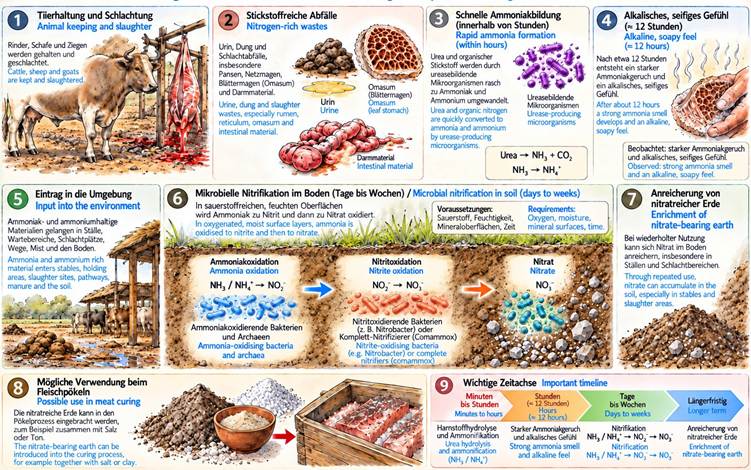
Figure A2. From the ruminant to nitrate bearing earth, with ammonification in the soil
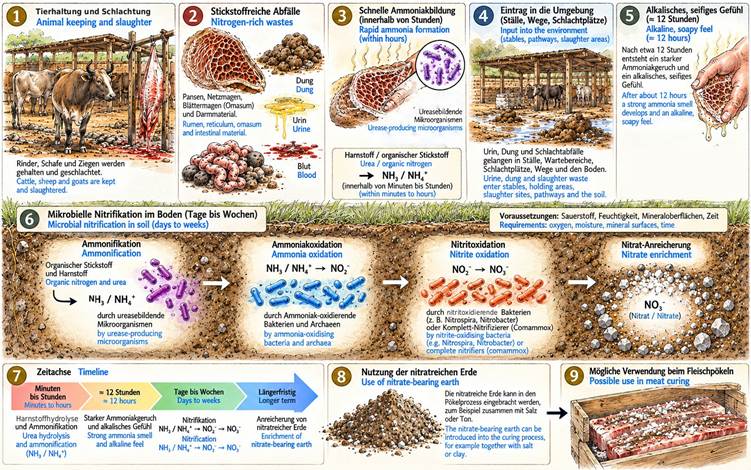
References
References are numbered in the order of their first citation in the text.
[1] Strabo. Geography, Book 3. Translated by Jones HL. Loeb Classical Library, 1923. Section 3.4.16.
[2] Pliny the Elder. 77 CE. The Natural History, Book 28. Translated by Bostock J and Riley HT. Volume 5. Chapters 7, 18, 19 and 22.
[3] Bourke JG. 1891. Scatalogic Rites of All Nations. Washington, Lowdermilk. Chapter 11, Poisonous Mushrooms used in Ur-Orgies, quoting Grieve J (1764), The History of Kamtschatka and the Kurilski Islands, pages 207 to 209, and Steller.
[4] Van Tonder E. 2024. Re-evaluation of the Discovery of Nitrate and Nitrite Curing. EarthwormExpress.
[5] Van Tonder E. 2025. Urine in Meat Curing. Revisiting Historical Practices through Biochemical and Agronomic Insights. EarthwormExpress.
[6] Van Tonder E. Bacon & the Art of Living. Chapter 12.06.2. Ammonia from Urine and Horse Sweat. EarthwormExpress.
[7] Van Tonder E, Berger C. 2025. The Hallstatt Meat Curing Method. An Update on Late Bronze Age Industrial Processes. EarthwormExpress.
[8] Van Tonder E. 2024. The Hallstatt Curing Method. EarthwormExpress.
[9] Van Tonder E, Brynwyn C. 2024. Meat Preservation in Clay with Ammonia, Saliva and Lime. A Historical and Chemical Perspective. EarthwormExpress.
[10] Van Tonder E. Uncovering the Link Between Celtic Curing Traditions and Early Monastic Practices in Austria. A Journey from Hallstatt to the Benedictine Abbey. EarthwormExpress.
[11] Udert KM, Fux C, Münster M, Larsen TA, Siegrist H, Gujer W. 2003. Nitrification and autotrophic denitrification of source-separated urine. Water Science and Technology 48(1), 119 to 130.
[12] Abell JT, Quade J, Duru G, Mentzer SM, Stiner MC, Uzdurum M, Özbaşaran M. 2019. Urine salts elucidate Early Neolithic animal management at Aşıklı Höyük, Turkey. Science Advances 5(4), eaaw0038.
[13] Medieval Gunpowder Research Group. 2013. Making Saltpetre. Report Number 11. Middelaldercentret, Nykøbing, Denmark.
[14] Wiesenthal CF. 1776. Process for making crude saltpetre, published by order of the Maryland Convention in Dunlap’s Maryland Gazette, 2 January 1776. Reproduced in All the Dung and Other Putrescible Matter.
[15] Schahl A. 1969. Der Salpetersieder im altwürttembergischen Dorf. Württembergisches Jahrbuch für Volkskunde, 249 to 273.
[16] Van Tonder E. A Newspaper’s Record and Old Chemistry Textbooks References on Use of Urine and Dung in Antiquity. EarthwormExpress.
[17] Barth FE. 2001. Bronzezeitliche Fleischverarbeitung in Hallstatt. Arheološki vestnik 52, 139 to 142.
[18] Reschreiter H, Kowarik K, Loew C. Hallstatt during the Bronze Age, Hallstatt during the La Tène Period, The salt mine in prehistoric times, Beginnings, Everyday life and Meat curing vats. Natural History Museum Vienna, Hallstatt research pages. Consulted on 10 and 11 October 2026.
[19] Van Tonder E. 2016. Saltpeter. A Concise History and the Discovery of Dr. Ed Polenske. EarthwormExpress.
[20] Polenske E. 1891. Arbeiten aus dem Kaiserlichen Gesundheitsamte 7, 471 to 474. Berlin, Springer. Cited from Huffman and Bryan.
[21] Van Tonder E. 2017. Salt, 7000 Years of Meat Curing. EarthwormExpress.
[22] Binkerd EF, Kolari OE. 1975. The history and use of nitrate and nitrite in the curing of meat. Food and Cosmetics Toxicology 13, 655 to 661. Cited from Salt, 7000 Years of Meat Curing.
[23] Van Tonder E. 2017. And Then the Mummies Spoke. EarthwormExpress.
[24] Van Tonder E. Bacon & the Art of Living. Chapter 05.01. The Development of Dry Curing from Salt Only to Salt, Saltpetre and Sugar. EarthwormExpress.
[25] Van Tonder E. Bacon & the Art of Living. Chapter 12.04. The Saltpeter Letter. EarthwormExpress.
[26] Van Tonder E. Bacon & the Art of Living. Chapter 12.07.1. Lauren Learns the Nitrogen Cycle. EarthwormExpress.
[27] Van Tonder E. The Nitrogen Cycle and Meat Curing. EarthwormExpress.
[28] Van Tonder E. 2024. Chemistry and Biochemistry of Fertilizer Production. EarthwormExpress.
[29] Suetonius. The Life of Vespasian. Translated by Rolfe JC. Loeb Classical Library, 1914. Section 23.3.
[30] Ramsbottom J. 1953. Mushrooms and Toadstools, pages 43 to 48. London, Collins. Reproducing Jochelson’s account. Cited from Brown JK, Malone MH. 1972. Pacific Information Service on Street Drugs 2(1).
[31] Van Tonder E. 2024. The Ancient Use of Urine as a Filter for Amanita Muscaria Consumption. Ritual and Medicinal Practices Across Eurasia. EarthwormExpress.
[32] Stépanoff C. 2012. Human-animal joint commitment in a reindeer herding system. HAU. Journal of Ethnographic Theory 2(2), 287 to 312.
[33] Ganapathi Rao B, Sudborough JJ, Watson HE. The Refining of Crude Saltpetre. Journal of the Indian Institute of Science, pages 196 to 235. The copy consulted states no year.
[34] Soentgen J. Die Bluttaufe des Salpeters. Über die vorindustrielle Herstellung einer Machtsubstanz. In Ertl G, Soentgen J (editors), Stickstoff. Ein Element schreibt Weltgeschichte, 79 to 100. Consulted as the copy in the repository of the University of Augsburg.
[35] Smith RD. 2005. The Saltpetre Extraction Experiment, August 2004. Report Number 3. Medieval Gunpowder Research Group, Middelaldercentret, Nykøbing, Denmark.
[36] Thévenot M. 1665. Of the way, used in the Mogol’s Dominions, to make Saltpetre. English summary of his account in Philosophical Transactions 1.
[37] Keeton JT. 2011. History of Nitrite and Nitrate in Food. In Bryan NS, Loscalzo J (editors), Nitrite and Nitrate in Human Health and Disease, 69 to 84. Totowa, Humana Press. Quoted from a reproduction of the passage. Still to be checked against the original chapter.
[38] Kidd J. 1814. Observations Respecting the Natural Production of Saltpetre on the Walls of Subterraneous and Other Buildings. Philosophical Transactions of the Royal Society of London 104.
[39] Mandl F. Prehistoric farming. Natural History Museum Vienna, Hallstatt research pages. Consulted on 10 October 2026.
[40] Honikel KO. 2008. The use and control of nitrate and nitrite for the processing of meat products. Meat Science 78, 68 to 76.
[41] Gøtterup J, Olsen K, Knöchel S, Tjener K, Stahnke LH, Møller JKS. 2007. Relationship between nitrate/nitrite reductase activities in meat associated staphylococci and nitrosylmyoglobin formation in a cured meat model system. International Journal of Food Microbiology 120(3), 303 to 310.
[42] Sindelar J. 2010. Natural Curing for Meats. Presentation to the Niche Meat Processor Assistance Network. University of Wisconsin.
[43] Huffman RD, Bryan NS. Nitrite and Nitrate in the Meat Industry. Chapter 5 in Food, Nutrition and the Nitric Oxide Pathway. The copy consulted states no year.
[44] Krause BL, Sebranek JG, Rust RE, Mendonca A. 2011. Incubation of curing brines for the production of ready-to-eat, uncured, no-nitrite-or-nitrate-added, ground, cooked and sliced ham. Meat Science 89(4), 507 to 513.
[45] Löfblom J, Rosenstein R, Nguyen MT, Ståhl S, Götz F. 2017. Staphylococcus carnosus. From starter culture to protein engineering platform. Applied Microbiology and Biotechnology 101, 8293 to 8307.
[46] Fedtke I, Kamps A, Krismer B, Götz F. 2002. The nitrate reductase and nitrite reductase operons and the narT gene of Staphylococcus carnosus are positively controlled by the novel two-component system NreBC. Journal of Bacteriology 184(23), 6624 to 6634.
[47] Neubauer H, Götz F. 1996. Physiology and interaction of nitrate and nitrite reduction in Staphylococcus carnosus. Journal of Bacteriology 178, from page 2005. Cited from the summary in Fedtke and colleagues (2002).
[48] Hartmann S, Wolf G, Hammes WP. 1995. Reduction of nitrite by Staphylococcus carnosus and Staphylococcus piscifermentans. Systematic and Applied Microbiology 18(3), 323 to 328.
[49] Shi Q, Wang X, Ju Z, Liu B, Lei C, Wang H, Li H. 2021. Technological and safety characterization of Kocuria rhizophila isolates from traditional ethnic dry-cured ham of Nuodeng, Southwest China. Frontiers in Microbiology 12, 761019.
[50] Casaburi A, Blaiotta G, Mauriello G, Pepe O, Villani F. 2005. Technological activities of Staphylococcus carnosus and Staphylococcus simulans strains isolated from fermented sausages. Meat Science 71, 643 to 650.
[51] Department for Environment, Food and Rural Affairs. Product specification for Wiltshire Cured Ham, Wiltshire Cured Bacon and Wiltshire Cured Gammon. Quoted from the reproduction in Chapter 13.16 of Bacon & the Art of Living.
[52] Rose C, Parker A, Jefferson B, Cartmell E. 2015. The characterization of feces and urine. A review of the literature to inform advanced treatment technology. Critical Reviews in Environmental Science and Technology 45, 1827 to 1879.
[53] Florin THJ, Neale G, Cummings JH. 1990. The effect of dietary nitrate on nitrate and nitrite excretion in man. British Journal of Nutrition 64(2), 387 to 397.
[54] Betteridge K, Andrewes WGK, Sedcole JR. 1986. Intake and excretion of nitrogen, potassium and phosporus by grazing steers. The Journal of Agricultural Science 106(2), 393 to 404.
[55] Kohn R. 2007. Use of milk or blood urea nitrogen to identify feed management inefficiencies and estimate nitrogen excretion by dairy cattle and other animals. Florida Ruminant Nutrition Symposium, Gainesville.
[56] da Silva Cardoso A, José Neto A, Azenha MV, Morgado ES, Brito LF, Janusckiewicz ER, Berchielli TT, Reis RA, Ruggieri AC. 2019. Mineral salt intake effects on faecal-N concentration and the volume and composition of beef cattle urine. Tropical Animal Health and Production 51, 171 to 177.
[57] Knowles R. 1982. Denitrification. Microbiological Reviews 46, 43 to 70.
[58] Mielke LN, Ellis JR. 1976. Nitrogen in soil cores and ground water under abandoned cattle feedlots. Journal of Environmental Quality 5(1), 71 to 75.
[59] Moussa MS, Sumanasekera DU, Ibrahim SH, Lubberding HJ, Hooijmans CM, Gijzen HJ, van Loosdrecht MCM. 2006. Long term effects of salt on activity, population structure and floc characteristics in enriched bacterial cultures of nitrifiers. Water Research 40, 1377 to 1388.
[60] Inubushi K, Barahona MA, Yamakawa K. 1999. Effects of salts and moisture content on N2O emission and nitrogen dynamics in Yellow soil and Andosol in model experiments. Consulted as the record in AGRIS.
[61] Du LJ, Pan CZ, Wang CY, Chen ZJ, Xiong YW, Huang GH. 2026. Effects of salt stress on nitrification and denitrification rates and N2O emissions in soil using a 15N isotope tracing approach. International Journal of Agricultural and Biological Engineering 19(3), 191 to 197.
[62] Oren A. 1999. Bioenergetic aspects of halophilism. Microbiology and Molecular Biology Reviews 63(2), 334 to 348.
[63] Reschreiter H, Kowarik K. 2019. Bronze Age Mining in Hallstatt. A New Picture of Everyday Life in the Salt Mines and Beyond. Archaeologia Austriaca 103, 99 to 136.
[64] Maixner F, Sarhan MS, Huang KD and others. 2021. Hallstatt miners consumed blue cheese and beer during the Iron Age and retained a non-Westernized gut microbiome until the Baroque period. Current Biology 31, 5149 to 5162.
[65] Arthofer P. 2015. Der Salzbergbau von Hallstatt/Oberösterreich und seine Mineralien. Oberösterreichische GEO-Nachrichten 30, 5 to 27.
[66] Ganskopp D. 2001. Manipulating cattle distribution with salt and water in large arid-land pastures. A GPS/GIS assessment. Applied Animal Behaviour Science.
[67] Ledgard SF, Welten B, Betteridge K. 2015. Salt as a mitigation option for decreasing nitrogen leaching losses from grazed pastures. Journal of the Science of Food and Agriculture 95, 3033 to 3040.
[68] Summermatter S. 2009. Salpeter. Historisches Lexikon der Schweiz.
[69] Gebauer G, Rehder H, Wollenweber B. 1988. Nitrate, nitrate reduction and organic nitrogen in plants from different ecological and taxonomic groups of Central Europe. Oecologia 75, 371 to 385.
[70] Barth FE. 2013. Die Blockwandbauten des Salzbergtales bei Hallstatt und ihre Verwendung. In Pucher and others 2013, 93 to 134.
[71] Pucher E. Results of animal bone analyses from the Salzbergtal valley. Natural History Museum Vienna, Hallstatt research pages. Consulted on 10 October 2026.
[72] Polisca F, Dal Corso M, Baldan M, Bortolini M, Battistel D, Dal Sasso G, Gherardi F, Canti M, Piazzalunga G, Nicosia C. 2025. Phosphatic crusts as macroscopic and microscopic proxies for identifying archaeological animal penning areas. Journal of Archaeological Science 177, 106207.
[73] Alexianu M, Tencariu FA, Asăndulesei A, Weller O, Brigand R, Sandu I, Romanescu G, Curcă RG, Caliniuc Ș, Asăndulesei M. 2015. The salt from the Alghianu beck (Vrancea County, Romania). A multifaceted ethnoarchaeological approach. In Brigand R, Weller O (editors), Archaeology of Salt. Approaching an Invisible Past, from page 47. Leiden, Sidestone Press. Pages 47 to 53 consulted.
[74] Hofmann-de Keijzer R, van Bommel MR, Joosten I, Hartl A, Heiss AG. Colors and dyeing methods. Natural History Museum Vienna, Hallstatt research pages. Consulted on 11 October 2026.
[75] Harding A. 2013. Salt in Prehistoric Europe. Leiden, Sidestone Press.
[76] Nicosia C, Dal Corso M, D’Aquino S, Baldan M, Bortolini M, Battistel D, Polisca F. 2025. Multiproxy analysis of stabling layers in four middle bronze age byre-houses from the site of Oppeano 4D (Verona, Italy). PLOS ONE 20(5).
[77] Baldan M, Polisca F, Dal Corso M, Piazzalunga G, Bortolini M, Battistel D, Nicosia C. 2025. Analysis of biomarkers for the characterization of phosphatic crusts of compacted herbivore dung. General Assembly of the European Geosciences Union 2025, abstract 18638.
[78] Jakobitsch T, Dworsky C, Heiss AG, Kühn M, Rosner S and others. 2023. How animal dung can help to reconstruct past forest use. A late Neolithic case study from the Mooswinkel pile dwelling (Austria). Archaeological and Anthropological Sciences 15, 20.
[79] Boenke N. 2005. Ernährung in der Eisenzeit. Ein Blick über den Tellerrand. In Karl R, Leskovar J (editors), Interpretierte Eisenzeiten. Studien zur Kulturgeschichte von Oberösterreich 18, 241 to 256. Linz.
[80] Kendall C. 1998. Tracing nitrogen sources and cycling in catchments. Chapter 16 in Isotope Tracers in Catchment Hydrology, 519 to 576. Amsterdam, Elsevier.
[81] Portillo M, García-Suárez A, Matthews W. 2020. Livestock faecal indicators for animal management, penning, foddering and dung use in early agricultural built environments in the Konya Plain, Central Anatolia. Archaeological and Anthropological Sciences 12(2), 40.
[82] Mackay H and others. 2020. Characterising life in settlements and structures. Incorporating faecal lipid biomarkers within a multiproxy case study of a wetland village. Consulted as the record in the University of Glasgow repository.
[83] Jin D, Zhao S, Wang P, Zheng N, Bu D, Beckers Y, Wang J. 2016. Insights into abundant rumen ureolytic bacterial community using rumen simulation system. Frontiers in Microbiology 7, 1006.
[84] Könneke M, Bernhard AE, de la Torre JR, Walker CB, Waterbury JB, Stahl DA. 2005. Isolation of an autotrophic ammonia-oxidizing marine archaeon. Nature 437, 543 to 546.
[85] Daims H, Lebedeva EV, Pjevac P, Han P, Herbold C, and colleagues. 2015. Complete nitrification by Nitrospira bacteria. Nature 528, 504 to 509.
[86] Van Kessel MAHJ, Speth DR, Albertsen M, Nielsen PH, Op den Camp HJM, Kartal B, Jetten MSM, Lücker S. 2015. Complete nitrification by a single microorganism. Nature 528, 555 to 559.
[87] Hammer SE, Tautscher B, Pucher E, Kowarik K, Reschreiter H, Kern A, Haring E. 2018. Bronze Age meat industry. Ancient mitochondrial DNA analyses of pig bones from the prehistoric salt mines of Hallstatt (Austria). BMC Research Notes. Consulted as the report of the University of Veterinary Medicine Vienna of 12 June 2018.
[88] Kowarik K, Brandner D, Hofmann K, Strasser M, Reschreiter H. 2022. Researching Change, Understanding Change, Facing Change. 3500 years of human-environment relations in the Hallstatt/Dachstein region. Internet Archaeology 60.
[89] University of Innsbruck. 2020. Hundeschädel und Schweineknochen. Report of 5 August 2020 on the work of Staudt, Goldenberg, Saliari and Pucher at Schwaz and Brixlegg.
[90] Russ-Popa G. Leather, Furs and Skins. Natural History Museum Vienna, Hallstatt research pages. Consulted on 11 October 2026.
[91] Moser S. The Settlements at Dürrnberg. Natural History Museum Vienna, Hallstatt research pages. Consulted on 11 October 2026.
[92] Toldrá F, Aristoy MC, Flores M. 2009. Relevance of nitrate and nitrite in dry-cured ham and their effects on aroma development. Grasas y Aceites, special issue, 291 to 296.
[93] Kerner J. 1820. Neue Beobachtungen über die in Württemberg so häufig vorfallenden tödtlichen Vergiftungen durch den Genuss geräucherter Würste. Tübingen, Osiander.
[94] Kerner J. 1822. Das Fettgift oder die Fettsäure und ihre Wirkungen auf den thierischen Organismus. Ein Beytrag zur Untersuchung des in verdorbenen Würsten giftig wirkenden Stoffes. Stuttgart and Tübingen, Cotta.
[95] Erbguth FJ. 2004. Historical notes on botulism, Clostridium botulinum, botulinum toxin, and the idea of the therapeutic use of the toxin. Movement Disorders 19, Supplement 8, S2 to S6.
[96] Archer DL. 2002. Evidence that ingested nitrate and nitrite are beneficial to health. Journal of Food Protection 65(5), 872 to 875.
[97] Erbguth FJ. 2009. The pretherapeutic history of botulinum toxin. Chapter 1 in Truong D, Dressler D, Hallett M (editors), Manual of Botulinum Toxin Therapy. Cambridge, Cambridge University Press.
[98] Rasetti-Escargueil C, Lemichez E, Popoff MR. 2020. Human botulism in France, 1875 to 2016. Toxins 12(5), 338.
[99] European Centre for Disease Prevention and Control. 2023. Botulism. Annual Epidemiological Report for 2021. Stockholm, ECDC.
[100] Watson SC. 2026. Traditional meat preservation techniques and their modern applications. Animal Frontiers 16(1), 14 to 17.
[101] Majou D. 2026. Effets bactéricides des nitrates et des nitrites dans les viandes transformées. Académie d’Agriculture de France, Encyclopédie, Fiche Questions sur 08.08.Q13.
[102] Majou D, Christieans S. 2018. Mechanisms of the bactericidal effects of nitrate and nitrite in cured meats. Meat Science 145, 273 to 284.
[103] Van Tonder E. 2015. Concerning Nitrate and Nitrite’s antimicrobial efficacy. Chronology of scientific inquiry. EarthwormExpress.
[104] Tompkin RB. 2005. Nitrite. In Davidson PM, Sofos JN, Branen AL (editors), Antimicrobials in Food, third edition. Boca Raton, CRC Press. Cited from my earlier article.
[105] Wakamatsu J, Nishimura T, Hattori A. 2004. A Zn-porphyrin complex contributes to bright red color in Parma ham. Meat Science 67(1), 95 to 100.
[106] Federal Ministry of Agriculture of Austria (BMLUK). Speck. Traditionelle Lebensmittel. Consulted on 12 October 2026.
[107] Pucher E, Barth FE, Seemann R, Brandstätter F. 2013. Bronzezeitliche Fleischverarbeitung im Salzbergtal bei Hallstatt. Mitteilungen der Prähistorischen Kommission 80. Vienna, Verlag der Österreichischen Akademie der Wissenschaften.
[108] Rzeźnicka Z, Kokoszko M, Jagusiak K. 2014. Cured Meats in Ancient and Byzantine Sources. Ham, Bacon and Tuccetum. Studia Ceranea 4, 245 to 259.
[109] Van Tonder E. The Celtic Cradle of European Meat Curing. Hallstatt’s Salt and Iron Legacy. EarthwormExpress.
[110] Van Tonder E. Sal Prunella in History. EarthwormExpress.
[111] Van Tonder E. 05. Concerning Ladislav Nachmüllner and the Invention of the Blend that Became Known as Prague Salt, and 08. The Naming of Prague Salt. EarthwormExpress.
[112] Ras G, Zuliani V, Derkx P, Seibert TM, Leroy S, Talon R. 2017. Evidence for nitric oxide synthase activity in Staphylococcus xylosus mediating nitrosoheme formation. Frontiers in Microbiology 8, 598.
[113] Kozlowski JA, Kits KD, Stein LY. 2016. Comparison of nitrogen oxide metabolism among diverse ammonia-oxidizing bacteria. Frontiers in Microbiology 7, 1090.
[114] Van Tonder E. Bacon & the Art of Living. Chapter 12.06.1. From Sea to Deserts. Sal Ammoniac Predating Saltpetre. EarthwormExpress.
[115] Van Tonder E. 2018. The Sal Ammoniac Project. EarthwormExpress.
[116] Johnstone CI. 1833. The Cook and Housewife’s Manual. Edinburgh, Oliver and Boyd. Page 412. Quoted from my earlier article. Still to be checked against the original.
[117] Chen Ming. 2022. Transmission of Persian medicine into China across the ages. Translated by Stanley-Baker M. In Lo V, Stanley-Baker M, Yang D (editors), Routledge Handbook of Chinese Medicine, 475 to 492. London, Routledge.
[118] Hansen V. 2005. The impact of the Silk Road trade on a local community. The Turfan oasis, 500 to 800. In de la Vaissière É, Trombert É (editors), Les Sogdiens en Chine, 283 to 310. Paris, École française d’Extrême-Orient. Page 291.
[119] Skaff JK. 1998. Sasanian and Arab-Sasanian silver coins from Turfan. Their relationship to international trade and the local economy. Asia Major, third series, 11(2), 67 to 115. Table of goods traded in 7th century Turfan on page 91, cited from Hansen (2005).
[120] Ouseley W (translator). 1800. The Oriental Geography of Ebn Haukal, an Arabian Traveller of the Tenth Century. London, Wilson for Cadell and Davies. Page 264.
[121] Needham J. 1959. Science and Civilisation in China. Volume 3. Mathematics and the Sciences of the Heavens and the Earth. Cambridge, Cambridge University Press. Quoted from my earlier article. Still to be checked against the original.
[122] Smith FP. 1871. Contributions towards the Materia Medica & Natural History of China. Shanghai, American Presbyterian Mission Press, and London, Trübner. Quoted from my earlier article. Still to be checked against the original.
[123] Qin Y, Li Y, Bao H, Liu F, Hou K, Wan D, Zhang C. 2012. Massive atmospheric nitrate accumulation in a continental interior desert, northwestern China. Geology 40(7), 623 to 626.
[124] Van Tonder E. 2017. Nitrate Salt’s Epic Journey. From Turfan in China, through Nepal to North India. EarthwormExpress.
[125] Wakamatsu J, Odagiri H, Nishimura T, Hattori A. 2006. Observation of the distribution of zinc protoporphyrin IX (ZPP) in Parma ham by using purple LED and image analysis. Meat Science 74(3), 594 to 599.
[126] Gemson W, Harck T, Burgess R. 2022. Nitrate Dynamics at Mine Sites. Broader Context, Source and Management Considerations. Proceedings of the International Mine Water Association 2022.