Chronicle of a Boer Family
By Eben van Tonder, 17 September 2026

Introduction
Meat is in our blood. This is true for South Africans and Austrians alike. Christa’s dad had a T shirt that read, “My name is Hans and I eat Meat!” It is therefore only fitting for Christa and me to have met around meat and salt!The most iconic Afrikaans dishes are Our South African family traces its Boerewors recipe to the earliest days of trekking from the Cape Colony into the interior of South Africa. It is the story of a family, a recipe, and the journey from the Cape into the interior and eventually to Austria. This is our story.
The story begins with a family whose South African history reaches back to Johann Hendrik Christoffel Kock, also recorded as Johann Heinrich Christoph, who came from Waldeck in Germany in 1745 in the service of the Dutch East India Company [5]. Five generations later the family had moved from the Cape into the Free State, and the recipe that became Oupa Eben’s Boerewors went with the family by ox wagon. The story continued to evolve. Eben van Tonder and Christa Berger married and began making their own Boerewors based on Oupa Eben’s recipe along with biltong and droëwors. Boerewors had become a family obsession, and it became even more interesting when Eben discovered that Boerewors, or Burenwurst in Austrian German, despite finally being produced more like the South African Russian than traditional Afrikaner Boerewors, is also an important Austrian sausage with strong links to the Boer people of South Africa. Eben and Christa decided to base their own Boerewors on Oupa Eben’s recipe, and bring traditional Austrian and South African recipes to life under their own brands of Van T’s and Van Tonder-Berger’s. This is the story of Oupa Eben’s Boerewors recipe.
This is also the story of three men who carried the same name, JW Kok I, JW Kok II and JW Kok III. The investigation into the history of Oupa Eben’s Boerewors recipe became the lens that allows us to look into their characters, and into the character of the man whose mentoring of JW Kok I left a legacy which stretched across five generations, the Swellendam minister, Ds William Robertson.
1. The Story

Oupa Eben had three children, Sannie, Jan and Uysie. Sannie was followed by Jan and then Uysie. Jan, JW Kok III of the third generation, was born on 3 May 1942. JW Kok III was known to Eben and his brothers as Oom Jan and many others as Kokkie.
1.1 The 1862 move
Oom Jan’s great grandfather was JW Kok I, the memoirist who through his writing gave us much of the information for this article, was born on 29 July 1848 at Klaasvoogdrivier in the district of Swellendam, in the Cape [2]. Born into a family whose South African history already extended back five generations to a German immigrant from Waldeck who arrived in 1745 [5]. His later move into the Free State therefore formed part of a much longer family history.
He was the eldest of three children at Klaasvoogdrivier, a house, in his own words, as fine as anyone could want, and a mother he described in the same way, loving but strict. In 1860, while the family was still at Klaasvoogdrivier, a severe fever swept through the household. JW Kok I became so ill that he lay unconscious for several days. His mother died while he was unconscious, and she had already been buried when he recovered sufficiently to ask where she was [2].
His own account calls the illness “the plague”, but it does not give a medical diagnosis. The most likely explanation is that JW Kok I and his mother were suffering from enteric fever during the epidemic that affected the Robertson area at this time [17]. Robertson experienced a serious measles epidemic in 1860, followed by an epidemic of enteric fever that continued into early 1861. Eighty-nine people died [13] [15]. Contemporary accounts attributed the epidemic partly to inadequate isolation of the sick and to pollution of the town’s open water furrows [14].
The importance of the water furrows is worth considering to understand the circumstances of the epidemic in Robertson. The water did not begin as contaminated water. The supply came from the mountains and was described as clean at its source, but it then travelled through the town in open furrows where, as it passed through the inhabited area, it could become contaminated. Historical accounts specifically state that the inhabitants of Robertson drew their drinking and household water directly from these furrows [14]. Those who had rainwater tanks could instead use water collected from their roofs, although such supplies depended on rainfall. There is, however, no evidence presently available to establish that the Kok family at Klaasvoogdrivier obtained their household drinking water from these Robertson furrows. Klaasvoogdrivier was a rural farming area outside the town itself. It would therefore be unsafe to imply that the epidemic reached the Kok household through the Robertson water supply.
Still, the underlying source of the contamination was almost certainly human waste from people carrying the infection. Enteric fever is caused by bacteria that are maintained in humans, principally Salmonella Typhi and Salmonella Paratyphi. These bacteria are shed in the faeces of infected people. Where human waste entered the open water furrows, the bacteria could contaminate the water and be carried through the settlement. Anyone drinking that contaminated water could then ingest the bacteria and become infected. This faecal oral route is the established principal route by which enteric fever spreads. The significance of the Robertson furrows was therefore not that the water was inherently unsafe, but that a clean mountain water supply could become contaminated as it passed through a populated settlement where human waste entered the water system. For the Kok family at Klaasvoogdrivier, however, the precise route of infection cannot be established. The family lived outside Robertson, and there is no evidence that they obtained their drinking water from the town’s furrows. Nevertheless, the existence of an active enteric fever epidemic in Robertson and the surrounding district provides a plausible context for the illness that struck the household. Someone from the Kok household could have travelled into Robertson and returned carrying the infection. A farm worker, visitor, or other person could similarly have brought the infection to the farm. Contaminated food or other provisions purchased in town could also have introduced the bacteria into the household. The infection could then have spread within the family through contaminated hands, food, water, or household utensils. We cannot determine which, if any, of these routes was responsible for the illness of JW Kok I and his mother. What we can establish is that enteric fever was circulating in the immediate region at the time, and that the conditions responsible for the Robertson epidemic provided a credible opportunity for the infection to reach households beyond the town itself.
This also explains why the contemporary observers connected the Robertson epidemic with the water supply. The later history of Robertson supports the importance of this problem. Another enteric fever epidemic occurred between 1896 and 1897 and was again associated with unhygienic water. In 1898, the Robertson Water Supply Act resulted in drinking water being brought into houses through pipes from a cleaner mountain source [14].
JW Kok I’s several days of unconsciousness indicate that his illness was extremely severe. Severe enteric fever can produce very high fever and profound disturbance of consciousness [16] [18]. Therefore, his description of being unconscious for several days is compatible with a severe case of enteric fever. His mother’s death while he was unconscious makes the account even more consistent with a serious infectious disease affecting the household.
His father remarried six months later.
In 1862, when he was fourteen, his father sold the Swellendam farm, by his account very cheaply, and the family trekked to the Free State, a journey of six months, arriving at the farm Welgevonden in the district of Bethlehem. In 1864, unrest with the Basotho pushed them further, to the district of Winburg, in the Vetrivier ward, where they lived for six years. Their war, when it came, was the Basotho War under Moshoeshoe rather than the Matabele conflict of 1836.
JW Kok I, still a teenager, served in the Winburg commando through the Basotho conflict of 1865 to 1869, including the battles of Paulus Moperi and Thaba Bosiu adjacent actions, under commandants including Marthinus Prinsloo. He married Jacoba Johanna Elizabeth Theron in January 1875 and settled at Kransdrift in the Winburg district, where he farmed for the rest of his life, wrote his memoir in 1910, and died on 14 June 1918.
The family genealogy follows the Kok line from Johann Hendrik Christoffel Kock of Waldeck, through the Cape generations and into the Free State [3]. The family records also carry the story of the recipe that travelled with them.
1.2 The Kok Family at Klaasvoogds Rivier

Klaasvoogds Rivier was not merely a place that appeared in the later history of the Kok family. It was connected to the same Kok lineage from which JW Kok I descended.
J.M. Joubert’s 2016 article in the VASSA Journal, “Farmhouse at Klaasvoogds Rivier”, traces the Kok family associated with the property back to Johann Heinrich Christoph Koch of Waldeck, who arrived at the Cape in 1745 and settled at Swellendam. Joubert records that his son Johan Gottfried was the father of Johan Andries Kok. She then records another Johan Andries Kok, son of the first, who became the father of Catharina Elizabeth Kok. Catharina Elizabeth later married Johan Wilhelm Francois Fourie, and the Fourie house at Klaasvoogds Rivier was completed in 1881 [6].
The EarthwormExpress genealogy allows this relationship to be identified more closely. Johan Godfried Kock, baptised in 1760, had a son Johan Andreas Kock, baptised on 4 October 1789, and another son, Jacobus Eduard Kock, baptised on 17 August 1794. Jacobus Eduard was the father of Johan Hendrik Christoffel Kock, born in 1826, who was in turn the father of JW Kok I, born in 1848 [3].
Johan Andreas Kock of 1789 was therefore the brother of JW Kok I’s grandfather. He was JW Kok I’s great uncle. Johan Andreas’s son, the later Johan Andries Kok who married Elsie Sophia van Billion, was therefore a first cousin once removed of JW Kok I. His daughter, Catharina Elizabeth Kok, who married Johan Wilhelm Francois Fourie, was JW Kok I’s first cousin twice removed.
There is, however, a chronological difficulty in the VASSA account. Joubert states that Johan Andries Kok became the owner of Klaasvoogds Rivier in 1790. The Johan Andreas Kock recorded in the EarthwormExpress genealogy was baptised in 1789 and therefore could not have been the adult who acquired or occupied the property in 1790. Joubert herself recognises that the early ownership history is difficult to reconstruct because property could pass through a widow when she remarried in community of property. She suggests that Hendrik junior van der Merwe’s widow may have married J.A. Kok and had several children with him before subsequently marrying Jacobus Conradie. The property later passed to Kok sons and heirs [6].
The safest conclusion is therefore not to identify the 1790 owner with the Johan Andreas Kock born in 1789. Instead, the evidence establishes a broader and more significant connection. The Kok family associated with Klaasvoogds Rivier belonged to the same early Cape Kok lineage from which JW Kok I descended. By the nineteenth century, the connection becomes explicit through Catharina Elizabeth Kok, a descendant of this branch, whose marriage to Johan Wilhelm Francois Fourie returned the Kok name to the history of the Klaasvoogds Rivier house.
For several generations, different branches of the family remained within the same geographical network centred on Swellendam and the surrounding districts. They lived in the same region, married into neighbouring families, and in some cases remained connected through the same farms and properties.
JW Kok I was therefore born in 1848 into a family that had already been established in the Swellendam region for roughly a century. His childhood connection with Klaasvoogds Rivier and the surrounding district formed part of a much longer family presence in the region.
1.3 The three Johannes Willem Koks

It is interesting that the name, JW Kok, recurs three times in three generations, one of which was my uncle, Jan Kok (JW Kok III).
| Generation | Johannes Willem Kok | Identifying details |
| 1 | 1848 to 1918 | The memoirist, of Kransdrift, Winburg. Served in the Basotho War as a young man, 1865 to 1869. Decades later, as commandant of Kransdrift, surrendered with General Cronje at Paardeberg, February 1900. Kransdrift was later burned under the scorched earth campaign; his wife and children were sent to a concentration camp, where a daughter died. Also served on the Dutch Reformed Church council at Winburg. |
| 2 | 1880 to 1950 | Son of generation 1, born at Winburg. Oupa Eben’s father. Took part in the Anglo Boer War as a young man and surrendered separately, at the Brandwater Basin, alongside Marthinus van Schalkwyk, several months after his father’s surrender at Paardeberg and was sent to Ceylon as a prisoner of war. Refused to take up arms again afterward and was reportedly chained for four days by his own side for that refusal. It was on Ceylon that he felt called to the ministry; he trained at Wellington from 1902 and served as a missionary at Heilbron from 1906. |
| 3 | 3 May 1942 | Oupa Eben’s middle child and first son, known as Jan or Kokkie. He was younger than his sister Sannie and older than his brother Michiel Uys Kok, Uysie. He was born on 3 May 1942. It is this Johannes Willem Kok who compiled the family’s genealogical register and collective works. He served as a Dutch Reformed Church minister for the whole of his working life. |
The family records and archival material place generation 1 with Cronje at Paardeberg on 27 February 1900. Generation 2 surrendered at Brandwater Basin in July 1900 and was subsequently sent to Ceylon. The four day chaining account is supported by the archival research cited in the EarthwormExpress family records [3] [4] [8].
The investigation into the history of Oupa Eben’s Boerewors recipe is the lens through which the characters of these three men, JW Kok I, JW Kok II and JW Kok III, come into view.
1.4 The Swellendam minister
One of the greatest influences on JW Kok I was their local DRC Minister, Ds Robertson.
It is through the same lens that we meet the man whose mentoring of JW Kok I left a legacy which stretched across five generations.
Robertson, the Kock Family and the Formation of a Missionary Tradition
JW Kok I remembered his father as a prosperous farmer and his mother as a loving but strict woman. He wrote that she loved her children but was strict in their upbringing. He remembered being disciplined by her as a young boy and, decades later, still felt sorrow when he recalled seeing tears in her eyes.
Then, in 1860, when JW was twelve years old, the family was struck by a severe fever. He became the most seriously ill member of the household. In his own words: “In die jaar 1860 was daar die groot koors wat byna ons hele gesin ernstig laat siek word het. Ek het die siekste van almal geword en ek was nie altyd bewus van wat om my aangegaan het nie.” / “In the year 1860 there was the great fever which caused almost our entire family to become seriously ill. I became the sickest of them all and I was not always aware of what was happening around me.”
He then describes the death of his mother while he was unconscious: “My moeder is aan die koors oorlede en my vader het met vyf kinders agtergebly. Ek het, as gevolg van my siekte, niks geweet van haar dood en haar begrafnis nie.” / “My mother died from the fever and my father was left with five children. Because of my illness, I knew nothing of her death or her funeral.”
When he regained consciousness, he asked where his mother was. His aunt, who had been sitting beside his bed, told him: “My kind, jou moeder is al enkele dae gelede begrawe.” / “My child, your mother was buried several days ago.”
JW wrote that he would never forget that day. He turned his face towards the wall and wept bitterly. He compared himself to Hezekiah in the Bible. He then prayed that God would make him well and regarded his recovery as his first experience of answered prayer. He wrote: “Na ernstige gebed het ek die sekerheid gekry dat ek sou gesond word en dit was my eerste ervaring van gebedsverhoring.” / “After earnest prayer I became certain that I would recover, and this was my first experience of an answer to prayer.”
He then described the realisation that followed: “Maar nou was ek ‘n weeskind sonder ‘n moeder. Ek het nou eers besef wat dit beteken om ‘n liewe moeder te hê.” / “But now I was an orphan without a mother. Only then did I realise what it meant to have a dear mother.”
These events occurred when JW was twelve years old. His mother died while he was unconscious, he missed her funeral because of his illness, and he regained consciousness to discover that she was already buried. One can only imagine the impact that these events had on him. His first recorded experience of what he understood as answered prayer occurred during this illness.
Their local minister, William Robertson, operated in the same rural community at the time and ministered among farming families who were experiencing illness, death and bereavement on a considerable scale. JW’s own illness and the death of his mother occurred within that environment. It is therefore worth turning to Robertson himself, and to the mark his ministry left on the generations that followed him.
William Robertson and the Religious World of Young JW Kok I
Robertson had been the minister of the Swellendam congregation since 1834. He remained there until 1872, a term recorded elsewhere as 38 or 39 years, the longest of any minister to serve the parish. JW Kok I was born in 1848 and left the district in 1862. Robertson was therefore the principal minister of JW’s childhood from birth until the family moved to the Free State.
From 1859, Robertson was assisted by Reverend Johannes Rynard Keet. For JW’s final three years in the Swellendam district, both ministers served the congregation. For the preceding eleven years of his life, Robertson had been the principal minister.
Robertson was Scottish by birth and had been educated in Scotland, including theological study at Aberdeen and Edinburgh. He brought a strongly evangelical and Presbyterian influenced religious outlook into the Dutch Reformed Church. His ministry was concerned with preaching, personal conversion, pastoral care, education and missionary work. He was also active in recruiting ministers for the wider Cape church. In 1862 he recruited Andrew McGregor in Scotland to serve in South Africa; McGregor travelled to Swellendam to consult Robertson, preached there on 29 June, and preached twice more shortly afterward “tot algemeen genoegen,” to general satisfaction, before being called to the ministry at Robertson itself.
His influence reached the farming population directly because he travelled into the countryside. The rural members of the Swellendam congregation did not have to wait for every religious activity to take place in town. Robertson travelled to farming districts to conduct services and communion. At Hoops River, for example, services were held at the farmhouse of Johannes van Zyl. The nagmaal was an important occasion for the farming community because families travelled considerable distances to attend. Robertson and his friend Joseph Barry, who together helped found the town later named after him, were remembered as “the providers of all things earthly and spiritual” to that community.
For a child growing up on a farm, therefore, the minister was one of the most important adult figures outside the immediate family. Robertson would have been encountered through worship, religious instruction, family ceremonies, communion and the wider religious life of the farming community.
For JW Kok I, this importance was intensified by his age and circumstances. His father was naturally the dominant male figure in his life. But Robertson was the minister of the congregation into which JW was born and within which he spent the whole of his childhood. When JW was twelve, his mother died while he was unconscious from a serious fever. He then experienced what he himself regarded as his first answered prayer. In the two years between that experience and the family’s departure for the Free State, Robertson remained the senior minister of the congregation.
It is therefore plausible to surmise that Robertson became one of the most important adult influences in JW’s childhood outside his father. The evidence allows us to place JW’s childhood religious formation, his mother’s death, his illness and his first recorded experience of answered prayer within Robertson’s long pastoral ministry. And it is here that the first specific fingerprint of Robertson’s influence on subsequent generations becomes visible, in his zeal for missions.
Robertson’s Missionary Christianity
Robertson’s Christianity was particularly important because his ministry did not stop with the white farming population.
In 1857, after almost twenty-four years at Swellendam, Robertson described his responsibility towards the Coloured population in remarkably direct terms. Writing about his ministry, he said: “Ever since I came to Swellendam, now nearly twenty-four years ago, I considered the coloured population a very important part of my pastoral and ministerial charge, and have done what I could for their temporal and spiritual welfare.” / “Sedert ek by Swellendam gekom het, nou byna vier en twintig jaar gelede, het ek die gekleurde bevolking as ‘n baie belangrike deel van my pastorale en ministeriële verantwoordelikheid beskou, en het ek gedoen wat ek kon vir hulle tydelike en geestelike welsyn.”
He reported that 108 Coloured adults had been baptised and admitted as church members, together with 220 children.
This was a large position in the Cape of the mid nineteenth century. Robertson was explicitly describing people outside the white farming community as part of his own pastoral responsibility.
The Quaker travellers James Backhouse and George Washington Walker witnessed Robertson’s ministry at Swellendam. They reported that he had: “succeeded in a considerable measure, in convincing the inhabitants of the unreasonable and unchristian character of the prejudices they had entertained against the Coloured people.” / “in ‘n aansienlike mate daarin geslaag om die inwoners te oortuig van die onredelike en onchristelike aard van die vooroordele wat hulle teenoor die Kleurlingbevolking gekoester het.”
Their account also records an important limitation. White and Coloured people attended the same services, but remained physically separated within the church: “When the meetings are appointed for the white people, the Coloured sit behind, and when for the Coloured, the white sit behind them; hitherto they have not been prevailed upon to mix.” / “Wanneer die byeenkomste vir die wit mense gereël word, sit die Kleurlinge agter, en wanneer dit vir die Kleurlinge is, sit die wit mense agter hulle. Tot dusver kon hulle nie oorreed word om te meng nie.”
Robertson therefore did not remove the racial structure of nineteenth century Cape society. He did, however, challenge the idea that prejudice against Coloured people was compatible with Christianity.
His missionary interests also extended to African communities beyond the established Cape congregations. In 1860, precisely during the period when JW was twelve years old, Robertson travelled to Europe to recruit ministers, teachers and missionaries for the Dutch Reformed Church. Among those recruited were Henri Gonin and Alexander McKidd. McKidd subsequently undertook missionary work among African communities in the northern Transvaal.
Robertson was therefore not simply a country minister concerned with the spiritual lives of his white parishioners. Missionary expansion formed part of his religious work.
The Kock Family and Missions
The Kock/ Kok family itself subsequently became strongly associated with missionary work.
Johannes Hendrik Christoffel Kock, JW’s father, was remembered as a great supporter of the missionary cause. The family account describes him as: “a great friend and supporter of the missions” / “‘n groot vriend en ondersteuner van die sending.” It further describes him as having: “an open hand and a warm heart” / “‘n oop hand en ‘n warm hart” towards the missionary cause. The same family account describes him as a man who was respected for: “his humility and his love towards everybody.” / “sy nederigheid en sy liefde teenoor almal.” It adds: “Jan was everybody’s friend and his door was always open to all.” / “Jan was almal se vriend en sy deur was altyd oop vir almal.”
Two of his sons subsequently entered the ministry. One was JW Kok II, who became a missionary at Heilbron. Another son became a minister in the DRC, first in Pretoria, Kwaggasrand, and then in Warmbaths (Bela Bela).
It is entirely plausible to surmise that the missionary emphasis which surrounded the Kock family in the Swellendam years, an emphasis that had Robertson’s own missionary zeal as one of its models, became part of the religious inheritance carried into the subsequent generations. Robertson’s ministry provides an especially important part of that environment because he was the family’s minister throughout JW’s childhood and because missionary work among Coloured and African people was an explicit part of his ministry. This serves as a striking example of the impact mentors can have on young people, and of how much a mentor can mean to a child during a time of great distress.
JW Kok II, War, Captivity and Mission
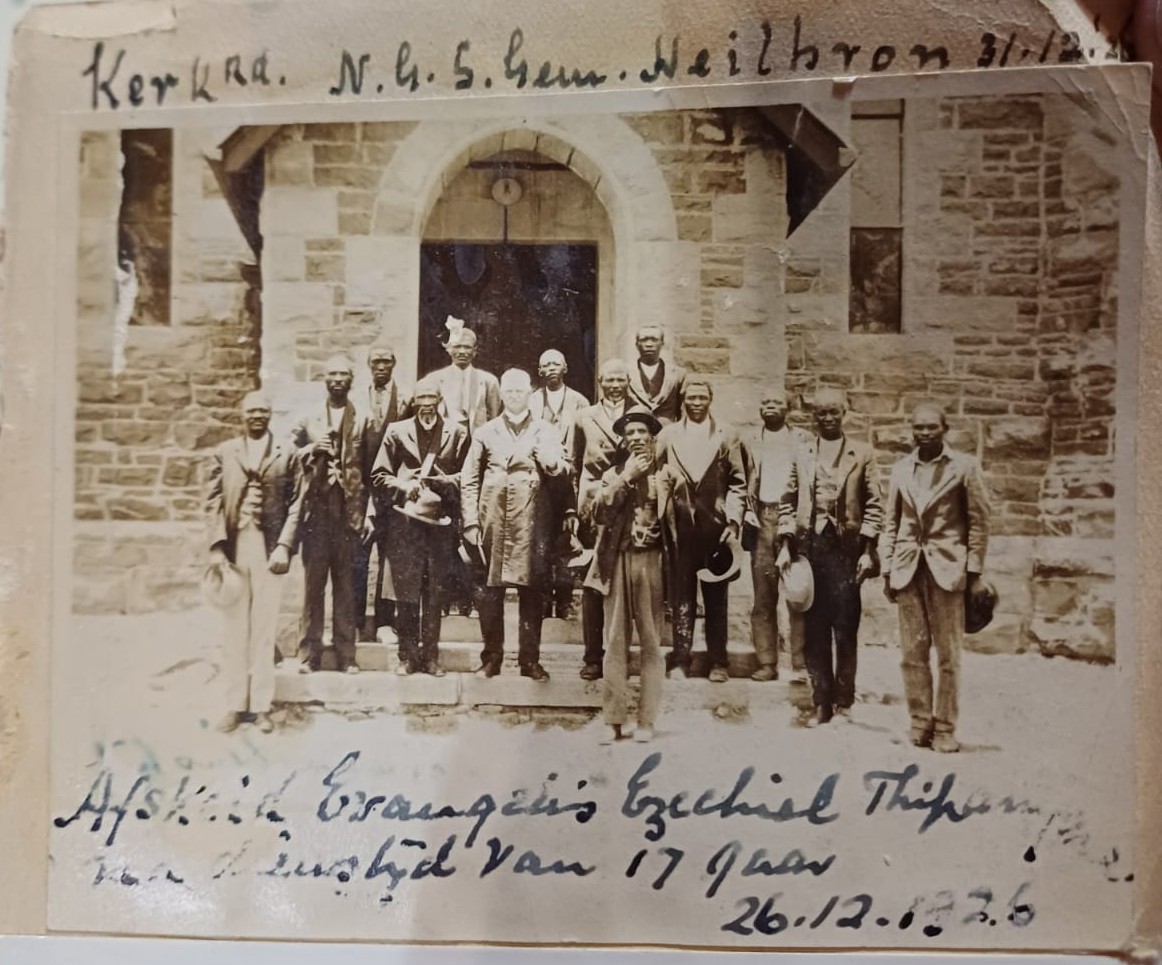
The missionary emphasis became unmistakable in JW Kok II’s later life (JW Kok II, son of JW Kok I who came from the Cape Colony). It can be said that it defined him.
During the Anglo Boer War, after he was taken prisoner at the Brandwater Basin, he entered a completely different environment. Yet his diary shows him turning increasingly towards religious work, in terms that echo the emphasis Robertson himself had placed on missions two generations earlier [8].
His captivity diary records religious activity almost as a matter of daily administration. On 3 January 1901 he notes that a school had been started in the camp and that the prisoners were encouraged to attend. On 22 September 1901 he records that Gert van de Venter started a choir in hut 48, while Ds Roux preached and taught katkisasie, Bible study, in hut 63. On 1 October 1901 he records Ds Roux’s own accusation during katkisasie, that the men had surrendered selfishly, out of pity for their horses and a wish to go home, a charge JW recorded without comment. On 7 January 1902 he writes: “A missions prayer meeting is started as well as a missions class.” [8]
That last entry marks a turning point. On 1 June 1902 JW became one of the founders of the Zuid-Afrikaansche Pennie Vereniging, the South African Penny Society, whose stated goal was to promote the missionary cause and, through this, to expand the Kingdom of God. Founding a fund-raising society from inside a prisoner of war camp is a striking act, and it shows that his missionary commitment had already moved from private devotion to organised administration well before he returned home. [8]
Among the prisoners there was also a belief that the war could be understood as God’s judgement because the Boer community had failed in its missionary responsibility towards African peoples. The EarthwormExpress account records this belief as follows: “It is reported that there was a belief among the young men at these camps that a reason for the war was that they did not do everything in their power to spread Christianity among the native African tribes. The war was seen as God’s judgment upon them for this failure.” / “Daar word berig dat daar onder die jong manne in hierdie kampe ‘n oortuiging was dat een van die redes vir die oorlog was dat hulle nie alles in hulle vermoë gedoen het om die Christendom onder die inheemse Afrikastamme te versprei nie. Die oorlog is gesien as God se oordeel oor hierdie tekortkoming.”
After the war he enrolled at the Missionary Seminary of the Dutch Reformed Church in Wellington. He was confirmed in a mission church at Heilbron in March 1906 and began his ministry there in April 1906. The missionary commitment therefore continued after captivity, moved from a prayer meeting and a penny society in a Ceylon camp to a lifelong profession, and became his life’s work. [8]
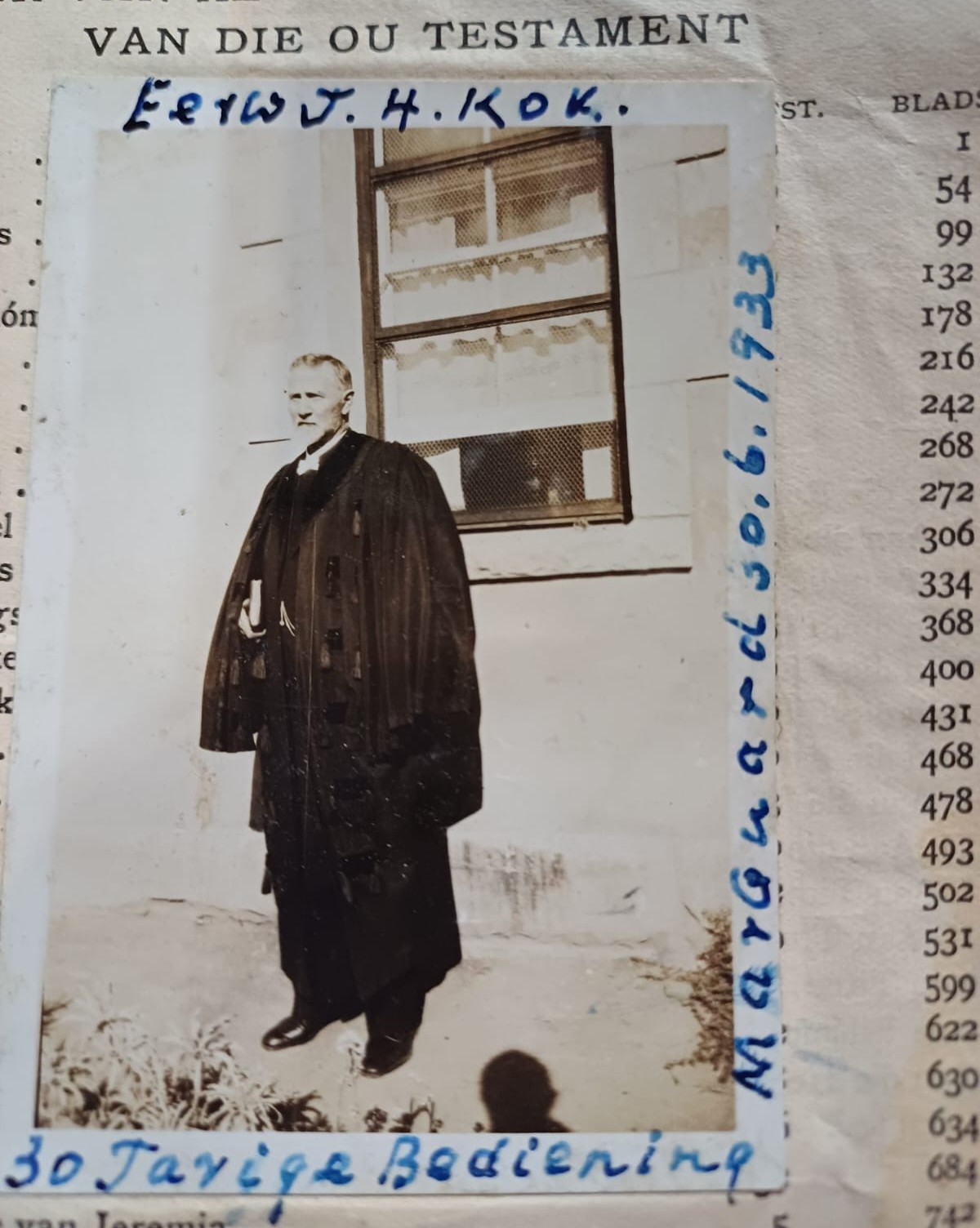
The Pastoral Character of JW Kok I
The missionary tradition of JW Kok I was accompanied by a strongly pastoral character in JW’s own conduct.
After the Battle of Paardeberg and the surrender of General Cronjé, an engagement his own diary calls a “fiasco,” JW witnessed the condition of the wounded Boers in the aftermath. He recorded: “Almost all our horses were killed and were strewn throughout the camp. Our wounded lay in ditches under bucksails without a doctor to treat them.” / “Byna al ons perde is gedood en was oral in die kamp versprei. Ons gewondes het in slote onder seilskuilings gelê sonder ‘n dokter om hulle te behandel.” [7]
He described his own response: “Yes, this I witnessed with my own eyes and I gave some water to quench their thirst.” / “Ja, dit het ek met my eie oë aanskou en ek het vir hulle water gegee om hulle dors te les.” He encountered a severely wounded man whose leg had been shot off. JW asked: “How are you?” / “Hoe gaan dit met jou?” The man answered: “My Uncle, very badly!” / “My Oom, baie sleg!” The wounded man then asked JW to pray with him. JW wrote: “He politely asked me to come in and do a prayer for him. I complied with his request and then departed from him.” / “Hy het my beleefd gevra om in te kom en vir hom te bid. Ek het aan sy versoek voldoen en daarna van hom af weggegaan.” [7]
JW’s response combined practical care and spiritual care. He gave water to the wounded. He encouraged the dying. He prayed with him.
The experience affected him profoundly. Afterwards he wrote: “I could write more about this fiasco at Paardenberg but my pen refuses to write more about this suffering, or rather, it is I who don’t want to write about it any further.” / “Ek kon meer oor hierdie fiasko by Paardenberg skryf, maar my pen weier om meer oor hierdie lyding te skryf, of eerder, dit is ek wat nie verder daaroor wil skryf nie.” [7]
He concluded: “This is enough for successive generations to have an idea of what we went through.” / “Dit is genoeg vir opeenvolgende geslagte om ‘n idee te hê van wat ons deurgemaak het.” [7]
This pastoral response fits remarkably well with the religious environment in which he had grown up. Robertson had described pastoral responsibility as extending to the “temporal and spiritual welfare” of people outside his own racial community, an emphasis JW would have absorbed as a boy. JW’s response at Paardeberg similarly joined physical care with spiritual care.
JW Kok I as Father
The same character appears in his relationship with his sons. During the war, while imprisoned at Simon’s Bay, JW wrote about his separation from one of his sons. The son was less than two miles away, but JW had not seen him for five months. He wrote: “Ek het gedink aan my een seun wat nie twee myl van my af was nie, maar ek het hom in vyf maande nog nooit gesien nie.” / “I thought about my one son who was not even two miles away from me, but I had not seen him for five months.” [7]
When he received a letter from his son, he wrote: “Die brief het my weer sterk gemaak.” / “The letter made me strong again.” [7]
The relationship between father and sons was deeply religious. His sons sent him religious material. They exchanged religious thoughts. JW recorded sermons, prayer meetings and Bible studies throughout his captivity in unusual detail. His own translator, Oom Jan, noted that “at some sermons he even carefully wrote down the points into which the preacher divided his sermon.” The diary bears this out. On Sunday 11 March 1900, for example, he records a full order of service held in the ship’s dining room: “Kommandant Wolmarans het die verrigtinge ge-open met die sing van Psalm 25:1. Daarna het kommandant Thomas Martins ‘n ernstige gebed gedoen. Kommandant A Smith het Ps. 71 gelees en daarna het ons Ps. 42 gesing en ek het die dankgebed gedoen.” / “Commandant Wolmarans opened the proceedings with the singing of Psalm 25:1. Then Commandant Thomas Martins offered an earnest prayer. Commandant A Smith read Psalm 71, after which we sang Psalm 42, and I gave the prayer of thanks.” On Sunday 18 March, after evening worship on deck, the men agreed among themselves “om elke aand bymekaar te kom vir Godsdiensoefening,” to meet every evening for a service. On 4 April 1900 he records a further decision: “Ons het ook besluit om elke eerste Woensdag van die maand om twee uur ‘n biduur te hou,” to hold a prayer hour on the first Wednesday of every month, a decision JW himself closed in prayer. Through the following months he names the preacher and gives the exact text almost daily, Ds. Alheit, Ds. du Plessis, Ds. Botha of Swellendam, Ds. du Toit, each entry logged with the same care his translator described. [7]
His children therefore encountered Christianity through their father’s conduct as well as through his words. They saw how he responded to suffering, his concern for wounded men, his prayers and how he maintained his faith while separated from his family.
| The Obituary of Johannes Willem Kok (JW Kok I) An obituary from Winburg, signed G. J. H., describes JW Kok I as follows. It gives a contemporary portrait of JW Kok I’s character [56]. Winburg. The late Johannes Willem Kok. Oom Jan Kok is no more. On Friday morning, the 14th of this month, he breathed his last at his home, Krantzdrift, after a long illness, which he bore with the greatest patience and contentment. Born in the Cape Colony in the Robertson district in July 1848, he moved with his parents to the Orange Free State in 1862. Here, as a youth, he had to endure much during the great drought of that time, as well as through the incursions of the Basotho. As a young man he also took part in the Basotho War, and he could tell much about it. He later married a daughter of the late Mr Thomas Theron of Leeuwfontein, and the young couple then settled on the farm Krantzdrift, where he has now died and lies buried. In November 1899 he was chosen as their commandant by a divisional commando of Winburgers and Senekallers, and he took part in the battles of Modder River and Magersfontein, as well as the encircling battles at Paardeberg, where he and his burghers had to surrender under General Cronjé. He was therefore a prisoner of war at Green Point and Simon’s Town until after the peace. He leaves a widow and eight children, almost all of them grown up, of whom five are already married. Among them are two missionaries, at Knysna and at Heilbron. He was a great friend and supporter of the mission cause, for which he had an open hand and a warm heart. As a citizen too he was a model of loyalty and obedience to authority. As a Christian he was accustomed to test all matters against God’s Word. As a faithful supporter of his Government, he commanded the greatest respect even from those who differed from him, because of his humility and the love he bore to everyone. Indeed, he was everyone’s friend, and consequently his door stood open to all. The funeral took place at his home on Sunday, 16 June. A large crowd of mourners, about 300, was present. Rev. Jooste of Trompsburg conducted the funeral service. At the graveside Senator Staurt spoke a very solemn word about the deceased, whom he had already known and respected as a youth. He rightly pointed out how Oom Jan excelled in great steadfastness and never sought himself. He never competed for position in society, but one could count on him and rely on his word. He was a type of the forefathers. Rev. Badenhorst of Rietfontein offered the closing prayer. With the deepest sympathy for his bereaved family, I lay this humble little wreath on his lonely grave. May his memory be a blessing to us. G. J. H. |
Oom Jan and the Preservation of the Missionary Tradition

The later Oom Jan, grandson of JW Kok II, became a Dutch Reformed minister and subsequently wrote extensively about this religious tradition. His connection to the family history was personal. In his foreword to the translation of his grandfather’s war diary, he wrote: “Die skrywer van hierdie Dagboek, of Joernaal, soos hy dit genoem het, was Kommandant Johannes Willem Kok [JW Kok I]. Hy was my oupagrootjie aan my pa se kant van die familie. Ek is trots daarop dat ek ‘n naamgenoot van hom kan wees.” / “The author of this diary, or journal, as he called it, was Commandant Johannes Willem Kok [JW Kok I]. He was my great grandfather on my father’s side of the family. I am proud that I can be his namesake.”
He explained why he translated the diary: “Ek het hierdie dagboek in Afrikaans vertaal sodat die huidige geslag kan weet waar ons vandaan kom en wat ons familie se rol in die geskiedenis van Suid Afrika was.” / “I translated this diary into Afrikaans so that the present generation could know where we came from and what our family’s role was in the history of South Africa.”
His assessment of his grandfather’s religious character was explicit: “By die lees van hierdie dagboek was dit baie duidelik dat Jan Kok [JW Kok I] ‘n diep gelowige mens was.” / “In reading this diary it was very clear that Jan Kok [JW Kok I] was a deeply believing man.”
Oom Jan also drew attention to the importance of ministers and missionaries in the lives of the prisoners: “Ek het ook onder die indruk gekom van die enorme rol wat predikante en sendelinge, nie net die wat self krygsgevangenes was nie, maar ook die plaaslike predikante in Kaapstad en Simonstad en omgewing, in die lewe van die krygsgevangenes gespeel het.” / “I was also struck by the enormous role played by ministers and missionaries, not only those who were themselves prisoners of war, but also the local ministers in Cape Town and Simon’s Town and the surrounding areas, in the lives of the prisoners of war.”
He continued: “Eredienste, Bybelstudies en biduure was deel van elke dag se gebeure.” / “Church services, Bible studies and prayer meetings were part of the events of every day.” And: “Geloof het ‘n baie belangrike rol gespeel in die lewe van die boerevegters en later ook as krygsgevangenes.” / “Faith played a very important role in the lives of the Boer fighters and later also as prisoners of war.”
Oom Jan’s Own Missionary Scholarship
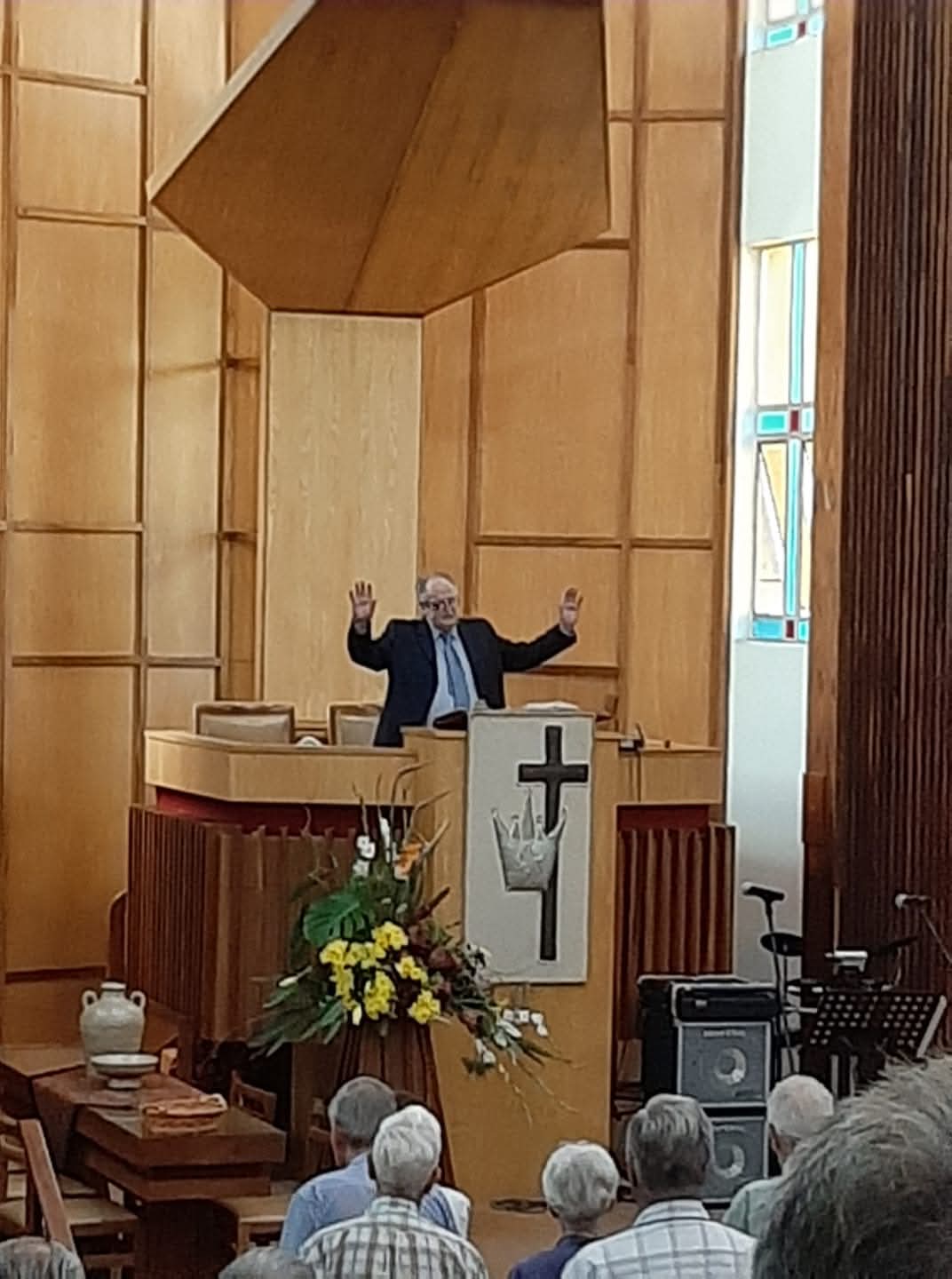
Oom Jan’s interest in missionary work was not limited to preserving his grandfather’s diary. After completing his theological studies as a Dutch Reformed minister, he wrote a dissertation on the development of missionary zeal in the prisoner of war camps. The work was subsequently published as Sonderlinge Vrug.
The subject itself is significant. Oom Jan chose to investigate why missionary zeal developed among Boer prisoners and why a number of men who entered captivity as soldiers returned to South Africa and entered missionary work. His grandfather was one of the men whose religious life was transformed during captivity. Oom Jan therefore became the minister and scholar of the next generation who studied the missionary movement that had affected his grandfather.
The family connection is unusually close. His great grandfather had supported missions. His grandfather became a missionary after the war. Oom Jan became a minister and wrote a substantial theological and historical study of the missionary movement that had developed among the Boer prisoners.
As DRC minister, he remained intimately involved in the missions with missionary churches under his oversight and leadership. It remained integrally part of his work as pastor right up till his retirement.
Oom Jan and the Question of Race
Oom Jan’s writings show that he regarded missionary work as an important historical and religious subject. He devoted his theological research to the missionary movement among Boer prisoners and translated his grandfather’s diary. He returned repeatedly to the importance of ministers, missionaries, prayer, Bible study and Christian service. Sonderlinge Vrug is a critical primary source on this. The many conversations Oom Jan and I had on the subject form a second source, and two of them bear directly on the question of race.
The first concerns a difference he noticed as a boy. When the family visited his Oupa, JW Kok II, the missionary and father of my Oupa Eben, the black staff came and sat at the same table after the family had eaten. They used the same cutlery and ate exactly the same food as the family. On the farm, however, black workers were not allowed to sit at the table or use the cutlery of the family. Oom Jan asked his mother, my Ouma, why this was so. She answered “Sommer”, which translates as “Because.”
The second story concerns the local black missionary in Warmbaths. He was a colleague who worked among the black population of the area, and the two men met regularly at Oom Jan’s house. He was treated as any other guest would be, with tea and coffee followed by lunch. Oom Jan used the time to encourage him in matters of faith, and the missionary reported on the progress of his work. On one occasion the parents of Oom Jan’s wife, Tannie Magna, were visiting. Her father, Oupa Ben, was upset that the missionary had used the same cutlery as the rest of the family. Oom Jan told me that he then marked the cutlery used by his colleague so that Oupa Ben would not have to use the same.
The practice was not unusual. My mother and father did exactly the same in our house, as did many other Afrikaans families. My mother marked glasses with nail varnish. In general the domestic workers had their own tin cups and plates, and we never used them. I have wondered about the origin of this practice many times.
The historical record offers a possible source, although no author consulted links the household practice to it directly. Bubonic plague was recorded in Cape Town in early February 1901. The first cases occurred among dockworkers who had unloaded grain and fodder that harboured rats and their fleas [37] [33]. The disease is caused by Yersinia pestis and, in epidemics, it is transmitted by the bite of rat fleas, principally Xenopsylla cheopis [31]. The disease therefore had nothing to do with race.
The authorities nevertheless directed their response at the African population. On 12 March 1901 the Cape government removed about 6,000 Africans from the poorest parts of the city under armed guard. By the end of May they had been placed at Uitvlugt, a former sewage station near Maitland [34]. The city’s Medical Officer acted under the Public Health Act of 1883, which had been introduced after a smallpox epidemic [37]. Removal depended on race and place of residence, and not on infection or exposure [34]. Whites and coloured people removed from infected homes were placed in an emergency camp and allowed to return after fumigation, while Africans were moved permanently [27] [36]. This happened although fewer Africans than whites or coloured people contracted the plague [27] [36].
The site became a permanent location. Its name was changed in 1902 to Ndabeni, a Xhosa word meaning place of debate [35]. Bickford-Smith describes it as the first forced removal of Africans from Cape Town, and it was the city’s first planned township. It was replaced by Langa in 1927 [38]. Blame was also directed at other groups regarded as unclean, namely Jews and Asians. This occurred although soldiers had about 50 percent more cases of plague than the civilian population [26].
Swanson named this pattern the sanitation syndrome. He argued that infectious disease and public health worked as social metaphors, and that between 1900 and 1904 the plague led to the mass removal of African urban populations to hastily established locations [36]. The pattern was repeated elsewhere. In Port Elizabeth Africans were forced to live in designated areas such as New Brighton [35]. In Johannesburg in 1904 the authorities removed 3,178 Indian, African and coloured residents of the Coolie Location to a tented camp at Klipspruit, later Pimville, after pneumonic plague was reported [29].
The plague was not the only disease attributed to Africans. Between 1900 and 1904 the threat of plague, cholera and smallpox led to the hasty removal of African urban populations to locations in Cape Town and Port Elizabeth. The idea that black urban settlement endangered the health of white communities then became a routine part of public health discourse. It contributed to the panic that shaped legislation on tuberculosis and miners in 1916 [28]. Syphilis followed the same course. Jochelson shows that Africans and people described as half castes were regarded as spreaders of venereal disease. She argues that the epidemic among Africans in the 1880s was in fact endemic syphilis, an indigenous disease related to venereal syphilis and transmitted through unhygienic working and living conditions in urban centres. Medical explanations were shaped by contemporary racial ideas, and the fears may have reflected wider fears about social and moral disorder more than a real increase in disease [30].
The washing of linen at the Cape also has a documented precedent, although it concerns smallpox and not plague. On 13 February 1713 the clothing and linen of the crew of a Dutch ship, whose men had smallpox, were sent to the slave lodge of the VOC for laundering [35]. The epidemic that followed killed about a quarter of the European population of Cape Town according to Theal, and the slave population of Cape Town fell by about 21 percent [39]. The Khoikhoi suffered the greatest losses.
The hygiene reasoning behind separate crockery and cutlery is documented in later periods. A survey of domestic workers reported by Motala quotes a worker in a Johannesburg suburb who said that the utensils she used were kept outside and called this apartheid [32]. A 2018 newspaper report on mugs labelled “The Maid” and “The Gardener” quoted a commentator who said that helpers were denied household crockery and cutlery because they were considered unworthy and unhygienic [40]. These sources show the practice and its stated reason. However, they do not date its origin.
The link between the sanitation syndrome and the marking of cutlery in the Afrikaans household is therefore a hypothesis. It is consistent with the record, because disease was used to justify the separation of Africans from white communities in the first years of the twentieth century, and cleanliness is the reason given for separate utensils.
Whichever the origin, Oom Jan saw all people as equal. His passion for the missions without a doubt came from what he saw in his grandfather, who in turn received it from his father, JW Kok I. JW Kok I was without question greatly influenced by Ds Robertson. Oom Jan treated black people as equals, and the circumstances of his own baptism show how close this tradition stood to him.
Oom Jan was baptised in 1942 by his grandfather, Jan Kok (JW Kok II), who was born on 4 April 1880 and whose name he received. His grandfather was a missionary of the Dutch Reformed Church and served the congregation at Heilbron for 39 years until his retirement in 1945 [41] [42]. The baptism took place in the “black church” at Heilbron, where his grandfather was the pastor [42]. In the words he sent me with the family photographs on 28 December 2017, Oom Jan wrote, “Ek was seker een van die eerste blanke kinders wat in die Swart kerk gedoop is, en as gevolg van die Apartheidswette mag my doop nie in die boeke van die Sendingkerk opgeteken word nie, maar wel in die ‘Wit’ gemeente, Heilbron Suid.” / “I was probably one of the first white children to be baptised in the Black church, and because of the Apartheid laws my baptism could not be recorded in the books of the Mission Church, but only in the ‘White’ congregation, Heilbron South.” [41]
The record of the baptism therefore lay in a different congregation from the one in which it took place. This became important many years later. Oom Jan needed a doopseël, a baptismal seal, as proof that he had been baptised, because this was a requirement for becoming a dominee in the church. The seal was eventually found at the white church in Heilbron South, where his grandfather must have registered it [42]. The episode shows a white child baptised in a mission congregation by the white missionary who served it, and a record that had to be kept in another congregation because of the racial rules of the time.
Two currents therefore ran through the same family. The first was the custom of separate cutlery, cups and tables, which was widespread among Afrikaans households, including my own, and which rested on an appeal to cleanliness and possibly on the disease scares of the early twentieth century. The second was a missionary tradition that passed from Ds Robertson to JW Kok I, from him to JW Kok II, and from him to Oom Jan. Within that tradition black staff sat at the missionary’s table, a white child was baptised in the mission church, and a black colleague was received as a guest with tea, coffee and lunch. Oom Jan knew both from childhood and asked why they differed, and his mother answered “Sommer”. The marked cutlery in his own house shows how strong the custom remained, even for a man whose convictions pointed elsewhere. Yet his life work, from his ministry among missionary churches to his study of the missionary zeal that changed his grandfather in captivity, shows which of the two he followed.
Barry Kok and the Table in Namibia
The missionary table at Heilbron was not confined to one branch of the family. JW Kok II had more than one son, and the same practice appears in the line of his eldest son, Johannes Willem Kok, known as Johan, who was born in 1908 and was Oupa Eben’s older brother. Johan’s son was Leon Kok, a first cousin of Eben van Tonder’s mother, Sannie. Leon’s son is Barry Kok, a second cousin of Eben van Tonder.
Johannes Willem KokJW Kok II1880 to 1950 │ ├───────────────┐ │ │Johannes Willem Ebenhaezer KokJohan Kok Oupa Ebenborn 1908 1911 to 1981 │ │ Leon Kok │ │ Barry Kok
Leon Kok and his family lived in Namibia. Barry Kok described the household of his childhood in a private communication [57]. He wrote, “We had an Ovambo ‘non-Caucasian’ gentleman living in our third bedroom for all my school life. His name was Moses, a great man, a great ‘all-rounder’, cook, gardener, friend, and he ate at the table with my dad and I every night.” [57]
The family later moved to Pretoria during Barry’s final school years. He recalled that the move pleased him because he played for Harlequins. His father then asked Moses to take him to the state library in Pretoria, and Barry described what followed as his first shock. The bus driver told them that no “non-Caucasian” passengers were allowed on the bus. They therefore took the Putco instead [57].
Putco is the Public Utility Transport Corporation, and the name is an acronym formed from its full title. The company was founded in 1945, during a period when reliable transport was scarce for most South Africans. The Dictionary of South African English defines it as a large bus company transporting Black commuters in the Transvaal provinces and in KwaZulu-Natal. Public transport in South African cities was divided by race at the time. A 1990 source quoted in the same dictionary records that until recently, bus companies mainly served racially defined groups, and Putco buses carried Africans and coloureds. In Pretoria its routes brought commuters into the city from Atteridgeville and Mamelodi on its outskirts. Putco was also connected with resistance to the system it served. When it raised fares in 1957, a bus boycott began in Alexandra and quickly spread to other areas, including the Pretoria townships of Atteridgeville and Lady Selborne. [58] [59] Heritage on the move: Celebrating Putco’s 80-year legacy +4
The episode in Pretoria therefore placed the two currents described above side by side within a single day. At home in Namibia, Moses lived in the house and ate at the family table every night, as the staff had done at JW Kok II’s table at Heilbron. In the city, the law would not allow him onto the same bus as the boy he was accompanying. Barry and Moses resolved the problem by travelling together on the bus reserved for Moses, and in that act the household custom of the Kok missionary line held against the public rule.
Barry’s account shows that the attitude towards people of other races was well established in the Kok lineage. It appears in two separate branches descending from JW Kok II, through Oupa Eben’s line to Oom Jan and through Johan Kok’s line to Leon and Barry. The two branches lived far apart, one in the Free State and Transvaal and the other in Namibia, yet both kept the table that JW Kok II had kept at Heilbron.
From Robertson to JW Kok I to Oom Jan
Three bodies of research help to explain how one man can shape a family across more than a century. Bandura showed that people acquire behaviour by observing models, and that they attend most closely to models who carry authority and credibility [43]. Jordan B. Peterson, the Canadian clinical psychologist and professor of psychology at the University of Toronto, argues that no one meets chaos alone, because each person is born into a family, a culture and a faith that already hold a map of what is worth doing [45] [46]. He also describes the imitation of Christ as the making of a courageous, truthful and individually unique life [47]. Bengtson and his colleagues followed more than 350 families and more than 3,500 people for 35 years and found that faith travels down the generations through warm bonds and strong role modelling, above all through the bond with a father [44]. The Kok record shows the same pattern, namely that a person of conviction, met at the right moment, can set a pattern that later generations carry long after they have forgotten where it began.
The raw model was William Robertson. He was the minister of Swellendam throughout JW Kok I’s childhood, and he came from the Scottish evangelical tradition. He regarded the Coloured population as part of his “pastoral and ministerial charge” and worked for their “temporal and spiritual welfare”. Observers of the time recorded that he called racial prejudice “unreasonable and unchristian” [4]. No document shows a conversation between Robertson and the boy. However, Robertson was the dominant minister of the community in which the Kock household lived, and JW’s father, Johan Hendrik Christoffel Kock, was remembered as a man with “an open hand and a warm heart” towards the missionary cause. The boy therefore met the same example in the pulpit and at home, which is the repeated and authoritative exposure that Bandura describes [43].
The example met him at his most vulnerable. At twelve JW nearly died of fever, and his mother died while he was unconscious [2]. He woke as, in his own words, “an orphan without a mother”, and his first recorded experience of answered prayer came from this illness. In the terms of Peterson’s chapter on apprenticeship and enculturation, the boy adopted a map that was already drawn, and grief gave it a personal meaning [46]. The world around him had supplied a language for suffering before he needed one.
Four decades later the language became conduct. After Paardeberg JW gave water to wounded men who lay in ditches without a doctor, and when a man whose leg had been shot off asked him to pray, he prayed with him [7]. In Bandura’s terms this is reproduction, the stage at which what was observed in youth is performed when circumstances call for it [43]. In Peterson’s terms it is the imitation of Christ as a lived habit and not as a creed [47]. It also repeats Robertson’s own pairing of temporal and spiritual welfare, because JW’s care joined the body and the soul in one act.
The next steps in the chain are the ones that Bengtson’s research would lead one to expect. The vocation moved through family bonds and not through argument. Jan Kok (JW Kok II) served the congregation at Heilbron for 39 years and baptised his grandson in the black church [42] [41]. That grandson was Oom Jan, who grew up beside a missionary household in which black staff sat at the family table, and who later received his own black colleague as a guest. Bengtson found that the influence of grandparents on the faith of their grandchildren has not declined, and that in families that pass on their faith the relationship with a father figure is decisive [44].
Oom Jan then did something that the theory does not predict. He turned the example he had inherited into a subject of study. He translated the war diary, wrote Sonderlinge Vrug on the missionary zeal of the prisoner of war camps, and preserved the family papers so that later readers could see the line for themselves. A man who had received an example became the person who made it visible.
The line from Swellendam to Oom Jan is therefore a chain of examples and not a chain of arguments, and each example was seen at close range by the next person. Robertson gave a boy a picture of what a minister could be. The boy carried that picture onto a battlefield. His descendants gave it a church, a table, a font and eventually a book. Much changed across more than a century and a half, yet the pattern held, because at every stage someone stood near enough to be watched.
1.5 The next generation: to Oupa Eben


Oupa with me and my brothers. The photo on the right, Ouma and my mom and dad are also there.
JW Kok II of generation 2, born 1880, is Ebenhaezer Kok’s father. Ebenhaezer, Oupa Eben of the recipe, was born 18 June 1911 in Heilbron in the Free State. He married Susanna Maria Uys on 7 August 1939 and died on 21 February 1981 at Vredefort. Their three children were Susanna Maria (Sannie, Eben van Tonder’s mother, the eldest), Johannes Willem (Jan, JW Kok III, generation 3, the middle child and first son), and Michiel Eksteen Uys Kok (Uysie, the youngest, born 28 February 1945). [3]
Generation 2’s first son was Johannes Willem Kok, born in 1908. The Johannes Willem naming sequence therefore continues through the first son of generation 2.
Neither source has generation 2 himself explain why he named his son Ebenhaezer. The sources do not establish the reason. A likely explanation is that it was in done in the belief that it was God who brought them safely through the war or at least to the point of safety and understanding.
The family’s recurring name is Johannes Willem, through three generations. Generation 1 was JW Kok I, generation 2 was JW Kok II, and generation 3 was JW Kok III, born on 3 May 1942. The family register therefore provides a clear three generation recurrence of the name.
The name carried forward again. Eben van Tonder, whose mother Sannie was Oupa Eben’s eldest child, was named Ebenhaezer after his grandfather, with Kok, Oupa Eben’s own surname, as his second name. His full name is Ebenhaezer Kok van Tonder, Eben for short. The chain runs Ebenhaezer to Ebenhaezer Kok van Tonder, three generations carrying the same stone of help.
Oupa Eben worked as a bank clerk at Standard Bank in Koppies. It was there that the family boerewors recipe was typed out [1].
1.6 Timeline
| Date | Event | Person |
| 1745 | Arrives at the Cape from Waldeck as a VOC mercenary; settles at Swellendam | Johann Hendrik Christoffel Kock |
| 29 Jul 1848 | Born, Klaasvoogdrivier, Swellendam district, Cape | JW Kok I, generation 1 |
| 1862 | Family sells the Swellendam farm and treks to the Free State, six months, arriving at Welgevonden, Bethlehem district | Generation 1, aged 14 |
| 1864 | Basotho unrest forces a further move to the Winburg district, Vetrivier ward | Generation 1 |
| 1865 to 1869 | Serves in the Winburg commando through the Basotho War against Moshoeshoe | Generation 1 |
| Jan 1875 | Marries Jacoba Johanna Elizabeth Theron; settles at Kransdrift, Winburg | Generation 1 |
| 4 Apr 1880 | Born, Winburg | JW Kok II, generation 2 |
| Feb 1900 | Surrenders with General Cronje at Paardeberg on 27 February 1900, as commandant of Kransdrift | Generation 1 |
| 30 Jul 1900 | General Prinsloo formally surrenders to General Hunter at the Brandwater Basin | Generation 2 |
| 31 Jul 1900 | Jan Kok (JW Kok II) and the other burghers lay down their arms after the surrender | Generation 2 |
| 15 Aug 1900 | Goes aboard the Dilwara from Cape Town for Ceylon | Generation 2 |
| 1901 to 1902 | After refusing to rejoin the fighting, is imprisoned by his own side and later sent to Ceylon as a prisoner of war, where he is called to the ministry | Generation 2 |
| 15 Oct 1910 | Writes his autobiography at Kransdrift, aged 62 | Generation 1 |
| 14 Jun 1918 | Dies at Kransdrift, Winburg district | Generation 1 |
| 18 Jun 1911 | Born, Heilbron, Free State | Ebenhaezer (Oupa Eben) Kok |
| 7 Aug 1939 | Marries Susanna Maria Uys | Oupa Eben |
| 21 Feb 1981 | Dies at Vredefort | Oupa Eben |
| 3 May 1942 | Born at Vredefort | JW Kok III, generation 3 |
2. The Predikant and the Family’s Faith Background
The Swellendam minister is identified in section 1.4 above: the Reverend William Robertson throughout the family’s years there, joined by the Reverend Johannes Rynard Keet from 1859. Neither man appears by name in JW Kok I’s own 1910 memoir, which focuses on his own working. As the sitting ministers of the only congregation the family had, one or both would have baptised, catechised, and very likely confirmed him before the 1862 move.
The family’s own documented church involvement runs deeper than that memoir shows. Generation 1, the memoirist, later served on the Dutch Reformed Church council at Winburg. Generation 2, his son, went considerably further: called to the ministry during his imprisonment on Ceylon, he trained at the Mission Institute at Wellington from 1902, and began his ministry in the Heilbron mission congregation in 1906, serving an area that stretched across Petrus Steyn, Edenville, Koppies, Oranjeville, Viljoensdrif and Heilbron itself.
What JW Kok I’s own memoir says of the household he grew up in, clearly and in his own words, is that the family were raised in daily household worship, morning and evening, and that he describes his forebears as descendants of pious Huguenots, urging his own readers to honour that inheritance and the God of their fathers. That is a Reformed, Calvinist household piety of the ordinary Cape farming kind, and the family’s later record, a church council seat in one generation, a full ministry in the next, and a lifelong Dutch Reformed ministry in the generation after that, is consistent with it.
The Newspaper Report Stuck in JW Kok II’s Bible
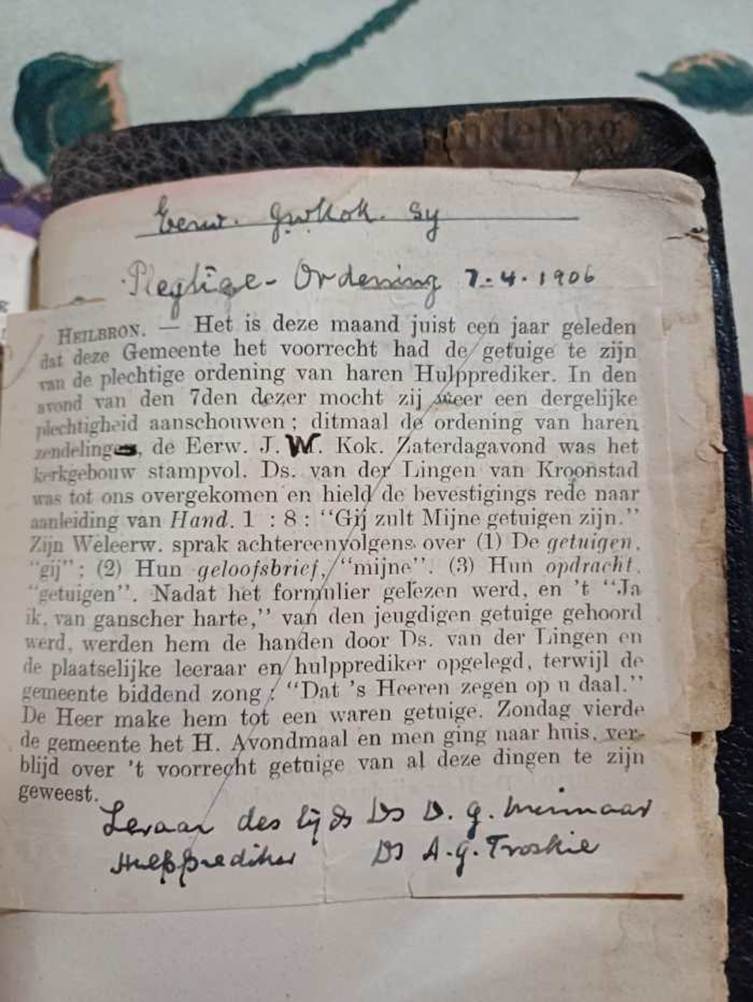
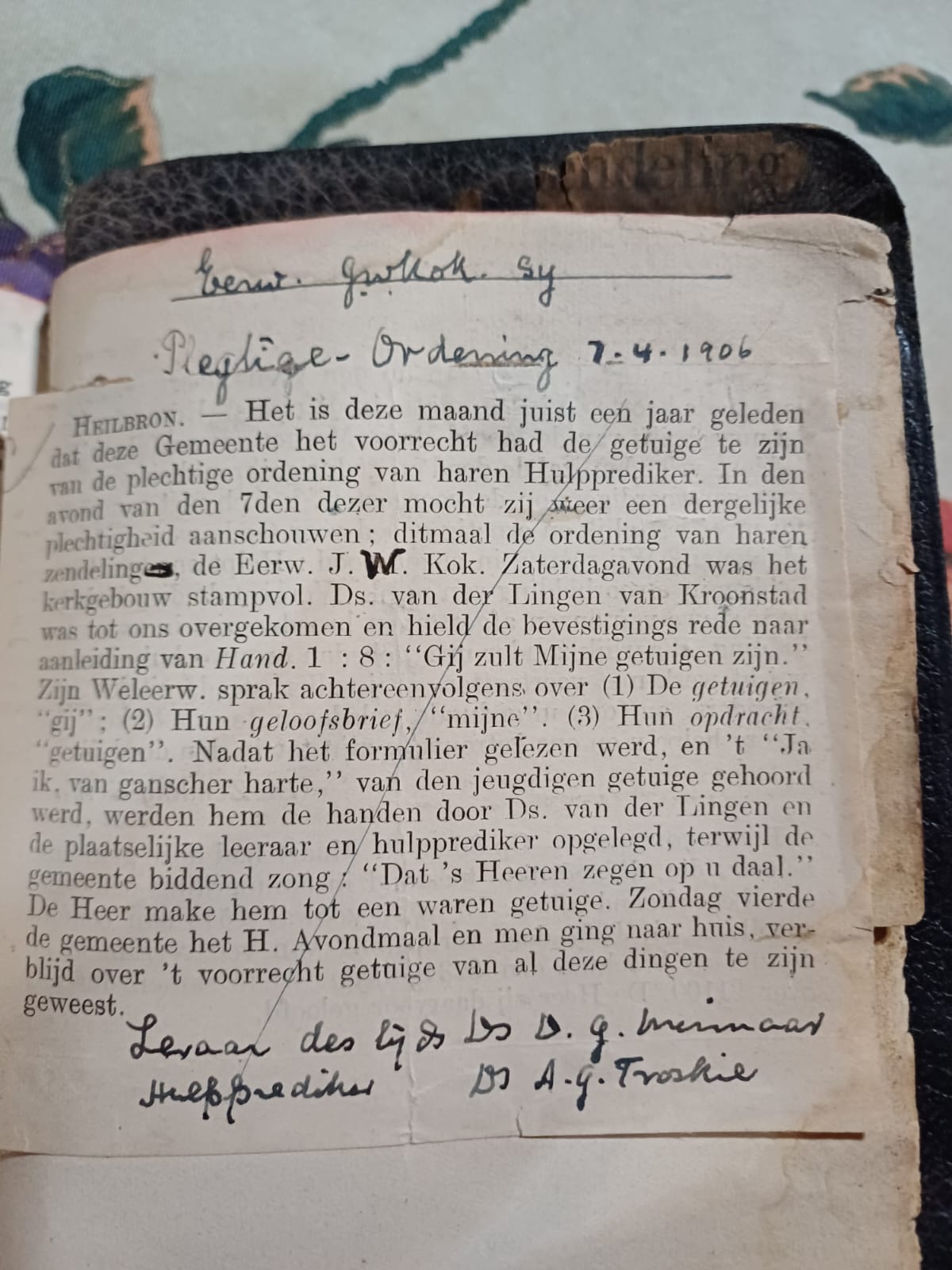
Newspaper clipping on the ordination of the Rev. J.W. Kok (JW Kok II) at Heilbron, 7 April 1906, with handwritten annotations
Handwritten heading
Eerw. J.W. Kok. sy
Plegtige Ordening 7.4.1906
Rev. J.W. Kok. His solemn ordination, 7 April 1906 [53].
Printed article, as transcribed
HEILBRON. Het is deze maand juist een jaar geleden dat deze Gemeente het voorrecht had de getuige te zijn van de plechtige ordening van haren Hulpprediker. In den avond van den 7den dezer mocht zij weer een dergelijke plechtigheid aanschouwen; ditmaal de ordening van haren zendeling, de Eerw. J. W. Kok. Zaterdagavond was het kerkgebouw stampvol. Ds. van der Lingen van Kroonstad was tot ons overgekomen en hield de bevestigings rede naar aanleiding van Hand. 1 : 8: “Gij zult Mijne getuigen zijn.” Zijn Weleerw. sprak achtereenvolgens over (1) De getuigen, “gij”; (2) Hun geloofsbrief, “mijne”; (3) Hun opdracht, “getuigen”. Nadat het formulier gelezen werd, en ‘t “Ja ik, van ganscher harte,” van den jeugdigen getuige gehoord werd, werden hem de handen door Ds. van der Lingen en de plaatselijke leeraar en hulpprediker opgelegd, terwijl de gemeente biddend zong: “Dat ‘s Heeren zegen op u daal.” De Heer make hem tot een waren getuige. Zondag vierde de gemeente het H. Avondmaal en men ging naar huis, verblijd over ‘t voorrecht getuige van al deze dingen te zijn geweest.
Handwritten note at the bottom
Leraar des tijds Ds D. J. Minnaar
Hulpprediker Ds A. J. Troskie
English translation
HEILBRON. It is exactly one year this month since this congregation had the privilege of witnessing the solemn ordination of its assistant minister. On the evening of the 7th of this month it was again privileged to witness a similar ceremony. This time it was the ordination of its missionary, the Reverend J. W. Kok [JW Kok II]. On Saturday evening the church building was packed. Rev. Van der Lingen of Kroonstad had come to us and delivered the ordination address on Acts 1:8, “You shall be My witnesses.” His Reverence spoke in turn on (1) the witnesses, “you”, (2) their credential, “My”, and (3) their commission, “witnesses”. After the form had been read, and the young witness had been heard to say, “Yes, I do, with all my heart”, Rev. Van der Lingen and the local minister and assistant minister laid their hands upon him, while the congregation prayerfully sang, “May the Lord’s blessing descend upon you.” May the Lord make him a true witness. On Sunday the congregation celebrated Holy Communion, and they went home rejoicing in the privilege of having witnessed all these things.
Handwritten note, translated
Minister at the time, Rev. D. J. Minnaar.
Assistant minister, Rev. A. J. Troskie. [54] [55]
3. The Winburg Republic
Winburg’s founding belongs to the generation before JW Kok I’s own arrival there. Andries Hendrik Potgieter led a group of Voortrekkers into the area between the Vet and Vaal rivers in the mid 1830s, and on 16 October 1836 a Voortrekker laager at Vegkop, near the later town, withstood an attack by a large Matabele force under Mzilikazi, a defensive action generally credited as giving the settlement its name, Wenburg, victory town, later Winburg.
On 6 June 1837, Piet Retief was inaugurated as governor and Gert Maritz as judge president near Winburg, the first such democratic installation of leaders in the region, with a provisional Volksraad established shortly after. Winburg itself, as a town, was formally sited in 1842. It fell for a period under the Natalia and then Winburg Potchefstroom republican arrangements under Potgieter, then briefly under British administration from 1845, before becoming part of the Orange Free State from 1854, with Winburg serving as an early capital before that role moved to Bloemfontein.
JW Kok I’s own family reached the Winburg district in 1864, roughly three decades after these founding events, and their own conflict there, as his memoir makes clear, was with the Basotho under Moshoeshoe, not the Matabele Mzilikazi had already been driven off in the 1830s.
4. The Matabele Wars
The Matabele, under Mzilikazi, were the dominant power resisted by the first Voortrekkers into this part of the interior in 1836, most notably at Vegkop, the battle that gave Winburg its name. By the time JW Kok I’s own family arrived in the district in 1864, the Matabele had long since moved north, and the conflict this family actually lived through was a different one entirely, the Basotho War, fought in the 1860s against Moshoeshoe rather than Mzilikazi. The two conflicts are sometimes run together in family memory since both involve the same district, but the sources are clear that they are a generation and an opponent apart.
5. The Surname Question: Waldeck to Kok
The family did not arrive in South Africa as Kok. The first member of the family recorded in the EarthwormExpress genealogy was JOHAN HENDRIK CHRISTOFFEL KOCK, also given as Johann Heinrich Christoph, who came from Waldeck in Germany in 1745 in the service of the Dutch East India Company [5]. He became a burgher at Swellendam. The family remained Kock in the Cape generations. Johan Hendrik Christoffel Kock, born at Robertson in 1826, was still Kock, as was his son Johannes Willem Kock (JW Kok I), born in 1848. The spelling changes to Kok in the later generations after the family moved into the Free State. The genealogy records the transition from Kock to Kok as the family became established in the interior. The EarthwormExpress genealogy also records JHC Kock as moving his family from Robertson into the Free State and settling in the Winburg district [3].
The spelling also belongs to the wider language history of the family. The Kocks came from Waldeck, a German Protestant territory with a predominantly Lutheran tradition. They entered a Cape society whose European language and culture were predominantly Dutch. The German Kock gradually became the Dutch spelling Kok. The old European distinction between High Dutch and Low Dutch is useful here. High Dutch was a historical term used for German, while Low Dutch referred to Dutch and related Low German speech. The Kock to Kok spelling can therefore be understood as part of the gradual identification of a German immigrant family with the Dutch speaking population among whom they lived. The sources do not record why the spelling changed. It does not mean that Afrikaans developed from German. Afrikaans developed principally from Cape Dutch and remains very closely related to Dutch. German and Dutch are nevertheless both West Germanic languages, and the older relationship between the German and Dutch language worlds is part of the wider European background from which Afrikaans eventually developed.
6. Boerewors Spice Note: Oupa Eben Compared to Van T’s recipe
The family came from Waldeck in 1745. Sausage making was already an established part of German and Central European food culture by that time. Contemporary German and Austrian sources show a long tradition of making sausages from pork, beef, fat and available seasonings. However, no verified eighteenth century Waldeck sausage recipe has been identified in the sources used for this family history that can be shown to be the direct ancestor of Oupa Eben’s Boerewors. The similarity therefore belongs to the wider Germanic sausage tradition, not to a documented Waldeck recipe. Oupa Eben’s family recipe remains the direct South African recipe preserved in the family.
The spice percentages below are approximate. The recipe gives spoon and cup measurements, not analytical gram weights. The recipe records eight parts pork, eight parts beef, four parts fat, 800 ml grape vinegar and the listed spice measures [9].
| Ingredient | Oupa Eben, approximate % | Van T % |
| Salt | 0.62% | 1.53% |
| Coriander | 0.21% | 0.69% |
| Black pepper | 0.06% | 0.28% |
| Cloves | 0.01% | 0.08% |
| Nutmeg | 0.02% (optional) | 0.05% |
| Brown sugar | 0.10% | 0.21% |
| Vinegar | 1.09% | not present |
| Worcestershire sauce | not present | 0.69% |
| Thyme | 0.03% (optional) | not present |
6.1 Why the quantities differ so much
Oupa Eben used much less salt, coriander, pepper and clove than the modern Van T’s / Van Tonder-Berger Recipe. Spices were imported goods in the interior and reached Free State farms through long supply chains from the coast. The family recipe therefore records a very different practical setting from a modern commercial formulation. However, the recipe itself does not tell us whether the quantities were chosen because of supply, taste, habit, or a combination of these factors.
The recipe also contains an entry for brown sugar that was subsequently crossed out [9]. The surviving document does not state why it was removed. The approximate 0.10 percent figure given in the comparison is a calculated estimate based on the recorded measure. It should therefore not be interpreted as evidence that brown sugar was intended to remain in the final formulation.
Sugar may have been scarce or relatively expensive, which could explain why the brown sugar was crossed out. However, this cannot be established from the recipe. The deletion appears on the version that Oupa Eben had retyped. It may therefore record a change made to an earlier family recipe, or it may have been an alteration made independently by Oupa Eben.
The same caution applies to the relatively small quantities of spices. Spices were not as readily available in the Free State farming environment as they are today. Cost and availability may therefore have encouraged economical use. However, the quantities may equally have reflected established family practice or simply a preference for a milder flavour.
The modern Van T’s / Van Tonder-Berger Recipe was developed in a very different environment, with reliable commercial access to salt and spices. Its considerably heavier seasoning therefore reflects a formulation developed without the same historical limitations on ingredient availability. It should not be interpreted simply as a judgement that heavier seasoning produces better boerewors.
6.2 Vinegar and Worcestershire sauce
Worcestershire sauce did not exist in South Africa in Oupa Eben’s grandfather’s generation; it was first commercialised in England in the 1830s and would only have reached the Cape and the interior gradually after that, if at all, on farms far from the coast. Vinegar, by contrast, was a staple a Free State farm could produce or keep on hand without depending on a long supply chain, which is almost certainly why it, rather than a bottled condiment, is what the old recipe actually calls for.
Worcestershire sauce brings its own vinegar content along with fermented anchovy and tamarind derived umami, so substituting it for plain vinegar is not introducing acidity where there was none, it is adding a savoury depth on top of the acidity that was already there. The family’s own choices elsewhere in this recipe were clearly driven by what was available rather than a fixed idea of correctness, in your grandfather’s own words about maize meal and rusk, that only the English would be vulgar enough to add such things. An ingredient that deepens flavour without changing the character of the dish fits that same approach.
6.3 The optional ingredients in the recipe
Of the ingredients present on Oupa Eben’s sheet but absent from Van T’s/ Van Tonder-Berger’s recipe, vinegar and thyme are the clearest points of comparison. Worcestershire sauce is used in the modern formulation in place of the old vinegar. Thyme is marked as optional in the recipe. Brown sugar is struck through in the recipe, and the reason for the strike through is not established. It should therefore not be described as an optional ingredient of the final historical recipe.
7. Pork, Beef, and Game
Oupa Eben’s recipe, in its clearest recorded form, calls for an even split, 8kg pork and 8kg beef against 4kg fat in the , or 7kg beef, 7kg pork and 6kg pork back fat in the later adjusted version, so pork sits at roughly a third to a little over a third of the meat content, not a minor addition [9].
Neither source states directly why pork appears at this level rather than beef alone, or why game is absent from the written recipe. The recipe itself establishes the pork, beef and fat proportions. It does not establish the economic or culinary reason for those proportions.
Pork contributes fat and flavour characteristics that can alter the sensory character of a beef based sausage, but this is a formulation observation rather than an explanation of why the family chose pork. The historical reason for the recorded proportions remains unknown.
8. Connective Tissue, C. Louis Leipoldt, and South African Law
The story of faith continues in a fascinating way with connective tissue. This matter became known to us only when we were introduced to the Austrian recipe for boerewors. In the Austrian Burenwurst tradition, connective tissue is deliberately included as Salzstoß, a defined material of low fat connective tissue, including tendons and muscle sheaths, that is collected during trimming of the meat and held in salted condition [21] [24]. This not only gives the family story a direct technical connection between Oupa Eben’s South African Boerewors and the Austrian Burenwurst that is closely tied to the Boer people of South Africa, but also reveals two traditions of faith.
8.1 C. Louis Leipoldt and connective tissue
Christian Frederik Louis Leipoldt, born in 1880 and died in Cape Town in 1947, is best known as a leading poet of the Second Afrikaans Language Movement. He trained as a doctor, worked as a journalist, and served as a war correspondent for pro Boer newspapers during the South African War [48]. His first volume of poems, Oom Gert vertel en ander gedigte, appeared in 1911 and is regarded as one of the most important volumes of early Afrikaans poetry [50]. He wrote in Afrikaans, English and Dutch, and his work includes poetry, plays, novels, children’s books, a travel diary and his autobiography, Bushveld Doctor, published in 1935 [49].
Few readers know that he also wrote extensively on food. His first culinary education came at home, in the company of the family cook, Maria [51]. While he lived in London he obtained diplomas in cookery, and he remained interested in the culinary art throughout his life [50]. Kos vir die Kenner appeared in Cape Town in 1933, and Leipoldt’s Cape Cookery is among his best known food books [50] [51]. Three Hundred Years of Cape Wine followed in 1952 and Polfyntjies vir die proe in 1963. Both were compiled after his death from articles he wrote under the pseudonym K.A.R. Bonade in Die Huisgenoot between 1942 and 1947 [50]. Polfyntjies vir die proe, the source used here, contains fifty five essays on food, drink and food preparation, written in the last five years of his life [52]. His collection of cookery books and recipe manuscripts is held in the South African Library in Cape Town [50]. His remarks on Boerewors therefore come from a physician, a writer and a trained cook.
Louis Leipoldt dealt directly with Boerewors in his writing. His description is used here because it is an actual historical South African source for the physical character expected of Boerewors. He stated that gristle, sinews and membranes should not be present in Boerewors [10]. This does not mean that every South African maker followed the same formulation, but it is an important historical statement about the expected character of the product. What is interesting is that the Austrian Burenwurst belongs to a different sausage tradition. Its formulation specifically includes salted connective tissue, or Salzstoß. The difference became important in the later family story because the South African recipe came from the Kok family tradition, while the Austrian Burenwurst became re-inserted through the Van Tonder-Berger story after Eben and Christa married. The comparison appears in the EarthwormExpress article, The Burenwurst [20].
The difference in how tendons are treated may be more interesting than it first appears. Waldeck was a Protestant territory with a strong Lutheran tradition, and meat production was also regulated by craft and guild practice. Historical accounts of German butcher guilds record that mixing different species of meat in a single sausage was, in various towns and periods, treated as a form of adulteration and restricted by guild ordinance. This kind of prohibition belonged to the wider butchers craft regulation of meat production in Protestant German territories rather than to any single doctrinal rule.
The Austrian government’s historical account states that Johann Georg Lahner had trained in Frankfurt and produced his Frankfurter in Vienna in 1805. Importantly, the same account states that Viennese butchers were permitted to process more than one species, unlike butchers in Frankfurt. This allowed Lahner to combine beef and pork, producing what became known as the Wiener sausage, called the Vienna sausage in South Africa. Frankfurt lay within the Protestant German sausage-making tradition described above, where species were kept separate. Vienna, in Catholic Habsburg territory, was not bound by that restriction.
The Kok family were staunch Boer Calvinists, and a family of this conviction, with its origin in Protestant Waldeck, would almost certainly have held to the conservative stance on meat found in Protestant Germany rather than the more permissive Catholic Austrian practice related to such matters. It is therefore entirely possible that the expectation that sinews and connective tissue should not be part of Boerewors reflects a Protestant butchers tradition carried forward through the family’s Waldeck origin and reinforced by their own Calvinist conviction, while Austrian Burenwurst, developed within a predominantly Catholic sausage tradition that did not have the same restriction, included connective tissue liberally as Salzstoß.
There is no source which explicitly identified that Lutheran belief, Calvinism, or a Waldeck guild butchers rule prohibited tendons in sausage because their use was considered impure, and no Waldeck butchers guild record has been identified that states this directly. It is, however, an interesting and plausible connection given the documented species restriction in Frankfurt and the absence of such a prohibition in catholic in Vienna, and given the family’s own strict Calvinist character. The different technical treatment of connective tissue in later Austrian sausage making, where Salzstoß is a defined material consisting of low fat connective tissue, including tendons and muscle sheaths, collected during trimming and held in salted condition [24] in contrast to the strict prohibition of its use in sausages like boerewors most likely has religious undertones.
The connective tissue matter therefore became important when the family recipe entered the Austrian context. In the Austrian version of boerewors, connective tissue is specifically included as Salzstoß, the salted connective tissue material used as part of the formulation [21]. Austria has its own form of boerewors, Burenwurst, which is closely tied historically and culturally to the Boer nation of South Africa. The Austrian tradition therefore provides a second context of Catholic creativity where there was no need to see any part of the animal as inherently “inferior” and accordingly, the connective tissue is not simply an unwanted material, but can form part of a deliberate traditional sausage formulation. The South African and Austrian approaches are not identical. For this family, connective tissue became a point of continuity between the South African Boerewors inherited through Oupa Eben’s recipe and the Austrian Burenwurst that Eben and Christa later developed.
8.2 From Oupa Eben’s recipe to Van Tonder-Berger
The Austrian Burenwurst has its own documented history. The Austrian register of traditional foods records it as a coarse, relatively fatty scalded sausage associated particularly with Vienna. It became known in Austria around the time of the South African War between 1899 and 1902. Its name is not settled historically. The Austrian source records several explanations, including a possible connection with the South African Boers, but it also records other linguistic explanations. The connection with the Boer story is therefore part of the history of the name, but its exact origin is not presented as proven. The modern Austrian specification uses beef and or pork, bacon, water and Salzstoß, with potato starch permitted within the defined formulation. The standard formula is 37 parts beef and or pork, 25 parts bacon, 20 parts Salzstoß and 18 parts water, with up to 3 parts potato starch per 100 parts sausage mass. This is a very different sausage from South African Boerewors, although the shared name makes the historical connection between the two especially interesting for this family [25].
The Van T’s name is an abbreviation of the brand that is now being developed as Van Tonder-Berger [23]. The name joins the Boer Afrikaner and Austrian sides of the family. Christa is Berger and Eben is van Tonder. Their marriage brought these two family names together.
In Austria we began making our own Boerewors from Oupa Eben’s recipe, together with our own biltong and droëwors. People liked the products so much that we are now commercialising them. The recipe therefore did not remain only a family document. It became the foundation of a living product range.
In South Africa we are retaining the Van T’s name while introducing Burenwurst. This is the Austrian Boerewors connected to the Boer people of South Africa. The connection is documented in the EarthwormExpress article, The Burenwurst [20], which examines the history of the Austrian sausage and its relationship to the South African Boerewors. The article belongs to the same historical thread as this family note.
The recipe has also continued within the wider family. Elmar, Eben’s brother, is making his own Boerewors in Hermanus and has developed his own distinctive chilli sauce. Tristan, Eben’s son, is similarly experimenting with his own chilli sauce and with a wide range of Boerewors, bacon, droëwors and Austrian Boerewors. The same family recipe remains the starting point. What began with the recipe carried from the Cape by ox wagon has become an obsession shared across at least two generations.
The current South African regulation identified for raw boerewors is the regulation published under the Agricultural Product Standards Act in Government Gazette 46789 of 26 August 2022. Raw boerewors must contain at least 90 percent total meat, have no more than 30 percent fat as analysed, be in an edible casing, contain no offal except where used solely as the casing, contain no mechanically recovered meat, contain no colourants, and contain no added ingredients other than cereal or starch, vinegar, spices, herbs or salt, food additives, and water [19].
The 2022 regulation defines meat in terms that include naturally occurring connective tissue associated with the skeletal musculature and fatty tissue. Naturally occurring connective tissue is therefore not prohibited by the regulation. The popular claim that boerewors may legally contain no connective tissue at all is not supported by the regulation [19].
8.3 Does Oupa Eben’s recipe comply with the current regulation?
| Requirement | Oupa Eben’s recipe | Assessment |
| Minimum 90% meat content | 20kg meat and fat against roughly 1kg combined spice and vinegar | The written formulation is above 90 percent on the meat and fat basis before the vinegar and spices are included, but exact legal compliance depends on the finished formulation. |
| Maximum 30% fat | 6kg back fat in 20kg meat, exactly 30% | The earlier version is 20 percent fat on the meat and fat basis. The adjusted version is 30 percent on that basis. The current regulation uses analysed fat content. |
| Edible casing | Sheep casings specified | Compliant |
| No offal except as casing | None used | Compliant |
| No MRM or MDM | None used | Compliant |
| Permitted ingredients only | Salt, coriander, pepper, vinegar, brown sugar, cloves, optional thyme and nutmeg | Salt, spices, herbs, vinegar, food additives and water are permitted categories. Brown sugar is not one of the listed added ingredient categories, so the brown sugar version cannot simply be described as compliant. |
| No added starch or filler protein | None used; the family’s own account explicitly rejects rusk and maize meal | Compliant, and deliberately so by family tradition |
The original recipe can be assessed against the current regulation, but it cannot simply be described as compliant on the information available. The 8 kg pork, 8 kg beef and 4 kg fat version contains 20 kg meat and fat before the vinegar and spices are considered, and the fat is 20 percent of that 20 kg meat and fat basis. The adjusted 7 kg beef, 7 kg pork and 6 kg fat version contains 30 percent fat on the meat and fat basis. The current regulation uses analysed fat content. Brown sugar is not one of the listed added ingredient categories, so a version containing brown sugar cannot simply be described as compliant with the current regulation. MSG is a food additive category, but its lawful use depends on the applicable food additive requirements [19].
9. From Kransdrift to Van Tonder-Berger
In Graz, the family recipe became a working product inspired by the family recipe. Eben and Christa made Boerewors from Oupa Eben’s recipe and developed their own biltong and droëwors. The Austrian setting brought the family into direct contact with Burenwurst and with the Austrian Salzstoß tradition. The work in Graz therefore did not replace the South African recipe. It became another stage in its life. In South Africa, the same family work continues through the Van T’s brand and the introduction of Burenwurst.
The recipe did not stop at Oupa Eben’s retyped sheet. In 2018, Eben van Tonder began work on a meat project in Lagos, where he met Christa Berger. They married in 2025. The family story then crossed from South Africa into Austria. The Van T’s/ van Tonder-Berger, the combined family name formed by Eben van Tonder and Christa-Berger and it stands directly in the tradition established by the Kok family.
In Austria, Eben and Christa began making Boerewors from Oupa Eben’s recipe, together with their own biltong and droëwors. People liked the products so much that the family is now commercialising them. The Austrian work also led directly to the development and introduction of Burenwurst in South Africa. The Burenwurst is connected historically to the Boer people of South Africa, and the full history is documented in the EarthwormExpress article, The Burenwurst [20]. The commercial work continues the family recipe.
10. The Van Tonder Name
Eben van Tonder’s own surname carries the same kind of crossing as Kok does. Three brothers, sons of Albert Cornelsen, a peasant from the Danish border town of Tønder, left for the Cape at the end of the seventeenth century: Adolph, born 1674, the oldest; Andres Cornelsen, born 1676, who took the lead; and Johannes, the youngest. Andres Cornelsen joined the VOC in Amsterdam, sailed for the Cape on the ship Huis te Bijweg on 9 May 1699, and arrived on 21 October 1699. At the Cape he took the surname Van Tonder, after the town his father came from. His brothers followed and became the other clan heads of the Van Tonders of South Africa [22].
Eben van Tonder’s name therefore holds both crossings at once, one on each side. Kok, and behind it Koch, crossed from Waldeck to the Cape in 1745, a German mercenary’s name settling into Dutch spelling over six generations before it reached Eben as a second name. Van Tonder crossed from a Danish border town to the Cape in 1699, a place name turned into a surname on arrival, six generations before it reached Eben as a family name. The brand Van T’s carries the second of these forward, back across the ocean and into Austria, on the same product, boerewors, that the Kok side of the family taken from the Cape to Kransdrift and down to Oupa Eben’s retyped sheet.
11. The Final Recipes and the Continuation of the Family Tradition
The line runs from Waldeck to Swellendam, from Swellendam to the Free State, and from the Free State to Styria. Johann Hendrik Christoffel Kock crossed from Waldeck to the Cape in 1745. Andres Cornelsen crossed from Tønder to the Cape in 1699. The Kok family later moved from the Cape into the Free State, where Oupa Eben’s recipe was preserved and typed at Standard Bank in Koppies. The recipe then crossed the ocean again when Eben and Christa married and began making it in Austria.
The story is now continuing through more than one branch of the family. Eben and Christa are commercialising Boerewors, biltong and droëwors in Austria. In South Africa the Van T’s brand is being retained while Burenwurst is introduced. Elmar is making his own Boerewors and developing his own chilli sauce in Hermanus. Tristan is experimenting with his own chilli sauce and with a wider range of Boerewors, bacon, droëwors and Austrian Boerewors. The result is not a single fixed recipe but a family tradition that continues to develop from the same historical starting point.
11.1 Boerewors
Meat, pork back fat and water make up the bulk of the batch; the spice blend below is the part carried forward from Oupa Eben’s recipe, adjusted through Van T’s.
| Ingredient | % of batch |
| Salt | 1.53% |
| Roasted coriander, 60% fine, 40% cracked | 0.69% |
| Black pepper, 60% fine, 40% cracked | 0.28% |
| Ground cloves | 0.08% |
| Ground nutmeg | 0.05% |
| Brown sugar | 0.21% |
| Worcestershire sauce | 0.69% |
Organic beef or local game, organic pork back fat and water make up the remaining 96.47%, in a ratio the recipe does not fix as a public number. Worcestershire sauce carries the acidity Oupa Eben’s vinegar once supplied, plus the depth vinegar alone did not have. Salt, coriander, pepper and clove all sit above Oupa Eben’s own levels, closer to Van T’s, since spice today is not rationed the way it was on the ox wagon. Nutmeg, optional in the recipe, is now standard. Thyme, in the recipe as an option, has no place in this version; sugar and coriander already carry the sweetness and lift it once supplied.
11.2 Droëwors
Beef or local game, pork back fat, water, salt, Worcestershire sauce and spices, in that order, is the ingredient list Van T’s sells under this name. The spice family is the same one used in the boerewors, coriander leading, salt, pepper, clove and nutmeg behind it, dosed lighter overall since the meat is dried rather than cooked and carries its own concentrated flavour once the water is gone.
Worcestershire sauce sits in this recipe the way vinegar sat in the early droëwors recipe, present but minor, mixed through the meat rather than applied to the surface, since a soak or a heavy exterior dose on a drying product risks the surface setting before the centre has released enough moisture. Salt goes on first and does the early work; the spice and Worcestershire follow once the meat has taken up the salt.
12. Conclusion
The line is clear from end to end. Johann Hendrik Christoffel Kock came from Waldeck to the Cape in 1745. The family remained Kock through the Cape generations before the spelling became Kok in the Free State. JW Kok I was born at Klaasvoogdrivier in 1848. In 1860 he survived a severe illness while his mother died. In 1862 the family moved from the Cape to the Free State. The later generations carried the family through the Basotho War, the Anglo Boer War, the Brandwater Basin surrender and captivity in Ceylon. Oupa Eben preserved the Boerewors recipe, and the recipe was continued into the next generations.
The recipe now continues in a different form. Eben and Christa married and joined the Van Tonder and Berger family names as Van Tonder-Berger. In Austria they began making Boerewors from Oupa Eben’s recipe, together with biltong and droëwors, and the products became popular enough to commercialise. In South Africa the same brand identity is being used while Burenwurst is introduced. Elmar and Tristan are developing their own Boerewors and chilli sauces and exploring further products. The family history therefore ends where the living tradition begins again. A recipe that travelled from Waldeck to the Cape, from the Cape to the Free State by ox wagon, and from the Free State to Austria through marriage is still being made, tested and developed by the family.
The investigation into the history of Oupa Eben’s Boerewors recipe therefore became the lens that allows us to look into the characters of three people called JW Kok, and into the character of the man whose mentoring of JW Kok I left a legacy which stretched across five generations.
References
1. Oupa Eben’s Boerewors, EarthwormExpress, including the background note on Ebenhaezer Kok written by his son, Oom Jan Kok.
2. Short Autobiography, Johannes Willem Kok (JW Kok I), EarthwormExpress, from the Collective Works of JW Kok III. Source for the 1910 memoir, the 1848 birth at Klaasvoogdrivier and the severe illness in 1860.
3. Geslagsregister, EarthwormExpress, the Kok family genealogical register compiled by Jan Kok (JW Kok III). Source for the Kock and Kok family genealogy and the Johannes Willem Kok line.
4. JW Kok, Research Notes, EarthwormExpress, archival research supplied by John Boje, drawing on Kalm maar Koppig, Winburg 150, Letters from a Boer Parsonage, National Archives and Free State archive sources.
5. Story of an African Family, EarthwormExpress, Eben van Tonder’s account of the Kok line and its Waldeck origin.
6. Joubert, J.M. Klaasvoogds. VASSA Journal, Issue 32, November 2016. Source for the Klaasvoogds Rivier family history and the Waldeck origin of the earlier Koch or Kock family.
7. Oorlogsdagboek van Johannes Willem Kok (JW Kok I), EarthwormExpress, translated from the original war diary by Oom Jan Kok.
8. The Life and Times of Jan Kok (JW Kok II), EarthwormExpress, including the Brandwater Basin chronology and extracts from the war diary.
9. The handwritten and retyped recipe sheet, Beproefde Boerewors.
10. Leipoldt, C. Louis. 1963. Wors. Polfyntjies vir die proe. Tafelberg, pages 154 to 157. Source for Leipoldt’s historical description of Boerewors and the exclusion of gristle, sinews and membranes.
11. Dijkman, E.J. 1891. Di Suid Afrikaanse Kook, Koek en Resepteboek.
12. Duckitt, H.J. 1891. Hilda’s Where Is It? Of Recipes. Chapman and Hall.
13. South African History Online. Robertson, Route 62. Source for the 1860 measles epidemic followed by the enteric fever epidemic in Robertson and the recorded 89 deaths.
14. Riverton Stud. History of Robertson. Source for the description of the 1860 to 1861 fever epidemic, its association with polluted open water furrows and inadequate isolation of the sick.
15. Cape of Good Hope Colony Blue Books, 1860, as reproduced and discussed in historical research on epidemics in the Cape Colony. Source for contemporary records of measles and continuous fevers.
16. Murthy, S. et al. 2026. Complications and mortality of typhoid fever, an updated global systematic review and meta analysis. The Lancet Infectious Diseases 26, 270 to 283. Source for the frequency of neurological and other severe complications.
17. Parry, C.M., Wijedoru, L., Arjyal, A. and Baker, S. 2011. The utility of diagnostic tests for enteric fever in endemic locations. Expert Review of Anti Infective Therapy 9, 711 to 725. Source for the diagnostic limitations of retrospective enteric fever identification.
18. Ahmed, T. et al. 2021. Enteric fever. BMJ 372, n437. Source for the clinical course of enteric fever, severe disease, encephalopathy and altered consciousness.
19. Republic of South Africa. Government Notice R. 2410, Government Gazette 46789, 26 August 2022. Agricultural Product Standards Act: Regulations: Classification, packing and marking of certain raw processed meat products intended for sale in South Africa.
20. Van Tonder, E. and Van Tonder-Berger, C. 2026. The Burenwurst. EarthwormExpress. Full article on the Austrian Burenwurst, its Boer connection and its comparison with South African Boerewors. https://earthwormexpress.com/about-eben/k-b/the-austria-articles-die-osterreich-artikel/the-burenwurst/
21. Van Tonder, E. and Van Tonder-Berger, C. 2026. Technical Evaluation, The Animal Behind the Burenwurst. EarthwormExpress. Supporting technical work on Salzstoß, connective tissue and the animal behind the Austrian formulation. https://earthwormexpress.com/about-eben/k-b/the-austria-articles-die-osterreich-artikel/the-burenwurst-a-technical-evaluation/
22. First Considerations, the Van Tonder Family, EarthwormExpress, and Bacon, The Art of Living, Chapter 12, The Denmark Letters. Source for the Van Tonder line and Andres Cornelsen.
23. VAN T’s Brand Story and Strategy, July 2026, the brand document for Van T’s, South African Specialities.
24. Österreichisches Lebensmittelbuch, B.2.3.3 Salzstoß. Definition of Salzstoß as salted low fat connective tissue from deseaming, including tendons and muscle sheaths.
25. Bundesministerium für Land und Forstwirtschaft, Klima und Umweltschutz, Regionen und Wasserwirtschaft. Burenwurst. Register of Traditional Austrian Foods. History, composition and production.
26. Cape SA Jewish Board of Deputies. The 1901 plague and its effect on Cape Town’s Jews. capesajbd.org. https://www.capesajbd.org/the-1901-plague-and-its-effect-on-cape-towns-jews/
27. Gevisser, M. Was apartheid the ultimate lockdown. markgevisser.com, citing Swanson (1977) and Phillips. https://www.markgevisser.com/blog/was-apartheid-the-ultimate-lockdown
28. Identifying Risk and Compensating Tuberculosis, 1916 to 1957. Springer Nature Link. https://link.springer.com/chapter/10.1007/978-981-19-8327-6_4
29. IOL. Pandemics and SA’s forced removals. Weekend Argus, 19 September 2020, citing Howard Phillips. https://iol.co.za/weekend-argus/news/2020-09-19-pandemics-and-sas-forced-removals/
30. Jochelson, K. 2001. The Colour of Disease: Syphilis and Racism in South Africa, 1880 to 1950. Basingstoke: Palgrave. https://link.springer.com/book/10.1057/9780333992661. Review consulted: https://pmc.ncbi.nlm.nih.gov/articles/PMC546305/
31. Journal of Medicine and Vascular Health. 2023. The History of Plague, Part 1. The Three Great Pandemics. https://jmvh.org/article/the-history-of-plague-part-1-the-three-great-pandemics/
32. Motala, M. Domestic Workers in South Africa. SACSIS. https://sacsis.org.za/site/article/473.1
33. Phillips, H. 2012. Plague, Pox and Pandemics. Johannesburg: Jacana. https://books.google.com/books/about/Plague_Pox_and_Pandemics.html?id=v0HwzeUx21EC
34. Social Science History. 2017. Global Risks, Divergent Pandemics: Contrasting Responses to Bubonic Plague and Smallpox in 1901 Cape Town. Cambridge University Press. https://www.cambridge.org/core/journals/social-science-history/article/global-risks-divergent-pandemics-contrasting-responses-to-bubonic-plague-and-smallpox-in-1901-cape-town/20F3E49CF8B45CF26C5B3F30E4BB57BB/core-reader
35. South African History Online. Ndabeni. https://sahistory.org.za/place/ndabeni. Smallpox Epidemic Strikes at the Cape. https://sahistory.org.za/dated-event/smallpox-epidemic-strikes-cape. Three cases of Bubonic Plague are reported in Cape Town. https://sahistory.org.za/dated-event/three-cases-buboinic-plague-are-reported-cape-town
36. Swanson, M. W. 1977. The Sanitation Syndrome: Bubonic Plague and Urban Native Policy in the Cape Colony, 1900 to 1909. Journal of African History 18(3), 387 to 410. https://www.cambridge.org/core/journals/journal-of-african-history/article/abs/sanitation-syndrome-bubonic-plague-and-urban-native-policy-in-the-cape-colony-190019091/6D7EEF9FEA053F609877EE3056BAE1CB
37. Twidle, H. As Others Feel Pain in their Lungs. hedleytwidle.com, citing Phillips 2012. https://hedleytwidle.com/home/2019/6/24/we-are-all-in-the-plague-4bd3n
38. University of Cape Town News. 2015. Cape cityscape, past and present. https://www.news.uct.ac.za/article/-2015-07-27-cape-cityscape-past-and-present
39. University of Hawaii at Manoa, Department of Economics. Working Paper 16 to 22, on the 1713 smallpox epidemic. https://www.economics.hawaii.edu/research/workingpapers/WP_16-22.pdf
40. Social media storm over derogatory mugs. Newspaper report, 7 November 2018. PressReader. https://www.pressreader.com/south-africa/post/20181107/281642486186593
41. Van Tonder, E. Eben Family Photos. Earthworm Express. https://earthwormexpress.com/about-eben/chapter-20-00-family-photos/
42. Van Tonder, E. Chapter 16.01.1: The Castlemaine Bacon Company. Earthworm Express. https://earthwormexpress.com/bacon-the-art-of-living/chapter-16-01-1-the-castlemaine-bacon-company/
43. Bandura, A. 1977. Social Learning Theory. Englewood Cliffs, NJ: Prentice Hall.
44. Bengtson, V.L., with Putney, N.M. and Harris, S. 2013. Families and Faith: How Religion Is Passed Down across Generations. New York: Oxford University Press. https://dworakpeck.usc.edu/news/professors-book-challenges-prevailing-notions-about-faith-and-american-families. Review consulted: https://www.researchgate.net/publication/276474351_Families_and_Faith_How_Religion_Is_Passed_Down_across_Generations_By_Vern_L_Bengtson_with_Norella_Putney_and_Susan_Harris_New_York_Oxford_University_Press_2013_Pp_xviii267_2995
45. Peterson, J.B. 1999. Maps of Meaning: The Architecture of Belief. Routledge. https://www.goodreads.com/book/show/508045
46. Beck, R. Maps of Meaning with Jordan Peterson, on Chapter 3, Apprenticeship and Enculturation: Adoption of a Shared Map. https://richardbeck.substack.com/p/maps-of-meaning-with-jordan-peterson-1ec
47. Beck, R. Maps of Meaning with Jordan Peterson, on Christ as the hero archetype and the imitation of Christ. https://richardbeck.substack.com/p/maps-of-meaning-with-jordan-peterson-08f
48. Britannica. C. Louis Leipoldt. https://www.britannica.com/biography/C-Louis-Leipoldt
49. Encyclopaedia of South African Theatre, Film, Media and Performance (ESAT). C. Louis Leipoldt. https://esat.sun.ac.za/index.php/C._Louis_Leipoldt
50. Ancestors Research South Africa. Christiaan Frederick Louis Leipoldt. https://www.ancestors.co.za/christiaan-frederick-louis-liepoldt/
51. South African Tourism. C Louis Leipoldt’s poetry and perlemoen. https://www.southafrica.net/au/en/travel/article/c-louis-leipoldt-s-poetry-and-perlemoen
52. Quagga Books. Polfyntjies vir die Proe, Leipoldt, C. Louis. Cape Town: Tafelberg, 1963. https://quaggabooks.co.za/product/polfyntjies-vir-die-proe-leipoldt-c-louis-2/
53. Newspaper clipping on the ordination of J.W. Kok (JW Kok II) at Heilbron, 7 April 1906. Newspaper not identified. Photograph.
54. Gemeentegeskiedenisargief. NG Gemeente Heilbron. https://www.gemeentegeskiedenis.co.za/ng-gemeente-heilbron/
55. Wikipedia. NG gemeente Heilbron. https://af.wikipedia.org/wiki/NG_gemeente_Heilbron
56. Obituary, Wijlen Johannes Willem Kok (JW Kok I), Winburg. Signed G. J. H. Newspaper and date not identified. Photograph.
57. Kok, B. 2026. Private communication with Eben van Tonder. Account of Moses and the Leon Kok household in Namibia and of the move to Pretoria.
58. Dictionary of South African English on Historical Principles. Putco, noun. https://dsae.co.za/entry/Putco/e05799
59. South African History Online. 7 January 1957, Alexandra bus boycott. https://www.sahistory.org.za/node/71658