By Eben van Tonder, 15 January 2025

Introduction
Meat curing is a practice with ancient origins, serving as a cornerstone in the preservation and flavour enhancement of meat products. Historically, nitrates and nitrites have been the primary agents responsible for achieving the characteristic pink hue and distinct cured flavour of meats. Nitrite, upon reduction, reacts with myoglobin in the meat to form nitrosylmyoglobin, imparting the desired colour. However, concerns exist regarding the formation of carcinogenic N-nitrosamines from nitrite which have prompted the exploration of other natural alternatives. One such avenue is the enzymatic conversion of L-arginine to nitric oxide (NO) via bacterial nitric oxide synthase (NOS). This paper delves into the historical development, scientific foundations, and global adoption of the L-arginine curing hypothesis. It critically evaluates its viability.
Historical Background of L-Arginine Curing
The exploration of L-arginine as a precursor for nitric oxide (NO) generation in meat curing has developed since its inception in the early 1990s. This approach aimed to replace traditional nitrite-based curing methods, in an attempt to address health concerns associated with nitrosamine formation. Here I do not discuss the question if nitrite free curing is actually possible.
Pioneering Discoveries
In 1993, Arihara et al. identified specific strains of lactic acid bacteria (LAB) capable of producing NO from L-arginine through the action of nitric oxide synthase (NOS) in the presence of NADPH. This enzymatic pathway suggested a natural method for developing the characteristic pink colour in cured meats without direct nitrite addition. Subsequent research by Morita et al. in 1997 provided further evidence supporting the role of LAB in mediating NO production, facilitating the formation of nitrosylmyoglobin, the pigment responsible for the desirable cured meat colour.
Mechanism of Action
L-arginine, an amino acid with a guanidino side chain, serves as the substrate for NOS. The enzyme catalyzes the conversion of L-arginine to NO and L-citrulline. The generated NO then interacts with myoglobin in the meat to form nitrosylmyoglobin, imparting the characteristic pink hue associated with cured meats. This biochemical pathway offered an appealing alternative to synthetic additives, aligning with the growing consumer demand for “clean label” and natural food products.
Advancements in Research
Building upon these foundational studies, researchers such as Dr. Leif H. Skibsted and his PhD student Jens Møller delved deeper into the chemical and microbiological principles underlying natural curing processes. Their collaborative work, including a significant publication in Chemical Reviews, analyzed the potential of bacterial pathways for NO generation in meat curing. Møller’s postdoctoral research further examined the role of LAB and other bacteria in producing NO from L-arginine, fostering increased interest and research in this area across Europe.
Industrial Applications
The practical application of this enzymatic curing pathway was demonstrated by Peijun Li et al. in 2013. Their research showed that Staphylococcus xylosus could efficiently convert metmyoglobin to nitrosylmyoglobin in raw meat batters without added nitrite, reinforcing the potential of bacterial NO production for industrial meat curing applications. This finding suggested that incorporating specific bacterial strains capable of NO production could serve as a viable alternative to traditional nitrite curing methods.
Contemporary Developments
Recent studies have continued to explore the feasibility of L-arginine-based curing systems. For instance, researchers at Texas A&M University have been investigating the activation of the NOS system in meat through the addition of L-arginine, aiming to naturally generate NO and nitrite to cure meat and poultry products without direct nitrite addition.
Critical Evaluation of L-Arginine Curing
Quantitative Assessment
A critical examination of the L-arginine curing pathway reveals substantial challenges in achieving adequate nitric oxide (NO) concentrations for effective meat curing.
We begin by assuming the addition of 0.5% arginine to the meat. Why such a small amount? Firstly, due to its extremely objectionable taste, and secondly, because of the high cost of the amino acid—even those produced through fermentation.
Drawing from the principles outlined in nitrite curing, we can assess the potential NO yield from L-arginine. In nitrite-based curing systems, nitrite itself is not directly responsible for curing but must first form intermediates such as nitrous acid (HNO₂), which subsequently generates NO (Sebranek and Bacus, 2007). This process is inherently inefficient, with only 0.1% to 1% of the added nitrite converting into reactive NO capable of participating in the curing reaction (Pegg and Shahidi, 2000; Toldrá, 2015).
Applying the same conversion factors to L-arginine, due to the absence of precise data on NO yield from L-arginine in curing systems, allows for a comparative evaluation. To quantify this, we can calculate the theoretical amount of nitrogen available from the guanidino side chain of L-arginine and estimate the resulting NO concentration.
L-arginine (C₆H₁₄N₄O₂) has a molecular weight of approximately 174.2 g/mol. The guanidino group contains three nitrogen atoms, contributing significantly to the molecule’s nitrogen content. For every mole of L-arginine, there are 4 moles of nitrogen atoms.
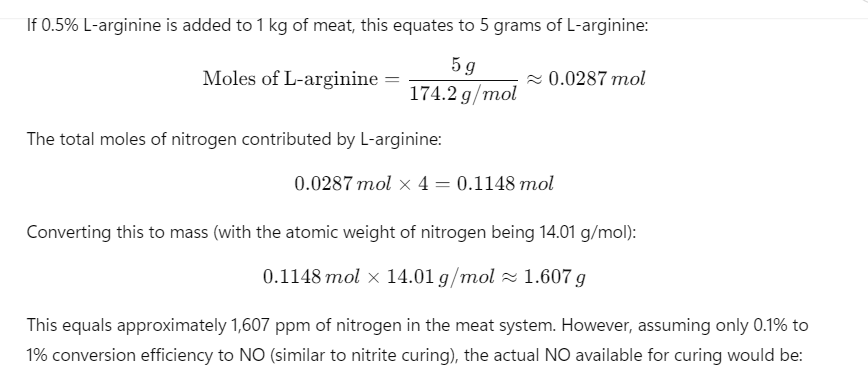
This equals approximately 1,607 ppm of nitrogen in the meat system. However, assuming only 0.1% to 1% conversion efficiency to NO (similar to nitrite curing), the actual NO available for curing would be:
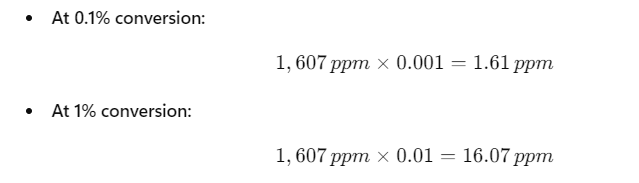
This calculated NO concentration, ranging from ~1.6 ppm to ~16 ppm, is critically below the ~120 ppm NO typically required for stable and vibrant cured meat colour development.
The guanidino side chain of L-arginine is chemically stable, limiting its reactivity and slowing the rate of NO formation. Furthermore, the conversion process requires optimal conditions—specific pH levels (5.5–6.0), temperature regulation, and nutrient availability—to maximize bacterial nitric oxide synthase (NOS) activity. Deviation from these parameters likely results in diminished NO production, jeopardizing the development of stable cured meat colouration. This assessment aligns with practical experience, suggesting that the actual NO yield from L-arginine remains very low, further supporting the use of the conservative 0.1% to 1% conversion factor (van Tonder, 2023).
This calculation parallels findings in nitrite curing, where only a fraction of nitrite is converted to the reactive nitrosating agent, reaffirming the limited capacity of L-arginine to produce sufficient NO for industrial meat curing applications.
Practical Limitations
High-throughput industrial meat curing operations require robust and predictable curing agents. The reliance solely on L-arginine and bacterial NOS for NO production introduces variability and inefficiency, posing challenges in scaling the process for commercial use. Moreover, the inclusion of L-arginine beyond 0.5% may adversely affect taste and increase production costs, limiting its practical application.
L-Arginine-Based Curing Recipes and Application Methods
For those interested in this work I give here a few recipes that I extracted from research papers.
1. Lactobacillus fermentum in Smoked Fermented Sausages
Source: Møller et al., (2003)
Bacteria Used:
- Lactobacillus fermentum strains JCM1173 and IFO3956
- Commercial starter culture: Pediococcus pentosaceus (PC-1) and Staphylococcus carnosus (XIII)
Growth Medium:
- MRS broth containing:
- Peptone: 10 g/L
- Meat extract: 8 g/L
- Yeast extract: 4 g/L
- Glucose: 2 g/L
- K₂HPO₄: 2 g/L
- Triammonium citrate: 2 g/L
- Sodium acetate: 5 g/L
- MgSO₄: 0.2 g/L
- Tween 80: 1 g/L
- MnSO₄: 0.04 g/L
Meat Batter Recipe for Salami Sausages:
- 95.5% pork shoulder meat
- 3.0% NaCl
- 0.5% sodium ascorbate
- 1% dextrose
Inoculation:
- L. fermentum IFO3956 at 10610^6 CFU/g
- L. fermentum JCM1173 at 10410^4 CFU/g
Processing Conditions:
- Stuffed into 44 mm casings (~400 g per sausage)
- Dried for 18 days under controlled conditions
- Cold smoked for 2 hours on day 2 using beech wood
2. Staphylococcus xylosus in Raw Meat Batters
Source: Li et al., (2013)
Bacteria Used:
- Staphylococcus xylosus A1
- Pediococcus pentosaceus R1
Growth Medium:
- MRS broth containing:
- Peptone: 10 g/L
- Beef extract: 8 g/L
- Yeast extract: 4 g/L
- Glucose: 2 g/L
- K₂HPO₄: 2 g/L
- Ammonium citrate: 2 g/L
- Sodium acetate: 5 g/L
- MgSO₄: 0.2 g/L
- MnSO₄: 0.05 g/L
- Tween 80: 1 g/L
Meat Batter Recipe:
- Minced pork (100 g)
- Sodium chloride: 3%
- Sodium nitrite (control group): 0.1 g/kg
Inoculation:
- S. xylosus at 10610^6 CFU/g
Processing Conditions:
- Vacuum packaged and incubated at 30°C for 8 hours
- Stored at 4°C for 16 hours
3. Nitric Oxide Formation and Use of L-Arginine
Source: Skibsted, (2011)
Concept:
- The study discusses the enzymatic formation of nitric oxide (NO) via nitric oxide synthase (NOS) from L-arginine.
- Although detailed recipes were not provided, the mechanism focused on NOS activity requiring optimal conditions:
- pH: ~5.5–6.0
- Presence of NADPH for enzymatic activity
4. Proposed Integration with Natural Nitrate Sources
Adaptation Based on Research:
- Combine L-arginine with nitrate-rich plant extracts (e.g., celery powder) to enhance NO production.
- Include phenolic antioxidants to stabilize cured colour by preventing oxidation.
Conclusion
While L-arginine has stirred up significant attention as a potential natural alternative to nitrite-based curing, its performance falls short of being the transformative solution once anticipated. The enzymatic conversion of L-arginine to nitric oxide (NO) via bacterial nitric oxide synthase (NOS) is inherently limited by low conversion efficiency and the chemical stability of L-arginine’s guanidino group. Achieving consistent and sufficient NO levels for stable colour formation and effective microbial control remains a substantial challenge, particularly in high-throughput industrial settings.
However, the exploration of L-arginine curing has been far from futile. It represents a pivotal step in demystifying and reshaping perceptions surrounding nitrogen chemistry in meat processing. By bridging the gap between traditional curing methods and natural, “clean label” alternatives, L-arginine research has opened avenues for innovative solutions that integrate bacterial pathways, natural nitrate sources, and antioxidant strategies.
Though L-arginine alone may not fulfil the industry’s demands for nitrite-free curing, its role in the broader pursuit of safer and more natural curing systems is invaluable. It stands as a critical component—a foundational spoke in the wheel—of the ongoing quest to develop sustainable, effective, and consumer-friendly meat curing solutions.
References
- Arihara, K., Itoh, M., Kondo, Y., Sameshima, T., Yamanaka, H., Akimoto, M., & Mizumoto, T. (1993). Production of nitric oxide by lactic acid bacteria responsible for the reddening of meat. Journal of Food Science, 58(5), 1061-1063. https://doi.org/10.1111/j.1365-2621.1993.tb06114.x
- Li, P., Kong, B., Chen, Q., Zheng, D., & Liu, N. (2013). Formation and identification of nitrosylmyoglobin by Staphylococcus xylosus in raw meat batters: A potential solution for nitrite substitution in meat products. Meat Science, 93(1), 67-72. https://doi.org/10.1016/j.meatsci.2012.08.015
- Martínez, L., Jongberg, S., Ros, G., & Skibsted, L. H. (2020). Plant-derived ingredients rich in nitrates or phenolics for protection of pork against protein oxidation. Food Research International, 129, 108789. https://doi.org/10.1016/j.foodres.2019.108789
- Møller, J. K. S., Jensen, J. S., & Skibsted, L. H. (2003). Nitric oxide and myoglobins in meat during packaging and storage: A review. Meat Science, 66(1), 41-55. https://doi.org/10.1016/S0309-1740(03)00003-7
- Morita, H., Sakata, R., & Nagata, Y. (1997). Nitric oxide complex formation with myoglobin in curing of meat products by Staphylococcus xylosus. Journal of Food Science, 62(3), 611-615. https://doi.org/10.1111/j.1365-2621.1997.tb15430.x
- Pegg, R. B., & Shahidi, F. (2000). Nitrite Curing of Meat: The N-Nitrosamine Problem and Nitrite Alternatives. Food & Nutrition Press.
- Sebranek, J. G., & Bacus, J. N. (2007). Cured meat products without direct addition of nitrate or nitrite: What are the issues? Meat Science, 77(1), 136–147. https://doi.org/10.1016/j.meatsci.2007.03.025
- Skibsted, L. H., & Møller, J. K. S. (2003). Nitrite and nitrate alternatives in meat products. Chemical Reviews, 103(2), 1243-1269. https://doi.org/10.1021/cr010203w
- Skibsted, L. H., & Møller, J. K. S. (2019). Plant-derived ingredients rich in nitrates or phenolics for protection of pork. Food Research International, 116, 510-518. https://doi.org/10.1016/j.foodres.2018.08.079
- Toldrá, F. (2015). Handbook of Fermented Meat and Poultry. Wiley-Blackwell.
- van Tonder, E. (2023). The mechanism of meat curing: Reaction sequence from nitrite (NO₂⁻) to nitric oxide (NO) and the cooked cured color. Earthworm Express. Retrieved from https://earthwormexpress.com/about-meat-curing/14-mechanism-of-meat-curing-reaction-sequence-from-nitrite-no2-to-nitric-oxide-no-and-the-cooked-cured-colour/