Eben & Kristi van Tonder, 8 January 2026

Introduction
Andreas Dunker commented on our braai picture which made me think of the various uses of the word Brät in German and the work we are doing on the original Vienna sausage. The history of the modern Vienna sausage Wiener is often reduced to recipes and casings, yet the true evolution lies in the development of the meat mass itself. When Johann Georg Lahner developed the Viennese sausage in Vienna in 1805, contemporary sources focused explicitly on the Brät used in its manufacture [1]. Lahner, trained in the Frankfurt tradition of pure beef sausages, introduced pork into the mixture in Vienna, a modification that bypassed rigid guild restrictions and created a technologically superior product [2]. This innovation was not merely a culinary choice; it was an advancement in the science of the meat matrix.
What Brät Means and What It Does Not Mean
In the German butchery tradition, Brät is a technical noun. It is fundamentally distinct from the verb braten to roast or fry. Brät refers to a prepared, finely comminuted raw meat mass intended for sausage making. The term originates from the Old High German brāto and Middle High German brāt, meaning chopped or worked flesh [3].
The defining features of Brät include
- Mechanical comminution. The meat is reduced to a microscopic level of fineness, traditionally via a bowl cutter Kutter.
- Salt induced protein extraction. The addition of salt and mechanical energy solubilises myofibrillar proteins actin and myosin, creating a glue that binds the mass [4].
- Cohesive matrix. A state where the meat can hold significant amounts of added water and fat in a stable, raw form prior to cooking.
Why “Emulsion” Is Not an Equivalent
In English speaking meat science, Brät is frequently referred to as a meat emulsion. From a physicochemical standpoint, this is technically inaccurate. A true emulsion is a dispersion of two immiscible liquids stabilised by an emulsifier. While a meat batter involves fat and water, it is more accurately described as a solubilised protein gel or a particulate matrix [5, 7].
English lacks a single native technical noun for this concept. Terms such as sausage meat, forcemeat, or meat batter are descriptive workarounds. This linguistic gap suggests that the fundamental technology of fine paste sausage making was an adopted practice in the English speaking world rather than a native innovation [6]. In meat science, emulsion is a term of convenience, whereas Brät is a term of craft precision.
Frankfurt Brät and Lahner’s Viennese Modification
The Frankfurt tradition Lahner inherited was defined by pure beef Brät. This was a result of strict guild regulations and Jewish dietary laws in the region which prohibited the mixing of species [2, 8]. By moving to Vienna and mixing beef Brät with pork, Lahner utilised the specific properties of pork fat and protein.
- Thermal stability. Pork fat has a lower melting point than beef tallow, providing a superior mouthfeel and snap when the sausage is bitten [9].
- Ionic strength. The combination of beef and pork proteins allowed for a more robust protein lattice, which could better retain moisture during the smoking and scalding process.
Mortar, Pestle, and the Pulverisation Myth
It is a common misconception that fine meat pastes like Brät were historically achieved through a mortar and pestle. Technically and practically, this is incorrect. A mortar and pestle relies on crushing and grinding, which generates significant friction and heat. In meat science, heat during the comminution phase is the primary enemy of a stable Brät. If the meat temperature exceeds 12°C for pork or 15°C for beef during chopping, the proteins denature and the bind is lost, resulting in fat separation during cooking [4, 5].
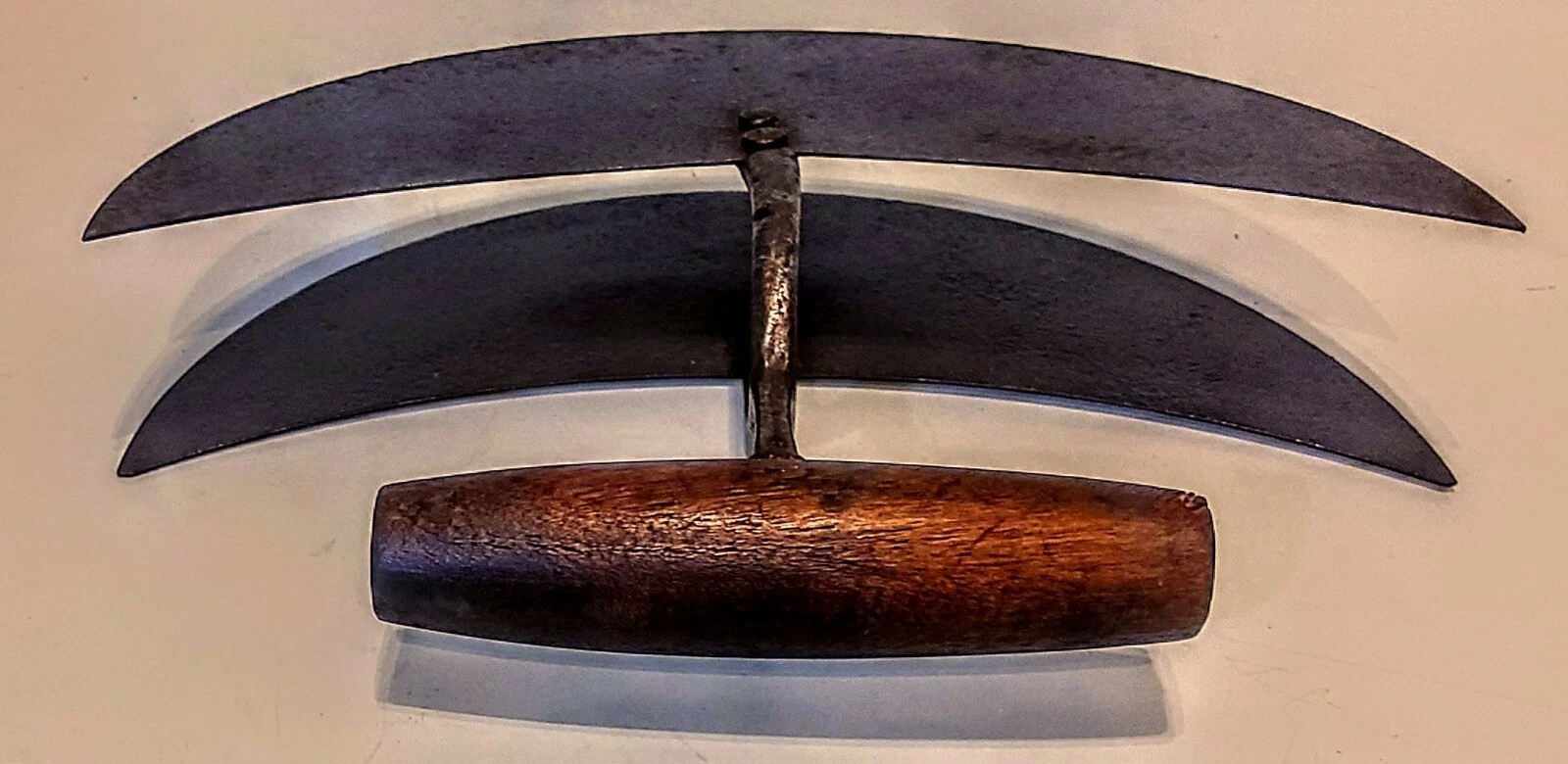
Traditional Brät was achieved through the mechanical action of extremely sharp blades the Wiege messer or cradle knife that cut the meat fibres without crushing them. The mortar and pestle was used historically for spices or medicinal pastes, but rarely for meat outside of specific medicinal or ancient preparations.
The earliest references to the use of a mortar and pestle to pulverise meat into a paste appear in Roman culinary texts, specifically attributed to Apicius in the fourth or fifth century AD, where meat was pounded with aromatics for puddings or Isicia mincemeat patties [19]. However, this pulverisation did not result in a Brät. It resulted in a pulpa or pastilla, a smashed meat mass that lacked the specific protein extraction and water binding capacity of a salt cured, blade cut Brät.
Polony and the Language of Pulverisation
There is a conceptual link between pulverised meat and the word Polony. While many etymologists trace Polony to Bologna Italy, others point to the Latin pulpa or the later culinary term pulveratus pulverised. In old English and some Mediterranean dialects, the term for a finely smashed meat sausage often shared a root with the concept of pulping [20].
In German, this distinction is clear. Smashed or pulverised meat was often referred to as Mus or Paste, whereas the technical, blade cut mass was always Brät. The word Mus implies a lack of structure, while Brät implies a structured, functional matrix. In Italian, the Mortadella of Bologna derives its name from the mortarium mortar, confirming that the Italian tradition did historically utilise the mortar to achieve its fine texture. This represents a different technological lineage than the Central European blade cut Brät used by Lahner [2, 21].
On Ratios and Recipes
While many claim to possess Lahner’s original recipe, no such document exists. The earliest documentary evidence comes from mid nineteenth century manuals, such as those by Friedrich, which suggest a ratio of
- Two thirds beef
- One third pork or pork fat
These ratios are scientifically sound. A 70 to 30 beef to pork ratio provides the optimal balance of lean binding protein and succulent fat for a stable Brät [10].
Brät, Braten, and the Austrian Bratl
Linguistically, Brät and braten to roast share a root, but their meanings branched centuries ago. Brät remains the raw, prepared mass, while Braten refers to the cooked roast. In Austria, a further nuance exists with the diminutive Bratl. In Austrian cultural convention, it refers almost exclusively to pork Schweinsbratl. If beef or veal is intended, it must be specified Rindsbratl or Kalbsbratl [13].
Conclusion
Brät is a technical meat concept, not a cooking method. Its presence in the German language tracks the historical and technological origin of fine paste sausage making. When Lahner introduced pork into the beef Brät of Frankfurt to create the Vienna sausage, he was operating within a sophisticated framework of meat science that the language had already spent centuries defining.
References
- Lahner G. 2005. 200 Jahre Wiener Würstel. Jubiläumsschrift der Wiener Fleischerinnung.
- Reixinger B. 2012. Die Geschichte der Frankfurter und Wiener Würstchen. Historischer Verein Frankfurt.
- Kluge F. 2011. Etymologisches Wörterbuch der deutschen Sprache. De Gruyter.
- Toldrá F. 2010. Handbook of Meat Processing. Wiley Blackwell.
- Feiner G. 2006. Meat Products Handbook: Practical Science and Technology. CRC Press.
- Ayto J. 2012. The Diner’s Dictionary: Word Origins of Food and Drink. Oxford University Press.
- Gordon A, Barbut S. 1992. Effect of chloride salts on protein extraction and interfacial tension in meat batters. Journal of Food Science.
- Wassermann U. 2008. Zunftwesen und Fleischereihandwerk in Mitteleuropa. Academic Press.
- Warnants N et al. 1998. Pork fat quality and its impact on sausage processing. Meat Science Journal.
- Friedrich J. 1852. Handbuch für Fleischhauer und Wurstmacher. Wien.
- Poutanen K. 2020. The evolution of food processing technology in Central Europe. Journal of Food Engineering.
- Park J W. 2013. Surimi and Surimi Seafood. CRC Press.
- Ebner J. 2019. Wie sagt man in Österreich? Wörterbuch des österreichischen Deutsch. Duden.
- Edwards J. 1984. The Roman Cookery of Apicius. Hartley and Marks.
- Davidson A. 2014. The Oxford Companion to Food. Oxford University Press.
- Simoons F J. 1994. Eat Not This Flesh: Food Avoidances from Antiquity to the Present. University of Wisconsin Press.