AW Versus Moisture Content, In Simple Terms
Moisture content, expressed as percentage of water lost during drying, tells you how much water has left the product. It does not tell you how much of the water still inside is actually available to a bacterium, yeast, or mould cell. Salt, sugar, and protein all bind some of that remaining water tightly enough that microorganisms cannot use it. Water activity, aw, measures only the free, usable fraction, on a scale from 0 to 1. Two pieces of omasum can lose the same percentage of weight during drying and still sit at different water activities, because one had more salt working on the water that remained. This is why a weight loss figure alone, without a corresponding water activity reading, cannot tell you whether a piece is actually safe to release.
Why Water Activity Is the Target, Not Moisture Loss
Water activity is the target because it is the figure that actually governs whether microorganisms can grow, not the figure that governs how the product looks or weighs. It addresses several distinct organism groups, each with its own threshold, so a single aw reading tells you which of these risks are still active and which have already been shut down.
| Water activity | What stops growing at or below this level |
|---|---|
| Below 0.91 | Most spoilage bacteria |
| Below 0.87 | Most pathogenic bacteria, including Salmonella and E. coli |
| Below 0.88 | Most yeasts |
| Below 0.86 | Staphylococcus aureus, a notable exception among pathogens because it tolerates lower water activity than most other bacteria of concern |
| Below 0.80 | Most ordinary moulds |
| Below 0.70 | The point generally described as the practical limit for common spoilage yeasts and moulds |
| Below 0.65 down to about 0.60 | Xerophilic, dry tolerant moulds, the most resistant fungal group and the last one to be shut down as a product dries |
| Below 0.60 | The generally accepted floor below which no microbial growth of any kind occurs |
Water Activity (aw) also addresses yeast and mould. It does, and it is in fact the figure that governs them specifically, since bacteria are usually the first risk eliminated as a salted product dries, while yeast and then mould, ending with the more resistant xerophilic strains, are what determine how far drying actually needs to go.
Drying and Product Quality
Aw 0.60 to 0.65 is presenetd above, purely from the microbial threshold table, without weighing what that level of dryness actually does to the tissue and to the eating quality of the finished product. Commercial precedent from biltong, the closest documented South African analogue to omasum, does not support drying that far.
What commercial biltong measures
A peer reviewed study of commercial South African biltong samples found two distinct categories rather than one target figure. Dry biltong measured aw 0.65 to 0.68, with moisture content between 21.5 and 25.3 percent. Moist biltong, the more widely preferred style, measured aw 0.85 to 0.89, with moisture content between 35.1 and 42.8 percent. Biltong as a category is classified as an intermediate moisture food falling across the range aw 0.60 to 0.90, and consumer preference studies cited in a review of South African biltong processing found that consumers generally prefer the higher moisture, higher aw style over the drier one.
This means the actual commercial range in South Africa sits well above the 0.60 to 0.65 figure proposed earlier, even for the drier style, and the more popular moist style sits close to double that water activity. A target of 0.60 pushed on omasum would be drier than the driest commercial biltong on the market, not merely at the safe end of it.
Drying and Tissue Damage
For a thick or folded tissue such as omasum, aggressive drying has a specific structural risk called case hardening, where the outer surface dries and stiffens quickly while moisture is still migrating out from the interior, trapping that interior moisture behind a dense, leathery crust rather than letting it escape evenly. This produces a piece that is dry and even brittle at the surface while the core has not actually reached target, and it also produces a texture that resists rehydration later, since the hardened outer layer restricts water uptake during cooking. I have not found a study measuring this specifically on omasum, so this is a reasoned expectation drawn from general dehydration behaviour in thick collagenous tissue, not a cited omasum specific finding, and it is a further reason not to chase the lowest aw the microbial threshold table alone would suggest.
Do not rely on drying alone
The answer is hurdle technology, the practice of combining several smaller preservation barriers rather than pushing any single one to an extreme. Biltong itself is a working example. Its marinade lowers pH with vinegar, its salt content sits high, at 5.5 to 7.9 percent in the dry style and 3.8 to 5.6 percent in the moist style, and its spice blend, typically coriander and pepper, contributes further antimicrobial activity on top of the acid and the salt. A separate study found that ground biltong challenged with mould isolates showed no meaningful mould development over two months of storage at 25 degrees Celsius when the aw was held at 0.70, precisely because the acid, salt, and drying were working together rather than the drying carrying the full burden alone.
What this means for the omasum target
The earlier recommendation of aw 0.60 to 0.65 for a year of ambient shelf life should therefore be adjusted. A target closer to 0.70, in line with both the biltong mould challenge result and the general literature review recommendation of drying to aw 0.70 to 0.75 to prevent microbial growth, is better supported by real product precedent, provided it is not asked to do the job alone. The organic acid wash already built into our process, and the salt content from dry salting itself, are both hurdles in this same sense, and their contribution should be counted alongside the final aw target rather than treated as separate from it. If year round ambient stability at aw 0.70 rather than 0.60 needs an additional margin, that margin should come from strengthening one of the other hurdles, a stronger acid wash, a higher salt percentage, or the potassium sorbate treatment already specified for the drying stage, rather than from drying the omasum harder than commercial biltong ever is.
The Target For a Year of Ambient Shelf Life
If the goal is stability for a full year without refrigeration, the practical limit of aw 0.70 is not a safe target on its own, since xerophilic moulds are documented to grow down to roughly 0.60 to 0.65, well below that limit. A year long ambient shelf life needs a margin below the most resistant organism still capable of growth, not just below the point where ordinary spoilage yeast and mould stop. Aiming for an aw at or below 0.65, and ideally closer to 0.60, gives that margin. This is a reasoned engineering target built from the thresholds above.
How Many Samples From a One Tonne Batch
There is no published sampling plan specific to dry salted omasum, so this has to be reasoned from general food sampling statistics rather than cited from a study on this exact product. The starting point is that omasum is a heterogeneous tissue, folded, of varying thickness, with salt and moisture distributed unevenly, so a one tonne batch cannot be represented by a single sample regardless of how carefully it is chosen.
A practical starting design is 10 to 15 samples, taken from different locations within the batch, different thicknesses, different positions in the salting stack, different pieces rather than repeated cuts from the same piece. This is a reasoned starting point, not a statistically derived final number. The correct way to fix the final number is to calculate it from batch to batch variability once there is a handful of production runs logged. Once the standard deviation of aw readings across a batch is known, the standard sample size formula, n equals the square of Z times the standard deviation divided by the acceptable margin of error, gives a defensible sample count for your actual variability rather than a guess. Until that calculation has been done, 10 to 15 samples per tonne is the reasonable working figure to validate the target with, weighted toward the thickest and most folded sections, since those are the last parts of the batch to reach target and therefore the parts most likely to fail if the batch fails.
Relating AW, Date, Temperature, and Drying Time, Combined With the DIY System
Ambient temperature and humidity change through the year, and drying rate changes with them, so a drying schedule that reaches target in ten days in a dry, cool month may need longer in a humid, warm one. Building a log that records the date, the ambient temperature and humidity for each drying run, and the final validated aw for that batch, over enough cycles, lets you start predicting how long a given batch will need to reach target under the conditions of that particular week, rather than running every batch to a fixed number of days regardless of the weather. This is a predictive tool, not a substitute for validation. It tells you when a batch is likely close to target so you know when to start testing, not that the target has actually been reached.
This is where a cheap temperature probe becomes useful alongside the DIY aw chambers rather than instead of them. A basic digital probe thermometer, a few euros each, can be placed in multiple locations through the stack daily without needing to open a sealed aw chamber for every check, giving you a live picture of how the drying is progressing across the whole batch at very low cost. Once the log and the probe readings suggest a batch is approaching the expected time to target for that week’s conditions, that is the signal to pull the statistically justified sample set, the 10 to 15 pieces discussed above, and run them through the calibrated DIY chambers to confirm the actual aw, rather than assuming the log’s prediction is correct. The probe and the log tell you when to test. The DIY chamber and its calibration are what actually confirm the result.
Outline of the DIY Unit at a Fraction of the Cost
The unit already specified for this project, a Sensirion SHT85 or Adafruit SHT31-D sensor, an Adafruit Feather HUZZAH microcontroller, an OLED display, and a MicroSD logging module, sealed into a glass jar with a silicone grommet feedthrough, costs roughly 150 to 200 euros to build, with a further 100 to 150 euros for a full spares set. This sits at roughly a tenth of the cost of even the cheapest new commercial entry level meter, and logs every reading automatically to a card with no network dependency, as already set out in the build list and spares tables earlier in this guide.
Approximate cost comparison
The two routes are not alternatives to choose between. A reliable programme needs both, one commercial reference instrument to calibrate and validate against, and a set of DIY chambers built alongside it. The reference unit is bought once and used for both purposes, validating the DIY chambers during setup and then continuing to serve as a working meter for production checks afterward. The DIY chamber count starts small during validation and is scaled up once the daily screening volume is known.
| Item | Approximate cost | Notes |
|---|---|---|
| Reference instrument, Novasina LabStart or equivalent | Roughly 1,700 euros | Bought once. Serves as the calibration reference during validation and continues as a working meter for production checks afterward |
| DIY chambers built for the validation phase, 2 to 3 units | Roughly 300 to 600 euros | Based on 150 to 200 euros per chamber, run alongside the reference instrument so each sample can be read on both at the same time |
| Spares for the validation phase chambers | Roughly 150 to 300 euros | Covers the spare sensors, boards, jars, and wiring set out in the spares table, sized to 2 to 3 chambers |
| Additional DIY chambers for daily production screening, scaled to need | Roughly 150 to 200 euros per chamber | Added once validation confirms the method and the daily sample count is known. This is where the DIY approach keeps its cost advantage, since matching the same throughput with additional commercial units would cost roughly 1,700 euros per chamber instead |
A project built this way, one reference instrument plus three DIY chambers with spares, comes to roughly 2,300 to 2,700 euros as a starting total, before any scale up. Matching that same validation capacity with commercial units alone would cost three to four times as much, since each additional commercial unit runs close to the reference instrument’s own price, while each additional DIY chamber for the scale up phase costs a small fraction of that.
Why Calibration Requires Access to a Reference Instrument
A DIY chamber, however well built, only produces a defensible water activity figure once its sensor has been checked against known reference points and, ideally, against a validated commercial instrument reading the same sample. The salt slurry calibration already described establishes the sensor’s accuracy at two known points, but confirming that the whole chamber, sample preparation, and equilibrium algorithm together produce results that agree with a trusted instrument on the actual product, omasum, requires access to that instrument during validation.
Renting a commercial meter for the validation period is one option, and several laboratory equipment suppliers offer short term hire specifically for this kind of validation project. Buying one outright is the better route, because the unit does not become redundant once validation ends. It becomes the reference instrument used to calibrate and periodically check the DIY chambers going forward, and it also becomes a working meter in its own right, available to measure aw directly on production batches whenever a result needs to be trusted without depending on a chamber that has not been recently checked.
Reference Unit Options
| Instrument | Approximate price | Notes |
|---|---|---|
| Novasina LabStart | Entry level, commonly cited around 1,700 euros for a new unit | Covers the 0.20 to 0.80 aw range, which sits comfortably around the working target discussed above, uses a resistive electrolytic sensor, and is described as a low cost precision instrument aimed at exactly this kind of routine supervisory check rather than full laboratory reference work |
| Rotronic HygroPalm HP23-AW-A | Roughly 1,500 to 3,000 euros new, depending on kit configuration | A handheld unit covering the full 0 to 1.00 aw range, giving more flexibility if the same instrument is ever needed for products well outside the intermediate moisture range, such as fresh meat or wet cured products |
| Used Decagon or METER AquaLab Series 3 TE | Roughly 1,700 to 2,500 euros on the secondhand market | A chilled mirror dew point instrument, the more precise measurement principle discussed earlier, at ±0.003 aw, available at a lower cost than new but with the usual secondhand risk of unknown service history and no manufacturer warranty |
Given the working target established above, aw at or below 0.65, the Novasina LabStart’s stated range of 0.20 to 0.80 covers this comfortably, and its price point matches the figure already mentioned. The Rotronic is the more flexible instrument if the same unit will also be used on products outside this range. The used AquaLab offers the highest precision of the three but carries the usual risk of buying an instrument secondhand without a service record.
Building The DIY Chamber
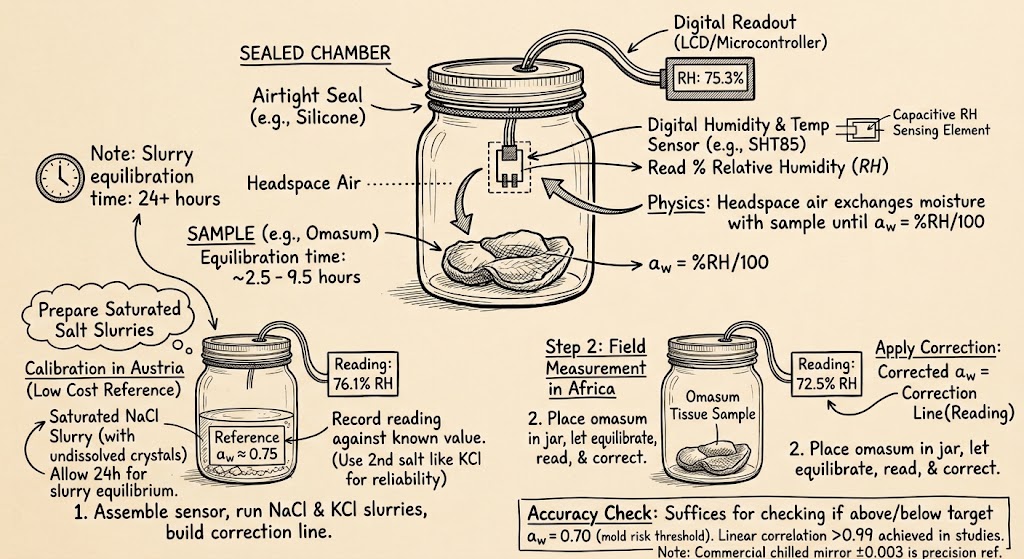
Build List for One Unit
| Item | What to search or order | Quantity |
|---|---|---|
| Humidity and temperature sensor breakout | Sensirion SHT85 digital humidity sensor breakout board. Order from Mouser Electronics, Digi-Key, or Sensirion directly. If unavailable, the Adafruit SHT31-D breakout (Adafruit product 2857) is the easier to source substitute, slightly lower accuracy but the same working principle | 1 |
| Microcontroller | Adafruit Feather HUZZAH ESP8266 with headers, Adafruit product 3046 (or the loose header version, product 2821, which needs the headers soldered on separately) | 1 |
| Display module | 0.96 inch I2C OLED display module, SSD1306 driver, 128 by 64 pixels. Widely sold under this exact description on Amazon, AliExpress, or via Conrad Electronic in Austria | 1 |
| Data logging module | MicroSD card breakout board with SPI interface, sold as “MicroSD card module SPI” or “Micro SD card breakout board”, available from Adafruit, SparkFun, or Conrad Electronic, paired with a small MicroSD card, 8 GB is more than sufficient for daily CSV logs | 1 module, 1 card |
| Connecting wires | Female to female jumper wires, 20 centimetre length, a pack of at least 10 | 1 pack |
| Cable feedthrough | Silicone rubber cable grommet, 6 to 8 millimetre bore, sold as “silicone wire grommet” or “cable entry grommet” | 3 |
| Sealant | Food grade silicone sealant, a small tube, sold as “aquarium safe” or “food grade” silicone sealant | 1 tube |
| Drill bit | Step drill bit or a standard twist bit sized to match the grommet, for making the hole in the jar lid | 1 |
| Jars | Wide mouth glass mason jars with two piece metal lids, 500 millilitre size, Ball or Kilner brand or the equivalent sold locally | 3 |
| Power source | USB power bank, small capacity, around 5,000 mAh, with a micro USB output | 1 |
| USB cable | Micro USB charging and data cable, standard length | 1 |
| Enclosure for electronics | Small IP65 rated ABS project box, dimensions to fit the Feather board, display, and SD card module, sold as “waterproof project enclosure box” | 1 |
| Calibration salt, sodium chloride | Sodium chloride, ACS reagent grade, from a laboratory chemical supplier such as Carl Roth, VWR, or Sigma Aldrich. Reagent grade rather than ordinary table salt, since additives in table salt such as anti caking agents and iodine can shift the reference value away from the certified 0.753 | 250 grams |
| Calibration salt, potassium chloride | Potassium chloride, ACS reagent grade, from the same supplier as above | 250 grams |
| Distilled water | Distilled or deionised water, sold in bottles at any hardware or pharmacy | 1 to 2 litres |
| Small calibration jars | Small glass jars with airtight lids, 100 to 200 millilitre size, for holding the salt slurries separately from the field jar | 2 |
| Labels | Waterproof marker and small adhesive labels, for identifying which jar holds which slurry or sample | 1 set |
| Soldering iron and solder | Basic soldering iron kit with lead free solder, needed only if the headers on the Feather board are not pre soldered | 1 kit |
Spare Parts, With the Reason Each Is Likely to Fail
| Part | Why it is at risk | Spare quantity to buy |
|---|---|---|
| Glass jars | Glass cracks or breaks during handling in transit and during repeated daily use in the field | 3 additional, so 6 total |
| Sensor breakout board | The sensing element is delicate, can be damaged by physical shock, direct contact with moisture if the grommet seal fails, dust ingress, or static discharge during handling | 1 additional |
| MicroSD card and breakout module | Card contacts corrode in humid climates, and cards fail after repeated read and write cycles or physical wear from being pulled out daily | 1 additional card, 1 additional breakout module |
| Jumper wires | Connectors loosen and corrode in humid climates, and repeated opening and closing of the jar strains the wire where it passes through the lid | 1 extra pack |
| Silicone grommets | Silicone tears or loses its seal with repeated threading of the wire through it | 3 additional |
| Silicone sealant tube | A tube left partly used can dry out and harden before the next application is needed | 1 unopened spare tube |
| Micro USB cable | Cables fray and break at the connector with repeated use and travel | 1 additional |
| USB power bank | Batteries degrade with heat exposure, and a single power bank leaves no backup if it fails or is lost | 1 additional |
| OLED display module | The screen is thin glass and cracks easily if the enclosure is dropped or crushed in transit | 1 additional |
| Microcontroller board | Less likely to fail outright, but humidity, dust, or a power surge can damage it, and there is no easy local replacement in the field | 1 additional, pre configured with the same code before travel |
Complete List, Build Items and Spares Combined
| Item | Quantity for the build | Quantity as spares | Total to buy |
|---|---|---|---|
| Sensirion SHT85 breakout board (or Adafruit SHT31-D) | 1 | 1 | 2 |
| Adafruit Feather HUZZAH ESP8266 (assembled, with headers) | 1 | 1 | 2 |
| SSD1306 OLED display module | 1 | 1 | 2 |
| MicroSD card breakout module and card | 1 | 1 | 2 |
| Female to female jumper wire pack | 1 | 1 | 2 |
| Silicone cable grommets | 3 | 3 | 6 |
| Food grade silicone sealant tube | 1 | 1 | 2 |
| Step drill bit | 1 | 0 | 1 |
| Wide mouth glass jars, 500 ml | 3 | 3 | 6 |
| USB power bank, 5,000 mAh | 1 | 1 | 2 |
| Micro USB cable | 1 | 1 | 2 |
| IP65 project enclosure box | 1 | 0 | 1 |
| Sodium chloride, ACS reagent grade | 250 g | 0 | 250 g |
| Potassium chloride, ACS reagent grade | 250 g | 0 | 250 g |
| Distilled water | 1 to 2 litres | 0 | 1 to 2 litres |
| Small glass calibration jars, 100 to 200 ml | 2 | 0 | 2 |
| Waterproof marker and labels | 1 set | 0 | 1 set |
| Soldering iron kit with lead free solder | 1 | 0 | 1 |
Source the electronics, including the MicroSD card breakout for the data logger, from Conrad Electronic, Mouser, Digi-Key, or Adafruit directly, all of which ship to Austria. Source the reagent grade salts from Carl Roth or VWR, both established Austrian and German laboratory suppliers, because a supermarket product would leave the calibration reference values open to question. The jars, sealant, drill bit, and cabling remain ordinary hardware and kitchenware items, available locally or through Amazon.at.

System Architecture & Components

Physical Assembly Breakdown
- Airtight Chamber: A small glass jar or plastic vial with a rubber gasket seal. Keeping the headspace volume minimal reduces the time required to reach vapor equilibrium.
- Capacitive RH/T Sensor: An SHT85 or similar digital sensor suspended near the top of the container, avoiding direct contact with liquid or solid samples.
- Hermetic Pass-Through: Wires routed through the lid and sealed with silicone or epoxy to ensure zero ambient air leakage.
- Readout / Controller: Connects to the sensor to display real-time relative humidity (%RH) and temperature (°C).
- Data Logger: A MicroSD card breakout wired to the same board, writing sample ID, time to plateau, and corrected aw to a CSV file as each reading completes, with no network connection required. The card is read at the end of each day.
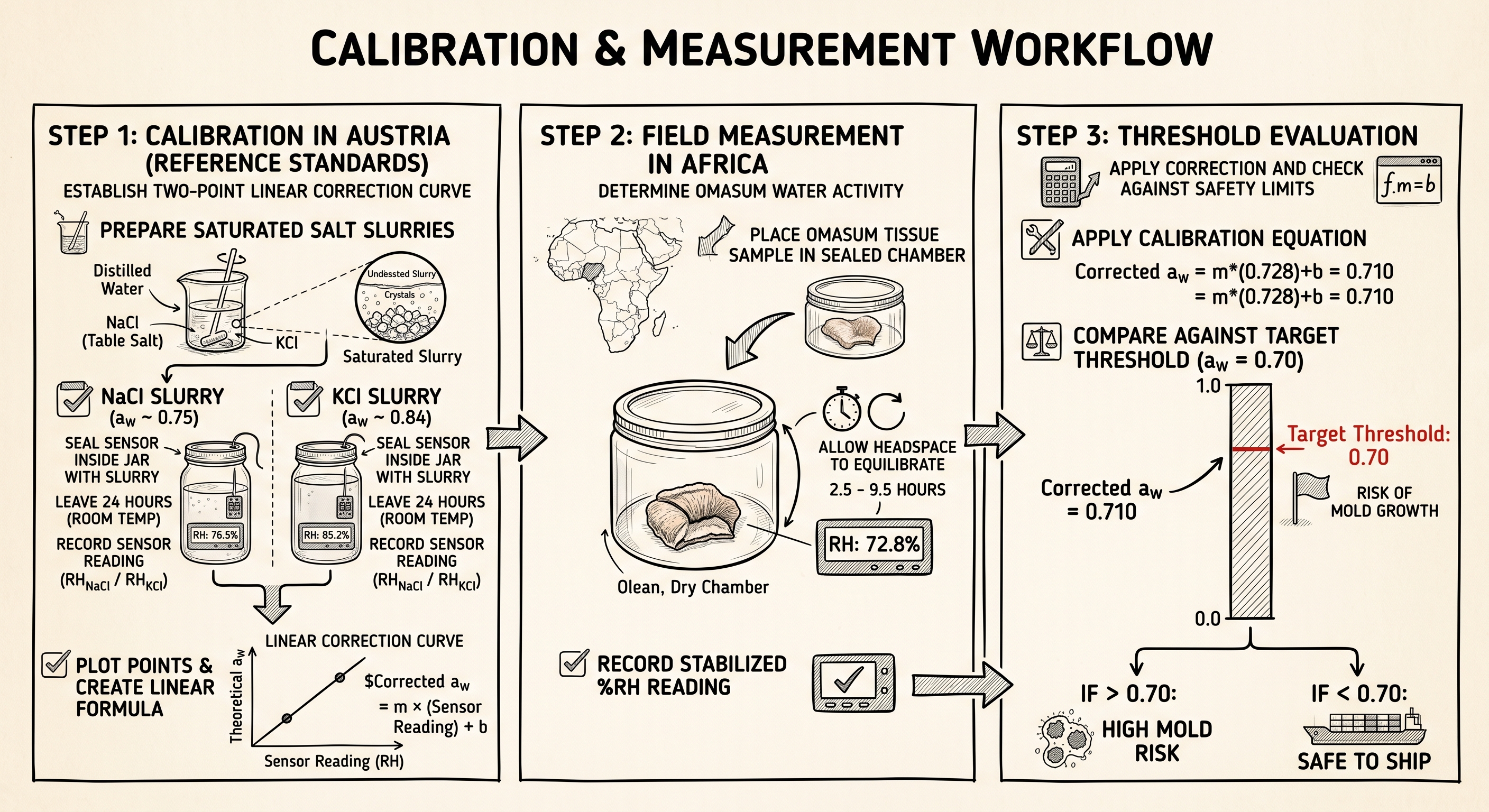

Calculate the two-point linear calibration line using NaCl and KCl reference readings.
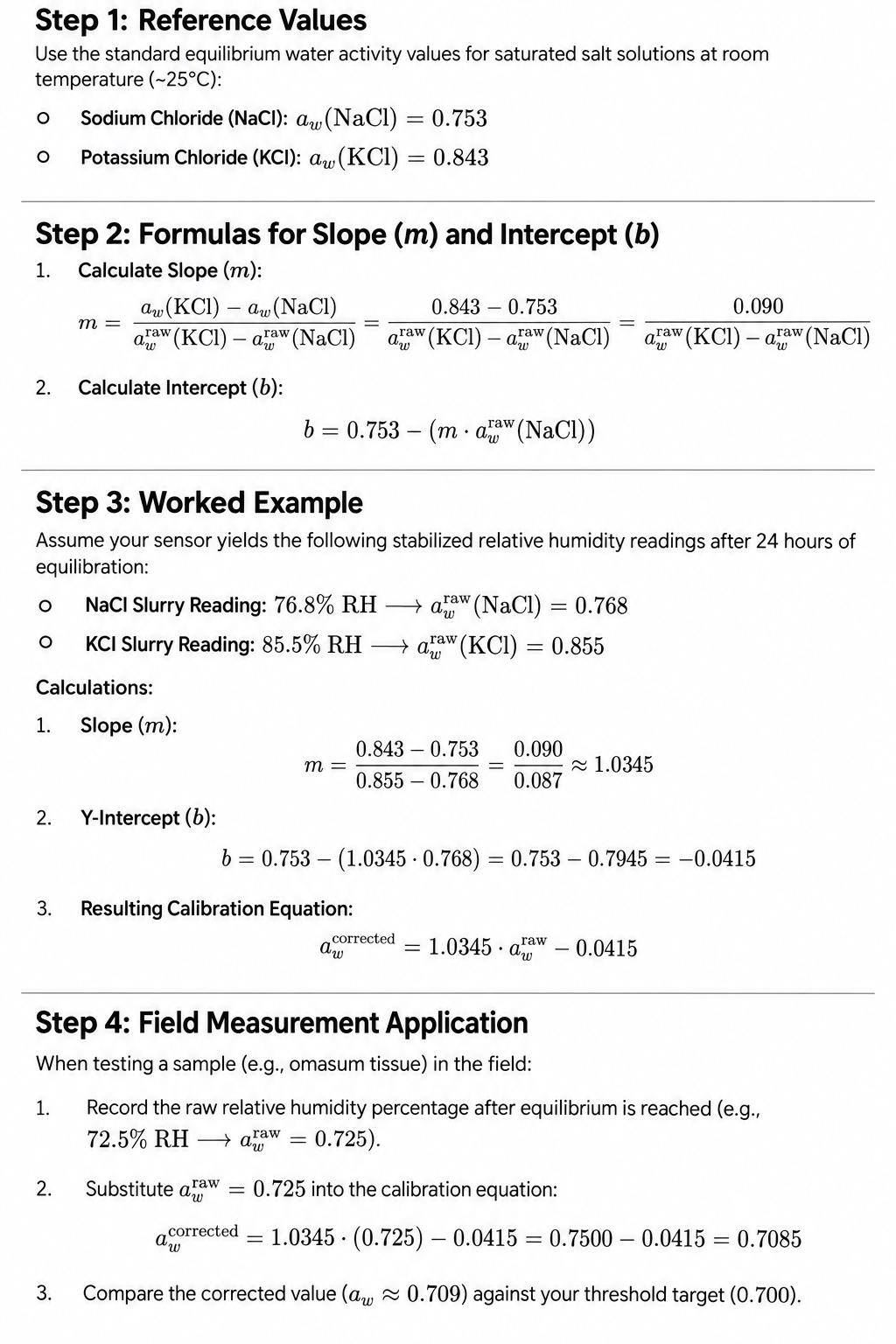
Daily Logging Without a Network Connection
The board logs directly to a MicroSD card rather than over WiFi. Every equilibrium result the algorithm confirms, sample ID, time to plateau, corrected aw, and the readings leading up to it, is written straight to a CSV file on the card as it happens. This removes any dependence on factory WiFi, which cannot be assumed reliable, and gives a physical, auditable record with nothing between the reading and the file.
At the end of the day the card is pulled and its contents copied to a laptop, either by reading the card directly or connecting the board by USB cable. The file already contains every result the chamber declared complete that day. No analysis is required at this point, since the plateau has already been identified by the device itself, not judged afterward from raw numbers on a spreadsheet.
Running more than one chamber at a time is how a daily sampling programme should work in practice. Two or three jars, loaded with pieces cut from different parts of the same batch, thicker sections and thinner sections included, run and log independently through the day or overnight. Each writes to its own card, or to separate files on a shared card if the chambers are wired to a single board, tagged by sample ID so the results are never mixed up. This gives a spread of readings per batch rather than a single spot check, which matters more for a tissue as uneven as omasum than it would for a more uniform product, and it costs no additional operator time beyond loading the extra jars.