By Eben van Tonder and Christa van Tonder-Berger, 19 July 2026
How the Invention Began
Christa and I were married almost a year ago. Before that year, and long before it, my life had already been given over to meat science, sixteen years of study and industry work carried out without a real pause, seven days a week for most of that time. Austria became the exclamation mark at the end of that sentence. Austrian master butchers who became friends gave me solutions for meat science challenges I had struggled with, and a pattern emerged from those conversations. The hardest problems in meat science were not new. They had been solved, and solved well, generations ago, using meat alone and a handful of clever processing steps. Every one of those old solutions produced something genuinely its own, a product with a character that could not have come from any other route.
This challenged many of the methodological assumptions I had previously taken for granted as established fact, among them the routine inclusion of starch and soy, whether as isolate or as textured vegetable protein. It opened my eyes to a genuinely radical idea, at least for me, that traditional processors had already developed highly effective solutions when they solved meat problems using only meat. Not just from a philosophical perspective, but also in terms of efficacy, simplicity, and the remarkably delicious result it produced.
Much of what I now understand about this came to me through countless hours of conversation with Christa. She grew up in an old part of the Wechsel mountains, in a district where meat science is not a discipline anyone studies from a book. It is simply in the blood of the people who live there, carried in daily practice rather than in a curriculum. Many times, when describing a traditional method, she went back to Oma, her mother, to check that her account of it was accurate before we relied on it. Listening to her describe how her family and neighbours handled a slaughtered animal, nothing wasted, every fraction of the carcass assigned its own use, was the closest I have come to seeing, firsthand, the economy of thought that produced Pressschinken [pressed ham], Toastschinken [toast ham], and Salzstoß [salted tendon fraction] in the first place. Many people speak of using the whole animal as a concept, and it is well known that nothing was wasted in antiquity. What I found here went further than that. Not only was nothing wasted, but every morsel became part of a tradition of culinary excellence, one that took everything the animal offered and turned it into masterful products rather than mere use of leftovers.
On the Wechsel
Christa grew up on the Wechsel, a mid-range mountain ridge, running roughly fifteen kilometres along the border between Lower Austria and Styria, southeast of the Semmering and northeast of the Graz basin, its highest point, the Hochwechsel, reaching 1,743 metres [7]. The wider Alpine region only became habitable once the last Ice Age eased, around 12,500 BC, and even through the Neolithic, 6000 to 2200 BC, settlement is only documented in the lowlands around the Wechsel, not on the mountain itself. The first confirmed settlement inside the Wechselland proper appears in the Chalcolithic and early Bronze Age, at Kranichberg and near Pinkafeld. Denser settlement across the wider Wechselland followed through the Iron Age and the Celtic period, roughly 800 to 15 BC, when the region is thought to have formed part of the Celtic kingdom of Noricum, before coming under Roman rule from 15 BC onward [8].
I do not want to give the impression that every tradition Christa carries came from her own family alone. As a young woman, her mother took a course in meat processing under Marcel Kropf, a leading Austrian authority on meat curing who has since retired. His son has taken over the family business, and their approach still holds to the oldest Austrian meat processing techniques. A great deal of what her mother knows was handed down across several generations of her own family, and Christa herself brings a natural feel and insight for meat that I have not found in many people.
Marcel Kropf has been a well known Austrian instructor in traditional meat processing for decades. He has taught private courses in traditional Austrian butchery, curing, sausage making, and home meat preservation. His work is firmly rooted in the methods that shaped Austrian meat culture long before industrial food production became the norm. Rather than relying on modern shortcuts, Kropf emphasises time tested techniques, careful craftsmanship, and a deep understanding of raw materials. His courses preserve regional knowledge that has been passed from one generation of butchers to the next. For anyone interested in authentic Austrian cured meats, hams, and sausages, Marcel Kropf represents a living link to one of Europe’s richest meat processing traditions.
What has struck me, living in Graz, is how ordinary this kind of knowledge still is in Austria. Our neighbour, to give one example, keeps his own smokehouse in the back of his garden and still smokes the sausages, hams, and bacon he makes himself. This part of Austria, like a number of others, feels like a place where time stood still, and where the voices of antiquity carry more clearly than almost anywhere else I have worked.
Our Invention
Three sets of old Austrian technology caught our attention, Pressschinken [pressed ham], Toastschinken [toast ham], and Salzstoß [salted tendon fraction]. We set out to create a restructured bacon, built upon these Austrian traditions. It culminated in the creation of what we call Formspeck. In the rest of this work we outline the nature of the traditions that inspired us.
The Old Austrian Tradition: Pressschinken [pressed ham], Toastschinken [toast ham], and Salzstoß [salted tendon fraction]
Three threads make up this tradition, and each subheading below follows one of them in turn. Salt comes first, because it is the oldest and the one everything else depended on. Monasteries come next, as far as the documented record actually supports, in general terms rather than as a specific origin claim. Salzstoß [salted tendon fraction] comes last, because it only makes sense once the demands of Pressschinken [pressed ham] itself have been set out, the requirement it exists to satisfy rather than a tradition standing on its own.
Salt and the Hallstatt Culture
The oldest tradition behind this recipe is salt itself. Salt mining was central to survival in the ancient world, and Austria was among the lands where that was especially true. The key site in Austria is the town of Hallstatt, in the Salzkammergut. Salt mining there is well documented from the early fourteenth century BC, the middle Bronze Age, where three large shaft mines over one hundred metres deep have been excavated [1]. This is the raw material every later curing tradition in the Alpine region depended on, and it places Austria, uniquely among Central European regions, at the literal source of the salt that made meat preservation possible here in the first place. The Iron Age culture that takes its name from that site did not stay local. It spread from northeastern France to the northwestern Balkans, and archaeologists divide it into a western and an eastern circle. The eastern circle, the one that covers this tradition, took in Moravia, Lower Austria, Styria, western Hungary and today’s Burgenland, Carinthia, Slovenia, and northern Croatia [9]. The Wechsel region where Christa hails from is in Styria.
Monasteries and Isolation
Alpine farming communities in this region were extremely isolated, cut off for long stretches of the year by terrain and weather, and had to survive on what they themselves raised, slaughtered, and preserved. That isolation is what honed the technology to the point where absolutely nothing was wasted. Austrian monasteries were part of that same picture in general terms, medieval monasteries here kept their own pig herds, did their own slaughtering, and processed the meat themselves, curing, smoking, and cooking cheaper cuts such as Bauchfleisch [belly meat], also known as Kaiserfleisch [Emperor’s meat] [13]. Several orders restricted or forbade meat on non-fasting days under their own rule [14], but despite the record not describing a specific pressed-ham or protein-extraction technique tied to any monastery, Pressschinken [pressed ham] developed inside that same wider discipline of making a whole animal last, combining fine and coarse portions of meat with real technical intention rather than by accident [4]. The same holds for Salzstoß [salted tendon fraction].
Isolation of this kind is well documented, across many subsistence societies, not only this one, as producing two things together, a practical drive to use every part of an animal, since limited trade makes waste expensive, and a wariness of interference from central authority, since difficult terrain makes outside administration hard to enforce in the first place. Both patterns are general, not specific to Austria or to monasteries. Whether monasteries here went further, actively guarding or transmitting meat curing knowledge rather than simply practising the same husbandry as everyone around them, is plausible given their documented role as centres of preserved technical knowledge more broadly, but it is our own inference, not something the record confirms for meat curing specifically. The idea that this isolation also produced a culture of excellence, an insistence that nothing entering the body should be less than delicious, is likewise our reading of the evidence rather than a documented historical claim.
Salzstoß [salted tendon fraction] and Its Purpose
Salzstoß [salted tendon fraction] belongs to the same economy of use, and it is tied directly to what Pressschinken [pressed ham] itself demands. A defining requirement of genuine Pressschinken [pressed ham] is that no sinew, membrane, or other connective material can remain in the finished ham, since the Codex restricts it to lean meat only [6]. Every piece of tendon and membrane removed to meet that standard still had food value, and Salzstoß [salted tendon fraction] is what that removal produced, the salted tendon and membrane fraction recovered whenever meat is deboned and desinewed [3], kept and put to use in lesser sausages rather than discarded. Burenwurst [Boer sausage], the product Salzstoß [salted tendon fraction] is most consistently documented in, has been a standard fixture of the Austrian Würstelstand [sausage stand] since the nineteenth century [5]. Two documented recipes give the actual ratios, rather than a single fixed figure. The Austrian Ministry’s own recorded recipe uses 37 parts meat, 25 parts Speck [pork back fat], 20 parts Salzstoß [salted tendon fraction], and 18 parts water [2]. A second widely cited version gives 55 parts Brät [sausage emulsion], 25 parts Speck [pork back fat], and 20 parts Salzstoß [salted tendon fraction] [5].
Pressschinken [pressed ham] versus Toastschinken [toast ham]
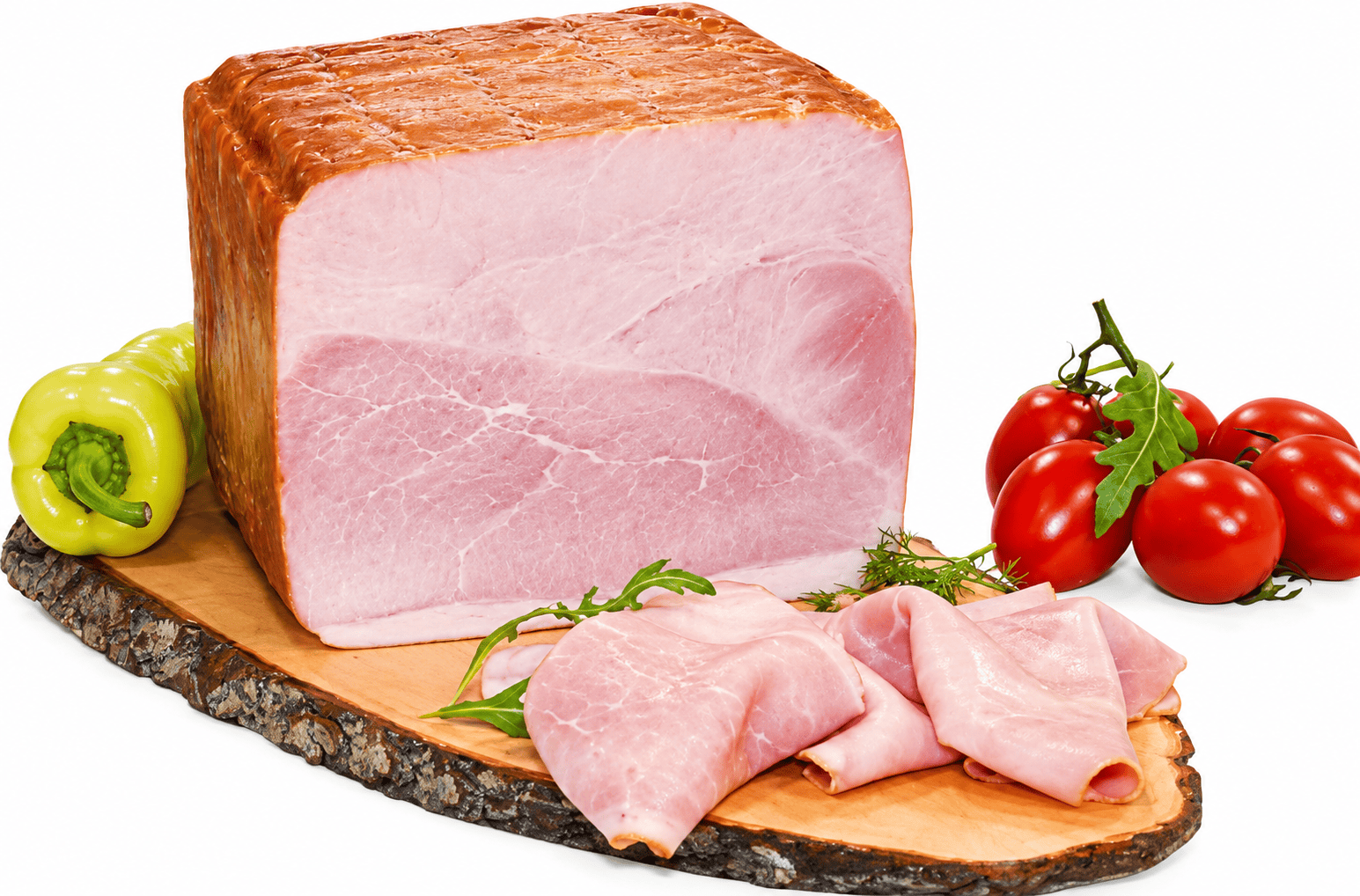
The broad approach in Formspeck is, in the first place, Pressschinken [pressed ham] and Toastschinken [toast ham]. The difference between Pressschinken [pressed ham] and Toastschinken [toast ham] is a matter of grade rather than a difference in principle. Pressschinken [pressed ham] is built from larger, whole pieces of the Schlögel, the pork hind leg, and Toastschinken [toast ham] from smaller offcuts of the same leg. Both are bound and pressed the same way, and both are cooked to the same standard, but the size of the meat pieces going in marks the difference between the two names.
The order matters here, and it is worth being precise about it rather than leaving injected and tumbled as if they were interchangeable options. For Pressschinken [pressed ham], built from large, whole Schlögel muscles, the leg is boned and injected with curing brine first, while it is still large enough for a needle to distribute brine through its own internal structure. This has to happen before any cutting down, because a needle needs intact muscle to inject into, a minced or diced mass has no structure left for it to push brine through [17]. Only after injection is the piece separated into smaller sections along its natural muscle seams, and those already-injected sections are then tumbled or massaged, which is the stage that draws a myofibrillar protein exudate to the surface of each piece [17]. The exudate-coated pieces are packed under pressure into a form, mould, or net, and cooked through to a safe core temperature.
Toastschinken [toast ham], built from offcuts too small to inject in the first place, skips the injection step entirely. Curing brine is mixed directly into the smaller pieces, and the same tumbling or massaging that follows injection in Pressschinken [pressed ham] does the whole job at once here, working the brine in and drawing the protein exudate out in a single mechanical stage, before pressing into a form and cooking to the same standard. This is also why the diced Klebemasse in this recipe is never injected. Its pieces are small from the start, so brine goes in during paddling, the same route Toastschinken [toast ham] takes, not the route Pressschinken’s [pressed ham] whole muscles take.
Pressschinken [pressed ham], Toastschinken [toast ham], and Salzstoß [salted tendon fraction] all exist today as legally defined categories in the Österreichisches Lebensmittelbuch, the Codex Alimentarius Austriacus, chapter B14, which still governs exactly what may be called by these names and how they must be made [6].
What Pressschinken [pressed ham] and Toastschinken [toast ham] Actually Were
Having set out where these traditions came from, it is worth being precise about what they actually were as products, not just as names. The table below sets out the traditional composition the Codex still holds Pressschinken [pressed ham] and Toastschinken [toast ham] to today, before the next section unpacks what each of those terms means in practice.
| Component | Traditional composition |
| Base meat | Schweinsschlögel, whole or roughly cut pieces, no fat |
| Salt | Nitritpökelsalz [nitrite curing salt] |
| Water | Injected or tumbled brine only, no separate direct addition |
| Additives | None, beyond salt and spice |
The Terms Themselves
A short note on the terms themselves, since they carry technical weight rather than being decorative names only. Schlögel [hind leg] is the pork hind leg, and it is the only cut the Austrian food code permits to be called Schinken [ham] at all [6]. Pressschinken [pressed ham] names the version built from larger, whole Schlögel pieces. Toastschinken [toast ham] names the smaller-piece, lower grade version, built from Schlögel offcuts rather than intact sections [6].
Why the Leg Is the Prime Cut
The binding protein in meat processing is myofibrillar protein, made up chiefly of actin and myosin, the two filaments that let a muscle contract in the living animal. In the resting muscle, actin and myosin already exist joined together as actomyosin. Salt dissociates this complex and solubilises primarily myosin, together with other myofibrillar proteins, drawing them out as a sticky extract. During heating these proteins form a firm gel that traps water and fat and binds separate pieces of meat to one another. This single mechanism is the inherent glue behind almost all processed meat, from a hamburger patty to an emulsified sausage to a restructured ham or bacon like this one.
The leg is not the prime cut because it holds more actin and myosin than the rest of the pig. Myofibrillar protein, actin and myosin together, the protein responsible for the salt-soluble extract that binds a pressed ham, sits at broadly similar proportions across most skeletal muscle in the animal. What actually makes the leg the prime location is that its major muscles are large, whole, and easily separated from one another, running through with very little connective tissue, so the actin and myosin already present can be extracted cleanly rather than fought at every turn by collagen and fat. Topside [Oberschale, also called Kaiserteil or Schale in Austria], the innermost muscle of the Schlögel, is documented as nearly collagen-free, fine-fibred, and lean [10]. Silverside [Unterschale, Frikandeau in Austria], on the outer side of the thigh, carries slightly more fat and a marginally coarser fibre than Topside, though it remains a whole, easily separated muscle in its own right [11]. Thick flank [Nuss, also called Kugel or Blume], another lean muscle of the pork hind leg, is fine-fibred and lean [12]. Topside, Silverside, and Thick flank are exactly the large, low-connective-tissue muscles that Pressschinken [pressed ham] and Toastschinken [toast ham] are built from.
No sinew, membrane, or connective material may remain in the finished product [6]. This requirement is not incidental. Collagen, the protein that makes up sinew and membrane, does not dissolve in salt the way actin and myosin do, so any of it left in the mix simply sits inert in the finished product, contributing nothing to the bind and showing up as a tough, visually distinct fleck on the cut face. The salt-based curing principle that governs Kochpökelwaren [cooked cured meat products] generally works only on the lean muscle fraction, using salt, or salt combined with nitrite, to solubilise myofibrillar protein and stabilise the cured colour, before cooking sets that protein into the gel that holds the product together. Removing every trace of connective material before that stage is what lets the principle work cleanly, which is exactly why Pressschinken [pressed ham] excludes it so strictly, and exactly why that excluded material still needed somewhere to go, which is where Salzstoß [salted tendon fraction] comes in.
What Klebemasse Is
Klebemasse [glue mass] is a term Christa and I have attached ourselves to a real and well documented principle, not a name we inherited from German meat-industry literature. It should not be confused with what German media calls Klebefleisch, meat pieces bonded together with enzymes such as transglutaminase, or with thrombin and fibrinogen drawn from blood, a labelling controversy serious enough that the European Parliament withdrew approval for the thrombin-based version in 2010 [15]. Klebemasse, as we use the term, contains no enzyme and no additive of any kind beyond salt. It names the natural, mechanically extracted myofibrillar protein mass that supplies the binding in this recipe, the same mechanism described above, given our own working name for the product it produces.
The underlying principle is set out in detail by Lynn Knipe of the Iowa State University Meat Export Research Center, in his paper Sectioned and Formed Meat Products, hosted at Ohio State University’s meat science extension [17]. Knipe describes sectioned and formed products as meat pieces mechanically worked, by tumbling, massaging, or mixing, to disrupt the normal muscle cell structure and produce a creamy, tacky protein exudate on the surface of the pieces. On heating, that exudate binds the pieces into a single cohesive product, one that keeps the texture and appearance of an intact whole muscle rather than reading as reassembled trim. Knipe is explicit that the mechanism is myofibrillar, primarily myosin, solubilised under the combined action of salt and alkaline phosphate, and that finer particle size and lower processing temperature both increase the amount of exudate produced and the strength of the resulting bind.
Knipe is equally explicit about why the technique exists at all, and it is economic before it is anything else. Mechanical conditioning, in his account, allows smaller, lower-value meat pieces to be bound together into a more appealing and saleable final product, and lets a processor make full and efficient use of raw material that would otherwise sell at a lower grade, trim, smaller cuts, shank meat worked back into a batch, whole pieces with bruises or broken bone removed. This is the same logic already at work in Salzstoß [salted tendon fraction] and in Toastschinken [toast ham] itself, using everything a carcass offers rather than only its best pieces, arrived at independently in the American literature under a different name.
Knipe also documents a related, secondary benefit relevant here. Mechanical conditioning improves pickle penetration and shortens curing time especially in dark, firm, and dry (DFD) meat, since thorough mechanical disruption compensates for meat that would otherwise cure unevenly [17]. PSE meat, pale, soft, and exudative pork, sits on the opposite side of the same coin. PSE develops when post-slaughter glycogen breakdown happens too fast while the carcass is still warm, and that rapid drop in pH, combined with the residual heat, denatures a portion of the muscle’s own myofibrillar protein before it can be put to use [16]. Klebemasse’s intensive mechanical work does not repair that damage, nothing does, but it maximises the yield of whatever actomyosin in the batch is still intact, giving a consistent, reliable bind regardless of the exact condition of the raw material, PSE-affected or not. It is a second, welcome benefit of the same technique, sitting alongside the economic one Knipe describes, not a substitute for it.
This is also exactly why we use the term the way we do in this recipe. Klebemasse, for us, is not one named cut. It is a treatment. We apply it to leg muscle, Topside, Silverside, and Thick flank, the same low-connective-tissue muscles Pressschinken [pressed ham] and Toastschinken [toast ham] were always built from, diced and stripped of every trace of sinew, membrane, and fat, then worked under salt until it behaves as Klebemasse should, regardless of whether that particular batch of leg muscle came in at its full native quality or carrying some degree of PSE. The name describes the process and the result, not a single cut of meat.
On grind size specifically, we settled on a single 8mm plate for the whole Klebemasse batch, not split with any finer fraction. A split grind was considered and rejected. Two textures inside the same lean matrix, coarse pieces sitting in a smoother, finer background, reads as the coarse pieces floating in an unrelated paste, a worse look than a single uniform grind even at some cost to the bind. Chicken Hautstoß keeps its own split grind, because there the coarser fraction reads as fat, an expected and acceptable sight in a bacon-style product, not a competing meat texture. Choosing 8mm throughout does mean the paddling stage takes meaningfully longer than a finer grind would, since less cut surface is exposed per piece, but that cost buys a single, consistent, meat-piece-visible texture across the whole cut face, with the Sehnenstoß, Salzstoß [salted tendon fraction], and Hautstoß fractions supplying the only visual contrast, reading as connective tissue and fat rather than as a second, competing kind of meat.
The Modern Method
The old system relied on passive salting alone. Meat was either rubbed with dry salt and left to cure over roughly three weeks, or laid whole into a brine of around 12 to 15% salt concentration and left for about a week, the salt diffusing into the meat on its own with no mechanical assistance at all [13]. Both routes worked on the same principle described above, they simply relied on time rather than force to get the salt where it needed to go.
The modern method replaces that passive stage with active mechanical work. Brine is injected directly into large, whole muscle pieces rather than absorbed slowly from the outside, and the meat is tumbled under vacuum, which achieves in a few hours what passive salting achieved over a much longer period. In the case of small meat fractions, such as the diced Klebemasse [binding mass] we use in this recipe, injection is not feasible, there is no whole muscle mass large enough to take a needle. A tumbler or paddle mixer is used instead, working salt directly into the diced meat by mechanical action rather than by injection. We chose this route deliberately, using smaller meat fractions worked in a paddle rather than large injected muscle pieces, because it gives a more even cut face. A whole-muscle injected ham can show visible seams and colour banding where separate large muscles meet. A paddle-mixed mass of small, uniform pieces, bound by protein extracted evenly across the whole batch, does not have those seams to show. It is then packed into a metal or plastic form, or a net, and cooked in a water bath or steam chamber to a core temperature of 68°C, held for at least twenty minutes, the standard set out in the current Codex [6].
From Salzstoß [salted tendon fraction] to HeatCut: What Christa and I Built on Top of It
Salzstoß [salted tendon fraction] was always a single answer to a single problem, what to do with the tendon and membrane trim left over from deboning. Functionally, its primary role in a sausage is adding firmness, the residual connective tissue gives bite and structure rather than juiciness. Working from that same instinct, rather than replacing it, Christa and I developed two further meat-only fractions that extend the same logic to different starting materials, but toward a different functional end. HeatCut Sehnenstoß [hydrated tendon fraction, from Sehne, the German word for tendon] takes tendon and hydrates it under controlled conditions rather than using it dry, giving a connective tissue addition with a known, adjustable water content instead of the variable native moisture of raw Salzstoß [salted tendon fraction]. HeatCut Hautstoß [hydrated skin fraction, from Haut, the German word for skin] applies the same hydration principle to chicken skin, turning a fat-bearing by-product into a measured, controllable fat and moisture fraction rather than an unpredictable one.
Where Salzstoß [salted tendon fraction] supplies firmness, the HeatCut fractions are built to do the opposite job, they act as carriers for the water that imparts juiciness. Held inside a hydrated tendon or skin matrix rather than sitting free in the mix, that water appears less prone to escaping as syneresis, the weeping of liquid that shows up as unwanted purge in a modern vacuum-packed product on the shelf, or as fat and water separating out during cooking, smoking, or the heating of an emulsified sausage. This is our own working observation rather than something we have tested experimentally. Neither HeatCut fraction is a foreign additive. Both are meat, or a direct meat by-product, prepared the way the old tradition prepared its own trim, kept and put to use rather than discarded.
The Formspeck Recipe
The recipe we developed and are currently testing is the following.
| Component | Ratio |
| Klebemasse | 67 |
| Beef Sehnenstoß | 10 |
| Salzstoß [salted tendon fraction] | 5 |
| Chicken Hautstoß | 10 |
| Spice pack | 5 |
| Water | 3 |
No bowl cutter is used at any point. Every stage runs on a paddle alone. Klebemasse supplies the lean base and, through paddle mixing under salt, the extracted protein that does the actual binding, exactly the mechanism that held Pressschinken [pressed ham] and Toastschinken [toast ham] together long before any commercial binder existed. Beef Sehnenstoß and Salzstoß [salted tendon fraction] supply structure and bite, in the same spirit as the original Salzstoß [salted tendon fraction] tradition. Chicken Hautstoß supplies the one thing the old Pressschinken [pressed ham] and Toastschinken [toast ham] formula never had, a real fat phase, which is what turns a formed, pressed ham into something that eats like bacon. The result is a cured, restructured pork bacon, built entirely from pork, beef connective tissue, and chicken skin, with no starch and no isolated protein anywhere in it.
Why Chicken Skin
Chicken skin was chosen for the fat phase because it brings fat and collagen together in one by-product, in roughly the proportion a rendering, mouth-coating fat layer needs to eat like bacon rather than like a lean ham. The skin’s own collagen contributes to the bind in the same general way Sehnenstoß and Salzstoß [salted tendon fraction] do, while the fat it carries renders during cooking and gives the finished product a bacon-like richness that a purely lean Klebemasse and Stoß blend cannot supply on its own.
It is not the only option. Pork fat, particularly pork back fat, could serve the same functional role, supplying the fat phase a restructured bacon needs. Choosing between the two is a matter of the eating quality, cost, and sourcing you are working toward in a given market, not a matter of one being technically correct and the other not. Chicken skin was our choice for this formulation; a version built on pork fat instead is a legitimate variation on the same underlying idea, not a different product in principle.
A Note on the Name
Formfleisch [formed meat] and Speck are both defined terms in Austrian and German meat law [6]. Formfleisch is restricted to whole or large meat pieces, mechanically roughened rather than paddle-extracted, with no fat and no additives beyond salt, curing salt, and spice. Speck is reserved for raw, dry-cured, cold-smoked products, never a cooked, water-bath product like this one. Formspeck is our working name for the formulation in this document, Form echoing Formfleisch and Speck kept intact, a shortened name rather than the full compound, because the product it describes grew directly out of the Pressschinken [pressed ham], Toastschinken [toast ham], and Salzstoß [salted tendon fraction] tradition, not a claim that the finished product falls inside either regulated category. Once this formulation is finalised for sale, the recipe above, and the ingredient declaration that sits beside it, are what should carry the description of what is actually inside it.
References
1. Land schafft Leben. Salz, Geschichte. Hallstatt salt mining, securely documented from the early fourteenth century BC, three shaft mines over one hundred metres deep. https://www.landschafftleben.at/lebensmittel/salz/herstellung/geschichte
2. Bundesministerium für Land- und Forstwirtschaft, Klima- und Umweltschutz, Regionen und Wasserwirtschaft. Burenwurst. Official recipe ratio, 37 parts meat, 25 parts Speck, 20 parts Salzstoß [salted tendon fraction], 18 parts water. https://www.bmluk.gv.at/themen/lebensmittel/trad-lebensmittel/Fleisch/Fleischprodukte/burenwurst.html
3. Österreichisches Lebensmittelbuch. B.2.3.3, Salzstoß [salted tendon fraction], official Codex definition. https://www.lebensmittelbuch.at/lebensmittelbuch/b-14-fleisch-und-fleischerzeugnisse/b-14-b-fleischerzeugnisse/b-2-herstellung/b-2-3-weitere-ausgangsmaterialien/b-2-3-3-salzstoss.html
4. van Tonder, Eben. Speckpökelung, eine historische Übersicht. Earthworm Express. Medieval Austria, Bavaria, and Slovenia as leading regions of European meat curing, Pressschinken [pressed ham] combining fine and coarse Brät. https://earthwormexpress.com/about-meat-curing/functional-ingredients/speckpokelung-eine-historische-ubersicht/
5. Kunst und Kultur im Austria-Forum. Burenwurst, Heimatlexikon. Burenwurst documented as a standard Austrian Würstelstand offering since the nineteenth century, and the ratio of 55 parts Brät, 25 parts Speck, 20 parts Salzstoß [salted tendon fraction]. https://austria-forum.org/af/Heimatlexikon/Burenwurst
6. Österreichisches Lebensmittelbuch, Codexkapitel B14, Fleisch und Fleischerzeugnisse. Schlögel restricted to the pork hind leg, Pressschinken [pressed ham] and Toastschinken [toast ham] definitions, the no-sinew and no-connective-material requirement, cook temperature and holding time, Formfleisch and Speck definitions. https://www.wko.at/oe/handel/agrarhandel/b14-fleisch-fleischerzeugnisse.pdf
7. Wikipedia. Wechsel (Berg). Location, length, and elevation of the Wechsel ridge. https://de.wikipedia.org/wiki/Wechsel_(Berg)
8. Historischer Verein Wechselland. Geschichte des Wechsellandes. Settlement history of the Wechselland from the Ice Age through the Celtic and Roman periods. https://www.geschichte-wechselland.at/geschichte-des-wechsellandes/
9. Wikipedia. Hallstattzeit. Geographic extent of the Hallstatt culture and Georg Kossack’s division into a western and eastern circle. https://de.wikipedia.org/wiki/Hallstattzeit
10. Wikimeat. Schale. Oberschale, called Topside in English and Kaiserteil in Austria, documented as nearly collagen-free, fine-fibred, and lean. https://www.wikimeat.at/fleisch/schwein/teilstuecke/schale/
11. Wikipedia. Unterschale. Anatomical composition and fat and fibre characteristics of Unterschale, Silverside, Frikandeau in Austria. https://de.wikipedia.org/wiki/Unterschale
12. Gutekueche.at. Warenkunde Schwein. Description of Nuss, Thick flank, also called Kugel or Blume, its location and lean, fine-fibred character. https://www.gutekueche.at/schweinefleisch-artikel-1918
13. Bundesministerium für Land- und Forstwirtschaft, Klima- und Umweltschutz, Regionen und Wasserwirtschaft. Geselchtes. Medieval Austrian monasteries raising, slaughtering, and processing their own pigs, curing, smoking, and cooking cuts such as Bauchfleisch and Kaiserfleisch, and documented dry and wet salting durations and concentrations. https://www.bmluk.gv.at/themen/lebensmittel/trad-lebensmittel/Fleisch/Fleischprodukte/geselchtes.html
14. Forum OÖ Geschichte. Alltag und Arbeit in den mittelalterlichen Klöstern. Fourteenth century papal rulings restricting meat consumption for religious orders, Cistercians forbidden meat entirely, Benedictines only partially permitted. https://www.ooegeschichte.at/archiv/epochen/mittelalter/alltagsleben-und-festkultur/kloesterliches-leben/alltag-und-arbeit
15. „Klebefleisch“ in der Lebensmittelbranche. Verbraucherzentrale Bundesverband, 13 April 2010; Wikipedia, Formfleisch, on the European Parliament’s 2010 withdrawal of approval for thrombin-based meat bonding. https://de.wikipedia.org/wiki/Formfleisch
16. Schwaegele, F. Kulmbach informiert: So werden die Eigenschaften von Schweinefleisch erfasst. Bundesanstalt für Fleischforschung, Kulmbach, 1993, via FAO AGRIS. PSE meat defined as resulting from accelerated post-slaughter glycogen breakdown, associated with denaturation of myofibrillar protein and changes in muscle cell membranes, occurring predominantly in pigs. https://agris.fao.org/search/ar/records/64735c0553aa8c896308b82f
17. Knipe, Lynn. Sectioned and Formed Meat Products. Iowa State University Meat Export Research Center, hosted at Ohio State University’s Department of Animal Sciences meat science extension. Mechanical conditioning, protein exudate formation, and the economic rationale for binding smaller, lower-value meat pieces into a saleable formed product. https://meatsci.osu.edu/node/95