By Eben van Tonder, 2 August 2026
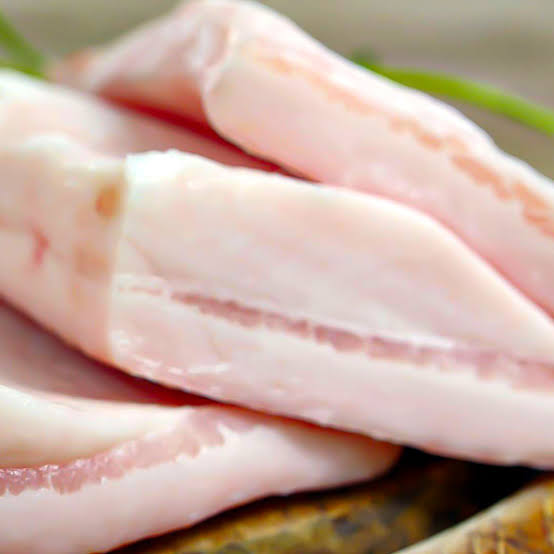
Abstract
Fettstoß is a deliberately designed animal fat management step in which actual animal fat is organised within an animal protein matrix to perform a defined structural, visual, sensory or thermal function in a processed meat product. Two systems are described. Fettstoß No. 1 uses extracted myofibrillar protein as the principal continuous matrix, with Hautstoß and raw rind as supporting collagen materials, for products requiring an invisible, finely distributed fat phase. Fettstoß No. 2 uses a gelatin-rich collagen matrix derived from Hautstoß as its principal structure, with fat incorporated and transglutaminase cross-linking intended to produce shape retention above the fat’s melting range, for use as a visible fat showpiece. Both systems form part of a broader functional family that includes Klebemasse (adhesion), Salzstoß (rigidity), Hautstoß and Sehnenstoß (water immobilisation). Fettstoß No. 1 builds on established meat batter science. Fettstoß No. 2 extends established gelatin emulsion gel research and is presented here as a defined experimental programme. Neither system has completed controlled product trials. Product applications, experimental priorities and outstanding questions are discussed.
Keywords: Fettstoß, Hautstoß, fat management, transglutaminase, gelatin emulsion gel, meat batter, reformed bacon, visible fat analogue
Klebemasse is the glue. Its job is adhesion, extra bind holding pieces of meat together that would otherwise separate on slicing.
Salzstoß gives the mixture firmness. During a month of production use, Salzstoß also appeared at least as tacky to the hand as Klebemasse. This remains a handling observation. It doesn’t establish equal adhesive strength, cooked bond strength, or slice integrity; those need direct comparative testing.[12]
Hautstoß and Sehnenstoß are put through an extended hot process, cooked at 85 to 98 degrees Celsius with water added. Heating denatures and solubilises part of their collagen, not necessarily all of it, and on cooling, the resulting gelatin portion forms a gel that binds water, holding it in the finished product. Whether this outperforms starch, isolates or TVP hasn’t been established by a controlled comparison at equal cost and addition level, so that comparison is left open here rather than claimed. This collagen-based water immobilisation represents a distinct principal mechanism, though its effects overlap with the firmness and adhesion produced by the other systems.
Fettstoß is the fourth member of this family, and it supplies the fat the other three don’t. Hautstoß and Sehnenstoß’s water binding mimics part of what fat contributes to a finished product, juiciness, yield, a fuller mouthfeel, though not all of it, since fat itself doesn’t directly bind meaningful amounts of water. The surrounding protein and collagen do that job, holding water and stabilising fat together. Fettstoß supplies the fat phase itself, contributing lubrication, flavour release, opacity, perceived juiciness and thermal rendering; the surrounding myofibrillar protein and collagen provide the principal continuous structure and hold the water and fat in place. Because different products require fat to behave differently, two Fettstoß systems are proposed and defined here: Fettstoß No. 1, where fat is distributed invisibly within a myofibrillar protein matrix for products where the fat must be felt but not seen, and Fettstoß No. 2, where fat is incorporated into a Hautstoß gelatin-rich collagen matrix cross-linked by transglutaminase into a structure intended to retain its shape above the melting range of the enclosed fat, for products where visible, firm fat pieces are required. Together they are intended to address a broad range of invisible, visible, retaining and rendering fat functions in processed meat products, though controlled release and free rendering remain untested for both systems.
Fettstoß is a separately formulated or separately controlled animal fat system, produced as a functional intermediate and then integrated into the final product to perform a defined structural, visual, sensory or thermal function. In Fettstoß, the fat phase is organised within an animal protein matrix; the continuous structure is either myofibrillar protein (No. 1) or a gelatin-rich collagen material (No. 2). The three characteristics that distinguish it from fat already present in a standard recipe are: the fat phase is separately formulated or controlled; it functions as a technical intermediate; and it is incorporated into a larger product system to deliver a specific outcome.
Fettstoß No. 1 distributes actual fat within a myofibrillar protein gel for products needing a smooth, invisible fat phase. In the candidate formulation examined here, Hautstoß, raw rind and chilled transglutaminase treatment are evaluated as possible reinforcing components. Fettstoß No. 2 takes the same fat management goal into a collagen-rich matrix: actual fat is incorporated into a Hautstoß system, and transglutaminase cross-linking is intended to produce shape retention above the melting range of the enclosed fat. Warm and chilled treatment routes are both under consideration because the optimum relationship between enzymatic cross-linking and physical gelation has not yet been established for plant-produced Hautstoß.
The family names in this article point at each system’s main intended job, not at mechanisms that never overlap. Gelatin can add firmness and adhesion of its own, and extracted myofibrillar protein can contribute to adhesion, water retention and final gel strength well beyond Klebemasse alone; Salzstoß can overlap with Klebemasse, and Hautstoß and Sehnenstoß can overlap with both. The names describe where each system’s main job sits, not a claim that the underlying mechanisms are exclusive to it.
What fat is for
Fat performs several different technological and sensory functions across these products, and which ones matter most changes the eating experience. In some products, the main functions are mouthfeel, lubrication, flavour release and perceived juiciness, finely dispersed through the matrix so it’s felt in the eating but never seen. In others, fat has a visible role too, on top of those functions, part of what the product looks like when it’s cut open, not only how it eats.
Bacon shows a third job fat does, beyond mouthfeel and sight: what happens when fried. Frying bacon renders its fat from solid to liquid, and that liquid fat lubricates the product, contributes to surface frying and heat transfer, and participates in lipid-derived flavour reactions and Maillard chemistry, which are principal pathways in cooked meat flavour formation.[17] Bacon flavour is also influenced by the earlier curing and smoking processes. Crispness itself comes from the combined effect of moisture loss, protein change and browning, not from fat alone. Bacon with no fat at all wouldn’t fry the same way. There’d be nothing to render, nothing to self-baste with, and a real part of the flavour and texture wouldn’t develop. That’s not a mouthfeel argument or a visual one, it’s what fat does under heat, and a collagen or gelatin particle can’t reproduce that rendering behaviour, which is why reformed bacon needs a source of actual fat when authentic rendering behaviour is intended, not only for how the finished slice looks. Fettstoß is one proposed way to supply that fat in a finely distributed, structurally supported form, not the only possible method.
Hautstoß and Sehnenstoß, left at a coarser particle size, can give a visual effect close to what cutting solid fat gives, a pale, distinct fleck against a finer background, even though neither is fat, an effect seen in practice in products like pressed ham. That similarity is strongest cold; gelatin and collagen don’t render the way adipose fat does once heat is applied, so a producer after that speckled look without adding actual fat has a practical observation worth trying, not a demonstrated equivalence to adipose tissue; its appearance, texture and heating behaviour would need direct comparison with visible fat particles before relying on it.
Fettstoß and Hautstoß or Sehnenstoß are not different strengths of the same tool. They differ in what they are and what they’re doing:
- Fettstoß supplies actual lipid, so it’s the source of lipid melting, thermal rendering, and a lipid phase for fat-soluble flavour compounds specifically. It also contributes to lubrication, opacity and perceived juiciness, though other components can influence those too. The surrounding myofibrillar protein and collagen, not the fat, hold and stabilise the water.
- Hautstoß and Sehnenstoß supply collagen-rich material; depending on the extent of thermal denaturation and solubilisation, the resulting gelatin portion can contribute to water immobilisation and texture, not through any fat content of their own.
- Where transglutaminase is used, susceptible proteins are cross-linked during a controlled warm or chilled holding stage, depending upon the system and the process route. Hautstoß and Sehnenstoß are built through an extended hot process, 85 to 98 degrees Celsius, that denatures and solubilises part of their collagen into gelatin, though not necessarily all of it.
- Within the No. 1 matrix, and within each No. 2 particle, the dispersed lipid phase is intended to become macroscopically indistinguishable. The complete No. 2 particle remains visible in the finished product, because the cross-linked block is cut into pieces before use. Hautstoß and Sehnenstoß, left coarser, stay visible as distinct flecks, close to what cut solid fat looks like, without being fat.
- Fettstoß adds real dietary fat to the product. Hautstoß and Sehnenstoß are intended principally as collagen-rich materials rather than lipid sources; their actual fat content depends upon raw material preparation and must be confirmed analytically before assuming a lower fat product results from using them in place of visible fat.
The systems therefore perform complementary functions. Fettstoß supplies actual fat where lipid rendering, lubrication and fat-related sensory properties are the point. Hautstoß and Sehnenstoß principally supply collagen-based water immobilisation and texture, and, where a producer wants it, the visible fleck as well, without asking either to do the other’s job.
A framework for fat design
Fat management in processed meat can be described on three separate axes, which together allow a more complete product specification than the smooth, coarse and diced categories alone.
Table 1. Three-axis framework for fat function design in processed meat.
| Axis | Option A | Option B | Option C |
| 1. Internal organisation | Finely dispersed lipid droplets | Finely comminuted adipose tissue | Intact adipose particles |
| 2. Position in the product | Distributed through matrix | Formed as a layer or cap | Visible particulate inclusion |
| 3. Thermal behaviour | Retain | Controlled release | Free render |
A reformed bacon fat cap is smooth internally (axis 1: dispersed), a visible layer (axis 2: cap) and aimed at controlled release (axis 3), since complete retention would defeat its frying function. A frankfurter is dispersed, distributed and retaining. A braai sausage is dispersed or coarse, distributed and free-rendering. A pressed ham showpiece is dispersed internally, a visible particulate and retaining. Fettstoß No. 1 handles finely dispersed internal organisation across distributed and cap positions, with thermal behaviour defined by the product. Where coarse fat is also required, it is used as a separate visible portion alongside Fettstoß No. 1. Fettstoß No. 2 is dispersed internally at the microscopic scale and used as a visible particulate at the product scale, targeted at retaining or controlled release depending on the product.
The comminution question
Three systems handle fat across different products.
1. A smooth system, where fat is comminuted until it’s visually indistinguishable. The fat itself doesn’t disappear, it remains present as dispersed droplets and small particles, inside a continuous matrix of water and protein, experienced and tasted but not seen. Fettstoß No. 1 and Fettstoß No. 2 are both smooth systems at the microscopic scale: in both, fat is finely dispersed within a continuous protein matrix. No. 1 uses a myofibrillar protein matrix with Hautstoß as support. No. 2 uses a Hautstoß gelatin-rich collagen system as the primary matrix, with fat incorporated into it. At the product scale, however, No. 2 behaves differently: the cross-linked block is cut into pieces before use, so it becomes a visible diced or coarse inclusion in the finished product, occupying the same position as a back-fat cube or lardello.
2. A coarse system, where fat is ground, but through a plate coarse enough that it stays in visible granules. Grinder plate size and handling set the dimensions of those particles; how much of the total fat goes through that coarse treatment sets how many of them show up, and how densely, across a cut surface.
3. A diced system, where fat is cut or cubed and kept as a distinct, intact piece.
It is in the coarse system where Hautstoß and Sehnenstoß could also be used.
Fat treatment differs among product categories.
A frankfurter and a Krainer sausage are both comminuted meat products, and both contain a substantial portion of fat, handled by different systems. In a frankfurter, US regulation caps fat at 30 percent of the mix, and combined fat plus added water at 40 percent, a legal ceiling rather than a formulation target,[13] the smooth system, comminuted until no fat particle remains macroscopically visible, dispersed within a visually homogeneous, continuous, protein-rich matrix. Krainer is a broader sausage category; Kranjska klobasa is the protected Slovenian product used here as a documented example of a coarse fat system. Its specification calls for 75 to 80 percent pork meat through a 12 mm mincer and up to 20 to 25 percent hard back fat cut to 8 to 10 mm, with finished fat capped at 29 percent, the coarse system, so that it stays as visible, discrete granules inside a coarser meat matrix.[1] Mortadella Bologna PGI requires well distributed pearly white shapes of adipose tissue comprising at least 15 percent of total product mass, which is not the same as a minimum total fat content since additional fat can sit within the finely reduced meat base.[14] Dry fermented sausages differ substantially in fat content and fat particle treatment; some styles retain diced fat, while others use coarsely comminuted particles.[3]
Smooth, coarse and diced are different technical requirements, not different amounts of the same thing. A cube of back fat survives as a particle because it is never comminuted. A smooth frankfurter matrix is produced when the fat phase and meat particles are reduced and dispersed sufficiently to create a macroscopically homogeneous appearance; the fat nevertheless remains present as dispersed droplets and small particles. Formulating Fettstoß starts with a clear objective as to which of these three a product needs, though as Splitting the fat treatment below shows, some proposed applications combine more than one.
The article first examines the internally dispersed fat systems used in Fettstoß No. 1 and No. 2, then considers how each is deployed as a distributed phase, a cap layer or a visible particulate inclusion. The coarse and diced fat treatments are separate from both Fettstoß systems and are covered in Splitting the fat treatment below.
Fettstoß No. 1: Building the myofibrillar matrix
| Ingredient | Job |
|---|---|
| Myofibrillar protein (lean meat) | Binds the system |
| Fat | Dispersed lipid phase, lubrication, flavour release, opacity, thermal rendering |
| Cooked skin (Hautstoß) | Prehydrated gelatin-rich structure, carrying water immobilised during its own manufacture, and contributing viscosity and gel structure |
| Raw rind, partly frozen and finely ground | Collagen-rich tissue in which part of the collagen may denature and solubilise during heating |
| Salt | Extracts myofibrillar protein |
| Double sour phosphate preparation described by Feiner | Promotes collagen swelling; chemical identity and dosage must be confirmed before production use |
| Microbial transglutaminase | Forms covalent cross links between susceptible proteins during chilled holding |
Added water, not water already present in the meat or in the rind’s own tissue, comes to roughly 17.5 percent against 30 percent fat, close to a 1 to 1.7 ratio, water to fat. That figure counts only the ice water cut in directly and the water added when Hautstoß itself was made; the rind’s own native moisture and the meat’s own biological water aren’t counted, since neither was added as part of this system. This is a ratio of fat to deliberately added process water, not fat to the true total water in the product; native moisture in the meat and rind also forms part of the actual continuous aqueous phase and contributes to how the whole system holds together.
Any proposed Fettstoß application must be assessed at whole-product level against the relevant compositional standard. A subcomponent can comply with a product standard only when its contribution is evaluated within the complete formulation; the individual subcomponent percentages are not sufficient. The United States frankfurter standard, for example, caps combined fat and added water at 40 percent.[13] At 30 percent fat and 17.5 percent added water, this candidate formulation already exceeds that limit as a standalone product. This does not rule out Fettstoß in a frankfurter application, but it means the complete recipe, with Fettstoß properly weighted within it, must be calculated before any compliance conclusion is drawn.
Fat and water don’t form a stable dispersion on their own. What actually happens is closer to a complex, multiphase meat batter than a simple classical emulsion: fat sits as a dispersed phase inside a continuous aqueous matrix that also contains salt, extracted protein and suspended tissue particles, not mixed directly into the water. Salt draws myofibrillar protein out of the meat, and during comminution that protein helps stabilise the fat and water interfaces, though not every droplet is necessarily wrapped in a complete, uniform protein film. On cooking, that protein forms a gel that immobilises the dispersed fat and water together. The water isn’t added to the fat directly. It’s added to a system built around the fat, and that system, not the fat itself, is what makes carrying this much water alongside this much fat possible at all.
The ingredients in the table above constitute one candidate Fettstoß No. 1 formulation. Cooked Hautstoß, raw rind, the double sour phosphate preparation and transglutaminase are variables to be evaluated, not mandatory defining components of every No. 1 system.
A productive first experimental sequence, before optimising phosphate or enzyme dosage, is: (1) myofibrillar protein and fat control, no collagen materials; (2) control plus cooked Hautstoß; (3) control plus raw rind; (4) control plus both collagen materials; (5) the best treatment from steps 1 to 4, with transglutaminase added; (6) the same formulation without transglutaminase. This sequence answers whether both collagen sources are necessary and whether transglutaminase adds anything beyond what the collagen and protein matrix already provide, before more complex variables are introduced.
The smooth Fettstoß formulation examined here draws on several functional components: extracted myofibrillar protein, actual animal fat, cooked Hautstoß, raw rind, added water, salt, the double sour phosphate preparation described by Feiner whose chemical identity and dosage remain to be confirmed, and microbial transglutaminase. Myofibrillar protein, extracted from lean meat, binds the system, the same protein Salzstoß depends on. Fat provides the lipid-related mouthfeel, lubrication and thermal behaviour this recipe is formulated to deliver; the target lean to fat ratio reflects the streaked, belly-like composition of the product it coats. Finished yield depends on the surrounding protein and collagen matrix’s ability to retain both the fat and the aqueous phase. Collagen comes from two sources with different thermal histories and expected functional contributions; their effects may overlap and would need separate testing to isolate.
The first collagen source is pre-formed. Cooked Hautstoß enters as a prehydrated, gelatin-rich structure, carrying water already immobilised during its own manufacture, and contributing viscosity and gel structure to the mix; whether it has further capacity to bind additional water once added would need its own measurement. The second source is raw. Skin reduced to a fine particle and kept cold, frozen even, through the grind, enters with much of its collagen still in a native state. During cooking, part of it may denature and part may become soluble, and on cooling, the resulting gelatin may add further water-binding capacity, though the extent of that conversion under this process hasn’t been measured.
Getting the raw collagen portion into the system takes a specific sequence. Feiner describes this sequence for working with skin as a raw, uncooked material.[4] A double sour phosphate preparation and a small quantity of soy protein go in together, after cutting of the chilled or partly frozen skin has already begun; the phosphate promotes collagen swelling while the soy protein emulsifies residual fat still attached to the skin. Ice water is then incorporated gradually. Feiner reports substantial water incorporation when chilled or partly frozen rind is treated with a double sour phosphate preparation and soy protein before gradual addition of ice water. The precise extension, phosphate identity and dosage must be confirmed from the original text before this figure is relied on. Fettstoß omits the soy protein, so equivalent water uptake cannot be assumed. Working with uncooked skin preserves a less thermally altered collagen structure; whether the modified process, without soy protein, produces the same result is a separate question that needs testing.
In the present production trials, unfrozen raw rind smeared and passed less cleanly through the grinder than partly frozen rind. That’s an observation from these trials, not a published finding, and “frozen” on its own is too loose a description to repeat reliably: tissue at minus 1 degree Celsius behaves differently from tissue at minus 18, so the actual rind temperature, plate diameter, grinder type and residence time all need recording alongside it. Whether the freezing duration and temperature history affect the rind’s later swelling, gelatin formation and water-holding capacity hasn’t been established here and would need its own testing rather than an assumption that freezing leaves function unchanged.
Raw rind can have a high bacterial count, and FAO guidance states that it’s normally heat processed before inclusion in comminuted products for that reason.[5] Freezing suppresses microbial growth during storage and may injure or kill some organisms, but it does not provide a validated or predictable microbial reduction and is not a lethality treatment. Partly freezing the raw rind improved comminution in the present trials, but it still needs its own controls on top of that: a microbiological specification for the incoming rind, hygienic preparation, a controlled chilled residence time, and prevention of cross-contamination, backed by a validated thermal process, not just a target core temperature, that delivers the lethality the finished product actually needs.
In a conventional finely comminuted meat batter, extracted protein contributes viscosity and interfacial stabilisation before cooking, and heating then produces the main thermal protein gel that determines final fat and water retention; conventional batters are not simply held together by raw stickiness alone. In Fettstoß, transglutaminase is intended to add covalent cross links between susceptible proteins during a chilled holding period, before the product reaches heat, on top of that same conventional mechanism. Cooking remains essential to the final structure regardless: myofibrillar protein denatures and forms its own thermal gel, the fat phase softens or melts and is retained within that developing gel, collagen may denature, shrink and partly solubilise during heating, with the extent depending upon the heating profile and the properties of the collagen-rich material, and the enzyme may pass through a range of increased activity before progressive thermal inactivation, the exact extent depending on the preparation and heating rate. The intended Fettstoß formulation contains no deliberately added starch or isolated non-meat protein. This must be confirmed against the complete composition of the selected commercial transglutaminase preparation, including its carrier. The system also includes added water, salt, phosphate and the enzyme, none of which are meat derived.
Transglutaminase
Microbial transglutaminase forms covalent cross links between susceptible protein molecules and can reinforce the protein network in a Fettstoß system, though whether the result is one single continuous network hasn’t been demonstrated here.
Reported optimum temperatures for microbial transglutaminase vary according to organism, preparation, substrate, pH and assay method. Values around 40 to 55 degrees Celsius are common in the literature, but they can’t be applied automatically to a commercial preparation. One experimental preparation from a Streptomyces hygroscopicus strain showed half-lives of roughly 20 minutes at 50 degrees Celsius and 8 minutes at 60 degrees Celsius.[8] Holding raw meat at these temperatures would place it within the range, roughly 4 to 60 degrees Celsius, in which foodborne bacteria can multiply rapidly.[16] A prolonged treatment at these temperatures would therefore require specific microbiological validation and should not be treated as a routine raw meat process.
One established method for cross-linking a raw meat system before cooking is chilled holding. Kuraishi and colleagues, in an early influential study of this technique, held pork muscle cubes at 5 degrees Celsius for two hours; microbial transglutaminase alone didn’t provide adequate practical binding, and their practically acceptable result used roughly 3 percent sodium chloride together with 0.1 percent microbial transglutaminase, since salt extraction is what makes myofibrillar protein available at the meat surfaces for the enzyme to act on in the first place.[9] That result supports the role of salt-extracted protein in the bind; it doesn’t establish that the same binding happens at the lower salt levels intended for Fettstoß. The same study also achieved effective salt-free binding using sodium caseinate, a route not directly applicable here, since the intended Fettstoß formulation excludes deliberately added isolated non-meat protein. Longer chilled holding periods may be used depending on enzyme activity, dosage, product geometry and the manufacturer’s instructions; the two-hour figure above is what Kuraishi’s own study demonstrated, not a general industry standard, and the actual hold time, along with the enzyme preparation, its activity, carrier, addition rate and salt level, needs to be established and specified experimentally rather than assumed. The Kuraishi study demonstrates that cross-linking can proceed at 5 degrees Celsius over a two-hour holding period. The required duration in Fettstoß must be established for the selected commercial preparation. The complete composition of the selected commercial preparation, including its carrier, must be obtained from the supplier before concluding that the final Fettstoß formulation contains no isolated non-meat protein.
Once the product reaches its first cook, a 75 degree Celsius water bath held to a 72 degree Celsius core, the mixture passes through the enzyme’s more active range on the way up and is then progressively inactivated as the core continues to climb; the exact extent and timing of that inactivation depend on the specific preparation, the product’s own matrix, and the heating profile used, rather than following a fixed schedule. The covalent cross links formed during the cold hold are already stable bonds and remain in the protein system; heating adds the separate effects of thermal protein denaturation and gel formation on top of them, rather than needing to lock anything in. These stated bath and core temperatures describe the proposed processing trial; they don’t by themselves establish microbiological lethality, which depends on time, product dimensions, heating rate, initial contamination and the target organism.
Collagen as a cross-linking substrate
Native collagen, still folded into its normal structure, offers transglutaminase fewer reactive sites than collagen that has been at least partially unfolded, usually by heat; unfolding is what exposes more of the sites the enzyme needs, and cross-linking becomes meaningfully more efficient once it has, though even native collagen isn’t entirely unreactive.[10] Myofibrillar protein has accessible reactive sites already, in its native state, which is why it does the cold-set cross-linking work described above.
The raw rind portion of Fettstoß keeps its collagen native and cold for the eventual cook. Myofibrillar protein is expected to be the principal accessible substrate for cross-linking during that hold, the same protein behind every cold-set bind described above, but its relative contribution compared with the heated collagen in the Hautstoß portion hasn’t actually been measured in this system; whether that pre-cooked collagen also takes part is a reasonable hypothesis from the mechanism, not an established result. Raw rind is included to investigate collagen swelling, partial thermal conversion during the cook, and the subsequent water immobilisation that may follow. The magnitude of each contribution has not yet been measured in this formulation.
Collagen as a filler, beyond cross-linking
LaBudde’s treatment of comminuted meat products as a filled, thermosetting bio-polymer system predicts how raw collagen could contribute to firmness, whether or not that collagen ever gets cross-linked at all, though this is an extrapolation from composite theory, not a measurement taken on this specific system.[11]
LaBudde’s framework describes cooked meat product as a protein matrix, plasticised by water, filled with fat and other insoluble material. Fillers stiffen a filled composite in compression by occupying volume, the same way carbon black stiffens rubber through simple physical presence in the matrix. A particle occupies volume, displaces protein and plasticiser, and raises the compressive modulus of the whole aggregate. A filler with real water-holding capacity of its own also pulls water out of free circulation as a plasticiser, and since water keeps the matrix soft and extensible, removing it from free circulation stiffens the product a second time.
Raw rind, kept cold to preserve its native collagen, should do both by this same theory. It would be a particulate solid within the aggregate, filling and stiffening the matrix by volume. Under the complete process described by Feiner, acid-phosphate treated rind can incorporate substantial added water; the magnitude of water uptake and immobilisation in the modified, soy-free Fettstoß system has not yet been established, so its water-binding contribution here is a hypothesis rather than a confirmed figure. The predicted filler effect arises mainly from particle volume, hydration behaviour, and the rind’s interaction with the surrounding matrix; chemical cross-linking isn’t required for a filler effect, but other physical and protein interactions may still occur alongside it. Filling a matrix this way doesn’t automatically improve every quality either; composite theory permits rigidity to rise, but it doesn’t establish that cohesiveness, elasticity or slice integrity will hold up as well, those need their own measurement, so which way this actually goes for Fettstoß needs its own test, not an assumption that more filler is simply better.
Raw rind may contribute water immobilisation through collagen swelling, partial thermal solubilisation and gelatin formation during cooling. The magnitude of this contribution has not yet been measured in the soy-free Fettstoß formulation. A predicted third effect, firming the aggregate as a filler through physical reinforcement and de-plasticisation, follows from LaBudde’s model for an insoluble, water-binding particulate, and also awaits measurement before it’s relied on.
Applications of Fettstoß No. 1
The smooth Fettstoß formulation examined in this article contains extracted myofibrillar protein, actual animal fat, two collagen-rich portions, added water, functional salts and microbial transglutaminase. The susceptible protein portion is partly cross-linked during chilled holding, and the final structure develops during cooking and cooling. This formulation is intended for evaluation as a poured, moulded fat cap on a formed product, and as a fine fat management system in a cooked, comminuted sausage.
The Hold and Release distinction discussed in detail under Fettstoß No. 2 applies to No. 1 as well. A frankfurter or polony requires dispersed fat retained through processing and storage: No. 1 Hold. Reformed bacon intended to fry needs some fat release at the surface: No. 1 Partial Release. A patty or braai product where rendering is central to the eating experience may need No. 1 Release. Transglutaminase concentration, myofibrillar protein level, droplet size, total collagen and matrix porosity could all affect how readily fat escapes during frying. The current article sometimes implies that No. 1 fat will render normally, but this hasn’t been measured and should be tested against a conventional fat control before assuming No. 1 behaves identically under heat.
Krainer-type sausages, mortadella and many dry fermented sausages normally retain at least one macroscopically visible fat portion, so their visible fat treatment differs from the fully smooth Fettstoß No. 1 system described here. The required technological function has to be defined before selecting the comminution, phosphate and enzyme process, not after.
Fettstoß No. 2: The Collagen Matrix System
Fettstoß No. 1 uses myofibrillar protein as the primary structural matrix, with Hautstoß as support. Fettstoß No. 2 uses Hautstoß as its principal structure. Hautstoß provides a gelatin-rich collagen matrix containing solubilised gelatin, denatured collagen and residual insoluble tissue; it is not purified gelatin, and its protein concentration, pH and available transglutaminase substrates must be measured rather than inferred from published purified gelatin work. Fat is incorporated directly into this matrix. Transglutaminase is then intended to cross-link susceptible proteins within the matrix and reduce its tendency to soften or flow at product cooking temperatures, though whether plant-produced Hautstoß can produce the same heat stability as purified gelatin systems is the central open question.
The question this raises immediately is whether pork fat or lard can be held inside such a system even above the fat’s own melting point. The chemical melting point of lard is fixed by its fatty acid composition and cannot be changed without industrial processing. What TG cross-linking can achieve instead is shape retention above the melting range of the enclosed fat. Chen and colleagues reported that TG cross-linking of gelatin-based emulsion-filled gels increased the thermal denaturation temperature by 21.87 degrees Celsius after 4 hours of cross-linking.[18] In the reported purified gelatin system, samples receiving the longer transglutaminase treatments retained a stable gel form during heating at 100 degrees Celsius for 20 minutes.[18] The fat inside it becomes liquid, but the structure surrounding it holds its shape. The fat still melts; the matrix does not flow. This is shape retention, not a raised chemical melting point of the fat itself, and the distinction matters for how the finished particle will eat: the fat may not render and drip freely the way adipose tissue does, which is the right behaviour for a pressed ham showpiece but possibly the wrong one for a braai sausage.
Two process routes need to be compared before settling on one. The literature, particularly Babin and Dickinson[22] shows that the order in which physical gelation and transglutaminase cross-linking develop can substantially change final gel strength and thermoreversibility. Physical gelation creates junction zones during cooling; if that happens before the enzyme has acted, protein mobility and enzyme access may be reduced.
Route A, warm cross-linking: create the fat dispersion while the Hautstoß system remains fluid. Add transglutaminase at approximately 45 to 50 degrees Celsius and hold for a defined period. Two variants should be compared: Route A1, where the enzyme is thermally inactivated separately before casting, and Route A2, where the material is cast and chilled without a separate inactivation step, relying on the final product cook to inactivate the enzyme. A1 gives more precise control; A2 uses less energy and one fewer heat treatment but risks continued cross-linking during chilled storage and possible cross-linking of the surrounding product after incorporation.
Route B, chilled cross-linking: create the warm emulsion, cool the system, add transglutaminase at chilled temperature, and cold hold at 4 to 5 degrees Celsius for 2 to 6 hours. This is closer to Fettstoß No. 1’s own cold-set logic and offers better microbiological control, but enzyme access to the partially set matrix may be reduced. The process order may be as important as the enzyme dose.
The emulsification assumption in the current process also needs testing. Gelatin does possess some interfacial activity, but the Chen system still used Tween 80 and high-pressure microfluidisation at 30 MPa. Whether plant-produced Hautstoß and ordinary bowl-cutter shear alone can stabilise a high concentration of lard needs to be established by trial, not assumed. Three treatments should be compared at an early stage: Hautstoß alone, Hautstoß with a small myofibrillar protein addition, and Hautstoß with lecithin where the label permits. Purified porcine gelatin run as a scientific control would help interpret the results.
Adding a myofibrillar protein portion is worth testing for three reasons beyond emulsification: it would improve the density of transglutaminase substrates in the matrix, it would bring the system closer to established meat batter science, and it would improve adhesion between the finished No. 2 piece and the surrounding meat. A collagen and myofibrillar dual network version of No. 2 may prove more stable and more compatible with its product context than a collagen-only version, while remaining entirely within an animal protein system. Published work on pork skin gelatin combined with pork myofibrillar protein and transglutaminase in restructured ham provides a directly relevant meat precedent for this approach.[23]
Not every No. 2 application needs the same cross-linking target. A highly cross-linked piece retains its shape and fat through cooking and pressing, which is right for a pressed ham showpiece or mortadella-style inclusion. But a piece that retains fat completely may eat as an elastic or rubbery gel rather than as fat when hot, which would be wrong for a Krainer sausage or braai application. Two endpoints should be distinguished. No. 2 Hold: higher cross-linking, shape and lipid retained through cooking. No. 2 Release: lower cross-linking, shape held during processing but some fat released during frying or grilling. The most innovative version may be a controlled-release particle rather than a permanently oil-retaining one.
A further step once stable pieces have been produced is surface bonding. A preformed No. 2 cube needs to adhere to the surrounding meat matrix through slicing and chewing. A light exterior coating with Salzstoß, Klebemasse, or a salt-extracted lean meat slurry before incorporation would create a separate adhesion zone at the piece surface, using an existing member of the functional family rather than adding anything new. This follows directly from the family concept: Fettstoß manages the fat, Klebemasse manages the interface.
Before any of this can be quantified, Hautstoß itself needs to be characterised as the starting material. The Chen system used 7 percent purified gelatin with known concentration, Bloom strength and pH. A Hautstoß batch at the same nominal inclusion may contain very different quantities of functional gelatin solids depending on skin source, cook time, temperature and extension ratio. The real formulation variable is not percentage Hautstoß, it is percentage functional gelatin or collagen protein. Moisture, total protein, hydroxyproline or collagen content, fat, pH, salt, gel strength at 4 degrees Celsius, softening profile, warm viscosity, particle size and microbiological status should all be measured before selecting a fat percentage or TG dose.
The broad concept of a collagen-based fat emulsion gel is not entirely new. Schnell and Mandigo combined mechanically modified pork skin, added water and fatty pork trim in a system that shares more with Fettstoß No. 2 than any purified gelatin laboratory study: their experimental systems included 3 to 10 percent pork skin, 25 to 50 percent added water and final fat contents between 20 and 40 percent, chopped and heated to solubilise collagen before incorporation with fatty pork material.[24] This is the most directly relevant published baseline for No. 2, not the corn oil and purified gelatin systems. It should be the control against which transglutaminase treatment is evaluated. Recent work has also produced biphasic gels that survived grinding, mixing, cooking and reheating in coarse sausage, demonstrating that fat analogue particles can go through an actual plant sequence, not just be hand-cut and pressed.[25] What the Fettstoß No. 2 system may contribute that is not yet found in those systems is the combination of actual animal fat, plant-produced Hautstoß, transglutaminase cross-linking for shape retention tuned between Hold and Release endpoints, integration with a separate exterior adhesion system, and placement within a broader functional family. No exact peer-reviewed match for that complete arrangement was located in the literature reviewed. This is not a patent novelty or freedom-to-operate conclusion; relevant patent prior art, including gelatin-stabilised fat-continuous meat emulsions and a marbled sausage system combining animal fat emulsion, pigskin, carrageenan and transglutaminase, has not been fully reviewed.
Two main No. 2 raw material routes should be distinguished from the outset, since they behave differently in the process. No. 2A, the lard route: cooked Hautstoß plus rendered pork fat. The fat enters fully melted; the system is simple in composition and theoretically allows warm enzyme treatment after a post-cook lethality step. The risk is poor emulsification without strong interfacial protein and the possibility of oil separation. No. 2B, the fatty trim route: Hautstoß plus finely comminuted high-fat pork trim, such as 70/30 trim. The trim’s own lean portion supplies myofibrillar proteins at the fat-water interface, improving dispersion without external emulsifier, and providing additional transglutaminase substrates. The risk is raw material microbiology, which pushes the enzyme treatment to a chilled rather than warm route. No. 2B is closer to the Schnell and Mandigo system and likely more compatible with ordinary meat plant equipment.
A fat-continuous phase-inverted system, in which small gelatin-rich aqueous domains are dispersed inside a continuous animal fat phase, should be included as a comparator in the experimental programme, but it falls outside the core Fettstoß definition used here because the continuous structure is lipid rather than animal protein. That architecture may give a more fat-like bite, since the mouth encounters a continuous lipid phase first, and may release fat more naturally during chewing and heating. Earlier patent work already describes water-in-oil emulsions made from fatty pork trim and aqueous gelatin solutions, with pork skin gelatin, cooling, tempering and conductivity testing to confirm phase structure; this constitutes significant prior art. It is best tested as a control against the collagen-continuous No. 2 systems at Stage 5 of the experimental programme, not in the first screen alongside No. 2A and No. 2B where it would confound interpretation.
The intended fat content of the No. 2 block is not yet defined in the current recipe, and that is fundamental. A particle containing 15 percent fat and 70 percent water may look white but is principally a collagen gel. A particle at 50 to 70 percent fat is an actual fat showpiece but harder to stabilise. Published biphasic gel work found that 70 percent fat structures behaved more like pork fat during eating, while more collagen-dominant structures retained particle definition too strongly, edging towards rubbery. The first No. 2 screen should therefore include fat targets of 30, 50 and 70 percent to establish whether the system is a collagen showpiece containing some fat, a balanced composite, or a fat-rich inclusion supported by collagen.
The physical state of the fat during processing deserves attention alongside the protein matrix. For lard or back fat, solid fat content at mixing temperature, fat crystal form, cooling rate, tempering programme and whether the fat is fully melted, partly crystallised or incorporated as chilled fine particles all affect the final texture and opacity. Tempering after casting may prove as important as transglutaminase concentration for producing a piece that slices cleanly, resists smearing during grinding, and matches the whiteness and opacity of back fat. Fat incorporated fully melted, partly crystallised and as fine chilled particles should be compared in the first material trial.
Hold and Release need operational definitions based on measured performance against back fat of equivalent particle size as the reference, not on arbitrary absolute thresholds. A shape retention index compares particle geometry before and after cooking; a lipid release index compares initial lipid to lipid released during a defined heating test. Product targets are then set relative to the back fat control: pressed ham Hold may require more shape retention and less lipid release than back fat; a Krainer-style release should approach back fat deformation and lipid release; braai applications may require equal or greater release than the Krainer target. These product-specific thresholds must be established by measurement.
Where the warm cross-linking Route A uses fully cooked Hautstoß and heat-treated lard as inputs, the warm enzyme hold is a post-lethality handling stage rather than a raw meat process. The principal risks then shift to recontamination, growth during holding and spore survival, which are managed through closed hygienic handling, time limits and a validated final lethality step. Where Route B uses raw fatty trim, full raw meat process validation applies and a warm hold should not be assumed safe simply because the product will be cooked later. The chilled Route B reduces microbial growth but may reduce enzyme access. The two routes therefore require separate process validation.
Hautstoß is not purified gelatin.[20] Its protein concentration, pH and available transglutaminase substrates must be measured before any commercial gelatin comparison applies.
Evidence status
The following table maps the principal propositions in this article to their evidence level. This allows the qualifications throughout the text to be read once rather than repeated.
Table 2. Evidence status of key propositions.
| Proposition | Evidence status |
| Plain Hautstoß pieces survive a ham cook and remain visible | Observed in production |
| Salt extracts myofibrillar proteins that stabilise fat and form a thermal gel | Established externally |
| Purified gelatin can be cross-linked by transglutaminase into heat-stable structures | Established externally |
| Hautstoß can emulsify 30–70 percent pork fat under plant conditions | Not yet demonstrated |
| Fettstoß No. 1 distributes and retains fat as No. 1 Hold or releases it as No. 1 Release | Mechanistically plausible, not yet measured |
| No. 2 retains shape above the fat melting range in plant-produced Hautstoß | Mechanistically plausible, not yet demonstrated |
| No. 2 Release mimics adipose fat behaviour during frying or grilling | Not yet demonstrated |
| Klebemasse or Salzstoß coating secures No. 2 particles in product | Proposed, not yet tested |
Splitting the fat treatment
Frankfurters take the fully smooth route, no split at all. The fat is reduced until no particle remains macroscopically visible; meat and fat may first be ground, but the final particle reduction and dispersion happen during fine chopping or emulsification, so the initial grinder plate isn’t the sole determinant of the final fat structure.
In this proposed experimental Krainer-style formulation, the fat is divided between two treatments, a division that sits outside the protected Kranjska klobasa specification and should be read as an experimental starting point, not the official recipe; a version using phosphate and transglutaminase is, by the specification’s own terms, outside it entirely, since the official rule permits no technical auxiliaries or polyphosphates at all. Ten percent stays raw back fat, cut and ground coarse; the official Kranjska klobasa specification itself uses 8 to 10 mm fat pieces, so reducing this visible portion to approximately 8 mm is an experimental selection within that range, not an optimised value of its own, with nothing added to it beyond the cut itself. The remaining ten percent goes through Fettstoß’s own method, comminuted finely, bound with salt and phosphate, and cross-linked with transglutaminase during a cold hold, the same cold-set system described above, built here from back fat and Krainer’s own lean pork rather than the full Fettstoß recipe’s trim, Hautstoß and rind, which belong to a different product. The official specification itself calls for 75 to 80 percent pork through a 12 mm mincer and up to 20 to 25 percent back fat cut to 8 to 10 mm, finished fat capped at 29 percent, and says nothing about dividing that fat between a coarse and a fine treatment.
The Mortadella Bologna PGI specification requires well distributed, pearly white shapes of adipose tissue comprising at least 15 percent of total product mass, and finely ground pork around them, and it prohibits polyphosphates and processing aids outright.[14] That means a Fettstoß-style fine base, built with phosphate and transglutaminase, cannot be presented as compliant Mortadella Bologna PGI; it would be a mortadella-style product outside that protected specification, not an authentic one, and should be labelled that way. In that experimental version, a further amount of fat would be comminuted finely into the base, alongside a visible lardelli portion modelled on the minimum specified for Mortadella Bologna PGI, not a legal requirement for this experimental product, since it already sits outside that specification. A conventional control, no transglutaminase, salt-extracted myofibrillar protein setting only once the product is cooked, should be produced first; transglutaminase could then be evaluated as a separate experimental treatment where its use is lawful in the intended market, since being outside the PGI specification already, on its own, isn’t a reason to rule it out of an experimental trial.
In many traditional dry fermented sausage styles, visible fat is retained as diced or coarsely comminuted particles, and fat level and particle size are product specific rather than fixed at one figure.[3] While salami’s lean phase still forms its own protein structure around that fat during fermentation and drying, there’s no separate fine, water-carrying fat system built in alongside it the way there is in Krainer or an experimental mortadella. A water-rich Fettstoß-style system cannot be transferred into a fermented sausage without its own separate validation of fermentation, acidification, water activity, drying rate and microbial safety, questions a straight transfer from a cooked product doesn’t answer on its own.
Fettstoß No. 1 and No. 2 by product
In production trials, Hautstoß incorporated as solid pieces into cooked pressed ham remained solid after cooking and presented visually as white, opaque fat-like showpieces. That observation supports Fettstoß No. 2 at one level, but it is important to be clear about what has and has not been demonstrated. At the level of direct observation: Hautstoß pieces can survive the ham cook, remain white and visible, and produce a fat-like visual contrast. What has not yet been demonstrated is that fat can be successfully dispersed inside the Hautstoß during preparation, that transglutaminase cross-linking will make that specific fat-in-Hautstoß system shape-stable, that melted fat will remain retained during cooking, or that the resulting piece will eat like adipose tissue rather than as a gel. These are the gaps Fettstoß No. 2 is designed to close.
Reformed bacon, fat cap (Pork Buikspek): Fettstoß No. 1. The fat cap is poured and moulded against the lean block, applied raw, and cooked in the same step. The technical requirements are adhesion to the lean block without delamination during slicing, controlled rendering during frying, and appropriate visible layer definition. Klebemasse or Salzstoß at the interface between cap and lean could improve adhesion. No. 1 is the more likely route since the cap is smooth internally, but it remains a visible layer at product scale. The three-axis description: dispersed lipid internally, cap position, retaining to partial-release thermally.
Reformed bacon, fat within the formulation: Fettstoß No. 1. Fat is distributed invisibly through the pressed lean matrix. On frying, it renders and gives the bacon experience of fat, browning, and dripping. Fettstoß No. 2 is not the first choice here because a shape-retaining matrix may resist the free rendering a fried bacon product depends on.
Krainer-style sausages, including the Russian and Hungarian styles produced in South Africa and Zambia where visible fat pieces are required: Fettstoß No. 2 for the visible fat portion. Traditional adipose particles soften and release fat during eating; a highly cross-linked No. 2 piece may remain too firm and eat as a rubbery gel rather than as fat. Two No. 2 variants should therefore be tested in this application: No. 2 Hold, more strongly cross-linked, targeting shape retention through cooking; and No. 2 Release, less extensively cross-linked, allowing partial fat release during eating. No. 1 can take on the fine fat load in the surrounding base if the total fat requirement exceeds what the visible pieces alone supply.
Frankfurters and Vienna sausages: Fettstoß No. 1. A fully smooth, homogeneous batter with no visible fat structure. No. 2 is not appropriate here.
Hamburger patties: Fettstoß No. 1 as the more likely candidate. Fat distributed through a cross-linked protein-and-collagen network may render differently from conventionally processed fat, which could improve yield but alter browning, dripping and crust formation. This hasn’t been measured for No. 1 in patties and should be checked against a conventional fat control before assuming No. 1 will allow the fat to function exactly as it would otherwise. No. 2 is not appropriate where visible pieces or shape retention are not the objective.
Braaiworst: This is the most open question of the group. Boerewors may contain up to 30 percent analytically measured fat under the applicable South African compositional standard, and part of what defines the braai experience is fat dripping into the coals. Free rendering is not incidental; it is the function. Fettstoß No. 1 distributes the fat evenly through the matrix, but whether a cross-linked protein-and-collagen matrix around the fat changes the rendering behaviour enough to affect the braai experience is untested. Some of the fat allowance should remain as conventionally processed fat if the traditional drip and flare behaviour matters to the product. The split, and how much of the fat allowance Fettstoß No. 1 can replace without changing the eating and braai experience, needs a trial.
Mortadella-style hams: Fettstoß No. 2 for the visible fat showpieces, No. 1 for any additional fine fat load carried in the base. The No. 2 pieces are cut to the desired size from the cooled, cross-linked block before folding into the finely comminuted base. The pressed ham observation supports the visual and thermal feasibility of a plain collagen-rich showpiece; it does not validate fat incorporation, transglutaminase treatment or the eating behaviour of a full No. 2 particle in this application.
Polony and Bologna-style products without visible fat pieces: Fettstoß No. 1. These are fully smooth, sliceable emulsion products where no fat structure should be visible. No. 2 would introduce visual heterogeneity.
Pressed ham with fat showpieces: Fettstoß No. 2, and this is the application with the most directly relevant production observation. Hautstoß pieces used in pressed ham remained solid and presented as white, fat-like showpieces after cooking. No. 2 formalises this into a deliberate design by incorporating actual fat into the Hautstoß gelatin-rich collagen matrix before the selected warm or chilled transglutaminase treatment, so that the pieces combine the visual appearance already demonstrated with an actual fat content, delivering lubrication and fat-related sensory properties that a plain Hautstoß piece cannot.
Sandwich ham and Sandwich Schinken: Fettstoß No. 1 for fine fat distribution within a smooth, sliceable block with no visible fat structure. Sandwich ham is a uniform product; visible pieces are not part of its definition. No. 1 supplies fat functionality without adding any visual structure.
Boerewors, regulatory note: the South African raw boerewors standard requires at least 90 percent total meat, prohibits edible and inedible offal except for casing, and limits other permitted ingredients. Whether Hautstoß, raw rind or a Fettstoß portion containing processed pork skin can be legally included in a product sold as raw boerewors depends on how those materials are classified under the relevant regulation (South African R.2410 of 2022).[27] If the collagen material is not permitted within that class, the product would need to be positioned under another lawful product designation under the applicable regulation. This classification must be confirmed before any braai or boerewors application is pursued commercially.
Evaluation of lower cost fat sources
Internal provisional observations suggest that Hautstoß costs substantially less per kilogram than the fat sources used in No. 1. These figures are not disclosed here because they have not been dated, sourced by supplier, located by market, or confirmed to include processing energy and labour. The price difference, on whatever verified basis it is eventually established, raises a testable economic question: could a cheaper, softer fat be used in Fettstoß if more Hautstoß and rind were added alongside it to help firm the batter back up?
When Fettstoß is costed as an isolated subcomponent, its apparent cost per kilogram may differ substantially from what it actually contributes to the whole product, and whether fat generally costs more than meat depends on the local raw material market, not something the prices used here establish on their own. The Pork 70/30 trim inside Fettstoß comes out of the same meat block already used for the sausage or reformed bacon it goes into, so it must be credited once against the meat and fat quantities it replaces elsewhere in the whole formulation, not counted twice. That correction prevents double counting; it doesn’t make the trim free, since it still has its own cost, whichever part of the recipe it’s assigned to. Any real economic advantage has to be calculated at complete formulation level, the lean tissue, fat and native moisture the trim contributes included, holding final fat, protein, added water and saleable yield as constant as possible across the comparison. Otherwise, an apparent saving may just be an artefact of comparing two products with different composition, not a real one.
The firming argument itself rests on the same LaBudde filled-composite theory already used above, and that theory is specifically about the finished, cooked matrix, not the raw cold batter. Additional collagen-rich material may increase the rigidity of the cooked product under this model; it says nothing on its own about the raw batter’s viscosity, emulsion stability or pumpability, which are a separate question this theory doesn’t address and would need their own test. Even limited to the cooked matrix, the theory permits a firmer product without establishing that cohesiveness, elasticity or slice integrity will hold up as well. A real trial of this combination would need to measure both raw batter viscosity or apparent yield stress, and the cooked product’s modulus, fracture stress and deformation, not just one or the other. It belongs in the workbook as a proposed alternative, not as a replacement for the standard recipe, until it’s been tried.
The same concept could be evaluated with rendered pork fat or lard. Rendering removes the cellular and connective tissue architecture of adipose tissue and changes the physical state in which the lipid enters the batter, but this doesn’t make rendered fat unsuitable or automatically unstable. Youssef and Barbut found no significant difference in fat loss among beef batter treatments made with beef fat, rendered beef fat and palm oil, which demonstrates that rendered fat can be stabilised under suitable formulation and processing conditions, though it doesn’t establish equivalent behaviour for pork lard in Fettstoß.[15] Performance will depend on fat temperature, solid fat content, droplet size, available interfacial protein, shear conditions and the developing thermal gel. The LaBudde filler model concerns the rigidity of the cooked matrix; it can’t establish whether the rendered fat phase itself will remain adequately dispersed during processing.
This version still holds fat and added water at a similar order of ratio to the standard recipe, close to 1.9 to 1, fat to water, 30 percent target fat against roughly 15.7 percent added water, counting only the ice water and the water put into Hautstoß when it was made, not the native moisture already in the meat and rind, which is why this is a ratio of fat to added water rather than fat to the true total water in the product. That 30 percent is a target figure based on the trim’s nominal composition, not an analytical measurement, and the actual fat content should be confirmed against real supplier data rather than assumed exact. The two versions differ in fat source, collagen content, native moisture, protein composition and the physical state of the lipid phase. Their final composition must be compared through a complete mass balance before any conclusion on cost or quality can be drawn.
Economics of Fettstoß No. 2
A cost model for No. 2 needs to be built at whole-product level, not at ingredient-price level. A hydrated collagen system will appear cheap per kilogram simply because it contains more water than the fat it displaces. The correct comparison is cost per kilogram of saleable product delivering the required fat behaviour. A complete No. 2 economic model must include: cost per kilogram of actual lipid delivered; cost per kilogram of functional collagen protein; Hautstoß cooking energy; emulsification energy; enzyme cost; warm or chilled holding energy and time cost; cooling and tempering cost; dicing or grinding cost; reject and separation losses; finished product slice yield; value of back fat displaced; and shelf life effects on both systems. Until a verified cost model at this level exists, No. 2 should not be described as economically favourable relative to conventional fat simply because its raw ingredient cost per kilogram appears lower.
Present technical status of Fettstoß
Fettstoß, as described here, is a technically plausible method for organising actual fat within a processed meat product. Across the two systems, possible components include animal fat, extracted myofibrillar protein, collagen-rich tissues, added water, salt, phosphate and microbial transglutaminase; the precise combination depends upon the required product function and not every version necessarily includes all of them. Evaluating either system properly means measuring, at minimum, fat and water separation, cooking loss, chilled purge, slice yield, breaking stress, deformation, sliceability, sensory juiciness and oral lubrication. Longer-term evaluation must also include: storage stability of chilled and frozen product, lipid oxidation rate compared with conventional fat controls, measurement of fat migration out of the No. 2 particle into the surrounding product over product shelf life, and a mass balance for fat release in No. 2 Release applications, comparing lipid in the cooked product against lipid exuded during the equivalent heating test. Total cost per kilogram of finished, saleable product, not raw ingredient cost alone, is also a necessary output. Until those trials exist, both systems should be read as product-specific experimental proposals, not proven or universally economical methods.
References
1. European Commission (2012). Publication of an application pursuant to Article 6(2) of Council Regulation (EC) No 510/2006. Kranjska klobasa. 2012/C 48/10. Official Journal of the European Union, C 48, 18 February 2012, pp. 23-27.
2. Commission Implementing Regulation (EU) 2015/11 of 6 January 2015 entering Kranjska klobasa in the register of protected designations of origin and protected geographical indications. Official Journal of the European Union, L 3, 7 January 2015, pp. 37-39.
3. Vignolo, G., Fontana, C., and Fadda, S. (2010). Semidry and Dry Fermented Sausages. In F. Toldrá (ed.), Handbook of Meat Processing, pp. 379-398. Wiley-Blackwell.
4. Feiner, G. (2006). Meat Products Handbook: Practical Science and Technology. Woodhead Publishing. Chapter 12, Section 12.2, Production and use of pork and chicken skin emulsion in cooked sausages.
5. Savic, I. V. (1985). Small-Scale Sausage Production. FAO Animal Production and Health Paper 52. Food and Agriculture Organization of the United Nations, Rome.
6. Ando, H., Adachi, M., Umeda, K., et al. (1989). Purification and characteristics of a novel transglutaminase derived from microorganisms. Agricultural and Biological Chemistry, 53(10), 2613-2617.
7. Motoki, M., and Seguro, K. (1998). Transglutaminase and its use for food processing. Trends in Food Science & Technology, 9(5), 204-210.
8. Cui, L., Du, G., Zhang, D., and Chen, J. (2008). Thermal stability and conformational changes of transglutaminase from a newly isolated Streptomyces hygroscopicus. Bioresource Technology, 99(9), 3794-3800.
9. Kuraishi, C., Sakamoto, J., Yamazaki, K., Susa, Y., Kuhara, C., and Soeda, T. (1997). Production of restructured meat using microbial transglutaminase without salt or cooking. Journal of Food Science, 62(3), 488-490.
10. Stachel, I., Schwarzenbolz, U., Henle, T., and Meyer, M. (2010). Cross-linking of type I collagen with microbial transglutaminase: identification of cross-linking sites. Biomacromolecules, 11(3), 698-705.
11. LaBudde, R. A. (1992). Review of comminuted and cooked meat product properties from a sol, gel and polymer viewpoint. American Meat Science Association, Technical Report 059. https://earthwormexpress.com/meat-emulsions-a-roadmap-to-investigations/review-of-comminuted-and-cooked-meat-product-properties-from-a-sol-gel-and-polymer-viewpoint/
12. van Tonder, E. (2026). Salzstoß: Rigidity That May Also Glue. https://earthwormexpress.com/salzstos-rigidity-that-might-also-glue/
13. Electronic Code of Federal Regulations. Title 9, section 319.180.
14. European Commission (2022). Publication of the amended single document following approval of a minor amendment. Mortadella Bologna. 2022/C 225/05. Official Journal of the European Union, C 225, 9 June 2022, pp. 10-12.
15. Youssef, M. K., and Barbut, S. (2010). Physicochemical effects of the lipid phase and protein level on meat emulsion stability, texture, and microstructure. Journal of Food Science, 75(2), S108-S114. DOI: 10.1111/j.1750-3841.2009.01475.x.
16. United States Department of Agriculture, Food Safety and Inspection Service. Food Safety Education. Danger Zone: 40 degrees Fahrenheit to 140 degrees Fahrenheit. https://www.fsis.usda.gov/food-safety/safe-food-handling-and-preparation/food-safety-basics/danger-zone-40f-140f
17. Mottram, D. S. (1998). Flavour formation in meat and meat products: a review. Food Chemistry, 62(4), 415-424. DOI: 10.1016/S0308-8146(98)00076-4.
18. Chen, Y., et al. (2023). Insight into transglutaminase cross-linking induced gel strength and thermal stability improving of gelatin-based emulsion-filled gels. International Journal of Food Science and Technology, 58(6), 2909-2920. DOI: 10.1111/ijfs.16394.
19. Lin, Y., Du, H., Roos, Y. H., and Miao, S. (2023). Transglutaminase cross-linked fish gelatins for emulsion stabilization: from conventional to Pickering emulsions. Food Hydrocolloids, 144, 108979. DOI: 10.1016/j.foodhyd.2023.108979.
20. Liu, Y., Weng, R., Wang, W., Wei, X., Li, J., Chen, X., Liu, Y., Lu, F., and Li, Y. (2020). Tunable physical and mechanical properties of gelatin hydrogel after transglutaminase crosslinking on two gelatin types. International Journal of Biological Macromolecules, 162, 405-413. DOI: 10.1016/j.ijbiomac.2020.06.185.
21. Du, J., Dai, H., Wang, H., Yu, Y., Zhu, H., Fu, Y., Ma, L., Peng, L., Li, L., Wang, Q., and Zhang, Y. (2021). Preparation of high thermal stability gelatin emulsion and its application in 3D printing. Food Hydrocolloids, 113, 106536. DOI: 10.1016/j.foodhyd.2020.106536.
22. Babin, H., and Dickinson, E. (2001). Influence of transglutaminase treatment on the thermoreversible gelation of gelatin. Food Hydrocolloids, 15(3), 271-276. DOI: 10.1016/S0268-005X(01)00025-X.
23. Lee, C. H., and Chin, K. B. (2022). Effect of Pork Skin Gelatin on the Physical Properties of Pork Myofibrillar Protein Gel and Restructured Ham with Microbial Transglutaminase. Gels, 8, 822. DOI: 10.3390/gels8120822.
24. Schnell, T. D., and Mandigo, R. W. (1999). Development and Use of Pork Skin Fat Emulsion Gels in Low Fat, High Added Water Bologna. Nebraska Swine Report, University of Nebraska-Lincoln. https://porkgateway.org/resource/development-and-use-of-pork-skin-fat-emulsion-gels-in-low-fat-high-added-water-bologna/
25. Kibler, N. D., Acevedo, N. C., Cho, K., Zuber McQuillen, E. A., Carvajal, Y. B., and Tarté, R. (2022). Novel biphasic gels can mimic and replace animal fat in fully-cooked coarse-ground sausage. Meat Science, 194, 108984. DOI: 10.1016/j.meatsci.2022.108984.
26. Wang, Y., Ma, X., Zhang, L., Xu, X., Cheng, S., and Du, M. (2025). Construction of thermostable and temperature responsive emulsion gels using gelatin: a novel strategy for replacing animal fat. Food Hydrocolloids, 158, 110529. DOI: 10.1016/j.foodhyd.2024.110529.
27. Republic of South Africa. Regulations regarding the Classification, Packing and Marking of Certain Raw Processed Meat Products Intended for Sale in the Republic of South Africa. Notice R.2410 of 2022, as amended by Notice R.5420 of 2024.