By Eben van Tonder, 7 September 2026
A study by Miller and colleagues provides clear experimental evidence that mechanically separated chicken can behave differently from conventional chicken meat during heating. They compared chicken breast trim with two mechanically separated chicken materials produced using different separation processes. MSC1 was produced using a Beehive separator from bones that were three to five days old. MSC2 was produced using a Poss separator from fresh bones. Both mechanically separated materials showed greater myosin fragmentation or modification than the breast trim and produced weaker thermal gel properties. [1]
This is important because it demonstrates that mechanical separation can alter the actual myofibrillar protein system, not simply reduce the particle size of the meat.
The EFSA scientific opinion provides complementary structural evidence. It describes heavy fragmentation of poultry myofibrils, breaks in Z lines and distortion of sarcomeres associated with mechanical separation. It also identifies separation pressure as an important factor influencing the degree of muscle fibre degradation. [2]
What is a sarcomere?
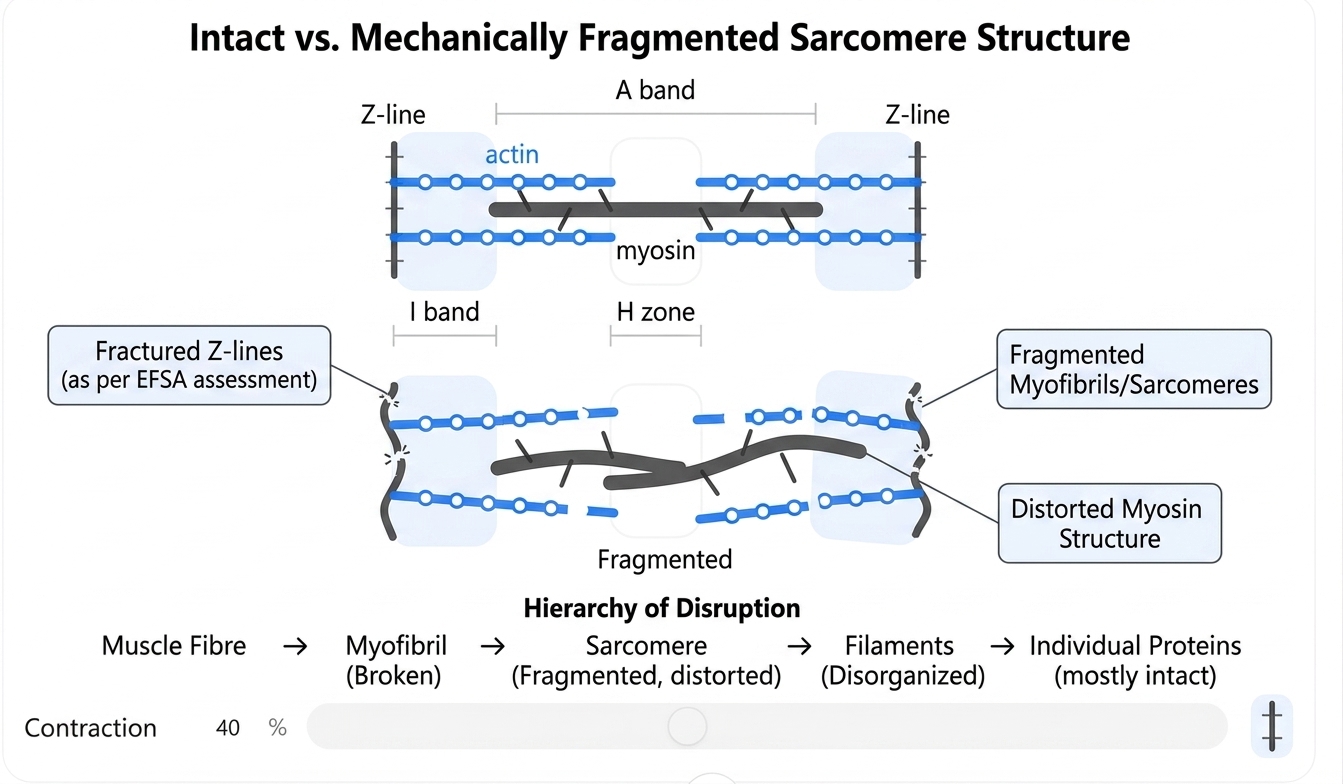
A sarcomere is the basic repeating contractile unit of a myofibril. It extends from one Z disc to the next.
Within the sarcomere are principally:
Thick filaments, made mainly from myosin.
Thin filaments, made mainly from actin.
Z discs, which define the boundaries of the sarcomere and anchor the actin filaments.
The structural hierarchy is therefore:
Muscle fibre → myofibril → sarcomere → myosin and actin filaments → individual proteins
The myofibril is consequently not simply a collection of loose proteins. It is an organised three dimensional structure made up of repeating sarcomeres.
This structure matters to water holding. Offer and Trinick demonstrated that myofibrils can swell in salt solutions similar to those used in meat processing. Changes in electrostatic interactions allow the filament lattice to expand, creating additional space for water. Conversely, contraction of the filament lattice contributes to water loss during heating. [3]
Ertbjerg and Puolanne likewise describe the molecular architecture of the sarcomere and changes in filament spacing as important factors in meat water holding. [4]
What does mechanical separation actually do?
Mechanical separation disrupts this organised structure.
Muscle fibres are torn apart.
Myofibrils are disrupted.
Z discs can break.
Sarcomeres can become distorted.
The organisation of the thick and thin filaments is disturbed. [2]
At this stage, however, structural disruption is not necessarily harmful.
Some disruption is beneficial because it exposes myofibrillar proteins to salt and phosphate.
This gives mechanical processing two possible effects.
Useful disruption
The muscle structure is opened and myosin becomes more accessible to extraction.
Excessive disruption
The mechanical forces also begin to modify the proteins themselves, while pressure and friction generate heat.
This distinction is fundamental.
The objective is not to preserve every sarcomere intact. The objective is to disrupt the muscle sufficiently to make functional myofibrillar protein available without unnecessarily damaging that protein.
What happens to myosin?
There are several different types of modification, and they should not be confused.
Structural fragmentation
The muscle and myofibrils can be physically broken while many individual myosin molecules remain chemically intact.
Molecular fragmentation
The myosin heavy chain and associated proteins can themselves become fragmented or modified.
Miller and colleagues found differences in the electrophoretic protein profiles of mechanically separated chicken compared with breast trim, including differences in bands associated with myosin heavy chain fragments. They interpreted these differences as evidence of greater myosin fragmentation or modification in the mechanically separated materials. [1]
Unfolding
A protein can retain its amino acid sequence while its three dimensional structure changes.
Tornberg reports that, under the experimental conditions reviewed, unfolding of myofibrillar proteins in solution begins at approximately 30 to 32 °C. Protein protein association becomes increasingly important around 36 to 40 °C, followed by gelation around 45 to 50 °C. [5]
These are progressive transitions rather than hard temperature limits.
Aggregation
Once proteins unfold, exposed regions of different molecules can interact. They can form aggregates that are less soluble and less available for subsequent extraction and matrix formation.
Oxidation
Protein oxidation can change protein conformation and promote protein protein interactions and aggregation. This can reduce solubility and functionality without necessarily reducing the crude protein content.
Proteolysis
Proteolysis is enzymatic cleavage rather than mechanical fragmentation. Controlled proteolysis contributes to tenderisation, but excessive degradation of structural proteins can alter the organisation of the myofibril and affect water holding. [6]
The important conclusion is that “protein damage” is not one single phenomenon. Mechanical fragmentation, thermal unfolding, aggregation, oxidation and proteolysis can all alter functionality by different mechanisms.
Why does this affect binding?
Myosin is one of the principal functional proteins in comminuted meat systems.
For it to contribute effectively to binding, it must be sufficiently accessible and extractable in the presence of salt and phosphate. It must then remain sufficiently functional to interact with water and other proteins and to participate in formation of the heat induced protein matrix. [7]
This is why total protein and functional protein are not the same thing.
A Dumas or Kjeldahl analysis tells us how much nitrogen containing material is present. It does not tell us how much of that protein remains functional myofibrillar protein.
The difference can be illustrated simply.
A formulation may contain 15% protein.
If most of that protein is functional myofibrillar protein, it can produce a strong matrix.
If a substantial proportion has become fragmented, aggregated, oxidised or otherwise modified, the same 15% protein may produce a weaker matrix.
The protein is still present.
Its functional capacity has changed.

Water uptake is not the same as water holding
This is particularly important when discussing MDM.
Mechanical disruption can expose myofibrillar proteins and make them more accessible to salt and phosphate. Salt and phosphate can promote protein extraction and hydration. [3,7]
Consequently, MDM can take up considerable amounts of water and appear cohesive in the raw state.
The more important question is what happens during heating.
During cooking, the extracted myofibrillar proteins unfold and interact. They form a three dimensional protein matrix that immobilises water and helps stabilise the fat phase. [7]
Therefore:
Water uptake is largely concerned with hydration and extraction before cooking.
Water holding during heating depends heavily on the ability of the extracted proteins to form and maintain a sufficiently strong matrix.
This explains why damaged MDM can absorb water but subsequently lose water during cooking.
If the MDM contains less functional myosin, or if the protein has already undergone excessive modification or aggregation, less functional protein may be available to construct the final matrix.
As the proteins contract during heating, water can migrate out of the structure.
The result is greater cooking loss and purge.
The important distinction is therefore:
Poor MDM functionality does not necessarily mean poor water uptake. It can mean that the absorbed water is not adequately immobilised within the heat induced protein matrix.
Minced meat, BAADER separated meat and conventional MDM
The difference between these materials is therefore not simply particle size.
Minced pork or chicken
Ordinary minced meat is mechanically disrupted, but it has not normally undergone the same combination of pressure, bone separation, compression and friction associated with conventional hard MDM.
Much of the myofibrillar protein system therefore remains comparatively intact before extraction.
This generally provides a favourable starting point for salt and phosphate extraction.
BAADER separated meat
BAADER separation is designed as a softer method of recovering meat from bone.
BAADER describes BAADERING as a soft separation process using a squeezing belt and perforated drum, intended to minimise mechanical stress and temperature increase. [8]
Independent experimental work using a BAADER 694 provides an actual example. Fresh mechanically separated chicken entered the machine at approximately 6 °C and left at approximately 10 °C under the reported conditions. [9]
This relatively small temperature increase is important because thermal history is closely linked to protein functionality.
The BAADER process does not mean that the material is structurally untouched. It means that the mechanical treatment can be considerably gentler than more severe separation processes.
Conventional high pressure MDM
Conventional MDM can impose substantially greater pressure and shear.
The muscle structure is heavily disrupted and the process can generate more heat.
This increases the potential for protein fragmentation, modification, aggregation and thermal damage.
Miller’s work demonstrates the practical consequence. The mechanically separated materials showed greater myosin fragmentation or modification and weaker thermal gel behaviour than the chicken breast trim. [1]
The correct comparison is therefore not:
Minced meat is good.
BAADER is good.
MDM is bad.
Instead:
The functional quality of the protein depends on the mechanical and thermal history through which the meat has passed.
There is no universal percentage of functional protein for each category.
Temperature during separation
Mechanical and thermal effects must be considered together.
Consider three examples.
If MDM enters the separator at 4 °C and the process adds 6 °C, the product leaves at approximately 10 °C.
If it enters at 25 °C and the process adds the same 6 °C, it leaves at approximately 31 °C.
If it enters at 30 °C and leaves at 36 °C, the protein is entering the region where protein unfolding and association become increasingly relevant.
Tornberg’s thermal transitions provide the context for why the exit temperature matters. [5]
The important measurements are therefore both:
Temperature entering the separator
and
Temperature leaving the separator
The difference shows how much heat the process has added.
The absolute exit temperature shows the thermal environment experienced by the protein.
The BAADER 694 study provides a useful real processing example of 6 °C entering and 10 °C leaving. [9]
Can we put a percentage on myosin fragmentation?
Not reliably.
The Miller study demonstrated greater myosin fragmentation or modification using protein profiling, but it did not establish a universal percentage such as “20% of the myosin was fragmented”. [1]
Therefore, percentages should not be assigned to conventional MDM, BAADER separated meat and minced meat without experimental measurement.
The useful qualitative comparison is:
| Raw material | Structural disruption | Potential protein modification | Expected functional protein |
|---|---|---|---|
| Minced pork or chicken | Lower | Lower | Generally high |
| BAADER separated meat | Moderate | Lower to moderate | Generally high to intermediate |
| Conventional high pressure MDM | Higher | Moderate to high | Potentially intermediate to low |
This is a functional ranking, not a measured percentage.
The actual result depends on raw material condition, separation pressure, temperature, residence time, freezing history, oxidation and subsequent processing.
Other causes of reduced MDM functionality
Mechanical and thermal protein damage are not the only causes of poor binding.
pH
pH strongly influences protein charge, swelling and water holding.
Near the isoelectric region, electrostatic repulsion is reduced and the myofibrillar structure retains less water.
Moving away from this region increases protein charge and can increase swelling and water retention.
This is one reason phosphate is effective in processed meat. [10]
Salt and ionic strength
Salt is fundamental to myofibrillar protein extraction.
Increasing ionic strength promotes solubilisation of myofibrillar proteins, making them available for interaction with water and subsequent gel formation. [11]
However, excessive ionic strength is not automatically beneficial.
Phosphate
Phosphate can increase pH, promote myofibrillar protein solubilisation, assist actomyosin dissociation, chelate divalent ions and improve water holding and emulsion stability. [10]
Thus, an MDM can contain functional protein but still perform poorly if extraction conditions are inadequate.
Calcium
MDM can contain more bone associated material and therefore more calcium than conventional minced meat.
Calcium can influence the ionic environment and protein interactions. Phosphate can help manage this environment through its interaction with divalent ions. [10]
Protein concentration
The relevant quantity is not simply total protein.
The functional protein concentration relative to water and fat is more important.
Two MDMs containing the same total protein can therefore have different binding performance if the proportion of functional myofibrillar protein differs.
Collagen
Collagen contributes differently from myofibrillar proteins.
It can contribute to texture and water retention after appropriate heating, but it does not replace the extraction and heat gelation functionality of myofibrillar protein.
A high crude protein result can therefore conceal a lower proportion of functional myofibrillar protein.
Postmortem history
The condition of the meat before separation matters.
Postmortem pH decline, proteolysis, oxidation and structural changes influence subsequent water holding. [6]
Consequently, two MDM batches produced on the same machine can perform differently because their raw materials had different histories.
Freezing and thawing
Freezing can cause myofibrillar protein denaturation and changes in the unfrozen phase. These changes can reduce water holding and increase thaw loss. Slow freezing generally produces greater thaw loss than rapid freezing. [12]
Fat to protein ratio
Myofibrillar proteins must stabilise both the water phase and the fat phase.
If fat increases without sufficient functional protein, the protein system may become overloaded.
The result can be fat separation, cooking out and reduced water retention.
Water to protein ratio
Additional water can only be retained if sufficient functional protein is available to immobilise it.
Increasing water beyond the functional capacity of the protein system therefore increases the risk of cooking loss.
Mixing and extraction
Salt and phosphate need time and mechanical energy to interact with the meat and extract the functional myofibrillar proteins.
Insufficient mixing can reduce extraction.
Excessive mixing can generate unnecessary heat.
The objective is therefore sufficient mechanical work without unnecessary temperature increase.
Storage
Storage allows oxidative, enzymatic and physical changes to accumulate.
This is particularly important when storage is combined with freezing, thawing or temperature fluctuations.
Why can 1% soy protein isolate make such a difference?
This brings us to an important practical observation.
A relatively small quantity of soy protein isolate can substantially improve a marginal MDM system because it adds additional functional protein to the formulation.
If the isolate contains approximately 90% protein, 1% soy protein isolate contributes approximately 0.9% additional protein.
That may appear insignificant.
However, if the MDM is already close to the limit of its functional protein capacity, that additional protein can contribute significantly to formation of the final heat induced matrix.
The effect will depend on the starting MDM.
If the MDM already contains sufficient functional myofibrillar protein, the effect may be modest.
If the MDM has reduced functional protein, the additional soy can make a much larger difference.
This is why a small addition can sometimes produce a disproportionately large improvement in gel strength, cooking yield and water retention.
It is not because 1% soy suddenly “binds” all the water.
It is because it adds another functional protein capable of participating in the matrix.
Research on soy protein isolate in meat protein systems supports this principle. Li and colleagues found that soy protein isolate improved gel properties and water holding in low salt pork myofibrillar protein systems under high pressure processing. Their study used 2% and 4% inclusion, so it does not establish 1% as a universal optimum. [13]
For MDM, 1% should therefore be regarded as a useful development benchmark, not a scientifically established universal optimum.
A useful experimental series would be:
0%
0.5%
1.0%
1.5%
2.0%
The important measurements should be gel strength after the actual reheating process, cooking loss, water release, purge and fat separation.
Prehydrating the soy protein isolate
For the intended application, prehydrating the soy protein isolate before incorporation into the MDM is a sensible approach.
Dry soy protein must first hydrate before it can contribute fully to the protein and water system.
If dry powder is added directly to MDM, hydration occurs simultaneously with meat protein extraction and water distribution. Prehydration separates these processes and gives better control.
For initial trials:
1 part soy protein isolate
4 to 5 parts cold water
A practical starting point is:
1 kg soy protein isolate + 5 kg water
Use water at approximately 5 to 10 °C.
Mix thoroughly and allow approximately 20 minutes for hydration.
The hydrated soy can then be incorporated into the MDM while keeping the batter temperature as low as practical.
There is no need to heat the soy during prehydration.
The objective is to have the soy fully hydrated before filling while keeping the protein in an unheated state. The desired heat induced protein transformation should occur during cooking or reheating.
The prehydration water must be included in the formulation’s total added water.
For example, if the formulation contains 20 kg total added water, the 1% soy treatment should still contain 20 kg total added water.
If 5 kg is used for soy prehydration, only 15 kg should be added elsewhere.
Otherwise, part of the apparent improvement could simply result from changing the water level.
What this means for Hautstoß
The objective of Hautstoß is not simply to make MDM absorb more water.
The more important objective is to improve the functional protein system that remains available for matrix formation.
Hautstoß cannot reconstruct a myosin molecule that has already been irreversibly fragmented.
It cannot simply reverse severe oxidation, aggregation or thermal modification.
Its potential value lies in contributing additional functional structure to a system in which the native MDM protein is insufficient to produce the desired final matrix.
This makes soy protein isolate a useful positive control.
The most informative comparison would be:
MDM without additional functional protein
MDM + 1% soy protein isolate
MDM + Hautstoß
The water, salt, phosphate, fat and total formulation conditions should be kept constant.
The products should then be compared after the actual filling and reheating process.
The key measurement should be gel strength after reheating, supported by cooking loss, purge, water release and fat separation.
If 1% soy produces a substantial improvement, it demonstrates that the original MDM system was operating below its optimum functional protein capacity.
The question for Hautstoß then becomes:
Can Hautstoß provide an equivalent or greater improvement in reheated gel strength and water immobilisation without relying on soy protein isolate and starch?
That is a much stronger test of Hautstoß functionality than simply measuring water absorption.
The complete MDM functionality model
MDM functionality can ultimately be understood through three broad questions.
Has the protein been damaged?
Possible mechanisms include:
Thermal modification.
Mechanical fragmentation.
Oxidation.
Aggregation.
Freezing induced denaturation.
Proteolysis.
Is the protein functional but insufficiently extracted?
Possible causes include:
Insufficient salt.
Insufficient phosphate.
Unfavourable pH.
Poor mixing.
Insufficient extraction time.
Unfavourable ionic strength.
Is the functional protein being overloaded?
Possible causes include:
Excessive added water.
Excessive fat.
Low functional protein concentration.
An unfavourable water to protein ratio.
An unfavourable fat to protein ratio.
This distinction matters because each problem requires a different solution.
If the protein is damaged, the objective is to preserve the functionality that remains and potentially supplement the system with additional functional protein.
If extraction is inadequate, the solution may be salt, phosphate, pH, mixing and temperature control.
If the functional protein is overloaded, the formulation itself needs adjustment.
Practical measurements
For MDM development, crude protein and moisture are therefore not enough.
The most useful measurements are:
Temperature entering the separator
Temperature leaving the separator
Temperature increase across the separator
pH
Moisture
Protein
Fat
Ash
Calcium
Salt soluble protein
Myosin heavy chain profile by SDS PAGE
Protein oxidation
Cooking loss
Fat separation
Final gel strength
The most powerful approach would be to correlate molecular measurements with final technological performance.
For example:
Myosin heavy chain integrity
with
Salt soluble protein
with
Thermal rheology
with
Cooking loss
with
Reheated gel strength
This would allow the distinction between protein damage, inadequate extraction and formulation overload.
Conclusion
MDM functionality is not determined simply by the amount of protein present.
Mechanical separation initially disrupts the muscle structure and can make myofibrillar proteins more accessible to salt and phosphate. That disruption can therefore be beneficial.
The problem arises when mechanical treatment becomes sufficiently severe to cause substantial protein fragmentation, modification, aggregation or thermal damage.
The result can be an MDM that absorbs water effectively in the raw state but cannot immobilise that water effectively when the final protein matrix forms during heating.
The comparison with minced meat and BAADER separated meat reinforces the importance of processing history. Minced meat generally begins with more intact myofibrillar protein. BAADER separation is designed as a gentler recovery process and published work using a BAADER 694 provides an example of material entering at 6 °C and leaving at 10 °C. Conventional high pressure MDM can impose greater mechanical and thermal stress. [1,9]
The objective is therefore not to prevent structural disruption.
It is to disrupt the muscle sufficiently to make functional protein available while avoiding unnecessary damage to that protein.
This same principle explains why 1% soy protein isolate can have a surprisingly large effect in a marginal MDM system. It adds functional protein to the matrix forming system.
For Hautstoß, the ultimate test is not whether it absorbs water.
The more important question is whether it can contribute to a strong continuous heat induced protein matrix that immobilises water and produces strong gel formation after reheating.
That is the functional target.
Updated references
[1] Miller, D. K., Acevedo, N. C., Lonergan, S. M., Sebranek, J. G. & Tarté, R. (2020). “Rheological characteristics of mechanically separated chicken and chicken breast trim myofibril solutions during thermal gelation.” Food Chemistry, 307, 125557. DOI 10.1016/j.foodchem.2019.125557. [1]
[2] EFSA Panel on Biological Hazards. (2013). “Scientific Opinion on the public health risks related to mechanically separated meat derived from poultry and swine.” EFSA Journal, 11(3), 3137. DOI 10.2903/j.efsa.2013.3137. [2]
[3] Offer, G. & Trinick, J. (1983). “On the mechanism of water holding in meat: The swelling and shrinking of myofibrils.” Meat Science, 8(4), 245–281. DOI 10.1016/0309-1740(83)90013-X. [3]
[4] Ertbjerg, P. & Puolanne, E. (2017). “Muscle structure, sarcomere length and influences on meat quality.” Meat Science, 132, 139–152. [4]
[5] Tornberg, E. (2005). “Effects of heat on meat proteins: Implications on structure and quality of meat products.” Meat Science, 70(3), 493–508. DOI 10.1016/j.meatsci.2004.11.021. [5]
[6] Huff Lonergan, E. & Lonergan, S. M. (2005). “Mechanisms of water holding capacity of meat: The role of postmortem biochemical and structural changes.” Meat Science, 71(1), 194–204. DOI 10.1016/j.meatsci.2005.04.022. [6]
[7] Acton, J. C., Ziegler, G. R. & Burge, D. L. (1983). “Functionality of muscle constituents in the processing of comminuted meat products.” Critical Reviews in Food Science and Nutrition, 18(2), 99–121. DOI 10.1080/10408398209527360. [7]
[8] BAADER. “BAADERING.” Official technical information on soft separation technology. [8]
[9] Cortez Vega, W. R., Fonseca, G. G. & Prentice, C. (2015). “Optimization of parameters for obtaining surimi like material from mechanically separated chicken meat using response surface methodology.” Journal of Food Science and Technology, 52(2), 763–772. DOI 10.1007/s13197-013-1056-1. [9]
[10] Kim, T. K., Lee, M. H., Shin, D. M., Kim, Y. J., Jung, S. & Choi, Y. S. (2026). “Strategies for replacing phosphates in meat processing.” Food Science of Animal Resources, 46. DOI 10.1007/s44463-026-00069-6. [10]
[11] Chen, X., Tume, R. K., Xu, X. & Zhou, G. (2017). “Solubilization of myofibrillar proteins in water or low ionic strength media: Classical techniques, basic principles, and novel functionalities.” Critical Reviews in Food Science and Nutrition, 57(15), 3260–3280. DOI 10.1080/10408398.2015.1110111. [11]
[12] Zhang, Y., Kim, Y. H. B., Puolanne, E. & Ertbjerg, P. (2022). “Role of freezing-induced myofibrillar protein denaturation in the generation of thaw loss: A review.” Meat Science, 190, 108841. DOI 10.1016/j.meatsci.2022.108841. [12]
[13] Li, Y. P., Kang, Z. L., Sukmanov, V. & Ma, H. J. (2021). “Effects of soy protein isolate on gel properties and water holding capacity of low salt pork myofibrillar protein under high pressure processing.” Meat Science, 176, 108471. DOI 10.1016/j.meatsci.2021.108471. [13]