By Eben van Tonder, 7 September 2026
A review of the mechanisms behind functional loss in mechanically separated meat, and what they mean for formulation practice.

Introduction
Mechanically separated meat, commonly abbreviated MDM or MSM, is recovered from bones after conventional boning by pressing or shearing the remaining flesh through a perforated barrier. Under Regulation (EC) No 853/2004, the product is defined by the loss or modification of muscle fibre structure that this process causes [14]. That definition already points to the central question of this article. Structural loss is not automatically a defect. It can also be the mechanism that makes the meat protein useful in the first place, because it exposes myofibrillar protein to salt and phosphate during subsequent processing.
The practical problem is that mechanical separation can go further than exposing protein. It can fragment, unfold, aggregate or oxidise the myosin and actin system that the finished product depends on for binding and water holding. Total protein content, measured by Kjeldahl or Dumas analysis, does not distinguish between protein that remains functional and protein that has already lost its capacity to form a heat induced gel. This article sets out the structural and chemical background to that distinction and what it means for MDM formulation.
Three levels of evidence are used throughout this article, and it is worth naming them once here rather than qualifying every sentence individually. A claim is demonstrated where it has been directly measured in MDM or the specific material under discussion. A claim is supported where it is established in the broader meat protein literature and mechanistically applicable to MDM, even though it was not measured in MDM itself. A claim is a hypothesis where it is mechanistically plausible given the principles set out in this article but has not been directly tested for the particular process or technology in question. Where a claim sits between these categories, the text says so.
The sequence from raw muscle to a finished, water holding gel can be summarised as a chain: intact muscle, mechanical disruption, exposure of myofibrillar protein, salt and phosphate extraction, protein solubilisation, myosin unfolding during heating, protein to protein interaction, formation of a three dimensional gel network, water immobilisation and, finally, cooking yield. Each step depends on the one before it, and a failure at any point in the chain can produce the same end symptom, poor yield, even though the underlying cause differs. The rest of this article works through where in that chain mechanical separation, equipment choice and formulation can each break the sequence.
MDM is not a single processing system
The term MDM covers a category of recovered material rather than one uniform protein history, and the evidence in this article should be read with that in mind. At minimum, the following distinctions matter. Low pressure mechanical separation, of the kind BAADER equipment is designed to represent, differs from conventional high pressure separation in the force and shear applied to the raw material. Different separator designs, whether based on an auger, a belt and drum, or a piston and cylinder, expose the meat to different combinations of pressure, temperature and residence time even at nominally similar settings. Poultry MDM and pork MDM differ in bone structure, fibre type and postmortem handling, so functional findings from one species should not be assumed to transfer directly to the other, and this article’s poultry focused evidence base is itself part of that limitation. Fine MDM and coarser mechanically separated material differ in particle size and therefore in surface area, extraction kinetics and heat transfer during any subsequent processing. Washed myofibril preparations, produced by rinsing mechanically recovered meat to concentrate myofibrillar protein and remove fat and pigment, are a further distinct sub-category with their own processing history, and Stangierski and colleagues’ work on such a preparation from mechanically recovered chicken illustrates how further modification, in their case enzymatic, changes protein solubility and the electrophoretic pattern of the myosin band [30]. Storage after separation is a further variable in its own right, since Xiong and Brekke found that the protein solubility and gelation properties of chicken myofibrils change measurably over storage time even without any further mechanical treatment [29], and functional consequences of mechanical separation have been documented across species since at least the 1970s, when Webb and colleagues characterised the proximate composition and functional properties of mechanically separated fish muscle tissue [31]. Miller and colleagues, discussed throughout this article, worked with two mechanically separated chicken materials produced on two different separators from bone of two different ages, compared against chicken breast trim [1]. That comparison is strong evidence for the materials and conditions actually tested. It is supported, rather than demonstrated, evidence for conventional high pressure MDM production in general, and it is a hypothesis, not evidence, for any separator, species or pressure regime not included in the study. This distinction is applied consistently through the rest of the article.
Muscle structure and its relation to water holding
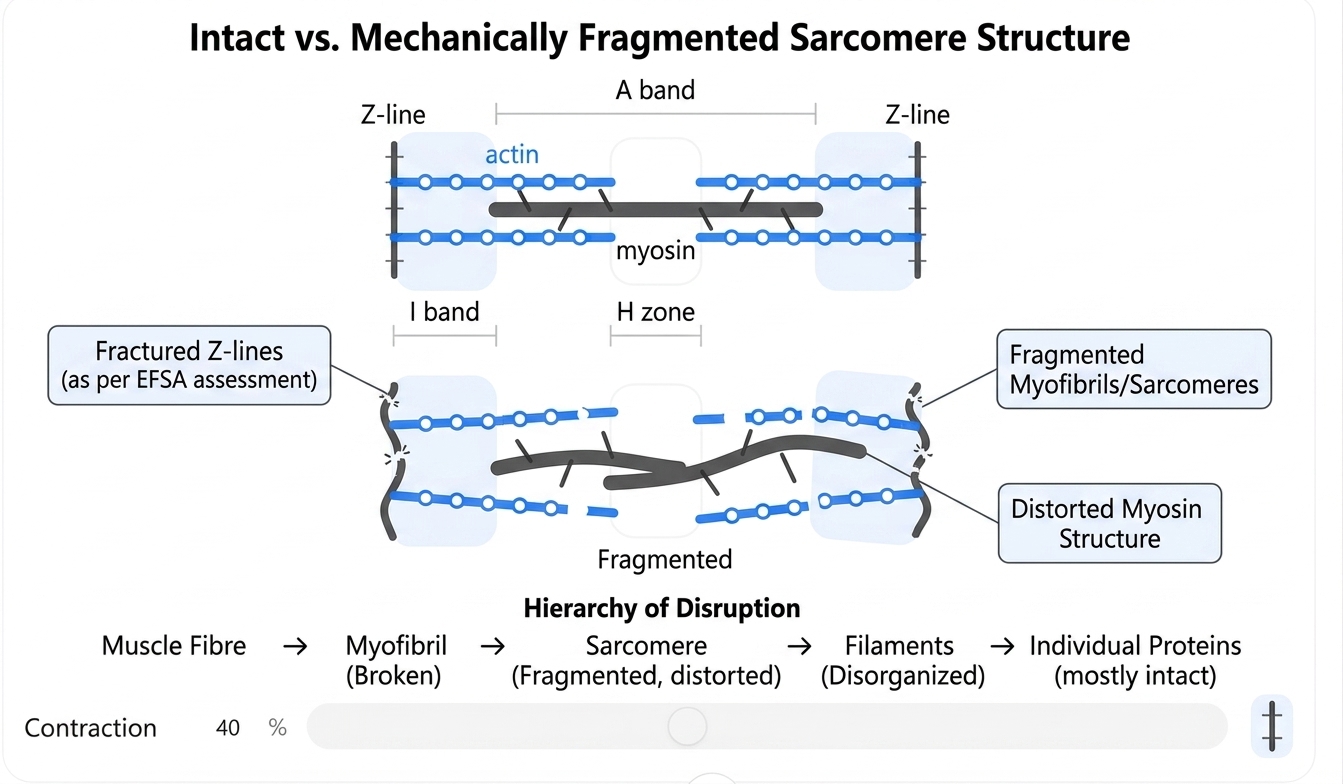
Muscle fibres are built from repeating myofibrils, and each myofibril is organised into sarcomeres. A sarcomere runs from one Z disc to the next and contains thick filaments built mainly from myosin and thin filaments built mainly from actin, with the Z discs anchoring the thin filaments in place. The muscle fibre is therefore not a loose collection of protein. It is a layered structure that runs from fibre to myofibril to sarcomere to filament to individual protein.
This structure governs water holding directly. Offer and Trinick showed that myofibrils swell in salt solutions of the kind used in meat processing, because changes in electrostatic interaction allow the filament lattice to expand and create space for water [3]. Ertbjerg and Puolanne describe the same sarcomere architecture and the resulting changes in filament spacing as central to meat water holding more broadly [4]. When the filament lattice instead contracts, as it does during heating, water is driven out of the structure. Mechanical separation acts directly on this architecture, and the degree to which it disrupts or damages that architecture determines what the resulting meat can and cannot do.
How mechanical action exposes myofibrillar protein
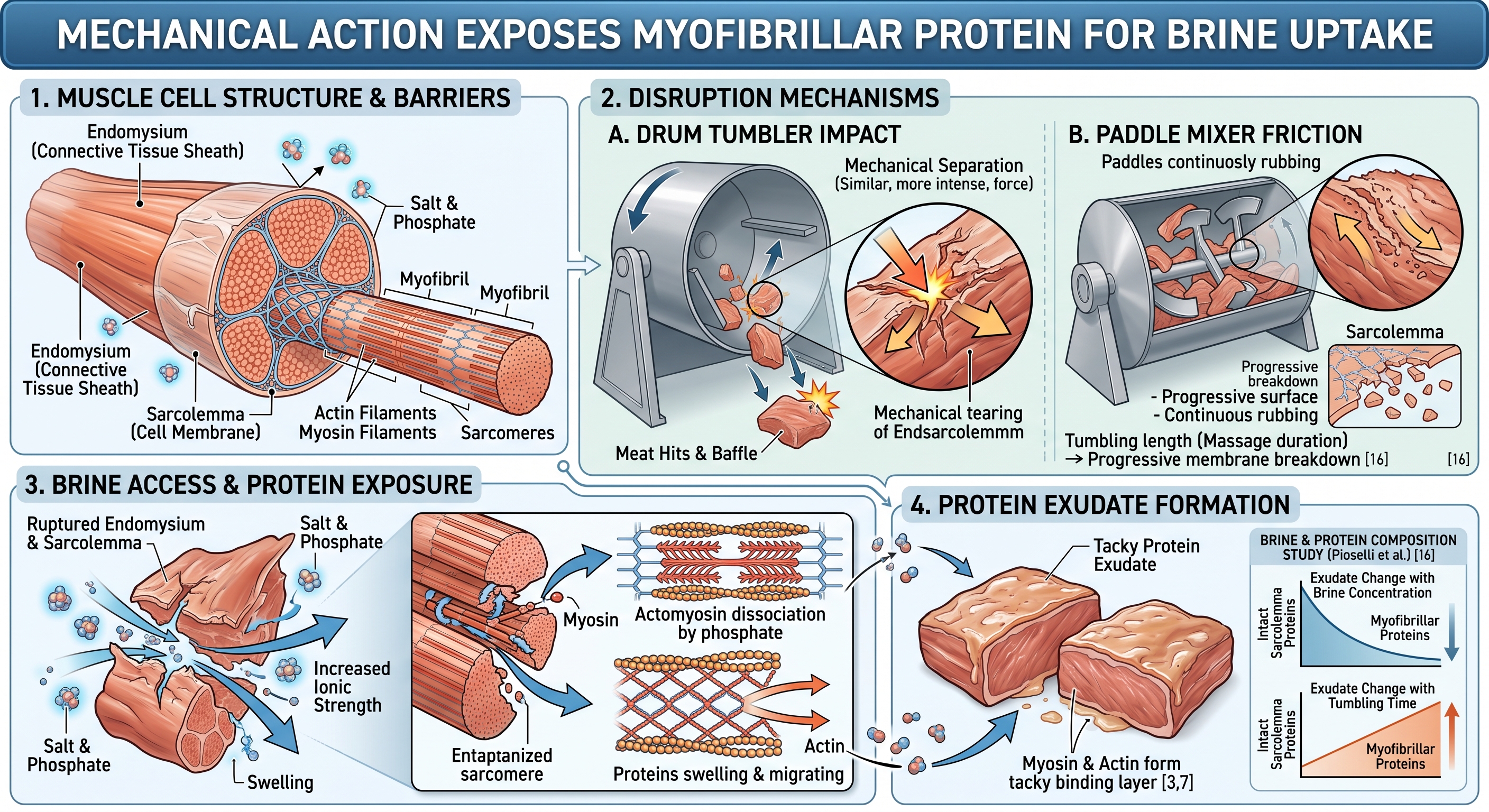
Salt and phosphate cannot readily reach the actin and myosin filaments while the muscle cell remains intact, because two layers stand in the way. Each fibre is wrapped in a sheath of connective tissue, the endomysium, and beneath that sheath lies the cell membrane itself, the sarcolemma, which Feiner describes as a net like structure directly connected to the filaments it encloses [15]. Disruption of these barriers substantially increases access of salt and phosphate to the myofibrillar system, and this disruption happens through physical rupture, diffusion and progressive surface damage rather than through any chemical action of the salt itself.
A rotating drum tumbler produces this rupture through repeated impact. Baffles fixed to the inside of the drum carry injected pieces of meat up the wall as it turns, and as each piece falls back under gravity it strikes other pieces and the baffles, and that impact tears at the endomysium and sarcolemma at the cut surface of the meat. A paddle mixer works on the same underlying principle but through continuous rubbing and folding rather than a fall, producing frictional rather than impact energy, and Feiner notes that the choice between the two is generally guided by the firmness of the muscle being treated [15]. Pioselli and colleagues confirmed the underlying mechanism directly through a proteomic study of pork ham exudate, in which the myofibrillar protein composition of the exudate changed measurably with brine concentration and with the length of the massage, consistent with progressive breakdown of the muscle cell membrane as tumbling proceeds [16].
Once membrane access has increased, rising ionic strength from the added salt alters the electrostatic interactions between the myofibrillar proteins and promotes their swelling, and phosphate assists in dissociating the actomyosin complex that forms after rigor, so that myosin and actin migrate to the cut surface of the meat and form the tacky protein exudate that binds pieces together on cooking [3,7]. Mechanical separation exposes protein through the same physical principle, because forcing bone and adhering flesh through a perforated barrier under pressure disrupts the same endomysium and sarcolemma. The difference is one of degree rather than of kind. Separation must strip flesh from bone rather than work the surface of an already boned piece, so the force applied is considerably greater and far less selective than tumbling or massaging, which is why the same disruption that exposes protein in separation can also fragment it, as the next section sets out.
Fine emulsions compared with whole muscle tumbled products
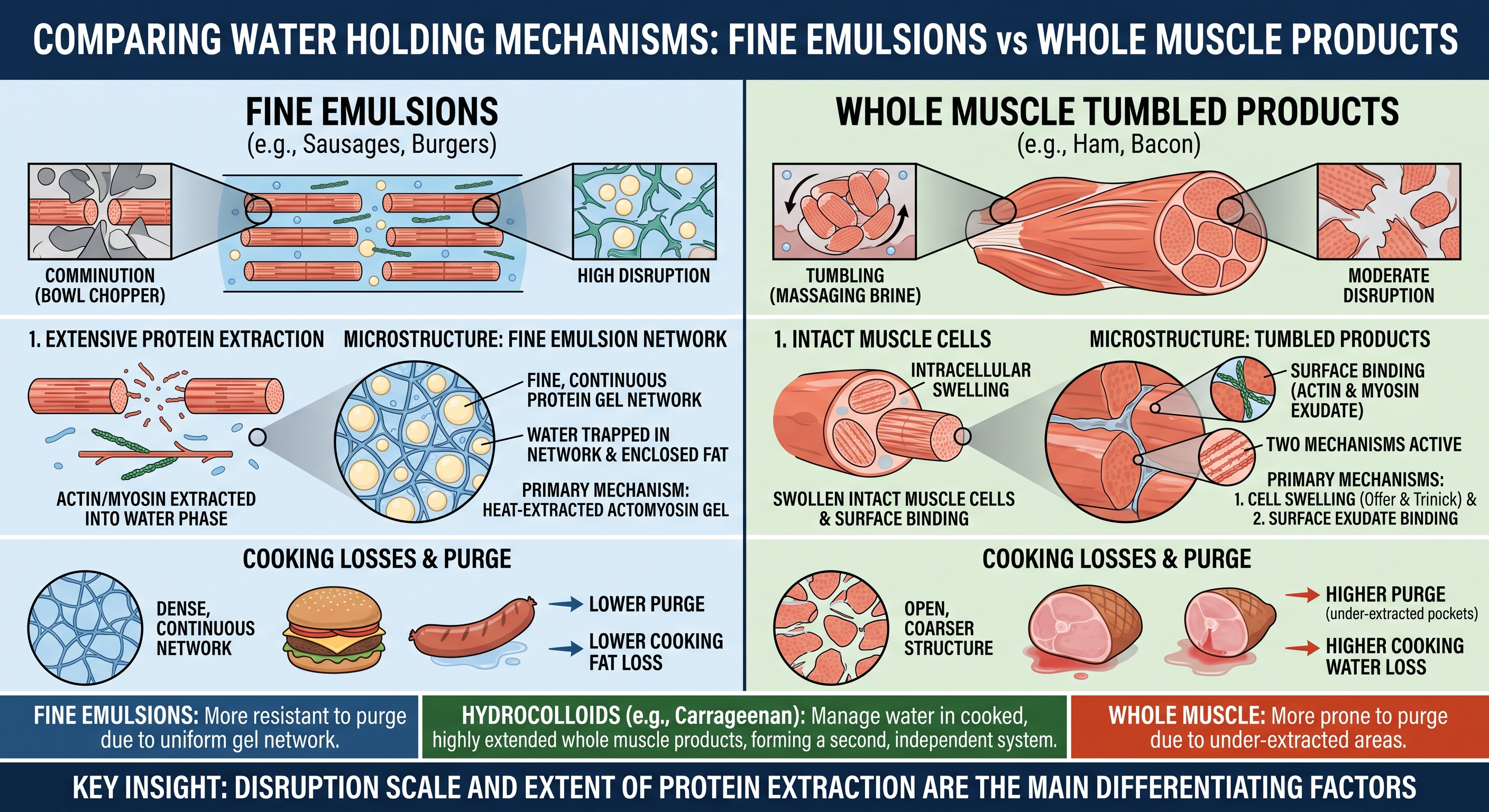
The tumbling mechanism described above is only one half of the picture, because bowl cutting works on a different scale entirely. A bowl chopper reduces meat to a fine paste in which the muscle fibre, myofibril and sarcomere are broken down well beyond anything tumbling produces, and Tornberg’s own microstructure comparisons show a cutlet, a beef burger and an emulsion sausage as three progressively finer stages of the same disruption [5]. In material broken down this finely, the swelling and shrinkage of an organised filament lattice that Offer and Trinick describe is not available as a mechanism across most of the batter, because an intact lattice of that kind is no longer present [3]. Water holding in a fine emulsion instead depends on the continuous protein network formed by extracted myosin and actin during heating, together with the fat that network encloses, and Tornberg notes that the amount of myofibrillar protein extracted into the water phase during comminution and blending is generally considered the most important factor governing the quality of that network [5].
Whole muscle products made by tumbling brine into pieces of meat, such as ham or bacon, sit at the opposite end of this scale. Most of the tissue volume in these products retains largely intact muscle cells, with disruption concentrated at the cut surfaces where pieces meet, as set out earlier in this article. Both mechanisms are therefore active in a tumbled whole muscle product at once. Surface exudate, built from extracted myosin and actin, bonds the pieces together in much the way a fine emulsion’s protein network holds itself together, while the swollen, salt treated interior of the largely intact muscle cells contributes water holding through the mechanism Offer and Trinick describe, a mechanism that is essentially unavailable to a fine emulsion because so little of its original cell structure survives comminution [3].
Whether one system holds water better than the other during cooking is not settled by a single figure here, but a related, confirmed comparison is informative. Tornberg’s own work found that beef burgers lose a substantially larger share of their fat during cooking than emulsion sausages do, a pattern linked to the continuity of the protein matrix in an emulsion compared with a coarser product’s more open structure [25]. Whether the water comparison runs the same way is a reasonable inference from that continuity argument rather than a confirmed figure, since a uniformly extracted network has little unextracted interior left to lose water from, while a whole muscle piece still contains largely intact cells whose filament lattice is known to contract on heating [3,5]. In the raw, unheated state neither system has an inherent advantage on the evidence reviewed here. A whole muscle product binds water through cell swelling before cooking begins, a fine emulsion through direct extraction during chopping, and both depend on adequate salt and phosphate conditions rather than on which mechanism is used.
Purge after chilled storage is the more clearly documented difference, again for reasons of extraction rather than cooking. Extraction in a whole muscle piece concentrates at cut surfaces and needle tracks, leaving pockets under extracted even after adequate tumbling, where purge later collects; a properly formed fine emulsion has no equivalent under extracted interior, which is consistent with fine emulsions generally being reported as the less purge prone of the two categories. Hydrocolloids such as kappa carrageenan are widely used to manage this in cooked, injected hams, but only where the ham is cooked, since carrageenan hydrates during cooking and gels on cooling rather than being made redundant by that step [26]. Verbeken and colleagues, whose peer reviewed model system work is the stronger evidence here, found that the resulting carrageenan gel forms a second, largely independent water holding system rather than joining the meat protein network [27]. What carrageenan compensates for is a formulation that adds more water than native protein, given the tumbling time available, can bind, not a functional shortfall in the protein itself. Whole muscle hams injected with 20 to 40 percent brine can in fact remain fully protein bound with no hydrocolloid at all, given six hours or more of tumbling, which is consistent with the low, early plateau of intracellular swelling against the much higher capacity of the extraction based gel route described above [3,26]. Hydrocolloids became closely associated with high extension ham mainly from the 1980s, but starch, phosphate and non meat proteins supported substantial extension before that, so a hydrocolloid is best understood as a substitute for tumbling time or for capacity beyond both native mechanisms’ plateau, not as the only route to a well bound extended product.
What mechanical separation does to the muscle
The EFSA scientific opinion on mechanically separated poultry and swine meat describes heavy fragmentation of myofibrils, breaks in the Z line and distortion of sarcomeres, and identifies separation pressure as an important variable governing the degree of muscle fibre degradation [2]. Miller and colleagues provide direct experimental evidence of the functional consequence. They compared chicken breast trim with two mechanically separated chicken materials, one produced on a Beehive separator from bones three to five days old and one produced on a Poss separator from fresh bone. Both mechanically separated materials showed greater myosin fragmentation than the breast trim and produced weaker thermal gels when heated [1].
This is important because it shows that mechanical separation can alter the myofibrillar protein system itself, and not simply reduce the meat to smaller pieces. The muscle fibres are torn, the myofibrils are disrupted, the Z discs can break and the filament arrangement is disturbed. None of this is inherently harmful, because some disruption is required to expose myosin to salt and phosphate during later processing. The difficulty is that the same mechanical forces that open the structure can also begin to modify the protein directly, and the friction and pressure involved generate heat that adds a further variable.
The objective in separation is therefore not to keep every sarcomere intact. It is to disrupt the muscle enough to make functional myofibrillar protein available, without damaging that protein beyond what extraction requires.
Distinguishing types of protein change
Several distinct mechanisms are often grouped together under the general term protein damage, and they do not all behave the same way. Structural disruption refers to the muscle and myofibrils being physically broken while many individual myosin molecules remain chemically intact. Molecular modification refers to the myosin heavy chain and associated proteins themselves becoming altered at the level of the protein itself, which can range from partial unfolding through to cleavage. Miller and colleagues found differences in the electrophoretic protein profile of mechanically separated chicken compared with breast trim, including bands consistent with myosin heavy chain fragments, and reported this as evidence of greater myosin fragmentation or modification in the separated material relative to breast trim [1]. This finding should be read at the scale the study actually measured, a comparative difference between two raw materials, rather than as a demonstration that mechanically separated meat in general undergoes extensive cleavage of intact myosin.
Unfolding is a separate phenomenon, in which a protein keeps its amino acid sequence but changes its three dimensional shape. Tornberg reports that myofibrillar proteins in solution begin to unfold at approximately 30 to 32 degrees Celsius under the conditions reviewed, that protein to protein association becomes increasingly important between 36 and 40 degrees, and that gelation follows at approximately 45 to 50 degrees [5]. These transitions are progressive rather than sharp thresholds. Once proteins unfold, exposed regions of different molecules can associate and aggregate, and aggregated protein is less soluble and less available for subsequent extraction and matrix formation.
Oxidation can change protein conformation and promote the same kind of aggregation, and it can reduce functionality without reducing the crude protein figure at all. Proteolysis is different again, because it is enzymatic cleavage rather than mechanical or thermal damage. Controlled proteolysis contributes to tenderisation, but excessive degradation of structural protein can alter myofibrillar organisation and affect water holding, as Huff Lonergan and Lonergan describe in their review of postmortem mechanisms [6]. Because these mechanisms differ, a single laboratory measurement rarely captures all of them, and a formulation problem attributed to protein damage in general terms may in fact stem from only one of these routes.
Why the distinction affects binding
Myosin is one of the principal functional proteins in a comminuted meat system. Acton and colleagues set out this requirement in two parts. Myosin must first be sufficiently accessible and extractable in the presence of salt and phosphate, and it must then remain functional enough to interact with water and with other proteins as the heat induced protein matrix forms during cooking [7]. Total protein content does not measure either of these requirements. A formulation containing fifteen percent protein can produce a strong matrix if most of that protein is functional myofibrillar protein, or a weaker matrix if a substantial share has already been fragmented, aggregated or oxidised, because the nitrogen is still present but its functional capacity has changed.
Water uptake is not water holding
This distinction is particularly relevant to MDM. Mechanical disruption exposes myofibrillar protein and makes it more accessible to salt and phosphate, which promote extraction and hydration [3,7]. As a result, MDM can absorb considerable water and appear cohesive while raw. The more informative question is what happens once the product is heated, because during cooking the extracted proteins unfold further and interact to form a three dimensional matrix that immobilises water and helps stabilise the fat phase [7].
Water uptake before cooking is therefore concerned mainly with hydration and extraction, while water holding during heating depends on whether the extracted protein can build and maintain a matrix strong enough to keep that water in place. Damaged MDM can absorb water in the raw state and still lose it on cooking, because as the remaining functional protein contracts during heating, water migrates out of a matrix that was never strong enough to hold it. The practical result is cooking loss and purge, and the underlying cause is not necessarily a shortage of water uptake but an insufficient supply of functional protein to immobilise the water once absorbed.
Minced meat, BAADER separated meat and conventional MDM compared
The difference between these three raw materials is not simply one of particle size. Ordinary minced pork or chicken is mechanically disrupted, but it has not usually passed through the combination of pressure, bone separation, compression and friction that conventional high pressure MDM experiences, so much of its myofibrillar structure remains comparatively intact going into the salt and phosphate extraction step.
BAADER separation was designed specifically as a gentler alternative. The manufacturer describes the BAADERING process as a soft separation method using a squeezing belt and perforated drum intended to minimise mechanical stress and temperature rise [8]. Independent experimental work provides a concrete figure for what this means in practice. Cortez Vega and colleagues report that mechanically separated chicken meat produced on a Baader model 694 separator entered the machine at approximately 6 degrees Celsius and left at approximately 10 degrees, twenty four hours after slaughter [9]. A rise of this size is modest, and because thermal history is closely linked to the unfolding behaviour described by Tornberg, a smaller temperature rise leaves more of the protein system in its native state entering the next processing step [5].
Conventional high pressure MDM production is, in general engineering terms, capable of imposing substantially greater pressure and shear than BAADER separation, and a process of that kind can be expected to generate correspondingly more heat, so the potential for fragmentation, aggregation and thermal modification is greater. That general expectation is supported by broader meat protein research rather than demonstrated for every high pressure separator. The demonstrated finding, specific to the materials Miller and colleagues studied, is that their two mechanically separated chicken materials, produced on two different separators, both showed greater myosin fragmentation or modification and weaker thermal gel behaviour than intact breast trim [1]. Extending that finding to conventional high pressure MDM production generally is a supported inference, not a directly measured result, since separator design, pressure and raw material condition vary across the industry.
The comparison therefore is not that minced meat is inherently good, that BAADER separated meat is inherently good and that MDM is inherently poor. It is that the functional quality of the protein depends on the mechanical and thermal history the meat has passed through, and no fixed percentage of functional protein applies uniformly to any of these three categories without direct measurement.
| Raw material | Structural disruption | Potential protein modification | Expected functional protein status | Evidence basis |
| Minced pork or chicken | Lower | Lower | Generally high | Inference |
| BAADER separated meat | Moderate | Lower to moderate | High to intermediate | Inference |
| Conventional high pressure MDM | Higher | Moderate to high | Intermediate to low | Supported |
This is a qualitative ranking rather than a measured percentage. Only the bottom row is directly supported by a study that measured functional consequences, Miller and colleagues’ comparison of mechanically separated chicken with breast trim, and even that study did not establish a universal figure for any category [1]. The minced meat and BAADER rows are inference from the mechanical principles set out earlier in this article rather than direct measurement of those specific materials, and the evidence basis column is included so the table cannot be mistaken for a specification. The actual result in a given batch depends on raw material condition, separation pressure, temperature, residence time, freezing history, oxidation and subsequent processing.
Other equipment related sources of damage
The same distinction between useful disruption and excessive damage applies to ordinary comminution equipment, not only to purpose built separators, though it is not the focus of this article. A mincer with a sharp knife running flush against its plate produces a clean shearing cut, but once the knife or plate wears, the meat is pressed and torn rather than cut, a fault the trade calls smearing. Smearing raises the temperature of the mince through friction rather than through any deliberate step, and this uncontrolled rise is governed by the same thermal transitions described by Tornberg [5]. Worn knives in a bowl cutter cause a related problem at higher speed, since a batter that tears rather than cuts on each pass accumulates heat quickly and can cross the temperature range where unfolding begins well before chopping is complete, and the resulting loss of gel strength is then easily mistaken for a fault in the raw material rather than in the equipment.
High pressure disruption technology, connective tissue and the limits of comparison with muscle protein
A separate category of equipment works by pressure and shear rather than by a blade. One such technology accelerates food particles through a narrow aperture at pressures reported between 700 and 1100 bar in a first stage and between 10 000 and 60 000 bar in a stepdown stage, reducing particle size to below 50 micrometres without a blade [17]. On rind, skin and other keratin and collagen rich connective tissue, this level of pressure and shear has performed well in practical trials, producing a stable, injectable gel from material that is otherwise difficult to use [17].
The stepdown from primary to final pressure happens over a very short distance. In one documented example, researchers passed a phosphate buffered saline suspension of two virus surrogates through a high pressure homogeniser working between 100 and 300 MPa as part of a study on viral inactivation, and recorded product temperatures rising from about 24 degrees Celsius to between 46 and 75 degrees Celsius in under two seconds, purely as a result of the pressure drop, shear and turbulence at the point of decompression [22]. That study was conducted on a saline suspension, not on meat, collagen or any food protein system, and it did not measure protein denaturation. The available evidence therefore establishes that rapid pressure release can generate substantial temperature increases in a fluid system. It does not establish the temperature history of meat or connective tissue processed by the technology discussed here, whose primary and stepdown pressures, at 700 to 1100 bar and 10 000 to 60 000 bar respectively, are considerably higher than the 1000 to 3000 bar range in the virus study and were not measured for temperature in the sources reviewed for this article [17]. The effect on myofibrillar protein therefore remains an experimental question rather than an extrapolation this article is in a position to make.
The published material on the technology described above does not report how, or whether, temperature is managed at these pressures, so no measured exit temperature can be given for it, and what follows is offered only as general engineering reasoning about how such heat could plausibly be limited, not as a description of what this particular technology does. Residence time at peak pressure and shear can be extremely short in processes of this kind, on the order of milliseconds, and because thermally driven unfolding is a progressive, time dependent process rather than an instantaneous one, as Tornberg’s data show [5], a sufficiently brief exposure may limit unfolding even where the instantaneous local temperature is high. Heat generated at the point of shear can also be localised rather than distributed through the bulk material, so a small, intensely sheared volume may heat sharply for a moment while the surrounding mass, which absorbs that heat almost immediately, shows a much lower average temperature. Pre chilling the material before it enters the system, and cooling it immediately after the pressure drop through a jacketed section or heat exchanger, are further measures documented elsewhere in high pressure food processing that could in principle limit protein exposure to damaging temperatures. None of this establishes that the technology in question applies any of these measures, and whether myofibrillar protein consequently escapes functional damage when the equipment is used directly on muscle remains untested in the sources available.
Whether that temperature rise, combined with the shear itself, causes a problem depends on the functional objective for the material passing through the system, and that objective differs fundamentally between collagen rich material and myofibrillar protein. Collagen’s principal transformation in meat processing is thermal conversion into gelatin, a change that benefits from a broken down fibre structure and increased surface area rather than from an intact filament lattice, though the actual outcome still depends on collagen source, crosslink density, temperature, hydration and the subsequent thermal treatment applied, so this is not a claim that arbitrary pressure and shear improves collagen regardless of those variables. Keratin is more heavily crosslinked through disulfide bonds, and in the case reviewed for this article its particle size reduction was valued specifically for improving digestibility, not for producing a binding gel, so there is no equivalent structure that needs to be preserved [17]. Plant tissue is bounded by a rigid wall of cellulose, hemicellulose and pectin rather than by a membrane, and rupturing that wall to release cell contents is the established mechanism by which high pressure treatment increases the extractability of plant compounds, a widely reported outcome in the high pressure homogenisation literature [22]. Myofibrillar protein has a functional molecular structure that must remain sufficiently intact to participate in extraction and gel formation, which is a different objective from any of the three cases above, not simply a case where disruption is more severe.
Muscle protein is different because the disruption itself is not the end point. As set out earlier in this article, disrupting the sarcolemma and endomysium is necessary and, up to a point, beneficial, because it is what increases access of salt and phosphate to the filament lattice. Functionality is not, however, a binary question of whether the myosin molecule is simply intact or not. It depends on a sequence of distinct properties, including whether myosin can be extracted from the filament lattice at all, whether the extracted protein remains soluble, whether the myosin head retains its enzymatic and binding function, whether the alpha helical rod retains the structure needed for coiled coil association, whether actomyosin dissociates properly under salt and phosphate, and whether the resulting protein aggregates in a controlled, gel forming way during heating rather than in an uncontrolled way that excludes water. This is the same distinction drawn earlier between structural disruption, which breaks up the muscle while leaving individual protein molecules intact, and molecular modification, which alters the myosin heavy chain and can affect any of these properties independently rather than as a single all or nothing outcome. High pressure MDM production is associated with greater myosin fragmentation or modification and weaker thermal gel behaviour, as Miller and colleagues demonstrated by comparing mechanically separated chicken with breast trim [1]. The technology described above operates at pressures and shear rates that could plausibly affect muscle protein in a comparable way, but this remains a hypothesis rather than a demonstrated finding, since the cited evidence establishes what conventional high pressure MDM production does to myosin in the materials tested, not what this particular technology does when applied directly to muscle. That specific effect has not been tested and would need direct experimental validation, for example by SDS PAGE or thermal gel analysis of muscle treated by the technology itself, before the comparison could be treated as more than plausible.
What a colloid mill shows about the same question
A colloid mill illustrates the same principle with equipment whose effect on meat protein has actually been measured directly, rather than inferred by comparison with unrelated technology. In a colloid mill, a rotor turns at high speed inside a closely fitted stator, and material is forced through the narrow gap between them, which shears it into a fine paste in much the same way any rotor stator device processes a fluid or emulsion. Colloid mills of this kind are already used industrially to reduce connective tissue, for instance ossein extracted from bone, into a fine collagen material for further processing, typically by passing the material through the mill at a wide gap setting first and then a narrower one [23].
A study that tested a colloid mill directly on chicken meat and bone raw material found that rotor speed decided the outcome. At a moderate 3000 revolutions per minute, the mill produced a paste with good viscosity, elasticity and water binding capacity, and protein functionality was preserved. The 4000 revolutions per minute treatment produced a material temperature of approximately 32 degrees Celsius and was associated with partial denaturation of the muscle protein, a destabilised emulsion, a disrupted protein gel matrix and a reduction in water binding capacity to between 59 and 64 percent of the untreated value, though the study’s design does not isolate the temperature rise from the mechanical shear that accompanied it as separate causes [24].
The published study did not examine the sarcomere or the Z line directly by microscopy, and grinding of this kind almost certainly disrupts that architecture at both rotor speeds, since reducing meat to a fine paste goes well beyond the level of disruption produced by tumbling or ordinary mincing. The more accurate reading of the result is therefore not that the lower speed spared the sarcomere while the higher speed destroyed it. It is that the organised lattice was most likely lost at both speeds, but at 3000 revolutions per minute the temperature stayed low enough that the myosin extracted from that already disrupted architecture remained functionally intact, while at 4000 revolutions per minute the added heat pushed the protein itself into partial denaturation. What appears to have separated a functional paste from a damaged one in this study is therefore the thermal and molecular condition of the extracted protein, not the survival of the sarcomere, which does not appear to have survived meaningfully at either speed.
Taken together, this result and the broader argument set out in this article point toward the same conclusion. In mechanically separated meat generally, some disruption of the sarcomere and the surrounding filament lattice is an unavoidable part of the separation process itself, whether the separator is a gentle low pressure design or an aggressive high pressure one, so the presence or absence of an intact sarcomere is not, on its own, what distinguishes functional MDM from poorly functioning MDM. What appears to distinguish them, on the evidence reviewed here, is the thermal and mechanical severity that goes beyond simple lattice disruption into the molecular condition of the extracted myosin itself, through unfolding, aggregation, oxidation or cleavage of the heavy chain. Preserving the sarcomere therefore matters mainly for the raw state swelling behaviour that Offer and Trinick describe [3], a behaviour that is largely unavailable to MDM in any case, because separation has already disrupted that lattice before extraction even begins. Within MDM production specifically, heat and the aggregation or fragmentation it drives appear to be the more decisive variables for whether the extracted protein can still form a strong heat induced gel. This is a reasoned synthesis of the evidence assembled in this article rather than a conclusion drawn from any single study, and it would benefit from direct testing that separates the two variables, since separation pressure and the heat it generates tend to rise together in practice, which makes them difficult to disentangle from processing data alone.
This gives an answer to whether such equipment can be used on connective tissue but not on meat. A colloid mill can be used on both, but the operating window is narrower on meat than on skin or other collagen rich material, because the point at which shear generated heat begins to damage myofibrillar protein has here been measured directly rather than left as an open question. Running the mill within that window rather than above it is what decides whether the outcome is useful disruption or the same kind of molecular damage responsible for weak binding in high pressure MDM [1,24].
The requirement to preserve the myosin molecule itself does not mean that the surrounding filament lattice is irrelevant once the cell has been opened. Offer and Trinick’s swelling mechanism operates at the level of the myofibril as an organised unit, because it is the expansion and later contraction of the filament lattice, anchored at the Z line, that governs how much water an intact or partially opened piece of meat can take up and then retain in that raw or lightly processed state [3]. That said, the survival of the original lattice is not, on its own, what determines whether a good heat induced gel can form later. Extracted myofibrillar proteins are capable of forming heat induced networks after the original myofibrillar architecture has been disrupted, provided the extracted protein itself remains functional, so the more important question for gel formation is not simply whether the sarcomere survives, but whether sufficient functional protein remains available for extraction, unfolding, interaction and network formation during subsequent processing. Reducing muscle to particles far smaller than an intact myofibril removes the organised lattice that governs swelling in the raw state, which is a different and more severe outcome than the sarcomere disruption produced by ordinary tumbling, massaging or mincing, but it does not by itself establish that the resulting gel will necessarily be weaker, since that depends on the condition of the extracted protein rather than on the survival of the original structure.
This distinction is relevant to both of the technologies discussed above, though it points to a question rather than a settled conclusion. Particle sizes below 50 micrometres, of the kind reported for the high pressure technology described earlier, and the fine paste produced by a colloid mill running above its safe speed, are both well beyond the scale of ordinary tumbling or mincing disruption, and at that scale the coherent filament lattice Offer and Trinick describe cannot be assumed to survive in the raw material [3]. Material reduced this finely can still show strong water uptake in the raw state, because fragmentation exposes a very large surface area of hydrophilic protein to the surrounding water and salt. What that raw uptake does not automatically guarantee is a continuous, crosslinked network capable of holding the same water once the product is heated, for the same reason set out earlier in this article under water uptake and water holding, and the deciding factor is the functional condition of the extracted protein rather than the loss of the original architecture as such. The colloid mill study cited above gives a measured example consistent with this pattern, since the 4000 revolutions per minute treatment, which generated more heat than the 3000 revolutions per minute treatment, was associated with partial protein denaturation, a disrupted gel matrix and a reduction in water binding capacity to between 59 and 64 percent of the untreated value [24]. Whether the higher pressure technology produces a comparable outcome on muscle protein specifically has not been tested and should be treated as an open question rather than an established parallel.
Some approximate figures from ham processing research help set the scale of what is involved, though they should be read as a general picture rather than a fixed formula. Myofibrillar protein is commonly reported at roughly half of total muscle protein, though the exact proportion varies with species, muscle and analytical method and the literature does not settle on one universal figure [18,19]. A typical raw ham runs at approximately 20 percent total protein, which places the myofibrillar fraction at somewhere in the region of 10 percent of the raw meat weight, as a general order of magnitude rather than a precise figure. Once tumbling has produced a surface exudate, that exudate is itself reported at approximately 80 percent water, 10 to 14 percent protein and a small remainder of lipid [20].
The available sources do not establish a quantitative split between the proportion of myofibrillar protein that remains within the muscle cell and the proportion that is extracted into the surface exudate, and no figure of that kind should be read into this article. What can be said is that extraction into the exudate is a progressive, time dependent process that rises and then plateaus, reported at around four hours under intense tumbling in one study of roast pork production [21], and that it is concentrated close to the cut surface of each piece rather than distributed evenly through its volume. Both observations are consistent with a substantial share of the myofibrillar protein in a whole muscle piece such as ham remaining within the cell rather than migrating out as exudate, but this remains a reasonable inference from the surface concentrated nature of extraction rather than a measured proportion.
Temperature through the separator
Because mechanical and thermal effects act together, both the temperature entering the separator and the temperature leaving it are informative, and the difference between them is not the whole picture. Tornberg’s thermal transitions were measured under specific experimental conditions, and the transition temperatures depend on species, protein preparation, ionic strength, pH, heating rate, protein concentration and measurement method, so the figures below should be read as the temperature region in which measurable conformational change becomes increasingly relevant under the conditions Tornberg studied, not as a universal damage threshold [5]. With that qualification, MDM entering at 4 degrees Celsius and gaining 6 degrees across the process leaves at approximately 10 degrees, comfortably below that region. The same 6 degree rise starting from 25 degrees leaves the product at approximately 31 degrees, already inside the region where conformational change starts to become relevant under those conditions. Starting from 30 degrees and leaving at 36 degrees places the protein further into the region where unfolding and protein association become increasingly important according to the same data. The Baader 694 study of 6 degrees entering and 10 degrees leaving offers one documented example of a low pressure process kept well clear of this region [9].
Other factors that affect MDM functionality
Mechanical and thermal protein damage are not the only causes of poor binding, and several other variables can limit performance even when the underlying myosin is largely intact.
pH strongly influences protein charge and swelling, because electrostatic repulsion falls near the isoelectric point and the myofibrillar structure then retains less water, while moving away from that point increases charge and generally increases swelling. Salt and ionic strength are fundamental to myofibrillar extraction, since increasing ionic strength promotes solubilisation of myofibrillar protein and makes it available for water interaction and gel formation, although excessive ionic strength is not automatically beneficial [11]. Phosphate can raise pH, promote solubilisation, assist actomyosin dissociation, chelate divalent ions and improve water holding and emulsion stability, and a recent review by Kim and colleagues sets out these mechanisms alongside current strategies for reducing phosphate use in meat processing [10].
Protein oxidation
Protein oxidation is distinct from lipid oxidation, though the two often occur together and are sometimes conflated in casual discussion. Protein oxidation results from oxidative attack on amino acid side chains, and its consequences for myofibrillar protein include altered solubility, increased surface hydrophobicity, carbonylation, and protein to protein aggregation through disulfide and other crosslinks. Bao and colleagues found that oxidation of myofibrillar protein alters filament charge and promotes aggregation in ways that directly change water holding, working through a mechanism distinct from mechanical fragmentation or thermal unfolding [28]. The practical consequence for MDM is that oxidation can degrade gel formation and water holding without changing crude protein content and without necessarily producing the SDS PAGE signature associated with mechanical fragmentation, so protein oxidation should be assessed as its own variable alongside mechanical and thermal history rather than assumed from those measurements alone. The relationship is not simply linear. Mild oxidation has been reported to improve gel strength and water holding in some myofibrillar systems, while more severe oxidation reduces both, so the degree of oxidation matters as much as its presence.
Calcium and ash as analytical indicators
Calcium requires separate attention in MDM specifically, because the product typically contains more bone associated material than conventional mince and therefore more calcium, and this calcium interacts with the same ionic environment that phosphate is used to manage [10]. Bone associated calcium introduces additional divalent ions into the system and can therefore alter the ionic environment and protein interactions in ways that are not captured by considering sodium chloride concentration alone, and because phosphate’s role includes chelating divalent ions, a batch with higher calcium may require different phosphate management to achieve the same degree of protein solubilisation as a batch with lower calcium, even at identical salt and phosphate addition rates. Ash content, which includes this calcium along with other minerals, is therefore a useful screening indicator when comparing MDM batches from different suppliers or separator settings, because a higher ash figure signals more bone associated material and a correspondingly different ionic environment, even before any protein specific measurement is made. Ash and calcium do not on their own indicate protein damage, but they flag batches where the extraction chemistry may behave differently and where phosphate levels calibrated on one batch may not transfer directly to another.
Particle size as an analytical variable
Particle size is implicit throughout the comparisons in this article, from ordinary mincing through BAADER separation, conventional MDM, colloid milling and the high pressure technology discussed above, and it deserves treatment as an explicit variable in its own right rather than only as a qualitative descriptor. Smaller particle size increases surface area, which increases the rate at which salt and phosphate can reach myofibrillar protein and therefore speeds extraction, but the same increase in surface area also increases exposure to oxygen, and therefore to the oxidative changes described above, and increases the rate of heat transfer during any subsequent chopping or cooking step. Particle size further affects fat distribution and the mixing behaviour of a formulation, since finer particles disperse more readily through a batter but also generate more frictional heat per unit of mechanical work applied, connecting this variable directly to the thermal history discussed throughout this article. For MDM development, particle size distribution is therefore a useful complement to the other measurements listed later in this article, because it helps explain why two batches with similar crude protein and even similar salt soluble protein can still extract, heat and gel differently.
Postmortem history before separation also influences functionality, because pH decline, proteolysis, oxidation and structural change after slaughter all influence the water holding capacity of the raw material before it ever reaches the separator [6]. Freezing and thawing add a further variable, since freezing can denature myofibrillar protein and alter the unfrozen phase in ways that reduce water holding and increase thaw loss, with slow freezing generally producing greater thaw loss than rapid freezing according to the review by Zhang and colleagues [12]. Finally, the ratio of fat and water to functional protein in the formulation itself sets an upper limit, because myofibrillar protein must stabilise both phases and additional fat or water beyond the functional capacity of the protein system increases the risk of fat separation and cooking loss. Adequate mixing time is needed for salt and phosphate to extract the available protein, but excessive mixing generates unnecessary heat, so the aim is sufficient mechanical work without unnecessary temperature increase.
A practical illustration: soy protein isolate
Soy protein isolate provides a useful positive control for MDM development because published work demonstrates that it can improve gel properties and water holding in certain meat protein systems, not because a small addition is known to reliably rescue a marginal MDM system in general. If an isolate is approximately ninety percent protein, one percent addition contributes roughly 0.9 percent additional protein to the formulation, which appears modest on its own. The functional protein argument set out earlier in this article gives a plausible reason why that addition could make a proportionally larger contribution where the MDM in the formulation is already close to the limit of its own functional protein capacity, because it is functional protein added to a system that was short of it rather than in surplus, but this specific application to MDM is a formulation hypothesis rather than a demonstrated result.
Li and colleagues found that soy protein isolate improved gel properties and water holding in low salt pork myofibrillar protein systems processed under high pressure, using inclusion levels of two and four percent [13]. Their study does not establish one percent as a universal optimum, and for MDM development one percent should be treated as a useful working benchmark rather than a validated target. A structured trial across 0, 0.5, 1.0, 1.5 and 2.0 percent inclusion, measuring gel strength after the actual reheating step together with cooking loss, water release, purge and fat separation, would establish where a given MDM system sits relative to its functional capacity.
Where soy protein isolate is used, prehydrating it before incorporation is a sensible working practice, since dry protein must hydrate before it can contribute fully to the water and protein system, and adding dry powder directly to MDM forces hydration to compete with meat protein extraction at the same time. The ratio, temperature and hydration time that follow are offered as a practical starting point for development trials rather than as a result demonstrated in the cited literature, and should be adjusted against the plant’s own measurements. A starting ratio of one part isolate to four or five parts cold water at approximately 5 to 10 degrees Celsius, mixed thoroughly and left to hydrate for about twenty minutes before incorporation, with the batter kept as cold as practical throughout, is a reasonable point to begin. The prehydration water must be counted within the formulation’s total added water rather than added on top of it, so that an apparent improvement is not simply the result of a higher overall water level.
Implications for proprietary systems such as Hautstoß
For a proprietary preparation developed to support MDM functionality, the objective set out above has a direct practical consequence. The purpose is not to make MDM absorb more water in the raw state, since that can already be achieved without improving the finished product. The purpose is to contribute additional functional protein structure to a system in which the native MDM protein is insufficient to build the matrix required after reheating.
This makes soy protein isolate a useful positive control in development work, because it isolates the functional protein question from other formulation variables. A five arm comparison, rather than a simple two way test, gives the clearest answer: MDM alone, MDM plus water only, MDM plus one percent soy protein isolate, MDM plus the proprietary preparation, and MDM plus soy protein isolate combined with the proprietary preparation. All five arms should hold water, salt, phosphate, fat, total protein, processing temperature, mixing energy and cooking programme constant, varying only the functional protein addition itself. That design tests two separate questions at once, whether the preparation delivers an equivalent or better improvement in reheated gel strength and water immobilisation on its own, and whether it replaces or merely adds to soy protein isolate’s contribution when combined with it. That is a considerably stronger test of functionality than measuring water absorption alone, or than a single comparison against one alternative, because it separates the preparation’s own contribution from any contribution soy protein isolate would have made regardless.
A working framework for MDM functionality
The material above can be summarised as three questions that separate distinct causes requiring distinct solutions.
- Has the protein been damaged, through thermal modification, mechanical fragmentation, oxidation, aggregation, freezing induced denaturation or proteolysis.
- Is the protein functional but insufficiently extracted, because of inadequate salt, phosphate, pH, mixing or extraction time.
- Is the functional protein present but overloaded, because of excessive added water or fat relative to the available functional protein concentration.
Each of these requires a different intervention. Where the protein is damaged, the aim is to preserve what functionality remains and, where appropriate, to supplement the system with additional functional protein. Where extraction is inadequate, the correction lies in salt, phosphate, pH, mixing and temperature control. Where the functional protein is overloaded, the formulation itself needs adjustment rather than any additive.
What different protein measurements actually tell a formulator
Because the central argument of this article is that protein quantity is not equivalent to protein functionality, it is worth being explicit about what each common measurement interrogates, since no single figure answers the whole question. Total protein, by Kjeldahl or Dumas analysis, indicates how much nitrogen containing material is present, without distinguishing functional from non functional protein. Salt soluble protein indicates how much of that protein is currently extractable under the salt and phosphate conditions tested, which speaks to extraction rather than to the intrinsic condition of the protein itself. SDS PAGE indicates molecular integrity, showing whether the myosin heavy chain and associated proteins are fragmented or otherwise altered at the molecular level, as in Miller and colleagues’ comparison of mechanically separated chicken with breast trim [1]. Thermal rheology indicates how the extracted protein system actually behaves as it is heated, capturing gelation behaviour that neither total protein nor salt soluble protein can predict on their own. Cooking loss and reheated gel strength indicate whether that functionality survives into a finished, reheated product under real processing conditions. Reading these five measurements together, rather than relying on any one of them, is what allows a formulator to separate protein damage, inadequate extraction and formulation overload from one another instead of attributing every binding failure to a single undifferentiated cause.
A proposed experimental design to test whether MDM protein is damaged
The measurement set above can be organised into a specific comparative protocol rather than left as a list. Using the same raw material throughout, MDM would be processed at different separator conditions, varying pressure or residence time while holding raw material source constant. Temperature would be measured both entering and leaving the separator for each condition. pH, total protein, salt soluble protein, myosin heavy chain integrity by SDS PAGE and protein oxidation would then be measured on each resulting batch. Standardised model emulsions or formulations would be prepared from each batch under identical conditions, and thermal rheology, cooking loss, fat separation, water release and reheated gel strength would be measured on the finished product. Correlating the separator conditions and raw measurements against the finished product measurements would show which mechanical or thermal variables actually predict functional loss in this specific raw material and equipment combination, rather than relying on inference from studies conducted on different separators, species or conditions. This is presented as a proposed design rather than a result, and it is the design against which the hypotheses set out earlier in this article, particularly those concerning the high pressure technology and the colloid mill, could be tested directly.
What this means for MDM formulation
The three cause framework above can be applied as a practical decision sequence when a batch of MDM is underperforming. If total protein is low, the first question is whether the raw material itself is diluted rather than damaged. If salt soluble protein is low relative to total protein, the likely issue is inadequate extraction, and the correction lies in salt, phosphate, pH, mixing time or temperature rather than in supplementing protein. If salt soluble protein is adequate but thermal gel strength is low, the likely issue is protein damage rather than extraction, and the correction lies in reducing mechanical and thermal severity or in supplementing functional protein rather than in adjusting extraction conditions. If gel strength is adequate but cooking loss is high, the likely issue is water or fat loading beyond the functional protein’s capacity, and the correction lies in the formulation itself. If gel strength is adequate but purge occurs during storage, the likely issue is the distribution of extraction and water through the finished matrix rather than a shortage of functional protein overall, and the correction lies in mixing, extraction uniformity or hydrocolloid support rather than in additional protein. Where MDM performance differs between suppliers or batches, the comparison that actually explains the difference is temperature history, pressure, separator design, raw material age, freezing history, pH, calcium, ash and protein functionality, not crude protein alone.
Practical measurements for MDM development
Crude protein and moisture alone are not sufficient to characterise MDM functionality. A more complete measurement set includes temperature entering and leaving the separator and the resulting temperature rise, pH, moisture, protein, fat, ash and calcium content, salt soluble protein, myosin heavy chain profile by SDS PAGE, protein oxidation, thermal gel rheology, cooking loss, fat separation and final gel strength. Miller and colleagues demonstrate the practical value of thermal rheology specifically, since it was this measurement that distinguished the gel behaviour of mechanically separated chicken from breast trim in their study [1]. Correlating myosin heavy chain integrity with salt soluble protein, thermal rheology, cooking loss and reheated gel strength allows a formulator to separate protein damage, inadequate extraction and formulation overload from one another, rather than attributing every binding failure to a single undifferentiated cause.
Conclusion
MDM functionality is not determined by the amount of protein present. Mechanical separation initially disrupts the muscle structure and can make myofibrillar protein more accessible to salt and phosphate, and that disruption is therefore beneficial up to a point. The difficulty arises once mechanical treatment becomes severe enough to cause substantial fragmentation, aggregation, oxidation or thermal modification of the protein itself, because the result is a material that absorbs water readily in the raw state but cannot immobilise that water once the final protein matrix is required to form during heating.
The comparison between minced meat, BAADER separated meat and conventional high pressure MDM confirms the importance of processing history over category labels. Minced meat generally begins with more intact myofibrillar protein, BAADER separation was designed as a gentler recovery method and documented practice with a Baader 694 shows material entering at 6 degrees and leaving at 10 degrees, while conventional high pressure MDM production can, in general engineering terms, impose considerably greater mechanical and thermal stress [1,9]. The aim in separation is therefore not to prevent structural disruption altogether, but to disrupt the muscle enough to make functional protein available while avoiding unnecessary damage to it, and the same principle explains why a small addition of functional protein such as soy isolate is a plausible way to improve a marginal system. For a preparation such as Hautstoß, the relevant test is not whether it absorbs water, but whether it contributes to a continuous heat induced protein matrix capable of immobilising water and producing adequate gel strength after reheating.
MDM should therefore not be evaluated primarily by total protein or raw water absorption. Its technological value depends on how much functional myofibrillar protein survives separation, how efficiently that protein can be extracted, and whether the resulting protein system can form a sufficiently strong thermal network for the intended water and fat load. That question can only be answered by the kind of measurement sequence and comparative testing set out in this article, applied to the specific raw material, separator and formulation in question, rather than assumed from crude protein content or from evidence gathered on different materials.
References
[1] Miller, D. K., Acevedo, N. C., Lonergan, S. M., Sebranek, J. G. and Tarte, R. (2020). Rheological characteristics of mechanically separated chicken and chicken breast trim myofibril solutions during thermal gelation. Food Chemistry, 307, 125557. https://doi.org/10.1016/j.foodchem.2019.125557
[2] EFSA Panel on Biological Hazards (2013). Scientific opinion on the public health risks related to mechanically separated meat derived from poultry and swine. EFSA Journal, 11(3), 3137. https://doi.org/10.2903/j.efsa.2013.3137
[3] Offer, G. and Trinick, J. (1983). On the mechanism of water holding in meat. The swelling and shrinking of myofibrils. Meat Science, 8(4), 245 to 281. https://doi.org/10.1016/0309-1740(83)90013-X
[4] Ertbjerg, P. and Puolanne, E. (2017). Muscle structure, sarcomere length and influences on meat quality. Meat Science, 132, 139 to 152. https://doi.org/10.1016/j.meatsci.2017.04.261
[5] Tornberg, E. (2005). Effects of heat on meat proteins. Implications on structure and quality of meat products. Meat Science, 70(3), 493 to 508. https://doi.org/10.1016/j.meatsci.2004.11.021
[6] Huff Lonergan, E. and Lonergan, S. M. (2005). Mechanisms of water holding capacity of meat. The role of postmortem biochemical and structural changes. Meat Science, 71(1), 194 to 204. https://doi.org/10.1016/j.meatsci.2005.04.022
[7] Acton, J. C., Ziegler, G. R. and Burge, D. L. (1983). Functionality of muscle constituents in the processing of comminuted meat products. Critical Reviews in Food Science and Nutrition, 18(2), 99 to 121. https://doi.org/10.1080/10408398209527360
[8] BAADER. BAADERING. Manufacturer technical information on soft separation technology. https://www.baader.com/baadering/
[9] Cortez Vega, W. R., Fonseca, G. G. and Prentice, C. (2015). Optimization of parameters for obtaining surimi like material from mechanically separated chicken meat using response surface methodology. Journal of Food Science and Technology, 52, 763 to 772. https://doi.org/10.1007/s13197-013-1056-1
[10] Kim, T. K., Lee, M. H., Shin, D. M., Kim, Y. J., Jung, S. and Choi, Y. S. (2026). Strategies for replacing phosphates in meat processing. Food Science of Animal Resources, 46, 65. https://doi.org/10.1007/s44463-026-00069-6
[11] Chen, X., Tume, R. K., Xu, X. and Zhou, G. (2017). Solubilization of myofibrillar proteins in water or low ionic strength media. Classical techniques, basic principles and novel functionalities. Critical Reviews in Food Science and Nutrition, 57(15), 3260 to 3280. https://doi.org/10.1080/10408398.2015.1110111
[12] Zhang, Y., Kim, Y. H. B., Puolanne, E. and Ertbjerg, P. (2022). Role of freezing induced myofibrillar protein denaturation in the generation of thaw loss. A review. Meat Science, 190, 108841. https://doi.org/10.1016/j.meatsci.2022.108841
[13] Li, Y. P., Kang, Z. L., Sukmanov, V. and Ma, H. J. (2021). Effects of soy protein isolate on gel properties and water holding capacity of low salt pork myofibrillar protein under high pressure processing. Meat Science, 176, 108471. https://doi.org/10.1016/j.meatsci.2021.108471
[14] Regulation (EC) No 853/2004 of the European Parliament and of the Council of 29 April 2004 laying down specific hygiene rules for food of animal origin, Annex I, point 1.14, and Annex III, Section V. Official Journal of the European Union, L 139.
[15] Feiner, G. (2006). Meat Products Handbook. Practical Science and Technology. Cambridge, Woodhead Publishing.
[16] Pioselli, B., Paredi, G. and Mozzarelli, A. (2011). Proteomic analysis of pork meat in the production of cooked ham. Molecular BioSystems, 7(7), 2252 to 2260. https://doi.org/10.1039/C1MB05050H
[17] van Tonder, E. (2021). The Power of Microparticles. Disruptor (DCD) Technology. EarthwormExpress. https://earthwormexpress.com/meat-emulsions-a-roadmap-to-investigations/dcd-technology/
[18] Dara, P. K., Geetha, A., Mohanty, U., Raghavankutty, M., Mathew, S., Chandragiri Nagarajarao, R. and Rangasamy, A. (2021). Extraction and characterization of myofibrillar proteins from different meat sources. A comparative study. Journal of Bioresources and Bioproducts, 6(4), 367 to 378. https://doi.org/10.1016/j.jobab.2021.04.004
[19] Hultin, H. O., Feng, Y. and Stanley, D. W. (1995). A re-examination of muscle protein solubility. Journal of Muscle Foods, 6, 91 to 107. https://doi.org/10.1111/j.1745-4573.1995.tb00560.x
[20] Bombrun, L., Gatellier, P., Carlier, M. and Kondjoyan, A. (2014). The effects of low salt concentrations on the mechanism of adhesion between two pieces of pork semimembranosus muscle following tumbling and cooking. Meat Science, 96(1), 5 to 13. https://doi.org/10.1016/j.meatsci.2013.06.014
[21] Barbieri, G. and Rivaldi, P. (2008). The behaviour of the protein complex throughout the technological process in the production of cooked cold meats. Meat Science, 80(4), 1132 to 1137. https://doi.org/10.1016/j.meatsci.2008.05.007
[22] D’Souza, D. H., Su, X., Roach, A. and Harte, F. (2009). High pressure homogenization for the inactivation of human enteric virus surrogates. Journal of Food Protection, 72(11), 2418 to 2422. https://doi.org/10.4315/0362-028X-72.11.2418
[23] Dick, E. and Walter, S. (2015). Particles of collagen material and process for the preparation. United States Patent 9,131,713 B2.
[24] Yessimbekov, Z., Turagulov, R., Kakimov, A., Suychinov, A., Okuskhanova, E. and Baikadamova, A. (2025). Development and evaluation of modified rotor stator knives for enhanced fine grinding of chicken meat bone raw material in colloid mill. Applied Sciences, 15(13), 7106. https://doi.org/10.3390/app15137106
[25] Tornberg, E. (2013). Engineering processes in meat products and how they influence their biophysical properties. Meat Science, 95(4), 871 to 878. https://doi.org/10.1016/j.meatsci.2013.04.053
[26] EarthwormExpress. Hydrocolloids in meat systems. Classification, structural roles and functional applications. https://earthwormexpress.com/hydrocolloids-in-meat-systems-classification-structural-roles-and-functional-applications/
[27] Verbeken, D., Neirinck, N., Van Der Meeren, P. and Dewettinck, K. (2005). Influence of kappa carrageenan on the thermal gelation of salt soluble meat proteins. Meat Science, 70(1), 161 to 166. https://doi.org/10.1016/j.meatsci.2004.12.007
[28] Bao, Y., Boeren, S. and Ertbjerg, P. (2018). Myofibrillar protein oxidation affects filament charges, aggregation and water holding. Meat Science, 135, 102 to 108. https://doi.org/10.1016/j.meatsci.2017.09.011
[29] Xiong, Y. L. and Brekke, C. J. (1989). Changes in protein solubility and gelation properties of chicken myofibrils during storage. Journal of Food Science, 54(5), 1141 to 1146. https://doi.org/10.1111/j.1365-2621.1989.tb05945.x
[30] Stangierski, J., Zabielski, J. and Grześ, B. (2013). Modification of functional quality of raw myofibril preparation obtained from water washed mechanically recovered chicken meat. European Food Research and Technology, 236, 281 to 287. https://doi.org/10.1007/s00217-012-1905-6
[31] Webb, N. B., Hardy, E. R., Giddings, G. G. and Howell, A. J. (1976). Influence of mechanical separation upon proximate composition, functional properties and textural characteristics of frozen Atlantic croaker muscle tissue. Journal of Food Science, 41(6), 1277 to 1281. https://doi.org/10.1111/j.1365-2621.1976.tb01152.x