By Eben van Tonder 3 August 2026
Introduction
71°C has been my standard cooking endpoint for sausages for many years. It raises a fair question. Is 71°C actually optimal from a bind perspective, or is it simply a number used from habit and from microbiological caution. A higher endpoint temperature does offer a microbiological safety margin. However, when the question is narrowed to bind alone, the graphs below show that 71°C leaves some achievable bind undeveloped, while the true sweet spot, where bind, shrinkage, and fat rendering are all in balance, is a few degrees higher still. This article sets out why that sweet spot, rather than habit, should now guide the endpoint we choose.
Why endpoint temperature is not a single number
Meat processors often treat final internal temperature as a single fixed target, chosen mainly for pasteurisation. However, internal temperature also governs three separate physical processes at the same time, and these three processes do not move in the same direction. Bind strength develops through protein gelation. Protein shrinkage develops through progressive denaturation. Fat rendering develops once the surrounding protein matrix can no longer hold fat particles in place. Because these three curves rise at different rates and at different onset points, choosing an endpoint temperature is an exercise in balance rather than maximisation.
The graph below sets out this relationship for a formed meat system such as mortadella.
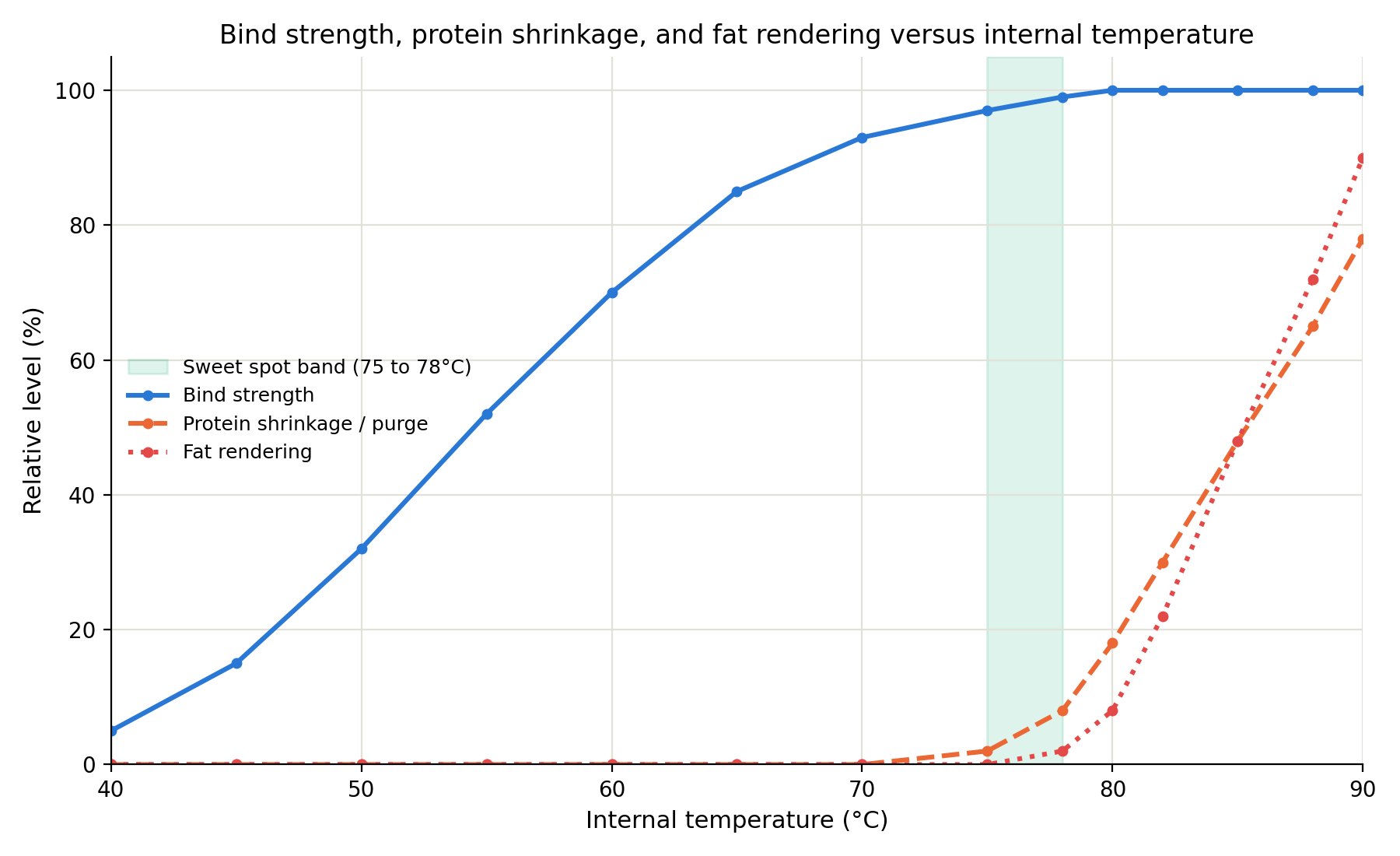
Bind strength rises steeply between 45°C and 65°C, because this is the range in which myosin extraction and initial gel network formation do most of the structural work. The curve continues to rise more slowly between 65°C and 80°C, because actin denaturation contributes further firming to the matrix during this stage. By 80°C, bind strength has essentially reached its plateau. Pushing temperature higher adds very little further bind.
Protein shrinkage and purge follow a different pattern. This process stays close to zero until roughly 78°C, then rises steadily as native protein continues to contract on its way toward full denaturation, squeezing bound water out of the matrix.
Fat rendering follows a third pattern again. It remains negligible until around 82°C, then rises sharply, because fat particles lose structural support once the surrounding protein network has already contracted past the point of holding them securely.
Published denaturation temperatures for myosin and actin vary somewhat between studies, depending on species, method, and ionic conditions. Some sources place myosin denaturation between 54°C and 58°C and actin between 80°C and 83°C, with the reinforced myosin actomyosin network completing around 60°C to 65°C. This variation does not change the shape of the curve or the conclusion drawn from it, and it confirms that myosin driven gelation dominates the earlier part of the cooking range while actin contributes further structural reinforcement later.
The sweet spot
The practical consequence is that the window where bind is essentially complete, but shrinkage and fat rendering have not yet become significant, sits in a narrow range. Based on the mechanism set out above, this range falls between 75°C and 78°C internal temperature. Below 75°C, some achievable bind is left undeveloped. Above 78°C, purge and fat rendering begin to climb while bind gain has already flattened, so nothing further is gained and product quality is put at risk.
This is why we now target the mid range of this window, rather than pushing toward higher temperatures in the belief that more heat means more bind. Once the gel matrix has formed, additional heat works against the product rather than for it.
The exact width of this window will shift slightly depending on fat particle size, casing permeability, and the specific protein and binder system used in a given formulation. The values plotted here describe the general pattern established by known protein and fat behaviour under heat, and they should be treated as a starting point for trial work on any specific product rather than as fixed figures.
Weight loss: soy isolate against Hautstoß and Sehnenstoß
The second question that follows from endpoint temperature is cook weight loss. This matters commercially as much as it matters technically, because weight loss during cooking is yield lost from the batch.

A finely comminuted sausage relying on soy protein isolate to hold added water shows a weight loss curve that climbs steadily from the earliest stages of cooking and then rises sharply once temperature passes 78°C. This happens because soy isolate holds water mainly through swelling and physical entrapment. This entrapped water remains, in a strict sense, still free water. It is held in place rather than converted into a stable protein gel, and it is therefore more easily driven out under sustained heat and mechanical pressure.
A formulation in which the water fraction has instead been bound through Hautstoß or Sehnenstoß shows a lower weight loss curve across the entire temperature range shown, and the gap between the two curves widens further as temperature increases. This is because the water in the Hautstoß or Sehnenstoß fraction has already been pregelatinised with connective tissue protein before it enters the batter. It behaves as structural water rather than free water, and it survives the same thermal stress that drives soy bound water out of the matrix.
Why we regard Hautstoß and Sehnenstoß as the superior approach to water management
Christa and I have worked on this system because it addresses water holding at its source rather than after the fact. Soy isolate, starch, and phosphate systems all attempt to manage water that remains, in physical terms, free water sitting within the meat matrix. They improve retention to varying degrees, but they do not change the fundamental state of that water.
Hautstoß and Sehnenstoß change that starting condition. Because the connective tissue protein is gelatinised before incorporation, the water held within it enters the system already converted into a stable structure. It is no longer competing with myofibrillar protein for a place in the matrix during cooking. It is already part of the matrix.
This has three consequences that we consider decisive.
First, weight loss is lower across the full cooking range, as shown in the graph above, which improves yield without recourse to synthetic hydrocolloids.
Second, the product remains within a meat only formulation, because the binding fraction is derived entirely from connective tissue rather than from soy, starch, or isolated plant protein. This matters for label integrity and for products intended to meet a clean label or meat only claim.
Third, the water bound in this way is more stable under the higher end of the cooking range. Where a soy or starch based system shows accelerating losses above 78°C, a Hautstoß or Sehnenstoß based system continues to hold water more effectively, because the gel structure was formed under controlled conditions before cooking began, rather than being asked to form and hold water simultaneously under the variable conditions of the cook itself.
We regard this as the most effective approach available to us for managing water in finely comminuted meat systems. This position rests on the mechanism described here and on our own bench observations at Van T’s.
Conclusion
Based on the mechanism set out in this article, we recommend a target core temperature of 76°C for finely comminuted and formed products such as mortadella. This sits in the mid range of the 75°C to 78°C window where bind is essentially complete and shrinkage and fat rendering remain minimal.
For chamber temperature, we recommend setting the water bath or steam chamber to 80°C. A differential of roughly 4°C between chamber and target core temperature is enough to drive steady heat penetration to the centre of the product without holding the outer layers at chamber temperature for an extended period. Because bind development is already complete once the core passes 78°C, brief exposure of the outer layers to 80°C during the final stage of the cook does not meaningfully add to shrinkage or fat rendering at the core, where the finished product is actually evaluated.
This gives a practical rule for the cook. Chamber at 80°C, pull the product at a core of 76°C, and rest before slicing to allow the core temperature to equalise slightly upward through carryover, without exceeding the top of the sweet spot.
References
Marin, C., et al. The effect of protein derivatives and starch addition on some quality characteristics of beef emulsions and gels. Foods, 2023, 13(4), 772. https://www.mdpi.com/2077-0472/13/4/772
Recent advances in meat science in Japan. JARQ, 1990, 24, 131 to 140. https://www.jircas.go.jp/sites/default/files/publication/jarq/24-2-131-140_0.pdf
Comparative study of thermal gelation properties and molecular forces of actomyosin extracted from normal and pale, soft and exudative like chicken breast meat. Asian Australasian Journal of Animal Sciences, 2018. https://pmc.ncbi.nlm.nih.gov/articles/PMC6502726/
A generalized model for predicting heat induced chicken myofibrillar protein gel strength. https://www.researchgate.net/publication/230168194_A_Generalized_Model_for_Predicting_Heat-Induced_Chicken_Myofibrillar_Protein_Gel_Strength
The effect of pH and heating on the aggregation behavior and gel properties of beef myosin. Food Chemistry, 2023. https://www.sciencedirect.com/science/article/pii/S0023643823011945
Vacuum treatment of an input stream without ruining delicate output fractions. United States Patent 7,017,277, background section on thermal behaviour of muscle proteins. https://image-ppubs.uspto.gov/dirsearch-public/print/downloadPdf/7017277
Phosphate elimination in emulsified meat products: impact of protein based ingredients on quality characteristics. Foods, 2021, 10(4), 882. https://doi.org/10.3390/foods10040882 and https://pmc.ncbi.nlm.nih.gov/articles/PMC8073691/
Marianski, S. and Marianski, A. Additives and water retention agents. Meatsandsausages.com. https://www.meatsandsausages.com/sausage-making/additives
Marianski, S. and Marianski, A. Soy products in sausage manufacturing. Meatsandsausages.com. https://www.meatsandsausages.com/sausage-making/additives/soy
Comparative evaluation of whey protein concentrate, soy protein isolate and calcium reduced nonfat dry milk as binders in an emulsion type sausage. https://www.researchgate.net/publication/229522866_Comparative_Evaluation_of_Whey_Protein_Concentrate_Soy_Protein_Isolate_and_Calcium-Reduced_Nonfat_Dry_Milk_as_Binders_in_an_Emulsion-Type_Sausage
Peanut and soy protein based emulsion gels loaded with curcumin as a new fat substitute in sausages, a comparative study. Gels, 2025, 11(1), 62. https://www.ncbi.nlm.nih.gov/pmc/articles/PMC11765018/
Effect of diverse binder materials and their addition levels on physico chemical characteristics of sausages. Journal of Food Measurement and Characterization, 2019. https://link.springer.com/article/10.1007/s11694-019-00071-1
Cautionary note
The reference list in this article supports the general mechanism described, meaning the sequence of myosin gelation, actin contribution, protein shrinkage, and the comparative water holding behaviour of soy protein against gelatinised connective tissue. It does not constitute a published, controlled trial of Hautstoß or Sehnenstoß specifically against these ingredients. It is based on Christa and my own work.