Eben van Tonder and Christa van Tonder-Berger, 18 November 2026
A follow-up to The Nitrate Source of the Hallstatt Cure (Van Tonder and Van Tonder-Berger 2026).
Summary
In 1891 Eduard Polenske analysed losses of nitrogenous constituents and phosphorus from beef stored in saltpetre curing brines, together with changes in brines of different ages. His original paper shows extraction losses from the beef of 7.77, 10.08 and 13.78 percent for nitrogenous constituents, and 34.72, 54.46 and 54.60 percent for phosphorus pentoxide, after three weeks, three months and six months respectively. It also records rising ammonia concentrations in the brine as storage time increased.
The ageing brine measurements show that repeated meat curing altered the composition of the liquid and the nitrogenous material it contained. Polenske measured ammonia concentrations of 0.0049, 0.0066 and 0.0306 g NH₃ per 100 g brine at three weeks, three months and six months respectively. He also explicitly referred to the probable microbial reduction of nitric acid to nitrous acid and ammonia. Nitrite, ammonium, nitrate and dissolved organic nitrogen are therefore treated here as related but analytically distinct pools.
Barth, Pucher and colleagues interpret the Hallstatt timber structures and associated animal remains as evidence of substantial Bronze Age meat curing. This article proposes a testable sequence in which salt preserving meat and a temporarily diluted, aerated curing mass supported different nitrogen transformations. Brine removal, addition of water, earth or cooking liquor, and subsequent resalting are considered together because the salt and water balances govern whether nitrification could occur. These operations remain historical hypotheses rather than excavated facts.
The archaeological findings, later scholarly interpretations, biochemical pathways and proposed operations are distinguished throughout. The curing structures, characteristic animal bones and their broad chronological setting are supported by primary and institutional sources. The deliberate inoculation or dilution of a curing mass, the use of urine and the intentional production of curing nitrite remain unverified. The figures are likewise labelled as measured, source reported, conceptual or interpretative.
Introduction
We revisited two earlier studies of Eduard Polenske, Eduard Polenske and the Scientific Discovery of Nitrite Formation in Meat Curing, 1891, and Saltpeter. A Concise History and the Discovery of Dr. Ed Polenske. The first examines his original curing experiments and their place in the scientific history of nitrite formation. The second situates Polenske within the wider history of saltpetre and meat preservation. Their reconsideration prompted the present investigation.
Rereading Polenske’s original 1891 paper brought renewed attention to his observation that ammonia accumulated as curing brines aged. In the experimental brines, ammonia rose from 0.0049 g per 100 g after three weeks to 0.0306 g after six months. He also proposed that microorganisms probably reduced nitrate to nitrite and ammonia. These observations led us to reconsider the possible retention and transformation of nitrogen in reused Hallstatt curing material.
We therefore examined the Hallstatt curing system as a succession of different chemical environments rather than a permanently concentrated brine. During meat preservation the material would have been strongly saline. Between charges, the removal of brine and introduction of water, earth or cooking liquor could, under suitable conditions, have altered salinity, oxygen access and microbial activity. The archaeological evidence for these proposed intermediate operations varies and is evaluated separately.
The present article flows from that rereading. We return to Polenske’s observations and assess them alongside the archaeological evidence from Hallstatt, the chemistry of curing brines and the proposed addition of earth, water and cooking liquor between cycles. We distinguish what Polenske measured, what the archaeological finds establish and what remains a testable reconstruction. The objective is to evaluate whether the whole sequence could have created different conditions for preserving meat and for transforming nitrogen within a reused curing basin.
Polenske’s Brines of 1891
Polenske’s paper, “Ueber den Verlust, welchen das Rindfleisch an Nährwerth durch das Pökeln erleidet, sowie über die Veränderungen salpeterhaltiger Pökellaken”, appeared in Arbeiten aus dem Kaiserlichen Gesundheitsamte, Volume 7, pages 471 to 474. The figures below are taken from the scanned 1891 volume.
Polenske’s Experiment
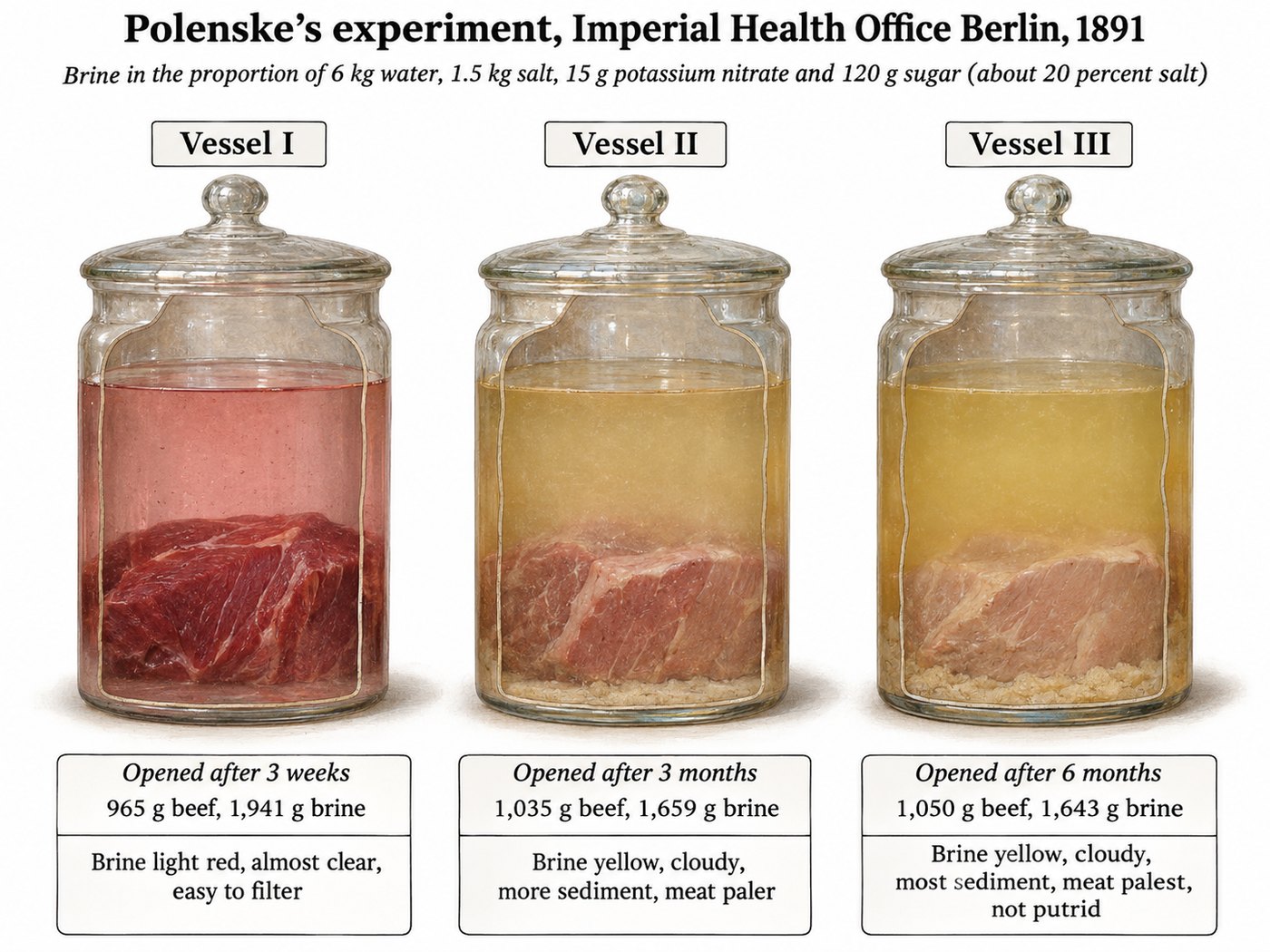
Polenske filled three vessels, each with a piece of beef and a brine in the proportion of 6 kg water, 1.5 kg common salt, 15 g potassium nitrate and 120 g sugar. The brine therefore held about 20 percent salt. The vessels held 965 g, 1 035 g and 1 050 g of raw beef with 1 941 g, 1 659 g and 1 643 g of brine, and he opened them after 3 weeks, 3 months and 6 months.
The first brine was light red, nearly clear and easy to filter. The later brines were yellower and increasingly cloudy, with more sediment, while the meat became paler. Polenske reported that the cured beef did not show putrefactive odour and that the muscle contained substantial NaCl. The beef gained 9.4, 13.0 and 8.6 percent in mass over the three respective storage periods (Polenske 1891, 471 to 472).
Protein and phosphate leave the meat
Polenske’s original paper reports losses of 7.77, 10.08 and 13.78 percent of the beef’s nitrogenous constituents after three weeks, three months and six months respectively. It reports corresponding losses of 34.72, 54.46 and 54.60 percent of the phosphorus pentoxide (P₂O₅). These figures show that the cure removed nitrogenous material progressively, while the extraction of phosphorus compounds rose rapidly and then levelled off.
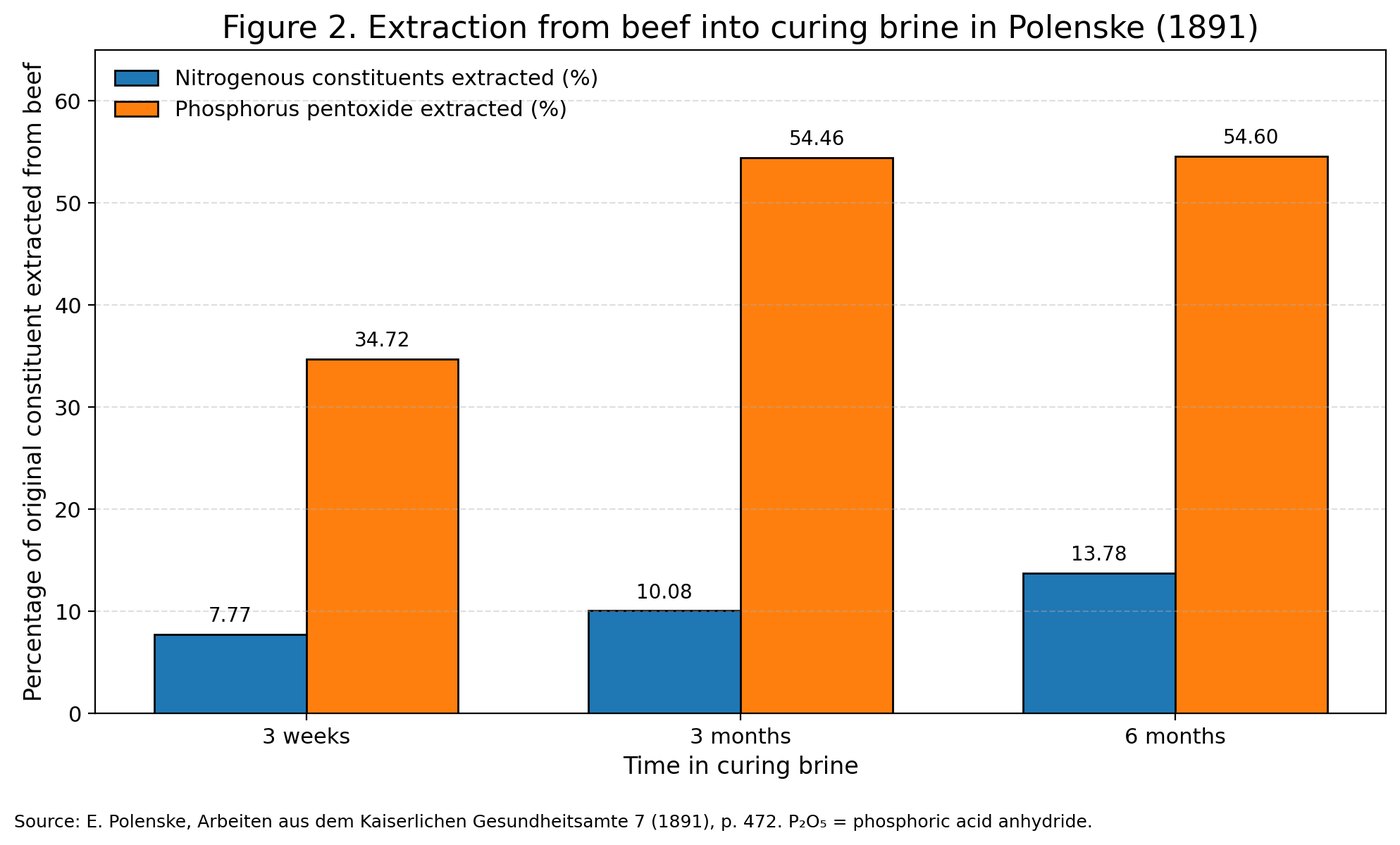
Figure 2. Percentage of original nitrogenous constituents and phosphorus pentoxide (P₂O₅) extracted from beef after three weeks, three months and six months. Exact figures from Polenske (1891), p. 472.
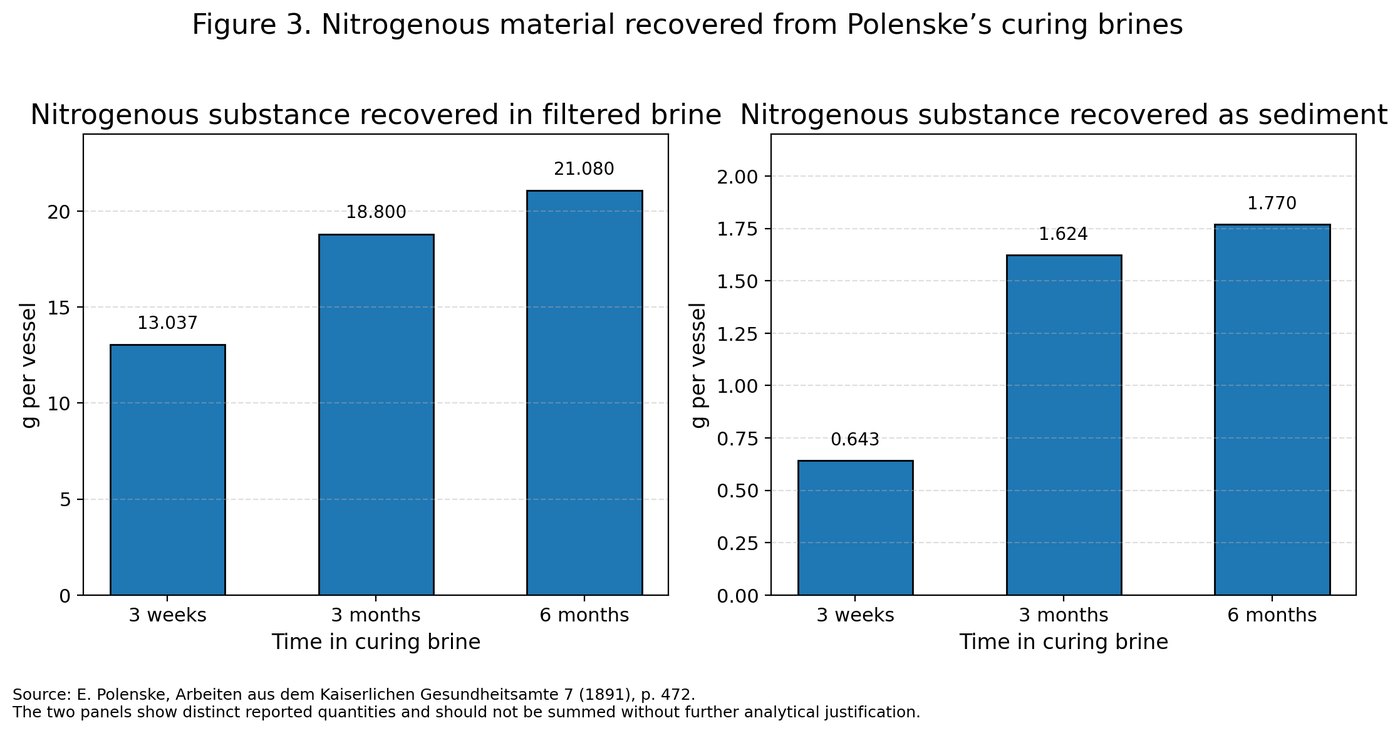
Figure 3. Nitrogenous substance recovered from Polenske’s curing brines. The filtered brines contained 13.037, 18.800 and 21.080 g. The coagulated protein sediment contained 0.643, 1.624 and 1.770 g. The quantities are presented separately because their analytical bases differ (Polenske 1891, 472).
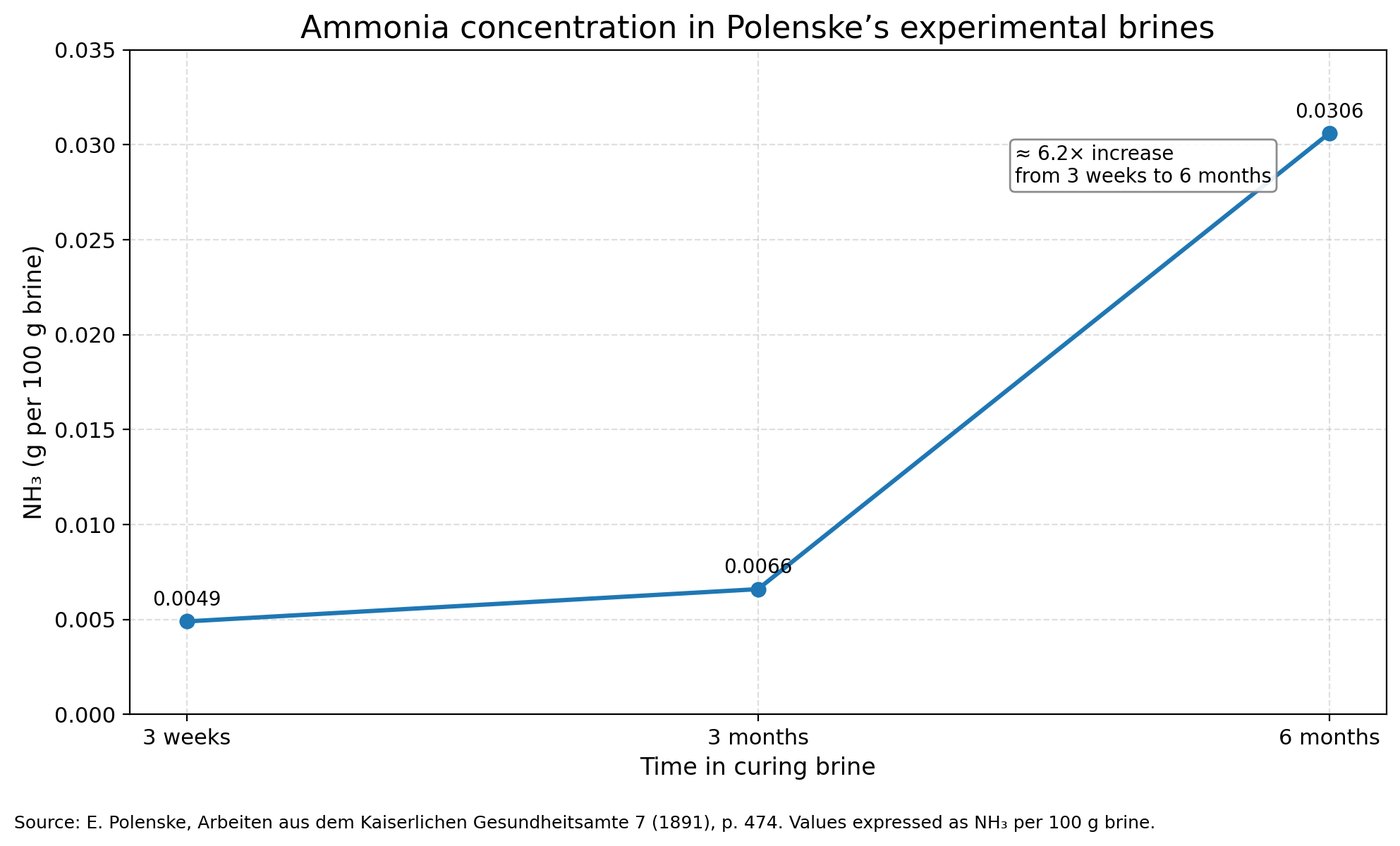
Figure 3A. Ammonia concentration in Polenske’s experimental brines: 0.0049, 0.0066 and 0.0306 g NH₃ per 100 g brine after three weeks, three months and six months respectively. Exact values from Polenske (1891), p. 474.
He called the process leaching (Auslaugung). He wrote that the potassium salts had been leached (ausgelaugt) to a high percentage, and that the nourishing substances of the meat were leached in such unequal proportions that its character as a food changed.
Salt and water move through curing meat according to concentration gradients, changes in muscle structure and the water holding properties of the proteins. Water transport may occur in either direction. Polenske recorded weight increases from 965 to 1,056 g after three weeks, 1,035 to 1,169 g after three months, and 1,050 to 1,140 g after six months. These increases of 9.4, 13.0 and 8.6 percent are consistent with a net uptake of water and dissolved solutes. They do not establish the individual contribution of each component.
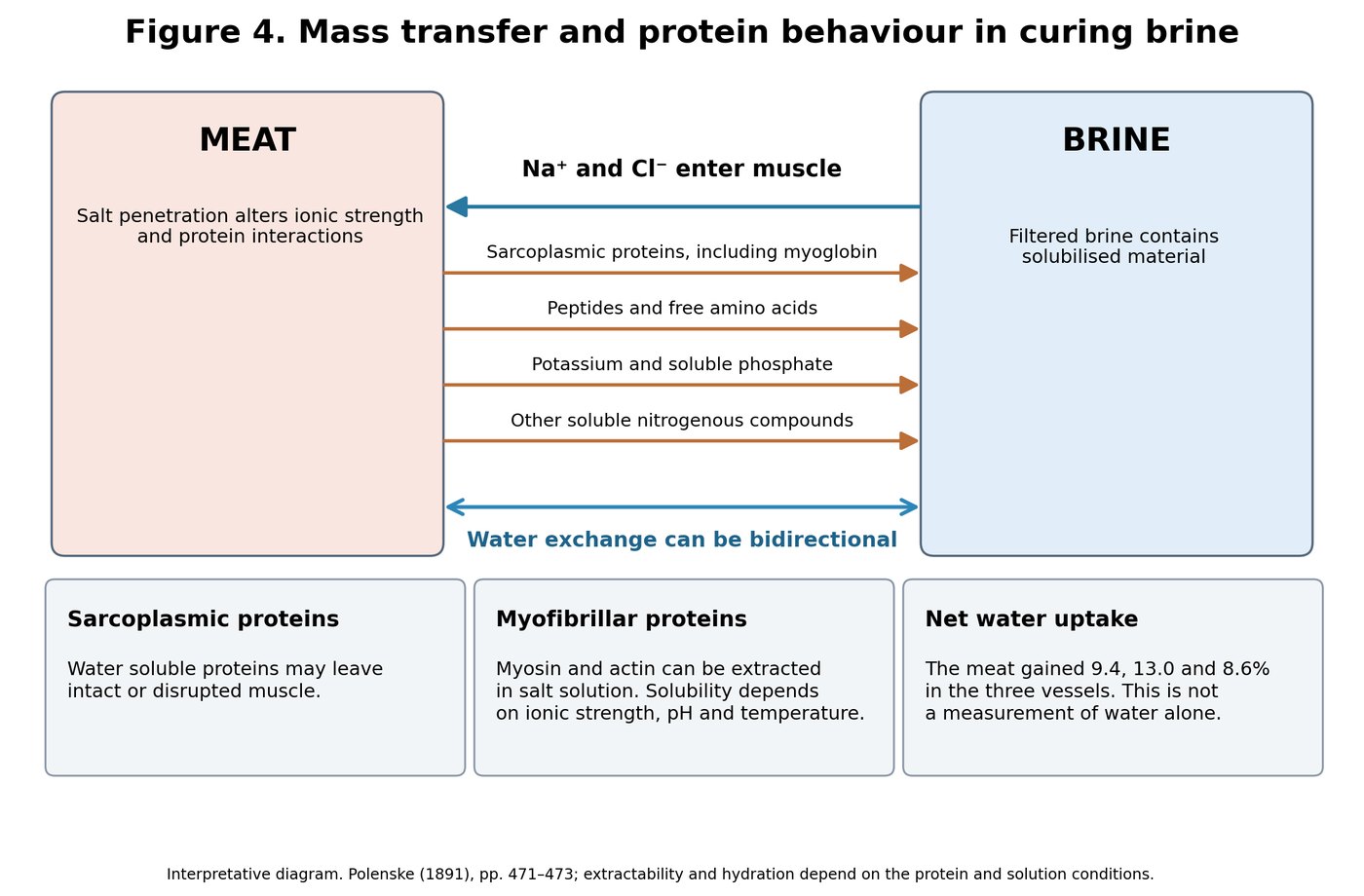
Figure 4. Conceptual movement of sodium chloride, water and soluble substances between meat and brine, with distinct sarcoplasmic and myofibrillar protein classes. Net water transfer depends on the solution and muscle structure. Polenske recorded increases in meat mass of 9.4, 13.0 and 8.6 percent, not isolated water uptake (Polenske 1891, pp. 471 to 473).
Two groups of proteins left the meat in this way:
- Sarcoplasmic proteins. These are the proteins of the muscle cell, among them myoglobin and the enzymes of the cell fluid. They dissolve in water and diffuse out readily.
- Myofibrillar proteins. These are chiefly myosin and actin, and they dissolve only in salt solution. At moderate salt they go into solution and can be extracted, an effect known as salting in. At high salt they precipitate again, an effect known as salting out, or Aussalzen in German.
Salt modifies myofibrillar protein extraction, aggregation and water binding according to ionic strength, pH, temperature and the condition of the muscle. Polenske described the sediment as consisting essentially of coagulated protein. His observations do not, however, identify the precipitated proteins specifically as myosin or actin.
The phosphate came mainly from the energy metabolism of the muscle. After slaughter, the muscle breaks down its adenosine triphosphate (ATP) and creatine phosphate, which releases inorganic phosphate and inosine monophosphate (IMP). These compounds, together with the phosphate of the cell fluid, are highly soluble and diffuse into the brine. Mellette pointed to the same source when he described the free phosphate formed from ATP, ADP and IMP in salted meat (private correspondence, 2017). The potassium that Polenske tried to measure leaves the meat in the same way, because it is the main mineral of the muscle cell.
Barth and Lobisser interpreted successive curing cycles as changes in the water and material composition of the basin contents. Polenske provides a later historical analogue for extraction from meat into brine, not a direct measurement of the Hallstatt material. If 7.5 to 10 tonnes of meat contained 3.2 percent nitrogen, the initial nitrogen inventory would be 240 to 320 kg. A hypothetical one percent transfer would correspond to 2.4 to 3.2 kg of total nitrogen. It would not mean that all this nitrogen became ammonium, nitrate or nitrite. Each of these transformations requires separate biochemical evidence and recovery factors.
Nitrite and ammonia rise with age
Polenske could not measure the potassium nitrate left in his brines directly, but in control trials repeated at intervals of several days the volume of nitric oxide gas obtained from the brine kept falling. He concluded that the nitric acid was decomposing, and he measured increasing amounts of both nitrous acid and ammonia in older brines. For the experimental brines, the ammonia concentrations rose from 0.0049 g NH₃ per 100 g brine after three weeks to 0.0066 g after three months and 0.0306 g after six months.
“Die wohl durch Mikroorganismen herbeigeführte Reduktion der Salpetersäure zu salpetriger Säure und Ammoniak gab Veranlassung, zu erforschen, bis zu welchem Grade Letztere sich in den Pökellaken anzuhäufen vermögen. Zumal die gleichen Zersetzungsprodukte auch in dem Pökelfleische gefunden wurden, dürfte dieser Gegenstand, die scharfe Verurtheilung des, diese Substanzen enthaltenden Trinkwassers ins Auge fassend, vom hygienischen Standpunkte aus betrachtet, beachtenswerth erscheinen” (Polenske 1891, 473).
Polenske attributed the reduction of nitrate to nitrite and ammonia probably to microorganisms. He noted that the same decomposition products were found in cured meat, and considered the question significant in view of contemporary sanitary objections to similar constituents in drinking water. He did not identify the organisms or isolate a microbial mechanism experimentally. His original wording, not a later paraphrase, supports the historical attribution.
Polenske also measured nitrous acid, expressed analytically as N₂O₃. The concentration in brine III was 0.0510 g N₂O₃ per 100 g brine. The table states “nicht bestimmt” for brines I and II, which means not determined rather than absent or below the analytical detection limit. Other butcher brines were also tested and reported separately (Polenske 1891, 474).
The brine turns alkaline and loses ammonia
The sum of ammonia and nitrous acid stayed far below the figures that theory predicted. Polenske explained this by the fact that the freshly made brines, which were neutral, gradually became alkaline because of free ammonia, which slowly escaped. His direct measurements nevertheless show a marked age dependent rise in ammonia concentration, particularly by six months (Figure 3A).
The share of ammonia that is free, and can escape, depends on pH and temperature. At pH 6 and 8 °C, less than 0.1 percent of the total ammonia is free ammonia. At pH 9 and 10 °C, by our calculation from the equilibrium data of Emerson and colleagues (1975), the share is roughly 15 percent. In slightly acid meat, ammonia stays as the ammonium ion. In an old alkaline brine, a substantial part of it is free and volatile.
No putrefaction and no amines
Polenske reported no putrefactive odour in the longest stored meat and no amines in the distillate. This does not establish the complete absence of biogenic amines because recovery and detection depend on the analytical method. Nor does it establish a complete nitrogen mass balance. The more limited inference is that ammonia was discussed among the decomposition products while obvious putrefaction was not reported under the conditions described.
Reused brines in the Berlin trade
Polenske also analysed brines from Berlin butcher shops. One had been in contact with its first charge of meat for 3 days. Two others held a second and a last charge of meat, and a further brine had lain on a ham for 5 months. All of them contained nitrous acid, and most contained ammonia (Polenske 1891, 473 to 474). In 1891, therefore, the Berlin trade reused its brines over successive charges of meat. This is the practice Eben described in The Mother Brine, where Danish mother brines were strained and reused for years, and the practice that Barth and Lobisser inferred for the Hallstatt curing basins.
Ammonia in Old Brine. Where It Comes From
Polenske attributed his ammonia to the reduction of nitrate. His measurements do not separate that source from others, however, and present knowledge points to four sources. All four could have operated in a Hallstatt curing basin.
Reduction of nitrate and nitrite
Staphylococci reduce nitrate to nitrite when oxygen is scarce. Once the nitrate is used up, Staphylococcus carnosus reduces nitrite further to ammonia, a step that nitrate itself inhibits (Van Tonder and Van Tonder-Berger 2026, and the work cited there).
- Conditions. Little oxygen, together with nitrate or nitrite, induces the reducing enzymes. Staphylococci from traditional sausages grew with 10 to 20 percent salt and reduced nitrate at 15 to 30 °C (Casaburi and colleagues, as cited in Van Tonder and Van Tonder-Berger 2026).
- Limits. At the 6 to 8 °C of the mine, the rate is not known and has to be measured. The Wiltshire live brines work at 1 to 5 °C, so reduction in the cold is possible.
- Consequence. A sealed cure with a reserve of nitrate keeps its nitrite, whereas a cure that has exhausted its nitrate turns nitrite into ammonia. Polenske’s oldest brines, with the most ammonia, fit this sequence.
Autolysis and deamination
The muscle’s own peptidases release amino acids during curing, including under saline conditions. Salazar and colleagues (2020, Table 5) measured an increase in total free amino acids in Chato Murciano dry cured ham from 10.4 ± 1.2 g per kg of total solids at day 0 to 81.2 ± 5.1 g per kg at 14 months. Values subsequently declined to 81.0, 72.1 and 70.1 g per kg at 18, 22 and 24 months. These data demonstrate proteolysis in that product, not a measured ammonium conversion rate in Hallstatt. Staphylococci can convert arginine through the arginine deiminase pathway with release of ammonia (Sánchez Mainar and colleagues 2014).
- Conditions. Autolysis needs no bacteria and proceeds under salt. Deamination by staphylococci tolerates salt.
- Limits. Both are slow in the cold. Polenske’s ammonia rose over months, not days.
- Consequence. Polenske’s brines, rich in dissolved nitrogen substance and with ammonia rising over six months, are consistent with this route.
Urea from urine
Bacteria with urease turn the urea of urine into ammonia within hours, and stored urine reaches a pH of about 9 (Udert and colleagues 2003a). In October 2026, in Tanzania, we observed fresh beef omasum become strongly ammoniacal within about twelve hours of slaughter (Van Tonder and Van Tonder-Berger 2026).
- Conditions. Urease bacteria are widespread in soil and in stored urine.
- Limits. At pH 9 a large part of the ammonia escapes as gas. Abell and colleagues allowed for a loss of about 45 percent of the nitrogen of urine in their model of urine salts (Van Tonder and Van Tonder-Berger 2026).
- Consequence. Urine or urine soaked earth added to a curing basin would have supplied ammonia quickly, but it would have lost part of it to the air.
Broths of skins, bones and meat juice
In Exploring the Hallstatt Salt Curing Method, Eben proposed that the curers boiled pig skins and other tissues, and that the protein rich broths added nitrogen to the curing basins. Barth and Lobisser interpreted the graphite clay vessels found in and around the curing basins as vessels in which meat juice was concentrated by heating. They noted that prolonged cooking yields a gelling liquid.
What boiling does. The protein of skin, tendon and bone is mostly collagen. Collagen is built of three chains wound into a tight triple helix, and in this form it resists most protein digesting enzymes. Only specialised collagenases cut it. Heat changes this in three steps:
- Above about 60 to 70 °C the triple helix unwinds. The protein is denatured, and the skin shrinks.
- With longer boiling, some of the peptide bonds that hold the chains together break, and the cross links between chains are cut. The collagen becomes gelatine, a mixture of soluble polypeptides of different lengths. This is the gelling liquid that Barth and Lobisser describe.
- Prolonged boiling, and above all treatment with lime before boiling, also converts the amino acids asparagine and glutamine in the protein into aspartic and glutamic acid. This reaction, called deamidation, releases ammonia directly. It is the reason why gelatine made from limed hides and bones differs from gelatine made with acid.
Why this helps the formation of ammonia. Native collagen is insoluble and nearly inaccessible to enzymes. Gelatine is soluble, and its unfolded chains are open to the ordinary proteases of meat and of bacteria. These enzymes cut the gelatine into peptides and then into free amino acids. Bacteria then split ammonia from the amino acids. Gelatine is rich in arginine, about 8 percent of its weight, and arginine is the amino acid that meat staphylococci deaminate most readily, through the arginine deiminase pathway. Boiling therefore turns an inert protein into a substrate that the enzymes and bacteria of the curing mass can break down to ammonium. Boiling itself makes no nitrate or nitrite. The ammonium formed from the broth becomes nitrite only later, in the aerated and stirred phase.
The sequence from bone and skin to cured meat is therefore: collagen, gelatine by boiling, peptides and amino acids by proteases, ammonium by deamination, nitrite by ammonia oxidisers in the stirred mass, and finally nitric oxide in the meat.
How much nitrogen. Eben’s earlier estimate of 320 g of ammonia nitrogen from 10 kg of skins and bones assumed that almost all the protein would be broken down to ammonia. A more reasonable estimate proceeds as follows. Fresh pig skin and bone together contain roughly a quarter of their weight as protein, so 10 kg hold about 2.5 kg of protein. Collagen contains about 17 to 18 percent nitrogen, giving about 400 g of nitrogen. Boiling in open vessels extracts perhaps a third to a half of it as gelatine, about 130 to 200 g of nitrogen. In a cold and salty curing mass, perhaps 5 to 20 percent of that would become ammonium within one cycle. On these assumptions, 10 kg of skins and bones would supply about 7 to 40 g of ammonium nitrogen per cycle. This is of the same order as the 58 to 151 g of nitrate nitrogen that one cycle needs, but smaller than the nitrogen that the meat itself leaches into the mass. Each figure in this estimate is an assumption that a trial would replace with a measurement.
- Conditions. Boiling long enough to form gelatine. Proteases and deaminating bacteria in the mass.
- Limits. Breakdown of gelatine is slow in the cold and under salt. Glycine and proline, the commonest amino acids of gelatine, are not readily deaminated by meat staphylococci.
- Consequence. Broth returned to the curing mass is a slow but steady source of ammonium, and a richer one if the skins were limed before boiling.
Assessment of Mellette’s proposed pathway
When Eben wrote about Polenske in Saltpeter. A Concise History and the Discovery of Dr. Ed Polenske, the South African meat scientist Dr. Francois Mellette explained that proteins broken down in salted meat yield NH3 and NH4⁺, and that these are aerobically changed into nitrite and nitrate (private correspondence, 2017). The first part of his statement is supported by Polenske’s brines and by the work of Salazar and of Sánchez Mainar. The second part does not hold in strong salt.
Moussa and colleagues (2006) found severe inhibition of enriched nitrifying cultures at 40 g chloride per litre, approximately 95 percent relative to their salt free activity. This is strong evidence against efficient conventional nitrification in an unchanged concentrated curing brine. It is not proof that nitrification is impossible following removal of salt bearing liquid, addition of fresh water and wet pen earth, or adaptation of halophilic communities. Cui and colleagues (2016) studied halophilic nitrification at 30 to 85 g NaCl per litre, using a different microbial assemblage and concentration measure. Chloride and NaCl figures must therefore be distinguished.
Seawater contains approximately 19 g chloride per kg (Millero and colleagues 2008). Moussa and colleagues (2006) found substantial inhibition of their enriched nitrifying cultures at elevated chloride concentrations. Marine microorganisms nevertheless oxidise ammonia in seawater (Ward 2008). Thus nitrification can occur under saline conditions, but its rate and extent depend on the adapted microbial community, oxygen supply, substrate availability and temperature. The conditions within a reused meat curing mass remain to be measured.
- the low salt of 3.5 percent, which does not stop spoilage
- the lack of oxygen around submerged meat
- the time that nitrification needs
Oxygen in a Wet Curing Mass
The oxygen atoms in water, H2O, are not available to bacteria. They are bound to hydrogen, and no bacterium in a curing mass can split water to release them. The only oxygen that nitrifying bacteria can use is dissolved oxygen gas, O2, which enters the water from the air. A wet curing mass therefore counts as an oxygen poor environment unless air is brought into it.
Water holds very little dissolved oxygen. Fresh water saturated with air at 10 °C holds about 11 mg of oxygen per litre, and salt lowers this further, to a fraction of that figure in a strong brine. The bacteria of a mass rich in protein, blood and organic matter use this oxygen up within hours to days. Nitrification, by contrast, consumes a great deal of it. Oxidising 1 g of ammonium nitrogen to nitrite takes about 3.4 g of oxygen, and to nitrate about 4.6 g. Converting 50 g of ammonium nitrogen to nitrite would take about 170 g of oxygen, the dissolved oxygen of roughly 15 000 litres of air saturated fresh water. The oxygen therefore has to come from the air, continuously, through the surface of the mass.
This decides which processes run where:
- A still, covered or sealed wet mass is oxygen poor. It favours the reduction of nitrate (NO3⁻) to nitrite (NO2⁻) by staphylococci, and later the reduction of nitrite to ammonium. It does not favour the formation of nitrate.
- A stirred mass with a large surface takes up oxygen from the air. Stirring renews the surface and carries air into the liquid. Only in this state can ammonia oxidisers form nitrite, and nitrite oxidisers form nitrate.
The whisk and shovels found in the curing basins are therefore more than mixing tools. Without stirring, a wet curing mass would stay oxygen poor, and no nitrite could form in it from ammonium.
What Our Earlier Work on Hallstatt Established
Since 2024 Eben, and later both of us, have examined the Hallstatt curing method in a series of articles. We summarise here what each contributed and what survives.
The curing basins
The curing basins of the Salzberg valley date to the 13th and 12th centuries BCE. Barth and Lobisser describe timber structures of up to twelve layers of beams, sunk into the ground and sealed on the outside with clay. In their account, the containers were filled with small pieces of rock salt or rich Haselgebirge, the meat was buried in them, and after seven to ten days it was exchanged for other meat. The mass became softer and richer in clay, and through the water extracted from the meat it became richer in protein, until the brine spoiled. The finds lay in pure clay, which means the contents were moved and processed repeatedly.
Christa observed that a whisk found in a curing basin was probably thrown in after mixing, and that such whisks are not strong enough to stir the clay itself. She also proposed that a salt solution may have been prepared in the large vessels and transferred to the curing basin (The Hallstatt Curing Method). Barth also described a partitioned gap in the structure exposed in 1877, from which concentrated brine could be scooped (Van Tonder and Van Tonder-Berger 2026).
Loam. The museum describes the curing basins as sealed with grey mountain loam (Van Tonder and Van Tonder-Berger 2026), and Barth and Lobisser describe the outer sealing clay as surface clay containing stones. Loam, Lehm in German, is a natural soil made of sand, silt and clay in roughly comparable proportions. When wet it is plastic and can be pressed and smoothed by hand. When compacted it forms a dense layer through which water and air pass only slowly. People have used loam for floors, walls and ovens since prehistory, and it is the natural material for sealing a pit or a timber structure. A layer of loam over a curing basin kept out rain and air, and it held in the brine and the gases of the mass.
Haselgebirge, the salt clay of the curing basins
Haselgebirge is the rock in which the salt of Hallstatt occurs. It is a Permian formation, later deformed into a tectonic mixture of rocks, and it is found at Hallstatt, Altaussee, Bad Ischl, Berchtesgaden and the Dürrnberg. Leitner and colleagues describe it as halite, mudstone and polyhalite, with mudstone forming about half of the rock in places. The average halite content in the salt mines lies between about 30 and 65 percent by volume, and the Natural History Museum Vienna describes it as a natural mixture of salt, clay and anhydrite (Van Tonder and Van Tonder-Berger 2026). Figure 5 shows the composition and the elements of each mineral.
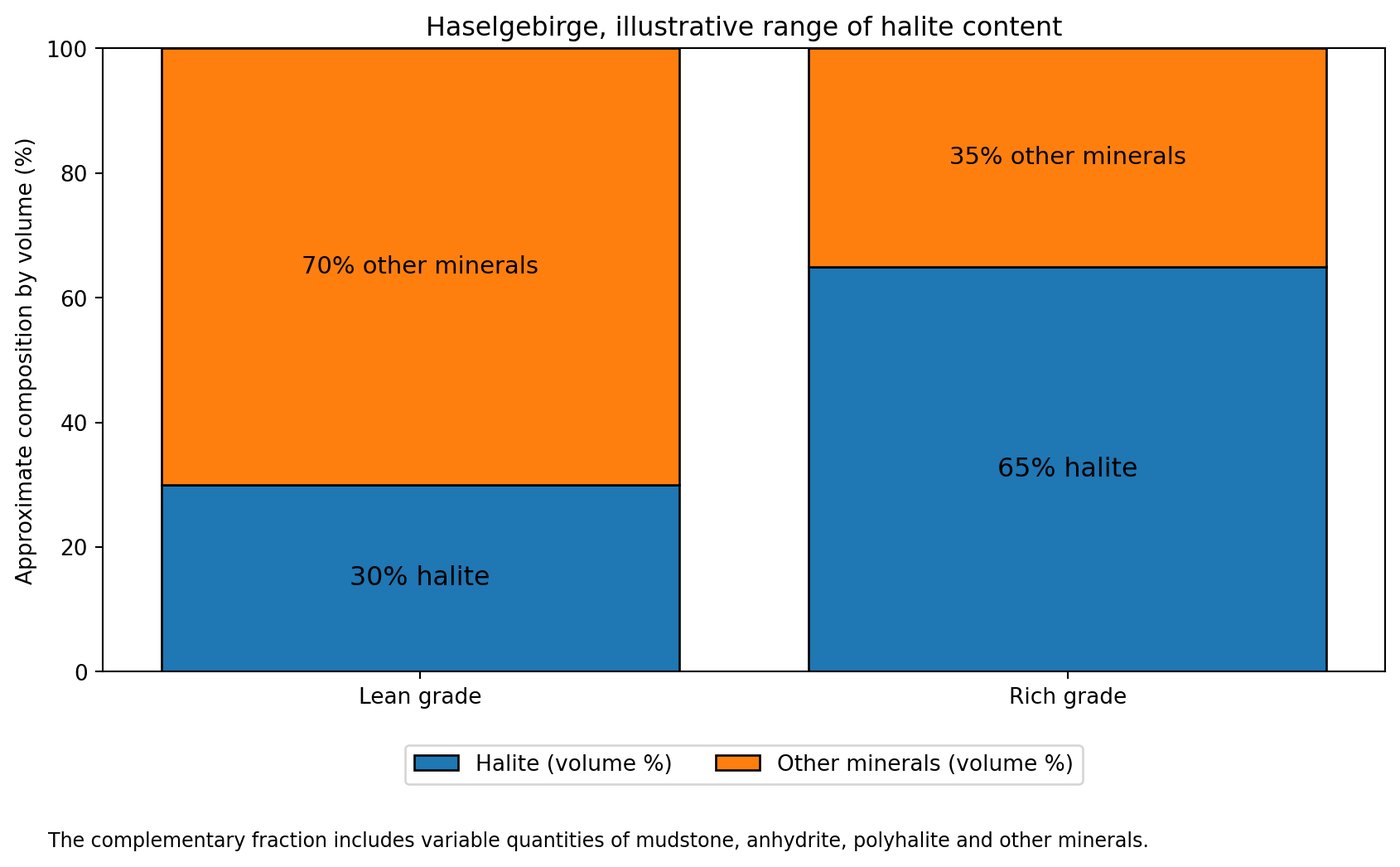
Figure 5. Variable Haselgebirge mineral composition. Published approximate mine averages span 30 to 65 percent halite BY VOLUME. The remainder includes mudstone, clay minerals, anhydrite, polyhalite and other minerals in variable proportions. The two bars are endmembers and do not represent two archaeological samples.
- Halite, rock salt, is sodium chloride. By weight it is 39 percent sodium and 61 percent chlorine. It supplies the salt of the cure.
- Mudstone is hardened clay and fine silt. Its clay minerals are built of silicon, aluminium and oxygen, with iron, magnesium and potassium. When the salt dissolves, the mudstone is left behind as the soft clay of the curing basin. Clay minerals bind ammonium on their surfaces, so the clay of a reused mass can hold ammonium between cycles.
- Anhydrite is calcium sulphate. With water it can turn into gypsum. It adds calcium and sulphate to the brine.
- Polyhalite is a sulphate of potassium, calcium and magnesium, and it is the only potassium mineral of the Haselgebirge.
A brine made from Haselgebirge therefore contains calcium, magnesium, potassium and sulphate besides sodium chloride. The rock also contains living microorganisms. Extremely halophilic archaea, among them Halococcus salifodinae, have been cultured from Permian rock salt at Bad Ischl, Altaussee and Berchtesgaden. They grow best at 20 to 25 percent salt and are not nitrifiers (Van Tonder and Van Tonder-Berger 2026). Whether hand mined Haselgebirge contained nitrate is the first question the discussion paper asks to be measured.
Ammonia from the meat, and the putrefied trials
In The Hallstatt Curing Method (2024) and in Meat Preservation in Clay with Ammonia, Saliva and Lime (2024), Eben proposed that the meat released ammonia under the salt clay, and that bacteria then oxidised it to nitrite. His trials of that route ended in putrefied meat before much ammonia had formed, as he reported in the article on Hallstatt and the Benedictine abbey of Admont. Polenske’s brines explain the result. Ammonia does form from meat in brine, but only over weeks and months, and only in brine strong enough to prevent rot. A weak brine putrefies first.
Amino acids
In Amino Acids in Late Bronze Age Curing (2025), we looked for the amino acids that yield ammonia. In spoiling meat, lysine is more likely to be decarboxylated to cadaverine than deaminated. Arginine, through the arginine deiminase pathway of staphylococci, is the more important source of ammonia. The absence of amines in Polenske’s distillates fits a salted mass in which deamination, not putrefaction, dominated.
Urine
In Urine in Meat Curing (2025), Eben proposed urine as a possible source of ammonium in the curing material. In The Hallstatt Meat Curing Method. An Update (2025), we examined that possibility jointly. In strong salt, urine supplies ammonium but little nitrate. The subsequent discussion paper proposed that urine or urine soaked earth, diluted and buffered with limestone or aged lime and exposed to oxygen, could undergo biological nitrogen transformation. The previously proposed quantities remain estimates requiring experimental verification.
Lime
In Meat Preservation in Clay with Ammonia, Saliva and Lime, and in the Admont article, Eben proposed lime as part of the Hallstatt method, both to raise alkalinity and to deter spoilage. The discussion paper refined this. Fresh lime, calcium oxide or calcium hydroxide, is strongly alkaline and drives ammonium off as ammonia gas, so it works against nitrate formation. Aged lime, which has turned back into calcium carbonate, and ground limestone neutralise the acid that nitrification releases. Without such buffering, the nitrification of urine stopped at about pH 6 (Udert and colleagues 2003b). The Dachstein above Hallstatt is limestone.
Lime therefore had three possible roles, depending on its state and its place in the work. In the stirring phase, carbonate kept nitrification going. Fresh lime used on skins before boiling would have loosened the hair and released ammonia from the collagen by deamidation. Fresh lime rubbed on meat or added under a seal would have released ammonia and raised the pH. In American processing, ammonia raised lean beef trimmings to about pH 9.6 and reduced salmonellae by about 4 log cycles (Niebuhr and Dickson, as cited in Van Tonder and Van Tonder-Berger 2026). The same alkalinity has a cost. The release of nitric oxide from nitrite needs acid conditions, so a strongly alkaline mass hinders the colour reaction at the meat surface. Slightly acid meat, at about pH 5.7, supplies that acidity itself, provided the alkaline mass does not overwhelm it.
Sal ammoniac
In The Sal Ammoniac Project (2018), Eben cured pork with 2 percent ammonium chloride and 4 percent salt, without vacuum, at about 7 °C. After a month the meat was brown on the outside, pink in the centre and smelled fresh, whereas a vacuum packed sample with 0.125 percent ammonium chloride and 1.5 percent salt spoiled. Ammonium in sufficient salt therefore preserved meat and gave a stable pink interior. The route to that colour remains to be tested with ammonium labelled with 15N.
Nitrous earth
The discussion paper established that nitrate forms where urine and dung lie on aerated, roofed ground low in salt, and that the cleanings of byres, heaped under cover, are a probable form of nitrous earth. It proposed that this earth, or water leached from it, reached the curing basins. The quantities are small, from 8 to 364 kg of earth per curing basin cycle, depending on its grade.
Sealed meat in the north
In his 2018 article 01. How did Ancient Humans Preserve Food?, Eben collected the Arctic accounts of meat sealed and buried in pits and skins. Bogoras wrote of the Chukchi that “Later on, when the pit is opened, the stench is so strong that it is disagreeable to the natives themselves”. Through Speth (2017), the article names ammonia, cadaverine and putrescine as the three nitrogenous gases of decomposing meat.
In Sacred Sustenance (2025), Eben described kiviaq, for which the seal skin was sewn shut and coated with seal fat to create an airtight seal, then buried under rocks. In Survival, Spirituality, and Celebration (2025), he described meat submerged in seal oil, which kept oxygen from the meat. Sealing, the exclusion of air, fat as a seal and the release of ammonia on opening are therefore documented practices of northern peoples. Their stores were unsalted and fermented. At Hallstatt, salt turned the same sealed setting into a cure.
The High Valley, the Curing Basins and the Farming Hinterland
The sequence proposed below took place in a particular landscape, with particular tools and people, and it depended on farms that lay far from the curing basins. This section sets out what is documented about each, so that the reconstruction in the figures can be checked against the finds.
The curing basins and their dates
Eight log structures sunk into pits in the ground are known in the Salzbergtal above Hallstatt, and two of them have been excavated and documented. The first was exposed by a landslide in 1877 and excavated the following year. Friedrich Morton uncovered the second in 1939, and it had double walls sealed with clay daub. Radiocarbon analyses placed both in the 13th and 12th centuries BCE, and excavations for the Natural History Museum Vienna in 1993 and 1994 led to their interpretation as curing basins (NHM, Bronze Age meat curing vats). Dendrochronology places the larch timbers of the log basins in the late 14th and 13th centuries BCE, with the outermost dated rings at about 1288 BCE (Grabner and colleagues 2021). The basins measured about 4 by 4 m (Reschreiter and Kowarik 2019), and each is estimated to have held 150 to 200 carcasses at a time. Grey mountain loam was packed deep into the walls and over the floor to make the timber watertight, and the salt used was the lower grade Haselgebirge rather than pure rock salt (NHM, Bronze Age meat processing).
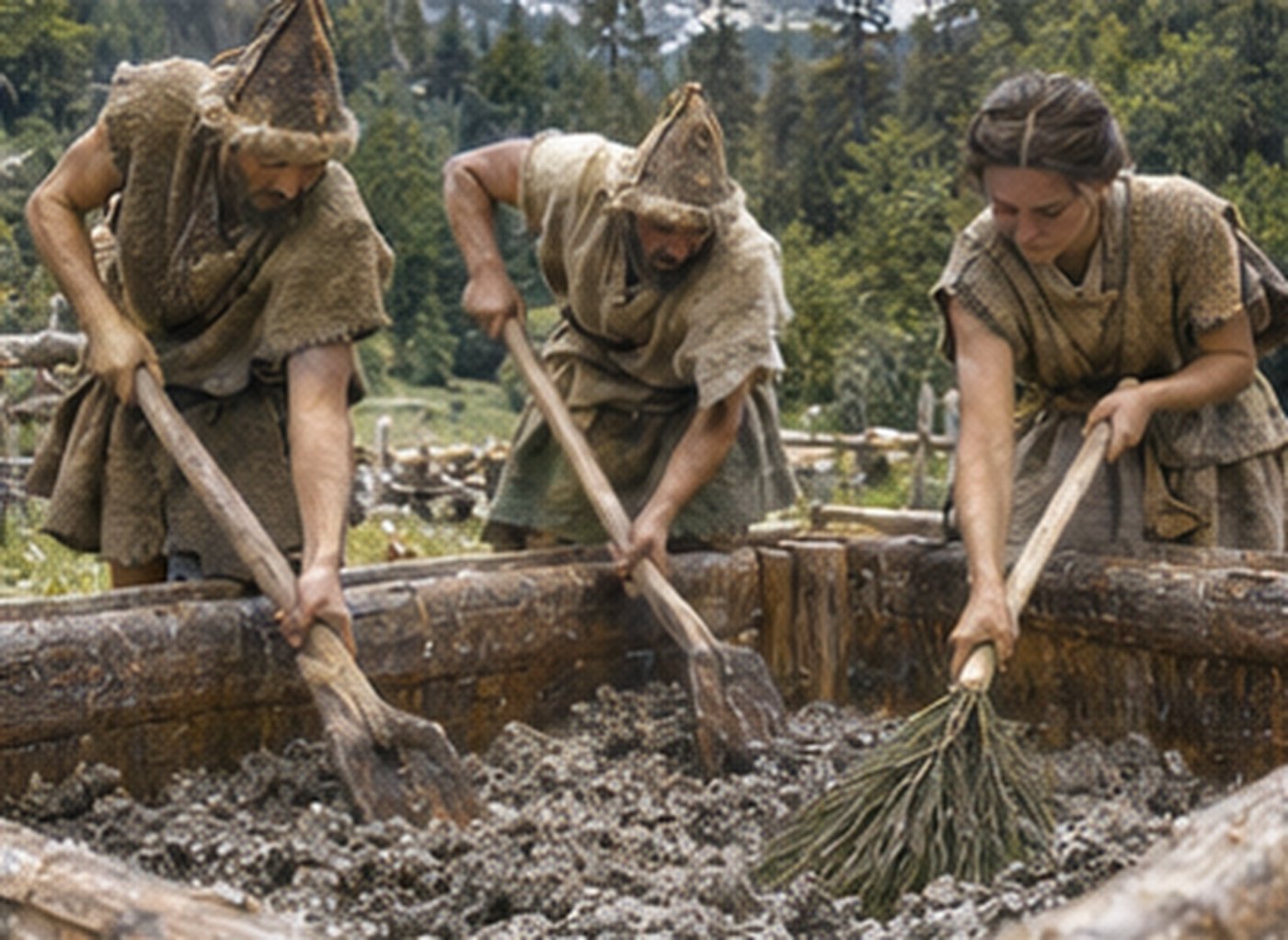
Barth found the excavated basins filled with dissolved salt clay and concluded that the curers used Hauklein, the small, unwashed salt that falls during mining (Barth 2001). Among the wooden finds from the structure of 1877 he lists a whisk of fir, cut from the top of a conifer with the bases of its branches left on, together with wooden shovels (Van Tonder and Van Tonder-Berger 2026).
The meat and its route to the curing basins
Erich Pucher identified more than 10,000 animal bones from the excavations of 1993 and 1994. Pig made up 60.5 percent, sheep and goat 21.5 percent and cattle 17.6 percent. Skulls, vertebrae and ribs of the pigs were almost absent, while the meat bearing long bones and the lower jaws lay in great numbers. Pucher counted 102 male jaws and 9 female jaws, and most pigs were killed at one and a half to two years. Piglets and old animals are absent, so the pigs were not bred or slaughtered in the high valley but arrived as carcasses. The large long bones of cattle had been broken up (NHM, Results of animal bone analyses; Pucher and colleagues 2013).
The pigs were opened along the back and the ribs and entrails removed, a method still used for Gailtal bacon, in which the two boneless halves are salted and smoked. A carcass of about 50 kg could be carried on a stave over the shoulders, and the lower jaws may have served as handles (NHM, Bronze Age meat processing). Pucher and colleagues (2013) also report graphite clay cooking vessels and conclude that bones were boiled until the broth gelled and could finally be dried. Boiling of bones to a gelling broth is therefore documented at the site, which bears directly on Step 3.
The people and their equipment
No Bronze Age settlement or cemetery has yet been found in the high valley. Archaeologists working on the mine nevertheless assume that a resident population lived there throughout the year, because the mine needed constant maintenance (NHM, Hallstatt during the Bronze Age). The mine has preserved what these people used and wore. Millions of burnt lighting splints of fir lie in the spoil. A cone shaped cap of hide, worn with the fur inside and adorned with leather strips hanging from the tip, survives complete from the Bronze Age, while the scraps of wool, flax and hemp cloth are too small to show the cut of garments (NHM, Working life in the Bronze Age). Leather carrying sacks, wooden shovels and troughs, bronze picks on wooden hafts and ropes of bast are known from the mine (Grömer and Reschreiter 2021; NHM, The salt mine in prehistoric times), and a timber staircase dated to 1344 BCE stood at the foot of a Bronze Age shaft (Salzwelten). In the figures of this article the caps, sacks, shovels, the whisk and the cooking vessels follow these finds. The cut of the tunics, the leg wrappings and the shoes are reconstructions.
Human faeces preserved in the mine record the diet and health of the miners. Their food was rich in fibre and carbohydrate, with bran and glumes of cereals and protein from broad beans, supplemented occasionally by fruit, nuts and animal foods (Maixner and colleagues 2021). Barth (2001) describes a stew of barley, millet and broad beans cooked together with the feet and tails of pigs, sheep and goats. Eggs of roundworm and whipworm were found in 91 percent of 35 coprolites from the Bronze and Iron Age mines (Barsch and colleagues 2023). These worms spread through soil contaminated with faeces, so human waste lay in the ground around the people who worked the mine and the curing basins.
Farming in the hinterland
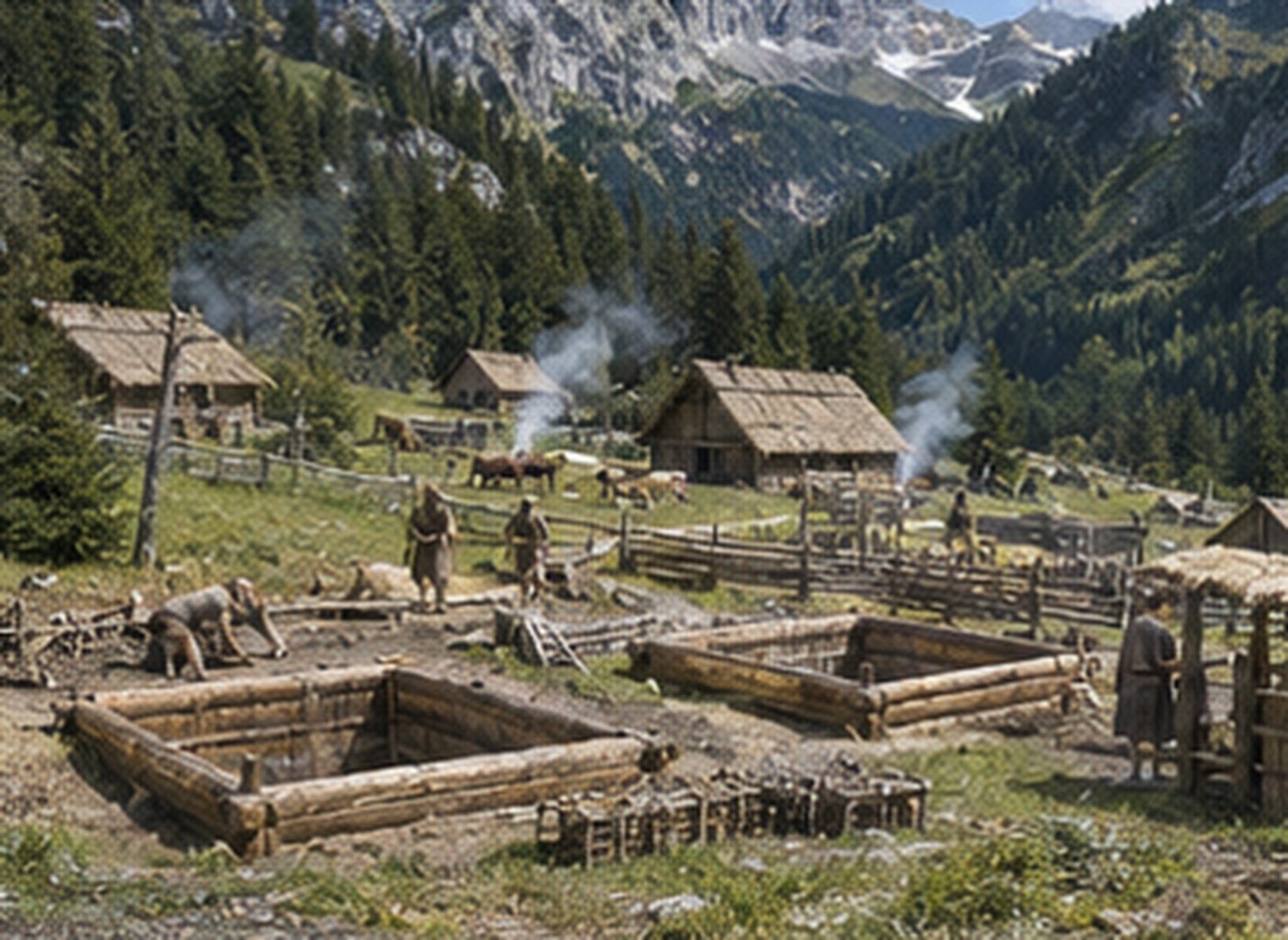
The high valley had little arable land. Between the Dachstein and Lake Hallstatt the Bronze Age salt centre had only few arable resources, and the meadows of the Dachstein are assumed to have supplied the miners with food (NHM, Prehistoric farming). Remains of 21 prehistoric huts have been found on the eastern Dachstein plateau, on natural pastures between 1300 and 2100 m. Most date by radiocarbon to the Middle Bronze Age, and alpine pasturing there is placed between about 1700 and 1000 BCE. At the Lackenofengrube, at about 2000 m, bones of cattle, sheep or goats, pigs or dogs and horses were all from young animals, which suggests that the animals were kept there only for the summer (NHM, Prehistoric farming). More than 30 sites with hut remains or cultural layers of the Bronze Age are now known on the plateau (Austrian Archaeological Institute 2023). The agricultural hinterland of the mine lay several days away, in the river valleys and on the high pastures (Heiss and colleagues 2021), and Pucher concluded from the bones that productive stock farms in the surrounding valleys and an organised supply delivered selected, processed carcasses to the site.
The farms of that hinterland grew the crops of the Central European Bronze Age. Barley and wheats such as emmer and spelt were joined during the Bronze Age by new crops, among them broomcorn millet, broad bean and gold of pleasure (Reed and colleagues 2024). Broad beans and cereals are also the plant foods of the miners’ faeces. Crops were manured. Nitrogen isotopes in charred cereals and pulses from 13 Neolithic sites across Europe record manuring from as early as about 6000 BCE (Bogaard and colleagues 2013), and in south west Germany the surplus grain of the Early Iron Age was grown with sustained manuring (Styring and colleagues 2017).
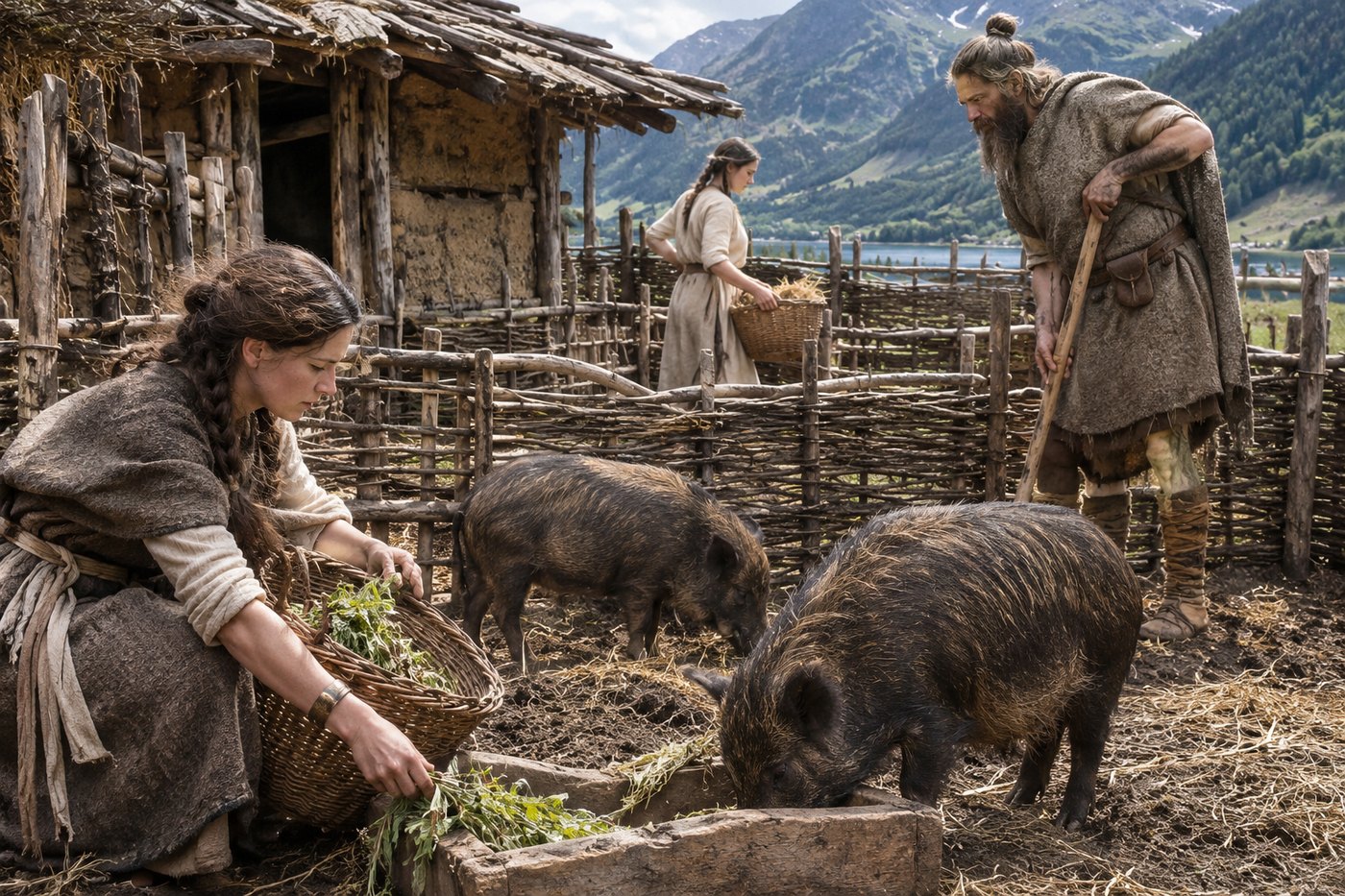
Manure has to be collected, and byres collect it. In the Middle Bronze Age byre houses of Oppeano in northern Italy, dated 1650 to 1550 BCE, people lived under one roof with stalled small herbivores, and the floors held finely laminated layers of dung alternating with layers of wood ash (Nicosia and colleagues 2022). Zimmermann (2014) lists the collection of dung among the reasons for keeping animals in byres. At Pungrt in Slovenia, within the Hallstatt sphere of the Iron Age, a building with floors of clay and a plaster of clay and lime became a stable in its last phase, and its floor held stabling crusts of dung, fodder and liquid animal waste (Van Tonder and Van Tonder-Berger 2026). Clearing out a byre, heaping the dung and urine soaked litter beside the house and carrying it to the fields was therefore part of the farmer’s ordinary work, and the people who supplied Hallstatt with carcasses did this work. Figure 7 places these tasks side by side. No Bronze Age farmstead has yet been excavated in the valleys around Hallstatt, so the farm in the figure is a reconstruction from sites elsewhere.
Lime at Hallstatt
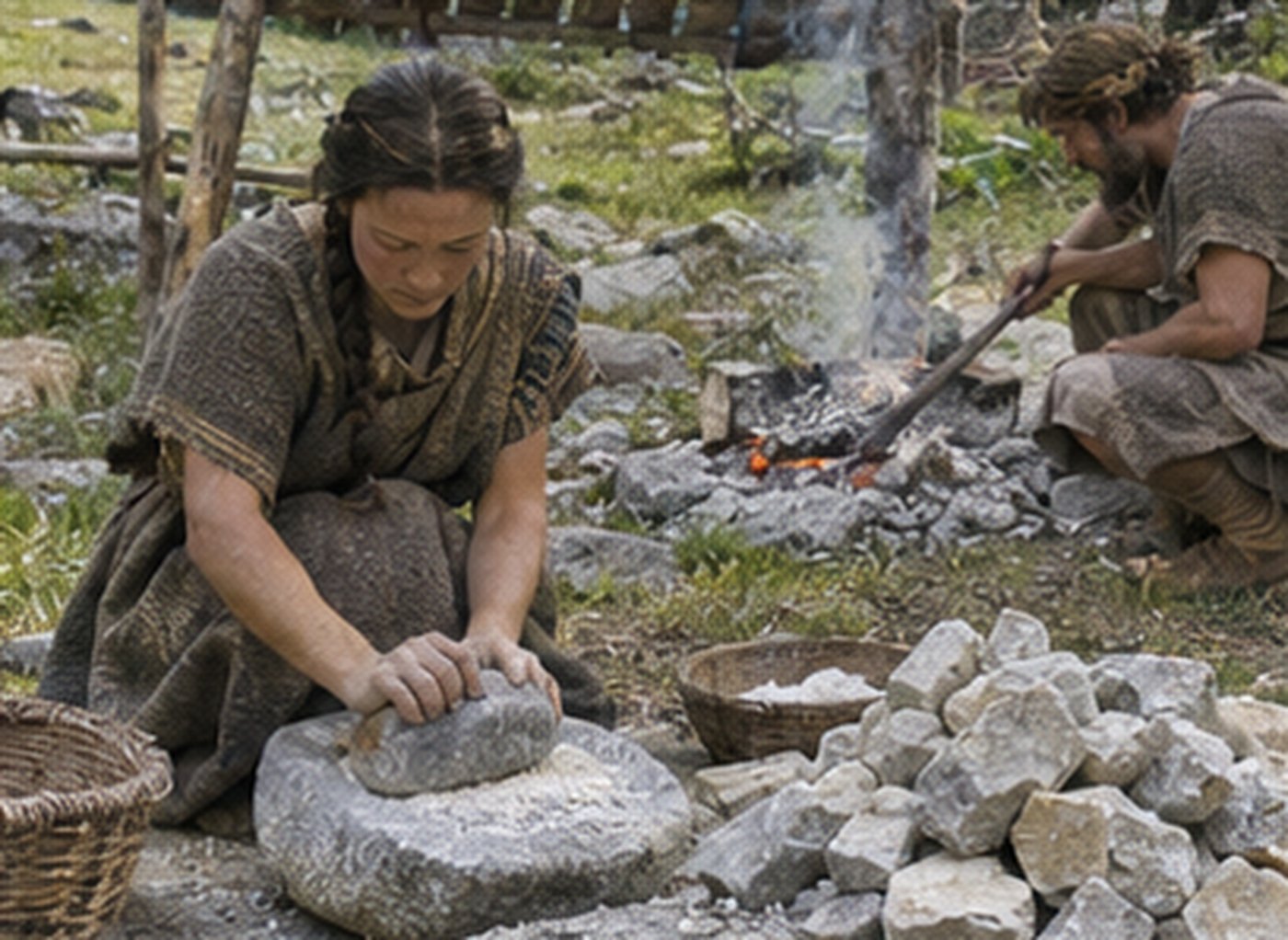
Step 5 needs a material that neutralises the acid released by nitrification without raising the pH so far that ammonia escapes. Three forms were within reach. Ground limestone was the simplest, because the Dachstein above Hallstatt is limestone. Wood ash was the most abundant, from every hearth and from the millions of lighting splints burnt in the mine, and the byre floors of Oppeano preserve dung and ash in alternate layers. Burnt lime is the third. Limestone burnt above about 700 °C gives quicklime, calcium oxide, which water slakes to calcium hydroxide, and in contact with the carbon dioxide of the air the slaked lime turns back into calcium carbonate (Thér and Maršálek 2013). In Central Europe, lime kilns are documented from the Roman period (Thér and Maršálek 2013), and the clay and lime plaster of Pungrt belongs to the Iron Age. Burnt lime at Bronze Age Hallstatt therefore remains possible, whereas ground limestone and wood ash are probable. Fresh quicklime or slaked lime would have worked against Step 6, and only lime left to age back into carbonate would have served as a buffer. Figure 8 sets out the three forms and the steps by which burnt lime would have been prepared.
The Processes and Their Conditions
Before setting out the sequence, we bring together the processes it depends on. Each has its own requirements and its own limits, and the sequence works only if each runs where its conditions are met.
| Process | What happens | Conditions | Limits |
|---|---|---|---|
| Leaching by diffusion | Salt enters the meat. Water, sarcoplasmic proteins, peptides, amino acids, phosphate and potassium leave it | A difference in concentration between meat and brine | Slows as equilibrium is approached. Penetration rate varies with cut dimensions, temperature, composition and salt concentration; no universal rate is assumed |
| Salting in and salting out | Myofibrillar proteins dissolve at moderate salt and precipitate at high salt | Moderate salt dissolves them. High salt precipitates them | Decides whether protein stays in solution or settles |
| Boiling of skins and bones | Collagen becomes soluble gelatine. Some ammonia is released by deamidation | Long boiling. Liming before boiling increases deamidation | Spores survive. No nitrate or nitrite is formed |
| Autolysis | The muscle’s own peptidases free amino acids | Proceeds under salt, without bacteria | Slow in the cold. Months rather than days |
| Deamination | Ammonia is split from amino acids, chiefly arginine | Staphylococci with arginine deiminase. Salt tolerated | Slow in the cold. Yields ammonium, not nitrite |
| Urea hydrolysis | Urea becomes ammonia and carbon dioxide | Urease bacteria. Hours | The pH rises to about 9 and much ammonia escapes |
| Ammonia oxidation | Ammonium becomes nitrite | Dissolved oxygen from the air, low salt, acid neutralised. Days to weeks | About a third of activity lost at 10 g chloride per litre and about 95 percent at 40 g. Stops at about pH 6 without buffering |
| Nitrite oxidation | Nitrite becomes nitrate | Dissolved oxygen, low salt, low free ammonia | More sensitive to salt and free ammonia, so nitrite tends to accumulate |
| Nitrate reduction | Nitrate becomes nitrite | Little oxygen. Staphylococci grow with 10 to 20 percent salt | Rate at 6 to 8 °C to be measured. Once nitrate is exhausted, nitrite becomes ammonium |
| Formation of nitric oxide | Nitrite gives nitric oxide, which binds myoglobin | Acidity and reducing compounds of the meat. Chemistry, no bacteria | Hindered by strong alkalinity. Limited by diffusion into large pieces |
| Release of free ammonia | Ammonium becomes volatile ammonia | High pH. At pH 9 and 10 °C about 15 percent is free | Loss of nitrogen to the air. Smell on opening. Boils off from alkaline liquor |
Two groups of processes are incompatible with each other. Ammonia and nitrite oxidation need dissolved oxygen and low salt. Nitrate reduction and the protection of meat from rot need little oxygen and high salt. A single curing mass can host both groups only if it alternates between two states, and this alternation is the basis of the sequence.
The Groups of Microorganisms and How They Interact
The nitrogen of a reused curing basin passes from one group of microorganisms to another. No single group completes the path from protein to cured pigment, and the groups need opposite conditions. Figure 9 shows how they hand nitrogen on.
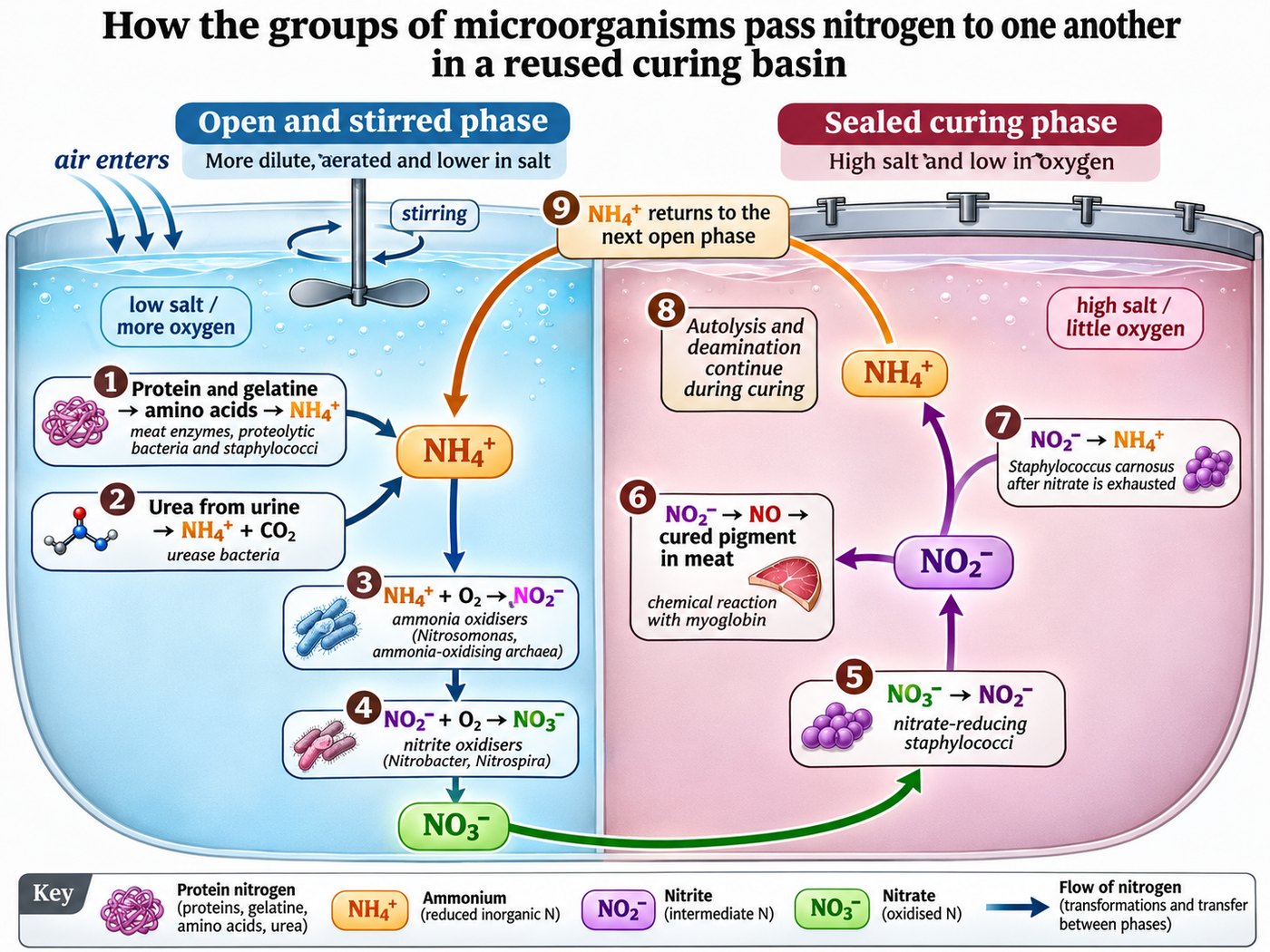
Figure 9. Conceptual biochemical pathways potentially linking nitrogen in protein, urea, ammonium, nitrite and nitrate across open and sealed phases. Arrows indicate pathways known in suitable microorganisms, not proven organisms or reaction rates in the Hallstatt curing basins. Competing reactions and losses are omitted for clarity.
- Meat enzymes, proteolytic bacteria and staphylococci break protein and gelatine down to amino acids and split ammonium from them. The meat’s own enzymes need no bacteria at all.
- Urease bacteria turn the urea of urine into ammonium within hours.
- Ammonia oxidisers, among them Nitrosomonas and ammonia oxidising archaea, turn ammonium into nitrite. They need dissolved oxygen and low salt, so they work only in the open and stirred phase. They come into the mass with village earth.
- Nitrite oxidisers, among them Nitrobacter and Nitrospira, turn nitrite into nitrate. They are more sensitive to salt and to free ammonia than the ammonia oxidisers, so in an ammoniacal mass nitrite tends to accumulate. Free ammonia inhibition of nitrite oxidisers is described by Anthonisen and colleagues (1976).
- Nitrate reducing staphylococci turn nitrate into nitrite under the seal. They tolerate high salt and need little oxygen, the opposite of the nitrifiers.
- Chemistry of the meat, without bacteria, turns nitrite into nitric oxide, which binds myoglobin and forms the cured pigment.
- Staphylococcus carnosus, once the nitrate is used up, reduces nitrite further to ammonium.
- Autolysis and deamination continue to release ammonium from the meat during the cure.
- The ammonium of the sealed phase returns to the next open phase, where the ammonia oxidisers use it again.
Salt holds back the spoilage bacteria in the sealed phase. The halophilic archaea of the rock salt live in the mass as well, but they take no part in these steps.
Chloride and Nitrification. The Cycle as a Whole
Salt does not hinder the formation of ammonia from meat and urine to any great degree. Urea becomes ammonia within hours, and the meat’s own enzymes and salt tolerant staphylococci release ammonium under salt. Salt hinders the next step, the oxidation of ammonia to nitrite and of nitrite to nitrate. Elevated chloride severely impairs that oxidation, and two bodies of research must be considered together.
Moussa and colleagues (2006) exposed enriched cultures of conventional nitrifiers to rising salt. At 10 g chloride per litre the activity of the ammonia oxidisers fell by about a third, and at 40 g it fell by about 95 percent. Polenske’s 20 percent brine holds about 137 g of chloride per litre, and a brine standing over solid salt about 192 g, between three and five times the concentration at which these cultures almost stopped. These results imply severe inhibition of conventional nitrification during a strongly saline curing phase. They cannot be applied as universal limits to every salt adapted community.
Research on halophilic nitrifiers points the other way. Cui and colleagues (2016) enriched a mixed halophilic sludge from estuarine sediment and raised the salinity of the wastewater it treated stepwise. The consortium still removed nitrogen at 30 to 85 g of salt per litre. Its nitrifiers had low maximum growth rates and low specific rates of ammonium oxidation, and the dominant ammonia oxidisers were Nitrosomonas marina, Nitrosomonas europaea and Nitrosococcus mobilis. In the earlier work of the same group with this sludge, nitrite accumulated stably during nitrification. 85 g of salt per litre corresponds to about 52 g of chloride, so nitrification is possible at salinities well above those that stopped the conventional cultures, although still well below that of a strong curing brine.
Moussa and colleagues investigated enriched nitrifying cultures that were strongly inhibited by chloride. Cui and colleagues studied a community acclimatised to elevated salinity. The question for Hallstatt is therefore not whether nitrifiers can work in a curing brine, which they cannot, but what the chloride concentration was in the water accessible to microorganisms during the phase in which the mass was prepared for the next cure, and which organisms lived in it.
The curing basin as a complete system
The chloride concentration must therefore be judged across the whole cycle and not in the curing phase alone. The proposed sequence is a total system in which the same material passed through different states, and each step changed the conditions of the next.
- Curing. The meat lies in strong salt and clay. Nitrification by conventional organisms is strongly constrained. Nitrate reduction may occur, while ammonium and dissolved organic nitrogen can accumulate in the curing mass.
- Removal of meat and brine. Scooping the brine from the partitioned gap removes dissolved salt together with part of the ammonium, nitrate and nitrite. Salt held in the pores of the clay and in undissolved Haselgebirge remains.
- Addition of liquid and earth. Water, urine, cooking liquor and earth from floors, pens and heaps are added. Earth from animal enclosures is more than a diluent. Depending on its state, it brings moisture, ammonium, nitrate, organic matter and microorganisms adapted to the nitrogen rich ground of byres and pens.
- Stirring. Air enters the diluted mass, and ammonium can be oxidised where salt is low enough and oxygen sufficient.
- Resalting. Fresh salt and Haselgebirge restore the strong salt that protects the next charge of meat and stops the nitrifiers.
The cooking liquor must be considered in two forms, because they act in opposite directions. Broth made by boiling bones, skins and feet in fresh water adds water, gelatine and soluble nitrogen, and it dilutes the mass. Liquor made by boiling the scooped brine keeps its salt and concentrates it as water evaporates, and returning it adds salt rather than diluting. Only the first form lowers the chloride of the mass.
A simple balance illustrates the arithmetic. If 20 litres of residual brine at approximately 137 g of chloride per litre for a nominal 20 percent NaCl brine are mixed with 180 litres of fresh water, the liquid holds 12 g of chloride per litre, about 20 g of salt, provided that no further salt dissolves. This is a hypothetical example and not a measurement. Dilution of this order is possible in principle, but the undissolved salt in the clay goes on dissolving until the liquid is in equilibrium with it, and that remaining salt decides whether the dilution holds. Dry earth, moreover, lowers the chloride of the liquid only by the water it brings.
The mass was also not uniform. A mixture of clay, earth, organic matter and water contains more dilute and better aerated zones beside more concentrated and oxygen poor ones. Nitrification would run first where salt was lowest and air entered, at the stirred surface and in pockets of fresh liquid. Stirring redistributes water and brings in oxygen, but the decomposition of dissolved protein, gelatine and other organic matter consumes oxygen as well, so the nitrifiers compete for it with the bacteria that break down organic matter, above all in the deeper layers.
Two routes to nitrification therefore remain open. Dilution may have brought the chloride low enough for the nitrifiers of ordinary soil and byre earth. Alternatively, a mass that passed many times between strong and weak salt may have selected organisms that stayed active at moderate salinity, as in the halophilic sludge of Cui and colleagues. Neither route shows that nitrification took place at Hallstatt, but together they mean that the chloride of the curing brine alone is not sufficient grounds to reject the mechanism. A third route needs no nitrification in the curing basin at all. Nitrate formed in floors, pens and heaps could have entered with the earth. Figure 10 sets out the course of chloride over one cycle as a concept. The extent of the fall is unknown and is the first thing a trial must measure.
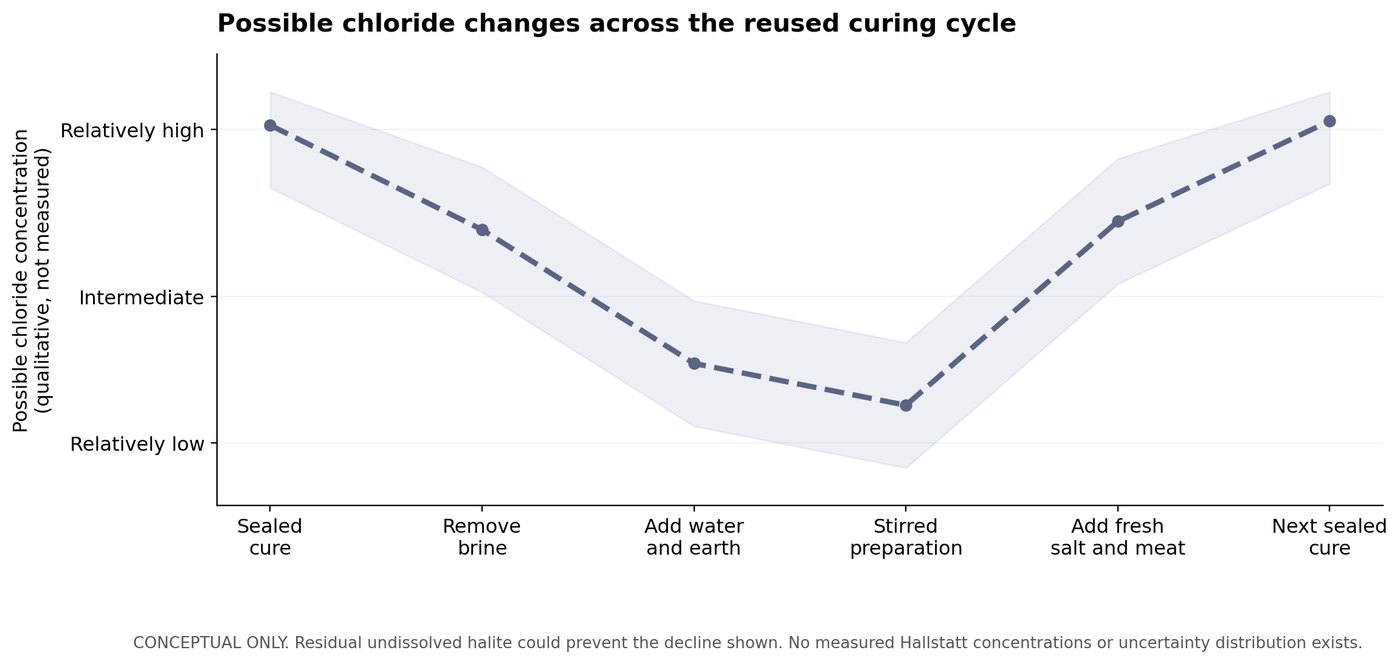
Figure 10. Qualitative conceptual trajectory of chloride concentration during a possible repeated curing cycle. No quantitative chloride concentrations or error bounds have been measured for Hallstatt. Dissolution of residual halite may prevent meaningful dilution even after water is added. Compare with the culture specific findings of Moussa and colleagues (2006).
The hypothesis is therefore not that nitrification proceeded while the meat lay in strong salt. It is that the reused curing material alternated between a state that preserved the meat and a state that allowed nitrogen to be oxidised. The essential chemical requirements are few: removal of part of the brine, addition of water and earth, air, a buffer and time, followed by resalting. Boiling, the return of liquor and fat as a seal are optional historical operations, and the hypothesis does not depend on them.
Proposed Amended Sequence of a Cure in a Reused Curing Basin
When Polenske’s brines are set beside the Hallstatt finds and our earlier work, a sequence emerges. The curing basin alternated between two states. In the first, it was sealed, salty and short of oxygen, and the meat cured. In the second, it was open, diluted and stirred, and the mass was prepared for the next cure. Table 2 summarises what moves into and out of the curing basin in one cycle, and Figures 11 to 18 depict the eight steps one by one. Each figure is drawn as a cutaway through a curing basin, with the double log wall, the clay daub between the walls and the grey loam of the floor as excavated. Coloured arrows mark what moves: meat in red, brine in blue, earth in brown, lime in grey, urine in yellow, salt in violet and air in turquoise. The green line at the foot of each figure lists what is documented, and the red line what rests on reconstruction. We set the sequence out as a hypothesis, with the conditions and limits of each step, and we name for each step the farm or household work from which the curers could have drawn it.
Table 2. What moves into and out of the curing basin in one cycle
| Step | Material | From | To | What it carries |
|---|---|---|---|---|
| 2 | Cured meat | Curing basin | The mine, to dry at 6 to 8 °C | Salt, nitrite and the cured pigment in its outer layer |
| 2 | Brine and meat juice, scooped | Partitioned gap of the curing basin | Graphite clay vessels | Salt, nitrate, nitrite, ammonium, dissolved protein, peptides, amino acids, phosphate, potassium, bacteria |
| 3 | Skins and bones | Slaughter | Graphite clay vessels | Collagen, which boiling turns into gelatine |
| 4 | Boiled liquor, part of it | Graphite clay vessels | Curing basin | Salt, concentrated nitrate, nitrite, gelatine. Bacteria killed, ammonia partly boiled off |
| 4 | Boiled liquor, the rest | Graphite clay vessels | Kept as concentrated food, as Barth proposed | Salt, gelatine, meat extract |
| 5 | Urine soaked earth | Byres, heaps and latrines of the village | Curing basin | Nitrate already formed, nitrifiers, staphylococci, urea, ammonium |
| 5 | Urine, limestone, water | Village and valley | Curing basin | Urea, carbonate buffer, dilution |
| 7 | Fresh salt or rich Haselgebirge | The mine | Curing basin | Salt, clay, anhydrite, polyhalite |
| 7 | Fresh meat | Slaughter | Curing basin, buried in the salt | Protein, myoglobin, the muscle’s own enzymes |
| 8 | Grey loam, perhaps fat | Valley | Over the curing basin | A seal against air and rain |
Step 1. Opening the curing basin
The curers break the loam seal. Ammonia that has built up under the seal escapes, as it did from the pits and skins of the north. It came from three sources: nitrate reduction, deamination and any urea present. The alkaline brine released it as gas. The meat is still in the curing basin at this point, buried in the salt mass.

- Conditions. An alkaline brine and a closed space let free ammonia accumulate.
- Limits. The ammonia that escapes here is lost to the cycle. Its quantity depends on the pH and temperature of the mass.
- Significance. The smell on opening was the normal sign of a sealed store. In a curing basin it may also have indicated that the nitrate of the last cure was exhausted, because only then is nitrite reduced to ammonia.
- Farm practice. Opening a sealed store was familiar from the pits and skins of the north, where the stench on opening was expected. Turning a heap of dung and urine soaked litter releases the same ammonia.
Step 2. Lifting the meat and scooping the brine
The meat is lifted out of the curing basin and carried into the mine, where it hangs to dry at 6 to 8 °C. Its outer layer is salted and coloured, and its interior colours further during maturation. The curers then scoop the free liquid from the partitioned gap that Barth described. This liquid is old brine mixed with meat juice. It contains salt, nitrate, nitrite, ammonium, dissolved protein, peptides, free amino acids, phosphate and potassium, together with the bacteria of the mass.
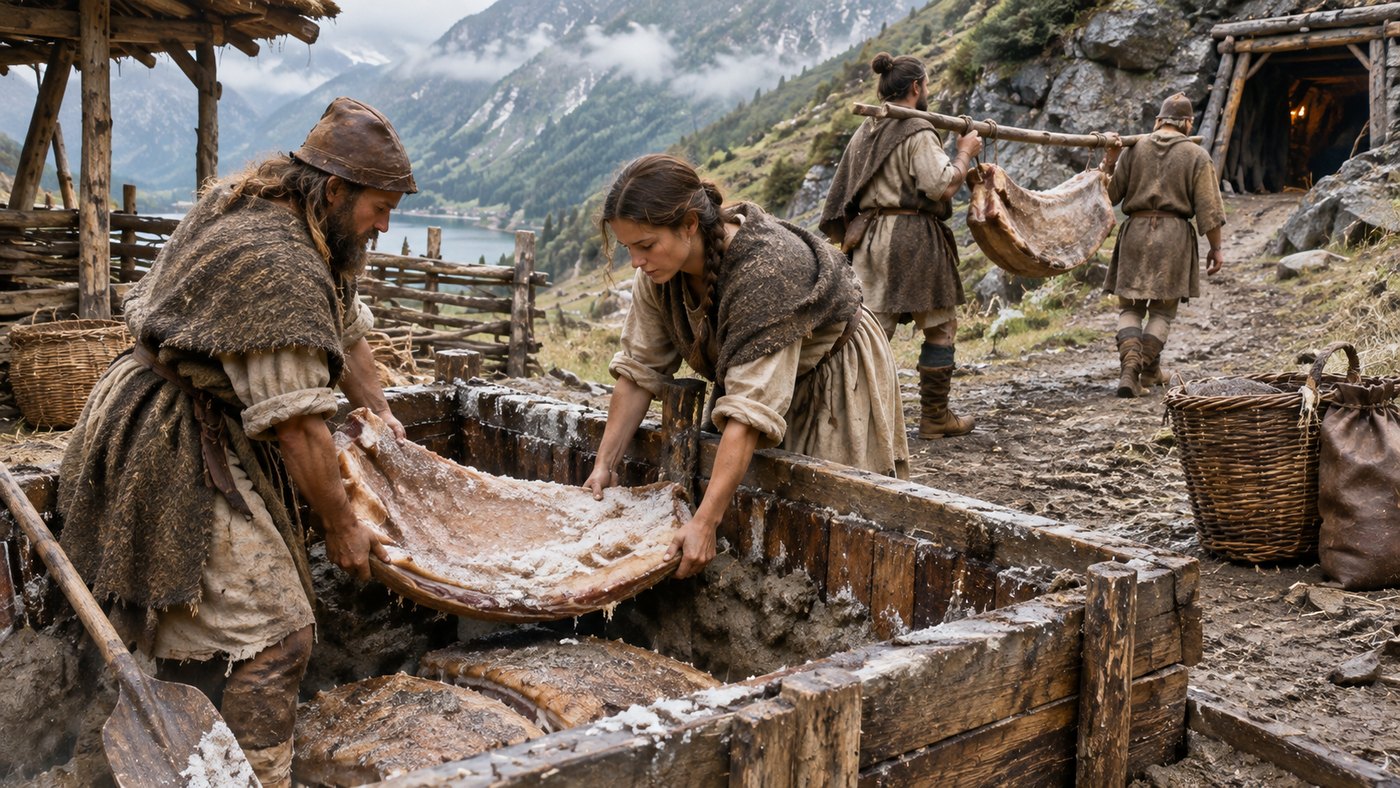
- Effect. Scooping removes salt from the curing basin, and with it part of the dissolved nitrogen compounds.
- Limits. The clay retains part of the brine in its pores, and clay minerals hold ammonium. The salt of the mass falls but is not removed entirely, and part of the nitrogen stays in the clay.
- Farm practice. Carrying carcasses and loads on staves and in leather sacks, and drawing liquid with wooden vessels, were everyday tasks. The carrying sacks are documented in the mine.
Step 3. Boiling the scooped brine
The scooped liquid is boiled in the graphite clay vessels, perhaps together with skins and bones, as Eben proposed. Skins, feet and bones may also have been boiled in fresh water. The two liquors differ, because boiled brine keeps and concentrates its salt, whereas a broth made with fresh water dilutes the mass it is returned to.
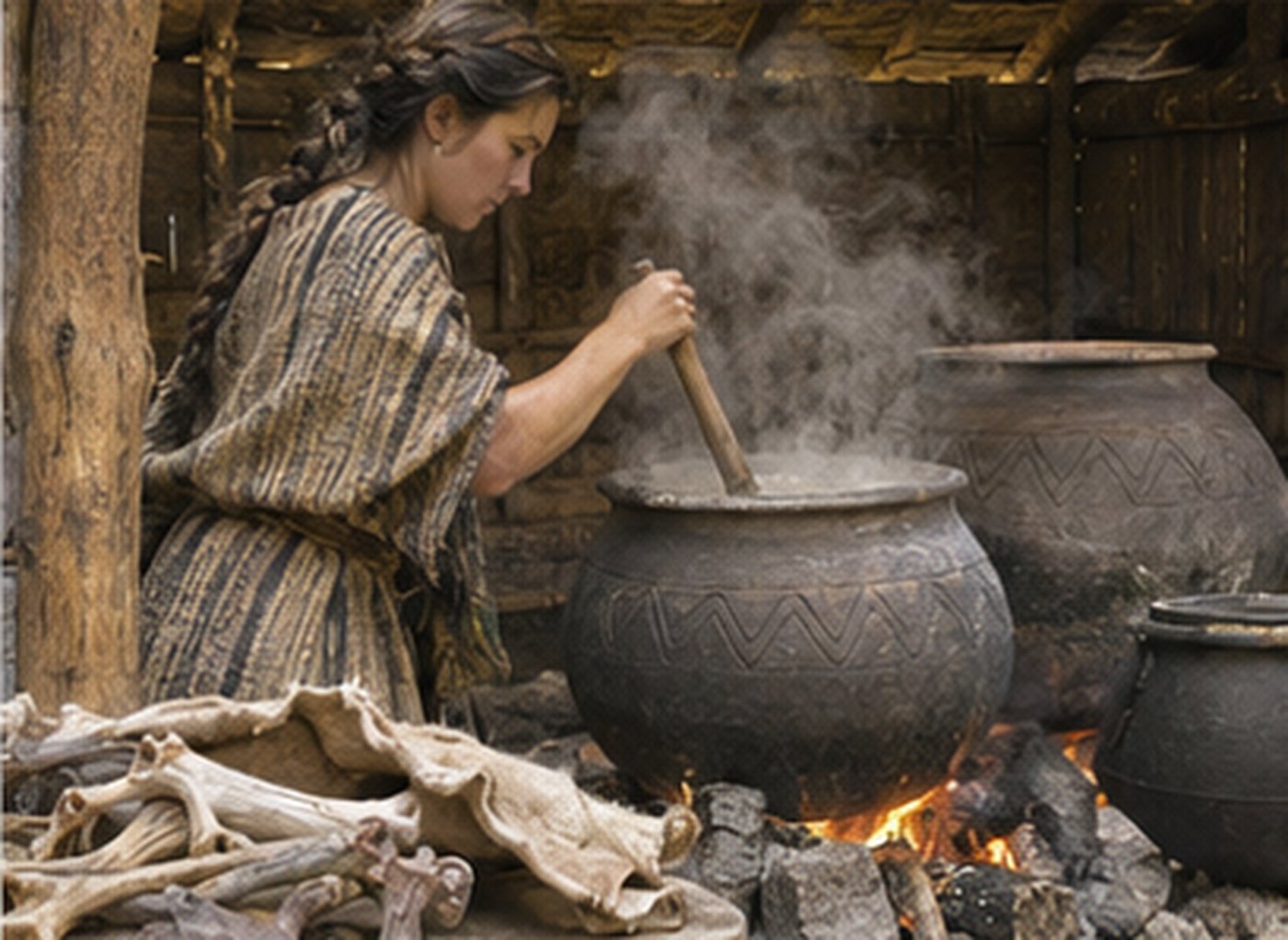
- What stays. Boiling does not remove nitrate. As water evaporates, the nitrate is concentrated in the remaining liquor. Nitrite also stays, because old brine is alkaline, and nitrite decomposes mainly under acid conditions. Salt stays and is concentrated as well.
- What leaves. Ammonia behaves differently. Ammonium in neutral or acid liquor stays largely in solution, but in an alkaline old brine part of it is present as free ammonia, and boiling drives this free ammonia off with the steam. Polenske used exactly this property to measure ammonia. He made his brines alkaline and distilled them, and the ammonia passed over. The boiled liquor therefore returns with less ammonia than it had.
- What changes. Collagen from meat juice, skins and bones becomes gelatine. The bacteria of the liquor are killed, but bacterial spores survive.
- Farm practice. Boiling bones and feet into a gelling broth is documented at the site, and the stew of barley, millet and broad beans with pig and sheep feet belongs to the same kitchen.
Step 4. Returning part of the liquor to the spent mass
Part of the boiled liquor goes back onto the spent clay, and the rest is kept as concentrated food, as Barth proposed. Heat does not sterilise the curing mass, because the mass is large and cold and the liquor is small. For illustration only, take 200 litres of liquor at 95 °C poured onto 5 tonnes of wet clay at 8 °C. With an assumed specific heat of 1.7 kJ per kg per °C for the clay, the mixture settles at about 16 °C.
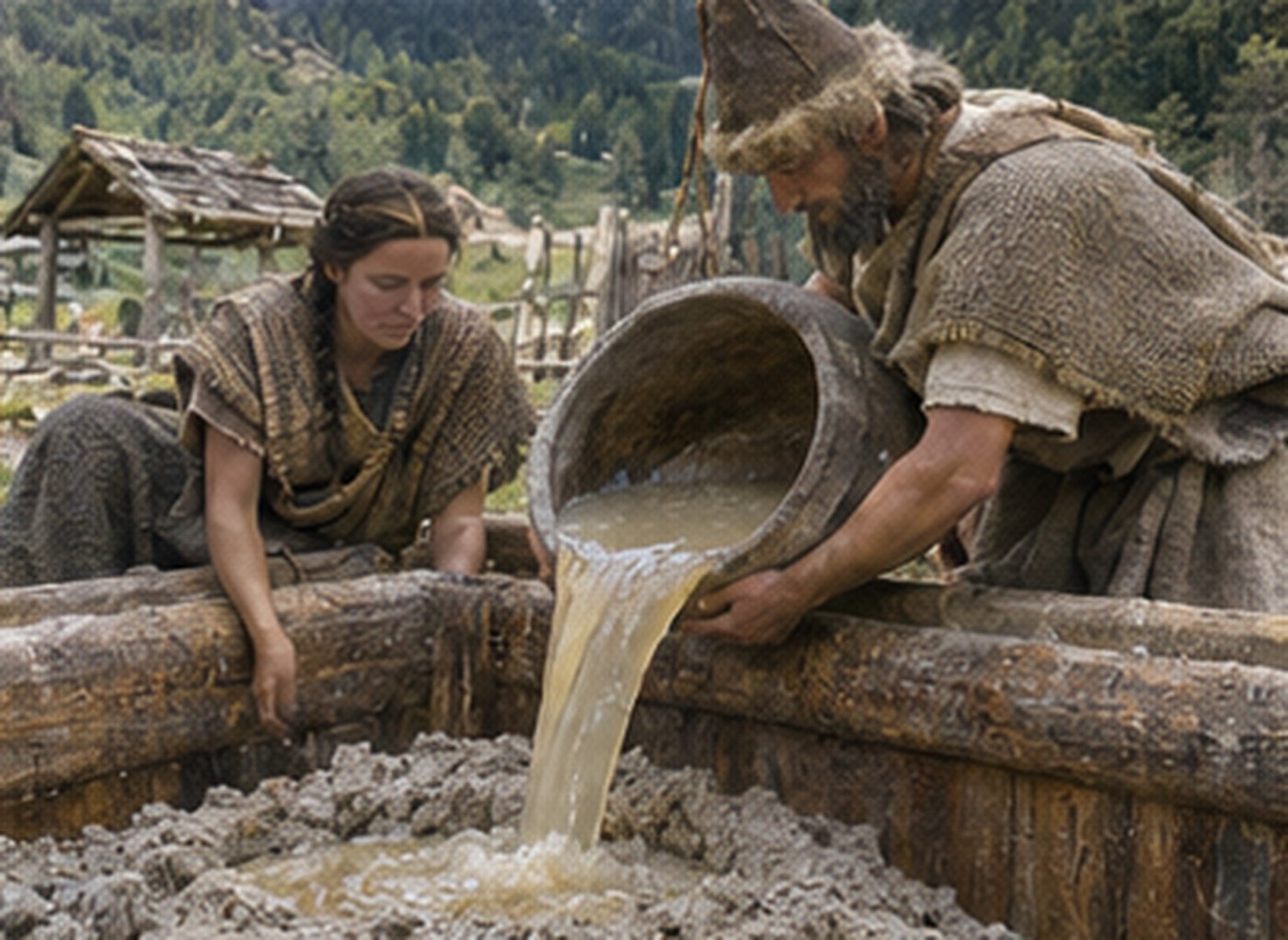
- Effect. The liquor cools within the mass almost at once. The bacteria of the mass survive, the mass is warmed slightly, and it gains nitrite, nitrate and gelatine.
- Limits. The warming is small and short. The mass soon returns to the temperature of the ground and the season.
- Farm practice. Pouring liquid onto a heap of earth and dung to enrich it is recorded in farm sources of the 18th and 19th centuries, as collected in the discussion paper. This is an analogy, not evidence for the Bronze Age.
Step 5. Adding urine soaked earth, urine and limestone
Urine soaked earth is carried in baskets from the byres, heaps and latrines of the village and added to the curing basin, perhaps with urine, water and ground limestone or aged lime. Cold earth lowers the temperature of the mass further, so there is no need to wait for the liquor to cool. No meat is in the curing basin at this stage. The earth brings:
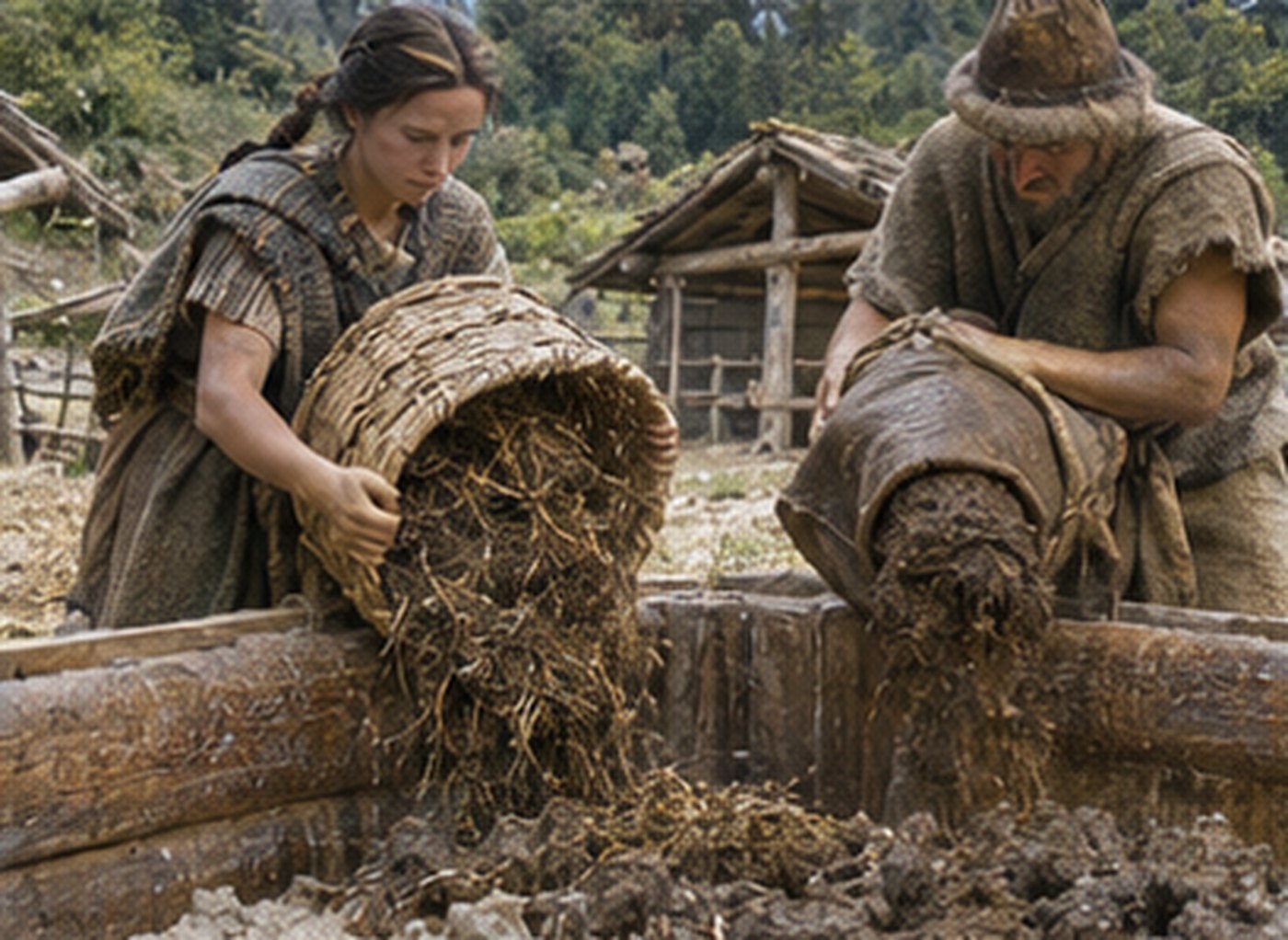
- nitrate already formed in it
- nitrifying bacteria and salt tolerant staphylococci
- urea, which becomes ammonia within hours
The limestone neutralises the acid of nitrification. Because the brine was scooped off and earth, urine and water were added, the liquid in the mass is now much weaker in salt than a fresh salt mass.
- Conditions. Ordinary nitrifying cultures may be severely inhibited at chloride levels substantially below those of a curing brine. Salt adapted communities have been reported to nitrify at elevated NaCl concentrations (Cui and colleagues 2016). The actual chloride concentration of the proposed diluted material, and its microbial activity, remain unknown.
- Limits. Fresh lime in place of limestone would raise the pH so far that the ammonia escapes and the nitrifiers are suppressed.
- Farm practice. Mucking out a byre and heaping its dung, litter and ash was routine farm work, documented for the Bronze Age at Oppeano. The same baskets and sacks carried the earth to the curing basin.
Step 6. Stirring
The curers stir the mass with the whisk and shovels, repeatedly, over some days. No meat is in the curing basin yet. Stirring brings dissolved oxygen into the liquid, and ammonia oxidisers turn ammonium into nitrite. The ammonium comes from four sources:
- the previous cure
- the meat proteins leached into the mass
- the gelatine broth
- the urine
Free ammonia can suppress nitrite oxidation under suitable conditions, permitting nitrite to accumulate. A repeated fluctuation in salinity could favour salt tolerant microorganisms, but neither the selection of such populations nor nitrite accumulation has been demonstrated for the Hallstatt curing material. Free ammonia inhibition of nitrite oxidisers is described by Anthonisen and colleagues (1976).
- Conditions. Air brought in by stirring, low salt, buffered pH and time. Warmer weather between slaughter seasons favours this step.
- Limits. A whisk can stir only a liquid or soft mass, so the mass must be wet enough to be worked. Without frequent stirring, the wet mass becomes oxygen poor again within hours to days. In winter cold, nitrification slows, and the stirring phase would need to be longer.
- Farm practice. Turning a dung heap lets air into it in the same way, and the fir whisk found in the curing basin of 1877 is a tool for mixing a liquid.
Step 7. Adding salt and meat
Fresh rock salt or rich Haselgebirge is brought from the mine and added, and the fresh meat is buried in it, as Barth and Lobisser describe. This is the point at which the meat enters the curing basin.

- Effect. The salt rises sharply and protects the meat, and it stops the nitrifiers, whose work is now done. Nitrite already present reacts with the meat chemically and needs no bacteria.
- Significance. This would explain the fine red colour that Barth obtained during salting, within 7 to 10 days. For large pieces, nitrate alone can hardly explain that colour, because penetration into large cuts may be limited. An estimate of about 1 cm in ten days is illustrative and is not a measured value for the Hallstatt carcasses.
- Limits. Pre formed nitrite also diffuses slowly, and it reacts on the way. The interior of large pieces would therefore colour later, during maturation in the mine. Meat added before the salt reached it would lie in weak liquid and risk spoilage.
- Farm practice. Salting was the household method of keeping meat, and the Gailtal practice of salting two boneless halves is still followed in Carinthia.
Step 8. Sealing and curing
Haselgebirge is laid over the meat, and grey loam is pressed over the curing basin to seal it. A layer of fat could have served as a further seal, as in the north, but only at this step, because fat added earlier would have kept out the air that stirring needs. The meat stays under the seal for 7 to 10 days.

- Effect. Under the seal, the remaining dissolved oxygen is used up. Staphylococci reduce the remaining nitrate to nitrite, and once it is exhausted they reduce nitrite to ammonium. Autolysis frees amino acids, deamination releases ammonium, and leaching carries protein and phosphate out of the meat into the mass. The brine turns alkaline, as in Polenske’s vessels.
- Limits. With each cycle the mass grows softer and richer in clay and protein, until, as Barth and Lobisser concluded, the brine spoils and the curing basin has to be rebuilt. The cycle then returns to Step 1.
- Farm practice. Sealing with clay was the builder’s daily work. The walls of the curing basin of 1939 were sealed with clay daub, and loam was packed into the walls and over the floor to make the timber watertight.
The order of the steps
The sequence is a reconstruction of possible operations. Salt curing and the removal of meat are necessary parts of the proposed process, whereas brine boiling, addition of livestock pen earth, deliberate aeration and the use of fresh cooking liquor remain unverified operations. Their exact order is not established by excavation evidence. Their chemical functions can be tested independently and in combination.
Evidence for Each Step. Archaeology and Chemical Reconstruction
The steps do not rest on the same kind of evidence. Some are documented by finds from the curing basins and the mine, some by finds from the site that do not prove their use in the curing basin, and some by chemistry alone. Table 3 separates the three for each step. We use fact for what the finds establish, probable for what follows from the finds with little further assumption, and possible for what the chemistry permits but no find supports.
Table 3. Evidence for each step of the proposed sequence
| Step | Archaeological and documentary evidence | What rests on chemical reconstruction | Status |
|---|---|---|---|
| Curing basins, salt clay, loam | Eight log basins, two excavated. Double walls sealed with clay. Grey loam in walls and floor. Filled with dissolved salt clay. Haselgebirge and Hauklein (NHM; Barth 2001) | Nothing | Fact |
| Reuse and turning of the mass | Mass grew softer and richer in clay and protein until the brine spoiled (Barth and Lobisser 2002). Fir whisk and wooden shovels in the 1877 structure (Barth) | Nothing for the reuse. The purpose of the whisk is inferred | Fact for reuse, probable for turning |
| 1. Opening, ammonia | Arctic sealed stores stank on opening (Bogoras). Ammonia from decomposing meat (Speth 2017) | Ammonia from the cure itself, from Polenske’s alkaline brines | Probable |
| 2. Meat to the mine, brine scooped | Mine climate 7 °C and 60 percent humidity, maturing trials (Barth 2001). Partitioned gap in the 1877 structure (Barth) | Composition of the scooped liquid, from Polenske (1891) | Probable |
| 3. Boiling | Graphite clay cooking vessels. Bones boiled until the broth gelled (Pucher and colleagues 2013). Barth’s boiled liquor as food | Boiling of the scooped brine itself. What stays and what leaves | Fact for boiling bones, possible for boiling brine |
| 4. Liquor returned | None | Return of liquor to the mass. Heat balance | Possible |
| 5. Earth, urine, limestone | Human faeces and worm eggs in the mine (Barsch and colleagues 2023). Byre floors with dung and ash elsewhere (Nicosia and colleagues 2022). Dachstein limestone | Earth or urine added to the curing basin. Nitrate in that earth | Possible |
| 6. Stirring and nitrification | The whisk and shovels (Barth) | Nitrite formation in a diluted, buffered and aerated mass (Moussa and colleagues 2006; Udert and colleagues 2003) | Possible |
| 7. Salt and fresh meat | Salt clay, Hauklein, boneless sides, 150 to 200 carcasses per basin (NHM; Barth 2001) | Salting after the stirring phase. Pre formed nitrite reacting with the meat | Fact for salting, possible for the order |
| 8. Sealing and curing | Grey loam and Haselgebirge. Ten days of brine curing gave adequate penetration in trials (NHM) | Nitrate reduction, alkaline brine and ammonium under the seal (Polenske 1891). Fat as a seal | Probable for sealing, possible for fat |
| Lime | Dachstein limestone. Ash in the mine. Clay and lime plaster at Pungrt in the Iron Age | Burnt lime at Bronze Age Hallstatt | Probable for limestone and ash, possible for burnt lime |
The fill of the curing basins is the record that could move the reconstructed steps towards fact. Samples of the salt clay that remain in or beneath the excavated basins, and in the basins not yet excavated, could be analysed for phosphate, for the nitrogen isotopes of their organic matter, for faecal sterols such as coprostanol, for eggs of roundworm and whipworm, and for wood ash. Faecal markers and worm eggs in the fill would support Step 5. Wood ash would support the use of ash as a buffer. Their absence would weaken both.
Source criticism and the limits of reconstruction
Excavation evidence and reconstructed operations are evaluated separately. The Natural History Museum Vienna documents the curing basin interpretation, the concentrated pig bone assemblage, unusual butchery pattern and the availability of Haselgebirge. Those findings support organised meat processing and the use of timber structures for salting. The existence of an intentional nitrification protocol, the collection and return of cooked brine, and the introduction of dung, urine or nitrate bearing earth are not demonstrated by excavation. They are reconstructions proposed to explain a possible source of nitrate or nitrite. (NHM, Meat Processing Industry; NHM, Analysis of Animal Bones; Pucher and colleagues 2013.)
Comparative sites establish technological possibility, not identical Hallstatt operations. Archaeological evidence for livestock pens, manure handling and cereal manuring elsewhere in Bronze Age Europe makes such materials historically credible, but it cannot show that Hallstatt curing workers selected, transported or inoculated their basins with them. Claims about repeated dilution and a removable airtight upper seal therefore remain conditional. The same caution applies to the realistic illustrations, which present the proposed sequence rather than photographs of excavation results.
The complete alternation of concentrated curing and low salinity preparation is a stronger hypothesis than nitrification in an unchanged 20 percent salt brine. Yet its feasibility depends on the residual mass of solid halite. Dilution lowers chloride only if added liquid outweighs dissolution from solids and retained brine. The relevant denominator is the liquid accessible to microorganisms, and pore water may be chemically heterogeneous. A combined salt, water and nitrogen balance is consequently necessary before any historical probability can be assigned to effective in basin nitrification.
Historical source fidelity
Polenske’s 1891 publication has been consulted directly in the digitised original, volume 7, pages 471 to 474. Page 472 reports the beef weight changes, extraction percentages and recovered sediment and dissolved nitrogenous material. Page 473 explicitly proposes a probable microbial contribution to nitrate reduction. Page 474 reports ammonia concentrations of 0.0049, 0.0066 and 0.0306 g NH₃ per 100 g for brines I, II and III, and identifies 0.0510 g N₂O₃ per 100 g in brine III. No N₂O₃ values are reported for brines I and II because they were not determined. The data establish the observations without identifying the responsible microbial species or demonstrating the operations proposed for Hallstatt.
Quantitative constraints and alternative pathways
The central nitrogen inventory calculation is illustrative. A 7.5 to 10 tonne charge at 3.2 percent nitrogen contains 240 to 320 kg total nitrogen. A hypothetical 1 percent loss into the curing material is therefore 2.4 to 3.2 kg total nitrogen. This is not a prediction of ammonium, nitrite or nitrate yield. Hydrolysis, mineralisation, volatilisation, microbial assimilation, dissimilatory nitrate reduction and nitrite oxidation compete for the same nitrogen pools. The oxygen requirement for oxidising ammonium nitrogen is approximately 3.43 g O₂ per g N to nitrite and 4.57 g O₂ per g N to nitrate. Availability of dissolved oxygen, not merely the presence of an open surface, governs the reaction rate.
Direct environmental supply of nitrate or nitrite is a separate explanatory route. Even if nitrification within the basin remained limited by chloride, nitrate bearing earth could introduce oxidised nitrogen already formed in a pen floor or a drained and aerated heap. Consequently, a negative in basin nitrification trial would not independently refute a soil derived nitrate pathway. Likewise, detection of nitrification in an experimental basin would not demonstrate that prehistoric people intentionally managed it.
Research priorities and experimental discriminators
A replicated factorial experimental programme should test the proposed whole cycle. The factors are brine removal, added fresh water, addition of ordinary or pre nitrified pen earth, collagen broth prepared with fresh water or concentrated curing liquor, stirring and oxygen supply, and carbonate buffering. Each treatment should include a concentrated reference curing mass and appropriate sterile and microbial controls. The five key contrasts within the design are meat introduced before versus after the preparation phase, with versus without urine, carbonate versus freshly slaked lime, with versus without brine removal, and stirred versus unstirred material. The order and interaction of these factors must be evaluated with replication. Sampling should occur before and after brine removal, after each addition, throughout preparation, and after resalting at several depths. Measure the total water and chloride inventory, pH, temperature, dissolved oxygen, ammonia in the air, ammonium, nitrite, nitrate, organic nitrogen, free amino acids, phosphate, proteolysis products and microbial populations. Separate measurements of pigment chemistry are required in the meat. An ammonium tracer labelled with ¹⁵N may test transfer into oxidised nitrogen and pigment, subject to appropriate analytical controls.
The resulting meat and curing material must be treated as experimental research material, not food intended for consumption, because the proposed use of environmental soil and animal waste introduces substantial contamination hazards. Historic plausibility must not be confused with food safety under modern standards.
Analytical measurements for the factorial experimental programme
The replicated factorial treatments incorporate the five contrasts listed below. Measurements must distinguish leaching, volatilisation, microbial nitrogen transformations and residual halite dissolution. All materials are experimental and are not intended for human consumption.
- nitrate, nitrite, ammonium and pH
- chloride in the liquid of the mass after brine removal, after each addition and through the stirring phase, at several depths, as the residual salt goes on dissolving
- dissolved oxygen in the liquid, during and after stirring
- dissolved nitrogen substance, gelatine, free amino acids and phosphate
- nitrate, nitrite and ammonium in the scooped liquor before and after boiling
- temperature of the mass after the hot liquor is returned
- nitrosyl haem and zinc protoporphyrin in the meat, with zinc protoporphyrin considered in relation to Wakamatsu, Nishimura and Hattori (2004)
- ammonia in the air on opening
The five experimental contrasts applied within this factorial design are as follows.
- meat introduced before versus after the open preparation phase
- preparation with urine versus the same preparation without urine
- carbonate buffer versus fresh lime under controlled pH
- brine removal followed by dilution versus no brine removal
- stirred and aerated material versus unstirred material
A trial with ammonium labelled with 15N would show whether ammonium from the meat reaches the pigment.
The chronology of Scandinavian mother brines, Wiltshire live brines and the microbiological safety of reused curing media requires separate consideration. No chronological continuity between those practices and Bronze Age Hallstatt is established by the present evidence.
Conclusion
Working back from what the curing basins produced, red cured pork in a few weeks and a mass that was reused until it spoiled, and taking together what the finds establish, the sequence divides into three parts.
The first part is established. The curing basins existed, they were sealed with loam, they were filled with Haselgebirge, they were used for large quantities of pork that came from the valleys as carcasses, the mass was reused and turned, bones were boiled to broth in graphite clay vessels, and cured meat could mature in the mine. Polenske’s brines of 1891 make it probable that a reused mass of this kind leached protein and phosphate from the meat, turned alkaline, released ammonia and contained nitrite.
The second part is probable. Opening released ammonia, brine collected in the partitioned gap and could be scooped, and the mass was turned between cures with the whisk and shovels. Each of these follows from a find together with the chemistry of an old brine.
The third part is possible but not demonstrated, and it contains the steps we regard as most problematic.
- Step 6, nitrification in the curing mass, remains experimentally unresolved. Moussa and colleagues (2006) observed strong inhibition in their enriched cultures at 40 g chloride per litre. A nominal 20 percent NaCl curing brine contains approximately 137 g chloride per litre, depending on density and concentration convention, and saturated brine can approach 192 g per litre. Brine removal and additions of water, moist earth or fresh water broth could reduce dissolved chloride, but residual halite could dissolve and limit the reduction. Both dilution and the biological response therefore require direct measurement.
- Step 5, the addition of urine soaked earth or urine, has no direct evidence. Human waste lay in the soil around the mine, and farmers collected dung as routine work, but no find places such earth in a curing basin. The analyses of the fill named above would test it.
- Steps 3 and 4, boiling the scooped brine and returning it, rest on chemistry and on Barth’s interpretation of the boiled liquor as food. Boiled brine changes little in the nitrogen balance and adds back salt. A broth made with fresh water would instead dilute the mass and add soluble nitrogen. The sequence would work without either.
- Burnt lime and fat as a seal are the least supported details. Burnt lime is documented in Central Europe only from much later periods, and fresh lime would in any case have worked against nitrification. Fat as a seal has an analogy in the north but no find at Hallstatt.
The distinction between a concentrated curing phase and a potentially diluted preparation phase provides a chemically testable explanation for changing nitrogen transformations in reused curing material. Whether Bronze Age workers intentionally created those conditions, and whether nitrification occurred within the basins rather than in imported earth, remains unknown.
Selected earlier studies informing this investigation
| Study | Authors | Online source |
|---|---|---|
| Saltpeter. A Concise History and the Discovery of Dr. Ed Polenske | Eben van Tonder | Open article |
| The Hallstatt Curing Method | Eben van Tonder | Open article |
| Meat Preservation in Clay with Ammonia, Saliva and Lime | Eben van Tonder and Christa Berger | Open article |
| Urine in Meat Curing | Eben van Tonder | Open article |
| Amino Acids in Late Bronze Age Curing | Eben van Tonder and Christa van Tonder-Berger | Open article |
| Eduard Polenske and the Scientific Discovery of Nitrite Formation in Meat Curing, 1891 | Eben van Tonder | Open article |
| The Nitrate Source of the Hallstatt Cure | Eben van Tonder and Christa van Tonder-Berger | Open article |
References
Anthonisen, A. C., Loehr, R. C., Prakasam, T. B. S. and Srinath, E. G. (1976). Inhibition of nitrification by ammonia and nitrous acid. Journal of the Water Pollution Control Federation, 48(5), 835 to 852. https://pubmed.ncbi.nlm.nih.gov/948105/
Austrian Archaeological Institute, Austrian Academy of Sciences (2023). Bronze Age pastures, climate change and environmental archives. Interdisciplinary research on the Dachstein plateau. News, 26 June 2023. https://www.oeaw.ac.at/en/oeai/media/news-archive/news-detail/dachsteinplateau
Barsch, E., Kowarik, K., Rodler, K., Hörweg, C., Reschreiter, H., Sattmann, H. and Walochnik, J. (2023). First molecular data on the human roundworm Ascaris lumbricoides species complex from the Bronze and Iron Age in Hallstatt, Austria. Scientific Reports, 13, 12055. https://doi.org/10.1038/s41598-023-38989-8
Barth, F. E. (2001). Bronzezeitliche Fleischverarbeitung in Hallstatt. Arheološki vestnik, 52, 139 to 141. https://ojs.zrc-sazu.si/av/article/download/8351/7714/22832
Barth, F. E. and Lobisser, W. F. A. (2002). Das EU-Projekt Archaeolive und das archäologische Erbe von Hallstatt. Veröffentlichungen aus dem Naturhistorischen Museum in Wien, Neue Folge 29. Quoted in Van Tonder, E. (2024). The Hallstatt Curing Method. EarthwormExpress. Hallstatt Notes
Bogaard, A., Fraser, R., Heaton, T. H. E., Wallace, M., Vaiglova, P., Charles, M., Jones, G., Evershed, R. P., Styring, A. K., Andersen, N. H. and colleagues (2013). Crop manuring and intensive land management by Europe’s first farmers. Proceedings of the National Academy of Sciences, 110, 12589 to 12594. https://doi.org/10.1073/pnas.1305918110
Cui, Y. W. and colleagues (2016). The effects of salinity on nitrification using halophilic nitrifiers in a sequencing batch reactor treating hypersaline wastewater. Scientific Reports, 6, 24825. https://doi.org/10.1038/srep24825
Emerson, K., Russo, R. C., Lund, R. E. and Thurston, R. V. (1975). Aqueous ammonia equilibrium calculations. Effect of pH and temperature. Journal of the Fisheries Research Board of Canada, 32, 2379 to 2383. https://doi.org/10.1139/f75-274
Grabner, M. and colleagues (2021). Prehistoric salt mining in Hallstatt, Austria. New chronologies out of small wooden fragments. Dendrochronologia, 66, 125814. https://doi.org/10.1016/j.dendro.2021.125814
Grömer, K. and Reschreiter, H. (eds.) (2021). Leather and skin artefacts from Hallstatt and their relevance for research. ArchOn 3. Vienna. Natural History Museum Vienna. https://verlag.nhm-wien.ac.at/ArchOn_Hallstatt/ArchOn_3.pdf
Heiss, A. G. and colleagues (2021). Dig out, dig in! Plant based diet at the Late Bronze Age copper production site of Prigglitz-Gasteil (Lower Austria) and the relevance of processed foodstuffs for the supply of Alpine Bronze Age miners. PLOS ONE, 16, e0248287. https://doi.org/10.1371/journal.pone.0248287
Lawrie, R. A. and Ledward, D. A. (2006). Lawrie’s Meat Science, 7th edition. Cambridge. Woodhead Publishing.
Maixner, F., Sarhan, M. S., Huang, K. D. and colleagues (2021). Hallstatt miners consumed blue cheese and beer during the Iron Age and retained a non Westernized gut microbiome until the Baroque period. Current Biology, 31, 5149 to 5162. https://doi.org/10.1016/j.cub.2021.09.031
Millero, F. J., Feistel, R., Wright, D. G. and McDougall, T. J. (2008). The composition of Standard Seawater and the definition of the Reference Composition Salinity Scale. Deep Sea Research Part I, 55, 50 to 72.
Moussa, M. S., Sumanasekera, D. U., Ibrahim, S. H., Lubberding, H. J., Hooijmans, C. M., Gijzen, H. J. and van Loosdrecht, M. C. M. (2006). Long term effects of salt on activity, population structure and floc characteristics in enriched bacterial cultures of nitrifiers. Water Research, 40, 1377 to 1388. https://doi.org/10.1016/j.watres.2006.01.029
Natural History Museum Vienna. Bronze Age meat processing around the mine in Hallstatt. https://www.nhm.at/hallstatt/en/trading_hub/meat_processing_industry
Natural History Museum Vienna. Results of animal bone analyses from the Salzbergtal valley. https://www.nhm.at/hallstatt/en/trading_hub/meat_processing_industry/analysis_of_animal_bones
Natural History Museum Vienna. Working life in the Bronze Age. https://www.nhm.at/hallstatt/en/salt_mine/bronze_age/working_life
Nicosia, C., Polisca, F., Miller, C., Ligouis, B., Mentzer, S., Mangani, C. and Gonzato, F. (2022). High resolution sediment analysis reveals Middle Bronze Age byre houses at the site of Oppeano (Verona province, NE Italy). PLOS ONE, 17, e0272561. https://doi.org/10.1371/journal.pone.0272561
Polenske, E. (1891). Ueber den Verlust, welchen das Rindfleisch an Nährwerth durch das Pökeln erleidet, sowie über die Veränderungen salpeterhaltiger Pökellaken. Arbeiten aus dem Kaiserlichen Gesundheitsamte, 7, 471 to 474. http://books.google.co.za/books?id=R_YAAAAAYAAJ&pg=PA471
Pucher, E., Barth, F. E., Seemann, R. and Brandstätter, F. (2013). Bronzezeitliche Fleischverarbeitung im Salzbergtal bei Hallstatt. Mitteilungen der Prähistorischen Kommission 80. Vienna. Austrian Academy of Sciences Press. https://library.oapen.org/handle/20.500.12657/33851
Reed, K., Kudelić, A., Essert, S., Polonijo, L. and Vrdoljak, S. (2024). House of Plenty. Reassessing food and farming in Late Bronze Age Croatia. Environmental Archaeology, 29, 165 to 181. https://doi.org/10.1080/14614103.2021.1979385
Reschreiter, H. and Kowarik, K. (2019). Bronze Age Mining in Hallstatt. A New Picture of Everyday Life in the Salt Mines and Beyond. Archaeologia Austriaca, 103, 99 to 136. https://doi.org/10.1553/archaeologia103s99
Salazar, E., Cayuela, J. M., Abellán, A., Bueno Gavilá, E. and Tejada, L. (2020). Fatty Acids and Free Amino Acids Changes during Processing of a Mediterranean Native Pig Breed Dry Cured Ham. Foods, 9(9), 1170. https://doi.org/10.3390/foods9091170
Salzwelten. The oldest staircase in Europe. Hallstatt archaeology. https://salzwelten.at/en/blog/hallstatt-archaeology
Speth, J. D. (2017). Putrid meat and fish in the Eurasian Middle and Upper Paleolithic. Are we missing a key part of Neanderthal and modern human diet? PaleoAnthropology, 2017, 44 to 72. https://paleoanthropology.org/ojs/index.php/paleo/article/download/752/713/1168
Styring, A. K., Rösch, M., Stephan, E., Stika, H. P., Fischer, E., Sillmann, M. and Bogaard, A. (2017). Centralisation and long term change in farming regimes. Comparing agricultural practices in Neolithic and Iron Age south west Germany. Proceedings of the Prehistoric Society, 83, 357 to 381. https://doi.org/10.1017/S0079497X17000032
Sánchez Mainar, M., Weckx, S. and Leroy, F. (2014). Coagulase Negative Staphylococci Favor Conversion of Arginine into Ornithine despite a Widespread Genetic Potential for Nitric Oxide Synthase Activity. Applied and Environmental Microbiology, 80(24), 7741 to 7751. https://doi.org/10.1128/AEM.02298-14
Thér, R. and Maršálek, D. (2013). Experimental lime burning based on the findings from the Roman Empire period. EXARC Journal, 2013/1. https://exarc.net/ark:/88735/10100
Udert, K. M., Fux, C., Münster, M., Larsen, T. A., Siegrist, H. and Gujer, W. (2003b). Nitrification and autotrophic denitrification of source separated urine. Water Science and Technology, 48(1), 119 to 130.
Udert, K. M., Larsen, T. A., Biebow, M. and Gujer, W. (2003a). Urea hydrolysis and precipitation dynamics in a urine collecting system. Water Research, 37, 2571 to 2582. https://doi.org/10.1016/S0043-1354(03)00065-4
Van Tonder, E. (2016). Saltpeter. A Concise History and the Discovery of Dr. Ed Polenske. EarthwormExpress. https://earthwormexpress.com/about-meat-curing/functional-ingredients/a-concise-history-of-saltpeter/
Van Tonder, E. (2018). 01. How did Ancient Humans Preserve Food? EarthwormExpress. https://earthwormexpress.com/the-prehistory-of-food/in-prehistory-we-ate-fermented-foods/
Van Tonder, E. (2018). The Sal Ammoniac Project. EarthwormExpress. https://earthwormexpress.com/2018/02/05/the-sal-ammoniac-project/
Van Tonder, E. (2019). The Mother Brine. EarthwormExpress. https://earthwormexpress.com/2019/03/03/the-mother-brine/
Van Tonder, E. (2024). The Hallstatt Curing Method. EarthwormExpress. Hallstatt Notes
Van Tonder, E. (2025). Eduard Polenske and the Scientific Discovery of Nitrite Formation in Meat Curing, 1891. EarthwormExpress. https://earthwormexpress.com/about-meat-curing/the-history-and-use-of-nitrate-and-nitrite/arbeiten-aus-dem-kaiserlichen-gesundheitsamte/
Van Tonder, E. (2025). Exploring the Hallstatt Salt Curing Method. An Archaeological and Biochemical Investigation. EarthwormExpress. https://earthwormexpress.com/about-eben/k-b/the-austria-articles-die-osterreich-artikel/hallstatt-notes/the-hallstatt-curing-method/exploring-the-hallstatt-salt-curing-method-an-archaeological-and-biochemical-investigation/
Van Tonder, E. (2025). Sacred Sustenance. The Celebration of Meat Preservation in Northern Cultures and Its Integration into Christian Traditions. EarthwormExpress. https://earthwormexpress.com/about-eben/k-b/sacred-salt-and-the-northern-gods/holisticus-index-page/sacred-curing-chronicles-the-origins-evolution-of-meat-curing/historical-origins-symbolism-and-easter-traditions-of-cured-meats-meat-blessing/sacred-sustenance-the-celebration-of-meat-preservation-in-northern-cultures-and-its-integration-into-christian-traditions/
Van Tonder, E. (2025). Survival, Spirituality, and Celebration. Inughuit Meat Preservation Practices and the Quviasukvik Winter Feast. EarthwormExpress. https://earthwormexpress.com/survival-spirituality-and-celebration-inughuit-meat-preservation-practices-and-the-quviasukvik-winter-feast/
Van Tonder, E. (2025). Urine in Meat Curing. Revisiting Historical Practices through Biochemical and Agronomic Insights. EarthwormExpress. https://earthwormexpress.com/about-eben/k-b/the-austria-articles-die-osterreich-artikel/hallstatt-notes/the-hallstatt-curing-method/urine-in-meat-curing-revisiting-historical-practices-through-biochemical-and-agronomic-insights/
Van Tonder, E. and Berger, C. (2025). The Hallstatt Meat Curing Method. An Update on Late Bronze Age Industrial Processes. EarthwormExpress. https://earthwormexpress.com/about-eben/k-b/the-austria-articles-die-osterreich-artikel/hallstatt-notes/the-hallstatt-curing-method/the-hallstatt-meat-curing-method-an-update-on-late-bronze-age-industrial-processes/
Van Tonder, E. and Brynwyn, C. (2024). Meat Preservation in Clay with Ammonia, Saliva and Lime. A Historical and Chemical Perspective. EarthwormExpress. https://earthwormexpress.com/about-eben/k-b/sacred-salt-and-the-northern-gods/holisticus-index-page/meat-preservation-through-ammonia-a-historical-and-chemical-perspective/
Van Tonder, E. and Van Tonder-Berger, C. (2025). Amino Acids in Late Bronze Age Curing. Investigating the Role of Lysine, Glutamine and Glutamate in Ammonia Production. EarthwormExpress. https://earthwormexpress.com/about-eben/k-b/the-austria-articles-die-osterreich-artikel/hallstatt-notes/the-hallstatt-curing-method/amino-acids-in-late-bronze-age-curing-investigating-the-role-of-lysine-glutamine-and-glutamate-in-ammonia-production/
Van Tonder, E. and Van Tonder-Berger, C. (2026). The Nitrate Source of the Hallstatt Cure. Discussion Paper. EarthwormExpress. https://earthwormexpress.com/salt-salz-sul-%e7%9b%90-yan-sol-%ce%b1%ce%bb%ce%b1%cf%83-usawoti-%d9%85%d9%84%d8%ad-letsoai-sel-sal-%d9%86%d9%85%da%a9-muoi-%e9%b9%bd-sout-%e5%a1%a9-shio-%ec%86%8c/the-origin-of-salted-pork-traditions-hallstatt-the-bronze-age-pork-industry-and-the-formation-of-the-european-curing-tradition/the-nitrate-source-of-the-hallstatt-cure-2/
Van Tonder, E. Uncovering the Link Between Celtic Curing Traditions and Early Monastic Practices in Austria. A Journey from Hallstatt to the Benedictine Abbey. EarthwormExpress. https://earthwormexpress.com/uncovering-the-link-between-celtic-curing-traditions-and-early-monastic-practices-in-austria-a-journey-from-hallstatt-to-the-benedictine-abbey/
Wakamatsu, J., Nishimura, T. and Hattori, A. (2004). A Zn-porphyrin complex contributes to bright red colour in Parma ham. Meat Science, 67, 95 to 100.
Ward, B. B. (2008). Nitrification in marine systems. In Capone, D. G., Bronk, D. A., Mulholland, M. R. and Carpenter, E. J. (eds.), Nitrogen in the Marine Environment, 2nd edition. Amsterdam. Academic Press.
Zimmermann, W. H. (2014). Anmerkungen zur Geschichte des Stalles von der Urgeschichte bis zur Neuzeit am Beispiel von Rinderstall und Schweinekoben. Praehistorica, 32, 329 to 358. https://karolinum.cz/en/journal/praehistorica/year-32/issue-2/article-1983
Illustration provenance and limitations
Figures 6 to 8 and 11 to 18 are interpretative historical reconstructions, not photographs of archaeological events or images supplied by the Natural History Museum Vienna. Figure 7 depicts a possible dark bristly pig type. Figure 12 depicts the hypothetical removal and transport of cured pork from the curing basin to the mine. Figures 1 to 5, 9 and 10 are scientific illustrations that identify source data or assumptions. Costume details are reconstructed from incomplete textile and leather evidence. Polenske’s numerical results are taken from the original 1891 paper, pages 472 to 474.